Showing posts with label stays. Show all posts

Saturday, November 26, 2011

A Regency-era Lady's Prodigious Layers of Clothing

by Wanda Luce

Poor darlings!  What a production it was for a lady of the Regency Era to go from bare skin to polished enchantress.  Knowing what must go under that elegant outer gown just makes me itch and turn in my skin. Such a binding set of underclothing must have made escaping it at night a great thing.  Or, maybe I am just a typical 21st century woman who finds modern day clothing too restricting.  Well, since you and I are involved in this article for the sole purpose of exploring those far more dreadful early 19th century underclothes, I suppose we might as well get on with the investigation.

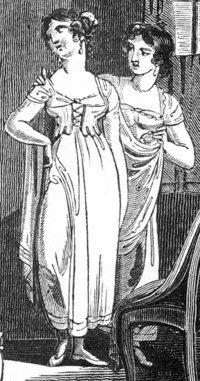
The very first layer donned by the fashionable women of the Regency Era was the chemise, or shift.  It was a thin, full-length cotton garment with short, tight sleeves, a low neckline, and a plain hem . Our present day slip is very similar, though unlike the chemise, a slip is worn under the other layers of undergarments.  A chemise provided a barrier between a woman's body and the other layers of clothing and absorbed perspiration.  This first layer bore up under washings with the most stringent soaps and were often boiled to achieve a high level of clean as well as to remove any stains or discoloration.  The transparent muslins and silks of the era were intended to flow elegantly around a lady's form, but without the help of a chemise or shift, society might have been granted far too immodest a display of her private "attributes."  In my Regency-era novel, Lydia, my heroine goes for a swim in a private pond wearing only her chemise.

Once the chemise was in place, a woman slipped into short stays, a corset that extended only a short way below the breasts.  Those who hoped to appear thin wore long stays.

  stays

Lastly came the petticoat, a long, sleeveless garment with a scooped neckline. It was anchored at the back with hooks and eyelets and was often embellished at the hem.  Petticoats were intended to be seen, since a lady often needed to lift her outer dress to protect its far more expensive and delicate fabric.

 
Drawers, or underpants, were not in common use at this time, though some did wear them.  They buttoned at the knee and were open at the crotch.  Quite a drafty bit of nonsense if you ask me!  Well, the advent of the modern toilet was yet a way off, so the logistics of squatting over a chamber pot necessitated certain "concessions" in the clothing line.  To our modern-day sensibilities and cultural delicacies (if we have any left) makes the idea sound rather obscene--but so it was.  However, consider; while women were anchored lock, stock and barrel inside so much fabric, at least they enjoyed the cooling free breezes underneath it all.  I cannot quite reconcile their rigid morality with the concept of a completely exposed &$%@(*.   Oh well, a great many things in history make very little sense by today's standards.


Although I cannot bear the thought of wearing all that rigamaroll, I often envy those ladies that they got to wear such wonderfully feminine clothing. Were I to dress in that way today, the local sherriff would most likely offer me a kind escort to the "sanitarium."


For those who would like the experience of dressing like a lady of the ton, several present-day organizations offer Regency-era balls.  How I would love to step back in time and mingle, just once, at a London-season ball with the most illustrious members of the "upper ten thousand!"  How fun it might have been to be a Miss Elizabeth Bennett.


 Hope you will take a minute to hop over to http://www.wandaluce.blogspot.com/ and read the blurb about my Regency-era romance, Lydia, and some of my weekly excerpts from my present historical work-in-progress.  Thanks.