Showing posts with label pilgrimages. Show all posts

Tuesday, August 28, 2018

Portable Reliquaries: Bringing the Medieval Pilgrimage Home

by Kim Rendfeld

In 757, if we are to believe the Royal Frankish Annals, Tassilo, the teenage duke of Bavaria, visited Frankish King Pepin and swore his fealty to the monarch and his sons on the relics of five saints. He touched the bodies of Dionysius, Rusticus, Eleutherius, Germanus, and Martin.

Scholars have said the Frankish annalist might have exaggerated the nature of the visit, as medieval writers were wont to do to please their bosses, in this case Pepin’s son Charles (Charlemagne). In reality, the visit might have been one of friendship rather than submission. Besides, that’s an awful lot of saints to bring to this occasion, considering the need for security and holy men. But for storyteller purposes, to have Tassilo swear on all those saints would have made his alleged disloyalty decades later all the more horrendous and justify Charles deposing his cousin.

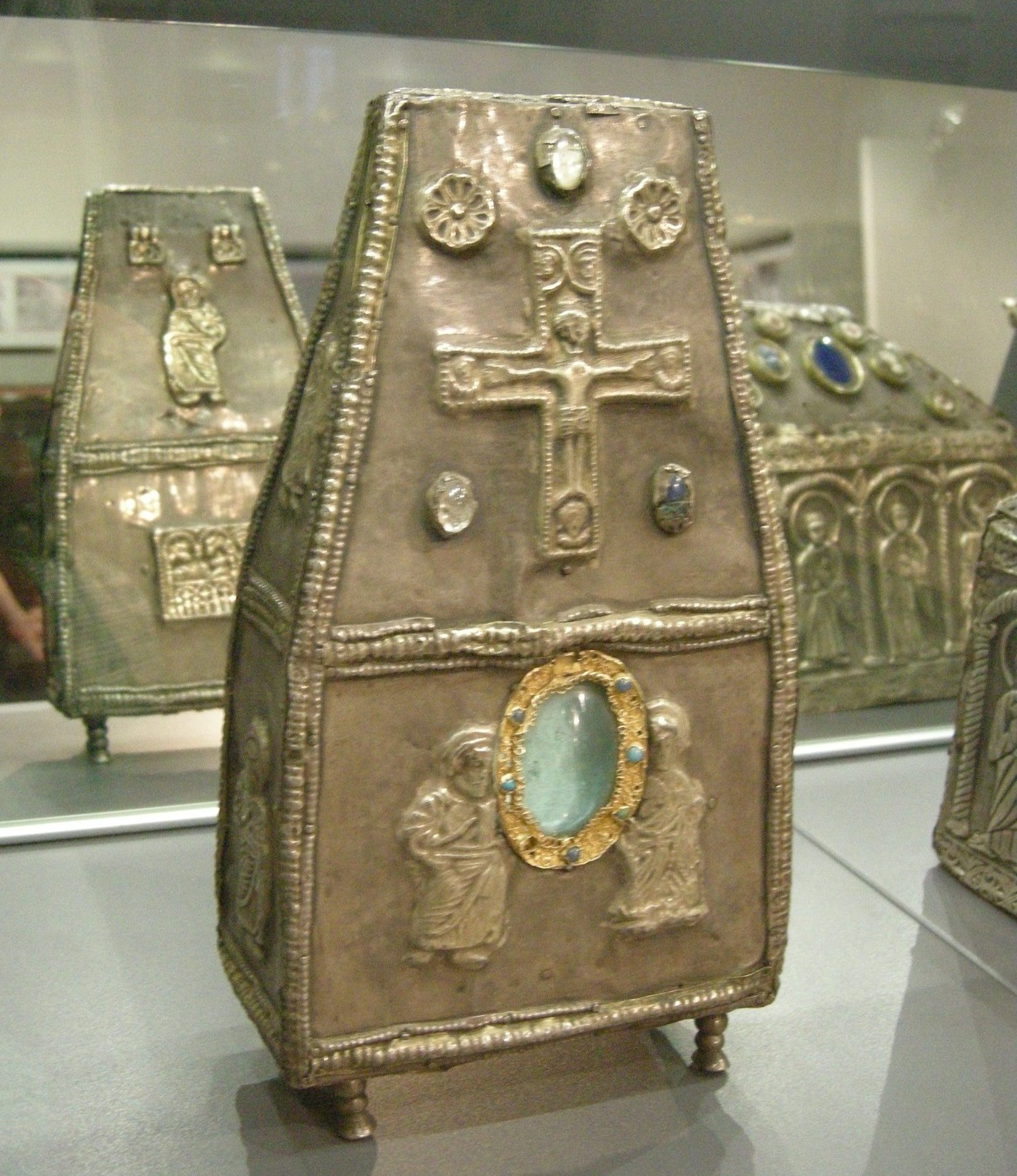
Imagining massive processions and huge reliquaries carried by carts or multiple men, I was inclined to believe that part about the saints not really being present at the meeting. Then I encountered portable reliquaries in my research for Queen of the Darkest Hour. Perhaps, it was possible to bring a token from all those saints—not whole skeletons but tiny items connected to the divine and imbued with miraculous power.

By I, Sailko (GFDL or CC BY-SA 3.0, from Wikimedia Commons)

Portable reliquaries were common throughout the West in the early Middle Ages, when travel was expensive and dangerous. Although every Christian aspired to go to Rome at least once, many could not afford the trip. The pilgrims who made the journey likely wanted to make the most of it, and a portable reliquary allowed them to do so. About five inches tall, the reliquaries were easy for one person to carry. With them, a pilgrim could bring a physical part of their faith home and interact with it. They would remain in the presence of the saint throughout their life, and they could bequeath this precious gift to their children.

This might be a good time to define just what a relic is. It was a physical thing connected to Jesus or one of the saints. It could be a pebble from a holy tomb, some dust from the tomb’s base, a vial of oil from a lamp burned over the tomb, a bone chip, a hair, a splinter of the true cross, a shred of clothing, or twigs from trees where the shepherds watched their flocks by night. It need not be large.

And it could look quite ordinary. The pilgrim had no objective way of knowing if the twigs were really from a saint’s favorite tree or a nearby woodpile, and some sellers of relics were less than scrupulous. The pilgrim was better off collecting a relic on site rather than buying one. Whatever the form, the objects made events in Christian history real.

To transport the relics, medieval pilgrims could carry a block of wood carved into the shape of a purse and hollowed out. As they traveled, they could collect relics of the saints they visited. The relic was wrapped in a bit of linen or silk, perhaps cut from discarded church hanging or liturgical vestments. Sometimes the cloth was stitched to secure the relics and labeled with a scrap of papyrus.

By Kleon3 (CC BY-SA 3.0, from Wikimedia Commons)

Once filled, the purse was sealed with a plug or sliding panel. To make this carved wood fitting for saintly objects, the purse was covered with a gilded metal, then stamped or decorated with gemstones or ivory. After chains were attached, the portable reliquary could be hung from a church beam or in a chapel, put on a bedpost, worn around the neck, or carried in a procession.

If the reliquary belonged to a church, a holy man could use it to raise revenue, heal the sick with its miraculous powers, bring warring factions to the peace table, or seek intercession during a famine or other natural disaster.

In a palace, the reliquary gave the king an aura of holiness, and it was handy when it came time for a vassal to swear an oath. It was one thing to offend a human lord, but quite another to anger a saint.

Whether Tassilo made a vow (assuming he did) while touching the actual saints’ bones or a portable reliquary with tiny objects, the promise was just as sacred.

Sources
Portable Christianity: Relics in the Medieval West (c. 700-1200) by Julia M.H. Smith

Carolingian Chronicles, which includes the Royal Frankish Annals and Nithard’s Histories, translated by Bernhard Walter Scholz with Barbara Rogers

~~~~~~~~~~

Portable reliquaries appear in Kim Rendfeld's third novel Queen of the Darkest Hour. In Kim's version of events, Queen Fastrada must stop a conspiracy before it destroys everyone and everything she loves. The book is available on Amazon, iBooks, Barnes & NobleKobo, and Smashwords.

Kim has written two other stories set in 8th century Francia. In The Cross and the Dragon, a Frankish noblewoman must contend with a jilted suitor and the fear of losing her husband (available on Amazon). In The Ashes of Heaven's Pillar, a Saxon peasant will fight for her children after losing everything else (available on Amazon). Kim's short story “Betrothed to the Red Dragon,” about Guinevere’s decision to marry Arthur, is set in early medieval Britain and available on Amazon.

Connect with Kim at on her website kimrendfeld.com, her blog, Outtakes of a Historical Novelist at kimrendfeld.wordpress.com, on Facebook at facebook.com/authorkimrendfeld, or follow her on Twitter at @kimrendfeld.


Wednesday, March 1, 2017

The Three Destinations of the Medieval Pilgrim

By April Munday

In the Middle Ages the top three destinations for pilgrims were Jerusalem, Rome and Santiago de Compostela, in that order of importance. For the English, a pilgrimage abroad was never an easy thing to undertake and wars, thieves and bandits made it even more difficult.

St James the Great by Georges de la Tour

Jerusalem and Rome were top of the list for obvious reasons, but why was Compostela the third? Compostela is in Galicia, in northern Spain, and is a little less than fifty miles from Cape Finisterre, which the Romans thought was the edge of the world.

The cathedral at Compostela is said to contain the remains of St James the Great, believed to be the first apostle to be martyred. One of the legends about St James is that he preached in Spain, before returning to Judea where he was martyred by being beheaded on the orders of Herod Agrippa in 44 AD. His remains were then transported from Judea to Spain in a rudderless, stone boat guided by angels. Santiago is the Galician form of St James.

There were earlier churches on the site, but the current cathedral of St James was built between 1060 and 1140.

Technically a pilgrim’s journey began with the first step and then he (or she) could follow whichever route he wanted to the shrine which was his goal. In reality this was not very practical, since he needed to pass through somewhere where he could get food fairly often. As long as he was on a route frequented by merchants, this was not a problem, as there were inns at regular intervals along the way.  Where the routes did not coincide the pilgrim could expect hospitality, or at least some kind of shelter for the night, from monasteries. Where there were neither inns nor monasteries there were often hospices. These were built by monks to assist pilgrims and there was a great need for them on the routes to Compostela. Most of these hospices were built by the Cluniacs.

There were four main routes across France and pilgrims from the north, east and south gathered at the four towns where those routes started and travelled, usually in the company of others, into Spain.  
Each route started in and went through towns containing important shrines. The route that started in Paris went through Orléans, Tours, Poitiers, St-Jean-d’Angély, Saintes and Bordeaux. The one from Vézelay (where the supposed tombs of Mary Magdalene and Lazarus were to be found) went through Bourges, St-Léonard-de-Noblat, Limoges and Périgueux. From Le Puy the route went through Conques and Moissac, before joining the first two routes at St-Jean-Pied-de-port at the foot of the Pyrenees. The final route went from Arles through St-Gilles, St-Guilhem-le-Désert, Castres, Toulouse, Auch, Oloron, the Somport Pass and Jaca before joining the other routes in Puente la Reina.

This meant that English pilgrims were presented with a huge amount of choice, depending on where they crossed the Channel. It was possible to sail from Bristol to La Coruña which meant a walk of approximately forty miles to get to Compostela once they were in Spain. This might sound like an easy option, but the Bay of Biscay was known for its storms and there was also the possibility of falling prey to wreckers or pirates (English, French or Castilian). It would entail travelling on a small ship for at least five days, usually much longer, in cramped and uncertain conditions. Generally passengers each had enough room to stretch out and sleep, but no more.

If a longer walk was required, the pilgrim could sail to Bordeaux which would allow him to complete his pilgrimage without going into territory held directly by the king of France, which might be the safest route during times of tension, if not outright war, with France. During more peaceful times, a shorter trip from Dover to Dieppe or Plymouth to Brittany might be preferred, which would mean the pilgrim walking the length of France before reaching Spain. If they sailed from Dover, they probably spent a night in the Pilgrim’s Hall at Aylesford Friary on their way through Kent.

The Pilgrims' Hall
It took about six months to walk from Paris to Compostela and back again. Pilgrims travelling overland faced wolves, bandits, fever, rivers that were not easy to cross, mountains and, in the early day, Moors. On the plus side, there were plenty of shrines along the route where they might pray and see miracles.

From the 1370s on most English pilgrims travelled by sea to Galicia since they were not permitted to cross Castile without the permission of the king of France.  Since the Hundred Years’ War was going through one of its more violent patches at this time, that permission was never going to be forthcoming. As the French gained more and more territory that had belonged to the English crown, English pilgrims had little choice but to travel by sea.

Pilgrims travelled with the hope of seeing, or touching, the relic of the saint. Some even broke or bit off part of the relic to take home with them. Clerics were particularly prone to this. This led to the construction of shrines and reliquaries to protect relics, but the pilgrims merely tried to take back bits of the shrines and reliquaries as souvenirs. 

At most shrines pilgrims could leave offerings of wax models which reflected the reason for their pilgrimage. This was not permitted when they reached Santiago.  Only money and jewellery were acceptable offerings. 

The eleventh century was a time of peace across Europe, allowing pilgrims to travel overland even to Jerusalem.  It was almost a golden age of pilgrimage. Hospices were built along the routes to Santiago and bridges were repaired. It is said that around half a million people a year went to Compostela in the eleventh and twelfth centuries.

There were pilgrim guidebooks, describing the route to be followed. The earliest known guidebook covering the route to Compostela was written by Aymery Picaud, a French monk, in the twelfth century. He detailed the stages of the journey starting from the Gascon side of the Pyrenees.  The book recommends shrines to be visited and describes things to be seen along the way. There is also a description of the cathedral which is the object of the journey. For good measure he tells some precautionary tales about the fates of people who tried to hinder or did not help pilgrims on their way to Santiago. A weaver, for example, did not give bread to a pilgrim and later found the cloth he had been working on torn in half and thrown on the ground. Picaud and, presumably, the weaver, attributed the act of vengeance to St James. We, however, might suspect that the perpetrator was someone other than the saint.

Travelling to Compostela from England was not cheap. Although there were hospices where he could expect to be accommodated for free, the pilgrim needed enough money to buy food, and to pay for accommodation in inns. A pilgrim could beg or work in order to gain the money, but most preferred to leave home with the requisite amount.

Once he reached Compostela, the pilgrim would purchase his cockleshell token, attach it to his tunic or hat (as modelled by St James in the picture at the top of the post), and return home.


Images:
Portrait of St James the Great by Georges de la Tour in the Public Domain
Pilgrim’s Hall, Aylesford – Author’s Own
References:
The Age of Pilgrimage – Jonathan Sumption
Pilgrimages to St James of Compostela from the British Isles during the Middle Ages – Robert Brian Tate
Power and Profit: The Merchant in Medieval Europe – Peter Spufford

~~~~~~~~~~

April Munday lives in Hampshire and has published a number of novels set in the fourteenth and early nineteenth centuries. They include Beloved Besieged, The Traitor’s Daughter, His Ransom, The Winter Love and the Regency Spies Trilogy. They can be purchased from Amazon 
Her blog ‘A Writer’s Perspective’ (www.aprilmunday.wordpress.com) arose from her research for her novels and is a repository of things that she has found to be of interest. She can also be found on Twitter.

Tuesday, December 15, 2015

Oh, Jerusalem! The Ultimate Medieval Pilgrimage

by Helena P. Schrader

Church of the Holy Sepulcher as it is Today*

Throughout the medieval period, the city in which Christ had been crucified and resurrected remained the holiest of cities and so the ultimate pilgrimage site. Particularly during the 88 years in which the city was in Christian hands, tens of thousands of Christian pilgrims flocked to the Holy Land each year to pray at the Church of the Holy Sepulcher and visit the other sites associated with the life of Jesus. Thousands of Englishmen and women made that pilgrimage, whether as “armed pilgrims” (i.e. crusaders) or as simple pilgrims (religious tourists.)  What would they have found? What follows is a description of Jerusalem as it would have been just before it was captured by Saladin.

The Countryside to the East of Jerusalem Today

The Holy City of Jerusalem crowns a hill in semi-arid, hilly countryside and was in crusader times encircled by tall, white-stone walls punctuated with square towers, seven gates and at least three, possibly more, posterns.  To the east, south and west the slope fell away sharply, but to the north the land was fairly level. There were olive orchards dating back to the time of Christ to the East, and in the crusader period the city was probably surrounded by other kinds of orchards as well. Common at this time were citrus orchards, but figs, dates, and almonds were also cultivated to serve the urban population. Almost certainly, there were also vineyards surrounding Jerusalem during the Christian period as wine was an important product of the kingdom, necessary for the liturgy and consumed in large quantities locally.


Picture of Jerusalem’s Walls

Life within crusader Jerusalem would have been exceptionally pleasant for the period. When the first crusaders took the city by storm in 1099 they carried out a massacre of the garrison and population that — while not as apocalyptic as often portrayed — left the city largely depopulated. The policy of not allowing any Muslims or Jews to live in the Holy City further reduced the population. The early kings of Jerusalem were compelled to invite Christian settlers not just from the West but from Syria as well.  Still the population never fully recovered and is estimated to have been no more than ca. 20,000 people in the second half of the 12th century. In consequence, Jerusalem was not densely populated and there were gardens and open spaces inside the walled city.

A Roof-top Garden in Jerusalem Today

Starting with life at the top, the religious and secular authorities both maintained palaces in Jerusalem. The patriarch’s palace was located beside the Church of the Holy Sepulcher, and unfortunately nothing is now left of it.  The royal family initially occupied the powerful citadel, whose oldest tower allegedly dated back to the reign of the biblical King David. However, they began construction of a “modern” palace in the first quarter of the 12th century. Although this too has been lost to us, contemporary accounts mention that the royal palace had extensive gardens. Since it was started by King Fulk of Anjou, it was probably inspired by similar to the palaces he was familiar with in France in this period — think of Eleanor of Aquitaine’s magnificent residence in Poitiers, for example, but it would have had “Eastern” elements of design and landscaping as well.


Citadel of David — the “Old Palace”

The gardens, for example, would have included palms, citrus fruits, pomegranates and other distinctive Mediterranean vegetation, such as oleander and hibiscus. More important, this palace (like the Patriarch's) was not a fortress intended for defense (as castles in Western Europe), but rather had a purely residential and representational character. There was no need for narrow, “arrow-slit” windows or massive walls. On the contrary, the crusader states had major glass-making centers, notably at Beirut and Tyre, and glazed windows were quite common, certainly among the upper classes. So the royal and patriarchal palaces would not have been dark, dingy and smoky, as in the castles depicted in Hollywood, but rather sunny, well-lit and designed with cross-ventilation for cooling in the summers. The use of mosaic and tile floors would, furthermore, have been inherited from their predecessors (and most of the houses in Jerusalem were taken over in-tact after the Christians seized control), as was the use of slender columns, often dating from the Roman period.  

A description of John d’Ibein’s palace in Beirut dating from 1212, for example, mentions mosaic floors so lifelike the observer was afraid of leaving his foot-print in the “sand” and polychrome marble walls as well as fountains and gardens. It offered splendid views of the sea as well — so large windows.  While John’s residence was built half a century later, it was also the home of a mere nobleman rather than a king. I think we can assume the royal palace of the Jerusalem and also the Patriarch’s palace were both very luxurious indeed.


Tiles Walls Today

Besides these two main palaces, Jerusalem housed the headquarters of the Knights Templar on the Temple Mount and the headquarters of the Knight’s Hospitaller, a huge establishment that took up a large city block and enclosed four churches, wards for over two thousand patients, a hospice for pilgrims, administrative buildings, barracks, kitchens etc. These complexes were large, multi-story stone buildings, again with glazed windows, courtyards, and sanitation. The accommodation for the Master and senior officers of these powerful orders would hardly have been less luxurious than for the king and patriarch.


Temple Mount Today: 
The hexagonal building on the left was a Baptistry from Crusader Times. On the right: The "Dome of the Rock" which in Crusader Jerusalem was converted into a church and known as the Temple of God


There were also lesser palaces for nobles and wealthy merchants.  The foundations of these houses in some cases dated back to the Roman period, and many were Byzantine or Fatimid since the capture of Jerusalem had not entailed whole scale destruction of the architectural substance. Arab sources stress that even when they re-took Jerusalem in 1187 (after a siege that did entail the use of stone throwers and mining), they still found many beautiful residences with “superb columns of marble and slabs of marble and mosaics in large quantities.” (Ibn al-Athir) Much of this ornamentation would have pre-dated the Christian period, but not all of it. Certainly, many churches were built and/or re-decorated in the crusader period and many of the craftsmen came from or were trained in Constantinople or by Byzantine masters. Undoubtedly some of these craftsmen also found employment on secular as well as sacred building projects.


   Houses with Medieval Features in Jerusalem Today


Life in any medieval Christian city was, of course, characterized by the pervasive presence of the Church and nowhere — except possibly in Rome — was the Church more important than in Jerusalem. There was not just the Church of the Holy Sepulcher and the Calvary Chapel, but dozens of churches catering to different Christian communities, Syrian and Armenian, Greek and Maronite, as well as the Latins. There were also the two great mosques on the Temple Mount which had been converted into churches, as well as the austere but lovely Church of St. Anne (below) and many more. 


As for the bulk of the population, while accommodation would have ranged from the comfortable to the squalid as in any city in the world, nevertheless, this being an ancient, eastern city, it was well supplied with public cisterns, reservoirs, and baths. Indeed, most of the buildings in Jerusalem at this time had rain-fed cisterns to supplement the municipal water supply.  There was also a network of open and covered markets. The covered markets are particularly intriguing and parts are still standing today. They were like tunnels, often running almost the entire width of the city, with vaulted ceilings and flanked by shop after shop. The paved walkway between the shops had steps to accommodate the slope and were not suitable for horses.

Covered Market in Jerusalem

Due to the annual pilgrim traffic, Jerusalem was also a city with many hostels and taverns, and the shops of the city would have catered to pilgrims by selling all the "exotic" things pilgrims sought from relics to silk and Turkish carpets. They would have sold all the necessities for everyday living  as well: shoes, textiles, candles and soap, for example. The city had separate markets for grain, pigs, poultry, fish, herbs and spices. It had quarters for the jewelers, gold and silver smiths, for textile goods, leather goods, glass, and weapons. My favorite is the “street of bad cooking,” which was apparently a medieval precursor of “food courts” for “fast food.”


Another Street Scene in Modern Jerusalem

Last but not least, the streets must have been a veritable “tower of Babel” with the native population speaking Arabic, Greek, Armenian and French, while pilgrims came from the far corners of the earth speaking Norse, English, Spanish, Italian, Hungarian, German and more.

* All photos in this entry were taken by the author in 2014.

Jerusalem is the setting for many key scenes in the first two books in Helena Schrader’s three part biography of Balian d’Ibelin, Knight of Jerusalem and Defender of Jerusalem. You can find out more about Crusader Jerusalem at http://defenderofjerusalem.com and about Helena Schrader’s books at: http://helenapschrader.com.


Wednesday, August 5, 2015

Imitations of the Holy Sepulchre: The Round Churches of Medieval England

By Mark Patton.

In an earlier blog-post, I explored the place of Jerusalem in the Early Medieval Scottish and English imagination. Pilgrimages to Jerusalem in the 8th, 9th and 10th Centuries were both expensive and dangerous, and so everything that was known about the holy places of Christendom was based on a handful of accounts from pilgrims who had successfully made the journey and returned to tell of it. Prominent among these was the account of the Frankish Bishop Arculf, who recounted his story to Saint Adomnan on the island of Iona.

The Church of the Holy Sepulchre that Arculf had visited was subsequently damaged by earthquakes in 746 and 800 AD, and by the Muslim forces of the Fatimid Caliph, Al-Hakim bi-Amr Allah in 1009. His son, Caliph Ali az-Zahir, however, permitted its reconstruction, and the rotunda that pilgrims and tourists visit today is, essentially, this 11th Century building, funded by the Byzantine Emperor, Constantine IX Monomachus.

The Church of the Holy Sepulchre
as restored by Constantine IX.
L. Hugues-Vincent 1912


The Church of the Holy Sepulchre, Jerusalem, as it is today.
The circular, domed sanctuary is the 
Catholicon, built by Constantine IX,
and the structure at its centre is the 
Aedicule, believed to
enclose the tomb in which the body of Christ was placed.
Photo: Jlascar (licensed under CCA).

During the epoch of the Crusades (1096-1204), many more Europeans, including Britons, travelled to the Holy Land than had done so in the preceding centuries, but for most people living north of the Alps, such a journey remained unthinkable. In church each Sunday, and on the many Holy Days of Obligation, people would hear their parish priests telling, in their sermons (the only part of the Mass that was delivered in the language of everyday speech) of things that had happened in lands that most of them could never hope to visit in life.

Some of those who had made the journey, and returned to England enriched by plunder, had the idea to build churches in imitation of the Holy Sepulchre, so that those unable to visit for themselves might, nonetheless, have an idea of what was to be found at the holy sites. One such was Simon de Senlis, the second Earl of Huntingdon and first of Northampton, who fought in the First Crusade, and returned to build the Church of the Holy Sepulchre in Northampton.

The baptistery of the Church of the Holy Sepulchre,
Northampton in 1897.
The pillars belong to de Senlis's original church,
but the arches visible today belong to a later Medieval phase of restoration 

Around half the size of the Jerusalem Catholicon, the circular structure built by de Senlis had a rotunda supported on eight round pillars. In the centuries following his death in 1111, as the town of Northampton grew, it was incorporated into a much larger parish church, in which it functioned as a baptistery.

The Round Church in Cambridge was built around 1130, by the Fraternity of the Holy Sepulchre, probably a group of Austin Canons. The Austin Canons were particularly concerned with the provision of hospitality to pilgrims, so it seems likely that Cambridge was a stopping off point for pilgrims travelling to holy places within England (Walsingham in Norfolk, for example, sacred to the Virgin Mary, and itself in the care of the Austin canons).

The Round Church, Cambridge.
Photo: Noles1984 (licensed under GNU).


The interior of the Round Church, Cambridge.
Although extensively restored following damage in the English Civil War,
this probably gives a clearer idea of the original architecture
than does Northampton's round church.
Photo: Sailko (licensed under GNU).

The Temple Church in London's Holborn is a larger and grander construction with direct royal connections. It was consecrated in 1185, probably in the presence of Henry II, as part of a large monastic complex that served as the London headquarters of the Knights Templar. Templar knights were monks as well as fighting men, and, when not on campaign, lived an enclosed life. The Temple Church served as a royal treasury during the reign of King John, and some of the most important negotiations leading to the adoption of Magna Carta took place there. It was seized by Edward II in 1307, as part of the Papal suppression of the Knights Templar.

Temple Church, Holborn,
in the early 19th Century. 


The Church of Saint John the Baptist
at Little Maplestead, Essex, was built in around 1335
by another military-religious order,
the Knights of Saint John (Knights Hospitaller).
Photo: John Webber (licensed under CCA).

Round churches, more or less directly styled on the Catholicon of Jerusalem, can be found in Scandinavia, Germany, the Balkans and Italy, many of them on pilgrimage routes, and most of them under the protection of the Knights Templar, who protected these routes, the Austin Canons & Augustinian Friars, who provided hospitality for pilgrims, or the Knights of Saint John, who served both of these functions. Whilst Jerusalem itself remained the ultimate pilgrimage destination throughout the Middle Ages, these representations provided a glimpse of the Holy City's glories for the overwhelming majority of pilgrims who had to content themselves with shorter devotional journeys, whether to Canterbury, Saint Andrews or Santiago de Compostela.

~~~~~~~~~~~~~

Mark Patton blogs regularly on aspects of history and historical fiction at http://mark-patton.blogspot.co.uk. His novels, Undreamed Shores, An Accidental King and Omphalos, are published by Crooked Cat Publications, and can be purchased from Amazon.


Friday, March 14, 2014

William Marshal in the Holy Land

by Helena P. Schrader

William Marshal has gone down in English history as one of the most famous non-royal heroes of the Middle Ages. He was famed even in his lifetime as one of the greatest knights of a knightly age and a “flower of chivalry.”


 Marshal loved and excelled at tournaments, depicted here in a 13th century German manuscript.

His story is better than fiction. Indeed, if his biography were not so well documented, it would be easy to dismiss the stories about him as pure invention. But William Marshal really existed, and he really rose by merit alone from being a landless knight to regent of England. Even his wife, through whom he became a magnate of the realm, was won by his prowess and loyalty, for he was granted the rich heiress by the dying Henry II as a reward for his decades of service to the Plantagenets; the grant was confirmed by Richard I to secure Marshal’s loyalty in the future. But in addition to being a paragon of chivalry, Marshal was typical of his generation in that he was also a faithful son of the Holy Catholic Church. On his deathbed he renounced the world and took vows as a monk, a Templar monk. He was buried in the Temple in London.

Tomb of a Knight in the Temple of London, sometimes identified as William Marshal

He also went on pilgrimage to Jerusalem.

Because Marshal was such a famous knight and powerful figure at the time of his death, we are lucky to have a long eulogy in the form of a poem or song that was commissioned by his eldest son and intended to record his life for posterity. The poem is nineteen thousand nine hundred and fourteen verses long, and it is a remarkable document in itself, both lively and evocative.  Perhaps even more astonishing, the poem identifies sources and distinguishes between hear-say and verifiable fact, points out when sources are contradictory, and recounts many events first hand, stating explicitly “this I have seen” in many places. The latter suggests that the author was an intimate of William Marshal, or at least a trusted member of his household. This document, otherwise so rich in detail, however, tells us almost nothing about Marshal’s stay in the Holy Land.

What we do know is that William Marshal was bequeathed the crusader cross – the vow to go to Jerusalem and pray in the Church of the Holy Sepulchre – by his liege, Henry the Young King. Henry had taken crusader vows sometime in 1182 or 1183 – which did not stop him from sacking churches and monasteries to pay his mercenaries. William Marshal appears to have been a witness – if not a participant – in the sack of Rocamadour, where the Young King stole the sword of Roland and much other treasure.  Returning from this disgraceful act, the Young King fell abruptly ill. In a high fever and fearing for his soul (at last), he sent messengers to his father begging for forgiveness, and turned over his mantle with the crusader cross to William Marshal.  He begged Marshal to fulfil his vow in his stead, then lay on a bed of ashes with a noose around his neck and died. It was June 11, 1183.


 According to Marshal’s biographer, William spent “two years” in Syria, serving the King of Jerusalem, doing great deeds of arms and winning the respect of the Knights Templar and Knights Hospitaller. However, he was back in Europe by 1187, months before the devastating Battle of Hattin, and he brought with him two white, silk shrouds for his own burial.  He also returned having vowed to join the Knights Templar before his own death. These are the only known facts we have about William Marshal in the Holy Land, but even these facts are intriguing. 

Marshall most probably reached the Holy Land, travelling by either land or sea, in the spring of 1184. If he spent two years there he departed at the latest in the autumn of 1186.


The Crusader Kingdoms were defended by a network of castles such as this: Krak de Chevalliers

Those two years were years of dramatic change in the Kingdom of Jerusalem. On the one hand, the Muslims, which had long been bitterly divided between the Sunnis loyal to the Caliph of Baghdad and the Shiites of the Fatimid Caliphate, had been united under the strong and charismatic leadership of the Kurdish leader Salah ad-Din.  Saladin, as he is known in western writings, had called for jihad, and the Kingdom of Jerusalem was more threatened than it had been since the early years of its existence. At the same time, the Kingdom was weakened from within because the king, Baldwin IV, was suffering from leprosy and slowly dying. His heir was a young boy, the son of his sister Sibylla, by her first husband.

Not long after William Marshal arrived in Jerusalem a delegation headed by the Patriarch of Jerusalem and the Grand Masters of the Templars and Hospitallers was dispatched by King Baldwin to the West. The delegation carried with it the keys to the Church of the Holy Sepulcher and the keys to the Tower of David: effectively the symbolic keys to the kingdom. The three men sought first the aid of Philip II of France and then Henry II of England, begging the later to follow in the footsteps of his grandfather, turn his Western lands over to his adult and capable heirs, and take up the cause of Christendom by defending the Holy Land. If he would not do that, the delegation pleaded, then he should send one of his sons in his stead.  One has to wonder if it was pure coincidence of timing, or if William Marshal, who knew the Plantagenets so well, had not recommended – or at least encouraged – the appeal.

Meanwhile, Baldwin IV, in anticipation of his death, made his vassals vow an oath with regard to the succession.  If his nephew did not live to manhood and sire heirs of his own, they were to send to the Kings of France and England and to the Pope, who were then to jointly name a successor. Baldwin IV expressly excluded his sister Sybilla and her second husband from the succession.  

In the summer 1185, in the midst of Marshal’s stay in the Holy Land, Baldwin IV died.  His nephew was crowned Baldwin V, and the High Court of Jerusalem chose Raymond of Tripoli, an able and experienced man, as his regent. Tripoli immediately secured a new truce with Salah ad-Din.

Baldwin V, however, was sickly, and in August 1185, with Marshal still in the Holy Land, he died. The regent and the High Court of Jerusalem met in Tiberius to deal with the interregnum, but the dead king’s mother and her husband staged a coup. Sibylla had herself crowned Queen in the Church of the Holy Sepulchre and placed a second crown on her husband’s head as her consort. Her second husband was a certain Guy de Lusignan, the younger son of a Poitivin baron and possibly an accomplice in the murder of Patrick, Earl of Salisbury, William Marshal’s uncle.

The murder of Patrick of Salisbury had been a highly significant episode in William Marshal’s young life. As a landless knight in his uncle’s entourage, he had been escorting Queen Eleanor through her own territories, when they were attacked by the Lusignan brothers, then in rebellion against her. Accounts vary on which of the Lusignans was present (there were four brothers: Hugh, Geoffrey, Aimery and Guy), but there is no disagreement on how the Earl of Salisbury was killed.  Namely, he was pierced from behind by a lance; he was neither armored nor defending himself.  This was clearly an “unchivalrous” act, a despicable crime, that outraged the young William Marshal.  William himself was severely wounded in the encounter, taken captive, and ill-treated by the Lusignans.

Given this history, it is hard to imagine that William Marshal was partial to Guy de Lusignan, whether he had been personally responsible for the Earl of Salisbury’s murder or not.  (Indeed, it may have been his opposition to Guy de Lusignan that inspired him to suggest the above mission to Henry II – assuming he had anything to do with it.) Furthermore, Sibylla and Guy’s coup preempted the rights of Henry II, Marshal’s liege, who should have been involved in naming the next King of Jerusalem.  Marshal must have been appalled by their behavior, and it would probably have reinforced his dislike for the Lusignans. Since Marshal appears to have left the Holy Land not long after Lusignan’s usurpation of the throne, it is probably fair to postulate that it was Lusignan’s rise to power that induced Marshal to quit The Holy Land.

This hypothesis is supported by the fact that William appears to have spent his years in the Holy Land as one of the many secular knights who temporarily served with the Templars.  These knights did not take the final vows of poverty and chastity, but for the period of the voluntary service, submitted themselves to the discipline and Rule of the Knights Templar.  Indeed, in William’s case we know that he vowed to join the Temple at a later date – as he eventually did. The timing, however, is significant. The Grand Master of the Templars, who had been sent to plead with Henry II to come to the Holy Land died during his mission and was replaced by a man who supported Guy de Lusignan.  So Marshal’s decision not to take his final vows and stay with the Templars in their hour of need, may have had to do with his unwillingness to serve Guy de Lusignan, leaving it to his deathbed to finally join the Templars.


An illustration from Matthew Paris’ “Greater Chronicle” depicting Knights Templar.

We will never know, but Marshal’s very silence to his household and family about this episode in his life suggests that he left the Holy Land with a bitter taste in his mouth – or opinions he felt he should best keep to himself.

Biographies of William Marshal available today include:

·         William Marshal, Knight-Errant, Baron and Regent of England, by Sidney Painter, 1933.
·         William Marshal, Flower of Chivalry, George Duby, 1985.
·         William Marshal: Knighthood, War and Chivalry, by David Crouch, 2002.
·         William Marshal Earl of Pembroke, by Catherine Armstrong, 2007

Recommended works of historical fiction featuring William Marshal:

·         Christian Balling’s Champion is delightful, but it only covers a tiny slice of Marshal’s life. 
·         Elizabeth Chadwick’s The Greatest Knight and The Scarlet Lion are well-researched and well-written tributes to William Marshal.

Helena Schrader is writing a series of ten novels set in the Age of Chivalry. For more information, visit her website: http://tales-of-chivalry.com or watch the video teaser Tales of Chivlary. She also has a blog devoted to the crusader kingdoms: http://DefendingCrusaderKingdoms.blogspot.com
One of these novels is set against the backdrop of the destruction of the Templars in the early 12th century:

The English Templar
An English knight en route to Cyprus is caught up in the mass arrest of French Templars on the night of Friday October 13, 1307. Tortured until he confesses to crimes he did not commit, he wants only to die, but fate puts him in the hands of two people determined to keep him alive – and resist the injustice of the French King.  A novel of faith, fortitude, and the power of love set against the backdrop of one of the most appalling instances of state terrorism in Western European history.


Wednesday, February 5, 2014

The Pilgrimage

~ Scott Higginbotham

The ideal of the medieval pilgrimage is nothing new, for it is a spiritual and physical journey that has deeper roots.  The physical site itself may be the object of veneration, because it may be where a saint was martyred or where certain relics are contained.  What better place to go than the very spot where history was made by way of a martyr’s death?
 
Along those same lines, there may have been reports that the site is a hub of spiritual blessings or the miraculous, thus drawing the throngs.  Or, the act may be the fulfillment of penance or perhaps a vow made to secure divine favor. 

There were perceptions that spiritual blessings would only be conferred within a set of physical boundaries, which hearkens back to the gods being localized – think of river gods having power only in a certain area.  “For pilgrimages properly so called are made to the places where the gods or heroes were born or wrought some great action or died, or to the shrines where the deity had already signified it to be his pleasure to work wonders. Once theophanies are localized, pilgrimages necessarily follow.” [1]   

Whatever the motivations, pilgrimages and wandering hermits were popular, so much so, that they appeared in the works of medieval writers. William Langland writes in the Prologue to Piers Plowman:

In a summer season when the sun was mild
I clad myself in clothes as I'd become a sheep;
In the habit of a hermit unholy of works,
Walked wide in this world, watching for wonders.


An early English balled from Sir Isumbras gives readers a unique insight into the difficulties faced by wayfaring pilgrims, having nothing in their purse and having to beg for their food:

For they bare with hem nothynge
That longed to here spendynge,
   Nother golde nor fee,
But for to begge here mete
Where they myghte ony gete,

   For love of seynt charyté. [2]


Geoffrey Chaucer popularized and parodied the ideal of a pilgrimage in The Canterbury Tales and, it is through him that many have become familiar with pilgrimages.  The shrine of Canterbury was England’s most popular pilgrimage site, owing to Thomas Becket’s martyrdom in the northwest transept on December 29th, 1170.  Reports of healing miracles brought throngs of pilgrims, happy to share the contents of their purses. This surge in income allowed for many upgrades and improvements to the cathedral, but only to have Henry VIII enter the scene and confiscate its treasures.

Canterbury Cathedral - Public Domain from Wikimedia Commons
But is it only just the physical destination that draws pilgrims of old and even modern ones?  Or is it the physical act, the journey itself, which has the appeal?  Perhaps both?  Imagine the mystique and adventure of packing a few belongings, tying up loose ends, and grabbing a wooden staff for a long trek of self-discovery.  Spiritual journeys such as these are oftentimes turning points for real and imagined characters. 

Henry II was stricken with anguish over his ill-spoken words that resulted in Becket’s death - so much so that he made his own pilgrimage to the shrine and did his best to set affairs aright.  Simon de Montfort made a pilgrimage to the Holy Land, and was overcome with emotion at his first view of Jerusalem’s sandstone walls.  These notables are what make the study of history and historical novels such a gem to read, for their deepest desires for redemption make them so much like us.


I made my own pilgrimage and received a Pilgrim’s Certificate at the conclusion of a tour of Jerusalem and Bethlehem.  I wore no floppy hat, nor held a weathered wooden staff in my hand; in fact, I was clean shaven in a military fashion.  But the moment I saw those same walls that countless others have gazed upon, I had the distinct sense that the raw emotion and overwhelming sense of belonging to some small part of history, as a result of pilgrimage, would never be forgotten.  History, historical novels, and even pilgrimages allow us travel to another time and place, but they also allow us to bring something back.

Jerusalem from the Garden of Gethsemane - by Scott Higginbotham


http://www.amazon.com/dp/B007EHUMSC?tag=forathogen-20&camp=0&creative=0&linkCode=as1&creativeASIN=B007EHUMSC&adid=0EC3CR9J80NNHXXSP77Q
A Soul’s Ransom
Scott Higginbotham writes under the name Scott Howard and is the author of A Soul’s Ransom, a novel set in the fourteenth century where William de Courtenay’s mettle is tested, weighed, and refined, and For a Thousand Generations where Edward Leaver navigates a world where his purpose is defined with an eye to the future.  His new release, A Matter of Honor, is a direct sequel to For a Thousand Generations.  It is within Edward Leaver's well-worn boots that Scott travels the muddy tracks of medieval England.