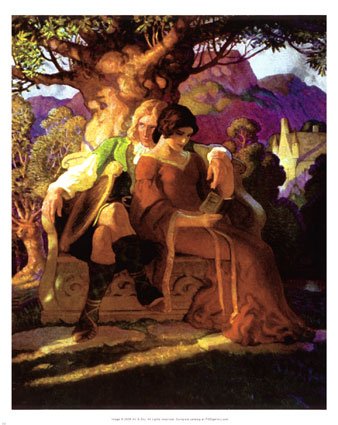
The King sits in Dunfermline town,So begins the Ballad of Sir Patrick Spens, which commemorates two tragic incidents: the drowning of many Scottish nobles returning from accompanying Margaret, the daughter of Alexander III of Scotland, to her marriage to King Eric of Norway, and the death on board ship twenty years after Alexander's death of his grandaughter Margaret, the Maid of Norway, heiress to the Scottish throne, on her voyage to Scotland.
Drinking the blood-red wine;
"O where shall I get a skeely skipper
To sail this ship o mine?"
Then up and spake an eldern knight,
Sat at the King's right knee:
"Sir Patrick Spens is the best sailor
That ever sailed the sea."
Dunfermline was a royal centre from very early in Scottish history. Malcolm Canmore had a palace there in the eleventh century, and it was in Dunfermline that he married Margaret of England, who was canonised and was remembered as Saint Margaret.
In 1070, Queen Margaret established the first monastery on the site, and the small priory was enlarged into an abbey by her son David.
The abbey became a mausoleum for Scottish royalty, and was the burial place of Malcolm and Margaret, their son David I, and Robert I (more generally known to the English as Robert the Bruce)
The abbey and lands were given as a wedding gift by James VI (son of Mary, Queen of Scots) to his bride, Anne or Anna of Denmark. Saint Margaret's power was believed to have protected women in pregnancy, and certainly, Anne-Marie, one of the guides at the abbey, told me that many Scottish queens felt a great affinity for the palace and abbey, and she believes the reason is that it was, unlike many other palaces, so strongly associated with a queen, rather than kings.
Visitors to Dunfermline Abbey will see that there are two distinct parts, one being the older abbey building, with the nave built by David I and said to be the most complete surviving example of its type in Scotland.

As with so many Scottish religious buildings, the reformation of 1560 meant that anything associated with Catholic worship was removed and/or destroyed and within three years the choir was roofless. In 1817 William Burn designed a new parish church and it opened on the site of the old choir in 1821. During this time, the remains of Robert the Bruce and fragments of his tomb were unearthed, and the modern church is home to a memorial for him. Major repairs undertaken in the 1840s exposed the the earlier church, under the nave floor.

Above, a bronze case of Robert I's skull; below, his memorial

It was the west side of the monastic cloister which was reused to become the royal residence gifted by James VI to Anna of Denmark. Anna wanted a residence befitting her status, and William Schaw, the king's Master of Works, was commissioned to build it. This once glorious building is now a ruin, but illustrations show what it once would have looked like.

the window marked as 2 above, is shown below


below, all that remains of the building shown above
 |
The history of Dunfermline is not confined to the abbey and palace, however, although my journey did bring me back to the churchyard in an unexpected way...
Across the road from the abbey is the park is Pittencrieff Park, an area popular for walks, and picnics. Within the park itself lie the remains of Malcolm Canmore's Tower, tucked well away from the modern, tarmacked path. The tower is all that marks the centre of Malcolm's centre of government, built on a defensible peninsular outcrop of rock above a deep ravine. The opening lines of the Ballad of Sir Patrick Spens are thought to refer to the tower:

Scattered around the park are also signs to 'Wallace's Well', again, hard to find, and easy to miss:

This unprepossessing slab of stones and metal grate gives little away. But an information board explains that in William Wallace's time, the Glen of Pittencrieff would have been a densely wooded area, and the legend has it that Wallace hid in this well shortly after the Battle of Falkirk. It's said that in 1303 he visited Dunfermline with his mother, to pray at the shrine of St Margaret, and that his mother died there and was hastily buried in the churchyard, under a thorn tree. I'd not noticed this tree on my arrival, so this is why I returned to the abbey.

the thorn tree, above, and the plaque, below

Dunfermline had not quite given up all its secrets, however. St Margaret's reputation for piety was not without justification. She used to pray regularly in a little cave, and in her day access was via a wooded path and a short climb up to the cave. Nowadays, visitors must descend a steep tunnel, which was built when the local council built a car park, obscuring the original entrance to the cave.

There is little left of St Margaret's shrine and all that remains now is the stone slab. Originally, her relics were encased in a carved casket covered with gold leaf. It seems likely that her remains were moved from their resting place in the original church when her son, David, began construction of his new church.


The association of Dunfermline with Margaret is hard to escape. Later queens favoured the place, as mentioned above, and it's likely that Anna of Denmark also made arrangements to be buried here when her time came. A burial vault near the south-east doorway was probably intended for her. In the event, the last member of the royal family to be buried here was Robert Stuart, infant son of James VI, in 1602. After James became James I of England, the family moved south, and Anna was buried in Westminster Abbey.
It's said that from the 1590s onwards she and James were all but estranged. I wonder if she yearned to return to her wonderful palace at Dunfermline...
[all photographs by and copyright of the author]
~~~~~~~~~~

Amazon Page
Website
Blog