Showing posts with label Swords. Show all posts

Monday, January 11, 2016

Sword Names - What's in a Name? What's Yours?

~ By Scott Howard

Throughout history, heroic figures have wielded swords to stave off hordes of enemies, whether man or beast. The style and shape of the weapon varied, depending on the time period and level of craftsmanship at the time. The blade could have been single or double-edged, one or two-handed, exquisite or ordinary.

Many pieces survive to this day, adorning a wall in a writing corner or preserved in a museum. Some are buried inches below the surface, begging to see the light of day and share its tales of glory or infamy. Others have decayed to the point of resembling only a shadow of what they once were.

The Vikings were feared for their ferocity and skill in battle. Their longships with their dragons heads had the ability to sail up shallow rivers, thus terrorizing England and making Saxon mothers wonder whether their men and stockade fences could withstand a sustained assault. Perhaps the attackers had the name ULFBERHT inscribed on the blade, which would have placed no small amount of fear in the defenders.

This type of blade was an early form of a brand name; it was a high-end brand of swords whose maker was ULFBERHT. It is believed that these high quality, super strong weapons were forged in a German monastery between 800 and 1000 AD. The name does not refer to one single person, but rather those who had the skill to forge under this name. The steel was of a high purity that it was not believed to have been available until the Industrial Revolution, which explains why 170 of these pieces bearing this inscription have been found.

While ULFBERHT is a type of brand name for a sword, sword-naming, that is, naming one’s personal sword is nothing new in history, myth, or historical fiction. Durendal, which is a French form of “endure”, came from Roland, who was Charlemagne’s paladin in a series of literature known as the “Matter of France”. The “Song of Roland” purports that an angel gifted it to Charlemagne, who then gave it to Roland. Inside of its hilt is a tooth of Saint Peter, the blood of Saint Basil, the hair of Saint Denis, and a piece Saint Mary’s garment. It is no wonder that Roland was able to hold off an advancing Muslim army so that Charlemagne could retreat into France, with a sword infused with such power.

This very sword caught the eye of young Henry, son of Henry II of England and Eleanor of Aquitaine, who stole this sword along with many other treasures. “The wondrous Durandel, to be sure, was brought back after Roland’s death and hung up before the altar of Notre Dame de Roc Amadour, to whom it had been vowed, where it remained till carried off by Henry Court-Mantel, who, adding sacrilege to hypocrisy, came here in 1183 on the pretext of a pilgrimage, and, in order to pay his soldiers who served him in his rebellion against his father, pillaged the holy chapel so revered by King Henry. He was soon after seized with a fatal illness and died, but not unabsolved, in the arms of Gerard III., Bishop of Cahors.”

 Like Arthur’s Excalibur, which is associated with Britain’s kings, there is a certain reverence associated with a sword’s name, whether it is the maker or a fitting name that hearkens back to its glory days. During the Third Crusade, Richard the Lionheart gave Tancred of Sicily a sword that was named “Excalibur”; Richard was larger than life and the aura of his prowess, coupled with a sword named thus, added to the greatness that surrounded him. Excalibur’s present location is curently unknown.

 When Edward of Woodstock was buried in Canterbury Cathedral, his armor and arms were suspended over his tomb.  Centuries after his death, he was dubbed the Black Prince, either because of his black-hued armor or his acts of cruelty during the Hundred Years War, depending on the scholar.  He was also known for for great acts of chivalry and legend has it that Oliver Cromwell, recognizing his sword as a potent symbol, stole it during the English Civil War.

 It becomes clearer that it is not only the actual physical sword that give it its strength, but the mystique and the persona behind it and, its name. There is also a spiritual aspect, based on the holy relics said to be contained in Durendal. Those who carried such a sword could command respect, regardless of skill or popularity.  Moreover, Cromwell understood the chivalric significance of Edward of Woodstock's sword if he indeed did steal it, but that is an entirely different matter requiring deeper research.

So when you come across the inevitable writer’s wall and have need of something spicy to add to your character’s inventory, choose a name or ideal that says much, but with a brevity of words. And if you come across a sword name that graces someone else’s pages, think about what that name means to the wielder and, what it portends to the one on the receiving end.

Mine would be Peacemaker.  What's yours?

Photo by Scott Howard Higginbotham


~~~~~~~~~~~~~ 
A Soul's Ransom
Scott Howard Higginbotham writes under the name Scott Howard and is the author of A Soul’s Ransom, a novel set in the fourteenth century where William de Courtenay’s mettle is tested, weighed, and refined, and For a Thousand Generations where Edward Leaver navigates a world where his purpose is defined with an eye to the future.  His new release, A Matter of Honor, is a direct sequel to For a Thousand Generations.  It is within Edward Leaver's well-worn boots that Scott travels the muddy tracks of medieval England.


References:

http://www.dailymail.co.uk/sciencetech/article-2878512/The-mystery-magical-superstrong-Viking-sword-Researchers-close-supermonks-believed-forged-weapons.html

https://en.wikipedia.org/wiki/Durendal#cite_ref-4

Catholic World, Volume 26, page 28.

https://myarmoury.com/feature_mow_bp.html

Thursday, November 20, 2014

Cutting Through a Medieval Notion or Two

by Scott Howard

To those with  a jaded view of history, the Middle Ages was a dark period, seething with swarms of brutish thugs, toothless peasants resembling a human shaped piece of mud, and nobles living lavishly while villages burned.  Books and movies have overplayed this notion, thus depriving the world of the learning and reforms that sprang forth from this period.  Looking at something as simple as a sword can uncover our eyes and show us new worlds that we may have overlooked - worlds we didn't like, because we didn't understand them.   

Indeed, history has chronicled baseless acts and the ruling class thumbed their nose, or wrinkled it in distaste, at those beneath them, but the fact that, we, as modern people, could trace our past to the "lower classes" should say something about their character, their skills, and determination to pass on whatever legacy they possessed to the next generation.


Modern metallurgy has come a long way.  The medieval blacksmith was a part time brute hired by the local baron to produce arms and armor and completely void of skill, right?  The swords and arms they produced were lucky to survive a melee or a season of campaigns.  They were simpletons who could only dream of producing a sword with triple fullers, tapered blade, leather wrapped grip, fishtail pommel, and a crossguard that resembles a ribbon.  The physical balance of the sword that only modern science could produce mustn't be overlooked.

KHM Wien A 141 - Ceremonial sword of the Rector of the Republic of Ragusa, 1466
Creative Commons Attribution 3.0 Unported license.

These notions beg a few questions, though.  Are museum pieces such as the Ceremonial sword of the Rector of the Republic of Ragusa, (1468) mere flukes that they lasted for so long?  Or were medieval blacksmiths expert craftsmen whose reputations went alongside a lord and his retainers during the campaign season?  Were they more modern than thought?

Judging by the sheer volume of swords used during the Crusades and sundry great battles of the Middle Ages appearing in photos of personal and museum collections, the evidence clearly points to the latter.  It is astounding to see how closely modern replicas mirror their medieval predecessors and how well preserved the small details are - visible fullers, etchings and designs on the blades, the intricacies of the pommels, the variety of crossguard shapes and sizes, and even remnants of leather grips.

Space does not allow for the breadth of information on forging blades, the grinding process, and how, even in the mire of what we call the Middle Ages, there were skilled artisans and specialists that knew what would stand the test of time.  An intimate knowledge of the crystalline structure of steel was unknown, but centuries of craft passed through the generations more than made up for that lack.  

Moreover, there were strong guilds that ensured a level of quality concerning any product a blacksmith would produce.  In addition to arms and armaments, they repaired or made tools, farm implements, and sundry other products that were not a mere cobbling together of steel and luck.  If that were the case you would never be able to balance a close replica of a typical medieval sword in one hand for any length of time, nor would you be able to twirl it, toss it, or survive for a day in the life of a medieval knight.  


For more information and ingenious ways of forging and grinding quality sword steel, follow the link here.  To experience a daily dose of medieval and replica pieces, whose existence points to something other than preconceived notions of knowledge and skill, follow the link here.

~ Scott Howard Higginbotham
~~~~~~~~~~~~~

http://www.amazon.com/dp/B007EHUMSC?tag=forathogen-20&camp=0&creative=0&linkCode=as1&creativeASIN=B007EHUMSC&adid=0EC3CR9J80NNHXXSP77Q
A Soul’s Ransom

 
Scott Higginbotham writes under the name Scott Howard and is the author of A Soul’s Ransom, a novel set in the fourteenth century where William de Courtenay’s mettle is tested, weighed, and refined, and For a Thousand Generations where Edward Leaver navigates a world where his purpose is defined with an eye to the future.  His new release, A Matter of Honor, is a direct sequel to For a Thousand Generations.  It is within Edward Leaver's well-worn boots that Scott travels the muddy tracks of medieval England.

Thursday, July 24, 2014

A Sinuous and Deadly Beauty: Pattern Welded Swords

The hard-edged blade with its woven patterns quivers and trembles; grasped with terrible sureness, it flashes into changing hues.
- excerpt from the Anglo-Saxon poem Elene. Translated by H.R. Ellis Davidson

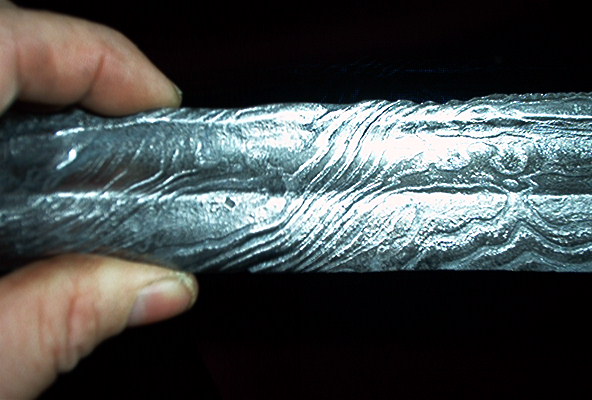
The sinuous curves of a pattern welded blade, crafted by master
 weapon smith Robert P. Shyan-Norwalt. For a detailed tutorial
of his work, see The Creation of a Pattern Welded Blade.
Photographs by Melissa Shayan-Norwalt

A good sword is strong, flexible, and light. Lacking high-quality iron ore, Anglo-Saxon (and earlier) weapon-smiths devised the technique of pattern welding to impart desired flexibility and strength to their sword blades.

Simply put, pattern welding is the art of hammering together, and then twisting and re-hammering layers of iron (often of varying strengths) in a charcoal fire to add the one per cent of carbon critical to the blade's flexibility. A brittle blade is the sword of a dead man, for it is a sword that breaks under the stresses of combat.

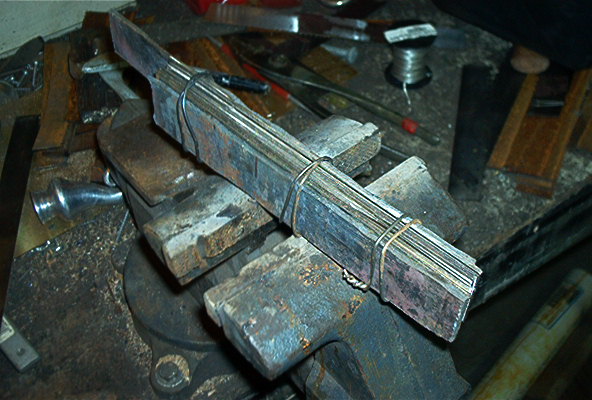
The many layers of steel prior to heating, hammering, and twisting.

Pattern welded swords show a distinct interwoven figuring in the steel that imparted an especial beauty and visual liveliness to the blade. Twisting, heating, and hammering drives the crystalline structure of the steel to form the wavy, watery pattern which the technique produces. Shaping and grinding the rough blade into finished shape reveals differing levels of the respective layers. Weapon-smiths further emphasized this figuring by acid etching. Amongst the materials weapon-smiths had at their disposal for this purpose were tannic acid, vinegar-produced acetic acid, urine (that indispensable by-product which found its way into so much early manufacture), sour beer, and various acidic fruit juices. Tannic acid would have given a blade a dramatic blue-black colouring, and helped protect it from rust.

At the end of the 5th century Cassiodorus described pattern welded sword made by the Teutonic Warni tribe:

The central part of their blades, cunningly hollowed out, appears to be grained with tiny snakes, and here such varied shadows play that you would believe the shining metal to be interwoven with many colours.

The snake-like pattern that so impressed Cassiodorus is caused by viewing the hammered, twisted layers of steel on edge, as it were. As in the excerpt from the poem Elene, in which the poet speaks of the blade's changing hues, Cassiodorus takes delight in the sword's "many colours."

The term "pattern welding" is a modern one, coined in 1947 by researcher Herbert Maryon upon examination of an Anglo-Saxon sword found in a heathen burial from Ely. It was he who also determined that inscriptions in sword blades were created by the insertion of narrow iron rods into the white-hot blade. After reheating the inlaid inscription would be hammered flush into the surface of the blade.

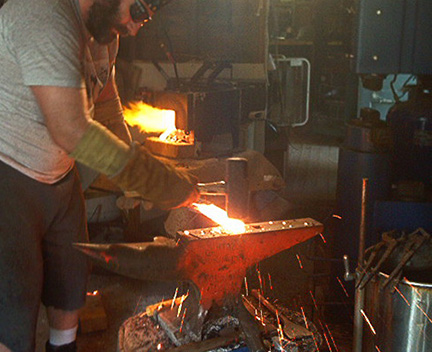
Weapon smith Robert P. Shyan-Norwalt at the forge;
the steel bundle is 1800 degrees F.

The process is an ancient one. The Celts as far back as the 8th century BCE may have made swords by pattern welding, and the Anglo-Saxons and Vikings used the technique extensively until the end of the 9th century CE. Because the intertwined and hammered layers of softer and harder iron had varying cutting ability, often an edge of high carbon steel was welded to the nearly completed blade, allowing a consistently sharp edge to be ground along the length of the sword. All of this was highly labour intensive, and the makers of pattern welded words were justly esteemed and rewarded in society. By the 10th century better, more consistent iron ore was obtainable via import in Britain, and furnace technology improved, making this laborious technique unnecessary - and swords the less glorious for it.

Yet practical knowledge of pattern welding in the West was not completely lost. In 1771, Jean Jacques Perret in his illustrated L'Art du Coutelier (The Art of the Cutler) describes in detail the making of pattern welded blades, praising them for their superior beauty and strength. He refers to such blades as "Damascus", a confusion which has persisted many centuries. True Damascus steel blades, gun stocks, and other objects with their beautiful figuring are not pattern welded, but instead forged from iron ore heated with carbon inside a closed crucible. "Damascus steel" forged from the cakes of steely, high-carbon-content iron called wootz likely originated in the Hyderabad region India and dates from between 200 BCE to 200 CE. The material spread both Eastward and Westward from there, with Romans importing the cakes for their own blade making.

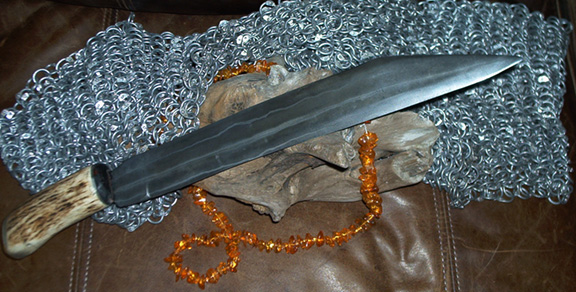
Seax created by Robert P. Shyan-Norwalt.  The seax was the distinctive
angle-bladed hand weapon which took its name from the Saxons.

 In the 1950's Englishman John Anstee successfully duplicated the pattern welded technique used by Anglo-Saxon and Viking weapon-smiths. During the course of his research he found that due to the crystalline nature of iron, he could produce wavy patterns on the finished blade even without layering wrought iron and steel, but by simply twisting the heated metal. Such blades however lacked the most important qualities of pattern welding, its superior strength and flexibility. He was also able to determine that old blades exhibiting a herringbone pattern and those with curving patterns were not structurally different; rust had removed the curving pattern in some, leaving only the herringbone figuring.

Interested in swords, and their importance to society? Hilda Ellis Davidson is a great expert, and her excellent book The Sword in Anglo-Saxon England is full of fascinating information, including complete details of John Anstee's recreation of pattern welding. A more recent work, covering all weaponry utilized by Anglo-Saxon warriors, is The English Warrior from Earliest Times to 1066 by Stephen Pollington ( Anglo-Saxon Books, 1996) a treasure trove of information about the men and their weapons. For more about Damascus iron work, see On Damascus Steel by Leo Figiel (The Print Center, NY 1991). Modern American weapon smith Robert P. Shyan-Norwalt’s detailed two part tutorial, The Creation of a Pattern Welded Blade, contains many photos and technical advice.

~~~~~~~~~~~~
 
Octavia Randolph is the author of  The Circle of Ceridwen Saga, all four of which are happily nestled on  Amazon's Top Twenty Best Sellers for Women's Adventure. Young women with courage. Swords with names. Vikings with tattoos. Warfare. Passion. Survival. Sheep. And Other Good Things...

Book Four
Book Two
Book Three


Book One