Showing posts with label RAF. Show all posts

Friday, August 14, 2015

"Scramble" - Remembering the Battle of Britain and Why it Still Appeals to us Today

by Helena P. Schrader

"Scramble!" RAF Squadron is given the order to
take off very early in the Battle of Britain
Courtesy of the Imperial War Museum

The Battle of Britain was more than a military victory. The Battle of Britain was a critical psychological and diplomatic victory as well. The psychological impact of defeating the apparently invincible Luftwaffe was enormous at the time. The RAF had proved that the Luftwaffe could be beaten, and by inference that the Wehrmacht could be beaten. This fact alone encouraged resistance and kept hope alive all across occupied Europe. Even more important, as a result of British tenacity and defiance in the Battle of Britain, the United States, which at the start of the Battle had written Britain off as a military and political power, revised its opinion of British strength.  Because of the Battle of Britain, the U.S.A. shifted its policy from ‘neutrality’ to ‘non-belligerent’ assistance. With American help, Britain was able to keep fighting until Hitler over-extended himself in the Soviet Union. The Battle of Britain was the necessary pre-requisite for future victory in Europe.

Yet, any such purely objective assessment of the Battle of Britain does not explain the appeal of the Battle of Britain to people today.  There were, after all, many other decisive battles in WWII from Stalingrad to Midway. The appeal of the Battle of Britain is less military and diplomatic than emotional.

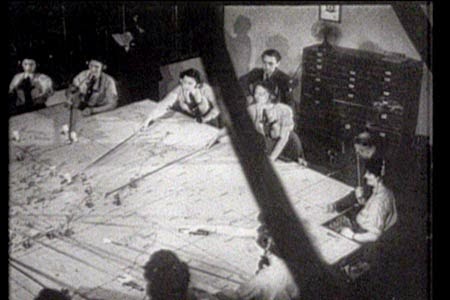
Fighter Command Control Room;
Courtesy of the Imperial War Museum

The Battle of Britain appeals to us today because it was not only a clear case of good against evil, but of the underdog winning against a bully. RAF Fighter Command was tiny!  Even including the foreign pilots flying with the RAF, there were only roughly 1,200 trained fighter pilots in Britain at the time of the Battles. (Numbers varied due to training, casualties and recruiting.) These men were a highly trained elite that could not be readily replaced. Pilots were not mere “cannon fodder.”  They were specialists that took years to train. In the summer of 1940, they stood against apparently overwhelming odds. Churchill – as so often – captured the sentiment of his countrymen when he claimed that “never in the field of human conflict has so much been owed by so many to so few.”

This image of a small “band of brothers” standing up to a massive and invincible foe in a defensive battle for their homeland was reminiscent of other heroic battles – Henry V at Agincourt, Edward the Black Prince at Poitiers, Leonidas and his 300 at Thermopylae.  Such battles, pitting a few defenders against a hoard of enemy, have always appealed to students of history and readers of historical fiction like almost nothing else.

RAF Pilots at "Readiness,"
Courtesy of Chris Gross

Furthermore, the Battle of Britain still resonates with us today in part because it wasn’t a battle won by generals, technology or even “aces” — but rather by young men barely out of their teens.  (The average age of RAF fighter pilots in the Battle was 22.)  They fought in beautiful, fragile machines that still awe aviation enthusiasts. And the casualties were devastating.  In just four months, Fighter Command lost roughly 40% of its pilots.  That means that each pilot had only a slightly better than 50% chance of surviving the Battle.  Furthermore, the effective casualty rate of killed and wounded was closer to 70%.  This situation was aggravated by the fact that, as a rule, the more experienced pilots had a 5-6 times greater chance of surviving than did the replacement pilots coming into the front line with very little flying and no combat experience.  The most critical period for a replacement pilot was his first fortnight in a front-line squadron.  Many pilots did not survive four hours.  That makes for an element of tragedy even in victory that catches at our heart-strings.

Funeral for PO Billy Fiske,
U.S. citizen and RAF fighter pilot, during the Battle of Britain,
Courtesy of  Andy Saunders

We shouldn’t forget, however, that the pilots alone did not win the Battle.  The RAF had worked hard to ensure that its pilots were supported by some of the best trained ground crews in the world.  With an ‘apprentice’ program, the RAF had attracted technically minded young men early and provided them with extensive training throughout the inter-war years. In some ways, ground crews were better educated than many pilots. Under the circumstances and given the fact that many pilots came up from the ranks themselves, it is hardly surprising that the relations between pilots and crews were on the whole excellent.  The RAF had a notoriously relaxed attitude toward discipline in any case, and this further worked to break down barriers. Last but not least, at this stage of the war, individual crews looked after individual aircraft and so specific pilots.  The ground crews identified strongly with their unit – and ‘their’ pilots. After the bombing of the airfields started in mid-August, the ground crews were themselves under attack, suffering casualties and working under deplorable conditions – often without hot-food, dry beds, adequate sleep or time-off.  The ground crews never failed their squadrons.  Aircraft were turned around – rearmed, re-fuelled, tires, oxygen, airframe etc. checked – in just minutes.

Ground Crews Refuelling in the Rain.
Imperial War Museum

Equally notable was the RAF’s early and exceptionally positive attitude toward women.  The RAF actively encouraged the establishment of a Women’s Auxiliary, which by the end of the war served alongside the RAF in virtually all non-combat functions.  Even before the start of the war, however, the vital and highly technical jobs of radar operator and operations room plotter, as well as various jobs associated with these activities, were identified as trades especially suited to women.  The C-in-C of Fighter Commander, ACM Dowding, personally insisted that the talented women who did these jobs move up into supervisory positions – and be commissioned accordingly. During the Battle of Britain over 17,000 WAAF served with the RAF, nearly 4,500 of them with Fighter Command. A number of WAAF were killed and injured and six airwomen were awarded the Military Medal during the Battle.

WWII WAAF Recruiting Poster.
Imperial War Museum

Last but not least, given the losses and the sheer physical demands placed upon the RAF pilots at the time, it was their ability not only to keep flying but to keep drinking and laughing that awed their countrymen, their leaders and their enemies — when they found out.  And it still appeals to us today.

Pilots of "B" Flight, 85 Squadron, July 1940,
Courtesy of Edith Kup
~~~~~~~~~~~~~

My novel on the Battle of Britain, Chasing the Wind (Kindle edition: Where Eagles Never Flew), pays tribute to the entire spectrum of participants, male and female, from mechanics and controllers to WAAFs as well as to the pilots. I based my account on the very meticulous records now available from both the UK and Germany to ensure that the raids, casualties, and claims each day are correct. Yet the most important research was reading the memoirs of dozens of participants and corresponding with others to try to get the atmosphere “right.” My greatest moment as a historical novelist came when I received a hand-written letter from a man I had only read about up until then: RAF Battle of Britain “ace” Bob Doe. Wing Commander Doe wrote to tell me I had “got it smack on the way it was for us fighter pilots,” and said that Chasing the Wind was “the best book” he had ever read about the Battle of Britain.  It doesn’t get any better than that for a historical novelist!

Here’s a video teaser about the novel. Click here!

For reviews click here: Reviews.

Tuesday, July 14, 2015

The Air Transport Auxiliary and the British Women who Flew in WWII

by Helena P. Schrader


The Second World War did not explode unexpectedly upon an unsuspecting world. Rather, it arrived with the slow, clanking certainty of an advancing panzer. Practically from the time Hitler came to power until the German invasion of Poland, the world moved inexorably toward conflict. Yet, while the world marched consciously toward conflagration, it did so — at least in the West — with reluctance and foreboding.

The First World War had been won by the Western Powers at such immeasurable cost in both blood and money that it created a profound and widespread abhorrence of war. Even as Germany started down the path of militant Revisionism, breaking one after another of the bonds imposed by the Treaty of Versailles, British public opinion remained firmly pacifist. The policy of Appeasement was arguably the only policy that a democratically elected government could pursue given the mood among voters.

All this explains why, despite the evidence of massive German aggression coupled with the expectation that aerial warfare would be decisive in any future conflict, Great Britain responded only slowly to the growing air threat posed by the Luftwaffe. In 1934, Germany was producing nearly 2,000 aircraft annually; Britain less than half that amount. By 1939 German aircraft production topped 8,000, while British aircraft production lagged behind at less than 5,000. The situation with regard to pilots was similar.

After the Sudeten Crisis of September 1938, the British Air Ministry finally realized that the situation was critical. Among other measures instituted was the creation of the “Civil Air Guard,” whose purpose was to increase the available pool of qualified pilots by subsidizing pilot training of volunteers in a civilian context. Applicants had to be between the ages of eighteen and fifty and were trained at some sixty private and commercial flying schools. The program, notably, made no distinction between men and women.

Gerard d'Erlanger
Founder and Commander of the ATA

Also in response to the Sudeten Crisis, a Director of British Airways, Gerard d’Erlanger, proposed to the Director General of Civil Aviation a scheme by which pilots ineligible for active service with the RAF could assist the nation in wartime. D’Erlanger foresaw that pilots, like himself, who were too old or otherwise unfit for active service in the Royal Air Force (RAF) or Air Fleet Arm (FAA) might nevertheless render valuable service in a support capacity. He envisaged such tasks as carrying mail, news and dispatches, the transport of medical and other vital but lightweight equipment as well as VIPs and ambulance services. The scheme won almost immediate approval and the name of Air Transport Auxiliary (ATA) was adopted.


At the outbreak of the war, thirty qualified pilots unfit for active service were recruited, but it was not until the Battle of France that the ATA really took off. The RAF was stretched beyond capacity. It was losing pilots faster than it could replace them, and every pilot was needed on the front line. It asked the ATA to assume complete responsibility for transporting aircraft from factories to airfields and back again for factory refits and the like. The ATA assumed that burden and soon found that it was too small to fulfill it. The ATA made appeals over the media for older, qualified pilots to volunteer, but there just weren’t enough out there. So the ATA instituted its own training scheme for persons not fit for active service. By the end of the war, the ATA had delivered 309,011 aircraft of 147 different types, and numbered almost 800 pilots and roughly 3000 ground personnel — including 162 women pilots.


The ATA’s greatest achievement was not merely one of helping the Allies win the war by ensuring that the vitally needed aircraft were delivered to the RAF and FAA, nor was it one of relieving healthy young men for combat duty. What makes the ATA fascinating was the unprecedented, unorthodox and creative way in which the ATA mastered the problems it faced with human resources deemed “sub-standard” by all conventional measures. 

The ATA required a previously unheard of versatility of its pilots. ATA pilots were required to fly aircraft they had never seen before simply on the basis of a few hours “conversion” training in similar classes of aircraft and with “Pilot’s Notes” printed on four by six-inch cards. ATA pilots flew without radios and so without the benefit of radio navigation aids, in-flight weather advisories or emergency communication. Furthermore, the ATA initially provided no, and later only very limited, training in the use of instruments for blind flying. Unlike the RAF flying from their own stations, pilots of the ATA were expected to fly in and out of aerodromes they had never seen before all across the country. It expected its pilots to fly in airspace regularly invaded by enemy aircraft without any means of self-defense. Most remarkable of all, the ATA expected all this of pilots who were deemed “unfit” for military service. Flying for the ATA were men with one arm or one eye, men who were short-sighted, men who were over-weight, over-aged, several of these all at once — and (as I said above) women.

ATA pilot "mounting" a Spitfire

The utilization and integration of women pilots in the ATA is one of its most striking successes. Less than three months after the start of the war, on November 14, 1939 the first eight women pilots signed contracts with the ATA effective January 1, 1940. From then on, the number of women pilots grew until by the end of the war a total of 162 women pilots and four women flight engineers had flown with the ATA. 

Even more remarkable, by the end of the war, the women pilots were receiving equal pay for equal work — highly unusual in 1945. Furthermore, women had served as instructors of both men and women, as Operations Officers and as Pool Commanders, all with the corresponding authority over men. Equally astonishing, women had been qualified on virtually every kind of aircraft the RAF and FAA flew except the large flying boats but including the first jet fighter aircraft. They literally faced the exact same hazards as their male colleagues and earned the equal opportunity and remuneration grated them. Furthermore, they enjoyed, without discrimination, the accolades, praise and thanks awarded to the ATA as whole. In short, the ATA is an exemplary case study in eliminating sex discrimination and integrating women into an already extraordinary organization for the benefit of all concerned.

~~~~~~~~~~~~~

Helena P. Schrader published a comparative study of British and American women pilots in WWII, Sisters in Arms with Pen & Sword Aviation. The book is available in Hardback, Trade Paperback and Kindle editions. For more information about her non-fiction history books and historical novels visit her website at: http://helenapschrader.com.

Monday, June 22, 2015

Britain's Critical Contribution to the Berlin Airlift

by Helena P. Schrader


On June 24, 1948 the Soviet Union abruptly closed all land and water access to the Western Sectors of Berlin. Over two million civilians, dependent on the surrounding territory and the West for food, fuel, and other basic goods, were suddenly cut off from all the necessities of life.

The Western Allies had the option of either withdrawing their garrisons and allowing the Soviet Union to take control of the entire city, or of trying to supply the city by air. Never in history had two million people been supplied exclusively by air before. Furthermore, the survival of the Western Sectors of Berlin depended not just on food supplies but above all coal to fuel the power plants that kept the water and sewage systems, the public transport network and the factories running. None of the senior military commanders of the time believed it could be done.

But the political leadership in London and Washington insisted that it must be done. A withdrawal from Berlin would discredit the West at a crucial moment in history, when the Soviet Union was expanding aggressively into Europe. Worse, it would endanger the political stability and economic recovery of Europe.


So the largest and most ambitious airlift in history was set in motion. It began without the West really knowing how much the Berliners needed in order to survive — much less how much those supplies weighed. It was launched despite an almost complete absence of aircraft and aircrews in Germany, and despite serious inadequacies in airfields and air traffic control. It was launched without airlift expertise in theater or a unified command structure. But once it took wing, it flew and turned into something that not even its originators and advocators had ever imagined or expected.

And all too often today it is remembered as an American victory. Without doubt without American resources the Berlin Airlift could never have succeeded. The U.S. Air Force carried 76.7% of all cargoes flown into Berlin by weight, and 69.4% of all flights. The United States literally threw everything it had into the airlift, stripping all other theaters of transport airport, calling up all reservists with four-engine experience (both in the air and on the ground) and air traffic controllers. The costs were literally incalculable — just trying to figure out what needed to be included was almost impossible without the lost opportunity costs of investing so many resources in a single endeavor. But not only was the RAF very much carrying it’s weight — it was only about one fifth the size of the USAF at this time —  the entire airlift might never have happened had it not been for the RAF and Foreign Secretary Bevin.

When the Blockade of Berlin started, the Western Allies appeared to have just two options: retreat, i.e. give up their rights to Berlin and withdraw their garrisons, or fight back by challenging the Soviet blockade with a show of force. The political leadership in both countries refused to even consider backing down. The problem with that was that while President Truman and Prime Minister Attlee might not be willing to consider withdrawal from Berlin, that didn’t keep over two million German civilians from starving to death. So the question was: how to supply the city.

The American Military Governor, General Lucius D. Clay strongly advocated sending a heavily armed convoy up the autobahn to Berlin and started pulling together five to six thousand troops to escort that convoy — including armor and artillery. Clay was not a hothead and did not think he would actually have to fight his way across East Germany, thereby igniting World War III. He supported the plan of an armed convoy because he thought the Russians — when confronted with Western resolve — would back down. The British, however, rejected the plan because they believed Clay’s convoy could be stopped without the resort to war. They thought all the Soviets would need to do was blow up a few bridges or erect manned barricades that forced the Allies to shoot first. Furthermore, the State Department agreed with the British arguing that “the Soviets would just sit up on a hillside and laugh.” Rather than challenging the Soviets in Berlin, the State Department talked about blockading Vladivostok or closing the Panama Canal to Soviet ships.

Air Commodore Waite

It was now that the RAF came up with a solution. One participant put it like this:

We were under duress. Berlin could not wait 6 months for a plan, no one had anything else to suggest apart from Clay’s armored column, and RAF top brass flew the first lot of UK-based transport aircraft to Germany … on a philosophy variously described as ‘the British genius for improvisation’ or ‘Limey muddling through,’ according to one’s level of politeness.

(Bob Needham, “Resisting Aggression without War: Berlin 1948 – 1949,” The Friends Quarterly, April 2001, p. 276.)

But this was seen as a “stop-gap” measure. No one believed West Berlin could be sustained by an airlift indefinitely — except RAF Air Commodore Waite. This unsung hero of the Berlin Airlift sat down in his office and started working out some rough calculations of cargo requirements and priorities, aircraft load-factors and the like. He came up with a detailed proposal, and the next day he asked for just ten minutes with the British Military Governor, General Sir Brian Robertson. Robertson liked the idea enough to share it with U.S. General Clay. According to some accounts Clay was enthusiastic. Washington was not.

Both the Pentagon and the State Department opposed the idea of an airlift — and a war over Berlin. They wanted to start an orderly withdrawal. Since this would have to be conducted in coordination with the Allies (and the French had suggested it from the start), this meant convincing the British to pull-out. General Wedemeyer, Director of Plans and Operations at the Pentagon, was sent to London by General Bradley, the U.S. Army Chief of Staff, to discuss plans for evacuating the Western garrisons from Berlin “gracefully.”

Foreign Minister Bevin in Berlin

Wedemeyer, however, met first with British Foreign Secretary Ernest Bevin and carefully outlined in great detail all the difficulties associated with supplying Berlin from the air. His words did not have the desired effect. Bevin listened politely and then responded: “General, I am very disappointed. I never expected to hear the Head of the American Air Force explain that the American Air Force couldn’t do what the Royal Air Force is already doing.” According to Bevin’s private secretary, Sir Frank Roberts, Wedemeyer came out of the meeting “like a Labrador, you know, coming out of a pond” and said: “I suppose that means we’ve got to do it.” And so they did.


The USAF had specialized in transporting coal — absolutely essential for the survival of Berlin because it powered everything from the transportation network to the sewage and water systems — but it didn’t have the flexibility of the RAF to handle children, salt, light blubs and newspaper reels. While the USAF rapidly converted to a homogenous fleet of C-54s (civilian designation: DC-4s) and standardized everything from parts and maintenance to flying speeds and heights, the RAF flew a wide variety of aircraft including the great flying boats, the Sunderlands. As a result, in the end, although the RAF was much smaller than the USAF, it carried a disproportionately high percentage of outbound cargoes — vital to the economy of blockaded Berlin — and specialty cargoes like liquid fuel and salt. The RAF also transported 80% of the passengers in and out of Berlin, and 45% of the food flown to the city. 


In retrospect, however, I think the greatest British contribution was to morale. It was the British who pulled together an Airlift fleet in a matter of just days and weeks, while the USAF scrambled to pull its resources from around the world. In the first full month of the Airlift, the RAF accounted for 42% of the cargoes — or more than twice its proportional size. In August, RAF and British civilians together accounted for 38% of the tonnage flown into Berlin. It was not until September that the British portion of the lift fell to roughly its “natural” proportion of 21 per cent as the C-54 started to replace the USAF’s twin-engined C-47 (DC-3s). Nor should the significance of the return cargoes be underestimated. The contribution to West Berlin’s morale by keeping the factories open, keeping people employed and selling goods abroad labelled “made in blockaded Berlin” is incalculable. It was absolutely critical to maintaining Berlin’s pride and its determination to keep up the fight against oppression.

Helena Schrader has published The Blockade Breakers: The Berlin Airlift. Amazon


Monday, July 15, 2013

Reflections on the Battle of Britain

by Dr. Helena P. Schrader


There are few events in British history that are as dramatic or as inspiring as the Battle of Britain. Indeed, Winston Churchill suggested in his famous speech that the Battle of Britain was the British Empire's "finest hour."

From the point of view of a historian, the Battle of Britain was significant because it brought Hitler’s aggression to a halt for the first time after he came to power in Germany in 1933. Admittedly, Hitler considered his failure to defeat the Royal Air Force in the summer of 1940 an annoyance rather than a major strategic set-back; his real objective was the Soviet Union, and to this day most Germans have never even heard of the Battle of Britain! Yet for Britain, the United States, and occupied Europe, the significance of the Battle of Britain can hardly be over-stated.

If the RAF had been defeated in 1940, the Luftwaffe would have been able to continue indiscriminate day-light bombing almost indefinitely and paved the way for a German invasion of Britain. Although many doubt this would have been successful, there is no certainty that it would have been repulsed either. The Royal Navy had been seriously weakened by the losses during the evacuation at Dunkirk and was over-stretched trying to protect the Atlantic lifeline. Furthermore, the Royal Army was had been mauled in France and the British Expeditionary Force had abandoned all its heavy equipment in France. In consequence, the British ground forces lacked tanks and artillery for fighting the heavily mechanized Wehrmacht. Churchill was not only being rhetorical when he spoke about fighting a guerrilla war against the invaders!

But the invasion did not take place because the Royal Air Force, or more specifically Fighter Command, prevented the Luftwaffe from establishing air superiority over England. Without air superiority, the Wehrmacht was not prepared to invade. So Hitler (more interested in invading the Soviet Union anyway) first postponed and then cancelled the invasion of Britain altogether.

This was more than a military victory. The Battle of Britain was a critical diplomatic and psychological victory as well. The psychological impact of defeating the apparently invincible Luftwaffe was enormous at the time. The RAF had proved that the Luftwaffe could be beaten, and by inference that the Wehrmacht could be beaten. This fact alone encouraged resistance and kept hope alive all across occupied Europe.

Even more important, as a result of British tenacity and defiance in the Battle of Britain, the United States, which at the start of the Battle had written Britain off as a military and political power, revised its opinion of British strength. Because of the Battle of Britain, the U.S.A. shifted its policy from ‘neutrality’ to ‘non-belligerent’ assistance. With American help, Britain was able to keep fighting until Hitler over-extended himself in the Soviet Union. This in turn made it possible to forge the wartime coalition of Britain, the U.S. and the Soviet Union, which would eventually, defeat Hitler’s Germany.

Yet, any such purely objective assessment of the Battle of Britain does not explain the appeal of the Battle of Britain to people today. There were, after all, many other decisive battles in WWII from Stalingrad to Midway. The appeal of the Battle of Britain is less military and diplomatic than emotional.
The Battle of Britain was a drama that has captured the imagination – and hearts – of all subsequent generations because of just how much hung in the balance and of just how little stood between Britain and a Nazi invasion. The Wehrmacht had just defeated the French in six weeks! The British Expeditionary Force had been rescued by the skin of their teeth in a dramatic, improvised evacuation – but only at the cost of abandoning all its equipment on the beaches of France. Thus, in the Summer of 1940, it seemed like only RAF Fighter Command stood between Britain and invasion, between freedom and subjugation.

Yet RAF Fighter Command was tiny! Even including the foreign pilots flying with the RAF, there were only roughly 1,200 trained fighter pilots in Britain at this time. (Numbers varied due to training, casualties and recruiting.) These men were a highly trained elite that could not be readily replaced. Pilots were not mere “cannon fodder.” They were specialists that took years to train. In the summer of 1940, they stood against apparently overwhelming odds. Churchill – as so often – captured the sentiment of his countrymen when he claimed that “never in the field of human conflict has so much been owed by so many to so few.”

This image of a small “band of brothers” standing up to a massive and invincible foe in a defensive battle for their homeland was reminiscent of other heroic battles – Henry V at Agincourt, Edward the Black Prince at Poitiers, Leonidas and his 300 at Thermopylae. Such battles, pitting a few defenders against a hoard of enemy, have always appealed to students of history and readers of historical fiction like almost nothing else.

Furthermore, it must be remembered that pilots were very, very young (averaging 22 years in age), and they were they were fighting with beautiful, fragile machines that still awed most of their contemporaries. Furthermore, the casualties were devastating. In the short, four month span of the Battle, Fighter Command lost roughly 40% of its pilots. That means that each pilot had only a slightly better than 50% chance of surviving the Battle. Furthermore, the effective casualty rate of killed and wounded was closer to 70%. This situation was aggravated by the fact that, as a rule, the more experienced pilots had a 5-6 times greater chance of surviving than did the replacement pilots coming into the front line with very little flying and no combat experience. The most critical period for a replacement pilot was his first fortnight in a front-line squadron. Many pilots did not survive four hours.

This meant that a smallish core of experienced pilots watched waves of replacements arriving and then being shot-down in a short space of time, until sheer exhaustion wore down even the most experienced pilots. By the end of the Battle, Squadron Leaders, Flight Lieutenants and Section Leaders were increasingly getting shot down as a result of mistakes, inattention, and ‘sloppy flying’ that resulted simply from fatigue.

These are the “human interest” stories that so fascinate us today – the inexperienced teenagers with less than 20 hours on combat aircraft being thrown into the bloody fray, and their experienced commanders, the “killers” who had to shoot down enough German aircraft to convince Goering and Hitler that the Battle could not be won , while at the same time leading, encouraging and advising their young colleagues so they could live to fight another day.

How did they do it?

Obviously one factor was sheer motivation. British pilots were fighting over their homes – and their historical and national heritage – acutely aware of being the last line of defense in a war against a widely abhorred enemy. But this alone would hardly have given them victory. The Poles and Danes and French etc. had also been fighting for their homes and country against the same aggressor.

Technology and organization were other critical factors and these have been analyzed and discussed in great detail in many good history books. I will only mention here radar, without which Britain would certainly have lost the Battle of Britain, and the system of ground control over dispersed fighter squadrons, which was equally important to Britain’s victory in 1940. The Spitfire deserves at least an honorable mention since it was such a magnificent fighter, even if honesty compels me to note that in the Battle of Britain more squadrons were equipped with and more German aircrafts shot down by Hurricanes.

But I would like to draw attention to one aspect of the Battle that I believe has often been overlooked in favor of the above explanations for success. This was the very strong “team spirit” that predominated in the RAF – in sharp contrast to the Luftwaffe at this time. The Luftwaffe enabled and encouraged individual fighter pilots to become “aces.” If a German pilot was an “ace,” he was not only lionized by the press and praised by his peers and superiors -- all the way to Hitler himself, but he was given a wingman and then an entire “Schwarm” to protect him so he could concentrate on killing. This way, German aces accumulated huge scores, sometimes over 100 attributed “kills,” while the highest scoring ace of the RAF, “Johnnie” Johnson, had only 38 recorded “kills.”

Yet the RAF with its ethos of acting as a team inflicted losses on the Luftwaffe in the Battle of Britain at a rate of almost 2 to 1. Furthermore – and far more important -- morale did not break. Given the losses and the sheer physical demands placed upon RAF pilots at the time, it was their ability not only to keep flying but to keep drinking and laughing that awed their countrymen, their leaders and their enemies – when they found out.

Furthermore, it was not the pilots alone who won the Battle of Britain. The RAF had worked hard to ensure that its pilots were supported by some of the best trained ground crews in the world. With an ‘apprentice’ program, the RAF had attracted technically minded young men early and provided them with extensive training throughout the inter-war years. In fact, because of a unique program that enabled exceptional “other ranks” to qualify for flying training, many pilots flying in the Battle of Britain had come up from the ranks, starting as mechanics themselves. This made the pilots appreciate their ground crews more than pilots did in other air forces of the time.

Perhaps most important, however, was that at this stage of the war, individual crews looked after individual aircraft and so specific pilots. The ground crews identified strongly with their unit – and ‘their’ pilots. After the bombing of the airfields started in mid-August, the ground crews were themselves under attack, suffering casualties and working under deplorable conditions – often without hot food, dry beds, adequate sleep and no leave. The ground crews never failed their squadrons. Aircraft were turned around – rearmed, re-fuelled, tires, oxygen, airframe etc. checked – in just minutes.

Last but not least, I would like to note that the RAF from the very start had an exceptionally positive attitude toward women. The RAF actively encouraged the establishment of a Women’s Auxiliary, which by the end of the war served alongside the RAF in virtually all non-combat functions. Even before the start of the war, however, the vital and highly technical jobs of radar operator and operations room plotter, as well as various jobs associated with these activities, were identified as trades especially suited to women. The C-in-C of Fighter Commander, ACM Dowding, personally insisted that the talented women who did these jobs move up into supervisory positions – and be commissioned accordingly. During Battle of Britain over 17,000 WAAF served with the RAF, nearly 4,500 of them with Fighter Command. A number of WAAF were killed and injured and six airwomen were awarded the Military Medal during the Battle. The presence of so many young women is another factor that contributes to its modern appeal.

~~~~~~~~~~~~

My novel on the Battle of Britain, Chasing the Wind (Kindle edition: Where Eagles Never Flew), pays tribute to the entire spectrum of participants, male and female, from mechanics and controllers to WAAFs as well as to the pilots. I based my account on the very meticulous records now available from both the UK and Germany to ensure that the raids, casualties, and claims each day are correct. Yet the most important research was reading the memoirs of dozens of participants and corresponding with others to try to get the atmosphere “right.” My greatest moment as a historical novelist came when I received a hand-written letter from a man I had only read about up until then: RAF Battle of Britain “ace” Bob Doe. Wing Commander Doe wrote to tell me I had “got it smack on the way it was for us fighter pilots,” and said that Chasing the Wind was “the best book” he had ever read about the Battle of Britain. It doesn’t get any better than that for a historical novelist!

Here’s a video teaser about the novel. Click here! (Note the Kindle Edition was published under the title Where Eagles Never Flew.)For reviews click Reviews.


Helena Page Schrader is a career diplomat, who earned a PhD in History from the University of Hamburg with a ground-breaking dissertation about the mastermind behind the coup attempt against Hitler in July 1944. She has published non-fiction works on the German Resistance, women in aviation in WWII, and the Berlin Airlift. Her novels on the German Resistance (Hitler’s Demons, the Battle of Britain (Chasing the Wind, Kindle Edition: Where Eagles Never Flew), and Ancient Greece have won praise and awards. (View a video teaser on her Leonidas Trilogy.) She is currently working on a ten Tales of Chivalry, novels set in the 13th and 14th century against the backdrop of the crusades. (View a video teaser on her Tales of Chivalry series.) The first novel in this series, A Widow’s Crusade, was released April 9, 2013 and can be purchased on amazon.com. You can find out more about Helena and her books at her website: http://www.helenapschrader.com.