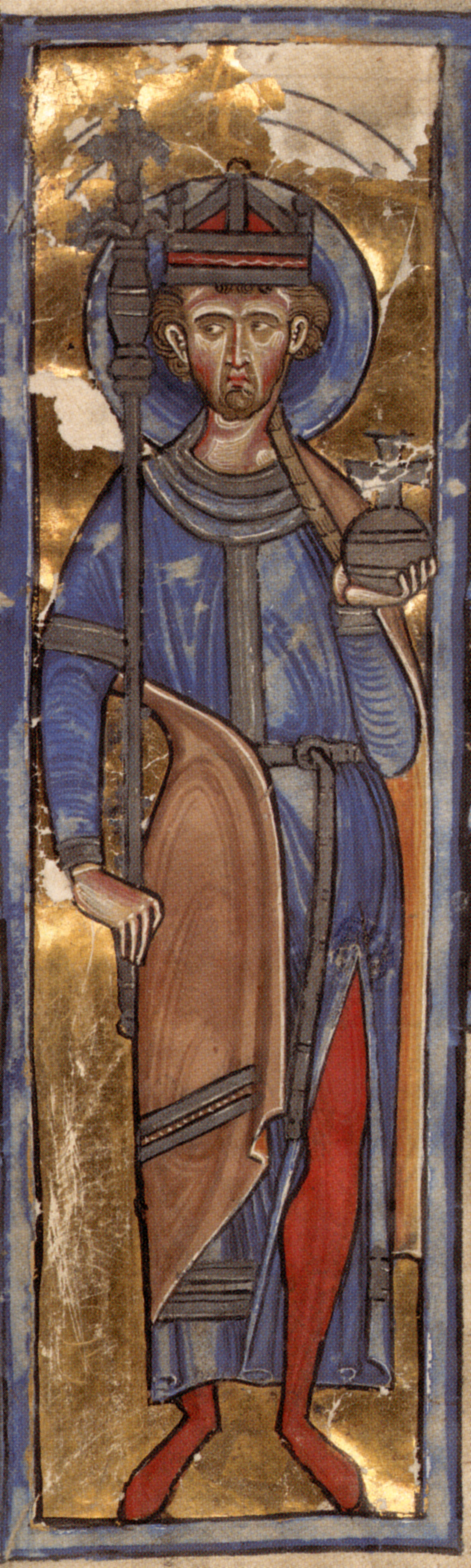
Showing posts with label Northumbria. Show all posts

Monday, February 3, 2020

The Man Who Broke King Harold

by Helen Johnson

The invasion, occupation and conquest of England by William of Normandy's troops in the 1060s created trauma that echoes through the centuries.

Famously, the Conquest began at the Battle of Hastings in 1066, when King Harold of England was killed.  But Normandy was a small duchy.  England was one of the wealthiest and best organised countries in Europe.  How could Duke William beat king Harold?

I believe that Harold was broken before he ever faced William - broken by his own brother, Tostig.

Tostig and Harold's father was Godwin, Earl of Wessex, who married King Cnut's kinswoman, Gytha.  In 1042, Cnut's succession failed and Edward, son of defeated King Aethelred 'the Unready', was invited to return from exile in Normandy.

Tostig's king and brother-in-law, King Edward the Confessor,
depicted in the Bayeux Tapestry. Image Credit

Under Edward, Earl Godwin rose to power.  His sons gained earldoms, and he married his daughter, Edith, to the King.

Tostig's sister Edith of Wessex,
wife of King Edward Image credit
The 'The Life of King Edward', written not long after the Conquest, describes two of Godwin's six sons, Tostig and Harold.  Both, we are told, were 'handsome and graceful persons.'  They were similarly 'strong' and 'brave'.

Harold was practiced in 'endless fatigues'.  He was mild tempered and 'of ready understanding'.  He 'could bear contradiction well'....'not readily... retaliating.'  If he thought someone loyal, he would share his plans.

It's a portrait of a self-controlled, thoughtful man, prepared to communicate and to listen to others.

Tostig, by comparison, 'occasionally was a little over-zealous in attacking evil.'  He was of 'bold and inflexible constancy of mind.'   He would 'ponder much and by himself the plans in his mind'.... 'In his word, deed or promise he was distinguished by adamantine steadfastness.'

And, in a comment that possibly tells us more about other men than of Tostig, 'He renounced desire for all women except his wife...'

Tostig's portrait is of a secretive, stubborn man, who might sometimes break into extreme behaviour.

However, Tostig was admired for his military prowess and firmness of mind, and became a  trusted servant of the King.

In 1051, King Edward's brother-in-law, Eustace of Boulogne, visited Dover. Unfortunately, his men ran amok. Townsfolk resisted, and around forty people were killed.

King Edward considered his brother-in-law to be in the right, and ordered Earl Godwin to punish the people of Dover. Godwin, believing the townsfolk to be in the right, refused.

Edward was furious.  He exiled Godwin's family, repudiated his wife, Godwin's daughter, and sent Godwin's youngest son, Wulfnoth, to Normandy as a hostage.

The incident was a flare for the Norman/English power play that simmered in England. Edward grew up in exile with his mother's people in Normandy after Danish Cnut took the throne. When Edward returned to England, he brought friends and habits gained in Normandy. But the Anglo-Scandinavian English aristocracy, including Godwin, did not like the Frenchified ways of the Normans.

A year after being exiled, Godwin returned, and supporters flocked to him. Edward was compelled to restore Godwin – and his sons and daughter.

Godwin subsequently appears to have been king in all but name.  Edward spent his time either in Church or at the hunt while his wife 'preserved the secret of the King's chastity.'  Edward developed his reputation for saintliness, while Godwin ran the kingdom.

When Godwin died in 1053, his son Harold moved into his place both as Earl of Wessex and as the King's 'Number Two.'

The Godwin plan was always for the whole family and in 1055 when Earl Siward of Northumbria died, Tostig was swiftly installed as Earl. The younger Godwins, Gyrth and Leofwine, became Earls of East Anglia and Kent.

Tostig's star was rising. He had, of all the brothers, the most illustrious wife: Judith of Flanders, half sister of Count Baldwin V of Flanders, granddaughter of Duke Richard II of Normandy, and cousin to King Edward.

A valuable gospel book, owned by Tostig's wife Judith
 and taken with her when the couple were expelled
from Northumbria Image Credit

Tostig was a favourite of King Edward, and they hunted together. Tostig was Queen Edith's favourite brother. He had a palace in York, from which to govern Northumbria.  He was wealthy, and made lavish gifts to Northumbria's patron saint, Cuthbert.

Project Godwin was going swimmingly: only one region of England, Mercia, was not ruled by a Godwin.

But in October 1065, while Tostig hunted with King Edward in Wiltshire, the Northumbrians attacked his palace in York. They slew his retainers and broke into the treasury.

The rebels rampaged south, stopping along the way to meet their allies: Edwin, Earl of Mercia, the Welsh, and their armies.

To show the King the strength of their feelings, the Northumbrians harried Northampton. Pity the unfortunate civilians of Northampton. Harrying, a standard military tactic of the time, meant burning houses and stealing cattle.

The rebels marched on to Oxford.

What had gone wrong?

Tostig's role as Earl of Northumbria was to govern, on behalf of the King, the whole of northern England. However, until 954, Northumbria was an independent kingdom, and in 1065 the Wessex-based King's power was limited to what historian W. E. Kapelle describes as 'essentially an overlord'.

Tostig was the first southerner ever appointed to rule there, and it appears either that he did not understand Northumbria, or that he aimed to govern in the same way as Wessex. However, Northumbria's laws were different to Wessex's. Northumbria had the 'Danelaw' – the laws of the Scandinavian immigrants who were the majority population in the area. Its territory and laws were defined by King Alfred in 879, and affirmed by subsequent kings including Cnut (reigned 1016 – 1035).

Many things were different in the Danelaw, but the universal complaint was that Tostig taxed too heavily. Taxes were significantly lower in the Danelaw. Did Tostig attempt to tax at southern levels?

Tostig was also accused of corruption. And there were murders – all men connected to the dynasty of hereditary Northumbrian earls, who were overlooked when Tostig got the Earldom. Might they have been a focus for rebellion?

Certainly, Tostig upset enough northerners that large numbers rebelled. They organised well. They allied with Edwin of Mercia, the only English Earl not a Godwin, keen to curb Godwin power.  Edwin allied with the Welsh, who Tostig and Harold had attacked in 1063.

The allies demanded that the king remove Tostig, renew the 'laws of Cnut' (i.e. Danelaw tax levels), and install Earl Edwin's brother, Morcar, as Earl of Northumbria.

King Edward sent Harold, his familiar 'number two', to negotiate.  Edward's orders were, essentially, to tell the Northumbrians to shut up and go home.

But when Harold saw that he had fewer soldiers than the massed Northumbrians, Mercians and Welsh, he knew that was impossible.

When Harold reported to Edward that there would be civil war unless Tostig was dismissed, Edward suffered a seizure.

Harold gave the Northumbrians all they demanded.  He averted civil war – but at cost of banishing his own brother.

Tostig went into exile in Flanders. Morcar became Earl of Northumbria. Peace settled.

Ships in the Bayeux Tapestry: Tostig travelled in ships like this,
to Flanders, Denmark and Norway.  And maybe to Normandy.
Image Credit

From this moment, King Edward descended into terminal decline. Some commentators have suggested that Edward and Tostig were homosexual lovers. From this distance, that is impossible to know. But they were certainly close companions. Edward's marriage was 'chaste'.  Tostig 'renounced desire for all women except his wife', although she did bear children.

Whatever the reasons, Edward died, childless, on 5 Jan 1066. The Witan, the country's council of wise men, overlooked Edward's teenage great-nephew, Edgar, and chose Harold to become King.

It appeared a prudent choice. The custom at the time was that the Witan chose the best candidate, and mature brothers or nephews were often chosen over younger contenders. Harold was brother-in-law to the deceased king, and had, in practice, been doing the job for years.

The news infuriated Tostig. As the king's favourite brother-in-law, and with a royal wife, I believe that Tostig had expected to become king. Instead, he was exiled, and Harold slipped into the throne.

In exile, Tostig's brother-in-law, Count Baldwin of Flanders, provided him with a home, an estate, and income of the town of St Omer. But Tostig was not satisfied: he wanted vengeance.  His 'adamantine steadfastness' cut in. Harold must pay for his betrayal.

Tostig sought support. Baldwin did not want a military adventure. Tostig surely went next to neighbouring William of Normandy, husband of Tostig's wife's niece. But I have found only writer – Peter Rex - who confirms that. Several historians record that Tostig went to his mother's cousin, King Swein of Denmark. Swein, like Baldwin and William, refused him. Tostig moved on, to Harald 'Hardrada', king of Norway.

Tostig reminded Hardrada of a treaty made in the late 1030s between Cnut's son Harthacnut and King Magnus of Norway, and persuaded Hardrada that he had a claim to England. Tostig, presumably recalling his father's return after exile, claimed that he had many supporters in England.

Hardrada was persuaded.  They raised troops, and in September 1066, they marched on York.

Was Tostig deluded when he promised Hardrada that supporters would flock to them? Or was he simply lying?

In the event, the Northumbrians defended York.  They met Tostig and the Norse at Fulford, a swampy place a couple of miles south of York.  The new Earl, Morcar, was young, not tested in battle.  Hardrada had a lifetime's military experience. The Northumbrians didn't have a chance.

After the slaughter, the Northumbrians surrendered. As usual, hostages were given as security.  Tostig began his vengeance by selecting those hostages. Promises were extracted from the Northumbrians to march with the invaders to depose King Harold – Tostig's primary aim.

Unbeknown to the invaders, however, King Harold was racing north.  Too late to save the Northumbrians, he went straight to attack the invaders.

Harold called out Tostig and offered him peace. He even offered him his place back as Earl of Northumbria – 'one third of the kingdom'.

Tostig refused – that 'adamantine steadfastness'.

So, at Stamford Bridge, on 25th September 1066, Harold's army wiped out the Norse, King Harald Hardrada, and Harold's brother, Tostig. Shortly afterwards, William of Normandy landed on the south coast.

As Harold rushed his troops back south, he paused to pray at Waltham Abbey.

A year previously, Harold and Tostig were the golden boys of England, King Edward's senior Earls.  Now, Tostig lay dead, killed if not by Harold's own hand, then certainly by his actions. What would he tell their mother?

While there, Harold received a message. The message told him that William had the Pope's blessing, and carried his banner. The message was that William had God on his side.

From this moment, Harold, the brother-killer, appeared a changed man.

His brother Gyrth volunteered to attack William, while Harold and his troops recuperated. Should Gyrth lose, the King and his troops could fight again. Gyrth also suggested they scorched the earth around William's encampment, contain them, and starve them out. They were all sensible suggestions.

But Harold – the brother-killer - did not listen. He insisted on facing William in battle at once.

Harold led his men to face God's judgement at Hastings on 14th October, 1066.

Harold, Gyrth and Leofwine were all felled by William's troops.

Their mother lost four sons in three weeks.

And England was conquered.

The death of King Harold, as depicted in the Bayeux Tapestry


Bibliography:

The Life of King Edward, anonymous, but believed to have been commissioned by Queen Edith Godwinson, and written by monk/s of St Bertin Abby at St Omer, Flanders.

The Relations between England and Flanders before the Norman Conquest, by Philip Grierson.

The Godwins, by Frank Barlow

The Saga of Harald Hardrada, in Heimskringla by Snorri Sturlesson

Queen Emma and the Vikings by Harriet O'Brien

Bloodfeud  by Richard Fletcher

The Norman Conquest of the North by William E Kapelle

William the Conqueror, the Bastard of Normandy, by Peter Rex


Finding Fulford by Charles Jones.

1066 The Year of the Conquest, by David Howarth


~~~~~~~~~~

Helen Johnson has roved around Yorkshire, England, for twenty years, writing about the history, heritage, landscape and people of the region.

She was inspired to write about the Norman Conquest after learning of William the Conqueror's 'Harrying of the North' – an act which today would qualify as genocide.

Her short story, 'God's own Country', published at Copperfield Review, imagines how two people might have felt about one of William the Conqueror's policies – his plan to blend what he described as the 'two races' of his dominions. Read the story HERE

Helen is working on two novels set in Conquest Yorkshire, one for adults and one for teenagers.

You can discover more of Helen's work and read about William the Conqueror's good intentions at her website, https://www.helenjohnsonyorkshirewriter.co.uk/ or follow her on Twitter @Yorkshirewriter.


Wednesday, May 15, 2019

Bede’s Life of Cuthbert: The Remarkable Life of a Mediaeval Best-seller

By Katharine Tiernan

Any visitor to the magnificent Romanesque cathedral in Durham will be drawn to the tomb of Cuthbert, the great saint of the north in whose honour the cathedral was built. His shrine is in the most sacred place in the cathedral, immediately behind the high altar. Originally hung with an ornate canopy, his tomb is now covered with a simple block of stone with his name, Cuthbertus, inscribed upon it. 

The visitor may ask, who was this Cuthbert? How did a seventh-century monk from a remote corner of Northumberland come to be at the heart of one of the most powerful and influential cults in mediaeval England?

Title Page - Bede's Life of St Cuthbert

Part of the answer to these questions lies at the other end of the cathedral, in the Lady Chapel. In these more secluded surroundings our visitor can find another tomb, that of the Venerable Bede. Bede was thirty-nine years Cuthbert’s junior, and the two men never met. But without Bede, Cuthbert might be nothing more than a vague legend, like many other saints of the period, and the great cathedral at Durham might never have been built.

The story begins with a young Anglo-Saxon warrior, who at the age of seventeen took the decision to enter a monastery. Cuthbert’s monastery was close to the old Roman settlement of Trimontium, now Melrose in the Scottish Borders. At that time it was part of the great Anglo-Saxon kingdom of Northumbria. The year was 651, and the Christian faith had only recently arrived in the kingdom.

Cuthbert spent the rest of his life as a monk, but not in seclusion. He was an evangelist for the new religion and was also involved in the bitter power struggle which was to take place between the original Celtic Christianity of Northumbria and the nascent power of the Roman Church. In the latter part of his life he became a hermit on Inner Farne for eight years, bearing witness to the austere values of the Celtic tradition. While he was there, his fame as a wise man and miracle worker started to spread. As the Roman Church under his contemporary, Bishop Wilfrid, grew in wealth and power to rival the state, Cuthbert embodied the alternative values of the Northumbrian Church. When Wilfrid eventually fell from power, the King himself sailed to Inner Farne to implore Cuthbert to return to lead the Church as Bishop of Lindisfarne, which he eventually agreed to do. He went from the solitude and contemplation of a hermit’s life to the busiest job in the Church.

Cuthbert was already regarded as a saint by the time he died in 687. But the final proof of his sainthood was discovered eleven years after his death. The Lindisfarne monks wished to move his relics into the church for veneration, and opened his coffin, expecting to find a skeleton. Instead, they found his body incorrupt, the grave clothes fresh.

This was sensational proof of Cuthbert’s sanctity. Lindisfarne was to become a major pilgrimage centre and the monks decided a record of his life and miracles was needed. A Life was compiled by one of the monks of Lindisfarne, now known as the Anonymous Life. It must have been widely copied and circulated, and a copy reached Bede, a monk in St Peter’s monastery at Monkwearmouth.  He clearly felt a strong affinity with the saint’s story. In 716, when Bede was in his early forties and already a distinguished scholar, he composed a version of the Life in Latin verse.  Impressed, the Lindisfarne brothers begged Bede to write a new and more comprehensive prose life of the saint. He undertook the task with his customary scholarly rigour.  In his Preface to the Life Bede tells us that he ‘has passed on nothing to be transcribed for general reading that has not been obtained by rigorous examination of trustworthy witnesses’. Of particular importance was a monk named Herefrith, who was with Cuthbert when he died. Bede quotes verbatim Herefrith’s account of the days leading up to Cuthbert’s death, and the death itself.

19thC Image of St Bede

The new Life was a great success. It is not difficult to see why. Although it is in some ways a conventional hagiography designed to give proofs of Cuthbert’s sainthood, it is also full of human interest and lively description. Bede loves a good story. He gives us a clear idea of Cuthbert’s character, and some of the miracles described are endearingly mundane – when the brothers forget to bring over a suitable plank to construct his latrine on Inner Farne, God obligingly arranges for a suitable piece of wood to be washed up on the shore.

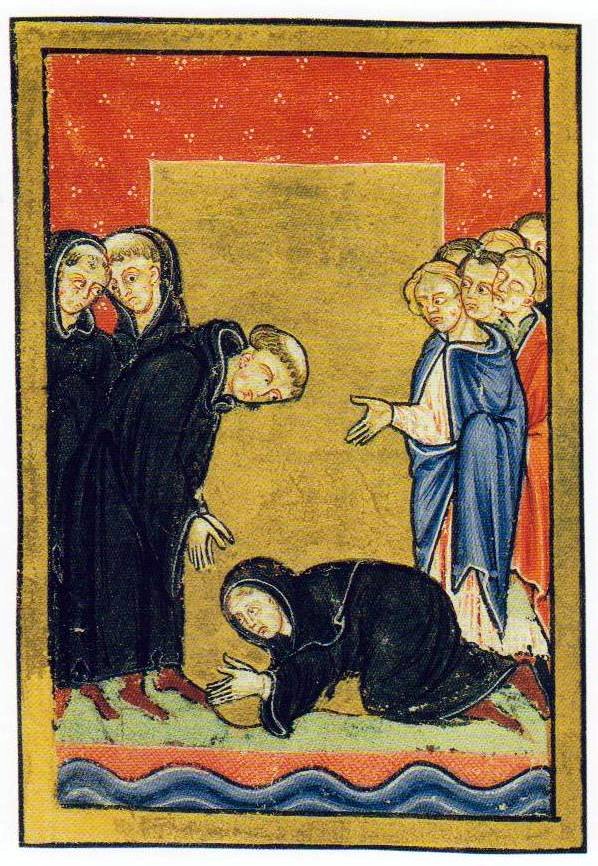
Some of the stories have become iconic, for example the tale of St Cuthbert and the otters, reported by one of the monks. He saw the saint leave the monastery where he was staying late at night and followed him, curious. He saw Cuthbert go down to the sea where he remained all night in prayer, standing in the icy waters. When he left the sea at dawn, two sea otters followed the saint out of the water and dried his feet with their fur. The watching monk was overcome with guilt at having spied on the saint and fell at his feet to beg forgiveness.

Cuthbert Praying in the Sea

Bede completed his Life of Cuthbert in 721. He went on to include an abridged version in his Ecclesiastical History of the English People, published ten years later. Bede’s monastery, St Paul’s, was one of two Benedictine monasteries at Monkwearmouth established in the Roman tradition. It was a thriving centre of scholarship and culture with a busy scriptorium. It was here that the Codex Amiatinus, the earliest complete Latin bible, was produced as a gift for the Pope. We can be sure that once completed, the Life of Cuthbert would have been copied many times and circulated to churches and monasteries in the other Anglo-Saxon kingdoms as well as Northumbria and further afield in Frankia and Italy. It was a true mediaeval best-seller.

This wide distribution was essential to the survival of the work. A hundred and fifty years later the Viking invasions destroyed the monastic culture of Northumbria. The monks and nuns were an easy target for pagan raiders who had no compunction in looting the monasteries and enslaving their inhabitants. The written word had no value for the Vikings. The monastic libraries with all their books, deeds and records were destroyed; St Paul’s at Monkwearmouth became a roofless ruin. In 875, with the Danes now in command of York and heading northwards, the monks took the coffin containing the incorrupt body of the saint, together with the illuminated Gospels created in his honour, and left Lindisfarne.

 Seven years later, in 882, they established a new monastery at Chester-le-Street after the miraculous intervention of the saint enabled them to make terms with Guthred, the Danish king of York. The cult of St Cuthbert, together with its lands and possessions, survived. It continued to attract pilgrims, not least from the royal house of Wessex.  We are not told whether a copy of Bede’s Life had been popped into the coffin alongside the Lindisfarne Gospels, but certainly copies would have still existed elsewhere in parts of the country which had escaped the brunt of the Danish invasions.

Chester-le-Street was the only surviving monastery in the north of England for close on a hundred years. Although the Community diligently preserved the Lindisfarne traditions associated with the cult, monastic discipline started to slip. Monks married and had families, and the senior positions in the Community became hereditary, with each family holding a portion of the lands owned by St Cuthbert. The monastic reform movement of the tenth century which sought to end such practices was confined to the southern half of England, which enjoyed more stability than the north. For the Community the main aim was survival.

By the end of the tenth century, renewed threat from Danish armies led the Community to move again, this time to a promontory above the River Wear. Uninhabited at the time, it was cleared with the loyal help of the local population and the saint’s new shrine was established at Durham. It proved to be an excellent choice and highly defensible.

Cuthbert Welcoming Visitors

However, 1066 saw the arrival of a new and different threat to the Community: the Normans. The threat this time was less physical – the Normans were, after all, Christians – but ideological. The Normans regarded Anglo-Saxon culture, including their saints, as backward and inferior.  As the Normans started to take over the English Church, they often replaced Saxon saints with their own continental saints. Although St Cuthbert’s incorrupt body gave him claim to special status, King William was not convinced. On a visit to Durham he demanded that the Community open the coffin before him and threatened to kill all the senior clergy if it proved to be a fake. However, during a mass for All Saints’ Day, which was to be followed by the opening of the coffin, the King was visited by a terrible heat and fever. He leapt up, called for his horse and galloped out of the city. He was never to return to Durham. The Community was reprieved – for the time being.

Sometime after this incident King William appointed a Norman to the bishopric at Durham. The man was Walcher, a cleric who had been a canon at Liege, one of the great centres of learning in mid-eleventh century Europe. What view would he take of Cuthbert’s claims to sainthood? Walcher was an educated man with access to monastic libraries. Before he came to Durham he read Bede’s Ecclesiastical History and his Life of Cuthbert.  They convinced him of the exceptional status of the saint and in turn, he convinced the King of the importance of the cult. Its future was secured – thanks to Bede.

There were to be changes, though. Having read Bede, Walcher knew that Cuthbert had been a celibate monk and that the original guardians of the shrine had been celibate monks also. Walcher’s plan was to oust the married canons and found a Benedictine monastery at Durham whose monks would be the new guardians of the saint.

Astonishingly, Bede was to play a role here too. A few years earlier, the prior of Winchcombe Abbey, a Saxon man named Aldwin, had acquired copies of Bede’s Life of Cuthbert and the Ecclesiastical History for the monastic library. They had an electrifying effect on him. The chronicler Simeon of Durham records:

He understood from the History of the Angles that the province of the Northumbrians had previously been peopled with numerous bands of monks, and many troops of saints … .these places, that is, the sites of these monasteries, he earnestly desired to visit, although he well knew that they were reduced to ruins, and he wished, in imitation of such persons, to lead a life of poverty.

Aldwin travelled north and with two companions set up camp in the ruins of St Paul’s Monastery. His single-handed revival of northern monasticism caught on, and others came to join him. By the time Walcher was planning to establish a monastery at Durham, there were local monks ready to help him.

Before Walcher could realise his plans he was murdered in a feud with the local Northumbrian nobility. The bishopric went to another Norman cleric, William St Calais. The new bishop energetically followed through on Walcher’s plans. Not only did he successfully found the new monastery, he went on to initiate the construction of a new cathedral in St Cuthbert’s honour to replace the existing Saxon church. The magnificent cathedral and the shrine of St Cuthbert would become the leading pilgrimage destination in the country. Bede’s Life of Cuthbert gained new popularity with lavishly illustrated versions appearing. The best-seller was back – and the fame of the saint it chronicled. 

REFERENCES
Two Lives of Saint Cuthbert, trans. Bertram Colgrave Christ the King Library
The Age of Bede, trans. J.F. Webb, ed. D.H Farmer Penguin Classics
Simeon’s History of the Church of Durham Llanerch

~~~~~~~~~~

Katharine Tiernan is a writer, teacher and passionate nature-lover. She grew up close to the dramatic coastline of North Northumberland and continues to draw inspiration from its history and landscape. She is currently working on a series of historical novels based on the legacy of St Cuthbert and his Community. Her first novel Place of Repose: A Tale of St Cuthbert’s Last Journey was published by Ningaui Press in 2013. Following its publication Katharine went on to hone her writing skills with an MA in Creative Writing (Distinction) at Newcastle University.

Her latest novel, Cuthbert of Farne: A novel of Northumbria’s warrior saint, published by Sacristy Press, traces Cuthbert’s life and spiritual journey against the background of his turbulent times.
Katharine lives in Berwick-upon-Tweed, with a view from her writing desk across the Tweed estuary to Lindisfarne.

Buy Cuthbert of Farne: https://www.sacristy.co.uk/books/fiction/cuthbert-novel

Connect with Katharine: www.katharinetiernan.com


Wednesday, January 17, 2018

Ælfflæd: An Abbess Who Was Always a Princess

By Kim Rendfeld


Ælfflæd’s life was decided in her father’s battle against the Mercians in 655. Northumbrian King Oswiu made a promise: if God granted him victory, he would give land and his 1-year-old daughter to the Church. Ælfflæd would never be a queen, but she wielded royal power.

When she was an infant, Ælfflæd was commended to the care of her mother’s kinswoman Hild, abbess of Hartlepool. Two years later, Hild founded the double monastery of Whitby with the donated land, and she and the toddler took up residence there.

Because of her father’s decision, Ælfflæd was no longer eligible for a political marriage. Probably not a bad thing in this family. Elder half-sister Alhflæd might have had something to do with the death of her husband, the son of the ruler Oswiu killed in battle. Her full sister, Osthryth, later married to a Mercian king, was murdered by Mercian nobles.

Ælfflæd grew up in Whitby, a center for learning and a cradle of bishops. While Ælfflæd was still a child, the abbey hosted the Synod of Whitby in 664 to decide whether the Church should practice Christianity like the Romans or the Celts. The two sides disagreed on many things such as the date for Easter and how tonsures should be shaped. Ælfflæd’s own parents were on different sides—her father favored the Celts while her mother supported the Romans. The Roman way prevailed.


At the abbey, Ælfflæd would become a teacher and was probably being groomed to succeed Hild. It was common for an abbey to pass from aunt to niece or another female relative. As an aristocrat, Ælfflæd was expected to lead.

After Oswiu died in 670, Ælfflæd’s widowed mother, Eanflæd, joined her daughter at Whitby. Eanflæd and Hild apparently were close in childhood, baptized together in 627. When Hild died in 680, Ælfflæd and Eanflæd jointly ruled the double monastery. Eanflæd died after 685, and Ælfflæd assumed sole rule until her death in 714.

And rule she did.

Ælfflæd might have played a role in one of Hild’s pupils becoming a bishop. She commissioned the Life of Gregory, a hagiography written by one of her monks or nuns, and oversaw the translation of her grandfather King Edwin’s relics to Whitby. She was influential enough to write to a continental abbess of behalf of religious women pilgrims. And she was a close friend of the holy man Cuthbert. One story has a linen girdle Cuthbert sent miraculously healing her of an illness that left her paralyzed. About 684, she consulted with him on a matter close to her heart.


She might have been concerned that her brother Ecgfrith, her father’s successor as king of Northumbria, had no sons. Ecgfrith’s first marriage with Etheldreda ended with her following her dream to be a nun, at the urging of Bishop Wilfrid (whom Hild also disliked), and her brother’s second marriage had yet to produce heirs. If we are to believe Cuthbert’s hagiography—and that’s a big if—Cuthbert reminded her that she had a half-brother born out of wedlock before her father’s first marriage. I have a feeling Ælfflæd knew all along and was testing Cuthbert’s loyalty.

Cuthbert was appointed a bishop of Lindisfarne soon after the meeting. Supposedly, he didn’t want the office. It would not surprise me if Ælfflæd played a role the decision.

Ecgfrith died in a disastrous battle in 685, and half-brother Aldfrith, a man in his 50s, ascended to the throne. Although she did not wear a crown, Ælfflæd was someone to reckon with when it came to making peace between Aldfrith and Wilfrid. The archbishop seeking the reconciliation wrote to both the king and his sister. Apparently brother and sister were close, and she had a streak of pragmatism.

When Aldfrith died at the end of his 20-year reign, he had an 8-year-old son, Osred. A rival named Eadwulf seized the throne but was expelled two months later, thanks to teamwork from Ælfflæd, Wilfrid, and a nobleman. Ælfflæd testified that Aldfrith wished for his successor to reconcile the royal family with Wilfrid, and Osred became Wilfrid’s adopted son and king. The next year, Wilfrid didn’t get the See of York as he wanted but he was allow to retain two churches and named a bishop.

With her combination of piety, education, and savvy, it is little wonder her contemporaries called her “a wise woman and learned in the Holy Scripture” and “ever the comforter and best counsellor of the whole kingdom.”

Public domain images via Wikimedia Commons.

Sources

“Ælfflæd (654–714)” by Alan Thacker, Oxford Dictionary of National Biography

“Osred I (696x8–716)” by David Rollason, Oxford Dictionary of National Biography

Bede’s Life of Cuthbert

Beda: A Journey to the Seven Kingdoms at the Time of Bede by Henrietta Leyser

The Earliest English Kings by D. P. Kirby

Double Agents: Women and Clerical Culture in Anglo-Saxon England, by Clare Lees, Gillian Overing

Motherhood and Mothering in Anglo-Saxon England by M. Dockray-Miller

Prayer and Thought in Monastic Tradition: Essays in Honour of Benedicta Ward SLG edited by Santha Bhattacharji, Dominic Mattos, Rowan Williams

A Handbook of Anglo-Saxon Studies, edited by Jacqueline Stodnick, Renée Trilling


~~~~~~~~~~

Kim Rendfeld has written two novels set in 8th century Europe. In The Cross and the Dragon, a Frankish noblewoman must contend with a jilted suitor and the fear of losing her husband (available on Amazon). In The Ashes of Heaven's Pillar, a Saxon peasant will fight for her children after losing everything else (available on Amazon). Her short story “Betrothed to the Red Dragon,” about Guinevere’s decision to marry Arthur, is set in early medieval Britain and available on Amazon.

Connect with Kim at on her website kimrendfeld.com, her blog, Outtakes of a Historical Novelist at kimrendfeld.wordpress.com, on Facebook at facebook.com/authorkimrendfeld, or follow her on Twitter at @kimrendfeld.


Friday, September 22, 2017

Yeavering – Anglo-Saxon Royal Palace

by Annie Whitehead
“So great is said to have been the fervour of the faith of the Northumbrians and their longing for the washing of salvation, that once when Paulinus came to the king and queen in their royal palace at Yeavering, he spent thirty-six days there occupied in the task of catechizing and baptising.” (HE II 14*)
The king in question is Edwin, seventh-century king of Northumbria, and the queen is his second wife, Æthelburg of Kent, known, according to Bede, by the nickname ‘Tate’.

Paulinus is said to have baptised people in the river Glen, which runs alongside the site of the palace. Visitors to the site will still be able to see the river, but of the palace, there is not a trace.

The view across the site towards the river

Archaeology has revealed that Yeavering at the time of Edwin’s reign was a magnificent royal vill. But Edwin didn’t build it. Rather, he rebuilt it.

What were Edwin, his wife, and the holy man Paulinus doing there? After all, it’s a forbidding place, surrounded by the towering Cheviot hills, windswept and desolate.


Edwin was technically the brother-in-law of the previous king of Northumbria, Æthelfrith, whose son, Oswald, was born to him by Edwin’s sister. Although in those days Northumbria was two distinct kingdoms, Deira (centred around York) and Bernicia (centred around Bamburgh), dynastic squabbles and bloody feuds meant that, periodically, one man ruled over both kingdoms.

The English kingdoms c. 600 (Public Domain)

In the seventh century, kings were gradually converting to Christianity.  It was no quick decision, and usually had some political element to it. Edwin was not about to make a spur of the moment conversion. The site of Yeavering was significant because it was in an area previously ruled over by Edwin's nemesis, Æthelfrith. Would conversion bring more power?

Edwin procrastinated, so much so that Pope Boniface wrote to him, and also to Edwin’s wife. Æthelburg was the daughter of Æthelberht, the Kentish king whom Augustine had converted, and a sister of Eadbald, the reigning king of Kent. When he wrote to her, Boniface urged her to bear in mind her Christian duty to evangelise, and included with his letter a gift of a silver mirror and a gold and ivory comb. To Edwin, he hinted that he would, by converting, put himself on an equal footing with the powerful king of Kent. This must have been quite an inducement.

Edwin evidently grasped what was expected of him, and offered a compromise – he expressed his willingness to convert if his advisers agreed, and undertook to place no obstacles in the way of missionary endeavour. He also offered a promise that took account of the position of Æthelburg, for he gave assurance that she and her retinue would be free to practice their own religion.

Paulinus, who travelled with ‘Tate’ from Kent, ‘bagged’ Edwin’s all-important royal soul, thus, according to Bede: when Edwin had been in exile in the court of Rædwald of East Anglia, an apparition came to him, promising him a kingdom, and salvation, if he would but remember by whose word this promise would be fulfilled. Paulinus now revealed himself now as the apparition by whose power Edwin had gained his kingdom. (HE II 12)

When the king and queen had produced a daughter, Eanflæd, Edwin was persuaded to allow Paulinus to baptise her in thanksgiving for his wife’s safe delivery.

Yeavering lies in what was the kingdom of Bernicia, forty miles north of Hadrian’s Wall, and about twenty miles inland from the great fortress of Bamburgh. It is a desolate and often a very cold place. Bede describes it as a royal vill, (town) and talks about the work of Paulinus there, but he also tells us that at some time later it was abandoned. Perhaps the archaeology and the history can be linked?

The site, showing the modern wall at the roadside

In 1949 an aerial photograph showed the marks of extensive buildings there, and the site was then excavated by Dr Hope Taylor.

He found that as a place of burial, Yeavering had a long prehistoric past. A big and seemingly elaborately defended cattle corral is likely to have gone back to the days when the area was ruled by British, not English, kings. Hope Taylor also discovered a series of buildings dating from the end of the sixth century to somewhat later than the middle of the seventh, corresponding to the reigns of Æthelfrith, Edwin, and Oswald.

Among the most important were a succession of halls. The largest, which he concluded was probably Edwin’s, was over 80 feet long and nearly 40 feet wide. Its walls were likely made of planks, 5 ½ inches thick. The fact that the post holes showed that timber were set up to eight feet into the ground, suggests that the walls must have been very high. There may have been a clerestory (a high section of wall that contains windows above eye level, with the purpose of letting in light, and/or fresh air). Its successor, probably dating to the reign of Oswald, Edwin’s nephew and successor, was equally grand.

Yeavering - digital 'fair use' image. (Attribution)

More remarkable still was a kind of grandstand, (top left of above image) shaped like a segment of a Roman amphitheatre, which stood facing a platform. When first built, possibly under Æthelfrith, it had accommodated about 150 people; later, perhaps under Edwin, it was enlarged to hold about 320.

It has been agreed that its only purpose can have been for meetings; and of a kind where one man on the platform, presumably the king, faced many. Perhaps it was here that Edwin consulted his amici, principes and consiliarii on the adoption of Christianity (though this debate more probably took place in York, where Edwin finally received his baptism.)

Yeavering in its heyday would have stood as a symbol of the might and power of Edwin, who, as one of the named ‘bretwaldas’ (overkings) in Bede’s list, wielded considerable power. A prince of Deira, he would have known the importance of establishing his authority across Bernicia, and building over the remnants of his predecessor’s hall.

And yet, the royal buildings at Yeavering were not fortified. Perhaps they should have been; there is evidence that the palace was destroyed by fire, not once, but twice, and the dates coincide with Bede’s records of Mercian incursions into Northumbria.

Additional finds included what may have been a pagan temple later converted to Christian use, and a building which might have been a small Christian church.


Yeavering, though a major centre for Bernicia, was by no means the only such centre these kings possessed. There was another, much more important, at Bamburgh, and other royal vills scattered through their kingdom, many of which may have had halls as grand. But the wonderful thing, for historians, is that we have the evidence for this one, even though there is now no trace of these once impressive and imposing buildings. To stand in this enormous field, (and it is a huge site) gazing out over the waters of the river Glen, and know that here stood the people whose lives I have studied, and written about, for years was, even on that very cold and blustery day, really quite moving. So little of Anglo-Saxon architecture remains, but thanks to Dr Hope Taylor, and to Bede, at least we know what once was here.

As to why it was, as Bede tells us, abandoned, well that remains a mystery, and one which neither the archaeology (which suggests 655, a time of Northumbrian supremacy) nor the history seem able to solve.

[*Bede's Ecclesiastical History of the English People]

~~~~~~~~~~

Annie Whitehead is an author and member of The Royal Historical Society. Her novels are all set in Anglo-Saxon Mercia and her latest, Cometh the Hour, includes the character of King Edwin, who was at turns related to, and then at war with the mighty pagan king, Penda.

Cometh the Hour
Amazon Author Page
Blog
Website

Wednesday, February 22, 2017

Cyneburg: A Child of Wodan Who Became a Saint

By Kim Rendfeld

When she was growing up, Cyneburg might have believed she was a descendant of the god Wodan and expected to marry to strengthen her family’s political alliances. So how did this 7th-century Mercian princess feel when she learned she would wed the son of her father’s enemy and abandon her gods?

The marriage was before 653, which puts Cyneburg’s birth year around 640 or before. We don’t know what her childhood household was like, but judging by Cyneburg’s and her sisters’ names, Queen Cynewise must have had some influence. Cyneburg grew up with her father, King Penda, constantly at war with Northumbria, the union of Deira and Bernicia.

Although the kings of Mercia and Northumbria practiced different religions, the disparate faiths didn’t cause the conflict. Penda likely used his lineage to Wodan as his claim to power, but he was remarkably tolerant. Both Christians and pagans believed deities determined victory in war or success of the harvest – and they wreaked havoc if displeased. Yet Penda did not bother Christian missionaries on his lands. His reasons might have been political; it would be easier to make alliances with Christian rulers against a common foe if he didn’t persecute their holy men.

At the battle of Maserfield in 642, Penda killed Northumbrian King Oswald, then ritually dismembered his foe and displayed his head and arms as trophies. To the Mercians, Penda got rid of an oppressor. In Northumbrian eyes, Oswald was a martyr. (A year later, Oswald’s brother and successor, Oswy, retrieved the remains, which became relics.)

Penda’s attacks on Bernica went on years. It’s easy to imagine Cyneburg seeing Oswy, his children, and his people as oppressors and loathing them.

We don’t know which father suggested two marriages between their children. Cyneburg would marry Oswy’s heir, Alchfrith, and her eldest brother, Peada, would marry Oswy’s daughter. A condition for the marriages was that Cyneburg and Peada accept baptism.

Saint Chad, with Peada and Wulfhere at Lichfield Cathedral
(by Sjwells53, CC BY-SA 3.0 or GFDL,
via Wikimedia Commons)
We can assume the royal families were trying to make peace. The heaviest burden fell on the daughters: both fathers and husbands expected the women to use their connections to help the men get their way. If the wife gave birth to a healthy son, her position would be that much stronger.
History doesn’t record what Penda and Cyneburg discussed when she was betrothed. Did Cyneburg have doubts about leaving her old gods behind? About her husband? About whether the marriage would stop the wars?

The hoped-for peace was not to be.

In the 655, Oswy killed Penda in the battle of Winwæd and took over Mercia, but he allowed Peada to ascend to the throne. That is, until Peada’s untimely death a year later because of his wife’s betrayal.

Was Cyneburg heartbroken as her father, then her brother, died at the hands of her in-laws? Her husband was not innocent. He had fought alongside his father and was rewarded by being crowned subking of Deira.

The sources conflict on what happens next. The Anglo-Saxon Chronicle says Wulfhere, also a convert to Christianity, succeeded his brother and worked with Oswy to donate land to the monastery at Medeshamstead (later Peterborough), which Oswy and Peada had started. Wulfhere did this with the counsel of Cyneburg and sister Cyneswith.

From Encyclopædia Britannica, 1911
(public domain, via Wikimedia Commons

Bede tells a different story: Wulfhere was a youth and hid from Oswy. Then with support from noblemen, he wrested Mercia back from Oswy in 658, and Oswy accepted that loss.

Despite this turmoil, Cyneburg appears to be a faithful wife. She and her husband might have had six children (this fact depends on which source you believe). She also seems to have embraced her adopted faith. Like Cyneburg, four of their children were later revered as saints.

Cyneburg and her husband were responsible for building monasteries at Ripon and Stamford. Ripon got off to a rough start. The monks renounced the gift when they learned they had to give up the Celtic practice of Christianity and follow the Roman rule as Alchfrith wanted. The land was then entrusted to Wilfred, a cleric who followed Roman tradition.

The clash over Celtic vs. Roman rule would extend to Alchfrith and his own father in the 660s. Cyneburg was with her husband the 664 Synod of Whitby, where Oswy relented and agreed to the Roman rule. But father and son didn’t stop fighting. This time, they disagreed over who should be bishop. Alchfrith rebelled. And then disappeared.

We don’t know how the widowed Cyneburg reacted. Did she regret, or question, why she had become part of a family that fought each other? In Mercia, her enemies were not close relatives. Did she grieve for her husband? Did she despise Oswy? Or did she accept the tragedy as God’s will?

Her children probably stayed in Oswy’s court, but Cyneburg left. Was that departure yet another loss on top of so many?

She turned to Wulfhere and must have still been important in her homeland. Joined by her sister, Cyneburg became the abbess of Castor (originally Cyneburgecaestre). It was common for widowed queens to retire to abbeys. In her case, the nunnery might have been a refuge, and for Wulfhere, the move ensured that the land was in the hands of an ally.

Castor (By John Salmon, CC BY-SA 2.0,
via Wikimedia Commons)
Perhaps, Cyneburg wielded more power at Castor than in Northumbria. Although she was officially under the authority of a bishop, difficult travel and lack of instant communication meant she controlled the convent’s land and made decisions over the nuns she ruled. This was also a time when Christian kings wanted monks and nuns to pray for them. The act would please God, who would then allow pious kings win battles and stay healthy.

She embraced the religious life, showing compassion to the poor and zealously instructing the women in her care. She tried to influence her brothers – Wulfhere and his successor, Æthelred – to give alms and show mercy.

After her death around 680, her reputation for virtue lived on. The Bewcastle Cross, a stone monument created in the late 7th or early 8th century, has an inscription with her and Alchfrith’s name in rune. In the 10th century, she and two kinswomen were translated to Peterborough—a tribute to her fidelity to Christ.

Sources

The Lives of the Saints by Rev. Alban Butler http://www.bartleby.com/210/3/065.html

“Cyneburg,” New Catholic Encyclopedia http://www.encyclopedia.com/religion/encyclopedias-almanacs-transcripts-and-maps/cyneburg-st

Woman Under Monasticism: Chapters on Saint-lore and Convent Life Between A.D. 500 and A.D. 1500 by Lina Eckenstein

"Cyneburg of Mercia (fl. 655)." Dictionary of Women Worldwide: 25,000 Women Through the Ages, edited by Anne Commire and Deborah Klezmer, Gale Virtual Reference Library

The Anglo-Saxon Chronicle, translated by E.E.C. Gomme

Oxford Dictionary of National Biography:
‘Penda (d. 655)’ by S.E. Kelly
‘Alchfrith (fl. c.655–c.665)’ by Rosemary Cramp
‘Wulfhere (d. 675)’ by S.E. Kelly
‘Osric (d. 729)’ by D.J. Craig

~~~~~~~~~~

Kim Rendfeld has written two novels set in early medieval times and is working on a third.

You can order The Ashes of Heaven's Pillar, about a Saxon peasant who will fight for her children after losing everything else, at Amazon, Kobo, Barnes & Noble, and iTunes. Kim's first novel, The Cross and the Dragon, in which a Frankish noblewoman must contend with a jilted suitor and the fear of losing her husband, is available at Amazon, Kobo, iTunes, Barnes & Noble, Smashwords, CreateSpace, and other vendors.

Connect with Kim at on her website kimrendfeld.com, her blog, Outtakes of a Historical Novelist at kimrendfeld.wordpress.com, on Facebook at facebook.com/authorkimrendfeld, or follow her on Twitter at @kimrendfeld.

Wednesday, January 18, 2017

Osthryth: Murdered Queen of Mercia

By Kim Rendfeld

For Osthryth and her family, living into old age was a luxury.

She was born to Northumbrian King Oswy and his second wife, Eanflaed. My best guess of when is the mid-650s. She might have grown up hearing about her father’s brother Oswald, who had been king before Oswy.

Oswald was a conqueror and a devout Christian. In 742, the pagan king of Mercia, Penda, killed Oswald on the battlefield, ritually dismembered him, and displayed his head, arms, and hands on stakes. Oswy retrieved the trophies a year later and sent Oswald’s head to Lindisfarne and his arms and hands to Bamburgh. In those places, they became relics worthy of veneration. Perhaps Osthryth prayed before those relics.

Northumbria and Mercia were still at war, but Osthryth was too young to remember. In 655, Osthryth’s father was fighting Penda, even though two of her six siblings were married the Penda’s children. Her half-brother Alchfrith had wed Penda’s daughter and her half-sister Alhflæd had wed Penda’s son Peada. (The Mercian prince had converted to Christianity as part of the marriage agreement, with Oswy as his godfather.) Her 10-year-old full brother Ecgfrith was a hostage in Penda’s court.

Perhaps, she would have known that her father, with Alchfrith, went into battle against Penda at the River Winwæd when she was a baby. She might have understood that her full sister, Ælfflæd, was at a convent because her father had promised to give her and 12 estates to the Church if God granted him victory on the battlefield. Oswy had triumphed: he beheaded Penda.

Stained glass window at Worcester Cathedral
(by Violetriga, GFDL or CC-BY-SA-3.0,
via Wikimedia Commons)
She might have known Oswy took over Mercia and allowed Peada to succeed his father. But not for long. Peada died in 656, allegedly due to Alhflæd’s treachery. But Osthryth might have been told to see this another way: Alhflæd’s loyalty lay with her father rather than her husband. It’s not too much of a stretch to speculate that Oswy was displeased with Peada, let his daughter know, and she acted accordingly. Would such tales have taught Osthryth the family loyalty trumped everything, even the nuptial vow?

Yet Oswy’s rule over Mercia was short-lived. In 658, another of Penda’s son, Wulfhere, wrested it from him.

Oswy didn’t fight to keep it. Perhaps he was diverted by turmoil within the family. Oswy had rewarded Alchfrith by crowning him subking of Deira (Northumbria is the union of Deira and Bernicia), but father and son disagreed about ecclesiastic policy in the 660s. At issue was whether to practice Christianity like the Celts or the Romans. Osthryth’s parents, Oswy and Eanflaed, often celebrated Easter at different times—an awkward situation when the husband is feasting to celebrate the Resurrection while the wife is fasting for Lent.

Oswy relented and agreed to the Roman rule at the Synod of Whitby in 664, but that did not bring peace. Father and son disagreed over who should be bishop, and Alchfrith rebelled. And then disappeared.

History is silent on whether young Osthryth mourned her brother. She would face another loss soon. Her father, in failing health, died on Feb. 15, 670 (one of the few royal deaths from natural causes in that era), and Ecgfrith succeeded him.

Northumbria and Mercia were still at odds. In 674, Wulfhere led soldiers, wanting to force the Northumbrians to pay tribute. It didn’t work out that way for the Mercian king. Ecgfrith won and forced his adversary to pay tribute. Wulfhere died soon afterward, and his brother Æthelred succeeded him.

By User:Hel-hama, GFDL or CC-BY-SA-3.0,
 via Wikimedia Commons

Osthryth was a marriageable age, and Æthelred was single. This is the point in the story where I think, “Really, Ecgfrith? You’re going to arrange for your sister to marry Æthelred, even though your brother’s and sister’s marriages failed to uphold peace? What makes you think it will work this time?”

Osthryth and Æthelred were wed. She might have borne Æthelred a son, but we don’t know for certain. Apparently, the peace held for a while. Together, Osthryth and Æthelred patronized the monastery at Bardney in the province of Lindsey, a territory Mercia and Northumbria had fought over. Her young full brother Ælfwine was apparently a frequent visitor and beloved in both kingdoms.

But Osthryth's loyalty would be tested. Northumbria and Mercia would fight again, this time in 679 near the River Trent. Ælfwine died. Ecgfrith wanted to avenge his brother’s death, but an archbishop brokered a peace deal, and in a show of goodwill, Osthryth and Æthelred exiled a bishop at odds with the Northumbrian king.

After Ælfwine’s death, Osthryth had her Uncle Oswald’s remains—the parts of his body not in Lindisfarne or Bamburgh—moved to Bardney. To her, these were a martyr’s relics, and she wanted to promote Northumbrian sympathies. To the monks at Bardney, Oswald had been an oppressor, and they at first refused to take them. If we are to believe legend, the monks changed their minds after seeing a light come from the tent in which the remains were housed.

Oswald, from a circa 1220
manuscript (public domain,
via Wikimedia Commons)
The peace would remain uneasy. Ecgfrith died in a battle against the Picts in 685, and Osthryth’s half-brother Aldfrith, born out of wedlock before her father married the first time, succeeded him. When the bishop whom Ecgfrith hated quarreled with Aldfrith, Æthelred gave the guy a bishopric. We don’t know how Osthryth felt about this.

Like Alchfrith, Ecgfrith, Oswald, and her in-laws, Osthryth would be denied the luxury of old age. In 697, Mercian nobles murdered her. That’s all we know. Were they seeking justice for the king killed by her sister over 40 years ago? Or did they fear her influence on her husband?

She was buried at Bardney. Perhaps, Æthelred had some affection for his wife, or maybe he felt guilty and hoped to make amends with her spirit. He gave a monastery on lands his wife controlled to the bishopric of Worchester for the forgiveness of his and his wife’s sins.

Like Oswald, Osthryth and Æthelred would be venerated as saints.

Related story: Saint Etheldreda: Twice Married and Still a Virgin

Sources

Oxford Dictionary of National Biography, including:
“Osthryth (d. 697)” by S.E. Kelly
“Peada (d. 656)” by S.E. Kelly
“Wulfhere (d. 675)” by S.E. Kelly
“Oswiu (611/12–670)” by D. J. Craig,
“Oswald [St Oswald] (603/4–642)” by D. J. Craig
“Æthelred (d. after 704)” by Ann Williams
“‘Aldfrith (d. 704/5)” by Rosemary Cramp
“‘Ecgfrith (645/6–685)” by J.R. Maddicott

Bede's Ecclesiastical History of the English People, ed. and trans. B. Colgrave and R. A. B. Mynors

The Haskins Society Journal 6: Studies in Medieval History by Robert B. Patterson

Kim Rendfeld has written two novels set in early medieval times and is working on a third.

You can order The Ashes of Heaven's Pillar, about a Saxon peasant who will fight for her children after losing everything else, at Amazon, Kobo, Barnes & Noble, and iTunes. Kim's first novel, The Cross and the Dragon, in which a Frankish noblewoman must contend with a jilted suitor and the fear of losing her husband, is available at Amazon, Kobo, iTunes, Barnes & Noble, Smashwords, CreateSpace, and other vendors.

Connect with Kim at on her website kimrendfeld.com, her blog, Outtakes of a Historical Novelist at kimrendfeld.wordpress.com, on Facebook at facebook.com/authorkimrendfeld, or follow her on Twitter at @kimrendfeld.


Wednesday, December 21, 2016

St. Etheldreda: Twice Married and Still a Virgin

By Kim Rendfeld


The only husband East Anglian Princess Etheldreda ever wanted was Christ, but her family needed her to marry a lord and secure an alliance against the Mercians threatening her homeland. What was a seventh century lady to do?

Known today at Saint Audrey, Etheldreda was a dutiful daughter to King Anna. Politics in her world were violent. Her father had ascended to the throne around 641 after the deaths of two cousins in battle, one of whom seized the crown from a murderous usurper. She probably was 5 years old. She must have sensed that royalty was both privileged and dangerous. Very few kings died of old age or even natural causes.

Her family were devout Christians, even though they were in the Uffing clan, which claimed descent from the pagan god Wodan. Two of her sisters (who also became saints) were abbesses, and Etheldreda wanted that vocation. In Etheldreda’s case—as with all medieval aristocrats—family needs came before her heart’s desire.

Then a teenager, Etheldreda married Tonbert, ealdorman of the Southern Gyrwe in the Fens, around 652. Yet she persuaded him to respect her wish to remain a virgin, not an easy feat when conjugal relations were consider a husband’s (and wife’s) right.

Tonbert might have been much older than his bride and might have already had heirs. If that was the case, one less son to accommodate might have worked to his advantage. If he needed to sate his lust, he could do so with a whore. True, it was a sin, and he would need to confess and do penance. But in early medieval eyes, it was not that big a deal.

Tonbert’s morning gift to Etheldreda, usually bestowed after the marriage was consummated and thus deemed valid, was strategic. It was the Isle of Ely. This tract of land on the border with Mercia was surrounded by water and marshes, formidable natural defenses. In early medieval times, a morning gift would always belong to the wife, even if her husband set her aside.

Etheldreda’s marriage did not protect her father, who was killed with her brother (another saint) in a 754 battle against his longtime adversary, the pagan Mercian King Penda. Anna’s brother Athelhere ascended to the throne and recognized Penda as an overlord.

Etheldreda and Tonbert’s marriage would also be short-lived. Tonbert died around 655, the same year Athelhere and Penda died in battle against Northumbrian King Oswy, a Christian. Etheldreda retired to the Isle of Ely, a common act for early medieval widows. She might have thought she could pursue the religious life she always wanted.

From a 10th century illuminated manuscript
(public domain, via Wikimedia Commons)

It was not to be. In 660, her family, probably led by her father’s brother Athelwold, arranged for her to marry Egfrith, Oswy’s heir and a former hostage in King Penda’s court. It was another strategic marriage in which Northumbria and East Anglia could form an alliance against Mercia.

Egfrith was probably 15 at the time. Etheldreda might have been 24. Again, she persuaded her husband to respect her wishes to remain a virgin.

At first, Egfrith consented and held her in high regard. For about a decade, Etheldreda lived at court, enjoying the society of learned monks and nuns and becoming friends with Bishop Wilfred. When Egfrith succeed his father in 670, he had a problem. He needed heirs born within wedlock. He could have forced himself upon his wife—although horrific to modern eyes, medieval folk would not recognize the act as rape. Or he could have asked Etheldreda to retire to an abbey and thus free him for another marriage.

Instead he asked Bishop Wilfred to persuade Etheldreda to willingly come to the marriage bed. Perhaps Egfrith feared losing his alliance with East Anglia, control of his wife’s dowry, and the connections she had made. Perhaps he thought his sons’ connections to the Uffings would help form alliances. Perhaps he truly loved Etheldreda and wanted her to be a real wife.

It would have been easier for Wilfred if he complied with the king’s request and accept the rewards Egfrith offered for the bishop and his churches. But Wilfred did just the opposite. He encouraged Etheldreda to hold fast to her vow of virginity. Maybe he believed Etheldreda’s desire to be a nun was her true calling and feared God’s anger for meddling with that more than the king’s.

Egfrith was none too happy when Etheldreda asked him for his permission to leave. At first, he reluctantly agreed, and she traveled to his aunt’s convent. Apparently, he missed her and was determined to get her back, even if she wanted no such thing.

Egfrith’s aunt advised Etheldreda to flee. Disguised as a beggar, she left with only two nuns to accompany her. The legend includes a few miracles in her escape such as a tide that rose and stayed high at just the right time and a staff that transformed into a tree.

Whatever the circumstances, she made it to Ely, where 600 families already lived, and built a double monastery. Wilfred made her abbess. (Egfrith did remarry. His second wife hated Wilfred.)

Saint Ethelreda's statue at Ely Cathedral
(photo by Jim Linwood, CC BY 2.0,
via Wikimedia Commons)

Etheldreda’s abbey thrived over the next seven years. During that time, she choose an austere lifestyle, wearing only woolen garments rather than linen near the skin. She also abstained from warm baths—not bathing was a form of penance in early medieval times—with the exception of four great festivals. Even then, other nuns had used the water first.

Shortly before she died, she had a quinsy, a painful abscess in her tonsil, which she believed to be punishment for her earlier fondest for necklaces. A surgeon cut it out, but it didn’t help. She died June 23, 679.

Sixteen years after Etheldreda’s death, her sister (a third one) and successor St. Sexburga wanted to move Etheldreda’s remains from a wooden coffin to a more fitting tomb within the church. If we are to believe legend, Etheldreda’s body was not at all corrupted—even the surgical incision had healed—proof that she had been chaste her whole life.

Sources

Bede on St Etheldreda

"St. Etheldreda" by Ewan Macpherson, The Catholic Encyclopedia.

A Dictionary of Saintly Women, Volume 1, Agnes Baillie Cunninghame Dunbar

The Mammoth Book of British Kings and Queens by Mike Ashley

The Peterborough Version of the Anglo-Saxon Chronicle: Rewriting Post-Conquest History, Volume 27 of Anglo-Saxon studies, by Malasree Home

“The Retreat of St. Etheldreda” Catholic World, Volume 62, Paulist Fathers

“Etheldreda” (Northumbria Community)

~~~~~~~~~~

Kim Rendfeld has written two novels set in early medieval times and is working on a third.

You can order The Ashes of Heaven's Pillar, about a Saxon peasant who will fight for her children after losing everything else, at Amazon, Kobo, Barnes & Noble, and iTunes. Kim's first novel, The Cross and the Dragon, in which a Frankish noblewoman must contend with a jilted suitor and the fear of losing her husband, is available at Amazon, Kobo, iTunes, Barnes & Noble, Smashwords, CreateSpace, and other vendors.

Connect with Kim at on her website kimrendfeld.com, her blog, Outtakes of a Historical Novelist at kimrendfeld.wordpress.com, on Facebook at facebook.com/authorkimrendfeld, or follow her on Twitter at @kimrendfeld.


Monday, August 1, 2016

The Christians Are Coming! (The islands of Iona and Lindisfarne)

by Matthew Harffy

The early seventh century was a time of military and religious upheaval in Britain. The different rulers of the small kingdoms across the island vied for supremacy, and violence and death were never far away. Unsurprisingly, most kings of the day died in battle and few reigned for more than a few years at best, some only for months before meeting their bloody ends.

Holderness cross
By portableantiquities [CC BY 2.0 (http://creativecommons.org/licenses/by/2.0)], via Wikimedia Commons

As Angles, Saxons and Britons fought for the land, so different religions battled for the souls of the populace. Christianity resurged on the island, pushing the older religions back into the darkest recesses of mountain valleys and deep forests. By the middle of the century Christianity had been adopted by most of the nations of Britain (or at least by their nobles and royal families). From the south came missionaries sent from Rome; Europeans such as Augustus, Paulinus, Birinus and Felix. From the north came a different flavour of Christianity, not Roman in background, but Irish.

The story of this northern Christianity is one of two islands. Iona in the west and Lindisfarne in the east.

Iona Abbey Scotland - seen from ferry
By Jan Smith from Brisbane, Australia (First glimpse of Iona) [CC BY 2.0 (http://creativecommons.org/licenses/by/2.0)], via Wikimedia Commons

Iona became the centre of the Irish Christian mission in the sixth century when Colm Cille (more commonly known as Columba), an Irish noble, was exiled. He settled on the small island of Iona, which was probably known as Hii at the time and almost certainly gaining its modern name from a transcription error of Ioua Insula (“Island of the yews”) to Iona sometime in the thirteenth century. Iona was then part of the Irish kingdom of Dál Riata and Columba was given it as a base for him and his brethren of monks from whence to preach to the people of Dál Riata and the Picts.

The mission was very successful and Iona became a Christian stronghold in the northwest of the British Isles. The expansion from the west to the east coast came as a result of another exiled noble taking up residence in Iona. This time it was Oswald, the offspring of Æthelfrith, the king of Northumbria.

In 633, after spending his formative years on Iona, Oswald, son of Æthelfrith, was presented the opportunity to take back the throne that had been his father’s. His father’s killer, Edwin, had in turn been slain by an alliance of Penda of Mercia and Cadwallon of Gwynedd. Oswald brought a warband south and confronted Cadwallon near Hadrian’s Wall. Before the battle, Oswald ordered a great cross to be erected and had his men kneel and pray to God for victory.

In the ensuing battle, Oswald’s warhost crushed Cadwallon’s force, slaying the Welsh king and cementing Oswald as the ruler of Northumbria. Christ had granted Oswald victory, and he vowed to bring Christ to the people.

Beach at low tide, Holy Island, Northumberland - geograph.org.uk - 1231059
Christine Matthews [CC BY-SA 2.0 (http://creativecommons.org/licenses/by-sa/2.0)], via Wikimedia Commons

As soon as he was settled on his new throne, Oswald sent to Iona for a bishop to guide his pagan people to Christ. The brethren of Iona eventually sent Aidan, a gentle and patient man who believed in engaging all people, even slaves, in discourse about Christ. He set up a monastery on the island of Lindisfarne, also known now as Holy Island. From that tidal island base, which in many ways mirrored Iona in the west, Aidan set about bringing Christianity to Northumbria.

Aidan travelled the land, founding churches and monasteries throughout the north, and Lindisfarne became famous as a place of religious teaching and great learning. And all the while, the bishops of Lindisfarne worked alongside the kings of Northumbria to bring the word of Christ to a land that had all but forgotten that religion after the Romans had left the island some two centuries before.

Statue of St Aidan, Lindisfarne Priory
By mattphotos (Flickr) [CC BY 2.0 (http://creativecommons.org/licenses/by/2.0)], via Wikimedia Commons

Oswald was followed on the throne by his brother Oswiu, who continued to champion Christianity and was responsible for convening the Synod of Whitby in 664. The Synod is important, for it was there that the two competing forms of the faith – Roman and Irish – were debated and one chosen. Such intricacies as the way monks' hair should be tonsured and how the date of Easter should be calculated were discussed. It might not sound like much, but the ramifications of the decision were far-reaching. The Roman way was decided upon, which ultimately saw Lindisfarne, with its Irish roots, fall out of favour.

It was still a place of great learning, however, and the following decades would see the creation of wonderful treasures such as the Lindisfarne Gospels. This period of cultural flowering is known as the Golden Age of Northumbria. Monks sought peaceful meditation of the will of God, praying and working diligently over beautiful manuscripts that would become famous all over the known world. For a hundred years or more the island of Lindisfarne was a beacon of education and culture.

St. Matthew - Lindisfarne Gospels (710-721), f.25v - BL Cotton MS Nero D IV
St. Matthew - Lindisfarne Gospels (710-721), f.25v - BL Cotton MS Nero D IV, via Wikimedia Commons

Little did those scholarly scribes know that one day Northmen would descend upon their island retreat, smashing the peace and tranquillity in a welter of blood. For one of the things that Lindisfarne is now famous for is that, in 793, it became the location of the first recorded Viking raid in Britain. Those treasures that were so well-known to be guarded only by peaceful monks proved too much temptation to raiders from across the North Sea.

But for those decades in the seventh and eighth centuries, Lindisfarne was a centre of learning and wisdom that saw Northumbria become one of the most important kingdoms of Britain, whose influence was felt across the continent.

~~~~~~~~~~~~~

Matthew Harffy is the author of the Bernicia Chronicles, a series of novels set in seventh century Britain. The first of the series, The Serpent Sword, was published by Aria, an imprint of Head of Zeus on 1st June 2016. The sequel, The Cross and The Curse was released on 1st August 2016. Book three, Blood and Blade, is due for publication in December 2016.

The Serpent Sword and The Cross and the Curse are available on Amazon, Kobo, Google Play, and all good online bookstores.

Blood and Blade is available for pre-order on Amazon and all good online bookstores.

Twitter: @MatthewHarffy