Showing posts with label Merlin. Show all posts

Wednesday, October 9, 2013

The Euhemerist -- Mixing the Lure of Legend with the Power of the Novel


by Persia Woolley

If someone had told Mom that her daughter would grow up to be a euhemerist, she would have run to the dictionary with some trepidation--it didn't sound like a fitting career for a young woman in the '50's when women were expected to become nurses, teachers or wives.

What Mom would have found was that a euhemerist is one who believes that legends are based on the real actions of real people doing real things in their own time which we have endowed with magic and surrealism over centuries of retelling.
So when an author decides to write a novel based on a favorite legend but strips away the trappings of fantasy in favor of reaching the human heart of the myth, he or she qualifies for that title no one has ever heard of and I can't always spell right.

If you're tempted to make that choice as a writer, Rejoice! You've two advantages going for you right from the start--you're dealing with an already proven story and whether you're deeply familiar with it or not, you know the content is going to touch some universal chord or it wouldn't have reached legendary status. Second, it's a wonderful chance to exercise all your skill as a story-teller breathing life and emotions into a cast of iconic characters.

When I first realized I wanted to do for Guinevere what Mary Stewart had done with her Merlin trilogy, I though it would take maybe a year--six months of research and six months of writing. I'd been a journalist for a decade and had two non-fiction books published, so it seemed to me a year would be enough.

Ha, was I wrong! Writers of historical fiction often admit that they love the research as much as the writing, and don't know when to stop exploring the one to concentrate on the other. A lot depends on how accurate you want to be--feeling a need to create as real a world as possible, I dove into it full tilt. My Guinevere Trilogy took up 11 years of my life and completely changed my career direction, but overall it was great fun and I'm still involved with the books and fans.

So how do you start? Getting to know the landscape and culture of the time when the legend began is essential. Since Arthur's traditional foes were the Saxons and there were no Legions to draw on, Camelot's niche was somewhere between 410 (when Rome told the Britons there would no help in fending off marauding barbarians), and 550 A.D. when the Saxons finally conquered Britain and drove the Romano-Celts into the mountains of Wales.

Over the next centuries they sat around their campfires telling tales of their last great leader, Arthur, who taught those Saxons a thing or two for twenty years while he struggled to keep the flame of civilization, orderly governance and political unity alive in the face of onrushing Dark Age chaos.

Great! There went any notion of fancy castles, shiny armor or flowing medieval garments--my Gwen would have to live in Roman ruins or Celtic mud huts, with now and then a stay in a wooden lodge or a Highlander's stonework fortress.


Clothing and armor would be a hodgepodge of what was left over from the days of the Roman empire augmented by common home-spun from the family loom and those local smiths who made spears and swords. (Don't knock provincial the metal worker--this was the origin of the most famous sword Excalibur. It's very name means 'cut's iron' which a metallurgist told me probably indicates that the smith had accidentally created a sort of alloy, thereby giving it it's great strength and renown.)

Foods would be a similar blending of old and new customs and religion was completely up for grabs; a recently excavated Celtic temple was found to have been built after the Roman influence died out, but before Christianity became the dominant moral code.

(The notion that Arthur held a Christian court rose with the power of the Medieval church which also decided that powerful, independent women had to be put in their place, and the stories were changed to make Gwen a repentant sinner and Morgan le Fey an outright witch.)

Once you've begun to feel comfortable with your setting it's time to start exploring the legend for internal clues as to the hidden dynamics of the story and the psychology of the individual characters. In other words, given their circumstances, what would explain why the people did the things the legend says they did? And are there inconsistencies that you can exploit or ignore?

Archaeology shows it was a time of great confusion, jumbled allegiances and odd incongruities--the finest pottery from the Byzantine area was showing up in the courts of warlords in the west of Briton when everyone else was lucky to have a wooden trencher.

Fortunately the mix of cultures--old Celtic in the north, fading Roman memories in the south, and roughshod Saxons along the coastal settlements--provides a potent palette for conflict and courageous endeavor so whatever was lost in the way of medieval glamour was made up for in historically honest color.

It also threw the whole landscape of the story wide open. The medieval tradition of Guinevere as a vain and imperious beauty, convent raised in the south could now rightly be called into question. And in some versions it's clear that a large part of the population loved her and would have taken her side in a war with Arthur following her escape from being burned at the stake. So it seemed unlikely to me that she would have been the shallow, bitchy creature she's made out to be by those who need a scapegoat for the fall of Camelot. Besides, if both such sterling characters as Arthur and Lancelot loved her, common sense says she must have been more than a pretty face.

By the same token, every anthologist will tell you that when a king conquers a new tribe, he'll cement his power by marrying a daughter of his new subjects. So it made perfect sense to place Gwen in the north, where she would have been raised with the power and freedom of a potential Celtic queen. And since one of the first things young Arthur had to do was put down a rebellion of the northern kings, what was more logical than that she was chosen as the political pawn to secure his new position? Her resistance to that provided an internal line of conflict in the first book, which covers her childhood and marriage to the new king. Who needs dragons and unicorns when human nature is running rampant?

While I was at it, I made her homely (at least in her own eyes) and killed off her mother when she was ten so that she could grow up an adventurous tomboy; bold, brave and intelligent--a worthy partner in the effort to form a cohesive unit out of the frequently squabbling Celtic factions under Arthur's rule.

My choice of making her from the north also meant that as an outsider she brought fresh eyes to every new circumstance, a great advantage for an author. How better to give the reader a picture of the remarkable world she would have discovered as the High Queen of Dark Age Britain? It's a great way to involve the reader, whether by recording Gwen's delight at staying in a Roman villa owned by one of the historical characters I wove into the books or her amazement at the cleverness of the warlord who built his fort atop the great rock in Dumbarton which was completely surrounded by swamp and marsh; with a large population of water birds always on guard, he'd have plenty of warning if some military foe tried to sneak up on him!

All such touches came from solid research which in some cases actually supported elements of the story often assumed to be most fantastic. Take the order for Bedivere to throw Excalibur into the lake at the end of the legend. Although I didn't have a hand reach up and grab it, it seems the Celts sometimes made sacrifices of splendid armor to the water goddess--several such finds have been located in the River Thames near Oxford, for example.

Couple that with the fact that if you saw 'the great horse Silver' being ridden by someone new, you'd immediately wonder what had happened to the Lone Ranger. So any important leader who had such a distinctive sword would have expected his followers to hide it when he died...it might not make much sense to us in the 21st century, but that's how things slip from history to legend.

Lastly, what about the fear of turning such archetypical characters into everyday frumps if the 'magic' is taken away? (Don't get me wrong, there's plenty of superstition in my Gwen's world, but no one gets in or out of trouble by supernatural means.) And there are a number of fine fantasy works based in some part on the Arthurian stories. But for me the allure of the Arthurian stories lies in the very human nature of the people involved; people who rose to difficult challenges, struggled with their complexities and lifted us all toward their dream in tales that endure to this day...which is why I love being a euhemerist.

~~~~~~~~~~~~~

Persia Woolley spent 11 years researching and writing on her Guinevere Trilogy, (Child of the Northern Spring, Queen of the Summer Stars, Guinevere-the Legend in Autumn), during which time she made five trips to Britain. All three volumes were Book of the Month Club Alternates and have been translated into seven languages. Recently they have been reissued by Sourcebook.


Monday, March 4, 2013

Henry VII and the Curse of Prophecy

By Nancy Bilyeau

The Yorkists were a hard-headed lot, basing their right to rule on bloodline. When their last king, Richard Plantagenet, was slain at the Battle of Bosworth on August 22, 1485, his devastated Yorkist supporters--as well as the rest of the country--waited to hear what claim to the throne the victor, Henry Tudor, earl of Richmond, would put forth.

It was a delicate question.


Henry VII
Tudor was the leader of the Lancastrian house, but strictly by default. Stronger claimants had been mown down a while ago. Yes, he'd won the crown in battle but there were laws in England. To hold the crown, he'd have to convince everyone he was the legitimate king. Tudor's father, Edmund, had not a drop of English royal blood; he was the son of French Queen Dowager Katherine of Valois and her Welsh servant, Owen Tudor. (And so half-brother to the last Lancaster king, Henry VI.) Through his mother, Margaret Beaufort, Henry Tudor had a stronger claim, as she was in direct descent from Edward III, but the Beauforts were barred from the succession.

We can imagine there was a certain level of suspense as the country waited. Most assumed that the newly declared Henry VII would swiftly marry Elizabeth of York, oldest living child of the dead Edward IV, and attach his weak claim to her greater one. But he did not marry her right away--it was important to him to claim the right to rule on his own.

When he invaded England with French-financed troops, Tudor had marched through his family stronghold of Wales, gaining support and men, under the banner of the red dragon: the battle standard of King Arthur and other Celtic leaders. Now it was announced that Henry Tudor was descended from Arthur himself through Cadwaladr and the Welsh chieftains who were ancestors of Owen Tudor. Genealogists had confirmed this, the skeptical court was informed. Henry's ascension was the fulfillment of prophecy.

Despite such grandiose claims, Henry married Elizabeth of York. But he did not drop the Arthur business. Far from it: He insisted that his first child be born in Winchester, sometimes identified as Camelot in legend. And when that baby boy was born, he was named...Arthur.


Le Morte D'Arthur
What could not be accidental is that in 1485 something else happened in England besides Bosworth. The first printing of Le Morte d'Arthur appeared, a compilation of tales by Sir Thomas Malory of Arthur and Guinevere, Launcelot, Mordred, and the magician Merlin. The tales were so popular, they were reprinted.

Henry VII would not be the first ruler to seize on the romance of Camelot to bolster his regime. But the direct connection of his legal claim to rule to a work of mythic entertainment is bold indeed--if not bizarre. It was as if, in 1977, the year Star Wars hit theaters, a president appeared who announced himself descended from Luke Skywalker.

But there were darker elements to this claim to Camelot. In legitimizing a mystical prophecy, Henry VII was unleashing a certain kind of power that would reach across the entire 16th century and into the 17th, bedeviling his great-great-grandson. Rebels against various Tudor regimes would repeatedly use their own prophecies to rally support. They effectively co-opted Henry VII's modus operandi, down to the symbolic banners. A frustrated Henry VIII sought to ban prophecy from his kingdom after he was nearly engulfed by seers, witches, and necromancers spouting predictions, many of them derived, allegedly, from Merlin and yet coded and obscure, open to many interpretations.


The Pilgrimage of Grace, and its many banners
"The craving to gaze into the future arises naturally in times of great danger and distress," said Madeleine Hope Dodds in the paper "Political Prophecies in the Reign of Henry VIII." It would be hard to imagine more distress caused than the Reformation and Dissolution of the Monasteries. Some of the rebels who rose up in the Pilgrimage of Grace spouted the "wisdom" of Merlin to lead them. Henry VIII was certain it played a part in the rebellion. In the same letter in which he ordered the Duke of Norfolk "you must cause such dreadful execution upon a good number of inhabitants, hanging them on trees, quartering them, and setting their heads and quarters in every town, as shall be a fearful warning," he commanded the duke "send to us the Witch of York."

Again and again, strange prophecies emerged in times of political distress in the Tudor era. After a young nobleman named Anthony Babington was arrested for a treasonous conspiracy to murder Elizabeth I and replace her with Mary Queen of Scots, a book of Merlin prophecies was found in Babington's London home.


John Dee and Edward Kelley
More than any other Tudor ruler since Henry VII, Elizabeth tried to harness prophecy, to understand it through her consultations with Dr. John Dee and his colleague, the bizarre necromancer Edward Kelley. She is the hard-headed queen, the ruler who said she had no desire for a "window into men's souls." However, she picked her coronation date based on what Dr. Dee told her to do.

It is with James VI that the brew of prophecy and the occult overflows. James was a Stuart king of Scotland, but part Tudor too, descended through both his parents--Mary Queen of Scots and Henry, Lord Darnley--from Margaret Tudor, the oldest daughter of Henry VII. 

Scotland was already a place uneasy with such fears before James VI was born. The Act of 1563 forbade anyone to use witchcraft, sorcery or necromancy or to claim any of its powers, the penalty for both witch and client being death.


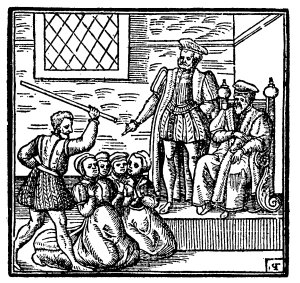
James VI overseeing witch trials

As a young man, James VI became convinced that witches were trying to kill him, specifically creating storms to drown him and his bride, Anne of Denmark, as he tried to bring her to Scotland. Afterward he oversaw witch trials, ordering torture of suspects, that led to a flurry of executions. In 1597 James personally wrote an 80-page book called Daemonologie expounding on his views on the dangers of sorcery and magic. Shakespeare drew from it when writing Macbeth, considered by many a tribute to King James, with its three witches spouting eerie prophecy that would change men's destinies.

His entire life, James VI was tormented by fears of a violent death. In the end he died in his bed, the king of England and Scotland. But fears of prophecy and of witchcraft, which he'd done so much to whip into a frenzy, did not die with him; instead, the frenzy led to the deaths of more English victims, and traveled to America with the Puritan settlers, before finally loosening their hold.

-------------------------------------------------------------

Nancy Bilyeau is the author of the historical-mystery trilogy The Crown, The Chalice and The Tapestry. To learn more, go to www.nancybilyeau.com.