Showing posts with label Danielle Marchant. Show all posts

Monday, December 31, 2018

#EHFA Top 20 Articles for 2018

The editors of English Historical Fiction Authors want to thank all the authors who contributed articles to the blog in 2018, and a sincere thank-you to all our readers.

Every week we bring you a bit of British history: people, places, social customs, and more. We hope you'll enjoy this look at the top 20 posts for 2018. 

by Danielle Marchant

by Arthur Russell

by Kim Rendfeld


by Matt Lewis

by Maria Grace


by Mark Patton

by Arthur Russell

by Maria Grace

by Paula Lofting


by Anna Belfrage

by Annie Whitehead


by Paula Lofting

by Derek Birks

by Paula Lofting

by Anna Belfrage


by Danielle Marchan

by Derek Birks


by Paula Lofting

by Derek Birks

And, our most read post for 2018, with over 8600 views:

by Matthew Harffy


Sunday, January 7, 2018

Editors Weekly Round-up, January 7, 2018

by the EHFA Editors

Join us for original articles on all aspects of British history. Our round-up for the week ending January 6 features:

by Maria Grace


Bad Queens 
by Danielle Marchant


by Linda Fetterly Root


by Lauren Gilbert


Thursday, January 4, 2018

Bad Queens - Part II

by Danielle Marchant

On Sunday 7th September 1533, Elizabeth, daughter of Henry VIII and Anne Boleyn, was born at 3 o’clock in the afternoon at Greenwich Palace. This was supposed to be a happy occasion, but there was one detail that cast a shadow over this important event.

The baby was a girl.

Both her mother and father were disappointed that she was a girl. Up until now, all of the best astrologers and doctors had predicted a boy. Henry had spent time wondering whether to call his son Edward or Henry and was making plans for the celebratory tournament. Anne had even seen in advance the letter announcing the birth. In the letter, it gave thanks to God for sending her “good speed, in the deliverance and bringing forth of a prince”.

However, as soon as the baby girl was born, Henry decided to name her Elizabeth, after his mother Elizabeth of York, instead. The tournament was cancelled and the letter announcing the birth was slightly altered with an extra “s”, giving thanks to God for the birth of a “princes”.

Why was there so much disappointment over the baby being a girl? The reason for this was that at the time, there was a fear of having a female ruler. A history of what has been perceived as a series of “Bad Queens” had made it all the more important for the heir to the throne to be a boy, to keep the stability of the country. Henry had even divorced his first wife, Catherine of Aragon and had broken away from the Catholic Church because of Catherine’s failure in producing a healthy, male heir - despite the fact that they did have a healthy daughter, Mary.

Here is a part II of a list of Queens that helped to create the climate of fear of having another female ruler… (Read Part I HERE)

The Queens in the Wars of the Roses

Just over four decades before Princess Elizabeth’s birth in 1533, the country was torn apart by civil war between the House of York and the House of Lancaster, in the Wars of the Roses that lasted nearly thirty years. Around the time of Elizabeth’s birth, there may have still been many old enough to remember what they had seen, and this made it all the more important for the current generation to maintain peace. There were two main Queens in this civil war who became focus points for both Houses and helped to exasperate the situation even more. The series of events and the roles these two Queens played would definitely have helped to contribute to the climate of fear of not wanting another female ruler in the Tudor period:


1. Margaret of Anjou

Like Queen Isabella a century before her, Margaret was another French princess, who married Henry VI in 1445. In Shakespeare’s Henry VI Part 3, she was famously named the “She-Wolf” of France, and that her “tiger’s heart wrapped in a woman’s hide”.

Margaret was niece by marriage to the French King, Charles VII. The marriage caused controversy because no dowry had been given to the English Crown for Margaret by the French. Alternatively, they agreed that Charles VII, who was at war with Henry V in The Hundred Years' War in France, would have the lands of Maine and Anjou returned to France. This caused friction in the King’s council.

A breakdown in law and order, corruption, the distribution of royal land to the king's court favourites, and the continuous loss of land in France meant Henry and Margaret’s reign was an unpopular one. Returning troops, who had often not been paid, contributed to the anarchy and triggered a rebellion led by Jack Cade. Henry lost Normandy in 1450 and later lost other French territories, leaving only Calais untouched.

It is believed that this loss of French territory contributed to Henry’s nervous breakdown, which modern Doctors would probably diagnose as Catatonic Schizophrenia. Margaret gave birth to their only son, Edward of Lancaster, in 1453. However, given Henry’s mental state, this fuelled rumours that the son was not his; he believed that he would have been incapable of fathering a child and that the baby was actually the result of an affair between Margaret and one of her favourites. Edmund Beaufort 1st Duke of Somerset, or James Butler Earl of Wiltshire were considered to be possible fathers. Nevertheless, Henry accepted the son as his own.

While Henry remained for some weeks in a catatonic stupor, Margaret had to rule in his place. The kingdom found difficulty in having to cope without a king, but Margaret was ruthless and called for a Great Council in May 1455. This council excluded Richard Duke of York, and this sparked the series of battles between the Houses of York and Lancaster. Margaret attempted to raise support for the Lancastrian cause and subsequently, Lancaster was victorious at the Battle of Wakefield and of St Albans.

However, they were defeated by York at the Battle of Towton, in 1461. Edward, son of Richard Duke of York (who had been beheaded at the Battle of Wakefield) overthrew King Henry VI and proclaimed himself Edward IV. Margaret then fled to Scotland with her son and remained there, plotting her return.

2. Elizabeth Woodville

Elizabeth was the eldest of twelve children and spent her early life in relative obscurity in Grafton Regis, Northamptonshire. Even though her mother was Jacquetta, Dowager Duchess of Bedford and her father was Sir Richard Woodville, she was considered to be a “commoner” by her contemporaries. Her first husband, Sir John Grey, was killed at the Battle of St Albans, leaving her a widow with two sons.

It is believed that around the summer of 1464, Elizabeth heard that Edward VI was hunting in Whittlewood Forest. She waited for him under a tree (which was later called the “Queen’s Oak”), holding her two sons tightly. The King then rode by and she allegedly threw herself at his feet, begging him for help with the Grey family inheritance. According to the story, Edward was so struck by her “mournful beauty” that he fell in love with her and assumed she would just agree to be his mistress. However, she refused to be his mistress, even when a dagger was put to her throat (according to some interpretations of the story, she produced the dagger herself and put it to her own throat).

Her refusal to give in to him, unless he married her, increased his passion for her even more. They married in secret on Mayday in 1464. Only her mother, a Priest, probably two others and “a young man who helped the Priest sing” were present. It is believed that Elizabeth and Edward continued to meet in secret with the help of Jacquetta (who even managed to hide the secret marriage from her husband) until September, when the Council met in Reading. Here, Edward was being coerced into a marriage with Bona of Savoy, sister-in-law to the French King. Edward then had to admit the truth about his relationship with Elizabeth.

The news was a bombshell. Richard Neville, Earl of Warwick – also known as “The Kingmaker” – who had helped Edward take the throne, responded angrily to the clandestine marriage. He had negotiated for the hand of Lady Bona, and her marriage to Edward would have helped to forge an alliance between the House of York and one of the greatest Houses of Europe, helping to replenish the dwindling treasury with a generous dowry. Warwick’s anger at not being consulted on such an important matter would have been understandable.

Elizabeth was crowned Queen in May 1465. However, refusing to accept the marriage, Warwick fell out with Edward. Warwick later formed an alliance with Margaret of Anjou. Together, they overthrew Edward and restored Henry VI to the throne. In addition, Warwick’s daughter, Anne Neville, was married to Margaret's son Edward in December 1470.

Their success was brief, as Margaret was taken prisoner by York after being defeated at the Battle of Tewkesbury, in May 1471, where her son Edward was killed. Soon afterwards in the same year, Warwick was killed in the Battle of Barnet by Edward VI’s forces.

Since her marriage to Edward, however, Elizabeth was plagued with rumours of being a “sorceress”, having bewitched Edward into marriage. When Edward died in 1483, his brother Richard seized the throne, accusing her of having bewitched his brother into a bigamous marriage. As a result, Elizabeth’s marriage was declared invalid, and her two sons were taken into the Tower of London by their uncle Richard, after which they mysteriously disappeared.

It is possible that she may have plotted against Henry VII, who married her daughter Elizabeth of York. It is believed that she may have conspired with rebels in the Simnel rebellion. Subsequently, she was sent to live in Bermondsey Abbey, where she died in June 1492. She was allowed only occasional visits to court, and all her lands were transferred to Elizabeth of York.

Therefore, it is understandable that this history of “Bad Queens” (or those perceived to be “Bad Queens”) would have made the news of Princess Elizabeth’s birth in 1533 most unwelcome news. However, as we know, Elizabeth grew up to become Queen Elizabeth I. Elizabeth was one of the most successful rulers in English history, and her reign was called “The Golden Age”. Not a “Bad Queen” at all and all fears of another female ruler had been unfounded.

Images:

Margaret of Anjou (British Library Royal)
Elizabeth Woodville, possibly a copy of a lost original (Master and Fellows of Queen's College, Cambridge)

Sources and further reading:

Elizabeth – David Starkey, 2001
Eleanor of Aquitaine – By the Wrath of God, Queen of England – Alison Weir, 2000
Blood Sisters – The Women Behind the Wars of the Roses – Sarah Gristwood, 2013
Anne Neville – Queen to Richard III – Michael Hicks, 2007
Elizabeth Woodville – Mother of the Princes in the Tower – David Baldwin, 2012.
She-Wolves: the Women Who Ruled England Before Elizabeth - Helen Castor, 2011
www.bbc.co.uk/history
www.historyextra.com
www.philippagregory.com

~~~~~~~~~~

Danielle Marchant is an Independent Author from London, UK. Parts 1, 2 and 3 of her series of historical novellas based on Jane Boleyn Lady Rochford’s life, The Lady Rochford Saga, are available now:

https://www.amazon.co.uk/gp/product/B077PRF6F9/ref=series_rw_dp_sw

Visit her pages at https://www.facebook.com/TheLadyRochfordSaga and at http://danielleliannem.wix.com/janeboleyn.


Wednesday, January 3, 2018

Bad Queens - Part I

By Danielle Marchant

On Sunday 7th September 1533, Elizabeth, daughter of Henry VIII and Anne Boleyn, was born at 3 o’clock in the afternoon at Greenwich Palace. This was supposed to be a happy occasion, but there was one detail that cast a shadow over this important event.

The baby was a girl.

Both her mother and father were disappointed that she was a girl. Up until now, all of the best astrologers and doctors had predicted a boy. Henry had spent time wondering whether to call his son Edward or Henry and was making plans for the celebratory tournament. Anne had even seen in advance the letter announcing the birth. In the letter, it gave thanks to God for sending her “good speed, in the deliverance and bringing forth of a prince”.

However, as soon as the baby girl was born, Henry decided to name her Elizabeth, after his mother Elizabeth of York, instead. The tournament was cancelled and the letter announcing the birth was slightly altered with an extra “s”, giving thanks to God for the birth of a “princes”.

Why was there so much disappointment over the baby being a girl? The reason for this was that at the time, there was a fear of having a female ruler. A history of what has been perceived as a series of “Bad Queens” had made it all the more important for the heir to the throne to be a boy, to keep the stability of the country. Henry had even divorced his first wife, Catherine of Aragon and had broken away from the Catholic Church because of Catherine’s failure in producing a healthy, male heir - despite the fact that they did have a healthy daughter, Mary.

Here is a part I of a list of Queens that helped to create the climate of fear of having another female ruler… (part II tomorrow)

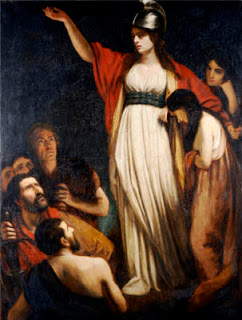
Queen Boudicca (died circa AD 60)

Boudicca was maybe not necessarily a “Bad Queen”, but her reign was definitely not a quiet and peaceful one. She ruled over the Iceni people of Eastern England and led a major uprising against occupying Roman forces. She was married to Prasutagus, ruler of the Iceni people of East Anglia.

When the Romans conquered southern England in AD 43, they allowed Prasutagus to continue to rule. However, when Prasutagus died, the Romans decided to rule the Iceni directly. They confiscated the property of the leading tribesmen. It is also believed that they stripped and thrashed Boudicca and raped her daughters. These actions helped to intensify widespread hatred at Roman rule.

In 60 or 61 AD, while the Roman governor, Gaius Suetonius Paullinus, was leading a campaign in North Wales, the Iceni rebelled with the help of members from other tribes.

Boudicca's warriors successfully defeated the Roman Ninth Legion and destroyed the capital of Roman Britain, which as the time was in Colchester. They went on to destroy London and Verulamium (St Albans). Thousands were killed. Finally, Boudicca was defeated by a Roman army led by Paulinus. Many Britons were killed, and Boudicca is thought to have poisoned herself to avoid capture. Where the battle had taken place and the site of Boudicca's death are unknown.

Empress Matilda

Once again, she was probably not exactly a “Bad Queen” (and Matilda was never crowned a Queen either), but it was down to the fact that she was a woman and the resulting dispute over her disregarded claim to the throne that led to years of civil war. Empress Matilda was the granddaughter of William the Conqueror and daughter of Henry I. She is known today as the Lady of the English, having never been crowned queen. She was married for a short time to the Holy Roman Emperor and was the rightful heir to the throne. If she had become Queen, she would have been the first reigning queen of England in 1135, being descended from Norman, Scottish, and English (Saxon) kings. However, on her father’s death in 1135 – and partly because she was a woman – her cousin Stephen of Blois seized the throne.

Like Matilda, Stephen was a grandchild of William the Conqueror. He had, on at least two occasions, promised Henry I to support Matilda as Queen of England, as had all other nobles in the realm. But after Henry died, Stephen claimed Henry made these promises under coercion and that Henry had named Stephen as his successor. In spite of this, the nobles and the Pope supported Stephen’s claim to the throne, and he became King of the English and Duke of Normandy, which was another title he had inherited from Henry I.

However, his reign was not a peaceful one, and this was the start of almost 20 years of civil war. Within four years of Stephen’s accession, Matilda had gathered a force to challenge him for the crown. She had a lot of political support, because along with other estranged nobles, she also had her husband, who was one of the most powerful nobles in France, Geoffrey, Count of Anjou.

In 1141, she was in London and was ready to be crowned. However, within a few months Stephen ruined her chances and forced Matilda out before the coronation occurred. In spite of this, Matilda’s supporters continued to fight for her claim by challenging Stephen. However, neither she, nor they could win and to make matters worse, her husband Geoffrey never sent a major force to England to assist them.

However, Geoffrey did eventually force out Stephen from Normandy and then, took over as its Duke. Geoffrey and Matilda had a son, Henry, who Geoffrey named Duke of Normandy in 1150. Henry inherited the titles and lands as Count of Anjou following his father’s death in 1151.

With the support of his mother, Henry claimed the English throne from Stephen. Eventually, Henry and King Stephen made an agreement that Henry would be the heir to the throne after Stephen died, even superseding the claims of Stephen’s son, Eustace. This ended the civil war. Within two years, both Eustace and Stephen’s wives were dead, and Stephen was forced to relinquish the crown to Henry. In 1154, Stephen died of natural causes and was succeeded by Matilda’s son, King Henry II.

Eleanor of Aquitaine

Eleanor was one of the most powerful and controversial women of the Middle Ages. She was beautiful, intelligent and headstrong. There were rumours about her in her lifetime, but definitely within reason and her contemporaries were shocked by her behaviour. Eleanor was the elder daughter of William, tenth Duke of Aquitaine. She was raised in one of Europe's most cultured courts and given an excellent education. She later became an important patron of poets and writers. It was also a relaxed and licentious place, where the arts of the troubadours thrived, and she even presided over the fabled Courts of Love.

In 1137, both her only brother and her father died, leaving her with a vast inheritance. At just the age of 15, she became the most eligible heiress in Europe. That same year, she married Louis, heir to Louis VI of France, who shortly afterwards became King Louis VII. The couple had two daughters.

In 1147, Eleanor accompanied her husband on the Second Crusade, travelling to Constantinople and Jerusalem. The Crusade was a failure. The relationship between Eleanor and her husband – which was already in a vulnerable state - worsened even more. Eleanor failed to produce a son, and this added to the tension. In 1152, they were divorced.

Two months later Eleanor married Henry of Anjou, who in 1154 became King of England. The couple had five sons and three daughters. For nearly twenty years, Eleanor played an active part in the running of Henry's empire, and she travelled back and forth between their territories in England and France.

In 1173, two of Eleanor's sons involved her in a plot against their father. Subsequently, Henry imprisoned her. After Henry's death in 1189, his eldest son, Richard I, ordered his mother's release. Despite her age (at this point, she would have been in her mid-sixties), Eleanor played a major part in government. In 1190, she acted as regent in England when Richard went to join the Third Crusade. She even played her part in negotiations for his release after he was taken prisoner in Germany on his way home.

Queen Isabella

Queen Isabella was the wife of Edward II. Isabella is definitely viewed as a “Bad Queen” because she helped to remove her husband from the throne, alongside her lover Roger Mortimer, one of Edward’s enemies. Edward was later imprisoned and murdered. In addition, Isabella’s reign alongside Mortimer was a failure.

Edward became King in July 1307. On his accession, he immediately recalled his favourite, Piers Gaveston from exile, whom his father, Edward I, had banished to France for having a bad influence on his son. Gaveston was given the earldom of Cornwall, which had previously been a title conferred on royalty.

This act sparked opposition to the king and his favourite. In 1311, the nobles issued the “Ordinances”. This was an attempt to restrict royal control of finance and appointments. Gaveston was twice exiled at the demand of the barons, but returned to England soon afterwards. In 1312, he was captured and executed by the barons.

In 1314, Edward invaded Scotland. He was defeated by Robert the Bruce at Bannockburn. Power was now in the hands of the barons led by Edward's cousin, Thomas of Lancaster, who by 1315 made himself the real ruler of England. Yet Lancaster did very little to pledge reform and as a result, some areas of the country collapsed into anarchy.

By 1318, Edward and Lancaster did resolve some issues between them, but the king had two new favourites - Hugh le Despenser and his son. When Edward supported the two Despensers' ambitions in Wales, a group of barons banished both father and son. This made Edward want to fight back. Edward defeated Lancaster - who had begged the Scots to help him - at Boroughbridge in March 1322. He executed him and recalled the Despensers, with whom he now ruled.

This is where Isabella comes in, because at this point, she emerged as a focus for Edward’s enemies. In 1325, she was sent on a diplomatic mission to France. There she met and became the mistress of Roger Mortimer, an exiled opponent of Edward. In September 1326, they invaded England. Fortunately for them, there was almost no resistance. The Despensers were captured and executed, and Edward was overthrown in favour of his and Isabella's son, who was crowned Edward III in January 1327. Edward II was imprisoned at Berkeley Castle and murdered there.

As Edward III was still a minor, the country was ruled by Queen Isabella and Roger Mortimer. However, their reign was as bad as Edward II’s. They had even gone so far as to recognize Robert the Bruce as the King of Scots, something even Edward wouldn’t do.

As soon as Edward reached the age of 18 in 1330, he decided to take matters into his own hands. He had Mortimer arrested, but instead of having him killed straight-away, Edward had Mortimer tried for treason in Parliament. Despite Queen Isabella’s protest, Mortimer was then hanged.

Isabella, however, escaped such a similar fate when Edward allowed her to retire from public life for the rest of her life. She died in 1358.

Tomorrow, Part II will explore the lives of the 'Bad Queens' of the Wars of the Roses...


Sources and further reading:
Elizabeth – David Starkey, 2001
Eleanor of Aquitaine – By the Wrath of God, Queen of England – Alison Weir, 2000
Blood Sisters – The Women Behind the Wars of the Roses – Sarah Gristwood, 2013
Anne Neville – Queen to Richard III – Michael Hicks, 2007
Elizabeth Woodville – Mother of the Princes in the Tower – David Baldwin, 2012.
She-Wolves: the Women Who Ruled England Before Elizabeth - Helen Castor, 2011
www.bbc.co.uk/history
www.historyextra.com
www.philippagregory.com

~~~~~~~~~~

Danielle Marchant is an Independent Author from London, UK. Parts 1, 2 and 3 of her series of historical novellas based on Jane Boleyn Lady Rochford’s life, The Lady Rochford Saga, are available now:
https://www.amazon.co.uk/gp/product/B077PRF6F9/ref=series_rw_dp_sw

Visit her pages at https://www.facebook.com/TheLadyRochfordSaga and at http://danielleliannem.wix.com/janeboleyn.

Monday, August 17, 2015

The Taming of Katherine Parr

by Danielle Marchant

This month sees the release of Philippa Gregory’s latest historical novel The Taming of the Queen, which is about Henry VIII’s sixth wife, Katherine Parr. As with all historical novels and dramas, there’s always anticipation on how the character is going to be portrayed and how their story will be told. In some cases, the historical fiction version of the characters tends to be a lot more exciting and dangerous than the real life characters. The various portrayals of Anne Boleyn is a good example of this, where in fiction she is often portrayed as a home-wrecking, man-eating Sex Goddess with a sixth finger, whereas in reality it has been argued that she was probably far more sober and God- fearing. The fictional portrayals of Katherine Parr, however, tend to buck the trend.

Katherine, as the famous nursery rhyme told us, was the one that survived. She was the sober nursemaid, the much-needed mother figure for Edward, Elizabeth and Mary who liked nothing more than to change Henry’s bandages for his putrid leg wound. However, in an interesting reversal – and of course, with the exception of the “The Tudors” TV drama series - it was actually the real Katherine that lived a far more interesting, exciting and even dangerous life compared to her fictional portrayals. It’s almost like the image of the real Katherine has been straitened to nothing more than a boring nursemaid, skulking in the shadows of the far more famous of Henry VIII’s wives. The real Katherine has been tamed. However, the real Katherine, who is possibly the least famous of all of Henry VIII’s wives, not only narrowly escaped facing the same tragic fate as that of two of Henry’s other wives, but she also was a major influence on the future Queen Elizabeth I.

In March 1543, thirty-year-old Katherine was widowed for the second time after the death of her husband Lord Latimer, but financially she was comfortable. She found herself in a position of freedom and was able to think about what she wanted to do with her life. There were two things that were certain for Katherine. She knew that she definitely wanted to stay at court, and she wanted to remarry. She had also fallen in love. The man that had stolen her heart was Thomas Seymour, the King’s brother-in-law. Four years later, she had told Seymour: “As truly as God is God, my mind was fully bent the other time I was at liberty to marry you before any man I know.”

This is quite a passionate image of Katherine, an image we don’t often associate with the real Katherine. However, Katherine had to forget about Thomas. There was another man who wanted her hand in marriage – it was the King. Despite already going down the aisle five times before, it didn’t deter him from a sixth trip. This time he was looking for an attractive woman without a reputation (Anne Boleyn and Catherine Howard would have come to mind on the latter point). Lady Latimer ticked these boxes, so the King popped the question and, forgetting all about Thomas Seymour, she wisely accepted. They were married on the 12th July at Hampton Court Palace in the Queen’s Closet. This does show another quality that isn’t emphasised that much when referring to Katherine – bravery. She was brave in the sense that she was about to marry a man who had executed two of his previous wives.

In addition, she showed bravery in her religious beliefs. She wasn’t afraid to talk about her beliefs later on in the marriage. This was incredibly risky because it later nearly led to her being put in the Tower. Henry caused some confusion with his religious beliefs. When Katherine first married the King, we don’t really know what Katherine’s religious beliefs were at the time. However, even though the King had embraced the Reformation and the break with Rome, on the other hand, he was not a Lutheran and still very much believed in the presence of the body and blood of Christ in the bread and wine at mass. Katherine, however, did seem to demonstrate reformist – even Calvinist – beliefs, which became more apparent as the years went by. Henry and Katherine would often have religious debates, but at this stage it didn’t cause any particular concern to Henry. She collected books such as a 1542 English translation of A Sermon of St Chrysostome by the Oxford Scholar John Lupset. Katherine also wrote books for her ladies and friends. They were books of prayers, beautifully bound in gilt and leather, sold at 16 shillings, or £250 a copy in today’s money. Katherine was particularly in awe of the Great Bible, printed in Paris, which then emerged in England in April 1540. The Great Bible showed the word of God in the English language – it spoke directly to the people, including Katherine, without any additional interpretations from Priests. This encouraged Katherine to become more involved in the great religious debates. Her enthusiasm reached a peak in 1545, when Katherine went on to write the “Lamentation of a Sinner”. Based on St. Paul’s teachings and the epistles, it was the first work of its kind written by a woman. So, not only was the real Katherine brave, passionate and religious, she was also creative. These are qualities that are not often associated with Katherine.

However, Katherine's involvement in religious discussions and the views she expressed in her writing began to cause suspicion to the King, and this provided ammunition to the conservative faction at court. Bishop Gardiner and his cronies looked at everything that could be used against her – the books she wrote, the books she read and even her ladies-in-waiting were held with suspicion. There were three ladies in particular that became a focus of this campaign – Lady Herbert (Katherine’s sister), Lady Lane (Katherine’s cousin) and Lady Tyrwhit. John Foxe recalled the events later in the Elizabethan period:
It was devised that these three should first of all have been accused and brought to answer to the six articles (the act passed in 1539) and upon their apprehension in court, their closets and coffers should have been searched, that somewhat might have been found by which the Queen might be charged; which being found, the Queen herself presently should have been taken, and likewise carried by night by barge to the Tower.

However, fate intervened. The King revealed to one of his physicians, Dr. Wendy, what he was going to do, but the bill of articles against Katherine, signed by the King himself, had been accidently dropped by an anonymous councillor. It was then found and brought to the Queen. As you could imagine, Katherine flew into panic mode – she “fell immediately into a great agony, bewailing and talking on in such sort”. Dr. Wendy was summoned to the Queen and advised her that she should “shew her humble submission to the King”.

Katherine took on board this advice, and one night she went to the King’s Bedchamber. The King decided to launch a debate on religion, a topic they were always guaranteed to have a debate on. However, instead of speaking her mind on religious matters, she instead said to him: “God has appointed such a natural difference between man and woman, and your majesty being so excellent in gifts and ornaments of wisdom, and I a silly poor woman, so much inferior in all aspects of nature to you”.

Katherine was now playing the part of a submissive wife. She said that she only debated with him on religion to distract him from the pain caused by his ill health. She said it was ridiculous, the thought of a woman trying to teach her husband. Both made peace with each other, and all was well. When Chancellor Thomas Wriothesely arrived with his armed guards of forty men to arrest the Queen, Henry sent him away, shouting “Knave, arrant knave, beast and fool”. Katherine had lived to see another day. This does show a very clever and witty side to Katherine as well – she certainly knew how to turn a negative situation into a positive one.

Wriothesely’s involvement is interesting as it refers to another unknown side to the real Katherine. Katherine was not one to give in to self-pity. Wriothesely’s wife, Jane, who was also Katherine’s lady-in-waiting, had lost her baby son. Katherine wrote a letter to her in March 1545, and even though this was written in an age when child mortality was common, its tone still seems very cold and harsh:
It have pleased God of late to disinherit your son of this world, of intent he should become partner and chosen heir of the everlasting inheritance, which calling and happy vocation ye may rejoice. If you lament your son’s death, you do him great wrong and show yourself to sorrow for the happiest thing there ever came to him.

Even though this was written in an age of religious fervour, Katherine’s tone in this letter still comes across as very cruel to a grieving mother who has just lost her child. With the exception of being a step-mother, Katherine at the time of writing this was not a mother herself, so would not have related to the pain that Jane was experiencing. Katherine, based on her own personal experiences, was a woman who kept a lid on her emotions and didn’t dwell on the past, and probably felt that in her own way, she was trying to help Jane. However, this would have provided little comfort to Jane and her husband. Their reaction to the letter is not known, however, it’s very possible that this may have caused so much upset that it fuelled Wriothesley’s anger towards Katherine later on.

As part of the campaign to put Katherine in the Tower, Wriothesley tried to link Katherine to Anne Askew, a heretic who became a martyr for her reformist beliefs and was burnt at the stake in July 1546. The torture Anne endured while being interrogated was particularly shocking as they resorted to putting her on the rack in a desperate attempt to get her to blurt out the names of members of Katherine’s privy chamber. Even Wriothesley himself turned the rack. Was this his revenge for the hurt Katherine had caused him and his wife before with her letter about their son? Anne Askew described her torture:
Then they put me on the rack, because I confessed no ladies or gentlewomen to be of my opinion; and there they kept me a long time, and because I lay still and did not cry, my lord chancellor and Master Rich took pains to rack me with their own hands till I was nigh dead.

The incident was also particularly shocking to her contemporaries as Anne was born into the gentry, and the gentry were never tortured. Even more disturbing, it is possible that the King himself gave them permission to torture her.

The fate of Anne, along with the attempt to put Katherine in the Tower, was evidence of a move against reformist belief in the last two years’ of the King’s reign. The campaign had begun in April 1546 – coincidently, soon after the conservative Bishop Gardiner’s return from Europe. In a sense, it was probably a blessing that Katherine did have this side to her where she could keep her emotions in check – it may have caused anger to the Wriothesleys, but at the same time, it ultimately helped her to face the King when she was interrogated herself over religion and come out of the situation calmly and unscathed.

Another fascinating but little-known fact about the real Katherine was how well she got on with her step-daughter, Mary Tudor. We’ve always been given the impression in fiction that the two simply did not get along due to their religious differences - Protestant Katherine vs Catholic Mary. This image, however, was created later on. We do know that when Mary became Queen, she did ban Katherine’s book The Lamentation of a Sinner. However, Mary did accept the changes her father had made, and the Mass was just as important to her as it was to her father and Katherine. Mary even helped Katherine to translate Erasmus’s Paraphrases of the New Testament, where she translated St. John’s Gospel. Due to illness, Mary was unable to finish her part of the project, but Katherine’s chaplain, Francis Mallet, intervened to finish Mary’s work. It has been suggested that the illness was an excuse to not finish the work, but this is unlikely as later on, Mary became uncomfortable with the idea of gaining credit for work that was not entirely her work. Katherine, however, reassured her:
All the world knows that you have toiled and laboured much in this business, I do not see why you should repudiate that praise which all men justly confer on you. However, I leave this whole matter to your discretion, and whatever resolution you may adopt, that will meet my fullest approbation.

This shows how very supportive and encouraging Katherine was as a step-mother to Mary and had helped her to become a published author.

Katherine also had a pleasure-loving side. She fully embraced the role of Queen. Her household ate, drank, were merry, sung, danced and took part in sports. Katherine kept hounds and hawks for hunting, parrots for entertainment, and she loved dogs. Katherine’s spaniel, Rig, owned an impressive collar of crimson velvet embroidered with damask gold and it had rings made of silver gilt to attach its lead.

Katherine loved clothes and her wardrobe was full of beautiful and expensive items. Crimson was her favourite colour and she even dressed her footman and pages in Crimson. Even her own lavatory had a crimson velvet canopy, cushions covered in cloth of gold and a seat of crimson velvet. A removable commode was covered in red silk and ribbons, attached with gilt nails. She chose luxurious, expensive fabrics, such as cloth of gold and silver (silver being her favourite), damasks, taffetas, silks, satins and velvets. In the three years that she spent being Henry’s sixth wife, she had bought 315 yards of black velvet, 95 yards of black satin and 35 yards of orange damask. Katherine also had a thing for shoes – she owned no less than an impressive 117 pairs of shoes, although this number did eventually drop to 47 pairs.

What is possibly the most important but little-known fact of the whole Tudor period was that Katherine was a huge influence on the future Queen Elizabeth I. The many little ways that Katherine had helped to mould the young Elizabeth would emerge later on and help to make her the kind of Queen that she became.

Katherine was meticulous in her choice of clothes and jewels for portraits. She wanted to show the world that she was Queen, that she was a regal figure in her own right. Even more interesting, these portraits were not ordered by the King; the Queen had requested these herself. There were more portraits of Katherine than there were of any other Queen of England in this period – but, with the exception of Elizabeth I.

Queen Elizabeth has been seen in many portraits, bedecked with jewellery and fine fabrics, giving a clear message to those looking at her portrait that she was Queen and was so in her right - in very much the same way as Katherine had done once before. Therefore, the young Elizabeth had definitely watched her step-mother and took notes. The image that Katherine gave to the public would have no doubt made a lasting impression on Elizabeth, teaching her the art of being a Queen.

The young Elizabeth and Katherine also shared a love of studying, and Elizabeth became aware of Katherine’s religious interests. As a New Year’s gift in 1544, Elizabeth endeavoured to impress Katherine with a translation of Margaret of Navarre’s Le miroir de l'âme pécheresse. Elizabeth called it The Mirror or Glass of the Sinful Soul. While accomplishing this, Elizabeth learned that the writer “can do nothing that good is or prevaileth for her salvation, unless it be through the grace of God”. This was the earliest statement of Elizabeth’s religious views and was evidence of how possibly Katherine’s reformist beliefs were influencing Elizabeth’s. When Elizabeth grew up and became Queen, unlike her siblings Edward and Mary, she did not favour just Catholicism or Protestantism alone; she worked towards a middle way between the two, leading to the creation of the Church of England. So, having been exposed to her step-mother’s beliefs and then, seeing the two extremes of religion in the reigns of both of her siblings – Protestant Edward and then Catholic Mary – this all must have had an impact of how she wanted to run the country and mediate its spiritual and ecclesiastical issues.

Possibly the most important tutorial in being a Queen that Elizabeth observed came in the summer of 1544. In that summer, the King had sailed to France and Elizabeth observed Katherine as a Queen Regent. This would help to prove to the young Elizabeth that in an age when women were seen as inferior to men, a Queen could rule England just as well as any King. Only Katherine of Aragon had been made Queen Regent before Katherine Parr. Katherine Parr excelled in and took great delight in her new responsibility, handling with ease the mass of papers, taking part in discussions with advisers and make important decisions. This definitely had a great influence on the young Elizabeth who later on as Queen faced and defeated the Spanish Armada. Everything that Elizabeth had learned about being Queen was epitomised in what was to be her most famous speech, given to her army at Tilbury in 1588:
I am come amongst you, as you see, at this time, not for my recreation and disport, but being resolved, in the midst and heat of the battle, to live or die amongst you all, to lay down my life for my God and for my kingdom and for my people, my honour, and my blood, even in the dust. I know I have the body of a weak and feeble woman, but I have the heart and stomach of a king, and a king of England too.

Therefore, the real Katherine Parr was brave, passionate, religious, creative, witty and clever, liked glamour, escaped with her life from the Tower and helped to mould and influence one of English history’s greatest Queens. She even got on well with a Catholic. However, many of us don’t know this because the real Katherine has been tamed.

Images:
- Katherine Parr – artist unknown, painted in 1545.
- Katherine Parr – artist unknown.
- The young Elizabeth.
- Elizabeth I “The Rainbow Portrait”

Sources and suggested further reading:
Katherine the Queen – Linda Porter, Macmillan, 2010.

~~~~~~~~~~~~~

By Danielle Marchant
I am an Independent Author from London, UK. I am the author of “The Lady Rochford Saga”, based on the life of Jane Boleyn, Lady Rochford. Both parts 1 and 2 are out now, and I am currently working on part 3, due for release Spring/Summer 2016:

Amazon

Visit my Facebook page and website.


Saturday, May 9, 2015

A Great Matter.

by Danielle Marchant

Tourmens de Mariage is Part 2 of The Lady Rochford Saga, focussing on the life of Jane Boleyn. One of the relationships that is focussed upon in Part 2 is that between Jane and her Queen, Catherine of Aragon.

Catherine of Aragon
As I wrote Part 2, it began to gradually occur to me how unique and testing this relationship was. Catherine was the first Queen that Jane had served, and I do believe that she felt some loyalty to both her and her daughter Mary. This loyalty even appeared to continue up to 1535, long after Henry VIII had divorced her, when apparently Jane was seen protesting for Mary in London. However, whether Jane had been present there or not is still an area of debate.

However, even if she felt loyalty to Catherine and Mary, Jane was still a “Boleyn”; George married Jane around 1524/5 after all, and she had to appear loyal to their cause. In spite of this though, I don’t believe this would have prevented Jane from feeling some empathy towards Catherine. Like Catherine, Jane also appeared to have problems with conceiving an heir. There are no records of still births, or miscarriages as of yet, but we do know that Jane and George did not have children. Having a child to carry on the family line would have been part of Jane’s duty, and like her Queen who failed to have a son, Jane too probably felt that she had failed in her role, and Jane’s experience of this is explored in Part 2.

Like many women in England, I believe that Jane would have feared for her own marriage. If the King could put aside Catherine due to lack of male heirs, Jane probably feared if George could do the same to her. So, she would have sympathised with Catherine and even possibly resented Anne Boleyn for what she was doing.

Likely Jane Boleyn
Another common ground that Jane and Catherine shared was their religion. Both were Catholics, whereas Anne and George Boleyn were Evangelical. One thing I have explored in Part 2 is the possibility that even though Jane was close to both George and Anne, she probably was also uncomfortable with their beliefs. We take for granted that up to this point, England was Catholic and prayers were said in Latin, while in the background in Europe there were a growing number of people wanting to translate the Bible into their own language. To people like Jane in this time, this change in thought and attitude may have seemed frightening. Therefore, as Catherine was very much committed to the Catholic faith, Jane probably felt more comfortable with having Catherine as a Queen as opposed to Anne.

As Henry VIII’s love for Anne Boleyn grew, I believe that Jane is torn between loyalties – to her Queen and to her husband’s family. There is a point in Part 2, where she is confronted on this by Anne openly – it’s either Catherine or them. Jane, however, is a woman in the 16th century; her choices have been dictated by her parents and her husband’s family. She doesn’t have a say in the matter. Therefore, I do think that Catherine would have known this all too well, sympathised with Jane and would not have held it against her if she did choose to stay loyal to the Boleyns. For Jane, this was the inevitable. So, indeed being torn between loyalty to the Queen and loyalty to the Boleyns was Jane’s “Great Matter”.

Sources and suggested reading:

Jane Boleyn: The Infamous Lady Rochford – Julia Fox, Phoenix, 2007.

Catherine of Aragon – Henry’s Spanish Queen – Giles Tremlett, Faber and Faber Ltd, 2011.

Images – Catherine of Aragon, by Lucas Horenbout and “The Lady Parker” by Hans Holbein, a sketch believed to be that of Jane Boleyn.

~~~~~~~~~~~~~

By Danielle Marchant

I am an Independent Author from London, UK. I published my first historical novella The Lady Rochford Saga Part 1: Into the Ranks of the Deceived in October 2013. The Lady Rochford Saga Part 2: Tourmens de Mariage will be released on the 19th May 2015 and is now available to pre-order: Amazon
Facebook
Website