Showing posts with label George I. Show all posts

Wednesday, July 4, 2018

The Lords Proprietors of Carolina

By Susan Keogh

Before there was a North and South Carolina, there was the province of Carolina. The Englishmen who oversaw this vast wilderness in the American colonies were known as the Lords Proprietors. King Charles II provided these eight men of noble blood with a charter to establish a colony there.


The Proprietors were George Monck, 1st Duke of Albemarle (pictured above), Edward Hyde, 1st Earl of Clarendon, John Berkeley, 1st Baron Berkeley of Stratton, William Craven, 1st Earl of Craven, Sir George Carteret, Sir William Berkeley, Sir John Colleton, 1st Baronet, and Anthony Ashley Cooper, 1st Earl of Shaftesbury. The Duke of Albemarle’s name was used for Albemarle Point, where Charles Town (modern day Charleston) was first settled. Anthony Ashley Cooper’s name would provide the names of Charleston’s two large, flanking rivers—the Ashley and the Cooper. Each of these men contributed at least £775 sterling, not a small amount in the late seventeenth century, for their Carolina endeavor. These men had “extensive experience at the leading edge of early modern commerce.”

Anthony Ashley Cooper

In S. Max Edelson’s book Plantation Enterprise in Colonial South Carolina, the author also writes, “The colony’s Proprietors exercised their legal title to Carolina as if the scope of their official authority conveyed the power to implement their schemes for settlement, society, and production. Their dilated visions of exotic commodities, new-world aristocrats, and village communities failed to appreciate how little settlers wished to be subjects.”

The Proprietors envisioned the lowcountry of Carolina as some sort of utopia where a new aristocracy would arise and rule over settlements and farms grouped together. To urge settlers to come to this new world they spread word of fertile soil and wonderful climate, as well as religious freedom. This latter promise enticed some, like the French Huguenots, to come there. The majority of settlers, however, were Englishmen from Barbados where land was becoming scarce due to the sugar plantations there.

The Proprietors had a wide range of ideas on how to make Carolina prosperous and lucrative, most based around agriculture. Silk and wine were two of the ideas nurtured, and commodities like corn thrived. One of the Proprietors’ experimental plantations toyed with growing cotton, ginger, olives, indigo, and sugarcane. The crop that eventually made the colony rich was rice, which thrived in the lowcountry’s flat, marshy land, where rivers, not roads, were thoroughfares in the vast wilderness.

Image attribution LINK

Fifty acres were granted to colonists as well as fifty acres for each free and enslaved dependent. For a small charge, additional acres could be bought, turning a small farm into large landholdings. From these acquisitions, the Proprietors collected quitrents. By 1680, ten years after the start of the colony, about 1,000 white settlers lived in South Carolina. This number would rise to around 6,000 by the end of the century.

Colonists from Barbados accounted for between 300 and 400 of those early settlers. They arrived from a well-established plantation community where shortages of fresh water and arable land made the pull of a new life and opportunity in the Proprietors’ Carolina irresistible. These experienced planters brought their slaves with them and had them planting many of the crops that flourished in the Caribbean—sugarcane, ginger, yams, tobacco, and indigo. In turn, they supplied Barbados with many of the resources it lacked—wood and meat, among other things.

These settlers’ wealthy elites would lead the colony’s revolt against of Proprietary reign. The first thing they did was reject Ashley’s designs of keeping settlers grouped together. The very topography of the land worked against this design—swamps and marshes stretched everywhere, making it impossible to ensure large swaths of arable acreage. So these experienced planters looked for better land, often finding that further inland from settlements like Charles Town, spreading out in resistance to the Proprietors’ scheme of community cohesion.

These colonists “rejected the view of Carolina as a vast plantation in which they were subjects [of the Proprietors]. Instead, they defined the plantation as an independently owned tract in which possession conveyed the power to command people and resources within its boundaries.” This removed them from the hierarchal society Ashley had hoped to engrain and made them into “propertied men who ruled independent domains.” The plantation aristocracy would eventually arise from ranks that had not been envisioned by the Proprietors.

Before rice took root as the driving crop in Carolina in the 1690s, these English planters made money from a familiar source—cattle. “As grossly distorted as Carolina’s version of mixed English farming might appear to agricultural improvers, subsistence-oriented grain production, combined with livestock raising for the market, formed the backbone of the new colony’s economy as it had structured the English rural economy for the better part of two centuries.”

Some historians credit the Proprietors with introducing rice to Carolina. However, its origin more likely should be credited to the enslaved Africans who toiled in the colony. Many of these slaves came from regions of Africa where rice was grown and eaten daily. While these slaves couldn’t have imported the seeds themselves, they certainly had more innate knowledge of cultivating it than their English masters. How such seeds arrived is left to legend, with various stories told.


As the Barbadian planters grew in power, they dominated the Commons House of Assembly and eventually were able to end Proprietary rule in 1719. No doubt their burgeoning power came from the growing value of rice as an exported commodity and the Proprietors’ continued frustration with their economic and social experiment not going according to plan, stymied by independent-thinking settlers. King George I converted the colony’s status to that of a royal colony.

“Planters did not reject the projecting vision for Carolina’s development outright, but as they managed independent plantations, they ignored its goals and left open-ended the ultimate social and economic product of their individual enterprises,” Edelson writes. This independent spirit in the American colonies would eventually lead to its struggle to break from England.

[all images in the Pubic Domain unless otherwise stated]

~~~~~~~~~~

When Susan Keogh won an elementary school writing contest and a trip to a regional young writers conference, she hadn’t realized that experience was the beginning of a love affair with words. Keogh was raised in a large family where reading was encouraged. Through her mother’s interest in history, Keogh grew to admire such authors as Michael Shaara and Bruce Catton, a fellow Michigan writer who focused on the American Civil War. So it was no wonder that her first writing credit was a featured article in the magazine America’s Civil War.

Keogh’s most recent time period of historical interest is early colonial America.  She has crafted a series of novels that center around the adventures of Jack Mallory, a young Englishmen who is both pirate and eventually the patriarch of a large rice plantation in the colonial province of Carolina.

Friday, April 22, 2016

A Whiff of Swedish Sin

by Anna Belfrage

Back in the 1960s, Sweden – and in particular its women – acquired a reputation for being somewhat over-generous with their sexual favours. Nothing new under the sun, if you ask me, and today’s post will hopefully prove my point by introducing you to two very handsome Swedish counts, their utterly ravishing sister, and the younger count’s one and only love – who unfortunately happened to be married elsewhere. Swedish sin? I see some of you frown, wondering just how this can play a role in British history. Bear with me…

The 17th century was one of huge Swedish expansion – for a while. With more lands at their disposal, Swedish nobles took the opportunity of wiping the oh, so boring dust of their homeland from under their feet and instead set out to explore what Europe had to offer. As polyglot back then as Swedes are now – for the same reason: no one but us speaks Swedish – these my distant countrymen established themselves in many of the smaller European courts – with a preference for all those very small principalities that made up present day Germany.

Aurora - in a blonde wig
One such Swedish family in happy exile was the von Köningsmarcks. The father, Kurt Christoffer, was the son of a decorated Swedish Field Marshal. The mother, Maria Christina von Wrangel, was of impeccable Swedish lineage, and the children, Carl Johan, Aurora, Amalia and Philip Christoffer, were all four drop-dead gorgeous. For Aurora, this would offer a heady if short career as preferred mistress to the future Augustus I of Poland. Being possessed not only of astoundingly good looks but also of brains, Aurora was wise enough not to cling when Augustus tired of her. Instead, she had him set her up for life as the princess-abbess of a nice little convent – this came with the perk of a solid income and a princely title and, apparently, little in the way of religious obligations.

Maurice de Saxe
I would say that the best thing that came out of Aurora’s illicit affair with Augustus was their stunningly handsome son, Maurice de Saxe, a future Marshal of France. And seeing as Augustus had presence rather than beauty, we must assume this was all due to the Köningsmarck genes. Maybe in this portrait of Maurice we get an inkling of what his maternal uncles, Carl Johan and Philip Christoffer, may have looked like.

Pretty Elizabeth Percy
The eldest of the Köningsmarck siblings, Carl Johan, led an adventurous life which included being a Maltese Knight, fighting the Ottomans, and lion hunting in Africa. At some point, he fell head-over-heels in love with the pretty and very young English noblewoman Elizabeth Percy, and so determined was he to wed her (and, I am sad to say, get his hands on her money) that he arranged for her husband, a certain Thomas Thynne, to be murdered in February of 1682. Thynne had been out partying with the Duke of Monmouth (yes, that Duke of Monmouth) and was shot dead in his carriage by three Swedish men acting upon Carl Johan’s orders. The three Swedes were duly hanged, but having offered invaluable services to England in Morocco some years earlier, Carl Johan was instead invited to a private audience with Charles II and then allowed to escape the country. He then went on to create yet another scandal when he enticed another English lady to run away with him to Venice disguised as his page. Those Swedes, hey?

I imagine big brother Carl Johan had quite the influence on Philip Christoffer. Alternatively, our Philip was an entirely different creature, which is why when he met a certain Sophia Dorothea of Celle in 1681, he fell in love. At the time, Philip Christoffer would have been around sixteen and Sophia Dorothea was a mere fifteen. They flirted mildly, and Philip Christoffer went on to do his tour of Europe. No such tour for Sophia Dorothea. Instead in November of 1682 she was wed to Georg Ludwig of Hanover, a young man six years or so her senior. In due course, Georg Ludwig was to become George I of Great Britain.

Georg Ludwig in his younger days
This was an unhappy marriage from day one. Georg’s mother – Sophia of the Palatine, granddaughter of James I& VI and the lady through which Georg Ludwig would eventually claim the British throne – despised her little daughter-in-law for being born on the wrong side of the blanket (Sophia Dorothea was the legitimised offspring of her father’s union with his long-time mistress) and as to Georg, he was just as unenthusiastic.

However, Sophia Dorothea came with a nice annual income, and she was pretty enough not to require Georg to squish his eyes shut when doing his duty in the marital bed, so soon enough there was a little son, Georg Augustus. Some years later, there was a daughter, but by then the marriage was more or less dead, with Georg entertaining himself elsewhere, primarily with Melusine von der Schulenburg, his long-time mistress to whom he would remain devoted throughout his life.

Sophia Dorothea
As to Sophia Dorothea, her interactions with her husband mostly took the forms of arguments – at times physical – with him complaining about everything she did, how she talked, how she ate, how she carried herself…Add to this the humiliation of having her husband’s mistress at close quarters, and one imagines Sophia Dorothea’s life was not exactly a rose garden. No wonder she was ripe for the wooing when in 1688 Philip Christoffer von Köningsmarck reappeared in her life, as dashing as she remembered him, but by now an experienced man of the world.

The Hanover court did not only consist of pig-headed (as per his mother in one of her exasperated moments) Georg Ludwig. He had brothers and sisters, and Sophia Dorothea was not entirely without friends – even less so when Philip Christoffer began to frequent the court, a boon companion to Georg Ludwig’s younger brothers. Over the coming two years, Sophia Dorothea and Philip Christoffer met regularly – almost daily – but at this point nothing indicates this was anything but a sweet romance, a young woman starved for affection flirting with a handsome admirer.

Still, the infatuation was noted. Not that Georg Ludwig gave a fig about what his wife might be doing, but he wasn’t about to have her openly mooning over some fresh-faced Swedish count. So I dare say it was with something akin to relief that the Hanoverian court waved bye-bye to Philip Christoffer as he rode off to fight in a campaign on the Peloponnesus.

Philip Christoffer
However, Philip Christoffer returned. And this time – at least to judge from the correspondence between Philip Christoffer and Sophia Dorothea – innocent love flamed into passion. The ignored princess bloomed, and soon enough “everyone” knew she was entertaining Philip Christoffer more intimately than she should. As a pre-emptive measure, Philip Christoffer was therefore exiled from Hanover.

Georg Ludwig, huge hypocrite that he was, was utterly incensed. The unloving couple fought like cats and dogs, she shrieking at him that who was he to come and wag a moral finger at her, what with his mistresses with whom he openly cavorted, while he yelled that it was different, he was a man, and by God, she’d best be a dutiful wife, or else… (Okay, okay, some artistic license here. After all, I wasn’t there) Apparently, Georg Ludwig did not shy from physical violence and had to be dragged off when he attempted to strangle her.

Whatever the case, Sophia Dorothea was becoming desperate – and afraid. Philip Christoffer agreed, and so the two lovers came up with a drastic solution: she would flee the Hanoverian court and they would live happily ever after, poor but together. An escape plan was formulated and in early July of 1694, Philip Christoffer dared a visit to his lady love so as to go over the final details of their plan. They spent some hours closeted in her rooms, and under cover of the dark Philip Christoffer slipped away, shrouded in a heavy brown cloak. And that, dear people, is the last time anyone saw the love-sick count.

The Hanoverian court went into a frenzy covering all tracks that could potentially lay the blame for Philip Christoffer’s disappearance – or should that be murder? – at their door. Georg Ludwig immediately initiated divorce proceedings against his wife, citing her “abandonment” of him as the reason rather than his own repeated infidelities.

Sophia Dorothea with her children, around
the time she was banished.
In 1694, Sophia Dorothea was forcibly removed from her home and her children and effectively imprisoned at the picturesque castle of Ahlden. While given the run of the manorial gardens, her movements elsewhere were severely restricted, as was access to her person. She was never to see her children again, remaining an isolated prisoner living off her memories until her death thirty-three years later.

In 1714, Georg Ludwig succeeded to the British crown as George I. His new subjects wanted not only a king but also a queen – and neither of their new king’s mistresses made much of an impression, one being nicknamed “The Maypole” the other “The Elephant”. Prospective wives turned him down, and so – or so the story goes – someone was desperate enough to approach Sophia Dorothea and ask her if she would consider coming over to England. Her purported response was as follows: “If I truly deserve to be punished as I have been these last two decades, then I am not worthy of being your queen. If I am innocent, then your king is not worthy of being my husband.” Nice and ambiguous, one could say…

In 1726, Sophia Dorothea fell seriously ill. In her death-throes she cursed her erstwhile husband, prophesising that it would not be long before they met before the throne of God, and then they’d see… She died in November of 1726, and George forbade any signs of mourning in Hanover or England, was mightily irritated when his daughter in Prussia hanged her halls in black. In keeping with his character, he therefore ordered that his former wife be buried “somewhere in the castle garden” with none of the funeral honours a lady of her rank deserved. 

Ahlden as per an engraving from the mid 17th century
The weather, however, conspired against him, making it impossible to dig a grave, and so Sophia Dorothea’s coffined remains were packed off to the cellars to wait for spring. By then, George had relented, and the mother of his heir was properly – if discreetly – buried in Celle, her home.

In 1727, George died, some say as a consequence of his mistreated wife’s curse. While there is a pleasing symmetry to that, I find it hard to believe. Whatever the case, his treatment of Sophia Dorothea had permanently soured his relationship with his son, further compounded by how cruelly George separated his grandchildren from their parents. Not, all in all, a nice man, in my opinion. Nope, not at all.

So what happened to our young dashing count? Was he bought off with gold? Did he perhaps stumble down a staircase and break his neck? Or was he, in fact, murdered on George I’s orders? We will never know, not for sure. However, it is said that during World War II, the old Hanoverian castle was badly hit by bombs. During the clearing up, a sealed closet was discovered, in which were found bones – and fragments of a heavy brown cloak... Murder, I say. Murder most foul.


The 300 odd letters between Sophia Dorothea and her Swedish count still survive and can be found in Lund’s University library. Written in code, they display a couple headily in love, just as headily attracted to each other. However, Sophia Dorothea always maintained that she had not, in fact, crossed the dividing line between wanting to bed her handsome lover and actually doing so. Personally, in view of what came after, I hope they did, but once again, we will never know.

All images from Wikimedia Commons, Public Domain  

~~~~~~~~~~~

Anna Belfrage is the successful author of eight published books, all of them part of The Graham Saga. Set in 17th century Scotland, Virginia and Maryland, this is the story of Matthew Graham and his wife, Alex Lind - two people who should never have met, not when she was born three centuries after him.

Presently, Anna is hard at work with The King’s Greatest Enemy, a series set in the 1320s featuring Adam de Guirande, his wife Kit, and their adventures and misfortunes in connection with Roger Mortimer’s rise to power. The first instalment, In the Shadow of the Storm, was published on November 1, 2015. 

For more information about Anna and her books, please visit her website. If not on her website, Anna can mostly be found on her blog.

Tuesday, October 13, 2015

The Maypole and The Elephant - Mistresses of George I

by Mike Rendell

I find the stories of the mistresses of the Hanoverian Kings fascinating. The love-life of George I was a case in point, and I would like to share a few facts about the King, his Queen, and two of his mistresses known to the British public as The Elephant and The Maypole.

George 1st, c.1714, painted by Sir Godfrey Kneller
George 1st, c.1714 
painted by Sir Godfrey Kneller
When George had married his cousin Sophia Dorothea of Celle in 1682 he was twenty-two and she was sixteen. It was not exactly a love-match – she referred to him as “pig-snout” and begged not to be forced to go through with the marriage. She fainted when she was first introduced to him. For his part, George was equally horrified, largely because he felt insulted by the fact that his bride was of illegitimate birth (although her parents did eventually marry each other). For some strange reason George’s taste in women did not extend to this vivacious, good-looking young girl with a stunning figure. It was rumoured that his preference was for a somewhat short and portly paramour - another Sophia (Sophia Charlotte von Kielmannsegg). She was the married daughter of his father’s mistress, the Countess Platten. The Countess was renowned for being particularly generous with her favours and there is no certainty as to which of her many lovers fathered Sophia, but the public were convinced that Sophia and George shared the same father. The relationship, if true, meant that George was having an incestuous relationship with his half-sibling.…

George's wife, Sophia Dorothea of Celle
George's wife
Sophia Dorothea of Celle

George’s marriage was arranged by the two prospective mothers-in-law purely for financial and dynastic reasons – George’s mother was the Duchess Sophia of Hanover, and she was keen to get her hands on the very substantial dowry on offer, payable in annual instalments. As the duchess wrote to her niece:
One hundred thousand thalers a year is a goodly sum to pocket, without speaking of a pretty wife, who will find a match in my son George Louis, the most pig-headed, stubborn boy who ever lived, who has round his brains such a thick crust that I defy any man or woman ever to discover what is in them. He does not care much for the match itself, but one hundred thousand thalers a year have tempted him as they would have tempted anybody else.
The marriage was doomed. George treated his new bride with contempt, humiliated her in public, and was constantly arguing. But despite his ‘extra-curricular activities’ he managed to sire a son and a daughter by Sophia: George Augustus, born 1683, who went on to become King George II of Great Britain; and Sophia Dorothea, born 1686, later to become wife of King Frederick William I of Prussia, and mother of Frederick the Great. However, Sophia was more and more abandoned by George – she had done her duty by producing a male heir, and he fell back on his other amorous pursuits.

Faced with such a loveless environment, Sophia developed a friendship with a Swedish Count by the name of Philip Christoph von Königsmarck. The Count had a penchant for writing somewhat indiscreet letters to Sophia, and soon they became lovers. A huge number of particularly torrid letters fell into the wrong hands (in other words they were intercepted or stolen) and ended up with Sophia’s father-in-law, and by 1694 the affair had become extremely public knowledge. George was incandescent with rage and physically attacked his wife, attempting to strangle her before he was pulled off by male attendants. His parting shot was that he never wished to see her again – and he never did.

Sophia and the Swedish Count decided to elope, but their plans were intercepted. Having enjoyed one last tryst with his inamorata, the Count was ambushed and killed by members of the palace guard. Sophia was placed under house arrest and a ‘kangaroo court’ was held. It found her guilty of malicious desertion – a finding which had the dual advantage of ensuring that the dowry payments from her parents would be maintained, while avoiding those awkward questions about the paternity of her children which might have arisen if she had been publicly declared to have been an adulterer.

In December 1694 the marriage was dissolved. Her children were then aged eleven and eight. They were taken away from her, and she was banished to the Castle of Ahlden, never to see her offspring again. She remained, incarcerated at Ahlden, for thirty-three years until her death in 1726. When she lay dying with kidney failure she sent a letter to George, in which she predicted that he too would be dead within the year. Delivered posthumously, it cursed him from the grave, and a popular story has it that within a week of opening the letter, George was indeed dead.

The Maypole
The Maypole (although in this portrait
she doesn't look particularly scrawny!).
All that was in the future when George ascended the British throne in 1714, but it explains why, when he first set foot on English soil on 18 September 1714 George brought with him two women who quickly became known by the nick-names of ‘the Maypole’ and ‘the Elephant’. The ‘Maypole’ was his somewhat scrawny and wafer-thin maîtresse-en-titre – his official mistress, by whom he had three illegitimate children. They had met when she became a maid of honour to Sophia, the Electress of Hanover, in 1691.The ‘Elephant’ was his illegitimate half-sister Sophia von Kielmansegg, mentioned earlier. The royal family denied vehemently that George slept with Sophia, but as far as the British public were concerned both the Maypole and the Elephant were royal mistresses, and stories were rife about the goings-on in the Royal household.

The Elephant
The Elephant
As to the Elephant, Horace Walpole recalled "being terrified at her enormous figure… Two fierce black eyes, large and rolling beneath two lofty arched eyebrows, two acres of cheeks spread with crimson, an ocean of neck that overflowed and was not distinguished from the lower part of her body, and no part restrained by stays; no wonder that a child dreaded such an ogress, and that the mob of London were highly diverted at the importation of so uncommon a seraglio! … indeed nothing could be grosser than the ribaldry that was vomited out in lampoons, libels, and every channel of abuse, against the sovereign and the new court, and chaunted even in their hearing about the public streets." Sophia was the complete opposite of the willowy Maypole, who Horace Walpole termed ‘long and emaciated.’

George was known to have a propensity for large women, or, as Lord Chesterfield put it: "No woman was amiss if she was but very willing, very fat and had great breasts"! That still leaves the question: whatever did George see in the Maypole?

The Maypole, more correctly styled Ehrengard Melusine von der Schulenburg, was loathed by the English court. She was hated for being dull and stupid, for having appalling dress-sense, for being avaricious, and for condoning incest (i.e. because it was believed that she shared the King’s bed with his half-sister). She must have had something going for her though, since the King kept her as his mistress for almost forty years, and during that time she became an invaluable intermediary between the King and his Ministers. She grew rich on the sale of appointments, and incurred the wrath of Grub Street hacks who resented her meddling in British politics. As Robert Walpole remarked, she was "as much Queen of England as any ever was, … he [George I] did everything by her." Above all though, she and The Elephant were closely linked with the scandal of the stock market crash in 1720 known as The South Sea Bubble.

Both women appeared to have shared a common link – neither of them had enough money.

In the case of Melusine she had her ‘three nieces’ to bring up and educate – they were in fact her illegitimate children by George, but he never acknowledged them nor contributed significantly to the cost of their upbringing. In 1719 she had been given the title of Duchess of Kendal, and she needed to maintain appearances appropriate to her status.

Meanwhile Sophia was a widow bringing up five children – in a country where the cost of living was far higher than in her native Hanover, and where keeping up a lavish lifestyle, appropriate to what she saw as her entitlement, was extremely expensive.

Both women were happy to be the recipient of bribes in the form of South Sea Company stock to the value of fifteen thousand pounds. In addition, two of Melusine’s ‘nieces’ each received shares to the value of five thousand pounds.

The South Sea Company entered into a guarantee with Melusine and Sophia that £120 would be paid for every point the stock price rose above £154. In 1719 the South Sea company had sought permission to convert some thirty million pounds of the British National Debt. Up until that time government bonds were not readily trade-able because there were problems redeeming the bonds, which were often for very large amounts which could not be sub-divided. The South Sea Company hit upon a clever wheeze whereby they would convert these un-wieldy, untrade-able bonds into low-interest, readily trade-able bonds, and they set about bribing half the cabinet, including both Lord Stanhope and Lord Sunderland, to gain support for the scheme.

The Elephant and the Maypole were enthusiastic supporters of the proposal – small wonder since they had a vested interest in the success of the venture. Stock, which had stood at £128 in January 1720, was being valued at £550 when Parliament accepted the scheme in May. The price had climbed to £1000 by August, before the crash caused the stock to plummet to £150 by the end of September. Many wealthy families became impoverished overnight. It was rumoured that the King had received payments from the Company, having been made a Governor of it in 1718. In the aftermath of the crash it became apparent that vast bribes had been paid to prominent people at Court, and both Sophia and Melusine were named in the House of Lords during a debate on the subject of bribery and corruption. Indeed the pair of them were most fortunate that Robert Walpole, entrusted with responsibility for clearing up the mess, shielded both the King and his royal appurtenances from the risk of prosecution.

The South Sea Scheme by William Hogarth

Caricatures appeared, suggesting that the Duchess of Kendal had helped Robert Knight, the Treasurer of the South Sea Company, to escape abroad. More ridicule followed with the publication of packs of ‘Bubble’ playing cards, while a young William Hogarth produced his first satirical engraving ‘The South Sea Scheme’ in 1721.

The Elephant a.k.a. Sophia was created the Countess of Leinster in 1721, becoming the Countess of Darlington and Baroness Brentford a year later. She died in 1725 and was buried in Westminster Abbey. Melusine, who went by the nick-name of ‘the Scarecrow’ in Germany and ‘the Goose’ in Scotland, died in 1743.

King George, then aged 65, had moved on to a new mistress – his first English one – a woman by the name of Anna Brett. Horace Walpole refers to her as being "very handsome, but dark enough by her eyes, complexion, and hair, for a Spanish beauty." The aristocracy was horrified to hear the rumour that she was to be elevated to the rank of Countess, since Mistress Brett (as she was derogatively called) was the daughter of a mere colonel with an infamous mother. No sooner had she started throwing her weight about at the Palace, making alterations and rubbing up the Maypole the wrong way, than news of the death of the King came through. She never did get her hands on a ducal coronet, and she disappeared from court and into obscurity.

~~~~~~~~~~~~~

The story of King George and his mistresses is mentioned in Mike's latest book, 100 Facts about the Georgians, available here. It will also feature as part of a series about royal shenanigans in his upcoming book In bed with the Georgians, Sex Scandal and Satire in the Eighteenth Century due to be published by Pen and Sword in 2016.

Tuesday, December 11, 2012

800 years of Plum Pudding

By Maria Grace

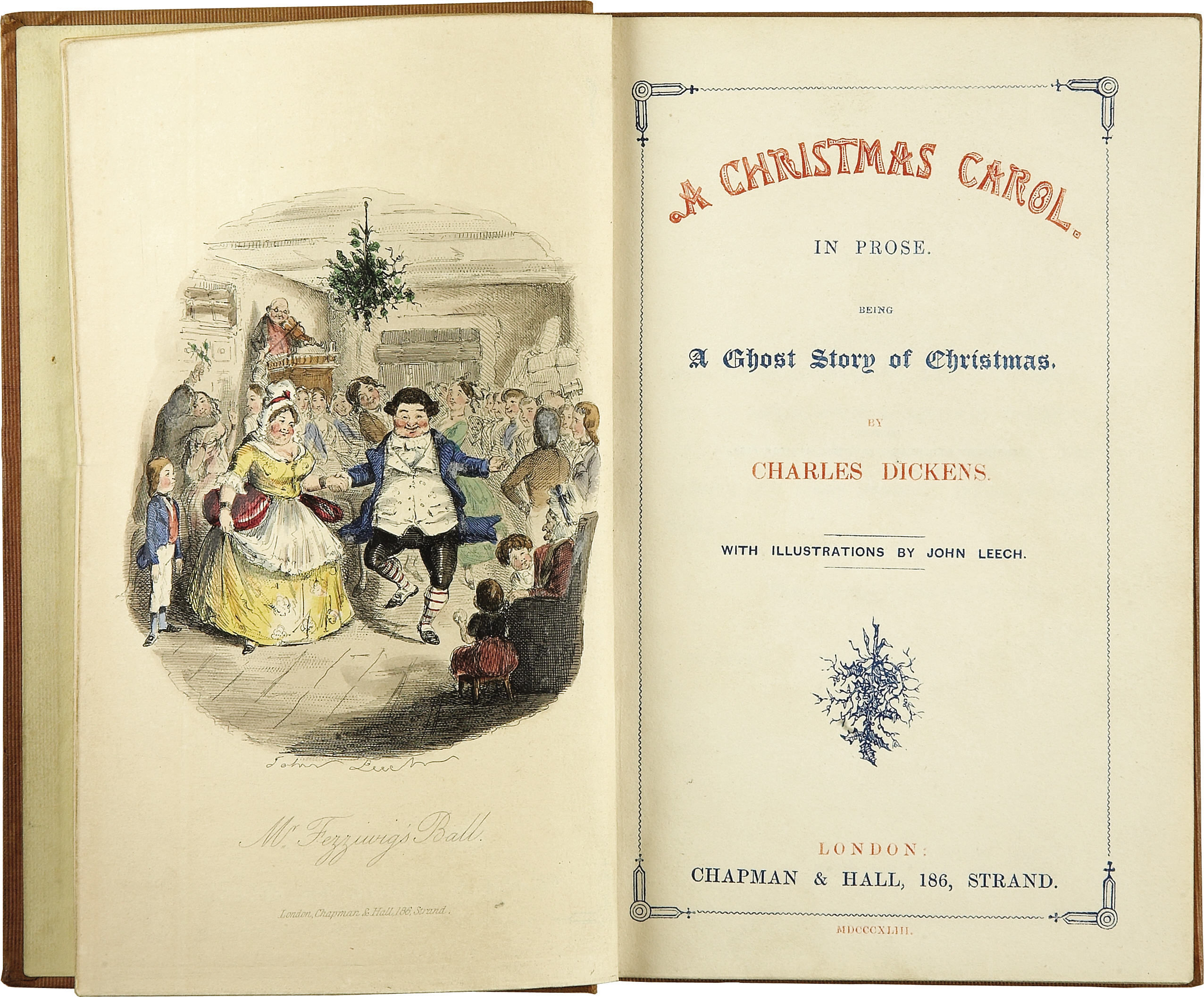
"Hallo!A great deal of steam! The pudding was out of the copper [boiler]. A smell like washing –day! That was the cloth [the pudding bag]. A smell like an eating house and a pastrycook’s next door to each other, with a laundress’s next door to that! That was the pudding! In half a minute Mrs. Cratchit entered—flushed, but smiling proudly—with the pudding. like a speckled cannon ball, so hard and firm, blazing in half of half-a-quartern of ignited brandy, and bedight with Christmas holly stuck into the top." "Oh, a wonderful pudding! Bob Cratchit said, and calmly too, that he regarded it as the greatest success achieved by Mrs. Cratchit since their marriage..."

Charles Dickens~A Christmas Carol  

Origins of the Plum Pudding

Christmas PUdding
Few foods can trace their history back through multiple centuries. Plum pudding stands out as one of those few. It began in Roman times as a pottage, a meat and vegetable concoction prepared in a large cauldron. Dried fruits, sugar and spices might be added to the mix as well.

Another ancestor to the plum pudding, porridge or frumenty appeared in the fourteenth century. A soup-like fasting dish containing meats, raisins, currants, prunes, wine and spices, it was eaten before the Christmas celebrations began. By the fifteenth century, plum pottage a soupy mix of meat, vegetables and fruit was served to start a meal.

As the seventeenth century opened, frumenty evolved into a plum pudding. Thickened with eggs, breadcrumbs, and dried fruit, the addition of beer and spirits gave it more flavor and increased its shelf life. Variants were made with white meat, though gradually the meat was omitted and replaced by suet. The root vegetables also disappeared. By 1650, the plum pudding had transformed from a main dish to a dessert, the customary one served at Christmas. Not long afterward though, plum pudding was banned by Oliver Cromwell because he believed the ritual of flaming the pudding harked back to pagan celebrations of the winter solstice.

George I, sometime called the Pudding King revived the dish in 1714 when he requested that plum pudding be served as part of his royal feast to celebrate his first Christmas in England. Subsequently it became entrenched as part of traditional holiday celebrations, taking its final form of cannon-ball of flour, fruits, suet, sugar and spices, all topped with holly in the 1830’s. In 1858 it was first dubbed the Christmas Pudding, recorded as such in Anthony Trollope's Doctore Thorne.  

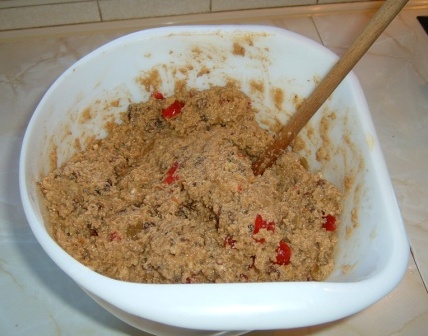
Preparing plum pudding

Many households have their own recipe for Christmas pudding, some handed down through families for generations. Two sample recipes from different centuries show remarkable similarity in ingredients.

A boiled Plum Pudding (18th century)
Take a pound of suet cut in little pieces, not too fine, a pound of currants and a pound of raisins storied, eight eggs, half the whites, half a nutmeg grated and a tea spoonful of beaten ginger, a pound of flour, a pint of milk. Beat the eggs first, then half the milk. Beat them together and by degrees stir in the flour then the suet, spice and fruit and as much milk as will mix it well together very thick. Boil it five hours ~Hannah Glasse, The Art of Cookery made plain and easy,

Rich Plum Pudding (19th Century)
Stone carefully one pound of the best raisins, wash and pick one pound of currants, chop very small one pound of fresh beef suet, blanch and chop small or pound two ounces of sweet almonds and one ounce of bitter ones; mix the whole well together, with one pound of sifted flour, and the same weight of crumb of bread soaked in milk, then squeezed dry and stirred with a spoon until reduced to a mash before it is mixed with the flour. Cut in small pieces two ounces each of preserved citron, orange, and lemon-peel, and add a quarter of an ounce of mixed spice; quarter of a pound of moist sugar should be put into a basin, with eight eggs, and well beaten together with a three-pronged fork; stir this with the pudding, and make it of a proper consistence with milk.

 Remember that it must not be made too thin, or the fruit will sink to the bottom, but be made to the consistence of good thick batter. Two wineglassfuls of brandy should be poured over the fruit and spice, mixed together in a basin, and allowed to stand three or four hours before the pudding is made, stirring them occasionally. It must be tied in a cloth, and will take five hours of constant boiling. When done, turn it out on a dish, sift loaf-sugar over the top, and serve it with wine-sauce in a boat, and some poured round the pudding. The pudding will be of considerable size, but half the quantity of materials, used in the same proportion, will be equally good. ~Godey's Lady's Book, Dec. 1860

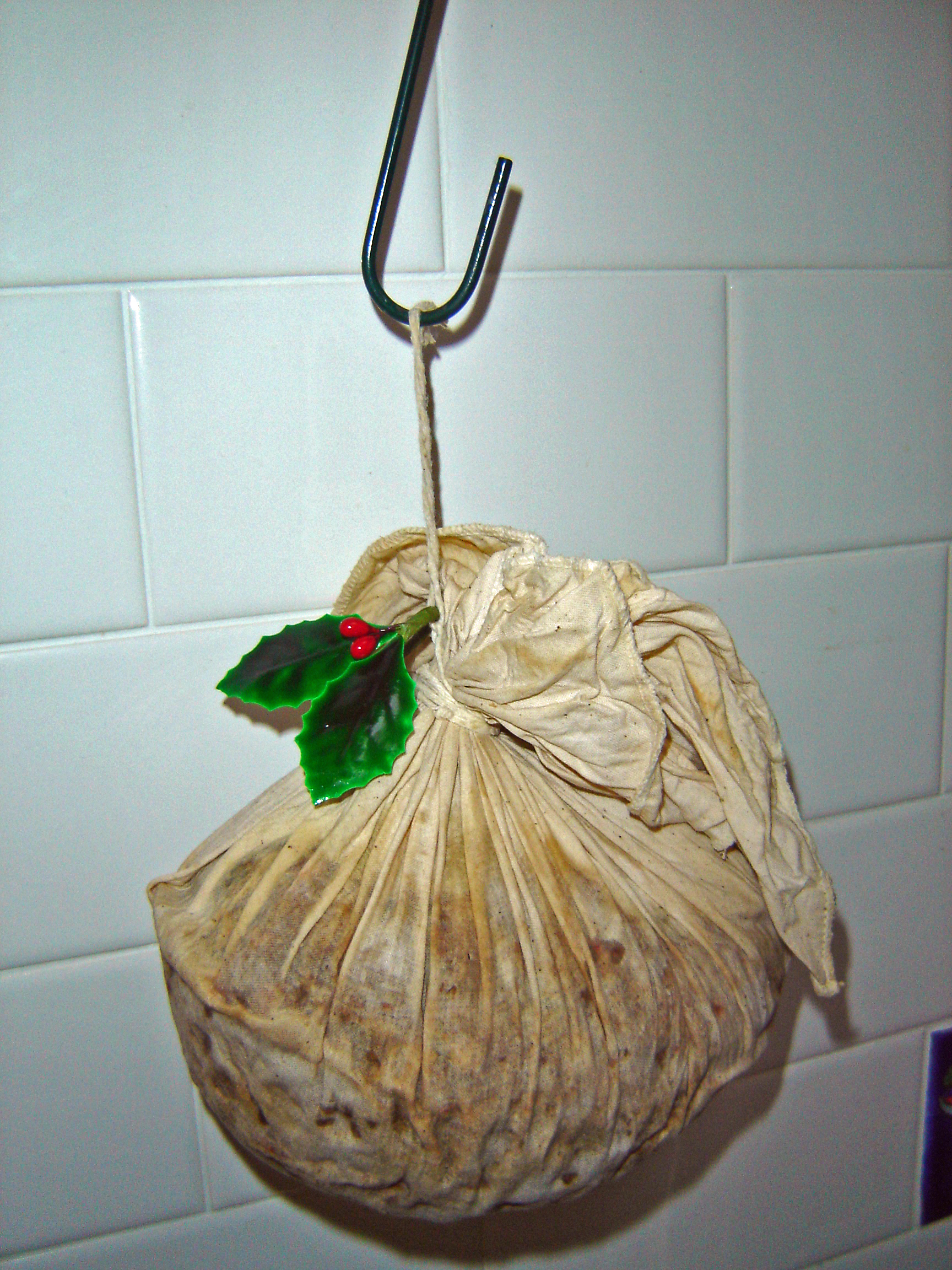
 After cooking, Christmas puddings were often dried out on hooks for weeks prior to serving in order to enhance the flavor. Once dried, they were wrapped in alcohol-soaked cheese cloth and stored earthenware/crockery and placed somewhere cool for the duration. More alcohol may have been added during this period. The puddings might also have been sealed against air with suet or wax to aid in preservation. Click here for a modern recipe and instructional video.  

Plum pudding traditions

 With a food so many centuries in the making, it is not surprising to find many traditions have evolved around the making and eating of plum pudding.

The last Sunday before Advent is considered the last day on which one can make Christmas puddings since they require aging before they are served. It is sometimes known as 'Stir-up Sunday'. This is because opening words of the main prayer in the Book of Common Prayer of 1549 for that day are:
"Stir-up, we beseech thee, O Lord, the wills of thy faithful people; that they, plenteously bringing forth the fruit of good works, may of thee be plenteously rewarded; through Jesus Christ our Lord. Amen." 

Choir boys parodied the prayer.
 "Stir up, we beseech thee, the pudding in the pot. And when we do get home tonight, we'll eat it up hot." 

Christmas pudding is prepared with 13 ingredients to represent Christ and the 12 apostles then it is "stirred up" all family members who must take a hand in the stirring, using a special wooden spoon (in honor of Christ's crib). The stirring must be done clockwise, from east to west to honor the journey of the Magi, with eyes shut, while making a secret wish.

After the family stirred the pudding, tiny charms might be added to the pudding to reveal their finders’ fortune. The trinkets often included a thimble (for spinsterhood or thrift), a ring (for marriage), a coin (for wealth), a miniature horseshoe or a tiny wishbone for good luck, and an anchor for safe harbor.

 When the pudding was served, a sprig of holly was placed on the top of the pudding as a reminder of Jesus' Crown of Thorns that he wore when he was killed. Flaming the pudding, as described by Dickens was believed to represent the passion of Christ and represent Jesus' love and power. It is also a key part of the theatrical aspect of the holiday celebration.

 Why is it called plum pudding?

 And the answer to the most burning question: Why is plum pudding called that when there are no plums in it? Dried plums, or prunes, were popular in pies in medieval times, but in the sixteenth and seventeenth century they began to be replaced by raisins. In the 17th century, plums referred to raisins or other fruits. The dishes made with them retain the term plum to this day.  

Resources

  An A-Z of Food & Drink, John Ayto [Oxford University Press:Oxford] 2002
 The Art of Cookery made plain and easy, Hannah Glasse.  
The Customs and Ceremonies of Britain by Charles Knightly. London:Thames and Hudson, 1986 Godey's Lady's Book, Dec. 1860
 The Folklore of World Holidays, Robert H. Griffen and Ann H. Shurgin editors, Second Edition [Gale:Detroit] 1998
 Food and Cooking in Victorian England: A History, Andrea Broomfield [Praeger:Westport CT] 2007 Oxford Companion to Food, Alan Davidson [Oxford University Press:Oxford] 2000
 Plum Pudding History - Plum Pudding Recipe
Christmas Pudding PLUM PUDDING - CHRISTMAS PUDDING RECIPE
Christmas Foods
The Christmas Pudding Sarah Lane Traditions & History


Maria Grace is the author of Darcy's Decision and The Future Mrs. Darcy. Click here to find her books on Amazon. For more on her writing and other Random Bits of Fascination, visit her website. You can also like her on Facebook or email her.