Showing posts with label Edgehill. Show all posts

Monday, May 2, 2016

Charles Stuart, Prince of Wales

By Cryssa Bazos

When people think of Charles II of England, they usually think of Charles the Merry Monarch. Yet there was more to this intelligent man than the number of mistresses (and illegitimate children) he had. His life was defined by war, loss, and exile, and in the end, restoration. He fought to reclaim his father’s throne during one of the most tumultuous and complex times in English history. To understand who he was before becoming the Merry Monarch, allow me to introduce his early years when he was still the Prince of Wales.

Charles Stuart by Philippe de Champaigne

Charles was the eldest son and heir of King Charles I of England and Queen Henrietta Maria (sister to Louis XIII of France). His grandfather, King James I of England (James VI of Scotland) united the crowns of Scotland and England upon the death of Queen Elizabeth I. Charles was born on May 29, 1630 in St. James’s Palace in London, and as the story goes, a bright star shone in the afternoon sky to mark his birth. Ironically, this star was Venus.

Charles took after his mother’s French heritage, with his dark looks. Henrietta Maria called him her ‘black boy', though not with affectionate fondness. Whereas most mothers are often blind to their children’s ‘imperfections’, Henrietta Maria was hypersensitive. Shortly after Charles’s birth, Henrietta wrote about her son to a former nanny, “he is so fat and so tall…I will send you his portrait as soon as he is a little fairer, for at present he is so dark I am ashamed of him.” Charles never became fair, but at 6’2” he fulfilled the promise of exceptional height.

The Children of Charles I

Over the next several years, Charles was joined by a clutch of brothers and sisters in order of birth: Mary (later Princess of Orange), James (King James II & VII), Anne, Elizabeth, Henry (Duke of Gloucester), and Henrietta (Duchess of Orleans, but known affectionately as Minette). He was particularly close to his brother James, who ultimately ascended the throne after him. The two had experienced the upheaval of the civil war together, and even when James later converted to Catholicism, Charles supported his decision even though it was politically inconvenient. Some have attributed Charles’s deathbed conversion to Catholicism as having signalled his support for his brother on the eve of James’s ascension to the throne.

When Charles was eight, he was given over to the care and education of William Cavendish, then Marquess of Newcastle-upon-Tyne. Cavendish was a notable horseman and the father of dressage. A long-time political player from a wealthy family, he instilled in Charles the gift to see men for what they were and the ability to work with them according to their talents. He also fostered in Charles a love of horsemanship.

Charles’s keen wit came through even at this young age. Having a strong aversion to taking physic, he wrote a clever note to Cavendish, which also demonstrated his affection for his guardian:

“My Lord, I would not have you take too much physic, for it doth always make me worse, and I think it will do the like with you. I ride every day, and am ready to follow any other directions from you. Make haste to return to him that loves you. Charles, P.”

Charles had a very different personality than his stubborn father. Had he been king during this time, war may very well have been avoided, and with it, years of bloodshed.

But civil war did break out, and Charles’s idyllic childhood came to an abrupt end in 1642 when Parliament raised an army against his father. Charles was given a titular captaincy and a troop of horse named after him, the Prince of Wales Regiment. At this time, his dashing cousin, Prince Rupert of the Rhine, came to lead his Majesty’s horse, and the young Charles looked up to his cousin as any impressionable twelve-year old would.

During the first major battle of the war (Edgehill), Charles should never have been anywhere near the fighting, and yet typically, he was and had a close shave with the enemy. His safety, and that of his brother James, was entrusted to the famous physician, Dr. William Harvey. In later years, the doctor became celebrated for documenting the circulation of blood, but at this moment, with two armies clashing on a field, the good doctor withdrew with his charges to the shelter of a hedgerow and the comforts of an absorbing book. The fighting heated and now being too close for comfort, Charles and his brother fled across a field to reach the safety of a barn. An enemy troop of horse saw the pair running, and without realizing who they were, gave chase. Fortunately, another Royalist troop headed off the enemy cavalry before they could capture the King’s sons, thereby avoiding a checkmate.

A History of England

In March 1645, Charles had been named Captain-General of his father’s forces in the west and was stationed in Bristol, relying on Edward Hyde as one of his chief advisors. Charles has always proved loyal to those who had shown him loyalty; years later when he won back his throne, he elevated Hyde to Chancellor and bestowed upon him an earldom.

By June 1645, the war had turned against the King. Following their defeat at Naseby, the Royalist army was in shambles. It soon became necessary to send Charles to the west where he would be safer from the threat of Parliament. As well, plague was becoming a threat in Bristol. Charles and his retinue left Bristol and travelled west to Barnstaple, and in September, continued to Cornwall. But by the spring of 1646, the mainland was not safe for the King’s heir, and he was forced to sail for the Isles of Scilly and then to Jersey.

iStock Photos

Sailing across the Channel to Jersey flared Charles’s sense of adventure. While on board the privateer, the Proud Black Eagle, he took the helm for a time. His ship was forced to flee from a fleet of Parliamentary ships, but they managed to safely sail into Jersey harbour.

Clearly this made an impression on him, for when he needed to come to his father’s aid, he chose to do it on the water. In 1648, one of the king’s supporters in Scotland, the Duke of Hamilton, raised an army for the King who was a prisoner of Parliament by this time. Wanting to be in readiness to join in the fray, Charles left France for Holland with a small fleet under his command. With some degree of schadenfreude, he happened to chance upon a naval mutiny in the Parliamentary fleet. Ten ships put aside their officers and placed themselves under Charles’s command. From there, Charles and his expanded fleet sailed for the Downs.

In the Channel, while waiting for favourable news on land, he played the privateer (or pirate, depending on your perspective). Things did not always go well for the Pirate Prince. His fleet suffered from internal divisions and a betrayal from some of the Prince’s supporters (though it was thwarted). Even the weather conspired against him. Just as his ships were geared to engage against the Parliamentary fleet, a fierce storm drove them apart. Unfortunately, rescuing the King was not in the cards, and Cromwell defeated Hamilton’s army.

One thing bore fruit from Charles’s Channel runs, an act of respect that paid dividends three years later. One of the prizes he seized was a ship captained by Nicholas Tattersell. Charles readily released the ship, which was no small relief to Tattersell. Years later, when Charles was a desperate fugitive with a reward of a thousand pounds offered for his capture, his last hope for finding passage on a ship ended up with Tattersell. Though Charles dressed and acted like a commoner, Tattersell had not forgotten the man who had captured his ship—nor did he forget that the Prince had promptly released it to him. Tattersell agreed to help Charles and spirited Charles safely to France.

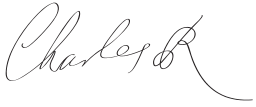
And finally, one of my favourite stories of Charles involves the carte blanche. Before his father’s execution on January 29, 1649, after Parliament had tried and found the King guilty, the story goes that Charles sent a carte blanche (a blank piece of paper with his signature) to Parliament so that they could fill in their own terms for sparing his father’s life. If true, the ramifications to Charles were enormous.

Did it actually happen or is it a 19th century fabrication or error? I like to believe in its veracity, not only because it is his signature that appears on the bottom of this blank document, but also is entirely in keeping with the nature and character of Charles Stuart, Prince of Wales.

References:

Memoirs of the Court of Charles the Second, Anthony Hamilton

Memoirs of Lady Fanshawe: Excerpt From: Lady Anne Harrison Fanshawe.

Reprobates: The Cavaliers of the English Civil War, by John Stubbs

Carte Blanche, by T. C. Skeat 

BCW Project


Media attributions:

Charles Stuart: By Philippe de Champaigne - Europicture.de, Public Domain, Wikimedia Commons

The Children of Charles I of England, by Sir Anthony van Dyck in 1637, Wikimedia Commons

A history of England from the landing of Julius Caesar to the present day (1913): Internet Archive Book Images via Visual hunt / No known copyright restrictions

Charles II signature: By Connormah, Charles II [Public domain], via Wikimedia Commons

~~~~~~~~~~~~~

Cryssa Bazos is a historical fiction writer and 17th Century enthusiast with a particular interest in the English Civil War (ECW). For more stories about the English Civil War and the 17th Century, visit her blog.

Thursday, October 22, 2015

Making Provision for Those That Shall Be Maimed In This Present War - Medical Care in the English Civil War

by MJ Logue

After the first battle of the English Civil War at Edgehill on 23rd October 1642, the people of Warwickshire found themselves with an estimated butcher’s bill of between one and two thousand men injured in the fight.

Camp-followers and soldiers’ wives who followed the Army were able to care for their injured menfolk, but a casualty list of such magnitude was beyond either their capability or their resources. Most sword-cuts were not able to penetrate the sleeve of a buff-coat – but not every soldier owned a buff-coat. A musket-ball was an ounce of lead, and would break thinner bones, such as ribs; thicker bones, such as limbs, tended to be shattered on impact. Not, as you can imagine, the sort of injury with which the ordinary woman – or, indeed, the ordinary medic – would be greatly familiar with from a civilian existence!

It is not known whether either Army’s medics operated a triage system. What is known, however, is that after Edgehill as many casualties as possible were removed to a more stable environment to provide the best care. In the Army of Parliament both Lord Brooke and the Earl of Essex are documented as having provided funds for the ongoing care of their casualties by local people: a receipt presented by Katherine Hobson of Warwick, after the battle, shows that she received £25 for the care of around 150 men. (Kington being Kineton, ie Edgehill)

These are to certifie to all those whom these may any wayes concerne
That I Katherine Hobson of Warwicke dureing the time of wars imployed by the Lord Brooke in the Attendinge & dressing of the wounded soldiers that came from Kington battel (wh[i]ch said Souldiers were in number aboute Seaven score & the said battell was in The year of our Lorde God 1642) I say Rec[eive]d of Mr Richard Lacell then Bayleff of Warwicke the sume of Twenty five pounds, for the buying Of necessarys for the said Soldiers

It is not known whether the King’s troops enjoyed a similar care: the wholesale destruction of His Majesty’s always-lackadaisical administrative paperwork after the surrender at Oxford means that it is impossible to say with any certainty. It may be guessed from contemporary Royalist sources that perhaps it was not always the case; it was conceded by many that the Parliamentarian medical services were far superior to the King’s, despite having men such as the physicians Thomas Sydenham (1624-1689) "the English Hippocrates”, and Richard Wiseman (1625-1686), the greatest English surgeon of his day, in the ranks. These practitioners fought in opposing camps. Sydenham was a cavalry officer for the Parliamentary forces, whereas Wiseman was an ardent Royalist. Moreover, Wiseman became a personal friend of King Charles II, just as the pre-eminent physician William Harvey (1578-1657) had been a good friend (and hunting partner) of King Charles I.

Sydenham was enrolled at Magdalen College, Oxford, at the beginning of the war, and qualified as a Bachelor of Medicine in 1648 – presumably using some of the experience and knowledge gained in active service, in his practice. Wiseman wrote a book on field surgery, Several Surgical Treatises, and was an advocate of early amputation on the field of battle as well as an expert on gunshot wounds – also, presumably, using his field experience! He was of a similar age to Sydenham, but had entered the ranks of Barber-Surgeons just before the Civil War. (One of the main differences between doctors and barber-surgeons was that doctors were academically trained, and barber-surgeons were apprenticed.)

Edgehill seems to have been significant not only for the aftercare of its soldiers but for the fortunate coincidence of cold weather conditions which saved the life of many left on the battlefield unattended. The eminent physician to Charles I, William Harvey, who was present at the battle of Edgehill reported:
... that Sir Adrian Scrope was dangerously wounded there, and left for dead amongst the dead men, stript; which happened to be the saving of his life. It was cold clear weather, and a frost that night; which staunched his bleeding, and at about midnight, or some hours after his hurte, he awaked, and was faine to draw a dead body upon him for warmth-sake.” Harvey was also familiar with the best way of raising body temperature: “I remember he kept a pretty young wench to wayte on him, which I guess he made use of for warmth-sake as King David did, and he took care of her in his Will.

On 25 October 1642, within hours of the stalemate at Edgehill, Parliament passed an Act that for the first time acknowledged the State’s responsibility to provide for the welfare of its wounded soldiers and also for the widows and orphans of those killed -"An Ordinance of both Houses, declaring their Resolutions of making provision for those that shall be maimed in this present war, who are in the service of Parliament; and for the wives and children of those that shall be slaine". Three weeks later, on 14th November with the pressure for care for the wounded rising, Parliament formed “The Committee for Sick and Maimed Soldiers” to rationalise the organisation and implementation of its aftercare arrangements.

Edgehill was significant not only as the battle which began the English Civil War, but, to a degree, the battle which began the concept of state responsibility for those hurt in its service. Diverse wounds and missing limbs often prevented returning soldiers from earning a living – these survivors seem to have been given a lump sum of £2 (in context, a colonel of horse in the New Model Army, three years later, would have received wages of a pound a week: £2 was a hefty lump sum, but not enough to retire on!) whilst a regular pension was agreed on. Significantly, widows and dependents of soldiers were also allowed to enter a claim for maintenance, provided they were able to provide relevant war records. Many of these widows were also in the position of having cared for injured soldiers who were wholly unrelated to them, after battle: Hester Whyte cared for wounded Parliamentarian soldiers after Edgehill, “who continued at her house in great misery by reason of their wounds for upwards of three months. She often sat up night and day with them, and in respect of her tenderness to the Parliament’s friends, laid out her own money in supply of their wants.” (Petition to the Committee of Safety for Warwick and Coventry)

There is much, much more to be said on the matter of Parliamentarian care of its soldiery – the hospital structure, the diet of sick and hurt soldiers, the value of opportunities afforded for women to be recognised in paid employment outside the home. In 1657 four women were interviewed for the single position of ward Sister at a London soldiers’ hospital. A nursing post in one of the London soldiers’ hospitals would have attracted a wage of 5s per week, with accomodation and food provided. (Set that against the widow’s pension of 4s per week, and it’s a much less impressive deal.)

That, however, is for another day entirely. On this anniversary of the battle of Edgehill, let us raise a toast to the Committee for Sick and Maimed Soldiers: the first of its kind in England.

~~~~~~~~~~~~~

MJ Logue can be found lurking at uncivilwars.blogspot.co.uk, , and the first three books in her bestselling series featuring the (mis)adventures of sweary Parliamentarian cavalry officer Hollie Babbitt and his rebel rabble are available here.

Monday, July 27, 2015

Giveaway: Red Horse by M J Logue

M J Logue is giving away a copy of the first book in the Uncivil Wars series, "Red Horse"This giveaway ends at midnight on 3rd August. To see more information about the book, please click HERE

Comment on this page to enter the drawing, and please be sure to leave your contact information.

Sunday, September 8, 2013

The English Cavalier and his Stomach

by Deborah Swift


File:17th-century unknown painters - The Chef - WGA24061.jpg
The Chef - artist unknown, first half of 17th C (Wiki)

It has long been recognised that an army marches on its stomach - that the importance of food to morale is vital. Apart from just the sustenance, the regularity of meals provides a routine in what can often be chaos during a war or campaign. Eating together has always bonded people and created friendships and loyalties which extend onto the battlefield. Particularly in cold wet weather (and England is often cold and wet!) the cheer of a good hot meal cannot be under-estimated. 

English Civil War scenes
The English Civil War , illustration from British Library online

In the English Civil War, a period I am researching right now, the official ration for a Cavalier was two pounds of bread, one pound of meat and two bottles of beer.

Meat was considered essential by both armies in the conflict, and between January and June 1645 (a six month period) the two hundred Roundheads stationed at Chalfield House,Wiltshire ate:

40000 lbs beef
1600 lbs bacon
580 lbs pork
1900 lbs mutton
64 lbs veal

As well as this heavy diet of meat, they also ate:

15000 pints of wheat
27000 pints of oats
20000 malt
5000 beans
5000 peas

All this was supplemented with small amounts of cheese and dairy produce.(statistics from Charles Carlton, Going to the Wars.)

The fact that vegetables are not mentioned does not necessarily mean that people ate no vegetables, it is perhaps that their cost does not appear in records in the same way as other foods. Pulses were widely grown in England and formed an essential part of most people's diet.

Who remembers this old rhyme?
Pease Pudding hot, Pease Pudding cold,
Pease Pudding in the pot, five days old.

Stroll across the picturesque yard to enter the medieval Manor. © Andrew Butler
Great Chalfield Manor (National Trust)

So how did the troops keep up this diet whilst on the move? When the Earl of Essex came to the aid of Gloucester, the thousand sheep and sixty cows that they drove along with them for food slowed them down. The meat had to be killed, skinned and butchered as they went, often in unsanitary conditions. The carcases were left behind to rot, but were taken by local people to use the bones for glue.

Once farther from a garrison town or when on the move, food became scarcer and scrounging or plundering food was a common occupation. Many citizens during the English Civil War found themselves with unwelcome guests. After their victory in Taunton in 1644, the Roundheads were so hungry that they stopped chasing the King's Army and went in search of food. Finding themselves unguarded, the Royalists counter-attacked, killing many with the bread still 'in their mouths'.

Plunder was a way to show high spirits, but also a way for defeated troops to vent their anger and shame . After the battle of Edgehill, one Royalist platoon got out of hand and brutally plundered their own home towns of Droitwich and Bromsgrove. And in a blind rage after being beaten at Marston Moor, Prince Rupert's men seized cattle, sheep, and chickens, killing all who tried to stop them.


Because the troops sometimes could not carry all their plunder, special market days were arranged where they would sell off what they had pillaged. Records show for example that Joyce Hammon managed to buy back gold plate and also some beaver hats that troops had stolen from her house in Hereford.

Feeding the soldiers on the march was compulsory - in the sense that refusal led to threats and violence. Householders were expected to billet soldiers at a set rate in exchange for an IOU that was often never paid. They were expected to provide food and ale and to feed their horses. The soldiers (on both sides) fresh from blood and battle were often the worst kind of house guest - violent, greedy, and out of control.

The cost to England of free quarter and plunder was enormous. In Cheshire £120,000 of free quarter was said never to have been re-imbursed, not to mention the claims of villages in the same county which lost as much as £190.000 worth of goods and livestock in plunder. Often a lifetime's hard work could be laid waste in one night.

Women alone in their houses whilst the men were at war feared the arrival of troops from both sides, even from the side they supported. In her memoirs Lucy Hutchinson condemned plunderers as 'the scum of mankind', and Milton wrote in his Poem to The Lord General Fairfax,
"In vain doth valour bleed,
Where avarice and rapine share the land."

I recommend these sources:

337707


~~~~~~~~
For more about my books set in the English Civil War and the 17th Century, please visit my website, www.deborahswift.co.uk .

Sunday, October 23, 2011

The Battle of Edgehill 23rd October 1642


by Richard Denning

Today - 23rd October is the anniversary of the first full scale pitched battle of the English Civil War: the Battle of Edgehill. I thought I would take a look at this important event in English history.

A World turned upside down! England at war with itself.


For decades tensions between King and Parliament had been growing but became acute during the reign of Charles I. Charles believed emphatically in the divine right of Kings to rule without question, whilst parliament had been trying to gain more authority and rights for years.

The problem for the King was that most of the money in the country was in the hands and control of Parliament.  In 1641, after years of ruling alone Charles found that recent wars in Ireland and Scotland necessitated funds. As a result he was forced to go to Parliament to request financial support. When he did so, he found Parliament in uncompromising mood. They took steps to curb his powers and restrict his independence.   
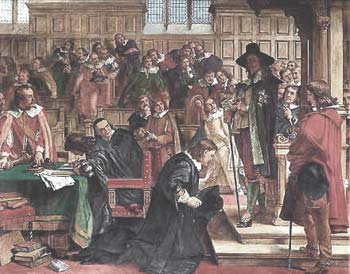
After months of wrangling, Charles, outraged by the attacks of Parliament, took an armed party to the Commons to try and arrest the most prominent members. Never before had a King gone to the Commons and tried to do this. The members managed to escape. This incident is recreated even today when the Queen goes to open parliament and the door to the chamber of the commons is shut in the face of her representative to symbolize the commons having independence from the monarch. Today it may be ceremonial but in 1642 this failure was a political disaster as it pushed more members into the Parliamentarian camp. Charles and his family fled the capital soon after the incident. 


The King in the House of Commons

After this event Parliament passed the Militia Act.This act attempted to wrench control of the army from the king. This was a direct attack on the royal Prerogative. Kings controlled armies and waged wars. The House of Lords refused to pass the act. The King refused to give consent. Pym forced through the act via the Commons alone – a breach of the rules and laws of the land which required assent of Commons, Lords and Monarch. Conflict was now inevitable.
It’s War!
In the summer of 1642 both the King and Parliament began raising troops. The Earl of Essex took command of Parliament’s troops. On the 22nd of  August 1642, Charles raised his standard at Nottingham and called for an army to join him. He set up his capital at Oxford and began making plans. With the Royalist army assembling in the Midlands, Essex took the Parliamentarian army towards him.
The first conflicts of the English Civil war was about to begin.
The 1642 Campaign
The King, beginning with around 2000 men, raised more troops in the Midlands as he moved south west towards Shrewsbury.  Shortly after the King had raised his standard at Nottingham, Essex led his army north  into the Midlands and across into the Cotswolds. By September both Essex and the King had around 20,000 men and were in close proximity on either side of Worcester. A clash was inevitable. That first battle was at Powick Bridge on 23rd September when Price Rupert – the King’s nephew and cavalry commander – defeated a Parliamentarian cavalry force and showed that in the early war the Royalists had an edge in terms of cavalry forces.

The Battle of Edgehill
After that first battle, the King decided to strike towards London and try and reach it before Essex could get back there. Essex responded by marching towards London as well. So it was that Essex finally brought his field army into the path of the Royalist army at the little village of Edgehill. There on 23 October 1642, the first major battle of the war was fought. 


Looking down from Edgehill towards Kineton. On those fields Parliament and the King clashed.  That fateful day Jacon Astley (Major General on the King's side prayed "O Lord, Thou knowest how busy I must be this day. If I forget Thee, do not forget me." 

Map of the Battlefield of Edgehill

The Opposing Forces
The two armies were evenly matched in numbers. Essex had better equipped infantry whilst the Royalist Horse had superiority over its opponents. The King Deployed on the steep ridge of Edgehill whilst Essex laid out his troops in the flat plain below.

Looking from Essex's original position toward the heavily wooden Edgehill in the distance.

The Battle
Essex made no move to advance up the steep Hill so the King descended from Edge Hill and deployed on the plains, infantry in the centre and horse on the wings just like Essex had done. Then the Royalist Cavalry charged. The Parliamentarian horse stood to receive the charge and attempted to discharge pistols to drive off Prince Rupert's horses on the right and that of Wilmot on the left. This failed and the Parliamentarian horse was swept away.

Rupert now made a critical error. Rather than turning to come onto flank and rear of Essex's foot soldiers (which could have ended the war right then), he went off with his cavalry to ransack Parliaments baggage some distance to the rear.


In the centre Essex's infantry initially fell back when they saw their cavalry running. But it was now the case that Essex had a superiority in horse because he had kept back several regiments in reserve behind his infantry. These - under Balfour - charged the King's infantry and so Essex's foot soldiers took heart and followed up and together they assaulted the kings foot regiments.

Charles found that his centre was crumbling and sent Prince Charles and Prince James away from the battle. Balfour's horses almost captured the princes as they reached the King's gun line at the bottom of the ridge.

Things could have gone very bad for Charles BUT at this critical moment royalist horsemen started returning and fell upon the rear of the parliamentarian army, saving the Royalist army.

The two forces drifted apart as night came. About 500 men had been killed on each side and around 1500 wounded. In the morning neither side showed any inclination to resume the combat.

The Aftermath
Both the Royalists and Parliamentarians claimed Edgehill as a victory but in truth it was inconclusive. The armies moved apart again and there was now a brief chance for Charles to reach London before Parliament, but he hesitated and by the time he did move that way Essex had again got in the way and  at the battle of Turnham Green was able to prevent the King breaking though.
The year ended with Charles forced to withdraw to Oxford which would serve as his base for the remainder of the war.

1642 had been a year of even honours with neither side able to get an advantage. The failure to achieve a decision at Edgehill meant the war would rage on for years and claim 100,000 lives - a higher % of the population than either world war.

The Monument on Edgehill Battlefield


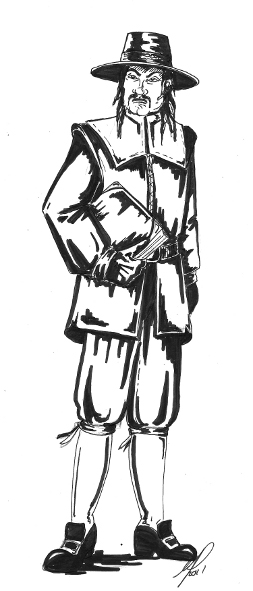
Two important characters in my 17th Century Historical Fantasy Novel, The Last Seal  fought at Edgehill - Artemas the Cavalier on the King's side and Matthias the puritan for Parliament.
Here is a little bit about them both with some character sketches: 

At Edgehill, he had ridden with Prince Rupert’s cavalry as it charged and routed the enemy horse and then went on to ransack the baggage train. The Prince should have got his men back to the field where their presence might have won the day for the King, but Rupert had lost control of his exuberant troopers and instead they helped themselves to the enemy’s pay chest, and while they robbed and caroused, the battle was lost. Not that Artemas had cared either way, of course. Edgehill might have been a poor result for the King, but not for him.

He thanked God that he had purpose again after so many years of despair. He felt the same fire in his soul that he had when he stood on the battlefields of Edgehill and Naseby alongside his brother and father, and had known with utter conviction that they fought for God and against the evil influences that poisoned his enemies. Upheld by this faith he had fought bravely against the King and had delighted in Parliament’s victory.