Showing posts with label Dancing. Show all posts

Sunday, May 10, 2015

First Hand from the Ballroom

by Maria Grace

Balls and assemblies form a regular feature of Georgian and Regency era historical novels. Often heroes and heroines meet, flirt, fight, and even fall in love on the ball room floor. But when watching videos of actual period dance, the first question on viewers’ minds is with such active and complicated dances, how did any communication take place?

My husband and I joined an English Country Dance group a couple of months before their big spring ball event. We attended two balls in the course of just a month. The experience offered a wealth of perspective on the myriad ways that period heroes and heroines might interact on a ball room floor.

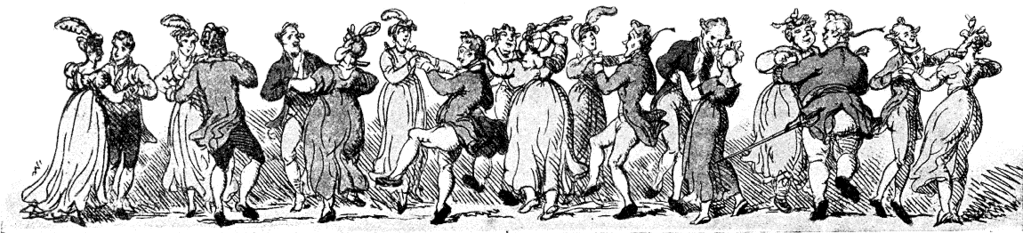
Though these dances require a partner, dances are generally not done by individual couples, but by couples in lines, groups of three or four couples, or circles. So, individual dancers interact not only with their partners, but with at least one other couple, and possibly every dancer in their set.

What do those interactions look like? To start the dance, the Master of Ceremonies (today the position is known as the caller) announces the dance and what formation is required. The modern caller guides the dancers through the steps, not unlike a square dance caller, however, in the era this was not done. Dancers were expected to know the steps to the dances. How was it possible for dancers to know the steps to all the dances that might have been called? It sounds like a daunting and overwhelming task.

During the period, yearly dance books like Preston's 24 Country Dances for the Year 1803 were published containing the music and dance steps for that year. Dance masters would use those books to teach their students the year’s dances. This helped insure common and well-known dances would be performed at public assemblies.


Most dances were built from a known array of standard steps. These steps included simple maneuvers like: partners turn by the right hand and two couples all join right hands and turn once around. Complex movements like figure eights, ‘hays’ and dancing down the set also had a place in the lexicon. (See the 'Hunt the Squiril' video later in this post.)

In many of the line-based dances, couples would ‘take hands four from the top’, that is they would form groups of two couples who would dance together for one repetition of the music. In simple dances, both couples would perform the same steps throughout the dance. More complicated dances might have the first and second couples executing completely different steps with one more complex than the other. Mr. Beveridges Maggot (featured in recent movie adaptations of both Austen’s Pride and Prejudice and Emma) is one such dance. At the end of that repetition, the final steps ‘progress’ couples into new groups of four, first couples moving down the set to be first couple in the group one down from their previous position, and second couples moving up.


In order for progression to work, couples at the top and bottom of the set would wait out a repetition of the music and not dance. This waiting out period offered a prime opportunity for couples to interact relatively privately on the dance floor. 

In the span of a several minutes long repetition, dancers might exchange pleasantries, flirtations, or even cross words. Whatever their conversation, though, they still had to pay attention to the music and other dancers so as not to miss their entry back into the set. At the next repetition they would rejoin the set, switching their role in the dance from first to second or second to first couple. Less experienced dancers might use the opportunity to refresh themselves on the new steps that may be required of them as they came into the set.

Not all dances offered these ‘time out’ periods. Circle dances and those done in sets of two or three couples required dancers to participate constantly, so little or no conversation might take place. Even so, a great deal of dance floor communication was possible without dialogue.

These exchanges would begin with being asked to dance. In the era, a gentleman could not ask a lady to dance unless they had been formally introduced. A chaperone, other acquaintance, or Master of Ceremonies could introduce potential dance partners during the ball to enable them to dance together. Couples, unless engaged or married, did not dance more than two dances together, so many partners might be required for an entire evening of dance.

Since dancers would engage with not only their partner, but other couples, it was possible to connect with many people while dancing a single dance. Mixer dances, like the Indian Princess, capitalized on this effect, with dancers switching partners frequently, oftentimes enabling dancers to ‘sample’ every partner on the floor. These could provide an excellent opportunity to scope out partners for future sets, particular if a one was looking for someone of a particular skill level or personality to pair with.


Although seemingly simple, the way one might be asked to dance spoke volumes. The offer might be made with eye contact and a quick gesture toward the dance floor; a smile, a bow and flowery words; a sweaty palmed, stammered request; or even a shrug and an eye roll of ‘well, I suppose you will do.’ All these offers set and color the stage for a series of silent communications on the dance floor. In cases where women drastically outnumbered the men, a Master of Ceremonies might allow women to dance with other women. Clearly not a desirable situation, but one that Jane Austen references when Mr. Bennet upbraids Kitty that she might not attend another assembly unless she ‘stands up with her sisters’. In other words, she would be restricted to dancing with her sisters only, a sad fate for the poor girl.

Eye contact plays a huge role in dance floor tete-a-tetes . Some partners engage in constant eye contact, holding their partners with their gaze in an almost physical grip. From a practical standpoint, the eye contact is a useful way to stave off dizziness in a dance that requires many rapid turns. At the same time though, such interchanges can become demanding and intimate, isolating the couple in a room full of people. Other partners offer little in the way of eye contact, even to the point of avoiding any direct gaze with their partner. An avoidant partner can communicate a variety of things from their own insecurity with the dance steps to distain for their partner, all without uttering a single word.

Subtle physical contact, usually restricted to taking hands or joining arms at the elbow for a turn, also speaks volumes when words are not possible. Hands might be taken, barely touching and only as long as necessary, or held reverently, lingering as long as possible in the connection.

The way partners dance together creates a conversation of facial expression and body language as eloquent as the finest speeches. A more experienced dancer can subtly and patiently assist a less certain dancer through complex steps with glances and subtle gestures, encouraging and praising with eyes and smiles. Conversely, experienced dancers can declare distain and even judgment on a struggling dancer even to the point of rough pushing or pulling that dancer into their correct position. Depending on the distraction created, the experience can be entirely humiliating.

Partners who are equally anxious about getting the steps right, and good humored in their anxiety, can assist one another, laugh at missteps, and celebrate their victorious achievements as they progress through a series of complicated steps. The experience has the potential to be very revealing of characters and offers a time for bonding over a shared challenge. A gentleman might even kiss a lady’s hand after surviving such a trial—a most romantic gesture indeed.

When two proficient dancers partner, the flow of their coordinated movements creates a connection between the dancers, bonding them in purpose and action. The communication and energy flowing between them can be visceral and compelling, poignant as the deepest conversation. No wonder young men often called upon their primary dance partner the next day.

Each dance itself possesses its own character, some being staid and elegant and others playful and flirtatious. Mr. Belvridge’s Maggot is dignified and elegant, befitting a somber, formal occasion. Lord Byron’s Maggot—by the way, a maggot referred to a catchy tune, what we would today call an ‘ear worm’—suits its name sake. One set of steps involved the woman from the first couple approaching the man from the second couple with a flirtatious ‘come hither’ beckon to follow her. The second couple’s woman did the same with the first couple’s man. These suggestive moves could be made as token gestures or with sincere energy. Similarly, the playful ‘pat-a-cake’ moves later in the dance offered an ideal opportunity for more flirtation.


The complicated, three couple dance, Hunt the Squiril required the first couple to chase each other, weaving through the other dancers. The chase could provide a playful opportunity for couples to express their interest (or lack thereof) in one another as they pursued one another.


In an era in which conversation was restricted to ‘polite’ topics and interactions between unmarried individuals were strictly chaperoned, the dance floor offered the one place where such open expression was considered acceptable. There individuals could be dramatic, funny and flirtatious without censure from society at large—provided of course that they did not take their self-expression too far. Therein lays the power and allure of the dancefloor for the Regency era hero and heroine, for there alone might they expression what they could not say directly.


~~~~~~~~~~~~

 Maria Grace is the author of Darcy's Decision,  The Future Mrs. Darcy, All the Appearance of Goodness, and Twelfth Night at Longbourn and Remember the PastClick here to find her books on Amazon. For more on her writing and other Random Bits of Fascination, visit her website. You can also like her on Facebook, follow on Twitter or email her.

Sunday, May 26, 2013

A Private Regency Ball

by Maria Grace


“The characteristic of an English country dance is that of gay simplicity. The steps should be few and easy, and the corresponding motion of the arms and body unaffected, modest, and graceful.” – The Mirror of Graces, 1811 
 
In a society governed by strict rules regulating the interaction of the sexes, the dance floor provided one of the only places marriage partners could meet and courtships might blossom. The ballroom guaranteed respectability and proper conduct for all parties since they were carefully regulated and chaperoned. Even so, under cover of the music and in the guise of the dance, young people could talk and even touch in ways not permitted elsewhere.

As far as the opportunity to meet people went, private balls had the very great advantage over public ones in that the hosts controlled who attended. One could be assured of the quality of guests at a grand house, so chaperons could rest a little easier that their charge was not interacting with someone below her station.

Hosting a ball was no small matter. Musicians had to be hired and supper for all the guests provided. Cards or invitations were sent out no less than two to three weeks prior to the event and a reply was imperative with a day or two. After the ball, thank you notes were expected of all the guests in appreciation for the hospitality.


Balls were, of course, formal occasions which allowed one to show off their finery. But even here, there were degrees of formality. The dress ball which usually began with minuets was the most formal, a cotillion ball somewhat less so. ‘Undress’ or ‘fancy’ balls invited the guests to appear all manner of historical or fanciful costumes. Whatever the form of dress, gloves were essential lest the dancers touch one another directly.

Opening the ball

Early in the Regency era, balls were opened with a minuet. By the early 1800’s the practice fell from favor as it took far too long for all the couples to have a turn to display in the slow, elegant dance.

Later in the period, the ball would be opened by the hostess, the lady of highest rank or the person in whose honor the ball was given (like a debutant or new bride) who took the top position of the first dance. The top lady would ‘call the dance’, determining the figures, steps and music to be danced. Polite young ladies were cautioned that if they should lead a dance they should not make the figures too difficult for the other dancers, especially if there were younger dancers present.

Dance Partners


Every dance required a partner. At a private ball, unlike a public assembly, everyone was considered introduced, so any young man could ask any young woman to dance. A young lady signaled she was interested in dancing by pinning up the train of her gown. If asked to dance, she could not refuse unless she did not intend to dance for the rest of the night.

Gentlemen, unless they retired to the card room, were expected to engage a variety of partners throughout the evening. Failing to do so was an affront to all the guests. A gentleman might request a dance in advance, but saving more than two dances for a particular partner was detrimental to a young lady’s reputation.

Even two dances signaled to observers that the gentleman in question had a particular interest in her. The day after a ball, a gentleman would typically call upon his principle partner, so a young lady who danced two sets with same gentleman might rightfully expect continued acquaintance with him.

Oftentimes women outnumbered men at these affairs. As a result, it was not uncommon for women to dance with other women rather than sit out the entire evening.

Food


Halfway through the evening, dancers would pause to refresh themselves with a meal. Depending on the hostess, the ladies might proceed to the dining room together, parading in rank order, or might be escorted in on the arm of a gentleman who rank matched their own.

One’s dance partner for the ‘supper dance’ usually would be one’s dining partner for the meal as well.

Each gentleman would serve himself and his neighbors from the dishes within his reach. He also poured wine for the ladies near them. Soup, especially white soup made from veal or chicken stock, egg yolks, ground almonds and cream) served with negus(sugar mixed with water and wine, served hot) were staples. If a dish was required from another part of the table, a manservant would be sent to fetch it. It was not good form to ask a neighbor to pass a dish. It was equally bad manners for the ladies to help themselves or to ask for wine.


During dinner, a gentleman would be expected to entertain the ladies nearest him with engaging conversation. The list of unacceptable topics far outnumbered the acceptable ones. A polite individual did not ask direct personal questions of someone they had just met.

To question or even compliment anyone else on the details of their dress might also be regarded as impertinent. Scandal and gossip should be omitted from public conversation. Any references to pregnancy, childbirth, or other natural bodily functions were considered coarse and carefully sidestepped. A man could sometimes discuss his hunters or driving horses in the presence of ladies though it was generally discouraged.

Dances

Supper was quite necessary as most of the ball dances were lively and bouncy. Country dances, the scotch reel, cotillion, quadrille made up most of the dancing.

One dance not likely to be found in balls held in the first decade of the 19th century was the waltz. When it was first introduced, the waltz was regarded as shocking because of the physical contact involved. However by 1812, it was a regular feature of private London balls, according to Lady Caroline Lamb--although Lord Byron was scandalized by the prospect of people "embracing" on the dance floor. It was unlikely to have been seen often in public assemblies until the latter part of the Regency era, and even then, not often.

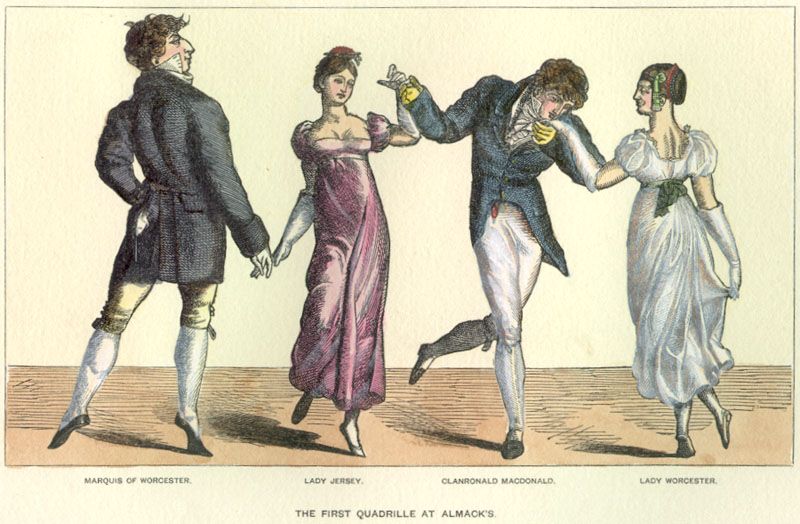
An example of the Quadrille

A Lady of Distinction. Regency Etiquette, the Mirror of Graces (1811). R.L. Shep Publications (1997)
Day, Malcom   -   Voices from the World of Jane Austen. David & Charles (2006)
Lane, Maggie   -   Jane Austen's World. Carlton Books (2005)
Laudermilk, Sharon & Hamlin, Teresa L.  The Regency Companion . Garland Publishing (1989)
Ross, Josephine   -   Jane Austen's Guide to Good Manners. Bloomsbury USA (2006)
Selwyn, David   -   Jane Austen & Leisure. The Hambledon Press (1999)
Sullivan, Margaret C.   -   The Jane Austen Handbook. Quirk Books (2007)
Period References
The Complete System of English Country Dancing – 1815 (click to download pdf) ~~~~~~~~~~~~

 Maria Grace is the author of Darcy's Decision and The Future Mrs. Darcy. Click here to find her books on Amazon. For more on her writing and other Random Bits of Fascination, visit her website. You can also like her on Facebook, follow on Twitter or email her.

Thursday, January 10, 2013

Regency Social Life: The Public Assembly

By Maria Grace
  
In the Regency era, an active social season was not limited to London. Most country towns had a formal social season during the autumn and winter months, often beginning in early to mid-October. Extra events might also take place in the spring. Public assemblies or balls were usually scheduled to coincide with the full moon to ease travel. Traveling at night, especially for those with a considerably journey to an assembly, was not considered safe without the light of a full moon. 

 Assemblies were held at local inns or assembly rooms, typically between the hours of 8pm and 11:30 pm. Subscriptions funded the events. A season's subscription might cost anywhere between £1 in the country to 10 guineas in London. Attendance was only limited by the ability to pay for the subscription and to dress appropriately for the event. Consequently, the company would be mixed, those of rank mingling with the lower orders.  

Assembly Rooms 

Assembly rooms followed a very distinct pattern. Each of three separate spaces accommodated a different activity: a ball room that included a musicians' gallery for dancing, a card room for various card game, and a supper room for refreshments. The layout might vary somewhat, but the essentials remained consistent. For example, in Bath, the assembly rooms were on the first floor, while in York, the assembly rooms were on the ground floor. Billiard rooms were also provided in some places. At grand assemblies, orchestras would be engaged while for smaller occasions, a few local musicians, perhaps only a fiddler, would be enough.  

Master of Ceremonies

A Master of Ceremonies supervised every aspect of the ball including room arrangements, the musicians, even the ordering of the dances. His duties also included insuring that too many undesirables did not gain entrance. He enforced dress codes: ladies were forbidden to dance in colored gloves (at Weymouth); men could not appear in ‘trowsers or coloured pantaloons’, boots or half-boots(Bath). And of course, he would insist that gentlemen leave their swords at the door. The Master of Ceremonies also performed the service of introducing dancing partners so that young people could interact respectably. 

 Dancers generally arranged themselves in order of precedence. To help manage issues of precedence in places where the lesser gentry, the professions and the genteel trades were the bulk of the attendance, ladies were usually presented with numbers as they entered the assembly rooms. These numbers indicated their place in the dance. Before each dance, the Master of Ceremonies would call out a number and the lady with that number and her partner would be the couple to lead that particular dance.  

For those who did not care to dance 

While some attended assemblies to dance, flirt and look for potential marriage partners, others attended simply to meet their acquaintances, talk and play card and possibly billiards. Chairs and benches were provided at the sides of the dance floor and in the card room. Private gossip might be facilitated by a stroll about the room with one’s conversational partner. 

While supper might be served at a private ball, public balls did not provide meals. Light refreshments might be provided with the tea served halfway through the night. Negus, a drink made from sugar mixed with water and wine (sherry and port) was also sometimes among the offerings.  

Dancing 

Unmarried girls were accompanied by a chaperon, typically a married relative, or an older woman friend, and closely supervised. A young woman did not dance more than two pairs of dances with the same man or her reputation would be at risk. Even two dances signaled to observers that the gentleman in question had a particular interest in her. Pairs of dances usually lasted half an hour, so an undesirable dance partner could have been quite a burden, especially considering dancing in a large set involved a lot of standing around waiting one’s turn to dance. However, if one’s partner were pleasing company, it was possible to have private conversations under cover of the crowd. 

Dances of this era were lively and bouncy. Ladies pinned up the trains of their ball gowns for ease in performing the steps. This also signaled potential partners that they meant to dance that night. 

Steps ranged from simple skipping to elaborate ballet-style movements. Country dances, the cotillion, quadrille and the scotch reel made up most of the dancing. Many versions of these dances existed and often the lady of the leading couple would get to select the specific one that was to be danced. 

 In the country dance, a line of couples performed steps and figures with each other, progressing up and down the line. As they reached the top, each couple in turn would dance down until the entire set had returned to its original positions. 

The scotch reel consisted of alternate interlacing and fancy steps danced in place by a line of three or four dancers. 

The cotillion was a French import, with elaborate footwork. It was performed in a square or long ways, like the country dance. It consisted of a "chorus" figure unique to each dance which alternated with a standard series of up to ten "changes" (simple figures such as a right hand star common to cotillions in general). 

The quadrille consisted of five distinct parts or figures assembled from individual cotillions without the changes, making it a much shorter dance. 

For a wonderful animated tour of the figures danced check out this site: http://rivkinetic.org/flash/ecdflash.html

 One dance not likely to be found in a Regency era ball was the waltz. When it was first introduced, the waltz was regarded as shocking because of the physical contact involved. Even Lord Byron was scandalized by the prospect of people "embracing" on the dance floor. It was unlikely to have been seen often in public assemblies until the latter part of the Regency era, and even then, not often.

References

Britain Express: Regency Dances

Rendell, Jane. The Pursuit of Pleasure: Gender, Space and Architecture in Regency London. Rutgers University Press (2002) 

Selwyn, David. Jane Austen & Leisure. The Hambledon Press (1999)

Sullivan, Margaret C. The Jane Austen Handbook. Quirk Books (2007) 

 Todd, Janet & Bree, Linda (editors). The Cambridge Edition of Later Manuscripts. Cambridge University Press (2008) 

 Period References  
The Gentleman & Lady’s Companion: Containing the Newest Cotillions and Country Dances; to which is added Instances of Ill Manners to be carefully avoided by Youth of Both Sexes. 1798.  

The Complete System of English Country Dancing – 1815 (click to download pdf)  

Pierce Egan - "Walks through Bath..." 1819 

 Maria Grace is the author of Darcy's Decision and The Future Mrs. Darcy. Click here to find her books on Amazon. For more on her writing and other Random Bits of Fascination, visit her website. You can also like her on Facebook, follow on Twitter or email her.

Thursday, March 22, 2012

The Hole in the Wall

by David Wilkin

As noted before and elsewhere, I have spent some time teaching the dances that have been done in the Regency Era. I have spent the time doing this because I found tremendous enjoyment performing them as well as guiding others through them. The advent of devices like the iPod and now our iPhones have allowed me to store some of these tunes on the device and carry them with me, as well as listen to them when I wish even as I write my Regency Novels, such as my latest, Jane Austen and Ghosts.

Regency Dancing has been in vogue for many years now. We owe it’s acceptance in the United States to the attendees of Science Fiction conventions, specifically the wives of the authors of Science Fiction and Fantasy.

These ladies, bored by not having much to do, took their love of Georgette Heyer Regency Romances, and asked one fan who was known for his ethnic dancing, to choreograph dances that they had read about. These dances took off. Dancing spread to other venues, where attendees of Science Fiction conventions also were members of Reenactment groups. Specifically the Society for Creative Anachronism, which ends it study of previous times in 1600. Well before our period.

Those interpreters of history however, found a resource for dance from John Playford, and the English Dancing Master. Though published in 1651, it is thought that all the dances he recorded and printed were also done before. A later dance, Hole in the Wall, made it’s way into both realms, that of the SCA and that of those dancing in the Regency genre at Science Fiction and Fantasy conventions, and events solely concerned with the Regency.

Presented for you here, notes say this dance is from 1721. Dancing certainly gives one a Regency feel. The music is from Henry Purcell and published in 1695 as Air VIII Hornpipe. The music was part of the incidental music in the revival of the 1677 tragedy of Mrs. Aphra Behn's Abdelazer or the Moor's Revenge. As far as we can tell the name of the dance has little to do with the play. The orchestration of the music make this piece related to the music of the French Court of the late 17th century.

As mentioned, re-enactment societies have taken this dance to the Regency and to the Renaissance. Many of those who dance it from those eras take the time to embellish their movements with the caricatures found at those times. The dance however, remains the same and is pleasant in any era.


1) A couple honor each other, cast out and around B couple, meet below, pass through B couple to place
B couple honor each other, cast out and around A couple, meet above, pass through A couple to place
2) A man, B lady bow and cross by right shoulders, exchanging places. B man, A lady bow and cross by right shoulders, exchanging places
3) All 4 in set join hands, circle clockwise half way to place. A couple cast around B's, B's lead up.

Breaking this down for you.

Defintions:

Set-The set is the group of dancers. In Hole in the Wall, men line up facing their partners. The first couple at the top of the line are the A couple. The next couple are the B’s and these two couples are one set. The next couple, the third in the line, are A’s once more.

Honor-An honor would be for the man to give a short bow, and the lady a curtsy.

Cast-Casting out and around means that the A man turns over his left shoulder and walks behind the B man to the place vacated by the next A man in line as he has also cast and moved down the line. The A lady does the same casting over her right shoulder and walking behind the B lady on her side of the set.

Cross-The cross is you getting to the other side of the set. In Hole in the Wall the cross is done along the diagonal, so instead of facing your partner, you face and cross with the person of the same gender next to your partner.

Hands Round-Often called as four hands round, though all four people and all eight of their hands (two each) are used. Everyone joins hands in the square, making a circle. The circle now advances a certain number of places, in Hole in the Wall, it is two, or half way around the circle. In this dance you end up back where you started so this is often called as half way to place.

Progression-The term for how couples move on to dance with new people. Advancing to your next set of partners.


The Dance Figures:

The first part of the dance:
❖The A couple exchange honors, which is the man bowing and the lady curtsying.

❖Casting-The A man turns over his left shoulder and walks behind the B man to the place vacated by the next A man in line as he has also cast and moved down the line. The A lady does the same casting over her right shoulder and walking behind the B lady on her side of the set.

❖Meet below and pass through means that the A’s are now next to the B’s, the B’s have not moved, along the line. This is often done with the active couple lightly touching inside hands at shoulder height. They walk back between the B couple and return to the place they started the dance. The entire figure is done without stopping.

❖The second part of the first figure is the B couple doing everything the A couple just did. The B couple is at this time the active couple.


The second part of the dance:
❖This is now done on the diagonal, the A man honors the B lady and she him. They cross to each others place passing right shoulders. Again many touch the fingers of their right hands to each other in our modern interpretation with a bit of flirtation. When they reach the place that was occupied by the other, they honor once more.

❖As there was repetition before, so too again. This time the B man and the A lady do what was just done by their partners.


Progression:
❖All four join hands and walk in a circle clockwise, halfway. This puts each person in the place where they started the dance.

❖As at the beginning of the dance, the A couple casts down, but not this time to where the other A’s were before. To where the couple they have been dancing with (The B’s) are standing.

❖Our B couple must get out of the way, and joining inside hands, as is done now, the B man leads his partner to the place that their A couple has vacated.

❖At the end of this the B’s find themselves with a new A couple, and the A’s have a new couple as well.


Please note that at each end of the line, after once time through, there are extra couples. The B couple at the very top of the line has no couple to dance with, and the A couple at the bottom of the line. This happens and the couples will wait one time through the dance and return to dance, but this time as they go along the line to the very other end, they are now the reverse couple of what they were before. If they started as an A, they are now a B, and vice-versa.

At the Regency Assembly Press pages there is one page devoted to Regency Dancing, as you would find at the time and that is recreated today.

Research
Kate Van Winkle Keller and Genevieve Shimer The Playford Ball, 1994

Mr. Wilkin writes Regency Historicals and Romances, Ruritanian and Edwardian Romances, Science Fiction and Fantasy. He is the author of the very successful Pride & Prejudice continuation; Colonel Fitzwilliam’s Correspondence. His most recent work is the humorous spoof; Jane Austen and Ghosts.

His work can be found for sale at: David’s Books, and at various Internet and realworld bookstores including the iBookstore, Amazon, Barnes and Noble, Smashwords.
He is published by Regency Assembly Press
And he maintains his own blog called The Things That Catch My Eye
You also may follow Mr. Wilkin on Twitter at @DWWilkin

Monday, December 5, 2011

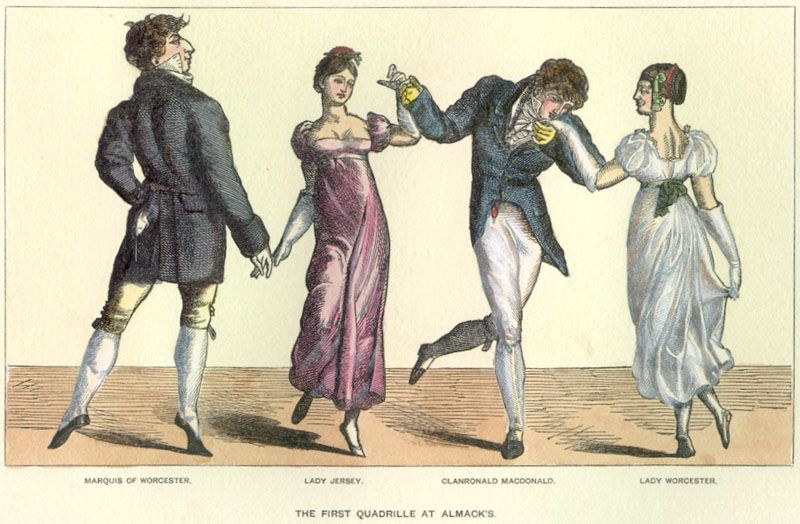
Waltzing during the English Regency? Preposterous!

by David W. Wilkin

One of the challenges that I have encountered as a writer is that history and what is happening around the characters be mostly true to what we know of the past. When I first read Regency Romances and saw inaccuracies, I wanted to fault the writer for what they should have known. Now that I am a writer I recognize that we bend the truth on occasion. Did Wellington really meet our heroine? Was Prinny an intimate of our Lord? But as a dance teacher of many of the dances of the period, nothing irks me more then to see our protagonist out for a spin on the dance floor before the waltz was accepted.

Our principals in uncovering whether this could be done are Thomas Wilson, dance master and author of the period, Tsar Alexander, ruler of all the Russias, and the Countess Dorothea von Lieven-a patroness of Almacks. The time period that this spans is 1813 to 1816, so recounting waltzing in England before then is verboten. Other writers might take exception to this. Waltzing was done on the Continent before 1812. Not as we know it now. The man’s hands were in completely different locations. The tempo of the music also was different, so the footwork is not the turning box step that we have today. Or even the floating circle that Victorian waltz was.

Waltzing on the Continent, in the midst of a war, where movement between society was very limited at the time, most likely would remain on the Continent. Many Romances set in the period of the Regency often turn a blind eye to the war and the effects of the war that went on for nearly 25 years. An entire generation lived at that time, and most books think of this as an after thought. It is clear that the war, and Liberated France had an effect on England. We look at the Regency as the years of 1811 to 1820 when Prince George served as Regent for his father, but culturally we can relate this as the end of the Georgian Era, say from the 1790s (the fall of Bourbon power in France) to the mid 1830s (William IV and Victoria.)

When I was first exposed to the issue, it was through verbal history that we have no waltzing in English Society until the visit of Tsar Alexander to Almacks. As a historian one knows that primary sources are best, and verbal history from 1814, just is very hard to verify at this time. (How old would someone have to be to have been at Almacks to have witnessed the event, 212 years old now?) But primary sources are also hard to track down, and sometimes if a thing is known by all to be true, then is it not true?

In all probability waltzing was known by some, the man’s right hand raised above, his left lowered in between he and his partner, not his left hand clutching the lady behind her back to bring her close to his chest. That of course is great for a romantic Regency novel, and one where your hero and heroine can talk ever so intimately on the dance floor. But should the waltzing of the period been known by a few the Patronesses of Almacks had deemed it socially unacceptable.

Now trying to put in context what that means today. To do something deemed socially unacceptable would be like dining nude in public as if you were a minority in San Francisco (It was recently in the news.) Once you have done it, you find that your circle of friends shrinks a great deal. (It also seems a little unhygienic. The dining in San Francisco thing.) So back to Regency London, if you are at Almacks, well the musicians are not going to play any music for you to have a chance to do so. Their playlist is already set by the Patronesses.

If you have your own ball, and it is found that you had done this scandalous dance, (men holding the hands of their partners throughout, absurd) then would you get vouchers to permit you back to Almacks, where all of society mingles? Not likely. You might be regarded as part of the fast set, those who are talked of in ondits all the time. And of course the waltz needs two to dance. So were you to do so, you also have to corrupt a partner to the dark side also.

Those of us who have learned to waltz, or who teach it, also know that doing so is not something that you snap your fingers and it is mastered. It takes time. So again, how do we allow that a country that does not want to have this dance done by its leaders of society see heroes and heroines in our novels know how to do it before it was taught?

Countess Lieven was a patroness of Almacks, in England as wife of the Russian Ambassador from 1812 to 1834, we see she was a beauty, and notorious for having several liaisons with many statesmen of Europe. She became a Patroness of Almacks sometime around 1814. In 1826, she became the Princess Lieven. She was quite instrumental as a go between when Tsar Alexander slipped into England with his sister, Grand Duchess Catherine. The English adored the Russians much more then they liked their own royalty and this caused no few problems for the allies. (Russia and England were allied at the time against France.) The Countess smoothed matters and Prinny (George IV) became indebted to her.

It is possible that the Countess first taught the waltz, but as the verbal history goes, the Tsar came to Almacks, where there was a ball in the Assembly rooms for Society (having a voucher to Almacks so you could see and be seen was the difference in being part of the Ton, the ten thousand elite of England, and the elite of the Ton.

It is more likely to my mind that the waltz for its intimacy, even though there was more separation between dancers then, then now, was not danced until the Tsar asked it to be played so that he could dance it.

One can see how perhaps the Countess may have showed off the waltz, but it was not yet accepted or allowed to be danced. She was not yet a Patroness of Almacks, she was the wife of an ambassador, she was not English. But in 1814 when she serves to intercede between the Tsar and Prinny, she rises in stature. Then she would have the presence in society to be a leader. She would be able to keep alive a cultural phenomena her sovereign introduced.

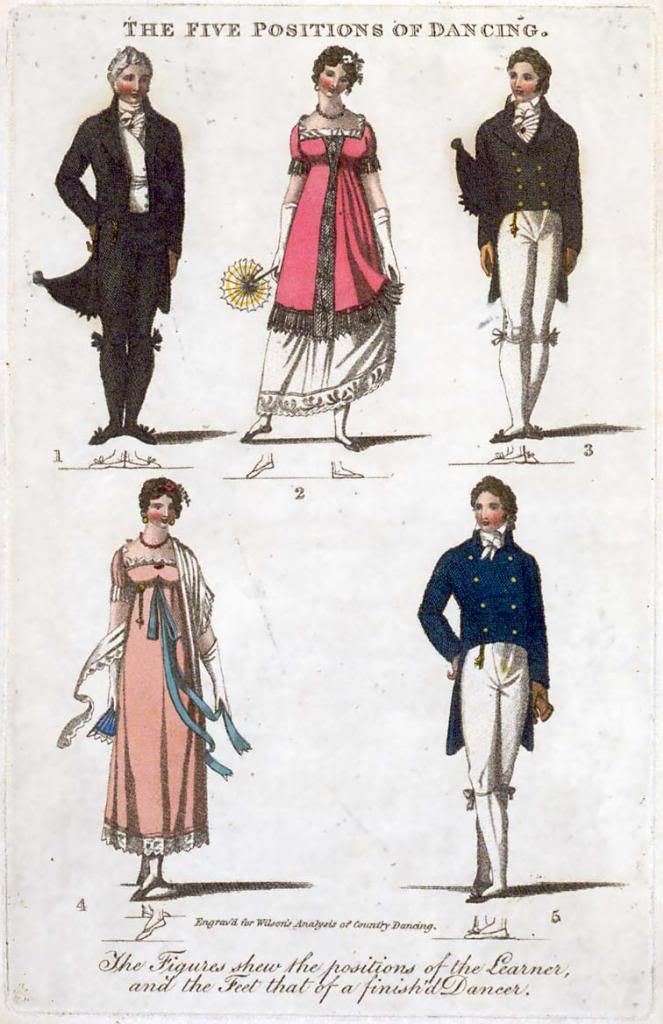
What is my last clue to how things play out, is how does one teach the waltz? Unlike country dance, where we have documentation going back over 150 years at the time to Playford and his The English Dancing Master, we don’t have an English text on the waltz until Thomas Wilson writes A Description of the Correct Method of Waltzing, the Truly Fashionable Species of Dancing, in 1816. Wilson presents a dance as described before, different then we are familiar with now, a five step movement. Are these clues, and pieces of historical fact enough to give us the definitive first day that one can cite that waltzing is allowable in England?

Perhaps.

Perhaps it is enough when we take into account the society of the times. We know the attitude of the period, and we have documentation showing us when others could learn how to do the dance. This research affirmed for me what the verbal history had shown and given me a predilection to. Waltzing before the Tsar visits London, never! But after, well if it is good enough for an Emperor, how can anyone question it being good enough for the Ton.


Research
Elizabeth Aldrich From the Ballroom to Hell, 1991