Showing posts with label !7th century London. Show all posts

Friday, September 21, 2018

Bifrons House: The End

by Lauren Gilbert

Bifrons Park by Jan Wyck
See also, Bifrons House: The Beginning

After John Bargrave “the youngest” sold the house to Sir Arthur Slingsby in 1662, the house had a family in residence again. Sir Arthur was knighted at Brussels in June of 1657, and was granted a baronetcy by letters patent in 1658 at Bruges. He was married, and had two sons and two daughters. Sadly, Sir Arthur died in 1665, at which point his son Charles succeeded to the baronetcy and the estate. Sir Arthur was buried in Patrixbourne on February 12, 1665. Sir Charles sold Bifrons in 1677. This sale was to the first of three or four additional owners. Little is known about the owners of Bifrons until it was purchased by John Taylor Esquire in 1694.

John Taylor was born December 7, 1655. He was the son Nathaniel Taylor Esquire, who had represented Bedford County in Parliament, and had served as recorder for the city of Colchester in Essex under Cromwell. John married the daughter of Sir Nicholas Tempest, baronet, from Durham. Her name was Olivia, and the couple had six sons and one daughter. The two oldest children were Brook (his father’s heir) born August 18, 1685, and Herbert (who succeeded his brother) possibly born sometime in early 1698 (he was baptized May 15, 1698). Sadly, only the two oldest boys survived. Olivia died in 1716. She was buried in Patrixbourne. John represented Sandwich in Kent in Parliament 1695-1698, and again from February-November 1701. John Taylor died April 24, 1729 and was also buried in Patrixbourne. He was succeeded by his son Brook.

The Children of John Taylor of Bifrons Park by John Closterman c 1696

Brook Taylor was a learned mathematician and a fellow of the Royal Society. He became secretary of the Royal Society in 1714, the same year he completed his degree at Cambridge. He was married to Elizabeth Sawbridge, and they had one child, a daughter, also named Elizabeth. Robert died in London in 1731 and was buried in St. Anne’s. His brother Herbert succeeded.

Herbert Taylor was a member of the clergy, being the rector of Hunton and the vicar of Patrixbourne. He married Mary Wake, and the couple had two sons: the oldest was Herbert who succeeded his father, and the younger was Edward who succeeded his brother. Reverend Taylor died September 29, 1763 and was buried in Patrixbourne. His older son Herbert never married, and died November 19, 1767 in London. He was only 36 years old. His brother Edward, now Reverend Edward Taylor, inherited. Reverend Edward Taylor was married to Margaret Paylor in 1769, and they had 5 sons and 6 daughters, the oldest being a son Edward born June 24, 1744, who was his father’s heir.

In 1770, the Jacobean house was demolished and a Georgian style house erected in its place. (Pictures of the later house can be seen at Lost Heritage: England's Lost Country Houses.) As Syrie James explained in her excellent post, the reverend moved his family to Europe due to financial constraints. Margaret died in Bruges April 27, 1780 at the age of 37. They returned to Bifrons, but financial problems continued to dog the family. It appears Reverend Edward Taylor died in 1798, and was succeeded by his son Edward. (Syrie’s article tells Edward’s story in detail.)

The house remained in Edward’s hands, but he moved to a nearby estate and leased Bifrons to John Loftus, the second Marquess of Ely in 1825. The Marquess was the first tenant and lived there 2 years between 1825-1827. In 1828, the house was let Anne Isabella (Annabella) Byron, baroness, Lord Byron’s estranged wife, and her daughter Ada. The house remained in the Taylor family’s hands until, about April of 1830, when Edward Taylor sold Bifrons House to Henry Burton Conyngham, 1st Marquess of Conyngham and his wife Elizabeth (born Dennison), realizing possibly as much as 100,000 pounds.

The Conynghams were an interesting couple. Henry Conyngham was born December 26, 1766, was Irish and succeeded his father as 3rd Baron Conyngham in 1787. He was later made Viscount Conyngham of Mountcharles in the Irish peerage in 1789. He married Elizabeth Dennison July 5, 1794. She was the daughter of a wealthy merchant turned banker. The couple was not themselves particularly well off, until Henry was rewarded for his support of union with Great Britain in the Irish Parliament. When the smoke cleared after the Act of Union passed, he received (among other benefits) 15,000 pounds for his borough in the Irish House of Commons and was made the Earl Conyngham in the Irish peerage. They had 2 sons and 2 daughters.
Elizabeth, Lady Conyngham
His wife’s friendship with the Prince Regent, later George IV, propelled them to court circles around 1812. She became the Prince’s last mistress around 1820. Lord Conyngham benefited from the friendship and her later position as mistress, receiving titles (including the title of Marquess in 1816), a position on the Privy Council and other benefices. Lady Conyngham became a person of influence at court, which lasted until George IV’s death early in the morning of June 26, 1830. Lady Conyngham left for Paris the next day. The Marquess remained in England, and died in London December 28, 1832, at the age of 66. He was succeeded by his oldest son Francis.

Print: The Cunning and Happy Family
(the Marquess of Conyngham is at the left seated on the chamberpot.) 1822
Lady Conyngham had not made herself popular while the king’s mistress, and consequently spent a great deal of time thereafter in Paris. She retained the use of the house until her death, apparently living there when not in Paris. Her son Francis, 2nd Marquess of Conyngham, did a great deal of work in Patrixbourne, including the remodelling of Bifrons House, especially after his mother’s death. She died in Bifrons House October 11, 1861. It appears that the family left the area permanently in 1874, but held the ownership of the property. It was leased to several different tenants including Frank Penn, a famous cricketer. The last tenants were Col. The Hon. Milo Talbot and his wife. Apparently, after the Colonel died in 1932, Mrs. Talbot continued to live in the house until shortly before, in 1939, it was requisitioned for use by the military; Canadian soldiers were housed there. It was used for military purposes until the war ended. It was razed in 1945, as it was deemed too damaged to repair.

Sources include:

See Bifrons House: The Beginning for the sources used.

GoogleBooks. Burke, John, Esq. A GENEALOGICAL AND HERALDIC HISTORY OF THE EXTINCT AND DORMANT BARONETCIES OF ENGLAND. London: Scott, Webster and Geary, 1848. P. 490. HERE; Burke, John Esq., A GENEALOGICAL AND HERALDIC HISTORY OF THE LANDED GENTRY; Or Commoners of Great Britain, Ireland Etc. Vol. III. London: Henry Colburn, 1839. P. 108. HERE; LA BELLE ASSEMBLEE, or Court and Fashionable Magazine. Vol XI from January to June 1830. No. LXIV April, 1830, p. 181. HERE

A Web of English History. “Lord and Lady Conyngham (1766-1832, 1769-1861).” Last modified January 12, 2016. Dr. Marjorie Bloy. HERE

Images from Wikimedia Commons

House: HERE

The Children of John Taylor: HERE

Print:HERE

Elizabeth: HERE

~~~~~~~~~~~~~~~~

Lauren Gilbert was introduced to English authors early in life. Lauren has a bachelor of arts degree in liberal arts English with a minor in Art History. A long-time member of JASNA, she has presented various programs at the South Florida Region, and a breakout session at the the Annual General Meeting in Ft. Worth, TX in 2011. She lives in Florida with her husband. Her first book HEYERWOOD: A Novel is available. She is finishing a second novel, A RATIONAL ATTACHMENT.

For more information, visit her website.


Wednesday, August 3, 2016

Ann Fanshawe: A Memoir of Love

By Cryssa Bazos

Journaling became fashionable during the 17th century. Well-known diarists, such as Samuel Pepys, and John Evelyn documented the affairs of the day, but the memoirs of Ann Fanshawe are a charming testimony of her love for her husband, Richard Fanshawe. She wrote it for her only surviving son, Richard, who was only ten months old when his father died. Ann wanted him to know the character of his father and achievements during his lifetime.

Cornelis Janssens van Ceulen
via Wikimedia Commons
Ann Harrison Fanshawe was born in London on March 25, 1625, the eldest daughter of Sir John Harrison of Balls (Hertfordshire). She had a carefree childhood, and although she was taught the necessary skills expected of one in her station, she was high-spirited:
I learned as well as most did, yet was I wild to that degree, that the hours of my beloved recreation took up too much of my time, for I loved riding in the first place, running, and all active pastimes; in short, I was that which we graver people call a hoyting girl; but to be just to myself, I never did mischief to myself or people, nor one immodest word or action in my life, though skipping and activity was my delight.
Throughout her life, she never lost her passionate and spirited nature. If her words mirrored her essence, she was an engaging and charming woman. There is no doubt that this is one of the traits that endeared her to Richard Fanshawe.

Had it not have been for the English Civil War, Ann and Richard may never have become acquainted. Although Ann was related to the Fanshawes through her mother’s side, Richard, who was seventeen years her senior, spent years abroad on the Crown’s business, only returning before the war.

By Unknown painter (British school)
(BBC Paintings [1] date: 2012-01-19 01:47:52)
[Public domain] via Wikimedia Commons
Richard Fanshawe was born in June 1608 to an ancient family whose lineage traced back to the time of William of Normandy. Richard’s great-grandfather improved the family fortunes when he became a respected civil servant during the reign of Henry VIII. Richard followed in his ancestor’s footsteps. He attended Cambridge for law, but the subject did not suit him, and instead travelled to Paris and Madrid where he became secretary to the English Ambassador to Spain. When the English Civil War broke, King Charles I appointed Richard Secretary of War to the Prince of Wales (future Charles II).
He was ever much esteemed by his two masters, Charles the First and Charles the Second, both for great parts and honesty, as for his conversation, in which they took great delight, he being so free from passion, that made him beloved of all that knew him.
The couple was married on May 18, 1644. Even though they had good prospects, this was a time of war and uncertainty so had very little resources to get them settled.
We might truly be called merchant adventurers, for the stock we set up our trading with did not amount to twenty pounds betwixt us;
In her memoirs, Ann described Richard’s personality with a great deal of affection. She took joy in remembering their special times together.
He never used exercise but walking, and that generally with some book in his hand, which oftentimes was poetry, in which he spent his idle hours; sometimes he would ride out to take the air, but his most delight was, to go only with me in a coach some miles, and there discourse of those things which then most pleased him.
Here was an intelligent and reserved man, a complimentary opposite to Ann’s more vivacious nature. Ann’s love for her husband remained undimmed after twenty-two years of marriage. Theirs was a perfect match:
Glory be to God, we never had but one mind throughout our lives. Our souls were wrapped up in each other's; our aims and designs one, our loves one, and our resentments one. We so studied one the other, that we knew each other's mind by our looks. Whatever was real happiness, God gave it me in him;
Over the course of their marriage, there were times when they had to be apart due to Richard’s work, and Ann felt those separations keenly. The first time, and possibly the most difficult, was after the birth of their first son, when Richard left to join the Prince of Wales in Bristol as his personal secretary. The child was sickly and did not survive.
I then lying-in of my first son, Harrison Fanshawe, who was born on the 22nd of February [1645], he left me behind him. As for that, it was the first time we had parted a day since we married; he was extremely afflicted, even to tears, though passion was against his nature; but the sense of leaving me with a dying child, which did die two days after, in a garrison town, extremely weak, and very poor, were such circumstances as he could not bear with, only the argument of necessity;
Richard sent for her as quickly as he could and in May of that year, Ann joined him in Bristol. By then, the war was not going in the King’s favour, and the Fanshawe’s were forced to move around as dictated by the changes in Royal fortune. They lived one year in Ireland, when Richard was Treasurer of the King’s navy, but were forced to leave for the continent when Cromwell arrived with an invading army.

They set sail on a sixty-gun merchant ship, laden with rich goods, and encountered a Turkish galley. Fearing to be taken as a prize if the Turks realized they were not a man o’ war, the captain locked the women in their cabins and prepared for battle. Ann was beside herself with worry for Richard, who joined the ship’s crew armed with gun and sword. As a true heroine, Ann was determined to meet this enemy by her husband’s side. Resourceful woman that she was, she bribed a cabin boy to release her:
I, all in tears, desired him [the cabin boy] to be so good as to give me his blue thrum cap he wore, and his tarred coat, which he did, and I gave him half-a-crown, and putting them on and flinging away my night clothes, I crept up softly and stood upon the deck by my husband's side, as free from sickness and fear as, I confess, from discretion; but it was the effect of that passion, which I could never master.
Richard must have been shocked when she appeared on deck dressed as a cabin boy. The first chance he could, he “snatched me up in his arms, saying, ‘Good God, that love can make this change!’ and though he seemingly chid me, he would laugh at it as often as he remembered that voyage.”

The next years were financially difficult for them, and rather than live on credit, Ann made frequent trips to England to obtain funds for her husband. In 1650, a year after the execution of Charles I, Richard left for Scotland to join Charles II in his bid to win back his father’s throne.

Richard fought at Worcester on September 3, 1651, the fateful battle of the civil war when the King lost to Cromwell and barely escaped with his life. Ann went wild with worry not knowing what happened to her husband.
When the King being missed, and nothing heard of your father being dead or alive, for three days it was inexpressible what affliction I was in. I neither eat nor slept, but trembled at every motion I heard, expecting the fatal news, which at last came in their news-book, which mentioned your father a prisoner.
She wasted no time and left for London. By chance, she met an acquaintance who gave her information about Richard and promised to make arrangements for her to meet him. She arrived at a Charing Cross inn with her father and the friends, not knowing if that would be the last time she would see him. When Richard saw Ann crying, he said, “Cease weeping, no other thing upon earth can move me.

After this, Richard was taken to Whitehall and held prisoner in isolation for ten weeks. Not even Ann was allowed to visit him, but every day she would go to Whitehall and see him at his window:
During the time of his imprisonment, I failed not constantly to go, when the clock struck four in the morning, with a dark lantern in my hand, all alone and on foot, from my lodging in Chancery Lane, at my cousin Young's, to Whitehall, in at the entry that went out of King Street into the bowling-green. There I would go under his window and softly call him: he, after the first time excepted, never failed to put out his head at the first call: thus we talked together, and sometimes I was so wet with the rain, that it went in at my neck and out at my heels.
It was Oliver Cromwell who was instrumental in gaining his release. Richard’s health was poor, and he advised Ann to get a doctor’s certificate stating that her husband was near death. Cromwell argued in favour of his release so he could receive treatment, and Richard was released on £4,000 bail.

Richard was now on parole and would continue to be until the death of Oliver Cromwell. When he was released from his bond, he relocated his family to Paris where he remained with the exiled King until the Restoration. At Charles II’s coronation, Richard occupied a place of honour, riding upon the King’s left hand with “rich foot-clots, and four men in rich liveries.” Ann’s pride in her husband could not be surpassed.

On June 26, 1666, Richard fell ill of the ague and died abroad, leaving Ann to raise their son and four daughters alone. She made arrangements to bring him home for burial where he was eventually laid to rest at St. Mary’s in Ware.

Ann included a lengthy prayer in her memoirs that spoke of her grief, even eleven years after Richard’s death. She admitted that she considered withdrawing from society in Richard’s memory but her duties as mother prevented her from doing so.

Ann Fanshawe passed away on January 20, 1679 at the age of 55, just over twelve years after Richard died. I believe that she was at peace in her final moments with the knowledge that she would soon be reunited with her love.

CC BY 4.0
(http://creativecommonsorg/licenses/by/4.0)
via Wikimedia Commons
[This article is an Editors' Choice post and was originally published on 15th March 2015]
~~~~~~~~~~~~~

References:
Memoirs of Lady Fanshawe, Wife of Sir Richard Fanshawe
Complete Baronetage, Volume III, 1649-1664, by George Edward Cokayne.

Bio:
Cryssa Bazos is a historical fiction writer and 17th Century enthusiast with a particular interest in the English Civil War. For more stories about that period, visit her blog.

Saturday, April 16, 2016

London's Lost Jewels: Wealth and Display in the 16th and 17th Centuries

by Mark Patton

This post is an EHFA Editor's choice. It was first published on December 9, 2013

In 1912, workmen engaged in the extension of a cellar at 30-32 Cheapside, in the City of London, came upon an ancient treasure-chest. Opening it, they saw not only the glistening of gold, but also the gleam of pearls and the brilliance of emeralds and diamonds. They took their discoveries to a well-known pawn-broker and antiquities dealer, George Fabian Lawrence.

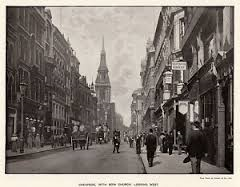
Cheapside in 1890

Better known as "Stony Jack," Lawrence had played an important role in educating the working men of London's building trade as to the archaeological discoveries they might expect to make. He regularly paid them for the objects they found and, even if these objects had little value, rarely sent a man away with less than the price of a half-pint of beer.

George Fabian Lawrence, or "Stony Jack" 

The Cheapside discoveries, however, were in a different league. Recognising key pieces as dating to the Elizabethan or Stuart period, Lawrence contacted Lord Harcourt, a trustee of the London Museum. The hoard was declared to be "Treasure Trove," and most of the pieces were acquired by the museum. They now form part of the collection of the Museum of London (www.museumoflondon.org.uk), and are the centrepiece of a public exhibition open until 27th April 2014.

The Cheapside Hoard, as it is known, is not a set of family jewels, but rather the stock-in-trade of a 17th Century jeweller. Cheapside was known for its jewellery shops at the time, and the hoard includes uncut and unset gemstones as well as finished necklaces, brooches, rings and watches.

A jewellery workshop of 1576

The discovery of the New World, and the explosion of international trade in the reign of Elizabeth I, had revolutionised London's jewellery trade. The hoard includes pearls from Borneo, Sri Lanka and the Persian Gulf, as well as emeralds from Colombia.

This watch, set into a large emerald from Colombia,
is one of the most valuable items in the collection (image - Museum of London)


This little brooch, in the form of a salamander (a symbol of endurance and resurrection)
is inset with Colombian emeralds and Indian diamonds (image - Museum of London)

Several of the objects in the hoard were already ancient when they were acquired by the 17th Century Cheapside jeweller. There are several gems carved with images of the saints from the 3rd-6th Centuries AD, another from the 14th Century, carved with an image of St George and the dragon, and even several pieces from pagan classical times.

This cameo, carved from sardonyx, was probably made 
in Alexandria in the 1st Century BC, and may depict Cleopatra 
with the attributes of the Goddess Isis (image - Museum of London)

One tiny gemstone, a carved carnelian gem, gives a vital clue as to the date at which the jewellery was buried. It bears the arms of William Howard, the first Earl of Stafford, who received his title from the king in 1640. This is the earliest date at which the jewellery could have been buried. It was clearly buried before the Great Fire of London in 1666, since the fire destroyed the building above the cellar.

The "Stafford Gem," a crucial piece of dating evidence
for the Cheapside Hoard (image - Museum of London).
The Great Fire of London, Dutch School, c1666

During the English Civil War, the City of London declared for the Parliamentary side. Perhaps the Cheapside jeweller was a man of Royalist sympathies, who buried his stock-in-trade for safekeeping, before stealing away to join the armies of Charles I?

Or perhaps, like many London goldsmiths, he was a foreigner, a man from Northern Europe who preferred to escape to his own country rather than face the chaos of a Civil War in which he had no role, but who dared not carry his treasure past the inevitable military checkpoints?

Whether he was killed in battle, or fell victim to one of the outbreaks of plague that swept across Europe in the 17th Century, he was clearly never able to recover his property, and the hoard remained in the ground, undamaged by the fire, and undiscovered until 1912.  

In it are to be found some of the best examples of the jeweller's art to have survived from the times of Elizabeth I and James I, showing the range of materials available to goldsmiths and gem-cutters of the period, and the variety of techniques they used to work them.

It is a testament, also, to the impact of global trade on the 16th and 17th Century, and the speed with which the fruits of this trade became available to wealthy Londoners for the purposes of personal adornment.

~~~~~~~~~~~~~

Mark Patton blogs regularly on aspects of history and historical fiction at http://mark-patton.blogspot.co.uk. His short story, "White Wings," was long-listed for the 2015 Aestas Prize, and is published in the Aestas Anthology, which can be purchased from Amazon UK or Amazon USA

Wednesday, July 17, 2013

Let There Be Light...Lighting London's Streets

by Regina Jeffers


In describing London at the end of the 1600s, Francis Maximilian Mission, author of Nouveau voyage d'Italie: avec un mémoire contenant des avis utiles à ceux qui voudront faire le mesme voyage (New travel from Italy: with a report containing of the opinions useful to those which will want to make the mesme travel), said:

“They set up (at every tenth house) in the streets of London (Mr Edward Hemming was the inventor of them about fifteen or sixteen years ago), lamps, which, by means of a very thick convex glass, throw out great rays of light which illuminate the path…They burn from in the evening until midnight, and from every third day after the full moon to the sixth day after the new moon.”

Mission had erred in his estimation of the use of lighting in the early 18th Century, but the City, obviously, impressed the French writer and traveler. As early as the 17th Century, the law enforced street lighting from Michaelmas (September 29) to Lady Day (New Year’s Day until 1752, but with the adjustment of the calendar from Julian to Gregorian, April 6) each evening until midnight.

In 1417, Sir Henry Barton, Mayor of London, ordained “lanterns with lights to be hanged out on the winter evenings between Hallowtide and Candlemasse.” Paris led the way with lighting the streets. A 1524 order said inhabitants were to keep lights burning in windows, which faced the street. With the regulations of 1668 to improve London’s streets, the residents were “encouraged” to hang out their lanterns each evening.

In 1690, an order required residents to hang their own lights before their homes. By an Act of the Common Council in 1716, all housekeepers, whose houses faced any street, lane, or passage, were required to hang out, every dark night, one or more lights, to burn from six to eleven o’clock, under the penalty of one shilling as a fine for failing to do so.

The aforementioned Edward Hemming attempted to set up lights in 1685 Cornwall as an example of his plan to light London with whale-oil lamps. Needless to say, the Companies opposed Hemming’s plan. Those who made tallow chandlers, tinsmiths, and horners saw Hemming’s proposal as a threat to their livelihood.

The historian, James Peller Malcolm, recorded that “Globular lights were introduced by Michael Cole, who obtained a patent in July 1708.”  Malcolm went on to describe “a new kind of light, composed of one entire glass of globular shape, with a lamp, which will give a cleaner and more certain light from all parts thereof.” Supposedly, Cole first exhibited the light outside a St James coffee house in 1709.


Cesar de Saussure, who has left an amusing and detailed description of his journey from Yverdon, Switzerland, through the German States and then across the North Sea from Rotterdam to London, describes the London streets of 1725 as, “Most of the streets are wonderfully well lighted, for in front of each house hangs a lantern or a large globe of glass, inside of which is placed a lamp which burns all night. Large houses have two of these lamps suspended outside their door by iron supports, and some houses even four.”

The most commonly used fuels until the late 18th Century were olive oil, fish oil, beeswax, whale oil, sesame oil, nut oil, etc. From parish to city parish, a system was put into place to raise a rate from “eligible” households for lighting the streets. Later, a similar system was used for financing paving the streets and establishing a watch. A series of Acts of Parliament established the necessity for proper lighting for London’s streets. A 1736 Act gave the City of London the power to charge the inhabitants for lighting the streets throughout the year.

From Dan Cruickshank and Neil Burton’s Life in the Georgian City, we learn,

“The aldermen and common council began by determining how many houses there were in the City, valued them, decided how many lamps were needed and what they would cost to erect and maintain, and then determined what proportions of the total each rateable inhabitant would have to pay. There were, it was calculated, 1,287 houses with rent under 10 pounds per annum 4,741 with rent between 10 and 20 pounds per annum; 3,045 with rent between 20 and 30 per annum; 1,849 with rent between 30 and 40 per annum; and 3,092 with rent of 40 pounds and upwards per annum. 'In all, 14,014 houses, then inhabited and chargeable.' 

"The reference to rent should not be confused with actual rent paid.' Rates were calculated on the value of a house that was expressed in terms of the rent it was worth. This is not to say that the occupier was actually paying that rent: he could have been a freeholder, a most rare thing in the 18th Century city, paying no rent; a lessee paying merely a nominal ground rent to the landlord; or a sublessee on a short lease paying a rack rent. The committee then established that the number of lamps required was 4,200, exclusive of those wanted in 'public buildings and void places.' 

"This was based on the decision that lights should be 'fixed at 25-yd distance on each side of the way in the high streets, and 35 in lesser streets, lanes, etc.' The money was calculated and raised in the following manner: The several wards of the City agreed for lighting them at an average of 41s. per annum per lamp, at which rate the expense of 4,200 lamps amounted to 8,610 pounds. The fixing of those on posts and irons, averaged at 14s. 6d. each [equalled] 3,045 pounds. 'Houses under 10 pounds [rent] paid 3s. 6d. per annum; under 20 pounds paid 7s. 6d.; under 30 pounds paid 8s.; under 40 pounds paid 9s. 6d.; upwards of 40 pounds paid 12s.'"

In 1726, Stephen Hales procured a flammable fluid from the distillation of coal. From "158 grains [10.2 g] of Newcastle coal, Hales stated he obtained 108 cubic inches [2.9 L] of air, which weighed 51 grains [3.3 g], being one third of the whole." However, Hale's results passed without notice for several more years.  


~~~~~~~~~~~~~

Regina Jeffers loves all things Austen and is the author of several novels, including Darcy’s Temptation, Captain Wentworth’s Persuasion, The Disappearance of Georgiana Darcy and Second Chances: The Courtship Wars .

Her website is: www.rjeffers.com