Thursday, July 30, 2020

A Photo Tour of Hadrian's Wall

by Richard Denning

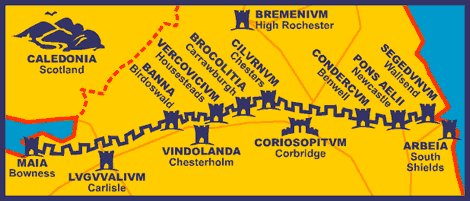
Over the weekend of 4th to 7th July I spent parts of four days touring Hadrian's Wall.The father of a friend is a custodian of the wall (his job is to, as best as possible, keep the wall in good repair). Thus equipped with our own tour guide half a dozen of us set off up the M6 from Birmingham.

The idea was to hit as many significant locations on the Wall as possible in the time we had along with the secondary objective of enjoying some decent real ale along the way!

Brief historical Background.

The Emperor Hadrian established the main borders of the Roman Empire. Although later Emperors would try expeditions outside these bounds the Empire more or less maintained the size and shape that he defined for three centuries. To defend the most northern edge of the empire from the barbarians outside he ordered the building of this wall in the year 122. It was manned more or less continuously through to the year 410. Today it is a World Heritage Site.

Anatomy of the Wall


The wall consisted of a twenty foot high, ten feet wide stone wall that was around 70 miles long and capped with a parapet and crenelations. Every mile was a minor Mile fort that would house a small section of men. Between mile forts were turrets for a small patrol. Along the wall, or sometimes behind it, are major forts with large garrisons and a surrounding civilian town. 10,000 men in all would garrison the wall. In front of the wall is a ditch, and behind it a grass mound and ditch called the Vallum.

Centuries later after the Jacobite rebellions of the 18th century came along. The main impact on the wall was that the English commander demolished large chunks to provide the rubble to build a military road from Carlisle to Newcastle running west to east behind and sometimes along the wall. Today it is the B6318 road and provides a perfect way to navigate along the wall.

Our Tour begins


On Friday 4th July we arrived at Carlisle around noon. We started with a visit to Tullie House Museum in Carlisle. This houses a good overview exhibit about the wall and the Roman Period and serves as an ideal starting point. We then went west out of Carlise to the Cumbrian coast. Although the Wall itself extended from Bowness to Wallsend there are supporting fortifications down both the Irish sea and North sea coast, and the idea was to see something of them.


We visited Maryport. In Roman times a fortress, Alauna, stood here. The fort was first established in around AD 122 as a command and supply base for the coastal defences that would prevent Pictish or Irish raids along the coast. Today the fort is only an outline in the grass. There is however a museum showing part of a large collection of Altars that would be made with each new commander. The old altars were used later as supports for posts of a large hall - perhaps in the post Roman period.

The mounds and lines that


A replica wooden watch tower that now functions as a view point at Alauna.

Around this time we had the only bad weather of an otherwise rather pleasant July weekend. It just poured down, and we abandoned attempts to see the other forts in the area. We did stop briefly at Bowness and looked out over the Solway Firth at the spot that the wall once started. There are no stone ruins west of Carlisle however - for that we would have to head east on Saturday.

Our Friday night Hotel turned out to occupy the site of a Roman Fort that stood on the wall. Today nothing is visible but a display board, and the brick line in the carpark of the hotel shows where the fort stood. It was rather fun to spend the night in a Roman fort - even if the fort vanished centuries ago.

Uxelodunum Fort Carlisle - its location

Day Two

Saturday meant time for some ruins. Our itinerary on the Saturday was to visit the first sections of the wall still visible coming from the west, the Roman Army Museum and the Vinolanda Fort.


I can recommend the most western section of surviving wall for a nice walking tour. Here is the local map:


First stop was the first section of wall and a turret.

The most western surviving section of wall  and a turret just west of Birdoswald.

The first turret on the wall. (Turret 52a Banks Turret) Just off the Of map

Just further along this road is Banna (known today as Birdoswald. This is the location of a significant sized partially excavated fort.

Birdoswald is adjacent to a later farmhouse and small manor house whose
19th century owners were some of the first enthusiastic excavators of the site.

Birdoswald has a nice little museum recording the first haltering attempts to excavate the wall in the 18th and 19th centuries.

Inside Birdoswald Museum

For more images on Birdoswald click here

We then walked the wall from Birdoswald the two miles to Gilsland. This route took us past a long section of surviving wall, two turrets and a milecastle and the remains of one side of a Roman bridge.

The Wall between Birdoswald and Gilsland.


The River Irthing - once bridged at this point by a Roman Bridge. A beautiful peaceful spot.


The Bridge approach in the eastbank is now all that is left.

Roman Army Museum

This museum at Brampton gives a excellent overview of life in the Roman army. It includes a well done 3D movie "Edge of Empire" whose participants also appear in a film  later on about a day's life in the army. There are lots of replica items from the period.


Nearby is Vindolanda, one of the star attractions of the wall. A huge part of the fort and nearby Viccus is excavated. Vindolanda lies behind the wall. It was a nearby supply base for this section of the wall.

Vindolanda visitors can explore the site, visit a museum in the former house of an early excavator, as well as climb replica stone and wooden towers.

Excavation is still on going all along the wall and you can often see digs and get
explanations of what is going on. Here our own guide fill us in on wooden  walls found
deep below the stone fortress - maybe an early part of the first fort here.

A well inside the commandant's house.

This was a granary. The elevated floor was to allow ventilation beneath.
The Romans would let dogs and cats chase the rats out from there.
The side buttresses can be seen - reinforcement for the tall (often 2 story) walls).

There are more Vindolanda images here

Day Three

On the Sunday we took in Housesteads, Chesters Fort and Corbidge. On the way to Housteads we passed Sycamore Gap.  This section of the wall runs along an escarpment which is almost sheer in places.


There is a dip in the high ground of this escarpment, and in that dip a tree grows made famous by Robin Hood Prince of Thieves from the bit where Kevin Costner is walking home to Sherwood from Dover and ends up on Hadrian's Wall somehow! Ah well, at least Alan Rickman was good as the Sheriff. Costner chose a good cinematic location, mind you, and it is a good spot for a photo. A tip though. Park up in the nearby Once Brewed Carpark and walk along the ridge. Don't try and reach it from the road as fences lie in your path - as well as a bog.


Housesteads fort  lies on the wall. To me it is one of the most dramatic locations as the approach walk dips down from one ridge and up towards the site above you on the far slope. You then have to endure heart attack hill as one of of our party called it. But the walk is worthwhile when you find yourself in Housesteads.


Housesteads is built on a slope, and many of the buildings are built on more than one level.

Hypocaust under floor heating system

Looking North from Housesteads over the wall and a tower. This way lie the barbarians!

More images from Housseteads here

Chesters Fort is not far from Housesteads and is on the River Tyne. There is a fort at Chesters that has all the usual features like granaries, barrack blocks, and commanders house, etc., but after 3 days of this we were getting a little "seen that done that", so I was pleased that Chesters had a bath house in decent condition as that was something I had not seen close up in the other sites. The bath house was on the river.


Changing room


Drainage system

Chesters has a fine museum of stone relics and other items found on various digs.

Joking aside, the fort is also a fine example. For more images from Chesters Fort, including the fort itself, go here.

Corbridge

Near the wall were other settlements that sometimes had heavy military presence and at other times did not. Corbridge, not far from Chesters, is such a place. This has evidence of military compounds within a more open civilian settlement which itself was probably not fully fortified. It's a slightly different feel and rounded off day 3 nicely.

Among other structures was a huge pair of granaries that may
have stored supplies ready for shipping up to the wall.

Although not purely a military base, the headquarters of the military compound contains
an underground strongroom of the sort found in all the forts.
More images from Corbridge here

Day 4

On the Monday morning we packed up ready for the homeward trip. First though we had 2 final visits.

Segedunum

Segedunum is at the extreme eastern end of the wall. It lies within modern day Newcastle. The fort here is excavated in outline only - outlines filed in mainly with rocks and pebbles to show the layout. As such its not as impressive as say Housesteads. However it is in some ways clearer to see what goes where in a Roman fort especially as there is a panorama level in the adjacent museum which allows you to see the entire fort from up high (or at least the half that is visible above ground).

Looking down on Segedunum from the Panorama room.
The site also features a reconstructed Roman Bath House (alas closed during our visit)


The site also has the most eastern section of Wall. This is where the wall went down hill into
the River Tyne 70 miles from its western end on the Solway Firth.

There is also a memorial to the men and units that built the wall.

Arbeia

Arbeia is a mirror to Alauna/Maryport. Just as Alauna watched over the Irish sea, Arbeia stood watch over the coast line of the Northsea just below the mouth of the Tyne. Today there is a partially excavated fort but what is of main interest here is a replica gatehouse, barracks block, and commandants house.

This is me standing outside the replica gatehouse.
This is what Hadrian's wall would have looked like as you approached it.
A Roman squad of 8 men slept in here.
10 such rooms made up the accommodation for one century.

This is the more spacious centurion's room.

Bedroom in the Commandants House

Public dinning room in Commandants House.

More Arbeia images here

All in all a great 4 days. I had in the past visited the Wall 2 or 3 times and each time just went to one fort. This tour gave me a much clearer overview of the whole wall from end to end, its general anatomy, how it was built, and the way of life of its inhabitants. It is a World Heritage Site and for good reason.

On a nice sunny day - such as we had - it is a magical location combining amazing views in places with a structure of huge historical significance.

Oh - and we got some good ale too!

This article is an Editor's Choice from the EHFA Archives, originally published July 14, 2014.

~~~~~~~~~~~~~

Richard Denning is a historical fiction author. His main areas of writing are the early Anglo-Saxon years. For more details go to his website: http://www.richarddenning.co.uk/

Wednesday, July 29, 2020

The Royal Pavilion, Brighton

By Carolyn Miller

A few years ago, I was blessed by the opportunity to visit my sister who was living in London at that time. For an Australian who had long dreamed of seeing England, this was a wonderful opportunity indeed. One of the places I had to see was the Royal Pavilion in Brighton, something that seemed most fantastical, a monument to the excesses of the Prince Regent, and something I’d read about in works such as Georgette Heyer’s Regency Buck. 

Originally built as a farmhouse and situated on Brighton’s main thoroughfare, the Steine, the Prince Regent bought the property in the mid-1780s when he wanted an establishment outside London. The salubrious sea air, the distance from the pressure of court, and the position that enabled him to discreetly conduct his affair with Mrs. Fitzherbert, who resided nearby, were all doubtless strong inducements to settling in a place long recommended by his uncle, the Duke of Cumberland (known to enjoy gaming and the theatre).


In 1787 the Prince Regent requested architect Henry Holland’s assistance. Holland, who had previously worked on London’s Brook’s Club and the neoclassical remodelling of Carlton House, added a central domed rotunda, cream tiles and Ionic columns, and the former farmhouse became known as the Marine Pavilion.

John Nash was later called on to create designs that reflected the Regent’s interest in the Orient. According to John Morley who wrote the wonderful The Making of the Royal Pavilion, the Prince Regent was very hands on in specifying what he did and didn’t want, which is why we see the fantastic mix of the Oriental, Moorish, and Indian in the building today. Nash’s remodelling also had to take into account the Prince’s new stable block, built by William Porden in 1804-1808 with a great dome and minarets, that could accommodate sixty (!) horses, and which towered over the Marine Pavilion. A house fit for a Prince (and future king) had to be fashioned.


From 1815 to 1823, further transformations saw the construction of the Great Kitchen, the Music Room and the Banqueting Room, and the new king’s status saw the Royal Pavilion moniker adopted. The dramatic façade included many minarets, onion shaped domes and cupolas, an exotic contrast to Holland’s earlier classical designs. Inside, redecoration became necessary, and designers Frederick Crace and Robert Jones—with specific direction from the Prince Regent—were largely responsible for the chinoiserie-infused decoration schemes, which blended various elements of Chinese décor for dramatic effect. The decoration of the rooms is designed to increase in vibrancy as the visitor enters through the Asian-inspired yet subdued Octagon and Entrance Halls, to the crimson theatricality of the Long Gallery and the State Rooms beyond.


The Long Gallery seen today is not dissimilar to the illustration of 200 years ago, in Nash’s Views of the Royal Pavilion, (published 1827), with its painted glass ceiling, tasselled lanterns, bamboo furniture and richly patterned carpet. The 1950s restoration show walls that strongly resemble the original design of trees, leaves and birds, which together with the bell-lined ceiling and mirror-backed doors give the illusion of an endless corridor in an exotic Oriental pagoda. No doubt those who gathered for cards and conversation would have spent much time talking about the fantastic (garish?) décor, the likes of which many visitors would never have seen before.

Passing through the Long Gallery serves as dramatic entrance to the magnificence that is the Banqueting Room. Robert Jones is understood to have designed this interior, a fabulous gilt-laden room of Chinese inspiration, centred by a grand chandelier suspended from a silver dragon. This 30ft chandelier holds six more dragons who breathe light into glass lotus shapes, and is believed to have cost eleven thousand pounds sterling. Princess Lieven is reported to have said “I do not believe that, since the days of Heliogabalus, there has been such magnificence and luxury” (John Morley, The Making of the Royal Pavilion). Dragons are a feature of the room, and can be seen festooned on sideboards, the Spode torchere, gilt wood columns, and the large Axminster carpet, the sumptuous display designed to show off the host’s status and wealth.


Palm tree columns were used to hide the cast iron supports for the upper floors in the Great Kitchen, a place that also employed the latest technology to create lavish meals, such as the famous menu designed by the French chef Marie-Antoine Careme with 60 dishes! Apparently the Prince Regent’s visitors were escorted to see this room (also known as the King’s Kitchen), and the attention to detail here further demonstrates the desire to impress with the best money could buy.

Further rooms continue to emphasise such things. The Banqueting Room Gallery, part of the original farmhouse, consisted of two rooms, an anteroom and a breakfast room. These were combined in 1815 to form the Blue Drawing Room, after Frederick Crace’s colourful decorating scheme. Nash’s later design saw the room designated as a gallery for use after dinner, with a more subdued colour palette, designed for guests to relax after the Banqueting Room’s excesses. Palm tree columns and the Dolphin Furniture (c. 1810), decorated with maritime motifs, demonstrates the importance of the sea and Nelson’s victories over Napoleon.


The rounded Saloon, situated directly under the central dome, dates from Holland’s time, and while its physical shape remained unaltered by Nash’s renovations, the interior décor changed several times over the years, from neoclassical style, to Frederick Crace’s Chinese wallpaper and clouded ceiling, to Robert Jones’s opulent, regal theme, complete with Indian motifs, completed in 1823. Today’s visitor will soon see a freshly restored room of silver and white, silk panels, and a replica of the carpet designed by Robert Jones.

The Music Room Gallery, used for recitals and smaller concerts and occasionally for dancing, provided respite from the more ornately decorated State Rooms. Frederick Crace’s earlier design showed a bright yellow drawing room, complete with Chinese-inspired details, which was replaced by another Crace design in 1821 that was more restrained, perhaps more in keeping with the role of the new king.

George IV loved music and would often join in with the evening’s entertainment, singing whilst accompanying himself on the pianoforte, and the Music Room was a favourite place for him to indulge his passion. Designed to hold an orchestra as well as many guests, this State Room has a domed ceiling with nine chandeliers of painted glass shaped like lotuses, painted dragons supported canvases of Chinese scenes, silver dragons held up blue silk draperies, and the gilding used throughout. An astonishing room indeed.


Of course, not all of the Prince Regent’s contemporaries approved such lavish displays of wealth. A number of people, no doubt influenced by the extravagant costs associated with the seemingly constant refurbishments, and the fact the Prince ‘paid’ for such refurbishments via taxes, were quite critical. The Pavilion has been described as “like a collection of stone pumpkins and pepper boxes,” “long been the subject of laughter all over the country,” “as if the genius of architecture had at once the dropsy and the megrims…fantastical,” and “it looks as if St Paul’s Cathedral has come down to Brighton and pupped.”

But despite this criticism, I think the Royal Pavilion in Brighton is a must see. I’m so glad this splendid edifice to royal Regency (and questionable!) taste has been preserved through the years, so if you get the chance, take the hour-long tour, then spend time in the lovely gardens. The Royal Pavilion truly has to be seen to be believed.

[all photographs copyright of the author]

[This is an Editor's Choice archive post, originally published on EHFA 2nd August 2018]

~~~~~~~~~~

Carolyn Miller lives in the beautiful Southern Highlands of New South Wales, Australia, with her husband and four children. Together with her husband she has pastored a church for ten years, and worked part-time as a public high school English and Learning and Support teacher. A longtime lover of romance, especially that of Jane Austen and Georgette Heyer’s Regency era, Carolyn holds a BA in English Literature, and loves drawing readers into fictional worlds that show the truth of God’s grace in our lives. Her Regency novels include The Elusive Miss Ellison, The Captivating Lady Charlotte, The Dishonorable Miss DeLancey, Winning Miss Winthrop and Miss Serena's Secret, all available from Amazon, Book Depository, Koorong, etc

Connect with her:        website | facebook | pinterest | twitter | instagram


Monday, July 27, 2020

Law & Order - Duties of the Constable in 17th Century England

by Deborah Swift


A Conventicle preacher brought before the Justices


The Role of the Constable
In the 17th century the responsibility for law and order fell on the community through its constables; though actually only a proportion of the community were eligible for this post – that is the householders. Tenants were not allowed to be constables. The office was usually held yearly amongst the wealthiest householders who were obliged to serve, or provide a deputy in their stead. I have read of one occasion in 1644 where in Upton, the householder turned out to be a widow. Given the often violent nature of the job, Jane Kitchin was obliged to hire a deputy. Though I have to say, I rather like the idea of a woman fulfilling this role.

Unlike later police, the position was strictly amateur, with the constable receiving no remuneration for his services, which could be both dangerous and cumbersome. However, what it did do was to promote a shared citizenship, and in the early 17th century, gave prominent householders an understanding of how the systems of ancient Manorial land ownership worked. Once a year, the constables from neighbouring parishes were sworn in at the local Justice’s office or residence by the High Constable of the County.

Their duties were primarily in disputes over land and territory, particularly with regard to tenancies, but also after the Excise Act of 1642 they were also charged with collecting tax and duty on goods. A duty was put on provisions coming into the cities from the country – on beer and cider and soap, and the next year on salt, hats, starch, and copper goods. This law was extremely unpopular, as these were not imported items from abroad, as before, but everyday necessities, and the enforcing of this law, and the collection of these monthly excise duties must have been a great burden on the elected constables.

Like doctors or vets today, the constables were constantly ‘on call’, meaning they often had to leave their dinner or their sleep to deal with the drunk and disorderly, street fights, or criminal activities.

Hue and Cry
If a murder or robbery had been committed, or a criminal had escaped, the Constable was responsible for recruiting a search party. The pay for chasing a criminal was anything from one penny to one shilling, depending on the perceived danger. The constable could call upon the villagers or townspeople for help, and anyone who refused to give chase or lend his horse to the party, was fined. The chases were known as Hue and Cry
‘given to Richard Taylor for going to Aram with a Huincri in ye night 2d’
Upton Constable's Account Book 

Hue and Cry of 'Canonbury Besse'

When the miscreant was caught, that was not the end of the constable's responsibility. If no gaol or lock-up was available, the constable had to find suitable premises and a watchman to keep the wrong-doer under lock and key.

Minor offences could be punished by a stay in the stocks, but more serious misdeameanours had to wait for the Justice at the Quarterly Assizes, known as the Quarter Sessions. Justice was a hit and miss affair, though, as the constable was often responsible for choosing the jurymen, to his own advantage in disputes.

Inside the Judge's Lodgings Museum Lancaster

Moral Guardians
Along with the churchwarden, the constable was supposed to keep an eye on the moral compass of the neighbourhood. During the Interregnum, with Cromwell in charge, staunch attacks on vice were demanded. Alehouses were restricted, various sports were banned, and the constable’s duties were to enforce all these new rules – an unenviable task, particularly since he was subject to the orders of the army Generals who were put in charge of each county district. In the period after the Civil Wars when there were many disputes over sequestrated land, (aristocrats' land seized by Parliament) the job must have required much diplomacy.

In addition there were all the new religious rules, such as fining those who did not keep Lent. Once the King was restored, a whole new raft of rules appeared, including persecution of religious dissenters such as the Quakers. A constable could call upon the trained band of soldiers to help quell a disturbance, and was resposible for enforcing that men of the parish trained in pike duty or other defensive arts as stipulated by law.
Allowed our trayne soldiers their charges when thery apprehended some Quakers in our town and conveyed them to prison 13/-
From the Upton Constable’s Account Book 1661

Taxes

The Long Parliament brought about a reform in taxation, moving away from the feudal system, and introduced a Poll Tax – no doubt extremely unpopular, and yet another difficulty for the constables to administer. The taxes were means tested, which meant constables must go door to door to assess the rate of tax – a task that was hardly going to enamour you with your neighbours. The taxes were resented because Parliament had promised that the poor would not be taxed. (sound familiar?)

Hearth Tax returns from Chaddersley Corbett, Worcestershire

Added to this already unpopular Poll Tax, the constable had to administer the Hearth Tax, introduced in 1662, where the number of chimneys had to be assessed.
There is not one old dame in ten, and search the nation through,but if you talk of chimney men will spare a curse or two
 Macauley 1662

Charity

Not only all this, but the constables were in charge of keeping the roads passable, and the bridges mended, and preventing vagrants from entering their boundaries. Vagrants were obliged to return to their place of origin, which resulted in many a poor beggar being turned away from one parish, and sent onwards to the next, spending their time sleeping in barns and calling on charity. More often than not the charity was supplied by the parish constable. No travelling was allowed on a Sunday, and canny travellers would arrive at a village on a Saturday night, knowing they would have to be accommodated there until the Monday.
'Given to a man that had been a footman to the Kinge, and who was in great want whose wiffe was with him 4d'
'Given to a souldier the 12th of May that was maimed at woster and had been under the surgon's hand 2d'
Upton Constable's record

Depending on where the sympathies of the constable lay, supporters or soldiers of the King after the end of the Civil War could be treated with kindness and respect, or they could be moved on, like common beggars.

Unpaid Civil Servant
The duties of the constable combined the duties of our police force with the duties of a charitable institution, and the constable was at the heart of the community. His house was taken over for a year as a gaol, a minor court, a meeting house, and a poor man's soup kitchen. The constable had to be a record-holder and thus was required to be literate and numerate, and thank goodness, for it is from constables' records that we know so much about the workings of the law in this period.

Sources:
Rude Forefathers: F.H West
The Gaol : Kelly Grovier
Every One A Witness - The Stuart Age: A.F.Scott


This is an Editor’s Choice from the #EHFA archives, originally published May 24, 2017.

~~~~~~~~~~
Deborah Swift is the author of nine historical novels as well as the Highway Trilogy for teens (and anyone young at heart!). So far, her books have been set in the 17th Century or in WW2, but she is fascinated by all periods of the past and her new novel will be set in the Renaissance. Deborah lives on the edge of the beautiful and literary English Lake District – a place made famous by the poets Wordsworth and Coleridge.

For more information of Deborah's published work, visit her Author Page. Find her historical fiction blog at her website www.deborahswift.com or follow her on twitter @swiftstory.

Friday, July 24, 2020

Club London in the Georgian and Regency Eras

By Lauren Gilbert

PAUL FARMER / White's Club St James's Street / CC BY-SA 2.0


During this time of social distancing and staying home, people miss socialising with friends. Just as we do, people in the Georgian and Regency eras enjoyed associating with others who shared their interests, a comfortable place to stay when traveling to another city to take care of business or for entertainment, and sharing a meal with friends or colleagues. For men during the Georgian and Regency eras, these activities frequently included a club.

In their earliest form, clubs were focused on providing food and drink. Some evolved from cocoa and coffee shops and taverns in the late 16th and early 17th century. Men visiting from the country wanted a comfortable place to sleep, eat a good dinner, and meet with friends or associates. Other men, living in town, wanted a place to go when they did not want to be at home (or somewhere else). Many clubs were formed with a political bent. Clubs began as a commercial enterprise. Then members’ clubs came into being. Membership became structured, with dues and rules. Some limited membership to a specific number. Membership criteria could be strict, good breeding and connections in some cases counting for more than money.

Gambling seemed to be a chief attraction of many of the clubs. Historical novels set in these eras frequently reference Brooks, Whites and Boodles, with excesses at the gambling tables (dissipated young men whose fortunes and properties were won or lost at the turn of a card; callow youths involved with frivolous bets, such as a race between raindrops on windows, cockroach races, etc.; the betting book at White’s, which could cause notoriety if one’s name (especially that of a woman) appeared). Jane Austen’s brother Henry Austen (the banker) was known to have visited White’s, although it does not appear he was a member. While some clubs did support, if not encourage, high stakes gambling, not all clubs were focused on gambling exclusively. We will take a look at some of the clubs that catered to people in particular groups or specific interests.

The Sublime Society of Beef Steaks got its start about 1735 when an actor named Henry Rich, in his private room at Covent Garden Theatre, used to fix himself a steak in his private room at 2:00. One Saturday, Mordaunt, Earl of Peterborough happened to be there when Rich laid his steak on his gridiron to cook. It smelled so delicious, according to the story, the earl invited himself to share Rich’s meal. Thereafter, a group formed for dinner on Saturdays, where they enjoyed steak, toasted cheese and a variety of beverages including port, whisky toddy and porter. The membership was limited to 24 persons; a person desiring to join had to wait until a vacancy occurred. (George III’s son, George, Prince of Wales, supposedly was one who had to wait.) The Covent Garden Theatre burned down, so the group met at the old Lyceum Theatre. When that burned down, they met at the Bedford Coffee House until the new Lyceum was built, and they returned there. Rich’s original gridiron decorated the ceiling. The members sported blue coats over buff waistcoats adorned with gold buttons embellished with a design of a gridiron and the motto “Beef and Liberty.” They met at 5:00 each Saturday from November to June at the Lyceum, until the club dissolved in 1867.

The Guards’ Club was formed in 1810, and was the first members’ club in London, established to be a non-profit entity. The Prince Regent and the Duke of Wellington felt that Guards officers, returning from the Peninsula, needed a place that was affordable, yet with better surroundings than chophouses and taverns. The goal was comfortable but not luxurious accommodation. The club moved from location to location, depending on rents and funding. For a period of time, they occupied a house across the street from White’s on St. James’s Street and offered good food, decent wine and cards played for low stakes. They moved again, and finally built their own premises in Pall Mall. They were able to remain at that location until the end of World War I. A large increase in membership after World War I required larger accommodation, so that house was sold, and the club moved to a larger building in Brook Street. After World War II ended, they moved again to a different property, that (unfortunately) had been damaged and needed expensive renovation. Financial problems resulted and they finally merged with the Cavalry Club on January 1, 1976.

The Roxburghe Club  was a club for book lovers established after the sale of the library of the Duke of Roxburghe, which was one of the great libraries of the day, which concluded June 17, 1812. Its membership was men who loved and who could afford books, comprised of a mixed group of aristocrats, businessmen and academics. The original group dined together on the night of June 17, 1812 at the Saint Alban’s Club. Thereafter, they met annually on June 17 for dinner. The dinners became a feature of the club, and were held at various locations, including Grillion’s, the Clarendon and Albion House. These dinners became known as the Roxburghe Revels, not least because of the quantity of alcoholic beverages consumed.

The members of the Roxburghe Club were (and still are) known for producing facsimile editions of rare books and publishing medieval texts. The membership was, and still is, limited to 40 members. They still dine every year on or near the date of June 17. Although originally made up of men, women are now included in the membership. You can visit their website  to see the membership list from 1812 to present, and what books are being produced, which are available for purchase.

A final example of a club established for a particular group was the Royal Society Club. As its name suggests, this club was a social club established in 1743 for members of the Royal Society, where the scientists and philosophers met for dinner every Thursday before the Royal Society meetings. The President of the Royal Society was the president of the club. Eventually, Membership was fixed at 40 members. Initially, most of the members were Fellows of the Royal Society. Members paid a fee of  one shilling six pence per dinner. Members also contributed a sum of 6 shillings into a fund, intended to cover any excess needed if the members’ 1 shilling 6 pence fees were not sufficient to cover the charges for a meal. Visitors were welcome, although not for 2 consecutive Thursdays. Available data indicates the Royal Society Club actually came into existence much earlier, possibly as early as 1731, as The Club of the Royal Philosophers. Some earlier form of this group may have existed as early as 1709. There appears to be no record of when or why the name changed, but it appears the shorter name was in use in 1786.

Royal Society Club members were elected, and there were usually more applicants than vacancies. Dinners were held at various locations, and records were kept of what was consumed. (Black pudding was apparently a popular side.) Gifts of food to the club were apparently fairly common; there were special rules established. Venison, beef, a turtle, and salmon are all among foods listed as comestibles given to the club. Discussions of science, the arts and other matters over dinner were apparently lively. Because there were applicants who were rejected, a new club was formed in 1847 called The Philosophical Club, made up Fellows actively involved in the natural sciences. Although they also met for dinner, they seemed to have a more serious intent. The two clubs merged in 1901. A history THE ANNALS OF THE PHILOSOPHICAL CLUB OF THE ROYAL SOCIETY was published in 1919.

Clubs in London provided their members the comfort of a home away from home and the society, in many cases, of individuals with similar interests and tastes. A common thread is the pleasure of a shared meal, good food and drink, in company. One cannot help imaging the conversations that must have taken place around some of these tables.

Sources include:

Chancellor, E. Beresford. MEMORIALS OF ST. JAMES’S STREET. 1922: New York, Brentano’s.

LeJeune, Anthony. THE GENTLEMEN’S CLUBS OF LONDON. 1984: Dorset Press, New York. Photographs by Malcolm Lewis.

Archive.org Bonney, T. G. ANNALS OF THE PHILOSOPHICAL CLUB OF THE ROYAL SOCIETY. 1919: Macmillan & Co., London HERE. 

GoogleBooks. Timbs, John. CLUBS AND CLUB LIFE IN LONDON. 1872: Chatto and Windus, London HERE ; THE NATIONAL REVIEW Vol. VIII September to February 1886-7. 1887: W. H. Allen & Co., London. “Club Sketches of Old London” by H. W. Hoare, pp. 225-241 HERE.

Royalsocietypublishing.org THE ROYAL SOCIETY JOURNAL OF THE HISTORY OF SCIENCE. “The Thursday’s Club Called the Club of the Royal Philosophers, And Its Relation To The Royal Society Club.” By T. E. Allibone, F.R.S. pp. 73-80. June 1, 1971 HERE.

(All online sources accessed July 19-20, 2020.)

~ ~ ~ ~ ~ ~ ~ ~ ~ ~

Lauren Gilbert was introduced to English authors as a child. Lauren has a Bachelor of Arts degree in liberal arts English with a minor in Art History. A long time member of JASNA, she has presented a number of programs. She lives in Florida with her husband. Her first book, HEYERWOOD A Novel, is available. A RATIONAL ATTACHMENT is her second novel, recently released. A long-time contributor to the English Historical Fiction Authors blog, her work is included in both volumes of CASTLES, CUSTOMS AND KINGS: True Tales by English Historical Fiction Authors. She is also writing a book about seven powerful women in Regency Europe. For more information, visit her website.

Wednesday, July 22, 2020

Lionel de Rothschild's Azaleas at Exbury

By Judith Taylor

Azalea is now an anachronistic term, purely descriptive. We are no longer allowed to refer to azaleas by the flower police. Modern taxonomy has shown that they are not a separate genus but actually rhododendrons. Pity.

Putting that cavil behind us let’s turn to Lionel de Rothschild and his gorgeous shrubs. He was born in 1882, the son of Leopold and Marie née Perugia de Rothschild and a great grandson of Mayer Amschel Rothschild, the founder of the dynasty in Frankfurt.  By then the Rothschilds had been established in England for almost eighty years and were completely Anglicized. The one thing they adhered to was their faith. The story of Nathan Mayer Rothschild finally being allowed to take his seat in Parliament on July 26, 1858, without having to swear on the New Testament, remains alive in English Jewish history. The House eventually permitted him to remain hatted and swear by Jehovah, not Jesus. He had been elected on two previous occasions but would not betray his religion.

Lionel de Rothschild in uniform, WWI

His parents sent Lionel to Harrow and later Trinity College, Cambridge and as the eldest son he was groomed to work in the family bank. Leopold was an affable and genial man who lived for hunting, shooting and horse racing. Lionel gradually lost interest in these pursuits even though he was a skilled shot.

What he loved was speed. Whenever he had a chance he would take one of his fast cars out for a spin. He spent a lot of time at race car tracks. While exciting this was an unproductive pastime. Fortunately it was later replaced by the very constructive passion for horticulture which absorbed the main part of his adult life but which could be traced back to his childhood. Even as a small boy he had been attracted to the rhododendrons in his father’s gardens at Ascott in Leighton buzzard. Unlike so many children he made good use of the little garden plot they let him have when he was five.

“Mr Lionel”, as all the staff called him, even senior managers, married the composer Meyerbeer’s grand daughter Marie Louise Beer in 1912. In 1919 Rothschild bought the Mitford estate at Exbury in Hampshire on the Beaulieu River. The property had been owned by the descendants of Walter Mitford, not David Freeman-Mitford, Lord Redesdale. Mitford’s grandson had called it an “earthly paradise”.

Azaleas at Exbury

The estate was heavily wooded and required an army of more than two hundred gardeners to clear out the excess undergrowth. Rothschild prevented the men from destroying the mature trees. Some of the cypresses had been grown from seed cones in the Duke of Wellington’s funeral wreaths in 1853. It was clear he already knew what he wanted to do.

Rhododendrons do best in partial to full shade. If you drive past wild ones in the Pacific North West the colours get deeper and richer the farther away you get from the road. A wood is the ideal place to raise them. A dairyman in Pennsylvania, or “cow feeder” as Sir Walter Scott called them, Joseph Gable, only had very modest means but did own a lot of untouched woodland. That enabled him to become one of the leading breeders of new rhododendrons of his generation. Later when he gave up farming and bred rhododendron full time someone asked why he had switched. Gable replied “Well, I never did like being nursemaid to a cow”.

Those decades were very fruitful for new plants. Since the nineteenth century various British syndicates and large nursery firms had sent explorers to very remote parts of Asia to bring back new and unknown plants. The syndicates dispersed their trophies amongst each other for gentle competition and enjoyment. The nurseries made fortunes from selling the exotic finds.

The explorers worked in different ways. Many of them were very tough Scots. They hired Chinese porters and stayed wherever they could, often in very rough conditions. One or two climbed to fifteen thousand feet in the Himalayas to reach the plants. At that altitude a rhododendron grows prostrate along the ground.  Their presence aroused dismay among Buddhist lamas and the latter tried to chase them away, attacking them violently.

The French missionary fathers in the region, who were very capable plant collectors themselves, had been too successful with their missionary efforts. Buddhists were becoming Christian. In the lamas’ minds all white men were devils. Plant explorers like George Forrest were not so easily intimidated. Their entire lives had been one of unmitigated hardship at the hands of the Scottish head gardeners.

In some cases Europeans already living and working in those countries were enthusiastic collectors. For example Nathaniel Wallich in India, a Danish surgeon who became an Englishman as a result of one of the many petty local wars of the time, sent back the enormous Rhododendron arboreum with its crimson flowers. Nothing like that had ever been seen before in England.  The few native European and Eurasian rhododendron species were in pastel colors. The lavender R. ponticum is one of those. The big challenge for the plant breeders was to keep the deep crimson colour but reduce the size of the trunk and branches.

Rhododendron arboreum

British gardens already had numerous azaleas from the eighteenth century exploration of North America such as R. catawbiensis. Trying to find more of the genus in Asia was a natural extension of this process. In the foundational epoch of the planet the single ur-continent of Pangaea is thought to have split into Asia and North America billions of years ago but still after the development of the flowering plants.  Plants of the same family which had been growing together in the mother continent were now separated and developed along their own lines. This was true of more than one genus, including magnolias and maples.

As a class of plants most rhododendrons require acid soil and many are very tender. They are endemic to the warmer southern parts of the United States and sub tropical China. Gable’s life work was to make them more winter hardy. Some breeders also tried to develop hybrids which might grow on chalky soil. The hardiness which came from the high alpine species was lost as a result of much breeding.

Rothschild wanted to breed in new color, dimensions and fragrance. When he died in 1942 he left 1024 new cultivars, immensely enriching the entire world by his work. He won many cups and medals in his life time but in 2001 the American Rhododendron Society gave him a posthumous Pioneer Achievement Award.  His death in the middle of World War II allowed the Admiralty to requisition his house and estate to be the headquarters for Navy shipping along the Beaulieu River. Lionel’s family vacated the house at forty eight hours notice.

Back in 1920, with the property cleared, he began construction. Winding paths were carved out. A large water tower emerged, the source of miles of irrigation pipes. That particular micro -climate was very dry. Rothschild built a small private railway to bring in the heavy rocks and stone he needed for his glens and dells. Later that came in very handy for rebuilding the dwelling house on the property. There were two small steam engines which are still an attraction now.

The final step was acquiring the plants to begin his great adventure. He did not always have to start from scratch. Knap Hill Nursery in Surrey was the source of many valuable hybrids on which he could build and the Belgian breeder Mortier had already introduced the  ‘Mollis’ azaleas.

One of the most striking elements of his work came from an obscure Japanese species only to be found growing on the top of a hill on a small island off the coast, R. yakushimanum. The moment it was presented to him by Koichiro Wada, a dedicated Japanese nurseryman, in the 1930s he saw its potential. The entire plant can only be about eighteen inches to three feet tall and is very hardy. This gave him a dwarfing gene with which to modify so many of his prospective hybrids. 

R. yakushimanum

During his active years he meticulously planned the crossings he wanted done to reach his goals. Unless a breeder has a strong notion of what he is trying to accomplish simply making crossings for their own sakes can be a meaningless exercise in futility. Other wealthy men used the same discipline with their flocks of pedigree sheep or their Arabian horses. Rothschild followed the advice he was intelligent enough to seek from experts like J. C. Williams at Caerhays in Cornwall. They often participated in the same plant exploring syndicates.

Every Friday he drove down from London to spend his time gardening. “Gardening” in his vocabulary did not mean putting on an old tweed jacket and wellies, then sallying forth with a hoe. No, this was a strategic planning meeting with the head gardener, laying out the genealogical background of each plant he wanted crossed. He had spent much of the time at the office working out these plans.  He himself performed the hand pollination of each cross but then told the staff where he wanted the older saplings to go. Once he had quipped that he wanted his epitaph to read “A gardener by profession and a banker by hobby”.

The head gardener issued his instructions to the thirteen gardeners at his disposal. Some of the exquisite results were R. ‘Albatross’, ‘Avalanche’, ‘Brocade’ and more in the alphabetical order he chose his names.

R. Albatross

There is actually much more to be said about the gardens at Exbury than is possible in this short essay. Rothschild liked almost all trees and plants. He created an arboretum of England’s trees on his land and dabbled in breeding narcissus. The distinguished forester W. J. Bean advised him about the arboretum.

After World War Two ended his son Edmund tried to maintain the estate but there were almost no men available to work in the gardens. As I write this I realize how little the idea of women working as gardeners had penetrated the wider consciousness. Beside this concern there were the issues of taxation and general maintenance which even the Rothschilds could not ignore. Edmund de Rothschild donated the estate to the public and set up a registered charity to take care of it. In that way the rhododendrons were kept in their natural habitat and many visitors would enjoy the cool charm of the winding paths and long vistas.


REFERENCES

Philips, C. E.  Lucas and Peter N. Barber 1979  (revised edition)  The Rothschild Rhododendrons

London                Cassell


Taylor, Judith M. 2014  Visions of Loveliness: great flower breeders of the past”

Athens, Ohio       Ohio University Press

~~~~~~~~~~

Judith M. Taylor MD is a graduate of Somerville College and the Oxford University Medical School and is a board certified neurologist. She practiced neurology in New York and since retiring has written six books on horticultural history as well as numerous articles and book reviews on the same subject.

Dr Taylor’s books include The Olive in California: history of an immigrant tree (2000), Tangible Memories: Californians and their gardens 1800 – 1950 (2003), The Global Migrations of Ornamental Plants: how the world got into your garden (Missouri Botanical Garden Press 2009), Visions of Loveliness: the work of forgotten flower breeders (Ohio University Press 2014) and An Abundance of Flowers: more great flower breeders of the past (Ohio University Press  2018).  In 2019 she published A Five Year Plan for Geraniums: growing flowers commercially in East Germany 1946 – 1989. This book has recently been shortlisted for a prize from the Council on Botanical and Horticultural Libraries.
Dr Taylor’s web site is: www.horthistoria.com

Monday, July 20, 2020

Black Britons in Georgian England

by Maria Grace

Although they they were a small minority population, Black Britons were definitely present in Georgian England.

The Earliest Black Britons


Evidence of Black Britons exists all the way back to Roman Britain. Archeological analysis of twenty-two sets of remains from Southwark, Roman London revealed at least one of them had African ancestry. Analysis of the ‘Ivory Bangle Lady’ burial in York suggests a mixed white/Back ancestry. Remains found in 1953 of Beachy Head Lady (dating to 245 AD) in East Sussex, and in 2013 in Fairford, Gloucestershire (dating between 900 and 1000AD) both appear to be of sub-Saharan African ancestry. Written evidence suggests the presence of residents in Roman Britain from Romanized North Africa (a section of the coast of modern Algeria, Libya and Tunisia).

During the Renaissance


As early as the beginning of the fifteen hundreds, Black entertainers could be found in Scotland and the royal courts. “They quickly became not only popular but fashionably essential in England as well.” (Gerzina,1995) Most historians though, suggest the 1555 arrival of five Africans in England to study English and facilitate trade as the start of a continuous Black presence in Britain.

During Queen Elizabeth I's reign, the Black population of London was mostly made of free individuals many of whom intermarried with native English people. Parish records suggest that many of the Black Londoners were servants, but some worked in local business establishments (Wood, 2012).

In Early Modern and Georgian England 


The Black population in Britain swelled exponentially during the 17th and 18th centuries, fed by the so-called Triangular Trade. Trade ships with goods from Britain exchanged goods for slaves on the coasts of West Africa. Slaves would be transported and sold for labor in plantations. Products of slave labor including sugar and rum would then return to Britain for sale.

Black communities began to develop and flourish in the port cities most associated with the slave trade, like Liverpool and Bristol. Early Black settlers in these cities included sailors in the merchant navy, soldiers and sailors in Britain's military, the mixed-race children of traders sent to be educated in England, servants, and freed slaves. During the American Revolution, slaves fleeing captivity often joined the British armed forces with the promise of freedom in Britain.

By the mid-18th century, Blacks accounted for somewhere between one and three per cent of the London populace. In 1768, some estimated the number of Black servants in London at 20,000, out of a total London population of 676,250. Others, depending upon the year and the source, put the figure somewhere between 10,000 and 30,000, although the accurate figure is probably closer to 15,000 (Gerzina 1995). Consequently, by mid-century Black men and women were a relatively familiar sight on the streets of London.

Slavery in Georgian England


Technically, the Cartwright decision of 1569 established that slavery was not legal in England. The 1706 ruling by Lord Chief Justice Holt supported the decision. However, these rulings were routinely ignored and slaves continued to be bought and sold throughout the 1700s.

Finally, the case of James Somersett a fugitive Black slave from Virginia in 1772 legally contested English slavery. Lord Chief Justice William Murray, 1st Earl of Mansfield, ruled that a master could not force a slave to leave the kingdom against his will. Mansfield was clear that his ruling did not abolish slavery per se, and it was vague enough to allow Blacks to continue to be hunted and kidnapped in cities like London, Liverpool and Bristol then sold elsewhere.

Still, the decision helped foster the decline of slavery. The Slave Trade Act of 1807 finally abolished the slave trade, but not the practice of slavery which would wait until the Slavery Abolition Act of 1833 to be finally eliminated.

The Black Community of Georgian Britain


Even against this backdrop of slavery, particularly in London, a thriving Black community developed, one that evidenced concern for joint action and solidarity (Gerzina 1995).

“The word 'Black' itself was a loose term; those men and women in Britain hailed from many different tribes and regions of Africa. And they spoke several different kinds of English: some, brought up by their aristocrat owners, used refined language; others, educated at sea, used Jack Tar lingo, a stew of Cockney, Creole, Irish, Spanish and low-grade American. All this created great differences in their way of life, and social class played at least as important a role as color in their way of dealing with day-to-day vicissitudes.” (Sandhu, 2011).

These class differences played out in the Black community much as they did in the rest of England. There were those who managed to attain a comfortable, and even prosperous standard of living in the free Black community. Cesar Picton and George Africanus are just two examples of successful Black businessmen. There is evidence of alehouses with a predominantly Black clientele, and of the existence of Black social events. It is also clear that Blacks participated fully in the working-class culture of London.

Despite the existence of community, barely 20% of the Black population was female (Sandhu, 2011). In part because of these gender imbalances and in part because of its social and geographical diffusion, many Black men married local women (Emsley, et al, version 8.0). In general, mixed-race marriages were not viewed as problematic, mainly because they occurred among the lower working classes. This attitude “is visually clear in the prints and engravings of Hogarth and Rowlandson, among numerous others, as well as in novels and plays, and that race was secondary, to the working class at least.” (Gerzina 1995).

This working class made up the bulk of English society, and an even larger percentage of Black society. But where did working-class Black people find employment?

For some Black men, a life at sea offered more opportunities than one on land. Although most never advanced far in rank, Black petty officers were not unusual in late 18th-century Britain. These sailors were the exception rather than the rule. For most, domestic service and urban occupations like porters, watermen, basket women, hawkers, and chairmen were the main employments for lower working-class Black Londoners (Emsley, et al, version 8.0). But even for those who found such employment, the specter of poverty was never far away.

The Problem of Poverty


In 1731 the Lord Mayor of London ruled that "no Negroes shall be bound apprentices to any Tradesman or Artificer of this City". Due to this ruling, most were forced into working as servants (Sandhu, 2011).

During this same period, many former American slave soldiers, who had fought on the side of the British in the American Revolutionary War, were resettled as free men in London. Left without pensions or access to the system of poor relief established by the Old Poor Law, and often without skills, many of them became poverty-stricken and were reduced to begging on the streets. Thus the "Black poor" became a much-discussed social phenomenon in the final quarter of the eighteenth century (Gerzina 1995). In truth though, the itinerant of any race had little hope of steady employment and a way out of their situations.

Some poor Blacks found shelter in the areas of St Giles or Seven Dials, St Paul’s, Ratcliff and Limehouse, and along the Wapping riverside. Black people forced to live in such areas shared these unsanitary conditions with poor whites who made up the majority of the population. These were not ghettoes defined by race, but by situation, inhabited by those whose only recourse to starvation and death was often theft, prostitution and beggary. (Gerzina 1995)

Conclusion


Though the poor were often out of sight and out of mind of the upper classes, this did not mean that Black people were invisible. Even if one lived away from the active Black communities of Georgian England, audiences, both literary and theatrical, were accustomed to seeing Black people in the theatre as both subject and spectators. They also knew them as musicians and performers at fairs. Black Britons were an active part of British society during the Georgian and Regency eras.

This post only scratches the surface, just highlighting a few points in a broad and important topic. Some of the references below might be helpful in gaining deeper understandings.

References

“Black Lives in England.” Historic England. 2020. Accessed July 10, 2020. https://historicengland.org.uk/research/inclusive-heritage/the-slave-trade-and-abolition/sites-of-memory/Black-lives-in-england/

“Black people in late 18th-century Britain.” English Heritage. Accessed July 12, 2020. https://www.english-heritage.org.uk/visit/places/portchester-castle/history-and-stories/Black-people-in-late-18th-century-britain/

Alliance for Workers’ Liberty. “A Short History of Black people in Britain.” Worker’s Liberty. March, 23, 2006. Accessed July 9, 2020. https://www.workersliberty.org/story/2017-07-26/short-history-Black-people-britain

Edwards, Paul. “The History of Black People in Britain.” History Today. September 9, 1981. Accessed 7/1/2020. https://www.historytoday.com/archive/history-Black-people-britain

Emsley, Clive; Tim Hitchcock and Robert Shoemaker, "Community Histories; Black Communities", Old Bailey Proceedings Online (www.oldbaileyonline.org, version 8.0, July 12, 2020). https://www.oldbaileyonline.org/static/Black.jsp

Gerzina, Gretchen, Black London: Life Before Emancipation, Rutgers University Press, New Brunswick, New Jersey, 1995.

Glover, Dominic. “The First Black Briton? 1000 Year Old Skeleton of African Woman Discovered by Schoolboys in Gloucestershire River.” International Business Times. October 2, 2013. Accessed June 30, 2020. https://www.ibtimes.co.uk/fairford-sub-sahara-africa-skeleton-gloucestershire-507102

Martin, S.I.. “African writers and Black thought in 18th-century Britain.” Discovering Literature: Restoration & 18th Century. June 21, 2018. Accessed June 30, 2020. https://www.bl.uk/restoration-18th-century-literature/articles/african-writers-and-Black-thought-in-18th-century-britain

Rebecca C Redfern, Michael Marshall, Katherine Eaton, Hendrik Poinar. "'Written in Bone': New discoveries about the Lives and Burials of Four Roman Londoners". Britannia 48 (2017), 253-277, doi:10.1017/S0068113X17000216. Accessed July 12, 2020. https://www.cambridge.org/core/journals/britannia/article/written-in-bone-new-discoveries-about-the-lives-and-burials-of-four-roman-londoners/F464D9E93FCE96341DDD7774C4C8CA10/core-reader

Sandhu, Sukhdev. “The First Black Britons.” BBC History. February, 17, 2011. Accessed 7/3/2020.http://www.bbc.co.uk/history/british/empire_seapower/black_britons_01.shtml

Seaman, Jo. "The mystery of Beachy Head Lady: A Roman African from Eastbourne.” Museum Crush. May 4, 2018. Accessed July 12, 2020. https://museumcrush.org/the-mystery-of-beachy-head-lady-a-roman-african-from-eastbourne/

Wood, Michael. “Britain's first Black community in Elizabethan London” BBC News. 20 July 2012. Accessed July 5, 2020. https://www.bbc.com/news/magazine-18903391

~~~~~~~~~~

Six time BRAG Medallion Honoree, #1 Best-selling Historical Fantasy author Maria Grace has her PhD in Educational Psychology and is a 16-year veteran of the university classroom where she taught courses in human growth and development, learning, test development and counseling. None of which have anything to do with her undergraduate studies in economics/sociology/managerial studies/behavior sciences. She pretends to be a mild-mannered writer/cat-lady, but most of her vacations require helmets and waivers or historical costumes, usually not at the same time. She writes gaslamp fantasy, historical romance and non-fiction to help justify her research addiction. 

Click here to find her books on Amazon.

For more on her writing and other Random Bits of Fascination, visit her website. You can also like her on Facebook, or follow on Twitter.