Tuesday, December 22, 2015

A sparrow's flight through King Edwin's great hall at Gefrin

by Matthew Harffy

One of the most famous sections in the Venerable Bede's Eccleciastical History of the English People (Historia Ecclesiastica Gentis Anglorum) is when King Edwin, king of the Northumbrians calls a council of his wisest retainers to debate whether they should convert to Christianity. Bede reports that one of the "king's chief men" gave the following speech, in which he compared man's life to that of a sparrow flying through a hall in winter:
The present life of man upon earth, O king, seems to me, in comparison with that time which is unknown to us, like to the swift flight of a sparrow through the house wherein you sit at supper in winter, with your ealdormen and thegns, while the fire blazes in the midst, and the hall is warmed, but the wintry storms of rain or snow are raging abroad. The sparrow, flying in at one door and immediately out at another, whilst he is within, is safe from the wintry tempest; but after a short space of fair weather, he immediately vanishes out of your sight, passing from winter into winter again. So this life of man appears for a little while, but of what is to follow or what went before we know nothing at all. If, therefore, this new doctrine tells us something more certain, it seems justly to deserve to be followed.
Bede's Ecclesiastical History of England, ed. by A.M. Sellar, [1907]

There has been much debate about whether the words were truly spoken, or merely written by Bede as an elegant explanation of life and the hope that Christianity could provide to shine light into the darkness of where we have come from and where we are heading. Perhaps the words were spoken, but had been rehearsed and taught to the man by Paulinus, the Christian missionary who had come from Rome, by way of Kent, to preach to the people of England. Whatever the truth of the matter, the words eloquently sum up mankind's total lack of knowledge about what lies beyond the realms of this life, using a metaphor that is as easily understood by anyone now, as it would have been in the early seventh century.

Today of all days, the shortest day of the year, Geola (Yule), as the Anglo-Saxons knew it, we can all imagine the hall in winter, warm inside, protected from the winter chill. And yet there are things that conjure up the picture of the great hall of the early medieval period and give us a small insight into what the hall was like. We see that the hall has a fire that "blazes in the midst". The hearth-fire would provide a pleasant smoky heat for all those lucky enough to be inside, whilst the cold blustery British weather beat against the timbers outside, causing the building to creak and groan. The sparrow flies in one door and out at another, so we learn that the hall has more than one entrance. It would have had windows too, though they would have not been glazed. Wooden shutters would be closed against the night and the elements.

It is not clear where this congregation of Edwin's retinue took place, but it could well have been at Ad Gefrin, or simply Gefrin, (modern-day Yeavering, Northumberland), where one of Edwin's royal vils stood. There was a great hall there and several other buildings. Anglo-Saxon kings travelled their lands from hall to hall, at each place reaffirming to the populace their power, presiding in judgement over disputes and accepting tribute. These halls were dotted about the kingdom, and the king and his retinue would journey from one to the next throughout the year. One such hall and royal township was Gefrin.

Gefrin was mentioned by Bede, but its exact location was forgotten and lost for centuries. Until, in 1949, an aerial survey, carried out by Professor J. K. St. Joseph, revealed an impressive series of crop marks in a field just north of Yeavering Bell. The survey was looking for Roman camp remains, but what it uncovered was arguably one of the greatest archaeological finds of the twentieth century.

Aerial photograph taken by St Joseph, 9th July 1949 (enhanced)
Photo: Used with permission. Copyright Brian Cosgrove / The Gefrin Trust.

A young Cambridge scholar, Brian Hope-Taylor, carried out a detailed excavation of the site from 1953 to 1962. Hope-Taylor’s work revealed a complex of great timber halls, some over eighty-five feet (26m) in length. There were also ancillary buildings, such as kitchens, a weaving shed and what may have been a pagan temple, later converted to Christian use.

Brian Hope-Taylor
Photo: Copyright Brian Cosgrove / Gefrin Trust. Used with permission.

One of the most remarkable buildings discovered is a large timber grandstand. It was a tiered, wedge-shaped construction, where many could sit to listen to a single speaker at the bottom point of the wedge, much like a modern-day lecture theatre. It is quite possible that King Edwin’s audience with all of his thegns and nobles to discuss the future religion of the kingdom took place at this very site. Perhaps, it was where Paulinus preached to large groups of people before baptising them in the River Glen, as described by Bede. Whatever its true purpose, it is an unusual and singular find.

Digital reconstruction of the "theatre" building.
Photo: Copyright Brian Cosgrove / Gefrin Trust. Used with permission.

The building work on the site started in the 6th century and the settlement was occupied for over 150 years. There is evidence that many of the buildings were burnt around 633, probably as a result of the war with Cadwallon of Gwynedd (or at least that fits with the timeline).

In September 2013, I was lucky enough to travel to Gefrin as part of the research for my first novel, The Serpent Sword. The site is now owned by The Gefrin Trust. It has placed some plaques and signs at the entrance to the field, but there is little else there to show its historical importance.

I arrived in the late afternoon and the rain that had been beating down all day finally decided to give me some respite. It was overcast, with broken cloud. The sun was attempting to shine through, but failing.

Welcome to Gefrin.
Photo: Copyright Matthew Harffy

The gateway into the field is carved with goat heads and is evocative of the gables of the great hall that stood there in the early medieval period. (Gefrin means "hill of the goats".)

Gefrin: Hill of goats.
Photo: Copyright Matthew Harffy

As I stepped over the stile into the long, plush, rain-soaked grass, I was struck by the stillness. The large area is surrounded by brooding hills. Grey clouds billowed over the peak to the north. To the south, a farmer burnt some refuse on a bonfire, the smoke wafting on the slight breeze.

Brooding hills surround Gefrin.
Photo: Copyright Matthew Harffy

I traipsed through the grass, the rain drenching my trousers and feet (as I discovered that my hiking shoes were not at all waterproof!). A small brown bird, surprised at my approach, burst from the foliage and flew away, squeaking angrily.

I stood there, dimly aware of time ticking by, but for a moment lost from the bustle of modern civilization. As I surveyed the land around me, I could imagine the wooden buildings of Gefrin. The smoke could have come from the forge, where Strang, and his daughter Sunniva, worked the metal for spear points and tools. The view of the hills could have been partially blocked by the great hall, its wooden-shingled roof, bejewelled and glistening with the remnants of the rain. The unusual, tiered, amphitheatre-like structure, would have cast its shadow over the grass.

Flowers after the rain.
Photo: Copyright Matthew Harffy

The same flowers would have grown there. The same grass. It was easy to imagine how it would have been nearly 1,400 years ago.

A car sped by on the road, breaking the silence. I had to leave this place and head back to my hotel in Newcastle.

I drove through hills, small villages and forests, all the time thinking of the characters in my story walking these same lands, traversing tracks and old, crumbling Roman roads.

What there was before we were born is still a mystery to us today. What comes after this life is still as dark to us as to the sparrow flying out of the hall into the stormy night of midwinter. Something about this continuity of mankind’s lack of knowledge through the ages gladdens me. But then I think of the burning of the hall at Gefrin, when different peoples clashed over land and religion, killing those who disagreed with them, or stood in their way. And I think of the world today, at what we see daily in the news, and I realise, with great sorrow, that in 1,400 years so much is different, and yet, nothing has changed.

~~~~~~~~~~~~~

Matthew Harffy lived in Northumberland as a child and the area had a great impact on him. The rugged terrain, ruined castles and rocky coastline made it easy to imagine the past. Decades later, a documentary about Northumbria's Golden Age sowed the kernel of an idea for a series of historical fiction novels. The first is the action-packed tale of vengeance and coming of age, The Serpent Sword. In The Serpent Sword you can read what happened to the great hall of Gefrin. The sequel, The Cross and The Curse is released on 22nd January 2016.

The Serpent Sword is available on Amazon.
The Cross and the Curse is available for pre-order on Amazon.

Website: www.matthewharffy.com
Twitter: MatthewHarffy
Facebook: MatthewHarffyAuthor

References:
http://www.gefrin.com/
http://gefrintrust.org/
Bede's Ecclesiastical History of England, ed. by A.M. Sellar, [1907]

Monday, December 21, 2015

The Two Wives of Sir Thomas More

by Susan Abernethy
Here lies Joanna, dear little wife of Thomas More, who intends this tomb for Alice and me. The first united to me in my youthful days, gave me a boy and three girls to call me father. The second, a rare distinction in a stepmother, was as affectionate as if the children were her own. It is hard to say if the first lived with me more beloved than the second does now. Oh how blessed if fate and religion had permitted all three of us to live together. I pray the tomb and heaven may unite us, thus death could give what life could not give.
Epitaph written by Sir Thomas More for his wives seen to this day in Chelsea Old Church
Aside from many other good qualities, Sir Thomas More, who served as Chancellor of England under King Henry VIII, was known as a dedicated family man. The illustrious Tudor court painter Hans Holbein the Younger painted a famous portrait of the More family. Sadly the original painting is lost but Holbein gave the original, preparatory sketch to Sir Thomas as a gift and it still exists. Thomas had two wives during his married life. Let’s take a look at these two remarkable women.

After attending school at Oxford and legal training, Thomas was living with the Carthusian monks just outside London when he decided to marry and pursue a career as a Member of Parliament. In November of 1504, Thomas was betrothed to Joanna, the eldest daughter of John Colt. John Colt’s father Thomas Colt had married a rich heiress allowing him to obtain Netherhall and all of its estates and to rebuild the manor house. Joanna’s mother’s name was either Jane, Joan or Elizabeth Eldrington. The child may have been named Jane after her mother but family documents show her as Joanna which could have been shortened to Joan. She is most commonly known as Jane so that is what we will call her.

An uncle later attested at a lawsuit hearing that Jane was seventeen at the time of her marriage. She would have received the standard education for a young woman of her class, including domestic management, deportment and religious instruction. The biography of Thomas, written by his son-in-law William Roper says Thomas was attracted to the Colt daughters due to their honest conversation and virtuous education. The connection to the Colt’s was made through Thomas’ father who knew John Colt. Jane never visited London before she was married and the couple probably only met each other no more than a half a dozen times before they were married.

There were economic advantages for the marriage for both parties. Thomas had an up and coming career and Jane’s father settled a dowry on her. The actual amount is unknown but compared to similar dowries of the time, it most likely amounted to £150-200. The best guess for their wedding date is mid-January, 1505. Thomas drew on Jane’s dowry to take out the lease on the Barge at Bucklersbury, furnish the house and landscape the gardens. The house was on the east end of Cheapside, about five hundred yards from the Thames.

Thomas’ humanist friend Erasmus, who spent time with the More’s at the Barge says Thomas arranged to have Jane educated and taught her how to play music. Jane would give birth to four children. Her first child was Thomas’ beloved daughter Margaret who was born in the fall of 1505. Jane’s labor was long and painful. Shortly after the birth, she made a special thank-offering to God at the Church of St. Stephen’s Walbrook where she attended regularly. Margaret may have been named for St. Margaret, the patron saint of childbirth.

A daughter named Elizabeth was born c. 1506 and another daughter, Cecily was born in 1508. Jane’s final child was a son John who was born in 1509. There was an adopted daughter in the household, an orphan of a neighbor named Margaret Griggs. She was brought up and educated with the More children.

During the Christmas season of 1510, Thomas was fulfilling his duties as “Lord of Misrule” at Lincoln’s Inn and couldn’t be with the family. Jane had welcomed Erasmus to the household for the holiday celebrations and he was allowed to invite his own guests. Erasmus asked an Italian friend and scholar Andrea Ammonio to join him. Six months later Ammonio was still at the Barge and wrote to Erasmus that Lady More was well and never mentioned Erasmus without blessing his name.

By September 1511, Jane had been struck by some fatal illness and was dead. Probable causes of death were influenza, typhus or dysentery. Her funeral was held at St. Stephen’s and she was interred beneath the flagstones of the chancel.

Alice More
Within a month, Thomas had convinced a wealthy widow of a family friend to marry him. Her name was Alice Middleton. Her husband John Middleton was a wool exporter, silk merchant and mercer who had been born in Beverly in Yorkshire. He was a Citizen of London, member of the Mercers’ Company and a Merchant of the Staple of Calais and he lived and worked in Fenchurch Street. Thomas was made a member of the Mercers’ Company so he could represent some of their members in negotiations. Whether he met Middleton or Alice here is speculation but the Middleton and More families certainly knew each other.

Middleton had become ill in October of 1509 and died a few weeks later. He made Alice a co-executor of his will and she inherited all of his goods in London and Calais, and his lands and rents in Hertfordshire and London. Alice was pregnant at the time of his death but unfortunately miscarried the child. At the time, she had a nine year old daughter named Alice and a younger daughter named Helen. The will included dowries for the two girls. Helen died shortly after her father.

Alice came from a notable and well-off lawyer family. She was born Alice Harpur c. 1474 probably at Epping, Essex. She was the daughter of Elizabeth née Ardern and Elizabeth’s second husband Sir Richard Harpur. Elizabeth was known for her sharp tongue and snappy wits. When Alice was ten, her father bought the manor of Latton as his main home. Alice loved this home and the countryside very much and was loathe to leave. Her father arranged her marriage to her cousin John Middleton when she was sixteen and she moved to London.

After her father died, the family home came to be sold and Alice made it her mission in life to recover Latton. She spent the next twenty years following the fortunes of the estate. She may have considered by marrying Thomas, she would have a stellar lawyer on her side in any future litigation.

Thomas may have known Alice was experienced in raising children and managing a household as well as managing the wealth and assets she had inherited. He also probably knew she was a godly woman. Thomas talked Alice into marrying him as soon as possible. He acquired a special license that allowed him to avoid the announcement of the wedding banns in church for three consecutive Sundays.

John Bouge was the acting rector of St. Stephen’s and he wrote a description of the events leading up to the marriage. He says that within a month after burying Jane, Thomas came to him with the special license late on a Sunday night. The marriage was performed on Monday. Alice lost no time in taking over management of the household at the Barge. She moved the household ledgers and the iron chest containing the ready cash to her bedroom. Ammonio was asked to leave.

Erasmus says Thomas loved Alice dearly. He treated her with kindness and good humor persuading her to do his will with his wit. He called her “a stout master woman”. He taught her to play the virginals, recorder and lute. Alice’s wealth came in very handy and allowed Thomas to renew his lease on the house at the Barge. Both Alice and Thomas shared a love of animals and there were many pets, including a monkey, weasels and dogs among others. They enjoyed exchanging jokes between themselves and teased each other mercilessly. Thomas worried about enjoying himself too much. He kept his private and his public life separate, rarely sharing aspects of his work with this family.

Alice was wise, the epitome of common sense, forthright in her speech and exercised practical efficiency. She demonstrated courage, sensibility and frugalness. She could also be generous and warm-hearted. She was just what Thomas needed at the time. She encouraged him to further his career. She took loving care of his four children plus Margaret Griggs and her own daughter Alice. She carefully supervised the children’s education, assigning lessons and making sure they were completed. She is remembered as being fun loving by her grandchildren.

Within a year or two of Jane’s death, Thomas made plans to build a tomb to honor Jane with an inscription written by himself. He then changed the plan to include himself and Alice in the tomb. He asked Alice if she preferred to be buried with him or John Middleton, whose tomb included a space for her. She chose to be buried with Thomas and he was exceedingly pleased with her choice. As Thomas’ career advanced, he was away from home more often and Alice was left in charge.

In 1524, Thomas acquired assorted parcels of land in Chelsea and began construction of a new house. The family moved into a smaller house nearby until it was finished. The new home had ample space, gardens and an orchard. Just after moving in, Thomas had Jane’s remains exhumed and buried in the vault in Chelsea Old Church. There is only one surviving letter between Thomas and Alice and it concerns the matter of their barn burning down in Chelsea in 1529. In 1530, Alice and Thomas joined the Fraternity of Christ Church, Canterbury, professing their devotion to St. Thomas Becket and the cathedral.

They only lived in Chelsea for seven years before their situation began to deteriorate. After Thomas’ resigned as Lord Chancellor in 1532, he called a family meeting to say they could no longer afford to live as they were accustomed. They were unable to support their children. He and Alice would have to live frugally and economically. Thomas and Alice lived with Margaret and William Roper in genteel poverty. Thomas was forced to sell his silver plate, and they lived on a £100 pension that Henry VIII had given him for life when he joined the King’s Council.

The Act of Succession was passed in 1534 and Thomas refused to swear the oath of succession recognizing Anne Boleyn’s children as Henry’s heirs. The king's council had Thomas imprisoned in the Tower in April. Anticipating he would be arrested, Thomas set up a trust giving property to his daughter-in-law Anne Cresacre, the Ropers and Alice. Only the property of the Ropers was actually transferred to them.

Alice never did understand the reasons for Thomas’ downfall. She only visited him once in the Tower during his fifteen month stay, probably at the behest of Thomas Cromwell in a desperate last ditch effort to get Thomas to change his mind. Alice was completely flummoxed on how her husband came to be locked up in the Tower. She didn’t think moral principles paid the bills. She strongly rebuked her husband during the visit. Thomas was unfazed.

After Alice’s visit to the Tower, she was left at the house in Chelsea with her furniture but the loss of her husband’s pension was a serious financial blow. She had £30 of rents from her own estates and she let out two farms but she was forced to rely on charity from a family friend. Thomas had spent all the cash she had inherited from her first marriage. She petitioned King Henry to pardon and release Thomas into her custody. The petition was ignored. She was forced to sell some of her clothes to pay off Thomas’ debts and the bills for board and lodging in the Tower. She petitioned Cromwell for help to no avail.

In late 1534, the Act of Supremacy passed in Parliament and Thomas was asked to swear an oath recognizing King Henry as Supreme Head of the Church in England. He did not swear. It was treason to deny the king’s new title and Thomas was tried, convicted and executed on July 6, 1535.

King Henry passed a special Act of Parliament dissolving the family trust Thomas had set up for Alice. The two small farms escaped the Act leaving Alice £20 per year. William Roper tried to evict Alice to take the rents. There was a lawsuit that lasted for five years but Alice won and Roper was forced to pay her compensation. She also finally won a backdated pension from King Henry and was now more solvent than she had been since Thomas’ downfall. She moved into a smaller property along the river and established her independence. She lived there the rest of her days. She died on or before 1551 and is most likely buried in Chelsea.

Jane was self-effacing, obedient and quiet, taking care of the household and giving Thomas four children. Alice and Thomas had a comfortable relationship that they both enjoyed. She had a deep affection for Thomas. She managed his household and brought up his children, teaching his daughters the requisite modest and appropriate behavior for a gentlewoman and the domestic skills need to run their own households. She was dutiful, pious and kind, endeavoring to save her husband’s life. They enjoyed a good life until his troubles began. It seems Sir Thomas was lucky with his two wives.


Sources

A Daughter’s Love: Thomas More and His Dearest Meg by John Guy, Wicked Women of Tudor England: Queens, Aristocrats, Commoners by Retha Warnicke, entry on Alice More in the Oxford Dictionary of National Biography written by Retha Warnicke. I would also like to thank my friend Meg McGath for her help in writing this article.

~~~~~~~~~~~~~

Susan has had a lifelong interest in history since watching “The Six Wives of Henry VIII” on TV as a teenager and earned a degree history. She has been blogging about her favorite topic for several years now with a specialty in Tudor, women’s, medieval, English, French, Scottish and Anglo-Saxon history. You can read her blog at The Freelance History Writer.

Sunday, December 20, 2015

The Amazing Mrs Somerville (1780-1872) ~ Queen of Nineteenth Century Science

by Linda Root

Engraving from bust of  Mary Somerville


There is an institution of higher learning at Oxford University known as Somerville College, named in honor of an astronomer-mathematician born on the grounds of Jedburgh Abbey in Roxburghshire in the year 1780. The child was born in Jedburgh quite by accident. William George Fairfax,  a high-ranking naval officer,  was stationed in London but deployed at the time of its birth, possibly serving in the Americas during the latter phases of the rebellion of the Colonies. His heavily pregnant wife Margaret Charters Fairfax was headed for their home in Musselburgh in Fifeshire for her lying-in.

She had stopped in Jedburgh to visit her sister, Martha Somerville when Margaret went into labor and soon gave birth to a daughter. Margaret Fairfax did not easily recover, and unable to continue her homeward journey. Fortunately, her sister Martha had recently given birth to a daughter of her own, and was available to serve as her newborn niece's wet nurse during their stay on the Borders.  She was christened Mary, and as soon as her mother was well enough to travel, she was hauled to the shores of the Firth of Forth to begin her incredible life.

Somerville College viewed from the Quad, Oxford University


As an adult in her middle years, Mary Fairfax Somerville was dubbed the Queen of Nineteenth Century Science by one of her distinguished peers. Among her lifetime achievements, she inspired John Couch Adams to hypothesize and locate the existence of the planet Neptune by observing the orbital perturbation of newly discovered Uranus, no mean feat  for a Fifeshire female child  whose parents disapproved of their marriageable daughter's attraction to what was known as  'natural philosophy' and sent her to a private school to learn embroidery and needlework.

Property of the Jedburgh Historical Walks

Many years later when Mary Fairfax Somerville was almost thirty and a widow, she married Doctor William Somerville, son of her favorite aunt and uncle.  It was a love match. Mary's daughter Martha Somerville recalls her mother's frequent jokes about having been suckled at birth by her future mother-in-law. Although she was a Fifeshire lass, Jedburgh lays claim to her as one of their famous residents. Her birth in Jedburgh is commemorated in a recently erected blue plaque placed at the site of Somerville House, honoring its famous if temporary occupant.

Mary Fairfax Somerville,  along with Caroline Herschel, became the first females admitted to the Royal Astronomical Society. She was a recognized mathematician and geographer and an enthusiastic geologist.  However, her successes did not come easily.  Once when she was wee, her father returned from sea duty and discovered that  Mary had been taught to read, but she had not been taught to write.  He ordered the deficiency addressed because bookkeepers made the best gudewives.

Vice-Admiral Wm. George Fairfax
The Making of a Proper Young Lady

Mary Fairfax displayed a love of the physical world of Burntisland in Fifeshire, but she was equally enchanted by the knowledge of her brother’s tutors, a luxury to which she was not entitled in her own right. She began to take a particular interest in mathematics. According to legend, one evening when Mary was less than ten years old, she found an unsolved algebraic equation left on a chalkboard when her brother’s tutor had been unable to solve it. When he came back the following morning for another try, he discovered she had solved it overnight. Mary tells it less dramatically, but from that time forward, he included her in her brother’s lessons when he could get away with it, and soon realized she was his equal. Soon she was better at it than he was, and her parents balked.

Mary’s youthful academic pursuits were discouraged by a family grooming her for a position in British society. Her father was alarmed when Mary surreptitiously acquired and copied Euclid’s Elements of Geometry when she should have been preparing herself for marriage, and decided to take action. He and Mary’s mother shared a common belief held even by educated Scots: women’s constitutions were too fragile to withstand the stresses of the more challenging academic pursuits. When they interceded and shipped her to Miss Primrose's Boarding School in Musselburgh, they did so with her best interests at heart. She later acknowledged they thought they were saving her from an early death. She, however, saw it differently, In her biography, she described it as going 'from perfect liberty to perpetual restraint.' For whatever reason, she only lasted a year, and when she left there, she felt   'like a wild animal freed of its cage.'

Licensed by Mary Somerville Welcome to Wikimedia via  Creative Commons.


Mary's return to Burntisland was a reprieve, but not a victory. She was sent to a  local school to study needlework. It is not too surprising that she displayed a talent for it, and continued to enjoy embroidery and needlepoint throughout her life. When the family took a house in Edinburgh as a part-time residence when Mary was entering her teens, she was given art lessons by accomplished artist Alexander Nasmyth. .

Of the many portraits, busts and cartoon sketches made of Mary Somerville during her life, my favorite a is a self-portrait that hangs at Somerville College, Oxford. Nasmyth obviously had a talented pupil.. When she felt frustrated by the limitations placed on her studies occasioned by her sex, she visited  Jedburgh, where her uncle, Thomas Somerville encouraged her interests in the world around her and taught her Latin.   Doctor Somerville was a minister of the powerful Scottish Kirk and a historian who appreciated the genius of his petite and unimposing niece.  He must have been delighted when as a young widow, she married his son. 

But I am getting ahead of the story.  There were obstacles young Mary Fairfax had yet to overcome, and some of them were personal.


The Russian Consul and His  Dutiful Wife, Mary Fairfax Greig

Painting and needlework were not the only art forms at which Mary Somerville excelled.  She was a proficient musician and practiced the piano almost every morning.   During the winter months when the family lived in Edinburgh, Mary took dancing lessons.  She had many friends among the educated young people in the city.  Mary had grown into a very pretty young woman who was referred to in Edinburgh society as the Rose of Jedwood.  When her daughter Martha Somerville annotated her mother's memoirs to co-author her biography, she included her mother's light-hearted lament that no artist had painted her portrait or sculpted her likeness until she was famous.  She wished they had taken note of her when she was young and lovely. However, by consensus, even at age ninety she was a handsome woman who always appeared years younger than her age.  At age 24, other than her family's lack of wealth, she was an ideal candidate on the marriage market,  possessed of the good looks, pedigree, manners, and skills becoming in a perfect wife.  Her only fault was her genius, which her family encouraged her to keep hidden least she drive her suitors off.  Had they been successful, we would not have heard of her.

When Mary was twenty-four, she met and soon married her mother's cousin Samuel Greig, the son of the Samuel Greig often dubbed the Father of the Russian Navy.  The senior Samuel Greig had been summoned to Russia by Catherine the Great to upgrade her navy.  When Mary met his son, he was a commissioner of the Russian navy and Russian Consul for Britain. At some point, Captain Greig sailed a frigate into the Firth of Forth and disembarked to pay a visit to his Scottish cousin Mrs. Fairfax. When Captain Greig sought the hand of his cousin's daughter Mary, her parents were delighted. Although William George Fairfax has been knighted for his part in the naval victory over the Dutch at the Battle of Camperdown, his only monetary award was a  pension of a size unlikely to attract suitors for his daughters.  The only stipulation they imposed upon the prospective bridegroom was that he establish a permanent residence in London and promise not to carry their daughter off to the Steppes of what had become an unruly Russia after Catherine’s death.  At the time of the marriage, it is unlikely that Mary knew of her husband’s disdain of women and his total lack of interest in mathematics and the physical sciences.

 On the way to London as a bride, Mary had a small amount of money her mother had pressed into her hand, knowing she left with an unimpressive trousseau and lacked the gowns expected of a young society wife in London. En route, Mary happened upon a painting in a shop window that depicted the surrender of the Dutch Admiral de Winter to her father's commander Admiral Duncan, with her father shown in the background.  She bought the painting and forewent the gown.

Surrender at of the Dutch at the naval battle at Camperdown{PD-Art}

 It would be unfair to call Mary’s time in London as Mrs. Samuel Grief as an unhappy interlude.
 She enjoyed the company of other educated women, most of them interested in the arts.  
The couple started their marriage in a small but well-situated house.  At first, money was sparse, and Mary lacked the wardrobe to attend the balls popular with her friends.  Eventually, her brother-in-law visited from Russian and provided her with luxurious furs, and her husband came into a substantial sum of money. She resumed taking art lessons and became a highly regarded amateur landscape artist. Between her arrival in London and her husband’s death in 1807, she gave birth to a daughter and two sons, one of whom became a well-known Scottish barrister, government official, and scholar. The second son died young. Other than tending to her children, her mornings were free, and she resumed her study of mathematics.  She purchased a comprehensive scientific library. She also learned to speak rudimentary French, and enjoyed riding with her friends. 

A young woman of Mary’s background could move about freely in London society. Although she shunned the life of a socialite, she made friends of both sexes in the scientific community.  From her writing and other sources, it appears her husband did not order her to cease her academic pursuits as long as he was not expected to support them or partake. After his death in 1807, she said of him:
 'He had a very low opinion of the capacity of my sex, and had neither knowledge of, nor interest in, science of any kind.'

Enter, the incredible Mrs Somersville:

When Samuel Greig died in London in 1807, she returned to Scotland as a widow of considerable means,  free to resume her prior studies.  Her second marriage to Doctor Thomas  Somerville, the son of the mentor of her early youth and the aunt who suckled her was a happy one.  Doctor Somerville had an academic bent of his own, and he gave Mary his wholehearted support.  Her biography is filled with memoirs of their travels, their shared love of nature, and their affection for one another.  They had five children including Martha, who co-authored the biography that has provided too many anecdotes to incorporated in a post. I shall include but a few below.

Mary Somerville always referred to her husband as Somerville and herself as Mrs.Somerville.  They were a successful team.  With her career approaching its Zenith, she willingly left London because of his health, extending their time together by twenty years, just as he had always let her needs supersede his own.  For both of them, the best was yet to come. They endured wars in Tuscany, volcanic eruptions, storms on Lake Como, and the Napoleonic Wars. Their friends included crowned heads of Europe and innovative thinkers in virtually every field and on many continents. In summary, theirs was a love match.


Memories from childhood in Burntisland:

Mary’s father was a horticulturist by hobby. He loved his garden.  He often came back from his maritime adventures toting sacks of tulips and other bulbous plants from Holland. Mary often stood by while he culled plants with blooms he considered imperfect. Any curling of a leaf, misalignment of petals or discoloration and the specimen would be removed. At the time, England was ruled by George the Third, who was very popular with the Fifeshire Scots. There was a tradition in Burntisland to put a nosegay in every window on June 4th in celebration of the King’s birthday, In the Fairfax household, the occasion was usually followed on June 5th by a rude awakening to a ravaged garden.

Mary remembered playing in the tall grasses that grew on the edge of a meadow when flocks of wild geese flew over and the well-fed, fat domestic geese they kept in their yard struggled but failed to join them.  She also remarks in her memoirs how much she loved birds.  During the cruel winters along the Firth of Forth, she would open the shutters so robins could come in to feed.

Scenes from the Life of Mrs. Somersville: 

 Doctor Somerville was a great friend and admirer of the Marquis d’ LaFayette.  When the Somervilles were in France, the visited with LaFayette’s two daughters who had stayed with him during his long stint in prison.  According to Mary, her husband was much intrigued by the girls' warmth and lively gesticulation, so different from the cold manner of the Scots.

When Mary was in Rome, she was invited to a dinner party to meet an American writer who wished an introduction, and who in Mary’s report of the occasion remains unnamed   When Mary arrived, she was introduced to the woman who had been so eager to meet her, but was quickly brushed aside.  The host had seated the two women together so they could talk, but again, Mary was ignored and snubbed. Having endured enough abuse, Mary left the table and moved to another location where she made the acquaintance of the celebrated poetess Elizabeth Barrett Browning, who became her friend for the remainder of Elizabeth's short life.

Following the death of her second husband, Mary’s wealth and reputation allowed her to continue to pursue her interests into her waning years and also afforded her opportunities to advocate higher education for women.  One of the most notable scientists of her day remarked to her when she was inducted into the Royal Society that she and her co-inductee Caroline Herschel and a third woman of which he knew nothing were the only women whose works revealed a mastery of his arguments. The mystery woman, he confessed, was an elusive woman named Madame Grieg.  He had no idea what had become of her, he said, unaware that  Mary Greig and Mrs.Somerville were one and the same. Among the many tributes to her multi-faceted genius, several historical sites, many institutions of learning including Somerville College at Oxford, an Island in the Barrow Straits and an asteroid bear her name.

The Sunset Years in Italy:

During her last decade in Italy following her husband’s death in 1860. Mary Somerville wrote: Age has not abated my zeal for the emancipation of my sex from the unreasonable prejudice too prevalent in Great Britain against a literary and scientific education for women.  She, without a degree, campaigned vigorously to allow women into advanced degree programs.  Her petitions were denied, but her passions lingered.

Shortly before her death, she discussed in her Personal Reflections such topics as her lifelong fear of the dark, her love of birds, and her excitement at the eruption of Vesuvius.  Her daughters trekked up the mountain to observe the lava flow, but Mrs. Somerville, at nearly 92, delegated the task to them.
Said her daughter Martha, who was with her at the end: Her pure spirit passed away so gently that those around her scarcely perceived when she left them. It was the beautiful and painless close of a noble and a happy life. 


Wikimedia, English Cemetery in Naples, with statue of Mrs. Somerville in the background


No recitation of her scientific awards and publications tells the story of the amazing woman buried in a Naples Garden.  Although her name has been given to a crater on the Moon and a mid-belt asteroid, she grieved the passing of a single starling, spoke against the inhumanity of slavery and opened her shutters in winter so the robins could come inside to forage. Thank you for joining me in my glimpse of a most amazing woman.


Author's note:  Personal anecdotes are from Somerville, Mary (2012-05-12). Personal Recollections, from Early Life to Old Age, of Mary Somerville (p. 230).  . Kindle Edition.

About the Author:  Linda Root is the author of The First Marie and the Queen of Scots, The Last Knight and the Queen of Scots, and four books in The Legacy of the Queen of Scots series.  The fifth, Deliverance of the Lamb, is coming in early 2016.  She lives in the Southern California high desert community of Yucca Valley with her husband Chris and two giant wooly Alaskan Malamutes, Maxx and Maya.  She is a retired major crimes prosecutor, a member of the Marie Stuart Society, and of the California State Bar and the Bar of the Supreme Court of the United States. Her books can be found on Amazon.


Saturday, December 19, 2015

The Medieval Perils of Marriage Without Parental Permission

by Anne O'Brien

This interesting petition is from Joan, Countess of Westmorland, to King Henry IV, written in 1406.  Joan was Henry's Beaufort half sister, born illegitimately of the union of John of Gaunt and Katherine Swynford, and afterwards legitimised.  Joan and Henry would not have been strangers to each other.

Here is Countess Joan, accompanied by some of her daughters and ladies-in-waiting.


Joan begins: 
Most high and puissant prince and most excellent sovereign lord, I recommend myself to your royal and high lordship in the most obedient manner, which, with my whole entire and simple heart, I can most humbly do as she who desires to know of you and your most noble estate and most perfect health, such prosperity as your royal and honourable heart can desire. 

What a fulsome start to a letter between sister and brother.  It makes it impossible to assess Joan's relationship with her brother, although she obviously felt a concern for his happiness and health as well as a certain assurance that he would listen sympathetically to her.  We know that by 1406 Henry had health issues that only grew worse.  But did they have a friendly relationship?  It is so difficult to dig beneath the formal wording, although we know that Joan's husband, Ralph Neville, Earl of Westmorland, had been prominent in supporting Henry in the usurpation of the crown from Richard II in 1399.    

She continues:  
I write to you now ... on behalf of your loyal liege and esquire Christopher Standish who ... has been in your service in Wales ... and in all  your most honourable journeys since your coronation, in which he has expended the substance that he could acquire of his own, in such wise that his wife Margaret (who)kept house and establishment, has left it and is lodged very uncomfortably with her children, of whom she had many having one or two ever year; and all this on account of the great charge which her husband has incurred and still incurs in your service.

So here is a sorry tale of woe, Christopher and Margaret, a young couple with a growing family in dire straits because of the cost of Christopher's service to the King in the Welsh campaigns, as well as the problem of limiting the number of children being born within wedlock.  Methods of contraception were practiced by careful women, but not always effectively.  Perhaps Joan had some sympathy for this situation that Margaret found herself in.  Joan gave birth to 14 children with her second husband Ralph, Earl of Westmorland.  

But the sad story for Margaret and Christopher Standish does not end there, as Joan explains to Henry:
He (Christopher) is the youngest and his father has dismissed him from his service, and that merely because he and his wife married each other for downright love without thinking what they should have to live on. 
Ah, the perils of embarking on wedded bliss, without due practical consideration.  And it appears, without parental approval.  Joan, subject to two arranged marriages, where love would never have been a consideration, continues:  
I entreat your most high and puissant lordship to consider that this same Margaret should dwell (in some suitable place or with the Queen) your wife, whom God protect.  May it please you to be gracious to her and her husband ... to support their persons in poor gentility that their affiance may turn to good effect for them, and to my honour ...

So here is the plea.  That Henry find a situation for the suffering Margaret and her family in the Queen's household where she will be more comfortable.  Clearly Joan considers that Henry owes it to Christopher for the young man's past service.  

Joan completes her plea.
I pray God to grant you a most honourable and long life and preserve you in his most excellent keeping and give you entire joy and gladness as much as your gentle and most noble heart would choose or desire.
Written at the castle of Raby. 
Your most humble and obedient subject, if it please you, J de W

It is an interesting letter as it shows us the depth of responsibility felt by Joan for this unfortunate couple who had served the King well but had fallen on hard times. She considers that Henry has some responsibility to offset their difficulties.  The relationship between the aristocracy and those who served them was complex, with duties and loyalties on both sides.  It also, of course, reveals the price a couple could pay for failing to fulfil family expectations and marrying for love.  

So was Joan's request successful?  Did Margaret Standish find a place in the household of the Queen, Joanna of Navarre?  Sadly we do not know the outcome, but we might guess from other circumstances.  Queen Joanna was forced by the Royal Council to dispense with most of her large Breton entourage.  Which would of course leave room for English ladies to step in. I like to think that the Queen was sufficiently compassionate to this young woman with a large family to offer her a position in the royal household.

#medieval #Beaufort #Lancaster

My novel of Joanna of Navarre, wife of Henry IV, will be published on 14th January 2016.

Visit my website for all up-to-date information about #TheQueensChoice


Friday, December 18, 2015

The Myth of the Good Dictator

by Anna Belfrage

History has repeatedly shown us that absolute powers rarely bring out the best in a man – rather the reverse – and yet history is full of these dictators, men who somehow got hold of power and who, once enthralled by the trappings of total control, were incapable of letting go. In some cases, there is something tragic about these men. They saw, they won, they conquered – and the tribulations in their wake has left them with tarnished reputations, some of them so black no amount of polish can bring back as much as a glimmer of what was once light and good in them.

Many of these men are fascinating. Quite a few deserve a permanent residence in hell. Many were, to a point, a victim to circumstances. After all, once power has been usurped, relinquishing it tends to be the equivalent of suicide. Many of them acted alone. Some did not, but have been apportioned the entire blame by history. And quite a few did have the best of intentions – or believed they did.

Roger Mortimer and Queen Isabella
Well, after that rather massive preamble, I’m guessing you’ve worked out that somehow one of these power-hungry figures has influenced my writing. You are, of course, absolutely right. Today, I turn the limelight on Roger Mortimer, 14th century rebellious baron, lover of a queen, and ruler of a country – for a while, at least.

I must admit straight off that I find Mortimer a delicious mixture of opposites: capable and honourable, a loyal servant to the crown until his enmity with the king’s favourite forced him to rebel, Mortimer was well-educated, a skilled general and a man of taste. This was a man who sported white tunics embroidered with butterflies, who spent lavishly on his various homes, who bedded his mistress on sheets of red silk and relished intelligent discourse with men of God. He was also ruthless, greedy and, once he’d tasted the heady brew of power, determined to remain on top.

The Mortimers were a power to be reckoned with on the Welsh Marches, the proud Norman bloodline strengthened with the genes of none less than Llewellyn Fawr, whose illegitimate daughter married one of the Mortimers up Roger’s family tree. Not that the Mortimers ever felt particularly Welsh. It was a Mortimer, after all, who hacked off Llewellyn the Last’s head and presented it to Edward I. Cousin killing cousin, one could say.

By the time Roger was born, the Welsh had been brought brutally to heel by their English overlords. As a Marcher lord, Roger would probably have spoken Welsh and his household would have included a number of Welsh retainers, but he would never have defined himself as Welsh. No, Roger Mortimer was the heir to a sizeable chunk of land, one of the king’s loyal barons – and it was as a loyal servant to the English crown Roger Mortimer set out to carve himself a glorious career.

Edward II
Things went well at first. Had Edward II been a different man – a strong ruler who refused to be swayed by favourites – chances are Mortimer would never had made it beyond a footnote in history. But Edward was not a strong ruler. He was one of those unfortunates born to a destiny he did not want – but could not escape. So he consoled himself with handsome favourites, men who made him laugh and who more than gladly relieved him of the tedious task of managing the day-to-day of England.

Once such favourite was Piers Gaveston. For a while, the young Roger Mortimer was actually Pier’s ward, and he does not seem to have disliked this flamboyant Gascon who’d captured the royal heart and ear. By 1312, Gaveston was history, brutally killed by the rebelling barons led by Thomas of Lancaster and the Earl of Warwick. Edward II was forced to promise he would go back to ruling his kingdom together with a council of barons and magnates.

But Edward chafed under the yoke of his barons, and sometime around 1315-16, a new man began worming his way into the royal affections. Well, to be correct, TWO men – Hugh Despenser father and son. The younger Despenser was married to Edward’s niece, Eleanor de Clare, so chances are they’d have been hanging out a lot throughout the years – Edward was very fond of Eleanor. Whatever the case, Edward was soon as enamoured of Despenser as he’d been of Gaveston. For Mortimer, this was a major, major problem. He detested the Despensers – a feeling returned in full and then some. (Mortimer’s grandfather had killed Despenser’s while helping the then king defeat Simon Montfort)

The Despensers grew fat and happy, ever greedy for more land, more power. The king gladly gave them what they wanted, even if the lands in question belonged to someone else – like the king’s half-brothers. In the north, Thomas of Lancaster was mightily irate. In the west, Mortimer had had it. Elsewhere, the barons muttered and fidgeted. Enough was enough: the Despensers had to go. In early 1321, the barons rebelled, led by Lancaster, Mortimer and de Bohun. A cornered king was forced to sign a pardon for the rebelling barons and exile his favourites.

The humiliation rankled. For once in his life, Edward II showed initiative and drive. Some months later, the king had turned the tables on his barons, who one by one slipped off to hide, leaving at last only a beleaguered Mortimer – and the brooding Earl of Lancaster.

Against the full might of the king, Mortimer could not prevail – especially as Lancaster chose to stay in the north. In January of 1322, Mortimer submitted to the king and was thrown in the Tower. His death was considered imminent – in fact, he was condemned to death by the court, but for some reason Edward II stayed his hand. Maybe it was the low rumbling of protests at all the other executions in the wake of the rebellion. Or maybe Edward just had had enough of seeing men hung, drawn and quartered. In retrospect, not killing Mortimer was the biggest mistake Edward ever made.

The Wheel of Fortune is a fickle thing. In August of 1323, Mortimer managed an incredible escape from the Tower. Up a chimney, over the rooftops and over the walls – long before the drugged guards had realised he was gone, Mortimer was galloping for the south coast of England, from there to take a boat to France. There he was to meet up with Queen Isabella, Edward II’s disgruntled wife – as much a victim of Despenser’s scheming as Mortimer. Sparks flew, as they say, and what was to become one of the more notorious love stories of the time quickly grew into a blaze.

Queen Isabella was no passive companion in the events that were to unfold. As intelligent as she was beautiful, the queen was convinced she had to save England from the Despensers and her husband. She had to do so for her son, the future Edward III. But before she could do anything, she needed to get her hands on the young prince, presently safe in England with his father.

Now Edward II held lands in France - Gascony, to be precise. There'd been a lot of recent hostility, and so as to conclude the proposed peace treaty (negotiated by Isabella as Edward's representative in France)  the French king, Charles IV - coincidentally Isabella's brother - insisted Edward had to do homage for his lands. Through deviousness - unwittingly abetted by Despenser, who feared for his life should his king leave him behind in England while he went to France - Isabella convinced Edward II to send his son instead to do homage. The young boy arrived in 1325, was greeted warmly by his mother and uncle, and was talked out of returning home.

In 1326, Isabella led an invasive force into England. Well: she rode at its head, together with her son, but the military mastermind was her lover, Roger Mortimer.

Isabella besieging Bristol
The king was shocked. His wife and eldest son in the enemy camp, and even more, the people of England welcomed them joyously. So Edward fled instead of fighting, and in November of 1326, his luck ran out – as did the Despensers’. Hugh Despenser the elder was summarily tried and executed in Bristol. Hugh Despenser the younger was just as summarily tried – and executed in a most horrible fashion – in Hereford. Edward II was brought to Kenilworth a prisoner.

By February 1327, England had a new king, the recently crowned Edward III. His father languished in captivity, and the royal seal was firmly in the hands of Isabella – and Mortimer. Over the coming years, those two ruled England as if it were their own. Fat wardships ended up in Mortimer’s control, land and titles flew his way, and in 1328 he was even made an earl. As capable as ever, Mortimer quickly had the administration back to running as it should, appointing competent men throughout the kingdom – men loyal to him, rather than to the young king.

A network of spies kept Mortimer appraised of everything that went on in England, and as much as a whiff of deceit was sufficient for him to come down like a ton of bricks on the poor suspect. In the long run, Mortimer’s position was fragile, and being an intelligent man he must have realised that, which was why he took the precautions of arming himself with ever more land, ever more riches.

Isabella and her brothers & father (she is third from the left)
Queen Isabella was as grasping as her lover – once again, this was a tough lady who had as much a say as Mortimer, if not more, in how England was ruled on behalf of her son. As an example, upon her son’s coronation she sweetly informed Edward III that she had taken the liberty of giving herself a coronation gift, a token of his esteem for his mother. Effectively, she’d granted herself a third of the royal income.

Mortimer became the power behind the throne – in fact, he acted as if he were the king. Arrogance? Probably – but also fear. Mortimer had reached the top of the pinnacle, and was all too aware that there were a number of people just waiting for him to overbalance so as to tear him down – a bit like Ahab and the dogs in the Bible.

Edward III
Edward III, however, was not destined to be a puppet king. Mortimer’s high-handed ways, his absolute control over everything from sheriff appointments to taxes, frightened his contemporaries. A monster in the making, a power so mighty he could tread them all to dust – including the young king – he had to be stopped. Which was why, in the autumn of 1330 Mortimer was arrested, torn from his mistress’s arms in Nottingham Castle. Some weeks later, he was dead, hanged by the neck like a common criminal. His crime? Treason.

Easy come, easy go, one could say – except that there was nothing easy about Roger Mortimer’s rise to power. He fought his way to the top, driven to do so by a weak king and his unprincipled favourites. Testifying to his skills as an administrator – and the capabilities of those he’d appointed to office – Edward III made very few changes to the organisation put in place by Roger Mortimer. Some twenty years later, his attainder for treason was formally reversed and his descendants were restored to his lands (well, not all of them, seeing as he’d been too greedy in appropriating some of them). And, as some of you already know, in 1461 a descendant of our Roger became the King of England, when Edward IV, the great-great-great-great-great-grandson of Roger, ascended the throne.

I suppose one cannot write a post about Mortimer without touching upon that most burning question – what happened to Edward II? As per popular legend, Mortimer had him killed rather gruesomely in September of 1327. As per some historians, it is uncertain if Edward died in 1327 – some argue there is evidence that the erstwhile king was smuggled out of the country. Others maintain he did die – but not necessarily due to murder. My personal opinion is that while I do believe Mortimer was ruthless enough to take drastic measures to ensure Edward II never returned to rule, I do not see him as dishonourable enough to murder him.  But that, of course, may reflect what I want to believe rather than what is actually true – after all, I am rather taken by the determined and ambitious Roger Mortimer.

~~~~~~~~~~~~~

Presently, Anna is hard at work with The King’s Greatest Enemy, a series set in the 1320s featuring Adam de Guirande, his wife Kit, and their adventures and misfortunes in connection with Roger Mortimer’s rise to power. The first instalment, In the Shadow of the Storm, was published on November 1, 2015.

Anna Belfrage is also the author of the acclaimed  The Graham Saga. Set in 17th century Scotland, Virginia and Maryland, eight books tell the story of Matthew Graham and his wife, Alex Lind - two people who should never have met, not when she was born three centuries after him.

For more information about Anna and her books, please visit her website. If not on her website, Anna can mostly be found on her blog.


Thursday, December 17, 2015

Saint Joseph, Will You Sell My House?

By Kim Rendfeld

When my husband and I decided to sell our house in a small Indiana town, I buried a 3-inch-tall statue of Saint Joseph upside-down close to the front door, even before the for-sale sign went up. Nine years ago, he had sold our rural home just in time to avoid our paying two mortgages, and this Protestant was counting on a repeat performance.

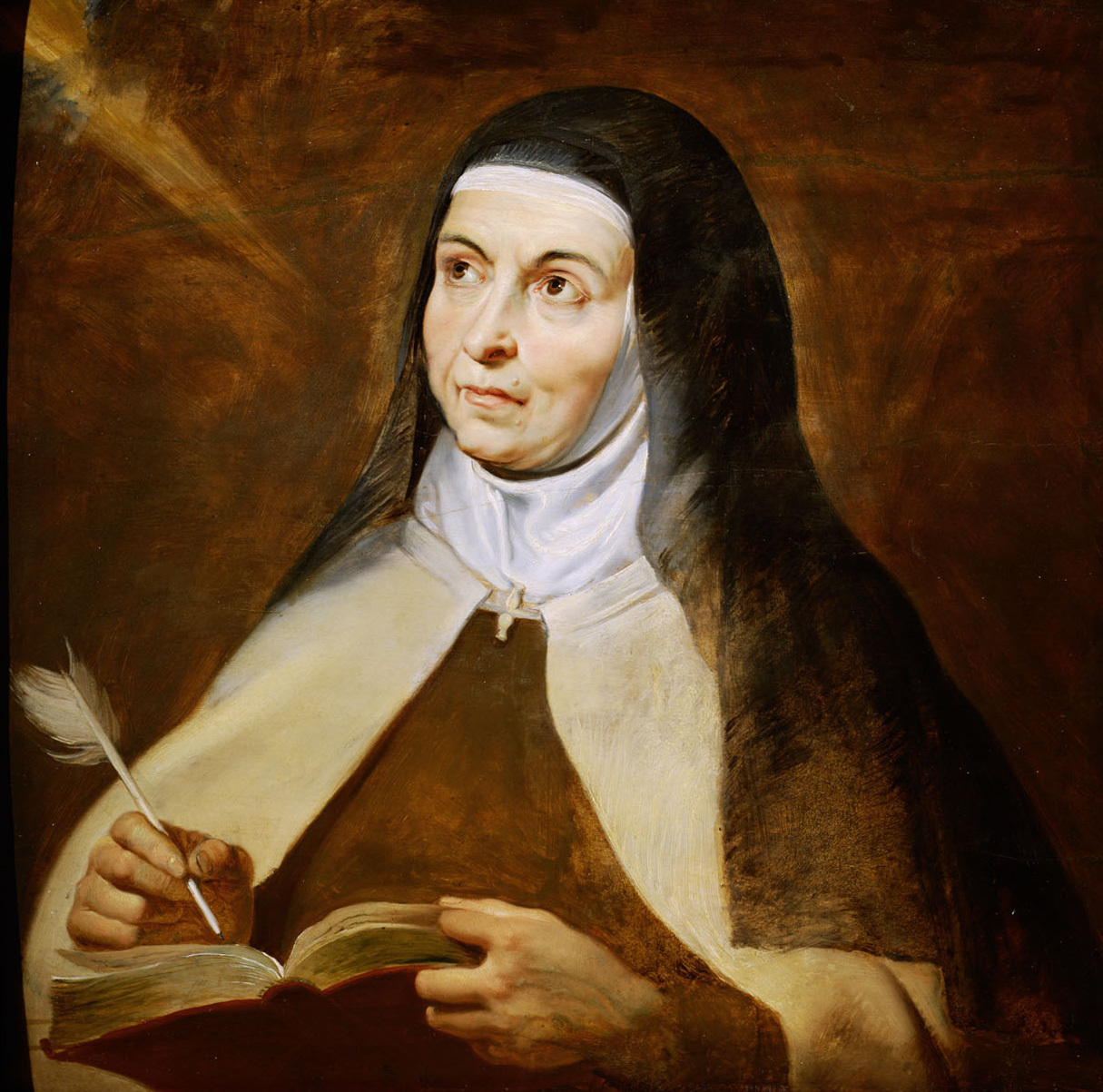
By Peter Paul Rubens, 1615
(public domain] via Wikimedia Commons)
As with many customs, the origin of this one are hazy. The best known story is that Saint Teresa of Avila, a 16th century nun, and her sisters needed land for a second convent for the growing Order of Discalced Carmelite Nuns. At first, they couldn’t afford the property they wanted. Then they buried medals of Saint Joseph and prayed to him, and they were able to buy it. (For those of you reaching for the dictionary, discalced means barefoot or wearing sandals, part of the nuns’ lives of solitude, austerity, and prayer.)

There is no way to tell if the story is truth or invention, but it is plausible. Saint Joseph was important to Teresa. She had coped with illness throughout her life, and she believe Saint Joseph’s intercession allowed her to recover enough to pursue her calling. She named her first convent after him.

Another possibility is that long-ago German workmen put a statue in the walls or foundation of the homes they were building. The assertion has a ring of truth to it. In folk tales, children are walled up in the basement as an offering to the gods. If such a practice existed, the Church would have encouraged a Christian symbol like a cross or saint’s medal be substituted, as is did for healing spells and other pagan riutals.

Perhaps burying the statuette is a variation of medieval Christian conquerors planting a cross or banner in new territory. Or it might have something to do with a figure of Saint Anthony being held for ransom upside-down until he found a match for someone’s daughter.

Photo by Kim Rendfeld
Today’s ritual has variations. The statue should be near the front step or the for-sale sign. The saint should face away from the house or where the homeowner wants to go. He should be buried horizontally or vertically. Above all, when the house sells, the statue should be unearthed and put on the mantel or a place of honor in the new house. The penalties for failure to dig him back up fall on the innocent buyers. Either the house will never sell again or it will constantly change hands.

A few days ago, my husband and I closed on the house we’re selling, and Saint Joseph came out of the ground. Now if you will excuse me, I must get back to packing.

Sources

When It Takes a Miracle to Sell Your House: Owners, Realtors Bury Statues of St. Joseph to Attract Buyers; Don't Forget to Dig Him UpThe Wall Street Journal, Oct. 30, 2007

Property Rites,” Snopes 

How the Tradition of Using a Saint Joseph Statue to Sell Home Got Started,” Saint Joseph Statue

St. Joseph, Real Estate Agent?” Fish Eaters 

"St. Teresa of Avila" by Benedict Zimmerman, The Catholic Encyclopedia,

Carmelite Chronicles: Teresa’s Ideal of the Carmelite Life” by Fr. Joachim Smet, Order of Carmelites blog,

Kim Rendfeld is the author of two books set in Carolingian Francia, The Cross and the Dragon and The Ashes of Heaven’s Pillar, and is working on Queen of the Darkest Hour. For more about Kim and her fiction, visit kimrendfeld.com or her blog, Outtakes. You can also connect with her on Facebook and Twitter.

Tuesday, December 15, 2015

Medieval Mythical Creatures

By E.M. Powell


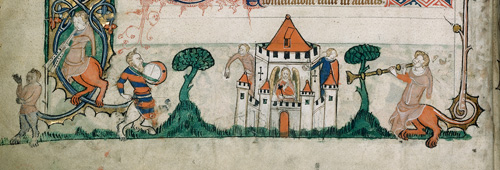
No matter how ardent a fan of natural history documentaries you might be, you may struggle to identify the creature on the right portrayed in this medieval manuscript.


Yes, it's the serra, defined by the Oxford English Dictionary as 'a fabulous marine monster.' The entry in the 1527 Noble Lyfe Bestes describes it thus: 'Serra is a fysshe with great tethe and on his backe he hathe sharpe fynnes lyke the combe of a cocke and iagged lyke a sawe.' While I think the serra is indeed quite marvellous, the OED means 'fabulous' in the sense of 'celebrated in fictitious tales.' But the medievals loved a fabulous creature and we find many examples of them in manuscripts and texts. I'd like to share a few personal favourites.

Dragon


I doubt if anyone would struggle to describe a dragon: a mythical monster like a giant reptile, winged and breathing fire. Even today the national emblem of Wales is Y Ddraig Goch, The Red Dragon. This of course is a different type of dragon to the gwiber (viper). Celtic dragons were said to live at the bottom of deep lakes or guard trees and represent elemental power, often that of the earth. But with the spread of Christianity, the dragon came to represent paganism. For the medievals, the dragon was a symbol of demonic power or the sin of pride.


It features again and again as the vanquished opponent of the hero knight: Lancelot, Tristan and Gawain all fought and defeated dragons. Yvain rescued a lion from one. Dragons, sea serpents and giant worms appear on medieval maps, with the creatures representing wilderness and the unknown. Twelfth century chronicler Gerald of Wales viewed Ireland as a wild and inhospitable place but he reported in his Topography of that country, 'There are no dragons,' presumably good news to all.

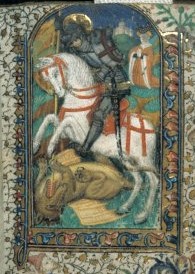
It wasn't only knights who battled dragons during the medieval period. We can find over one hundred saints who had skirmishes with dragons or monstrous serpents. These include Saints Margaret of Antioch, Martha, Sylvester, Gregory and Armel. Most famously is England's Saint George. George may have been a soldier who achieved martyrdom in fourth century Palestine and had a modest reputation in the centuries that followed.


But it was a medieval bestseller that brought him huge popularity. The Legenda Aurea (The Golden Legend) was a collection of saints' lives compiled by James of Voragine and completed by 1265. In it, George excitingly saves a king's daughter who is about to be eaten by a dragon. George spears the beast, secures it with the princess's girdle and leads it before a huge city crowd where he beheads it. Everyone who sees it promptly becomes a Christian. Many miracles were attributed to him throughout the medieval period (usually the victory in battle kind) and by the end of the Middle Ages he was regarded as the patron saint of England.


Unicorn


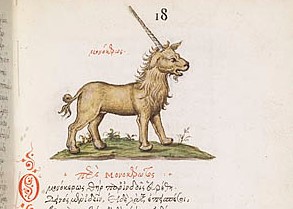
According to medieval bestiaries, the unicorn was the wildest of all beasts and it was swift and fierce. The only way to capture it was for a virgin to stay close, whereupon the unicorn would lay its head in her lap, and so be able to be caught. The animal came to represent power and purity and the links to Christ and the Virgin resonated with the medievals. Wealthy collectors coveted unicorn horn as it was believed to have magical and medicinal powers, specifically against poison and convulsions.

Whatever these collectors believed they had paid for it certainly wasn't unicorn horn. No-one of course had actually seen one, although received wisdom was that the unicorn inhabited the Far East and India. One can only imagine the excitement when Marco Polo finally encountered one (several, in fact) in Java in the thirteenth century. Trouble was, the unicorn was actually a rhinoceros. We can hear Marco's disappointment at his discovery in his account of his travels: 'They delight in living in mire and in the mud. It is a hideous beast to look at. ' Most disappointingly of all: 'In no way like what we think and say in our counties, namely a beast that lets itself be taken into the lap of a virgin.' One can only concur: no-one, virgin or not, would want to give thigh room to a rhino.

Giants


The 1440 manuscript Sir Eglam has the appealing line: 'Ther dwellyth a yeaunt in a foreste.' A 'yeaunt' is of course a giant and many appear in medieval romances. We have another medieval bestseller to thank for their popularity. Geoffrey of Monmouth, Bishop of St Asaph in Wales,  produced his Historia Regum Britanniae (‘The History of the Kings of Britain’) in around 1136.

In this work, King Arthur fights and slays giants. One of Arthur's quests is to seek the beard of one to make a leash for his dog. Geoffrey also says that Corineus, first human ruler of Cornwall, chose it because wrestling against giants was his favourite sport and Cornwall had lots of them. Gerald of Wales mentions giants bringing enormous stones to Ireland 'in ancient times.'

Representations of giants were also a popular feature of medieval pageants and processions. several major cities have records of their use. The figures were made from wood, wicker-work, and a coarse linen stiffened with paste. Many were brightly painted and were dressed in elaborate clothing. 1495 Chester had a family of them: giant, giantess, and two daughters.


Astonishingly, one processional giant still survives in England. The twelve foot high Salisbury Giant is around five hundred years old. He is sometimes called Saint Christopher, as were other processional giants. Christopher was a fourth century martyr that had become the patron saint of travellers by the Middle Ages. Many English churches had wall paintings and windows depicting Christopher, usually facing the main entrance, as it was said that anyone who saw an image of him would not die that day. Saint Christopher medals were already known to the medievals- one of Chaucer's pilgrims, the Yeoman, has one made of silver.


Mermaid


In early use, the mermaid is often identified with the siren of classical mythology. Recorded from Middle English, the word comes from mere with the obsolete sense ‘sea’  and 'maid'. The 1366 Romaunt Rose observes: 'Though we mermaydens clepe hem here,..Men clepen hem sereyns in Fraunce.' (Note: that sentence is in Middle English. But you don't need a translation. Read it aloud just as it is written and it makes sense. It is also great fun to do.)

Medieval mermaids are, unsurprisingly, a sinful creature. They are specifically accused of inspiring lust and sinful desire. Heresy is another of their fishy evils. 'Syrens' pop up in Geoffrey of Monmouth's Historia and we are assured that many swim around the seas surrounding the British Isles.


Mandrake


This very last mythical creature is my absolute favourite: The Shrieking Vegetable. Yes, it's the mandrake. The mandrake is a plant, the roots of which look (vaguely) like a human being planted upside-down. The medievals credited it with magical and medicinal properties and popular wisdom was that it would shriek when pulled from the ground. Those who dared to pick it would die as a result of their harvest.

Quick medieval thinking passed this fate onto a dog. Dog would be tied to mandrake, dog would be urged away from mandrake. Dog would pull it from the ground, so dog would die. Relief all round. In case you're wondering, that pale little chap in the picture above is a mandrake. People: if you see him amongst the carrots in your local supermarket, leave him alone. You have been warned.
~~~~~~~~~~~~~~~~
References:
All images are in the Public Domain and are part of the British Library's Catalogue of Illuminated Manuscripts. 
Dear, I. C. B. & Kemp, Peter, eds: The Oxford Companion to Ships and the Sea (2 ed.) (Oxford University Press 2006 Current Online Version: 2007)
Kieckhefer, Richard: Magic in the Middle Ages, Cambridge University Press (2000)
Knowles, Elizabeth, ed.: The Oxford Dictionary of Phrase and Fable (2 ed.) Publisher: Oxford University Press (2005, Current Online Version: 2014)
Lindahl, C., McNamara, J & Lindow, J. (eds.): Medieval Folklore, Oxford University Press (2002)
Livingston, E.A.,ed.:The Concise Oxford Dictionary of the Christian Church (2 rev.ed.), Oxford University Press (2006, Current Online Version: 2013)
MacKillop, James: A Dictionary of Celtic Mythology , Oxford University Press (2004, Current Online Version: 2004)
Resl, Brigitte, ed., A Cultural History of Animals in the Medieval Age. Oxford: Berg (2007)
Simpson, Jacqueline & Roud, Steve: A Dictionary of English Folklore, Oxford University Press (2003, Current Online Version: 2003)

E.M. Powell is the author of medieval thrillers THE FIFTH KNIGHT & THE BLOOD OF THE FIFTH KNIGHT which have both been #1 Historical Thrillers on Amazon's US and UK sites. 

Sir Benedict Palmer and his wife Theodosia are back in book #3 in the series, THE LORD OF IRELAND. It's 1185 and Henry II sends his youngest son, John (the future despised King of England), to bring peace to his new lands in Ireland. But John has other ideas and only Palmer and Theodosia can stop him. THE LORD OF IRELAND is published by Thomas & Mercer in April 2016.

E.M. Powell was born and raised in the Republic of Ireland into the family of Michael Collins (the legendary revolutionary and founder of the Irish Free State) she now lives in the north west of England with her husband and daughter and a Facebook-friendly dog. Find out more by visiting www.empowell.com