Showing posts with label food and drink. Show all posts

Wednesday, June 29, 2016

Medieval Monks' Meals

By E.M. Powell

The medievals were well acquainted with the Seven Deadly Sins, one of which was/is gluttony—the vice of excessive eating and drinking.


It is therefore no surprise that it was one of the vices that Saint Benedict, a key figure in starting the monastic movement in the early Christian Church, wanted to avoid. Benedict was a Roman nobleman who in around 500 AD, chose to leave Rome and worship Christ in an isolated setting. His popularity grew and he founded his own monastery, writing his famous Benedictine Rule. The Rule is a set of regulations for those in the monastic life and shaped almost every aspect of that life in the medieval period.

Saint Benedict

Saint Benedict did not approve of personal possessions and he prescribed how many hours a monk should sleep. And the Rule also laid down what monks should eat and the quantities of food that should be eaten. Benedict forbade the eating of meat from four legged animals. He was a fan of black bread, plain water, greens and vegetables.

He believed that monks should eat once a day in winter and have a second lighter meal in summer, in the evenings when days were longer. His plan was that monks should have a choice of two cooked meals, vegetable or cereal based and which could include a modest amount of fish or some egg. Meat was only for those who were ill. On feast days, monks could be allowed a supplementary treat known as a 'pittance'. A pittance might be better quality bread or wine instead of beer.

The rationale behind Benedict's Rule was to support one of the three monastic vows: chastity. There was a belief that a rich diets inflamed the senses, incited greed and lust. A full monk was a sleepy monk, and so would not be in a fit state to pray for hours at a time. Benedict did acknowledge that monks needed to have extra treats every now and then. Brothers were allowed to eat more if they were invited to the Abbot's table.

But as with all good intentions, the Rule was adapted over the centuries. A special room called the misericord was built for infirm monks. This was separate to the main refectory (dining room), so meat could be eaten here. Yet monks in full health would retire there to consume meat. By 1336, Pope Benedict XII (yes, another Benedict) permitted meat on four days outside of fast days. And what meat: records show the consumption of beef, mutton, pork, veal and suckling pig. Poultry and game were also popular: monks consumed swan, cygnet, chicken, duck and goose.

Another way in which the Rule was adapted was with regard to communication. It was stipulated that monks’ meals should be eaten in silence. However, no-one mentioned sign language. Or whistling. The monks adopted a practical solution to the extent that twelfth century chronicler Gerald of Wales complained of dining monks behaving like ‘jesters’ after one visit to Canterbury.

It has been calculated that some monks could have been consuming up to 7000 calories a day. Astonishing when you think that today, the recommended calorie intake for an adult male is 2500 calories. This level of consumption is certainly not what Benedict would have had in mind. His rule on gluttony did not just cover quantity but also quality. Monks should eat only at allotted times and consume whatever was presented. Food should be fuel for the body and nothing more.

What is also of note is that as much as one fifth of monks’ enormous calorie intake could have come from alcohol. Monks had access to beer (as did the rest of the population: it was safer to drink than water) but also wine, the bulk of which was imported from Gascony. One could argue that the monks practised restraint by only drinking wine on saints’ days—of which there were about seventy in the year.


Fish was also popular, especially as no-one was allowed to eat meat on a Friday. In the days before effective refrigeration, fish would come from the fresh waters of rivers, lakes and managed fish ponds. Coastal communities would eat fresh sea fish. For those further inland, this fish was eaten salted, smoked, dried or pickled.

Earlier in the medieval period, Wednesdays and Saturdays were also non-meat days, as well as the dietary restrictions imposed for Lent and Advent. That didn't stop the monks. With another bit of monastic Rule tweaking, certain types of geese and puffins were deemed to be fish because of their close association with water. A monastic feast day could consist of a couple of dozen dishes.

The monks were fans of toe-to-tail eating. Umbles, for instance, were sheep’s entrails cooked in ale with breadcrumbs and spices. Deer entrails might also be on offer, as would tongue and mutton in sauce. Dowcet sounds far more appealing, certainly for this writer: a sweet custard made of milk, cream, sugar, dried fruits and eggs. It is unlikely such dishes were a rare treat. Archaeological remains from a medieval hospital in London found evidence of monks with worse teeth than their patients. Others from priories and abbeys have found skeletal remains with obesity-related joint disease.


But these huge levels of consumption were taking place in a society where the vast majority of people were at the brink of starvation or were actually starving. Ordinary people began to deeply resent the excesses of the privileged religious. By the fourteenth century there were poems and ballads mocking the monastic life and the over-privileged monks. The stereotype of the overfed monk, portly in his robes, immune from poverty, became one focus for discontent with the established church—and a very visible one.
~~~~~~~~~~~~~~
All images are in the Public Domain and are part of the British Library's Catalogue of Illuminated Manuscripts. 
References:
Jones, Terry & Eriera, Alan: Medieval Lives, London, BBC Books (2004)
Kerr, Julie: Life in the Medieval Cloister, London, Continuum Publishing (2009)
Livingstone, E.A.,ed.:The Concise Oxford Dictionary of the Christian Church (2 rev.ed.), Oxford University Press (2006, Current Online Version: 2013)
Mortimer, Ian. The Time Traveller's Guide to Medieval England. London: The Bodley Head. (2008)
Whittock, Martyn, A Brief History of Life in the Middle Ages: London, Constable & Robinson (2009)

E.M. Powell’s medieval thrillers THE FIFTH KNIGHT and THE BLOOD OF THE FIFTH KNIGHT have been #1 Amazon bestsellers and a Bild bestseller in Germany. Book #3 in the series, THE LORD OF IRELAND, about John’s failed campaign in Ireland was published by Thomas & Mercer on April 5 2016.

Born and raised in the Republic of Ireland into the family of Michael Collins (the legendary revolutionary and founder of the Irish Free State), she now lives in northwest England with her husband, daughter and a Facebook-friendly dog. As well as blogging and editing for EHFA, she is a contributing editor to International Thriller Writers The Big Thrill magazine, reviews fiction & non-fiction for the Historical Novel Society and is part of the HNS Social Media Team. Find out more by visiting www.empowell.com.
Amazon
Barnes & Noble
Waterstones

Sunday, November 22, 2015

When Roasted Crabs Hiss In the Bowl - The Cup That Cheers, 17th Century Style

by M.J. Logue

What historical fiction, and what winter's evening, would be complete without the traditional foaming mug of mulled ale?

On those short, dark winter days - on those even shorter, darker, wintrier days of the Little Ice Age that was seveneteenth-century England - a brief social excursion could be a whole day's trip on horseback, or a perilous, freezing trip in a draughty carriage. Cold, wet stockings - there is no evidence to suggest that women wore anything so sensible as boots - and heavy, clinging cold wool cloaks. No central heating, nothing but an inadequate fire in houses bedevilled by draughts and inadequately insulated. Unbearable, no?

Well, no. Because in a rather civilised manner, one was provided with one's own, internal central heating.

I have blogged before on the dubious delights of buttered ale, much beloved of one fictional Parliamentarian officer's wife as a cure-all for every ill. Samuel Pepys is inclined to agree with her -

"Thence home and to the office, and so home having a great cold, and so my wife and Mrs. Barbary have very great ones, we are at a loss how we all come by it together, so to bed, drinking butter-ale."

Robert May in "The Accomplish't Cook" in 1660 described it as

... Take beer or ale and boil it, then scum it, and put to it some liquorish and anniseeds, boil them well together; then have in a clean flaggon or quart pot some yolks of eggs well beaten with some of the foresaid beer, and some good butter; strain your butter'd beer, put it in the flaggon, and brew it with the butter and eggs.

Het Babbitt's recipe is a late Tudor one and contains ginger and cloves as well as nutmeg, and (mercifully) no licquorice. There's a traditional folk song called either "The Owl" or "Who Gave Thee Thy Jolly Red Nose?" - which often turns up, rather wonderfully, in children's songbooks - the chorus of which goes

"Nose, nose, jolly red nose
and who gave thee that jolly red nose
Cinamin, ginger, nutmeg and cloves
and that gave me my jolly red nose!"

- and now you know in what capacity they were being taken!

Now, I will be honest, and say that having tried buttered ale it did nothing for me at all. Hippocras, on the other hand, is much nicer. Somewhere between a medicine, a syrup and a celebration drink, it was a spiced, sweetened wine served - possibly heated, and possibly not always - at the end of meals.

These two recipes are transcriptions from the Historic Food website, as an illustration of just how exotic - and expensive - a good hippocras would be:

Ipocras out of an old booke

Take a pottole of white or redd wyne and take a pynt of clarified honye: and mixe well the wyne and honye together in a clean pan, and you take 3 ozs of ginger, of pepper a quarter of an ounce, of good cynnimone 1 oz., saffron 1 oz., Spikenard of Spayn 1 oz., gallingale 1 oz., and make :all into pouder, and put it into the wyne and honye and medell them together, and you colour it with tumsole, and make it as red as you will: and pour it into a bagg and strain it through the bagg often tymes till it be clere, and so serve it forth.

From an early seveneteenth century manuscript (Mss. Sloane 3690, ff 26b.).
To make an excellent aromaticall Hyppocras
Take of Cinnamon two ounces, Ginger an ounce, Cloves and Nutmegs of each two drams, of white Pepper half a dram, of Cardamums two drams: of Musk Mallow seed, three ounces. Let these be bruised, and put into a bag and hanged in six gallons of Wine. Note that you must put a weight in the bag to make it sink.
‘Some boyl these spices in Wine, which they then sweeten with sugar, and then let run through a Hyppocras bag, and afterwards bottle it up, and use when they please.
A little too expensive for my plain Essex goodwife in 1645. and so her recipe is much plainer. taken from the same Elizabethan cookbook as her buttered ale:
2 quarts red wine
1 tbsp ginger
2 tbsp cinnamon
1/2 tsp nutmeg
6 whole peppercorns
9 whole cloves
1/2 tsp rosemary
1 cup sugar
Boil it all up, remove from the boil, allow to steep for 12 hours and longer if you can. Heady stuff, so drink cautiously - but very warming...

Of course, if you are in need of something more substantial, I will leave you with the very housewifely Elizabeth Cromwell's recipe for sack posset. I will say nothing about Oliver's much-vaunted tendency to start throwing this substance about in jest (he is reported to have spent a happy afternoon at his daughter's wedding in November 1657 chucking posset over the ladies' gowns - an interesting sense of humour, the Lord Protector.)

I think this may have been the recipe she used for the wedding, because it starts with

"Set a Gallon of Milk on the Fire, with whole Cinamon and large Mace, when it boyls stir in a half, or whole pound of Naples-bisket grated very small, keeping it stirring till it boyls, then beat eight Eggs together, casting of the whites away; beat them well with a Ladle-ful of Milk, then take the Milk off the fire, and stir in the Eggs; then put it on again, but keep it stirring for fear of curdling; then make ready a pint of Sack, warming it upon the coals, with a little Rose-water, season your Milk with sugar, and pour it into the Sack in a large bason, and stir it a pace, then throw on a good deal of beaten Cinamon, and so serve it up."

Aren't you glad we can just put the kettle on?

~~~~~~~~~~~~~

 MJ Logue can be found lurking at uncivilwars.blogspot.co.uk, and is currently working on the week-by-week run up to Christmas of that hard-done-to Essex goodwife Het Babbitt. and the first four books in her bestselling series featuring the (mis)adventures of sweary Parliamentarian cavalry officer Hollie Babbitt and his rebel rabble are available here.

Monday, February 23, 2015

A Coronation Feast, 23 April, 1685

by Margaret Porter


James II in 1685
Wikimedia Commons
 At about noontime on 6 February, 1685,  King Charles II breathed his last and his brother instantly succeeded him as King James II. In the midst of royal mourning and the many necessary changes within the royal household, thoughts quickly turned towards the planning of a coronation. The chosen date was 23 April, the Feast of St. George, England’s patron saint. Ten days after James's accession, the clerk of the Great Wardrobe was making lists of the “Necessaries” for such an event and researching earlier coronations.

 Officers of the Board of Greencloth were ordered to present to the Council “a particular account of the Dinner kept in Westminster-Hall at the Coronation of His Late Majesty King Charles the Second, and also that provided at the Coronation of his Royal Father, together with the whole Expense and Charge of each of the said Dinners.” They returned with the requested information, including the fact that Charles II's coronation dinner cost £1209 15s 7 ½d. But all records for Charles I’s coronation had been “lost in the Great War.”

Francis Sandford 1630-1694
By George Vertue
© National Portrait Gallery, London
We know every detail of James II's coronation day from Francis Sandford, the Lancaster Herald of Arms, whose very thorough, fully illustrated account of the proceedings was commissioned by the King. The planning, the pronouncements, the order of the service, its participants, what they wore, what they did and said . . . he recorded it all.

On the appointed day, the coronation began with a procession from Westminster Hall to the Collegiate Church of St. Peter—commonly known as Westminster Abbey.

The event was plagued by ill-omens: the staves of the royal canopy broke, and it nearly collapsed over the King as he entered the abbey. His newly-minted crown didn't quite fit and almost fell off as soon as it was placed upon his head. And, in a preview of conflicts to come, James—a convert to Roman Catholicism—refused to take communion by Anglican rite as required in the coronation ritual.
Diarist John Evelyn reported, “. . . to the greate sorrow of the people, no Sacrament, as ought to have ben . . . . Having ben present at the late King's Coronation, I was not ambitious of seeing this ceremonie.” Hard to say whether this reluctance was indicative of his opinion of James, or of his experience twenty-five years previously of a day-long event that stretched well into evening.

By five o’clock that day James and his consort Mary Beatrice had been crowned, and they processed out of the Abbey beneath their separate canopies. Wearing their purple velvet robes, carrying their regalia, accompanied by trumpeters, and hailed by the cheering populace, they returned to Westminster Hall for the grand feast.

Within the vast and ancient  hall the tables had been arranged and were already covered by all the banquet dishes that didn’t contain hot food—99 of them on the King and Queen’s table. These consisted of cold meat (flesh and fish) “excellently well Dressed and Ordered all manner of ways. In three very great Chargers and 14 large Basins, Dryed sweet-meats, and Plates of all sorts of Jellyes, Bla-mange etc., with Sallads of all kinds . . . Void places were left for the Hot Meat.” Sandford’s book shows each table and the placement of each dish—numbered, with a corresponding numbered list to indicate what was served and where.


The King and Queen occupied the high table and there were six additional tables, three on either side of the hall. On the west side was the First Table, for court officers and significant coronation participants, and the highest orders of the nobility from dukes and duchesses down to some of the earls and countesses. At the Second Table sat the remainder of the earls and countesses with the viscounts and viscountesses, The lowest table on that side was for barons and baronesses. On the east side was a table for the Lords Spiritual, judges, barons of the Cinque Ports, with a second table for sergeants of law, clerks and masters of Chancery, the Lord Mayor and Aldermen. And the lowest table was occupied by Kings’ Heralds (Francis Sandford was one of them) and Pursuivants of Arms. The King and Queen each had a carver and a cup-bearer, and every member of the nobility “had a servant of their own to wait upon them.” Quite a crowd, as evidenced by the illustration.


 The metrics of the feast are mind-boggling. The King and Queen had 145 dishes as a first course, with 30 more dishes of hot meat served in the second course, for a total of 175 dishes at the royal table. Each of the peers’ and peeresses’ tables had 213 dishes. A total of 1445 dishes was served!

What exactly were these dishes? Thanks to Sandford’s meticulous account, we know every single one of them. Here's a sampling of the more interesting or curious foods served to the King and Queen (period spelling preserved):

pistachio cream in glasses
custards
anchoviz
lamb stones
cocks combs, hot
marrow patie
sallet
stags tongues
sweet breads
patty pidgeon,  hot
cray fish, cold
bolonia sausages, cold
collops and eggs
frigase chicken, hot
rabbets ragou
oysters pickled
portugal eggs
Dutch beef
Andolioes
mushrooms, hot
veal
hogs tongues
cheese cakes
ciprus birds
tansy, hot
asparagus, hot
ragou of oysters, cold
scallops, cold
salmagundy
3 dozen glasses of Lemon jelly
5 neats tongues, cold
a whole salmon, cold
8 pheasants, cold
9 small pidgeon pyes, cold
24 fat chickens, hot
12 crabs, cold
24 partridges, hot
a dish of tarts
soles marinetted
4 fawns, hot
12 quails
10 oyster pyes, hot
pease
artichokes
Beef  a la Royal, hot
turkeys
bacon gammon
spinage
three pigs, hot
almond puff
a square pyramide rising from 4 large dishes on the angles and 4 lesser dishes on the sides, containing several fruits in season and all manner of sweet meats
4 dozen egg pyes, cold
A very large circular pyramide in the middle of the table rising from 12 dishes in the circumference, 6 of which were large and the other 6 less, containing several fruits in season and
all manner of sweet meats
6 mullets large souc’d
8 godwits
18 mincd pyes, cold
8 wild ducks marinated, hot
lampreys
shrimps
24 puffins, cold
smelts
truffles
4 dozen of petit paties, hot
morels
5 carps, cold
8 Ortelans
5 partridge pyes
12 lobsters, cold
12 leverets, hot
sturgeon, cold
24 ducklings, larded, hot
8 capons
8 geese 3 larded, hot
gerkins
soucd’d trout, cold
cabbadge pudding
french beans
periwinkles
cavear
olives
prawns
samphire
trotter pye
taffata tarts
parmezan
capers
whitings, marinated
cockles
mangoes
cardoons
3 dozen glasses of bla-mange, cold

After a 5-hour coronation ceremony, the diners must have been starving—but perhaps also too exhausted to do justice to such a feast. And the day's pageantry wasn't yet over.

During the interval between the first and second courses, the King’s Champion, Sir Charles Dymoke, rode into the hall on a “goodly white horse” with attendants. He declared to all present, “If any person, of what degree soever, shall deny or gainsay our Sovereign Lord, King James II . . . here is his Champion, who say that he lieth and is a false Traitor, being ready in person to combat with him.” The champion threw down the gauntlet, and after a respectable pause, it was returned to him by the herald, at which point he and his horse advanced further into the hall, repeating the challenge and throwing the gauntlet once more. And then again. When this spectacle concluded, the second course was served.

By virtue of his title of Baron of the Cinque Port of Sandwich, Samuel Pepys had marched beside the King in the coronation procession. As gourmand and convivial fellow he must have enjoyed the meats and fish served at his table, the first on the east side—and doubtless ate one of the 36 cheesecakes on the board.

At the conclusion of the feast, the amply-fed King and Queen processed out of the hall, with their regalia. The scheduled fireworks display on the River Thames at Whitehall Palace was postponed until the following night, “by the reason of the great fatigue of the day.” And when it did take place, the results were disastrous—a rocket misfired, an explosion ruined the illuminations, boats carrying spectators overturned, many were drowned.  Still more ill-omens clinging to the unfortunate King James II.

Francis Sandford’s book about the coronation day was so exhaustive that it took fully two years to compose and produce. It was not published until 1687, the year before James was denounced by his people and Parliament, de-throned by his son-in-law William of Orange, and sent into exile in France.

~~~~~~~~~~~~~

Sources:

Sandford, Francis, The history of the coronation of the most high, most mighty, and most excellent monarch, James II by the grace of God, King of England, Scotland, France and Ireland, defender of the faith, &c. and of his royal consort Queen Mary: solemnized in the collegiate church of St. Peter in the city of Westminster, on Thursday the 23 of April, being the festival of St. George, in the year of our Lord 1685; with an exact account of the several preparations in order thereunto, Their Majesties most splendid processions, and their royal and magnificent feast in Westminster-Hall; the whole work illustrated with sculptures; by His Majesties especial command/ by Francis Sandford Esq; Lancaster herald of arms, The British Library.

Tomalin, Claire, Samuel Pepys: The Unequalled Self.

The Diary of John Evelyn.

~~~~~~~~~~~~~
 
Margaret Porter is the award-winning and bestselling author of several historical fiction genres, and is also published in nonfiction and poetry. Various characters in her novel A Pledge of Better Times (April 2015) participate in James II's coronation. Margaret studied British history in the UK and the US. As historian, her areas of speciality are social, theatrical, and garden history of the 17th and 18th centuries, royal courts, and portraiture. A former actress, she gave up the stage and screen to devote herself to fiction writing, travel, and her rose gardens.

Monday, March 11, 2013

Chocolate the Regency Way

by Maria Grace 

Of the three luxury beverages of the Regency era, tea dominates the conversation, but coffee and chocolate were regularly enjoyed by many in the higher classes. Chocolate was typically served at breakfast, although specialty coffee and chocolate houses served it at all times during the day. 

While some chocolate candy did exist in the regency era, dipped chocolates and sweet chocolate bars would not appear until much later. French cookbooks dating from 1750 contained recipes for chocolate disks sprinkled with nonpareils, chocolate truffles and fudge-like chocolate conserve. Recipes for ices, ice creams, custards and various pastries and tarts abounded in English cookery books. Even so, chocolate in the Regency era generally referred to drinking chocolate. 

Preparing drinking chocolate was a time consuming, labor intensive process, beyond the means of many, particularly if started from dried cacao nibs. 

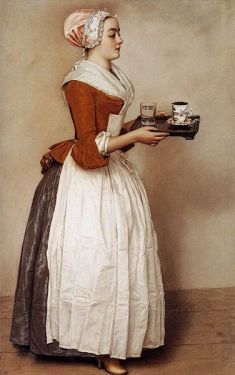
Liotard, "The Chocolate Girl" (La Belle Chocolatiere)
Hannah Glasse offered two recipes for preparing the nibs for use. 

How to make Chocolate. 
TAKE fix pounds of cocoa-nuts, one pound of anise-seeds, four ounces of long-pepper, one of cinnamon, a quarter of a" pound of almonds, one pound of pistachios, as much achiote as will make it the colour of brick, three grains of musk, and as much amber-grease, fix pounds of loaf-sugar, one ounce of nutmegs, dry and beat them, and scarce them through a fine fire ; your almonds must be beat to a paste, and mixed with the other ingredients; then dip your sugar in orange-flower or rose-water, and put it in a skillet, on a very gentle charcoal fire ; then put in the spice, and stew it well together, then the musk and amber-grease, then put in the cocoa-nuts last of all then achiote, wetting it with the water the sugar was dipped in stew all these very well together over a hotter fire than before; then take it up, and put it into boxes, or what form you like and set it to dry in a warm place. The pistachios and almonds must be a little beat in a mortar, then ground upon a stone. 

Another Way to make Chocolate. 
TAKE fix pounds of the best Spanish nuts, when parched, and cleaned, from the hulls, take three pounds of sugar, two ounces of the best cinnamon, beaten and sifted very fine; to every two pound of nuts put in three good vanelas, or more or less as you please; to every pound of nuts half a drachm of cardamom-seeds, very finely beaten and searced. 

These recipes, which might also include cardamom, aniseed, cloves, bergamot, produced a hard, gritty chocolate tablet. A few people ate them straight as a type of candy, but most believed they would cause indigestion if eaten in that form. These tablets were the basis of Regency drinking chocolate. 

Even with premade chocolate tablets, it took thirty minutes or more of strenuous effort and several specialized kitchen items to prepare a cup of drinking chocolate. 

First, a specialty chocolate grater would be used to shave the necessary amount of chocolate from the solid tablet. The powdered chocolate would be added to a large pan containing water, milk or possibly a mixture of water and wine or water and brandy and place over heat. 

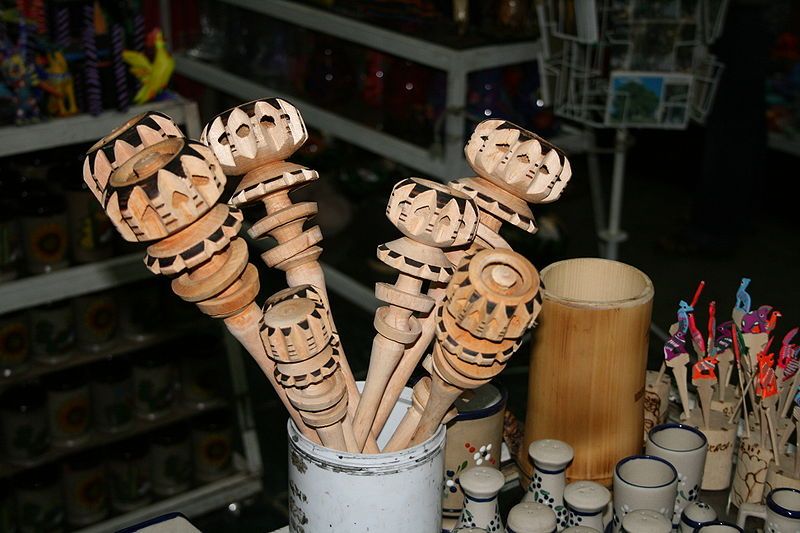
Chocolate mill or molinilla
The chocolate/liquid mixture would be brought to a boil, while constantly stirring to prevent scorching. After it came to a boil, the cook removed it from the heat and used a special tool, known in England as a chocolate mill (in France a molinet, in Spain a molinilla) to agitate the mixture. At this point eggs, flour, corn starch or even bread might be added to the mixture to thicken it. The cook would spin the chocolate mill between her hands for several to incorporate the thickeners into the drinking chocolate. 

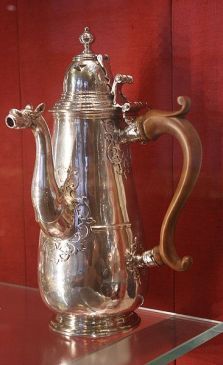
Chocolate pot
After beating, the pot was returned to the heat and brought to a boil again while stirring constantly. At this stage, cream might be added. The chocolate mill would be employed once more to fully blend the mixture and raise a head of froth without which drinking chocolate was not considered fit to be served. 

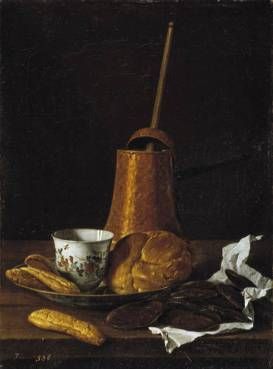
The finished drinking chocolate would be transferred to a special chocolate pot for service. A chocolate pot was taller and straighter than a tea pot, with a shorter spout than a coffee pot, placed high on the pot. It also sported a hinged finial on the lid to allow a coffee mill to be used while the lid was down to prevent splashing. 

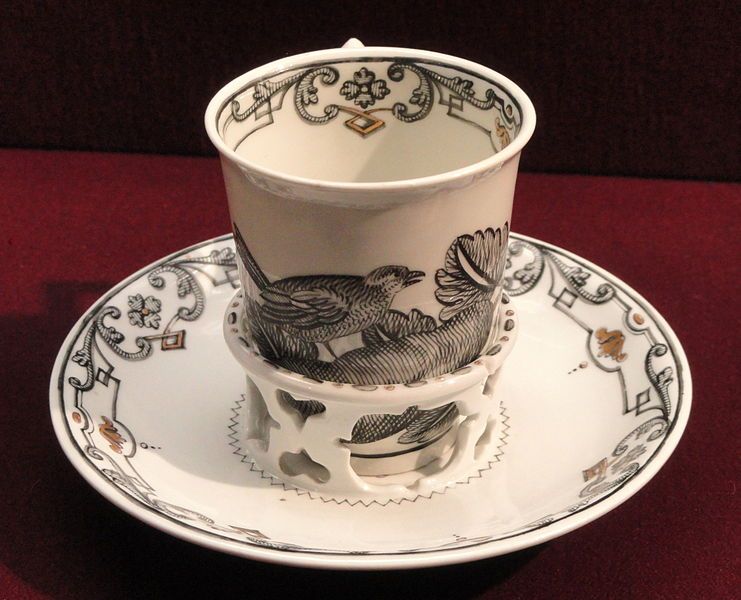
Chocolate cup with chocolate stand.
Chocolate cups were taller and narrower than coffee or tea cups. Their unique shape made them more likely to spill, so special saucers known as chocolate stands developed to steady the unstable cups. 

Those who could not afford all the specialty items made do with what they had, cooking their chocolate in skillets and drinking it out of whatever vessels they had. 

If they could not afford chocolate at all, Hannah Glasse offered this recipe. 

Sham Chocolate 
TAKE a pint of milk, boil it over a slow fire, with some whole cinnamon, and sweeten it with Lisbon sugar; beat up the yolks of three eggs, throw all together into a chocolate-pot, and mill it one way, or it will turn. Serve it up in chocolate-cups. 

Gingerbread might also be added to this beverage as a thickener. 

This modern recipe captures many of the flavors of Regency drinking chocolate. 

Spiced Hot Chocolate 
2 cups water
1/4 cup sugar
1 strip lemon peel 1″ by 2″ 
1 3″ cinnamon stick 
pinch of ground cloves 
1/4 cup cocoa powder 
1tsp vanilla 
1/2 cup heavy cream 

Heat the first 5 ingredients to boiling, reduce heat simmer 3 min. Remove from heat whisk in cocoa and vanilla until foamy. Strain into warmed cups. Top with whipped cream. From: http://www.janeausten.co.uk/a-passion-for-hot-chocolate/ 

References

Hannah Glasse. The Art of Cooer Made Plain and Easy. W Strahan, 1784 
Maria Rundell. A new system of domestic cookery. J Geave, 1839 Arthur Parker’s fortifying cocoa 
Chocolate
Hot Chocolate 18th and 19th Century style Regency Chocolate
Regency Chocolate: The correct accoutrements  
Regency Chocolate-pale, thick and frothy


 Maria Grace is the author of Darcy's Decision and The Future Mrs. Darcy. Click here to find her books on Amazon. For more on her writing and other Random Bits of Fascination, visit her website. You can also like her on Facebook, follow on Twitter or email her.