Showing posts with label Victorians. Show all posts

Thursday, August 27, 2020

Lady Sarah Frederica Caroline Villiers: An English Princess

 By Lauren Gilbert

https://commons.wikimedia.org/wiki/File:Schloss_Esterh%C3%A1zy_Eisenstadt_1587.jpg

Schloss Esterházy, Eisenstadt, Darstellung von Lady Sarah Frederica Caroline Child Villiers 
by Karl Gruber / CC BY 3.0 AT 


Lady Sarah Caroline Frederica Caroline Child-Villiers was born August 12, 1822 in London, and was baptized May 27, 1823 in St George’s Hanover Square Parish. Her mother was Sarah Sophia Child-Villiers, Countess of Jersey and her father George Child-Villiers, 5th Earl of Jersey. She was born into one of the wealthiest and most powerful families.

At age 18, Sarah was One of 12 bridesmaids to Queen Victoria when she married Prince Albert in 1840. They wore gowns designed by Queen Victoria, and each received a brooch designed by Prince Albert, shaped like an eagle in turquoises.

Sarah married Prince Miklos Pal Esterhazy von Galantha on Feb 8, 1842. (The date was changed multiple times.) Born June 25, 1817, Prince Miklos (Nicholas in English) was the son of Prince Pal Anton Esterhazy von Galantha and his wife Princess Maria Theresia Esterhazy von Galantha. (Lady Jersey and Princess Esterhazy were both Lady Patronesses of Almack’s and friends.) After marriage, Sarah's title in English was Princess Nicholas Esterhazy von Galantha.
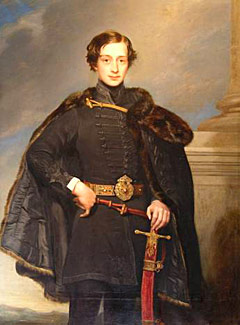
Nikolaus III, prince Esterházy de Galántha (public domain)

Theirs was a love match according to Esterhazy Palace data and the Duchess de Dino.(1) Nicholas had spent much of his life in England as the son of the Austrian Ambassador, so he and Lady Sarah Frederica could have become acquainted as children, especially given their mothers’ connection. Theirs was an unusually long engagement. It was known that they wanted to marry as early as 1836 (they apparently fell in love as teenagers). Prince Paul apparently was not pleased with the match (at least in part due to difference in status: the Jersey’s were not of a royal house, and Lady Jersey’s roots were in trade (her grandfather being the banker Robert Child)). He tried to prevent the match despite the fact the young couple were in love. There are indications that Princess Esterhazy was not enthused either (there are comments in the MEMOIRS OF THE DUCHESS DE DINO about having Lady Jersey as a mother-in-law (2), and a suggestion that the Esterhazy’s avoided having Lady Jersey in Vienna as much as possible). 

Lady Jersey encouraged the match. There were suggestions that she pursued the match relentlessly due to the status of the groom’s family. It seems equally possible that she wanted her daughter to marry the man she loved. Prince Paul tried to get out of the engagement as late as June 1841(3). However, he finally conceded. Lady Sarah Frederica’s trousseau was prepared and displayed for viewing in December 1841(4).

The marriage settlement was finally signed Monday Feb 7, 1842, and Lady Sarah Frederica and Prince Nicholas were married on Tuesday, February 8, 1842. Their wedding involved two ceremonies. At 10:00 in the morning, the couple was married in a Roman Catholic service in the library of Chandos House, the Austrian Embassy, performed by Rev. Dr. Griffiths, Apostolical Vicar of London. This service was followed by a breakfast. Shortly after 11:00, the wedding party arrived in St. George’s Hanover Square, where a Church of England service was performed by Robert Bagot, the Lord Bishop of Oxford (the bride’s uncle by marriage).

At this service, Lady Sarah Frederica had six bridesmaids, two of whom were her sisters Clementina and Adela*. She was given away by her father, who was visibly emotional. This service was followed by a sumptuous luncheon at the Child-Villiers home in Berkley Square, which included three bridal cakes. The wedding was a significant social event. Following the luncheon, the bride and groom spent some days at Osterley Park (the Countess of Jersey’s seat, formerly that of Robert Child), returning to Chandos House before leaving for Europe to join Prince and Princess Esterhazy. They arrived in Vienna in April 1842(5).

Prince and Princess Nicholas had an active social life in both England and Austria. Newspaper accounts document them going back and forth for a variety of social and family events (which included presentation at Queen Victoria’s Drawing Room on February 26, 1846, and a visit to the spa town of Ischl, Austria in August 1847 that included her mother and her sister Clementina (7)).

Prince and Princess Nicholas had six children, five of whom survived to adulthood: Pal Antal Miklos Prince Esterhazy von Galantha, born March 11, 1843 and died August 2nd, 1898; Alajos Gyogy Prince Esterhazy von Galantha, born March 9th, 1844 and died October 25th, 1912; Adolf Prince Esterhazy von Galantha born October 5th, 1846 and died in infancy February 1st, 1847; Sara Zsofia Princess Esterhazy von Galantha, born March 16th, 1848 and died February 22nd, 1885; Maria Terezia Princess Esterhazy von Galantha, born November 29th, 1849 and died May 7th, 1856 and Antal Miklos Furst Esterhazy von Galantha, born January 14th, 1851 and died February 10th, 1935. (The names are shown as in Vienna.)

Princess Nicholas sadly developed a lung complaint (consumption). After suffering several months of illness and unsuccessful spa treatments in Europe (at Ems and Ischl particularly), she finally went, at her doctor’s suggestion, to England to see if the air of her native country would help. It did not; she died at Torquay, Devon, England on November 17, 1853. She was buried at Eisenstadt in the Esterhazy vault. In 1871, Prince Nicholas raised an obelisk in the palace gardens in her memory. There is also a memorial in the Jersey family vault at the country estate in Middleton Stoney, England. Prince Nicholas did not remarry.
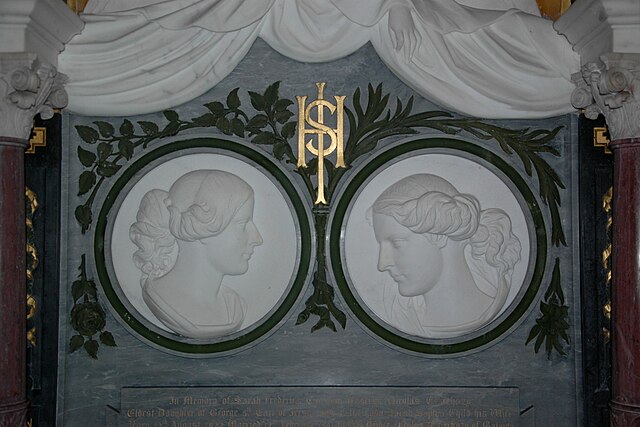
Church of England parish church of All Saints, Middleton Stoney, Oxfordshire; Jersey Chapel: detail of the tomb of Princess Esterhazy and Lady Clementina Villiers 
by Motacilla / CC BY-SA

*Newspaper accounts showed her sister's name as Adelaide; her name is correctly Adela Corisande.

Footnotes

(1) THE MEMOIRS OF THE DUCHESSE DE DINO, entry for June 16, 1841.

(2) THE MEMOIRS OF THE DUCHESSE DE DINO, entry for June 19, 1841.

(3) THE MEMOIRS OF THE DUCHESSE DE DINO, entry for June 16, 1841.

(4) Devizes and Wiltshire Gazette, Thursday 23 December 1841-British Newspaper Archives

(5) MEMOIRS OF THE DUCHESSE DE DINO, entry for April 17, 1842.

(6) The Globe, Saturday 26 March 1842-British Newspaper Archives.

(7) The Morning Post - Friday 27 February 1846, and the Morning Post- Saturday, 04 September 1847-British Newspaper Archives.

Sources include: 

Sudley, Lord, editor. THE LIEVEN-PALMERSTON CORRESPONDENCE 1828-1856. London: John Murray, 1943.

British Newspaper Archives. Northampton Mercury, Saturday 12 June 1841; London Evening Standard, MARRIAGE OF PRINCE NICHOLAS ESTERHAZY AND LADY SARAH VILLIERS, 22 December 1841; Devizes and Wiltshire Gazette, Trousseau of the Lady Sarah Villiers, Thursday 23 December 1841; Oxford Chronicle and Reading Gazette, MARRIAGE OF PRINCE NICHOLAS ESTERHAXY AND LADY SARAH VILLIERS< Saturday 12 February 1842; Weekly Freeman’s Journal Saturday, FASHIONABLE INTELLIGENCE, 12 March 1842; Globe, FASHION AND TABLE-TALK, Windsor, Friday. Saturday 26 March 1842; Morning Post, Ischl, Aug. 26, Saturday 04 September 1847; and John Bull, DEATH OF HER HIGHNESS PRINCESS NICHOLAS ESTERHAZY, Saturday 19 November 1853. (All articles © British Library Board) HERE

Gutenberg.org The Project Gutenberg’s eBook of MEMOIRS OF THE DUCHESSE de DINO (Afterwards the Duchesse de Tallyrand) 1841-1850, edited by Princess Radziwill, New York: Charles Scribner’s Sons, London: William Heinemann, 1910. HERE

RoyalCentral.co.uk “Queen Victoria’s Bridesmaids” by Elizabeth Jane Timms, July 4th, 2019. HERE

Thepeerage.com “Lady Sarah Frederica Caroline Child-Villiers.” HERE ; “Miklos Pal Prinz Esterhazy von Galantha.’’ http://www.thepeerage.com/p32788.htm#i327874

Esterhazy.net “Lady Sarah Child-Villiers.” HERE ; ‘’Prince Miklos Pal Esterhazy de Galantha.’’ HERE

Szervuszaustria.hu “Princess Have Happy and Less Happy Lives”. Supplement to the Eisenstadt Exhibition. November 6, 2012.HERE

Books.google.com THE NEW WORLD: A Weekly Family Journal of Popular Literature, Science, Art and News, Volume 3. New York: 1841. THE NEW WORLD, December 25, 1841. “Foreign Items.” HERE ; THE GENTLEMAN’S MAGAZINE, Volume XLI New Series, January to June inclusive. London: John Bowyer Nichols and Sons, 1854. January 1854, P. 106. Obituary of Princess Nicholas Esterhazy. HERE

Wikipedia. “Robert Bagot (Bishop)”. Last edited 29 January 2020. HEREImages from Wikimedia Common.

~ ~ ~ ~ ~ ~ ~ ~ ~ ~

Lauren Gilbert was introduced to English authors early in life. Lauren has a bachelor of arts degree in liberal arts English with a minor in Art History. A long time member of JASNA, she has presented a number of programs. She lives in Florida with her husband. 

Lauren's first book, HEYERWOOD A Novel, is available. A RATIONAL ATTACHMENT is her second novel. A long-time contributor to the English Historical Fiction Authors blog, her work is included in both volumes of CASTLES, CUSTOMS AND KINGS: True Tales by English Historical Fiction Authors. She is also researching material for a biography. For more information, visit her website.


Saturday, May 11, 2013

Victorian Violence: Repelling Ruffians (Part One)

by Terry Kroenung


 "The housebreaker freed one arm, and grasped his pistol. The certainty of immediate detection if he fired, flashed across his mind even in the midst of his fury; and he beat it twice with all the force he could summon, upon the upturned face that almost touched his own.

She staggered and fell: nearly blinded with the blood that rained down from a deep gash in her forehead; but raising herself, with difficulty, on her knees, drew from her bosom a white handkerchief--Rose Maylie's own--and holding it up, in her folded hands, as high towards Heaven as her feeble strength would allow, breathed one prayer for mercy to her Maker.

It was a ghastly figure to look upon. The murderer staggering backward to the wall, and shutting out the sight with his hand, seized a heavy club and struck her down."
    --- Oliver Twist, Charles Dickens

To judge by this disturbing scene (or, indeed, any episode of Ripper Street) it was as much as a man’s life was worth to walk the streets of Victorian London. Robbery and murder were commonplace, pickpockets were as ubiquitous as fleas on a mongrel, and as for an unaccompanied woman, well…

But was that true? Or were the news reports of that era just as slanted toward the sensational as are our own? ‘If it bleeds, it leads’ is the motto of modern media and certainly British journalism of the 19th century could hardly claim to be more scrupulous. The truth is that we do not know with any degree of certainty.

Then as now circumstances and geography dictated risk. Jack the Ripper’s outrages were committed in sordid Whitechapel, after all, and not in genteel Kensington. A critical mass of the poor and desperate has always led to increased criminality.

Wise ladies and gentlemen preferred to avoid dirty, ill-lit areas with foul reputations. Forewarned is forearmed and all that. Yet an assault could happen at any time and place. It was no respecter of persons, either. In 1862 a Member of Parliament was garroted and robbed in broad daylight in Pall Mall.

Earlier centuries may well have been worse. The gin-soaked gutters of Hogarth’s time, with none of Robert Peel’s bluebottles or even the Bow Street Runners to keep the peace, were likely a horror-show. A noticeable decrease in wretchedness did occur with the advent of the Metropolitan Police, though it took until the 1880’s for that force to gain wide-spread respect. Ennui was not a risk faced by the Peelers.

In a typical Dickensian year (1856) the force arrested over 73,000 people. And we would do well to remember that an enormous percentage of crimes went unreported or unrecorded. The citizenry did not trust its own officers, often with good reason. Particularly in the early days the policeman was often just as likely as the most hardened East Ender to be guilty of an offense.


Even if the bobby was honest, many residents felt it a waste of time to make a complaint, since so many crimes were not solved. Let us give savagery the benefit of the doubt and presume that it was enough of a concern that measures had to be taken.

To this end most men of the middle and upper classes considered training in pugilism and singlestick to be an essential part of their education. When faced with a determined defender, many a hooligan would likely seek easier prey. Quite apart from such practical considerations, the manly arts also served to toughen the mind and spirit, preparing a fellow for the rugged vicissitudes of life. Instructional manuals abounded, all stressing this point:

"Physical education is indispensable to every well-bred man and woman. A gentleman should not only know how to fence, to box, to ride, to shoot and to swim, but he should also know how to carry himself gracefully, and how to dance, if he would enjoy life to the uttermost. A graceful carriage can best be attained by the aid of a drilling master, as dancing and boxing are taught. A man should be able to defend himself from ruffians, if attacked, and also to defend women from their insults."
     --- Our Deportment, 1879

Naturally certain of these skills were better-suited to the country house than the alleys of the metropolis. Be that as it may, expertise with stick and fist doubtless preserved many a life when faced with a resolute robber in a fetid corner of the Empire’s capital. At a minimum it would have enabled the victim to keep a cool head and react with grace under pressure.

In Part Two we shall investigate what techniques and tools would have been available to a gentleman, or lady, in such duress.

~~~~~~~~~~~~

Terry Kroenung is the author of Brimstone and Lily, a seriocomic fantasy novel set in 1862, and its sequel, Jasper’s Foul Tongue. Book 3 in the series, Jasper’s Magick Corset, will be available in September. Paragon of the Eccentric, his Steampunk prequel to War of the Worlds, is pending. He has also written dramas set in the 19th century, such as Gentle Rain and Coolness and Courage.

Thursday, December 29, 2011

Writing Another Gender, Another Time

by Gary Inbinder

Thanks for inviting me to post on your blog. My novel, The Flower to the Painter, explores some major themes, including gender bias and the effect of the marketplace on culture within the context of what I believe is an engaging and compelling read, especially for those intrigued by the late Victorian period. Here’s a brief synopsis:

Marcia Brownlow, a young, unemployed American governess in late nineteenth century Italy, masquerades as a man to advance her career. She adopts the persona of her dead brother Mark and becomes the protégée of Arthur Wolcott, a famous American expatriate author who discovers Marcia’s artistic talent. Wolcott introduces his protégée to wealthy art patrons in Florence, Venice, Paris,
and London, including three women who, deceived as to Marcia’s sex, fall in love with the captivating artist.

Marcia emulates her idol, the great English landscape artist William Turner. As she develops her skills, James Whistler, John Singer Sargent, and Sir Frederic Leighton, the leader of the London art establishment, praise her paintings of Florence and Venice. However, on the eve of her greatest triumph, Marcia’s first love returns to threaten her with exposure and scandal.

I’ve always been fascinated by the Victorians, and have read about them extensively in literature of the period, Historical Fiction, and non-fiction. I was most influenced and inspired by the novels of Henry James and Edith Wharton, but I also considered the works of earlier writers for character and atmosphere. For example, some might detect a bit of Thackeray’s Becky Sharpe in my protagonist, Marcia Brownlow.

The Merchant Ivory films of period classics and BBC Masterpiece Theatre productions were an important resource as well. They’re great for visualizing scenes of the period—interiors, exteriors, dress and manners. Nevertheless, I still had to research quite a bit in reference books, especially to get enough detail on those painters, like Sir Frederick Leighton, who are not so well known today. I also had to pay a good deal of attention to period dialogue to get Marcia’s voice right.

It’s a challenge for a man of any era to write from the perspective of a woman, and even more so from the point of view of a woman from a much different time and place. So I took some risks writing this novel. Despite our differences, I could empathize with my protagonist. Many creative people feel marginalized, often to the point of alienation. Artists, writers, poets, actors, etc. tend to be “different” and that difference creates empathy with others similarly marginalized. Moreover, alienation can be exacerbated by bias based on gender and sexual orientation.

I’m attracted to stories told by outsiders looking in, people who hide behind masks to enter a world that might not otherwise be open to them. I tried to imagine what it would have been like to be a young woman artist in a male dominated culture. I’ve given some thought to role reversal classics, like Mark Twain’s The Prince and the Pauper where the eponymous characters trade places, and If I Were King in which the vagabond poet Francois Villon becomes “King for a Day.” There are also “Gender-Benders” like Victor/Victoria, Tootsie and Myra Breckenridge. And I recall social dramas like Gentleman’s Agreement, where a journalist posed as a Jew to investigate anti-Semitism in post WWII America, and Black Like Me, where another journalist posed as an African American to experience race prejudice in the segregated south.

In preparation for telling Marcia’s story, I’ve read several biographies of artists of the period. I’ve also taken Art and Art History courses in college, and I’m a lifelong museum addict. Although it’s quite a challenge for a man to write convincingly from the female perspective, I’ve read two books where it’s been done successfully: Arthur Golden’s Memoirs of a Geisha and Junichiro Tanizaki’s Quicksand. And I’ll also mention Alyson Richman’s historical novel, The Mask Carver’s Son, which she wrote from the perspective of a Gay male Japanese artist of the Meiji era (1867-1912).

I believe my novel will appeal to readers of Historical Fiction that focuses on the late nineteenth century, and especially to those who like art related themes and are fans of writers like Stephanie Cowell, Susan Vreeland and Tracy Chevalier. Moreover, the novel also deals with themes related to gender identity and sexual sublimation, which I believe adds complexity and interesting nuances to the characters, the narrative and the story-line.

By the way, I’ve received compliments and questions about the cover art. The painting is, “A Morning Walk,” by John Singer Sargent. It’s a portrait of the artist’s younger sister, Mrs. Violet Ormond. I’ve included a copy of the painting and a portrait of a Venetian lady by Frederic Leighton that readers of The Flower to the Painter might associate with a completely fictional major character, Princess Albertini.

Thanks again for inviting me to your blog, which I might add is itself a great resource for Historical Fiction aficionados.