Showing posts with label Victorian crime. Show all posts

Monday, March 21, 2016

The 19th Century Confidence Man

by Mimi Matthews

A Confidence Trick by J.M. Staniforth, 1898.

Though tricksters and con artists have existed throughout history, the 19th century confidence man was a creature that many Victorians considered to be uniquely American.  Not a thief in the traditional sense, he seduced his prey with silky words and fantastical promises until his victims willingly gave him their trust, their money, and, quite literally, their confidence.  This propensity for slick talk and tall tales does tend to put one in mind of a stereotypical American of that era.  But was the 19th century American confidence man more than just a Victorian stereotype?

In fact, the first formally recorded confidence trick was American.  It took place in New York in 1849 when William Thompson conned a man out of his watch.  According to the Social History of Crime and Punishment in America:
“Thompson approached a man on the sidewalk, struck up a conversation, and asked him if he would trust him with his watch until tomorrow.  Once the item was in his possession, Thompson walked off laughing.”
Thompson was later arrested and tried for his crime.  During the trial, the New York Herald reported on how Thompson had “tricked men by gaining their confidence.”  This phrase is credited as the origin of the term confidence man.

Liberty, Currier and Ives, 1885.
In 19th century England, newspapers were full of reports of American confidence men coming to Britain to perpetrate swindles.  Or, alternately, British men and women who were swindled by Americans while visiting the United States.  Describing the American confidence man, an 1893 edition of the Pall Mall Gazette states:
“The average ‘confidence man’ will rob you of your last shilling if he can do so, but not by knocking you down and taking it from you by force.  His plan is to work himself into your confidence, and having done so, despoil you.  In accomplishing his end he has just as much pity for his victim as a highway robber, but not more.”
The Pall Mall Gazette goes on to report the story of what they call “the cleverest confidence man who has visited England for many years.”  The American man in question had arrived in London the previous July and taken up residence at the Savoy Hotel.  Another American, a man by the name of McDonough, introduced him as “a director of the Standard Oil Company.”  To some, he was introduced as Mr. Griffiths.  To others, he was introduced as Mr. St. Elmer.  In both cases, he was presented as an American “oil king.”

Reporting on the same incident, the Yorkshire Evening Post identifies Griffiths' victim by the pseudonym “Mr. Lamb” and describes him as “the largest steel manufacturer in Great Britain.”  As the article states:
“The American met this gentleman in London, and afterwards took a train for the town in which Mr. Lamb was one of the most prominent residents.  He took rooms for himself and a companion McDonough at a hotel, and leaving McDonough there went to call upon Mr. Lamb.”
John D. Rockefeller Sr, 1875.
Griffiths was given a tour of Mr. Lamb's factory, during which he casually mentioned that he expected “his friend” John D. Rockefeller, the president of Standard Oil, to arrive in London “at almost any moment.”  He advised Mr. Lamb that they would need to take rooms in the local hotel for Rockefeller since, as soon as he arrived in London, he would make his way to join them.

Griffiths conducted his “business” with Mr. Lamb over the course of several days.  During that time, he convinced Mr. Lamb to lend him a large sum of money.  At the end of his visit, Griffiths hosted an elaborate dinner at the hotel for Mr. Lamb and several of his principal employees.  And then, when checking out of the hotel to return to London, he informed the hotel clerk that “Mr. Lamb would pay all the bills.”  To add insult to injury, he borrowed an additional £7 from the hotel clerk himself and told him to “put that down to Mr. Lamb also.”

It is not clear at what point Mr. Lamb realized that he had been duped, but at the time of printing in early December of 1893, that particular American confidence man was still wanted by the police.

Delmonico's, New York, 1893.
A similar story, reported in an 1890 edition of the Manchester Courier and Lancashire General Advertiser, involves two Englishmen, Sir Robert Peel and Mr. Clifford Talbot, who made the acquaintance of an American confidence man on board a ship headed to the United States.  Upon arrival in New York, the confidence man offered to show them the sights.  He subsequently divested them of their money and jewels.  According to the article:
“He was arrested last night at Delmonico’s whilst giving them a farewell dinner.  The Englishmen started for the West to-day wiser and poorer men.”
Adding to the many reports of American confidence men perpetrating confidence tricks on unsuspecting Victorians were the sometimes larger than life stories of cons perpetrated by Americans against their own countrymen.  For example, in an 1885 tale that has come to epitomize both the heights of con artistry and the depths of gullibility, William McCloundy famously sold the Brooklyn Bridge to a west coast tourist for $50,000.

Brooklyn Bridge by Currier and Ives, 1883.

But these criminal feats of what one 1928 American newspaper calls “super-salesmanship” were not limited to confidence men from the United States.  There were quacks and patent medicine peddlers galore in Victorian England.  And con men in 19th century Europe were so far ahead of their time that they even had their own version of what many of us know today as the Nigerian prince email scam.  Originating in the 18th century, it was known as the “Spanish Prisoner” or “Spanish Treasure Trick.”  The October 13, 1900 Dundee Evening Post reports on its latest victim:
“The victim, who is a retired newspaper proprietor of substantial means, received the usual letter from the sharper at Barcelona, stating that the writer was a political prisoner in Spain, and had in his possession plans of a spot in the Island of Barbados, where a large amount of treasure was buried.  These plans he was willing to dispose of for £600.”
Map of the Island of Barbados, 1682.

The retiree discussed the viability of this opportunity with “a young clergyman of the Church of England.”  The clergyman, in turn, consulted his father.  Between the three of them, they concluded that the scheme was legitimate and, in due course, the clergyman was dispatched to Barcelona with a draft for £600 and £150 for expenses.  According to the newspaper report:
“In due time he reached Barcelona, found the holder of the precious plans, and received them in exchange for the £600.  He was swiftly disillusioned.  Once in possession of the money, the confidence man turned on the unsophisticated cleric, and he had to flee for his life.”
Despite plenty of evidence that there were slick-talking fraudsters and con men from other parts of the world, the reputation of the 19th century American confidence man persisted.  Some simply chalk this up to the geographic origin of the phrase.  Others have argued that it has more to do with 19th century confidence men possessing qualities that many of that era saw as being quintessentially American.  Qualities like inventiveness, daring, and an entrepreneurial spirit.  In his book American Tricksters, author William Jackson even goes so far as to state that the confidence man is a major American cultural hero.

However you argue it, the 19th century American confidence man was a reality both at home and abroad.  As for the rest, I will let you be the judge.

©2016 Mimi Matthews
________________________________________

Works Cited

The Social History of Crime and Punishment in America: An Encyclopedia.  Thousand Oaks: Sage Publications, 2012.

“An American Confidence Man.”  Pall Mall Gazette.  December 1, 1893.

“An American Confidence Man.”  Yorkshire Evening Post.  December 2, 1893.

Brooklyn Daily Eagle.  July 8, 1928.

“Curate’s Unlucky Deal.”  Dundee Evening Post.  October 13, 1900.

“Englishman Swindled in America.”  Manchester Courier and Lancashire General Advertiser.  May 30, 1890.

Jackson, William.  American Tricksters: Thoughts on the Shadow Side of a Culture’s Psyche.  Eugene: Cascade Books, 2014.

________________________________________

Author Biography

Mimi Matthews writes traditional historical romances set in 19th century England.  She is a member of Romance Writers of America (PRO), The Beau Monde, and Savvy Authors, and is currently represented by Serendipity Literary Agency in New York.  In her other life, she is an attorney with both a Juris Doctor and a Bachelor of Arts in English Literature.  She resides in California with her family – which includes an Andalusian dressage horse, a Sheltie, and two Siamese cats.

Blog: MimiMatthews.com
Facebook: Facebook.com/MimiMatthewsAuthor
Twitter: Twitter.com/MimiMatthewsEsq

Thursday, September 19, 2013

Victorian Violence, Part Four ~ Elegant Brutality for Ladies and Gentlemen of Discernment: A Bartitsu Primer for Authors

by Terry Kroenung


The usual homeless lads had returned to the Oxford Street alley. Paragon noted their drunken snores and detoured around them. Within four paces of exiting the dark, narrow passage what little light had been visible at its opening vanished. A wide-shouldered figure in an immense topper blocked his way. While his brain absorbed that, the supposedly-sleeping pair he had just passed scrambled to hobnailed feet. One glance over his shoulder revealed stout cudgels and handkerchiefs across their faces.

These were no beast-men. Merely hired London bully-boys. Still, Paragon did not quite manage to evade the blow aimed at his right ear. He pivoted left, but still caught it on the shoulder. His Malacca stick clattered to the ground as his arm went numb. On his left the other man swung his cudgel at his exposed temple.

Paragon stepped inside the arc of the arm and used his would-be slayer’s own impetus to fling him into his partner. With no feeling in his right arm yet, and his stick out of reach in any event, he had to rely on some particularly unsavoury Parisian street fighting.

Whenever traveling in dangerous areas Paragon liked to slip on his Apache ring. A complex steel Medusa’s head with a small grip that rested against his palm, he had removed it from a deceased French gangster in Montmartre who had endeavoured to garrote him. Before the attackers could recover from his counter-stroke, he snapped a coup de pied bas into the knee of one with his aluminum foot. The vicious low kick brought the wincing man’s face down to the perfect height for a powerful left cross to his jaw. Paragon’s dreadful ring left Medusa’s bloody portrait on the bloke’s face as it put him down and out.

His opposite number tried to sneak in a killing blow to the crown of the actor’s head, since the boater offered little protection. Sliding left, Paragon let the fellow’s cruel cudgel spend itself on empty air. With the rowdy’s balance upset the fellow could not evade a powerful aluminium side kick to his ribs. The hapless villain’s body smote the unforgiving wall with a wet smack. As the fellow bounced from it Paragon elbowed his throat and turned to engage the giant who blocked his escape.

Except that the third man had gone.

This excerpt from my pending Steampunk novel, Paragon of the Eccentric, illustrates a few principles of the first true mixed martial art in the West since ancient Greek Pankration, the first to blend Asian and European techniques. Though the name Bartitsu can promote snickers and occasional calls of ‘Gesundheit!’ it is a deadly-serious means of self-defense and can claim a rich legacy in the annals of combat and literature (Arthur Conan Doyle had Sherlock Holmes employ it to defeat Professor Moriarty). Appearing, albeit in somewhat altered and anachronistic form, in such works as Will Thomas’ Barker/Llewelyn novels and the recent Sherlock Holmes films, Bartitsu is a wonderful means of spicing up your Steampunk or Victorian writing.
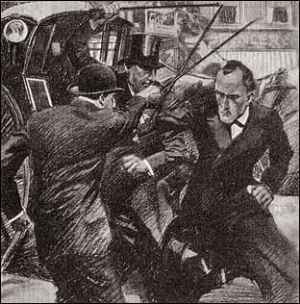

Bartitsu is a portmanteau word derived from a blending of the surname of its inventor, Edward Barton-Wright, and the Japanese discipline of ju-jitsu. Barton-Wright studied the latter when he was in the East working as an engineer in the 1890’s. He returned home to find the London papers full of outrage about a wave of street crime. Proper gentlemen and ladies were being regularly assaulted and robbed. To address this thuggish violence he developed a system of personal defense which he claimed could “meet every kind of attack, armed or otherwise.” 

His system blended techniques found in boxing, wrestling, French savate, la canne (walking stick), and ju-jitsu. Of these, the last named features most prominently in Barton-Wright’s description of Bartitsu’s guiding principles: “1) to disturb the equilibrium of your assailant 2) to surprise him before he has time to regain his balance and use his strength 3) if necessary to subject the joints of any part of his body whether neck, shoulder, elbow, wrist, back, knee, ankle, etc. to strain which they are anatomically and mechanically unable to resist.”

Any modern student of aikido (my martial art of choice, also a child of ju-jitsu) will recognize these principles. The opponent’s own momentum and strength are redirected and used against him. This was no sport for effete British dilettantes. Indeed, there is no competitive form of Bartitsu at all. From the first it was intended to be a means of defense against ruthless alleyway assailants. Fast, violent, and effective, Barton-Wright’s system aimed to put an attacker down as soon as possible and render him incapable of further outrage (though he took pains to advise that it not be taken to extremes or be used to hurt a man who has been made helpless).

This system embraces every possible eventuality and your defence and counter-attack must be based entirely on the actions of your opponent. Even though Barton-Wright’s original Pearson’s articles mentioned some 300 reactions to common situations, he insisted that the essence of Bartitsu was the fluidity of mind and body to respond to the circumstances of the encounter.

It was expected that the middle-class patrons trained at his Soho Bartitsu Club would never initiate an attack, but only take action when threatened. To this end there are few purely offensive techniques described, though an unscrupulous practitioner could always adapt Barton-Wright’s principles to the wrong ends.


Bartitsu tends to be fast and fluid, offering the writer a great variety of exciting moves when used in an action scene. There is little toe-to-toe pounding involved. If a tactic fails or is blocked, the Bartitsu fighter immediately abandons it in favor of another.


Besides the five primary disciplines already mentioned, great store is set on the employment of clothing and found weapons. Barton-Wright mentioned bowlers, coats, umbrellas, hatpins, and even bicycles as equalizers in a fight. In my books I have included all of these and more. They make for dandy spectacles of mayhem. Here’s another one from Paragon of the Eccentric as an illustration. (Note: Millie is a DNA experiment and has two tentacles at the base of her skull, one with teeth)

He gripped the fountain pen in his left hand, each rounded end protruding from his fist. “But we are not without resources.”

“What?” inquired Tilley. “You plan to write satirical poems at them?”

Pausing at the foot of the grimy steps, he jerked up the right leg of his trousers to expose his artificial calf. Out of its hidden compartment he took a six-inch black metal tube.

“Resources?” said Amber with a dubious note in her voice. “Some marvelous new death ray, perhaps?”

With a snap of his wrist the steel baton expanded like a telescope to its full eighteen inches. “Rather more primitive than that, but effective nonetheless. Apply it to any offered skulls, wrists, or knees.” He looked at Vesta. “Remember your training. Queue’s lessons shall serve you well. Millie, I do not have to tell you how to control a man, do I?”

The dollymop waved a dismissive hand. “It’s me stock in trade, ain’t it?”

Paragon burst up through the hatch and into the room before the nearest man could do much as raise his eyebrows. The heavy brass pen spiked him in the temple. He dropped as if shot point-blank.

Shouts. Blurred motion. Chaos. Curses and threats. Six other men reached for their pistols or truncheons. One gun clattered onto the floor at once when Amber’s baton broke its owner’s elbow. He shrieked and backed into Vesta, who seized his abused arm to whirl him into another bloke who had raised his billy to strike at Lady Moura from behind. Little Tilley, fully invested in her male persona, used her fists to jab the next chap in the nose and throat. A savate kick to his belly sent him down the hatch hors-de-combat. True to her promise, Millie simply reached down to take hold of her man’s bollocks as if crushing walnuts. When he raised a hand to bat her away a fanged tentacle bit into his palm and worried at it like a terrier with a rat.

Someone bear-hugged Paragon from behind to immobilize him so that another could apply a bludgeon from the front. A vicious stab of the pen into the hugger’s cheek made him loosen his hold, while a low kick from Paragon’s invincible right foot broke his partner’s knee. He turned, twisted the other’s arm like a corkscrew and spun him into a wall.

Pictures being worth much more than a thousand words, I encourage the reader to consult the Resources section of this article for photographic ad video illustrations of the essential Bartitsu techniques. That said, here are a few very basic descriptions of the basic disciplines.

Stick:

Barton-Wright naturally presumed that anyone in his audience would likely be in possession of a walking stick or umbrella when in the street. To that end Bartitsu relies quite a bit on stick play inherited from saber tactics and prior stick-fighting systems. Much of this came from his stick instructor at the Bartitsu Club (located in the appropriately-named Shaftesbury Avenue in Soho), French/Swiss military man and combat
expert Pierre Vigny.

The stick is held like a club, thumb wrapped around the fist, rather than like a sword with the thumb along the shaft. Preference is given to remaining out of distance of the opponent and striking his arm or head. Often this involves inviting a particular attack and then sliding or pivoting out of danger while simultaneously swinging the stick at a vulnerable spot.

Also favored is defending and attacking in a single move, such as blocking a club aimed at one’s head and continuing on to assail the foe’s own body. Closing the distance to get inside the arc of a punch or stick-swing is recommended. While wrapping and disabling the attacking arm, the handle of one’s stick may then be used against vulnerable areas. Alternatively, the shaft can leverage joints.

What is not advised is engaging in a pure fencing match with another stick or club. Of great utility is holding the stick in two hands like a rifle with bayonet, relying on thrusts with the point. Concentrating the force in such a tiny area is very effective. One should keep in mind that the stick, like the other disciplines, is not used alone, but in combination with kicks, punches, and throws.


French kick-boxing, derived from the tough waterfronts of Marseilles, gives Bartitsu a handful of useful tactics. Barton-Wright did not go into detail in print about the kicks used in Bartitsu, so some speculation is involved; however, he does specify three savate kicks. A coup de pied bas mentioned in the opening selection, is a low front kick to the knee or shin. This would most likely be used as a spoiling move against an advancing opponent, or as a setup/distraction in combination with a stick strike or punch. The chasse´ bas lateral: a low side kick, requires a bending of the rear leg and straightening the front one while turning the outside edge of its foot up. It is then thrust at the thigh, knee, or shin, the blow landing with the heel or outer part of the foot. From personal experience while sparring I can attest that it will absolutely stop an onrushing attacker in his tracks when used against his kneecap.

Finally, the chasse´ croise median aims for the foe’s solar plexus or stomach. Skipping the rear foot behind and past the front, the latter is then pistoned out at the enemy’s midline.

Savate:

Another use for the foot, though not borrowed from savate, is to maneuver behind one’s attacker and collapse his knee joint by simply stepping on it. Very little force is required and gentle pressure on collar or shoulder will drop the largest man.

Boxing:

"In order to ensure as far as it was possible immunity against injury in cowardly attacks or quarrels, they must understand boxing in order to thoroughly appreciate the danger and rapidity of a well-directed blow, and the particular parts of the body which were scientifically attacked.” He also seemed to believe that every Englishman of any breeding would already know the basics of pugilism, because he said precious little about it other than to note that street fighting and Marquis of Queensberry boxing were very different and the latter had to be adapted to ensure success in a battle for survival against the expected unscrupulous opponent. In point of fact, much of what he said about it seemed to be aimed at knowing how to defeat the expected moves of a trained boxer.

Viewing film of boxing matches from 1894 (indeed, some of the oldest movies in existence), one sees that the style of Barton-Wright’s time called for a very upright stance with the arms extended. The thumb would be on top of the fist instead of wrapping it around for safety as we would now do it.

Whereas today we would keep the hands close to the face, hunkering behind them in a close guard, the realities of bare-knuckle boxing called for a different approach. The opponent was to be kept literally at arm’s-length, since his hands weren’t padded and could do significant damage.

The milling of one’s fists is no movie parody but was an actual technique of the age. It confused the foe and kept the hands primed for use, much like a volleyball player ‘dances’ the feet to be more ready for a quick reaction to the spike. Punches often tended to be almost lunges, the lead foot and fist moving together, though there was also plenty of swinging from the rear foot in the old films. Blocking with the arms more resembles defense in an Asian striking discipline than in modern boxing. The movements tend to be more exaggerated, not tiny and controlled.

Wrestling:

As with pugilism, the references to standard freestyle wrestling are not extensive, possibly for the same reason, that Barton-Wright expected all young men to have practiced the basics. But he also borrowed from Swiss schwingen, a grappling style inherited from medieval times that chiefly involved grasping the opponent at the hips and throwing him. Many of its techniques are nearly indistinguishable from judo moves, which themselves evolved from ju-jitsu in the 19th century. Since Bartitsu’s founder relied primarily on ju-jitsu for close-quarters work and ground fighting, he likely taught standard wrestling as much for knowing how to counter it as for using it in a fight.

Ju-jitsu:

Much enamored of this Japanese discipline, since he had studied it in its native land and was convinced of its efficacy, Barton-Wright wrote and spoke more about it than any of the other principle techniques. He clearly prized it, since he incorporated its final syllables into the name of his art. In fact, he went so far as to import three ju-jitsu masters when he returned home. Some of the attention he paid to it might be put down to its sheer novelty in Britain, as it required much more explanation. It was also what made Bartitsu so very different from other combative systems in the West.

It is the essence of ju-jitsu which informs Bartitsu’s core principles. It can be translated as “the art of yielding.” This is appropriate, since it teaches practitioners to use the enemy’s own momentum and strength against him. Developed by samurai to fall back upon when disarmed and fighting an armored foe, it replaced futile hand strikes with joint locks. As previously stated, it depends upon disturbing an assailant’s equilibrium, inviting hostile motion so as to make use of the foe’s own energy, and taking pre-emptive action with offensive defense.

This is the aspect of Bartitsu that gives it a grace and elegance while at the same time enabling its violent character when joined with the other disciplines. Stepping into an assault, blending with its direction and carving circles in space while rendering the opponent helpless looks almost dance-like when performed well. When employed along with punches, kicks, and stick-play, it makes for an exciting and unique fight scene readers will enjoy.

Clothing and Found Weapons:


Apart from walking stick display, this is the area of Bartitsu where the Steampunk author can add Victorian flair and color to her writing. Hats, overcoats, parasols, and pins are all mentioned by Barton-Wright as adjuncts to the Bartitsu practitioner’s standard arsenal. He recommended flinging a bowler into the opponent’s face as a distraction while closing to engage, or tossing a coat over his head. A sturdy hat could even serve as a buckler in the off-hand while striking with a stick. This is all absolutely efficacious, as I discovered in a full-speed Bartitsu free-play exercise. My student charged me with a stick with no choreography. Unarmed, I flung my hat into his eyes, pivoted, wrapped his stick arm with my left, and disarmed him with my right. Despite his knowing Bartitsu, he still lost to this move.

Barton-Wright was not remiss in advocating that ladies practice Bartitsu. Umbrellas, particularly those with crook handles, made fine weapons. Offending arms and legs could be hooked and the brolly’s tip into the throat would deter any ruffian.

A 14-inch hatpin to the eye would certainly end a fight in the lady’s favor. It is known that suffragettes such as Edith Garrud defended themselves against the police with ju-jitsu, though whether they actually trained at the Bartitsu Club itself is conjectural. Also an established fact is that the sister of Boy Scouts founder Lord Baden-Powell was an expert at defending herself with both parasol and walking stick.

Group Fighting:

Since it was well-established that the criminal element rarely offered a fair fight and commonly attacked in groups to ensure success, Bartitsu included tactics for engaging several assailants at once. Naturally Barton-Wright preached that one should not stand on ceremony or honor in such situations but rather flee with all haste. If one were to be trapped, however, he offered means to clear a path to safety. These depended on having a stick and employing it in wide sweeps and vigorous back-and-forth motions to
prevent surprise from the rear. Once room had been made, then the single man could proceed as the
situation dictated.

We will end with a final fight scene from Paragon of the Eccentric:

She grasped a straight stick in her gloved hands and returned to the centre of the mat. Queue assumed the attitude of some ill-paid thug with minimal training as a fighter. Her stick sliced straight down at his skull while she bulled her way toward him.

Paragon pivoted on his front foot. Her impetus as the blow missed took her a step past him. Almost casually he stepped on her knee joint from the rear, causing her to fall onto that knee. A painless rap to the back of her shoulder with the light stick neck ended the first exchange.

Again they faced off. This time she swung her stick with both hands, as a frustrated rowdy might do. Like a batsman trying for six she chose a more horizontal path. Not so easy to avoid as a vertical attack.

Knowing this, Paragon did not attempt evasion. Instead he slid directly into her, body against body. Now the stick body was past him, unable to inflict harm. Adding his own force to hers, left arm across her stick arm, they spun like a top. He simply bent his knees as they went around, causing her to fall forward out of the spin. She landed on her back with a boom, his stick point against her throat.

After assisting her to rise, they met for a third time. Now she feinted another descending sabre cut, but as he raised his stick with both hands wide apart to parry it she shifted to a spiking bayonet-style strike at his chest. Leaving his stick up high, Paragon pivoted out of her stick’s path with a simultaneous left cross to her jaw. Despite her armour, the impact of the fist sent her sprawling.

Cursing under his breath, Paragon cast his stick aside and rushed to the immobile woman. He pulled off her bulky helmet to give her air. Queue’s eyes remained closed, her breathing shallow. “We need some help in here!” he bellowed, half-turned toward the door. “Halloo!”

The room swiveled as if on ball bearings. Before he could comprehend his predicament he lay flat on his back, staring into the painful glare of the electric ceiling lamps. A leg made of cast iron clamped onto each side of his arm, which was stretched high over his head. One heel bored into his throat. His air and voice were cut off. Jolts of pain shot along his arm as Queue hauled back on it, bending his elbow across her thigh. For good measure she ruthlessly twisted his wrist in a direction it had definitely not been designed to go.

I’ll be damned if I’ll tap out for her satisfaction.

Another three seconds showed him how much in error that last belief had been. Queue yanked on the arm as if trying to pull a locomotive down the track. At the same time her heel pressed in another two inches, until he positively gurgled and drooled.


Hopefully these few precepts concerning the Victorian/Edwardian fighting art will embolden you to craft exciting scenes of Steampunk or Victorian mayhem. While the normal tropes of the genre (those gears, clocks, and airships) are growing stale, Bartitsu is still fresh and unspoiled. Despite its century-old pedigree, book lovers are unfamiliar with it. Nothing thrills a reader quite so much as seeing a cool, well-dressed hero or heroine dispatching ill-mannered blokes. So let the sticks, feet, and erudite quips fly. Grace under pressure has always been the hallmark of good breeding and Bartitsu is certainly a means to that end.

~~~~~~~~~~~~
Terry Kroenung is the author of the Legacy Stone series of American Civil War fantasy novels. Book One, Brimstone and Lily, won the Bronze Medal in Fantasy/Science Fiction at the 2010 Independent Publishers Book Awards. Jasper’s Foul Tongue followed the same year and the third volume, Jasper’s Magick Corset will be out in November. Paragon of the Eccentric, a Steampunk prequel to H.G. Wells’ War of the Worlds, is currently under consideration by Tor.

His story “Lonely Crutch” appeared in the anthology Broken Links, Mended Lives, a Colorado Book Award finalist. “Winterlesson” where Santa Claus is shot down by the U.S. military (really), has been published multiple times, most recently by Toasted Cheese literary magazine. “Bladelight” offers a distinctly different take on a rapier duel for love.

Originally a playwright, produced in New York City and Europe, his dramas include Gentle Rain, Coolness and Courage, Blood and Beauty, and an adaptation of The Three Musketeers that features a chorus line of dancing swordsmen and a henpecked Alexandre Dumas.

He teaches Writing, Literature, and Film at Niwot High School in Colorado and next year will add a course in Science Fiction & Fantasy. In his copious free time from teaching, writing, and performing Shakespeare he gives Bartitsu workshops at Steampunk conventions and writers’ gatherings.

RESOURCES

Barton-Wright, E.W. The New Art of Self-Defence, Part 1: London, Pearson’s Magazine, March 1899.
Barton-Wright, E.W. The New Art of Self-Defence, Part 2: London, Pearson’s Magazine, April 1899.
Barton-Wright, E.W. Self-defence with a Walking Stick, Part 2: London, Pearson’s Magazine, January 1901.
Barton-Wright, E.W. Self-defence with a Walking Stick, Part 2: London, Pearson’s Magazine, February 1901.
Cunningham, A.C. The Cane as a Weapon: 1912
Gallowglass Academy Introductory Bartitsu: 2009
Lawson, Kirk: Bartitsu: The Martial Art of Sherlock Holmes: 2006
Wolf, Tony The Bartitsu Compendium, Volume 1, History and Canonical Syllabus: 2011
Wolf, Tony The Bartitsu Compendium, Volume 2, Antagonistics: 2011
Wolf, Tony Bartitsu: The Lost Martial Art of Sherlock Holmes: 2012
Wolf, Tony, et al International Bartitsu Society:
Academie Duello, Bartitsu Intro:
Bartitsu School of Arms:
Bartitsu Stick Sparring:

Friday, September 13, 2013

Victorian Violence: Repelling Ruffians (Part Three)

by Terry Kroenung


I was not surprised when Holmes suggested that I should take my revolver with me. He had himself picked up the loaded hunting-crop, which was his favourite weapon. ---The Adventure of the Six Napoleons

The light flashed upon the barrel of a revolver, but Holmes’s hunting crop came down on the man’s wrist, and the pistol clinked upon the stone floor. --- The Adventure of the Red-Headed League

"I’m a bit of a single-stick expert, as you know. I took most of them on my guard. It was the second man that was too much for me.” ---The Adventure of the Illustrious Client

Weapons

When a lady or gentleman of the Victorian upper or middle class ventured into a less-than-savory district, a variety of defensive aids was available, from the lethal pistol and knife to the simple cudgel, walking stick, and umbrella. In this essay we shall eschew firearms and confine ourselves largely to the items most likely to be either carried by someone of refinement or by those rogues who preyed upon them. 

Despite the accompanying illustrations, violence upon propertied people was probably not as widespread as novels and press reports of the time, both depending on sensationalism for sales, would have us believe. That being said, incidents of self-defense against the criminal element did occur with enough frequency that a brisk trade in protective means existed.


Cudgel

A mere club, the cudgel was more likely to be employed against our unfortunate gentleman than by him. It could be as crude as a limb wrenched from a handy tree or as refined as a gaily-painted policeman’s truncheon. Shorter and more rudimentary than the walking stick (generally less than an arm’s length), its affordability and ease of concealment made it popular, particularly with the lower sort. 

Indeed, the late Victorian police truncheon was only fifteen inches in length and lived in a specially-built pocket of the officer’s trousers. For even though the servant of the law could claim authority to employ his cudgel, it was not considered proper to wantonly display the threat, since moral suasion was the first line of a Peeler’s defense. Particularly in the first half of Victoria’s reign these sticks would be ornately decorated, as they were the officer’s mark of authority as well as his weapon.

Cudgel tactics were unsophisticated compared to the exotic joint-locking techniques taught today. Chiefly it was a case of ‘brain him’ with a stunning blow to the offender’s cranium. As can be imagined, this often resulted in a dead suspect and rather less labor for the magistrate.

Life-Preserver

A variant of the club was the so-called life preserver, which a respectable man might carry, though not as often as he might a proper cane. Easily hidden at about a foot in length, it had a flexible shaft of whalebone or some such supple core, leather-wrapped, with a weighted knob at one end. Their construction ran the gamut from crude to almost artistic. Principal targets were the head and wrist.


The knobstick was closely related, but its weighted end was a lead ball wrapped in string, rather than leather. It cushioned the blow somewhat, though it remains a point of conjecture as to whether the recipient often appreciated the consideration.

Loaded Hunting Crop


As seen in the Arthur Conan Doyle excerpts above, Sherlock Holmes favored a variation of the life-preserver. The loaded hunting crop contained a steel or lead core wrapped in leather. Less legally problematic than a pistol, and not as likely to permanently ruin a man whose testimony might be required to solve a case, they would be employed much as a life-preserver or cudgel.


Knuckleduster


Rather on the more brutal end of the spectrum lay the knuckleduster, a remnant of the sword hilt which had always been used when a duel got to close quarters and blades could no longer be effectively brought to bear. This had the advantage of being readier to hand than a pocketed cudgel, since in seamier districts it could remain on the fist. One version, marketed as the ‘Highway Protector,’ sported a spike on the little-finger side for striking behind.

Even easier to conceal was the Apache ring, essentially a knuckleduster for one finger but operating in the same manner.


Named for the vicious French street gangs of the Belle Époque who favored them, they often had fearsome projections that would leave ghastly wounds on the faces of their victims to serve as warnings against future trespass.


Walking Stick


Naturally the gentleman’s weapon most associated with the Victorian era in the popular imagination would be the cane or walking stick. Appearing in a bewildering variety of shapes, sizes, materials, and gadgetry, the stick was essential equipment for a man or woman of means. A substitute for the sword as an article of refined dress, its phallic symbolism is best left for another essay. The actual employment of canes and umbrellas in defense will be discussed in part 4 of this series.


The 19th century saw the height of the aristocratic stick’s popularity, both as ornament and as weapon (Victorian London boasted some 60 walking stick shops). It sprang from Louis XIV’s adoption of an embellished stick as a symbol of his majesty, a form of scepter. He even banned commoners from sporting them. Overnight, as with so much else in the Sun King’s orbit, fancy sticks became essential at court. 

The 18th century saw both smallsword and stick carried together. After the Napoleonic era the former gave way to the less lethal (and arguably cheaper, for the masses) stick. Functional jewelry, sticks could be decorated to the level of the bearer’s wealth as a symbol in a very status-conscious age. Almost incidentally a stick also kept a gentleman upright in dodgy ground and in dodgy company.

Canes could be utilitarian, of course, like a good Irish blackthorn. A certain type of confident gentleman would favor one of these, proclaiming to the world that he had no time to waste concerning himself with mere foppery.

There was the added benefit that such a stick made a more than serviceable weapon and its owner was less likely to wail if it shattered upon the thick pate of a luckless thug.

For self-defense two types stood out. A crook-handled stick had much to recommend it inasmuch as it could snare the limbs and even necks of assailants. As it lacked a solid punch, however, a gentleman might eschew it for a heavy knobbed affair that could cave in the skull of a determined adversary. The ultimate example of this sort of formidable stick would be the knobkerrie, originally a native weapon from South Africa that could even be thrown like a missile.

System Stick


Naturally some gentlemen preferred to employ less brute force and more surgical precision in a crisis. For them the discerning designers of the Industrial Age could provide system sticks, so called because they contained any number of clever devices, from brandy flasks to complete medical kits. Simplest was the classic swordstick, a steel blade inside the hollow shaft.


A few opted for spring-loaded stiletto points that could pop out of the end. One wicked French version had razors that would snap out along the whole stick, to the great inconvenience of anyone foolish enough to seize it. And the added advantage of a swordstick was that once drawn the user had a pair of weapons, for the hollow body made a splendid cudgel/parrying stick in its own right.

It goes without saying that any arms race will always increase in lethality. Once the criminal element in a particular region embraced firearms then a segment of the gentry would follow suit. Quite a few canes became vessels for powder and ball. Yet turning one’s stick into a shotgun could be considered a step backward for the genteel man.


Umbrella and Parasol


As ubiquitous as the walking stick, and seemingly an unofficial passport declaring one’s bone fides as an English citizen, the brolly may have been used in defense more often by women than men. Indeed, a significant body of literature exists outlining tactics to be employed by ladies with umbrellas (see part 4 for illustrations of such techniques). While specialized uses similar to stick-play were the norm, this did not exclude the manufacture of umbrellas with daggers, swords, etc.


Hatpin


While ladies’ fashions varied widely in the period, from enormous hoop skirts to bustles to leg-of-mutton sleeves, hatpins were a constant for much of the age. Particularly when bonnets tied under the chin gave way to hats perched atop the head, and even more so with the advent of wide-brimmed affairs easily caught by the wind, hatpins became utterly essential items for all women. So large was the demand that one Gloucestershire factory employed over 1,500 workers.

Pins grew very long, some over 14 inches, to accommodate the increasing size of hairstyles and chapeaus. Legislation had to be enacted to limit both the length of pins and the danger of their exposed points, requiring caps on the later so as to not scratch passersby. It took no great imagination, of course, to envision pins as weapons in a crisis. In point of fact, the very possibility of suffragettes wielding them against the police led to yet another law of 1908 restricting them.


Thus we have examined a number of common street weapons of the Victorian age. While no means an exhaustive account (the entire range of firearms and knives being reserved for another day, along with such exquisite rarities as belt buckle pistols and garrotes), the reader or author of 19th century literature may now be confident of a basic grounding in the more likely devices to be encountered or employed.


~~~~~~~~~~~~
Terry Kroenung is the author of Brimstone and Lily, a serio-comic fantasy novel set in 1862, and its sequel, Jasper’s Foul Tongue. Book 3 in the series, Jasper’s Magick Corset, will be available in November 2013. Paragon of the Eccentric, his Steampunk prequel to War of the Worlds, is pending. He has also written period dramas set in the 19th century, such as Gentle Rain, and Coolness and Courage.

Saturday, May 11, 2013

Victorian Violence: Repelling Ruffians (Part One)

by Terry Kroenung


 "The housebreaker freed one arm, and grasped his pistol. The certainty of immediate detection if he fired, flashed across his mind even in the midst of his fury; and he beat it twice with all the force he could summon, upon the upturned face that almost touched his own.

She staggered and fell: nearly blinded with the blood that rained down from a deep gash in her forehead; but raising herself, with difficulty, on her knees, drew from her bosom a white handkerchief--Rose Maylie's own--and holding it up, in her folded hands, as high towards Heaven as her feeble strength would allow, breathed one prayer for mercy to her Maker.

It was a ghastly figure to look upon. The murderer staggering backward to the wall, and shutting out the sight with his hand, seized a heavy club and struck her down."
    --- Oliver Twist, Charles Dickens

To judge by this disturbing scene (or, indeed, any episode of Ripper Street) it was as much as a man’s life was worth to walk the streets of Victorian London. Robbery and murder were commonplace, pickpockets were as ubiquitous as fleas on a mongrel, and as for an unaccompanied woman, well…

But was that true? Or were the news reports of that era just as slanted toward the sensational as are our own? ‘If it bleeds, it leads’ is the motto of modern media and certainly British journalism of the 19th century could hardly claim to be more scrupulous. The truth is that we do not know with any degree of certainty.

Then as now circumstances and geography dictated risk. Jack the Ripper’s outrages were committed in sordid Whitechapel, after all, and not in genteel Kensington. A critical mass of the poor and desperate has always led to increased criminality.

Wise ladies and gentlemen preferred to avoid dirty, ill-lit areas with foul reputations. Forewarned is forearmed and all that. Yet an assault could happen at any time and place. It was no respecter of persons, either. In 1862 a Member of Parliament was garroted and robbed in broad daylight in Pall Mall.

Earlier centuries may well have been worse. The gin-soaked gutters of Hogarth’s time, with none of Robert Peel’s bluebottles or even the Bow Street Runners to keep the peace, were likely a horror-show. A noticeable decrease in wretchedness did occur with the advent of the Metropolitan Police, though it took until the 1880’s for that force to gain wide-spread respect. Ennui was not a risk faced by the Peelers.

In a typical Dickensian year (1856) the force arrested over 73,000 people. And we would do well to remember that an enormous percentage of crimes went unreported or unrecorded. The citizenry did not trust its own officers, often with good reason. Particularly in the early days the policeman was often just as likely as the most hardened East Ender to be guilty of an offense.


Even if the bobby was honest, many residents felt it a waste of time to make a complaint, since so many crimes were not solved. Let us give savagery the benefit of the doubt and presume that it was enough of a concern that measures had to be taken.

To this end most men of the middle and upper classes considered training in pugilism and singlestick to be an essential part of their education. When faced with a determined defender, many a hooligan would likely seek easier prey. Quite apart from such practical considerations, the manly arts also served to toughen the mind and spirit, preparing a fellow for the rugged vicissitudes of life. Instructional manuals abounded, all stressing this point:

"Physical education is indispensable to every well-bred man and woman. A gentleman should not only know how to fence, to box, to ride, to shoot and to swim, but he should also know how to carry himself gracefully, and how to dance, if he would enjoy life to the uttermost. A graceful carriage can best be attained by the aid of a drilling master, as dancing and boxing are taught. A man should be able to defend himself from ruffians, if attacked, and also to defend women from their insults."
     --- Our Deportment, 1879

Naturally certain of these skills were better-suited to the country house than the alleys of the metropolis. Be that as it may, expertise with stick and fist doubtless preserved many a life when faced with a resolute robber in a fetid corner of the Empire’s capital. At a minimum it would have enabled the victim to keep a cool head and react with grace under pressure.

In Part Two we shall investigate what techniques and tools would have been available to a gentleman, or lady, in such duress.

~~~~~~~~~~~~

Terry Kroenung is the author of Brimstone and Lily, a seriocomic fantasy novel set in 1862, and its sequel, Jasper’s Foul Tongue. Book 3 in the series, Jasper’s Magick Corset, will be available in September. Paragon of the Eccentric, his Steampunk prequel to War of the Worlds, is pending. He has also written dramas set in the 19th century, such as Gentle Rain and Coolness and Courage.