One of the most intriguing characters in historical fiction is Milady de Winter of the Three Musketeers. Alexandre Dumas depicted her as a lethal spy whose loyalties were sold to the highest bidder, notably the Cardinal Richelieu.
The inspiration for Milady was a socialite and renowned beauty of her day, Lucy Hay, Countess of Carlisle. Though Lucy was not an agent of Cardinal Richelieu, she held court at a time of social upheaval when men were drawing battle lines against King Charles I. The real woman was even more fascinating than the fictional one.
 |
| Lucy Percy, by Anthony van Dyck [Public Domain] via Wikimedia Commons |
Lucy Hay was born Lucy Percy in 1599 to Lady Dorothy Devereux and Henry Percy, the 9th Earl of Northumberland. Lady Devereux was the daughter of the Earl of Essex and Lettice Knollys whose second husband, Robert Dudley the Earl of Leicester, had once been a favourite of Queen Elizabeth, that is until he and Lettice married without the Queen’s permission. Through her maternal line, Lucy was the great, great granddaughter of Mary Boleyn, sister to Anne Boleyn.
On Lucy's father's side, the Percys were an old and respected bloodline having first arrived with William the Conqueror, and later, descendants of King Henry III. The family stood for centuries as the bulwark against Scottish and Welsh invasion of England. Given Lucy's stellar connections, she was well poised to be a courtly influence.
On Lucy's father's side, the Percys were an old and respected bloodline having first arrived with William the Conqueror, and later, descendants of King Henry III. The family stood for centuries as the bulwark against Scottish and Welsh invasion of England. Given Lucy's stellar connections, she was well poised to be a courtly influence.
Unfortunately, her early years were marked by notoriety and not the favourable kind. When Lucy had been six years old, her father had been implicated in the Gunpowder Plot (to blow up Parliament and murder King James I) due to his kinship with one of the leading conspirators, Thomas Percy. For the next seventeen years, Lucy’s father was a prisoner of the Tower of London (along with famous prisoner Sir Walter Raleigh) and during this time Percy indulged his interest in alchemy and chemistry. He was committed to his experiments (even lost the hearing of one ear) and everyone called him the "Wizard Earl."
While Henry languished in the Tower, Lucy’s mother tried to secure her husband’s release. She appealed to her friend Queen Anne, who put in a good word with her husband, King James I, but unfortunately the King levied a crippling fine that the Percys couldn’t afford and they found their estates seized. This was Lucy’s early introduction to the influence women could yield in politics as well as the fickleness of royal prerogative [1].
Sometime around 1617, Lucy Percy caught the eye of James Hay, who would become the 1st Earl of Carlisle. At the time he was a baron and a widower. Her father was furious. His imprisonment put him at a disadvantage to squelch his daughter's choice, particularly since his wife favoured the match. Henry Percy did not have a high opinion of the Scottish faction at court, the courtiers who had followed King James to England upon his ascension of the English throne, and James Hay was one of the King’s more extravagent favourites. Henry Percy had been reputed to say, “I am a Percy and I cannot endure that my daughter should dance any Scottish jig.”
Sometime around 1617, Lucy Percy caught the eye of James Hay, who would become the 1st Earl of Carlisle. At the time he was a baron and a widower. Her father was furious. His imprisonment put him at a disadvantage to squelch his daughter's choice, particularly since his wife favoured the match. Henry Percy did not have a high opinion of the Scottish faction at court, the courtiers who had followed King James to England upon his ascension of the English throne, and James Hay was one of the King’s more extravagent favourites. Henry Percy had been reputed to say, “I am a Percy and I cannot endure that my daughter should dance any Scottish jig.”
 |
| James Hay, 1st Earl of Carlisle, by Unknown National Portrait Gallery: NPG 5210 [Public Domain] via Wikimedia Commons |
James Hay was not considered a handsome man, but he was suave, charismatic and knew how to entertain in style. He introduced Lucy to a sophisticated set, lavished her with courtly masques, fine music and theatre. For an ambitious woman like Lucy, James Hay was irresistible. More importantly, he pulled her from the shadow of her father’s disgrace straight into the royal limelight.
In November 1617, Lucy became James Hay’s second wife. Her wedding was attended by the fashionable and the powerful, including Charles, Prince of Wales and George Villiers (later the Duke of Buckingham).
In the early days of Lucy’s marriage, her husband served as a Privy Councillor and a Groom of the Stool. Between 1618 and 1622, Hay travelled to foreign courts on behalf of the King, counselled the King on the growing troubles in Germany and recommended England’s support for the Protestants in Bohemia and the Palatinate. He was a voice for the Huguenots in France though not a successful one. In 1622, the King made him the 1st Earl of Carlisle and Lucy became a Countess.
Lucy flourished in the years to come, greatly celebrated for her beauty and accomplishments. She had a gift for politics and intrigues, enjoyed poetry and theatre, and cultivated admirers by the score. In later years when she contracted small pox, the entire court feared that she would be disfigured. For a time, she wore masks to hide her healing face and managed to turn them into a fashion statement. Fortunately for Lucy, the disease did not leave lasting scars.
Men waxed poetic over Lucy’s charms. One admirer, John Suckling, wrote a risqué poem about the bewitching Countess of Carlisle in the form of a dialogue between himself and another admirer of hers, Thomas Carew. The poem was entitled, Upon My Lady Carlisle’s Walking in Hampton Court Gardens. Here is one of the stanzas:
Lucy and James Hay’s star continued to rise after the ascension of the new king, Charles I, and the growing influence of his favourite, George Villiers, the Duke of Buckingham. Lucy was rumoured to have been Buckingham’s mistress, and through Buckingham’s influence, she was appointed Lady of Queen Henrietta’s Bedchamber, while her husband received a similar honour for the King.
In November 1617, Lucy became James Hay’s second wife. Her wedding was attended by the fashionable and the powerful, including Charles, Prince of Wales and George Villiers (later the Duke of Buckingham).
In the early days of Lucy’s marriage, her husband served as a Privy Councillor and a Groom of the Stool. Between 1618 and 1622, Hay travelled to foreign courts on behalf of the King, counselled the King on the growing troubles in Germany and recommended England’s support for the Protestants in Bohemia and the Palatinate. He was a voice for the Huguenots in France though not a successful one. In 1622, the King made him the 1st Earl of Carlisle and Lucy became a Countess.
Lucy flourished in the years to come, greatly celebrated for her beauty and accomplishments. She had a gift for politics and intrigues, enjoyed poetry and theatre, and cultivated admirers by the score. In later years when she contracted small pox, the entire court feared that she would be disfigured. For a time, she wore masks to hide her healing face and managed to turn them into a fashion statement. Fortunately for Lucy, the disease did not leave lasting scars.
Men waxed poetic over Lucy’s charms. One admirer, John Suckling, wrote a risqué poem about the bewitching Countess of Carlisle in the form of a dialogue between himself and another admirer of hers, Thomas Carew. The poem was entitled, Upon My Lady Carlisle’s Walking in Hampton Court Gardens. Here is one of the stanzas:
“Twas well for thee she left the place;
There is great danger in that face.
But hadst thou viewed her leg and thigh,
And upon that discovery
Searched after parts that are more dear”
Lucy and James Hay’s star continued to rise after the ascension of the new king, Charles I, and the growing influence of his favourite, George Villiers, the Duke of Buckingham. Lucy was rumoured to have been Buckingham’s mistress, and through Buckingham’s influence, she was appointed Lady of Queen Henrietta’s Bedchamber, while her husband received a similar honour for the King.
It suited Buckingham to install Lucy as a companion to Queen Henrietta Maria, in order to be informed of the Queen’s visitors and activities. The Queen was passionately against Lucy's appointment. After all, Lucy was beautiful, witty and entirely Buckingham’s creature, and as her duties brought her in close contact with the King, Henrietta feared that Buckingham worked to install Lucy as the King's mistress. Charles was not so easily led astray and resisted Lucy’s charms; he even refused the Queen's petition to get rid of her. Over time, Lucy overcame the Henrietta's suspicions and became a close confident to her. Through her proximity to the Queen, Lucy became the centre of fashionable society, gathering poets and politicians within her circle.
 |
| George Villiers, Duke of Buckingham By Michiel van Mierevelt [Public Domain] via Wikimedia Commons |
It was around this time when the story of the French Queen’s diamonds surfaced, made famous by Alexandre Dumas in The Three Musketeers. A 17th century French diarist, Francois, Duc de La Rochefoucauld (Prince de Marcillac) wrote in his memoirs that Lucy stole the diamond studs that Anne of Austria, Queen of France, had given to her admirer Buckingham. Lucy's motives were reputed to be revenge for having been jilted by Buckingham by his obsession with the Queen. Dumas borrowed heavily from Rochefoucauld’s memoirs and created the character of Milady de Winter in Lucy's image.
James Hay meanwhile continued his diplomatic service for Charles I, engaging in intrigues against Cardinal Richelieu of France and was even named Governor of the Caribbees. Eventually his health failed, and he died in 1636.
Now Lucy found herself a wealthy widow, and it gave her a degree of freedom that she had never previously enjoyed before. Though she would not be shy of male companionship, she never remarried and so maintained her independence. During this chapter of her life, she fell in love with Thomas Wentworth, the Earl of Strafford. Intense, serious and ambitious, Strafford was the exact opposite of Lucy’s late husband.
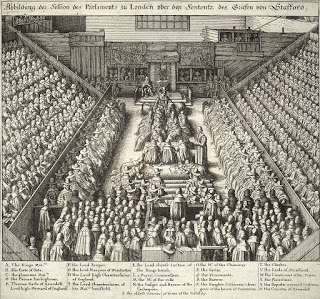
Strafford had at one point been a vocal supporter for the rights of Parliament against royal prerogative, but he eventually switched sides to become one of the King’s most ardent supporters. As discontent against the King grew and the country headed toward civil war, Strafford became a scapegoat for the country's ills, and Parliament called for his impeachment. The impeachment failed but a bill of attainder was passed against him, and Charles I had no choice than to sign the attainder and seal Strafford's death. To read more about Strafford’s trial, see Strafford Must Die by Annie Whitehead.
Politically astute, Lucy managed to distance herself from Strafford so she was not brought low by his ruin. Lucy Hay was a survivor, after all. She switched sides and started passing information to one of Parliament’s most ardent advocates, John Pym. Some even said she became his mistress. Perhaps one of the most important pieces of information that she passed to Pym, and which was credited with igniting the spark of civil war, was a warning that the King was planning to arrest Pym and four of his companions. Pym managed to escape, and a week later, he returned triumphant to Parliament to resume his crusade against the King.
When the English Civil War broke out in 1642, Lucy favoured Parliament, though she took care to not entirely burn her bridges on the other side. She had a growing aversion to royal prerogative. Lucy favoured moderation, where the nobility retained their privilege instead of being irrelevant by the whims of the king. By the end of the 1st civil war, when it became apparent that Parliament was being circumvented by a fanatic Puritan faction, moderate Lucy switched sides to help spy for the Royalists.
During the second civil war (1647-1648), Lucy raised funds for the king and acted as a go-between the Royalists in the north and Queen Henrietta. In the end, all her efforts were for naught. The King was captured and in January 1649, executed.
Two months later, Parliament arrested Lucy and sent her to the Tower of London for questioning. They threatened her with torture but could not break her. Lucy remained in the Tower for eighteen months, ironically not far from where her father had been kept all those years. Eventually she was paroled and released.
In the final years of Cromwell’s Protectorate, Lucy became a Royalist agent, joining others who worked to restore Charles II to his father's throne. A few short months after the Restoration, on November 5, 1660, Lucy Hay, Countess of Carlisle quietly passed away.
Femme fatale, informant, spy, Lucy Hay was a fascinating character. Alexandre Dumas obviously agreed.
Further reading:
Court Lady and Country Wife: Royal Privilege and Civil War (Two Noble Sisters in 17th century England), by Lita-Rose Betcherman.
[1] The English Civil War: A People’s History, by Diane Purkiss
Poem of the week: Upon My Lady Carlisle’s Walking in Hampton Court Gardens by John Suckling.
~~~~~~~~~~
Further reading:
Court Lady and Country Wife: Royal Privilege and Civil War (Two Noble Sisters in 17th century England), by Lita-Rose Betcherman.
[1] The English Civil War: A People’s History, by Diane Purkiss
Poem of the week: Upon My Lady Carlisle’s Walking in Hampton Court Gardens by John Suckling.
~~~~~~~~~~
Cryssa Bazos is historical fiction writer and 17th century enthusiast with a particular interest in the English Civil War. Her debut novel, Traitor's Knot, will be published by Endeavour Press and will be released in 2017. For more stories about the English Civil War and the 17th century, visit her blog cryssabazos.com. Follow Cryssa on Twitter (@CryssaBazos) and on Facebook.