Showing posts with label Elizabeth 1. Show all posts

Tuesday, November 20, 2018

Lady Elinor Fettiplace and Her Receipt Book

by Lauren Gilbert

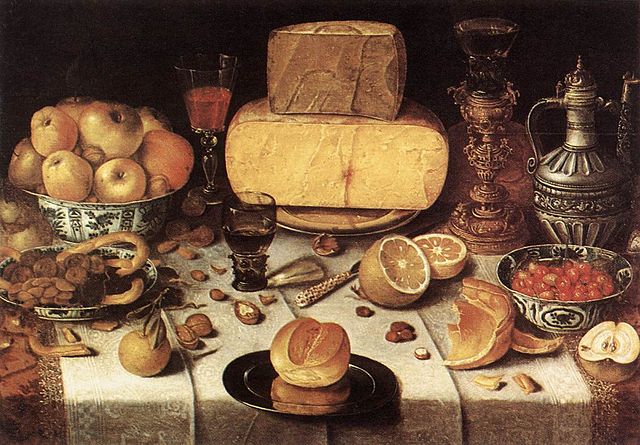
Laid Table by Nicholas Gillis, 1611

Old cookbooks and women’s household books or receipt books from times past are fascinating to me. So much “real people” information is to be found there: what they ate and when they ate it, how they celebrated, how they treated sickness or injury and which of those concerned them most, and other personal details of daily life can be found in these books. Women were responsible for the health, welfare, and feeding of their families, which at the wealthier end of the spectrum, included employees and visitors (uninvited as well as invited). Recipes were collected from friends and relatives and added to personal collections. The mistress of the household had to know what ingredients should be used and how dishes should be prepared (even if she did not do the cooking), make sure that medicinals and home remedies were properly prepared and available for use when needed, and that the supplies needed were available and techniques for completing tasks were known for household chores like laundry. Initially, these books were compiled by and for wealthy women (education being limited), but can still provide a view of their times that can illuminate the lives of people in general. One of the earliest of these books is the receipt book of Lady Elinor Fettiplace, of 1604.

Borne Elinor Poole c1570-1574, probably in Gloucestershire, to Sir Henry Poole of Gloucestershire and his wife Anne Wroughton (daughter of Sir William Wroughton of Wiltshire), Elinor was born into a family of “new men” making their fortune in the Tudor era by judicious marriages, holding positions with benefits and making themselves agreeable to important people. (The wool trade also helped.) Her paternal grandmother was a descendant of Sir Richard Whittington, a wealthy merchant who was Lord Mayor of London four times (and the inspiration for the story about Dick Whittington and his cat). Her paternal grandfather Sir Giles Poole was one of Henry VIII’s gentleman pensioners and prospered under all three of Henry’s children. (There was a family connection with the Earl of Leicester.) Her mother’s family prospered in a similar fashion. Other marriage connections included the Thynne family as well as Sir Walter Raleigh.

The Fettiplace family was an ancient line, which supposedly served William the Conqueror. Fettiplaces held various positions at court in the 13th, 14th and 15th century. They too made advantageous marriages and acquired large land holdings (at one point rumoured to hold 13 counties). At the time Elinor Poole married Richard Fettiplace in 1589, the Fettiplace name and land holdings were still impressive, but the family fortune was more uncertain. In February of 1589, her grandfather Sir Giles Poole died and left her a marriage portion of 400 pounds. It appears that, in their part of the marriage agreements, the Fettiplaces had to settle debts, which involved selling a certain amount of property. However, after the wedding of Elinor to Richard (later in 1589 after her grandfather’s death), influence by both sides got Richard invited to an important wedding at which Queen Elizabeth I was present in June of 1600. He was knighted during the celebrations. In 1604, Elinor wrote her name in her book of receipts with that year. The basic recording of the recipes themselves was apparently the work of a scribe, but she made notes herself. It’s important to realize that literacy among women was not particularly prized during this time; her ability to read and write (including knowledge of Latin) argues a more extensive education than was common even among upper-class women of this time.

The couple lived at Appleton Manor, near Oxford, where she would eventually have been responsible for the normal duties of the mistress of the house and prepared to manage the rest of the estate in her husband’s absence. The family in residence appears to have included Richard’s father Sir Bessell Fettiplace and mother (called Elinor or Helen) and his younger brothers and sisters. Elinor and Richard had 2 sons, John (the heir) born about 1589 and a younger son Henry born in 1602 about whom nothing else is known, as well as a daughter Anne born about 1594 who died in 1609. In between, there were 2 other daughters who did not survive infancy. It seems likely that Henry died in infancy or as a very small child, but his fate is not known. In 1603, Richard attended the coronation of King James, which indicated his holding a position of some influence. Son John was married in 1606 to his cousin Margaret Fettiplace. The young couple also lived at Appleton and had a son the next year.

Sir Bessells died in 1609 at which point Sir Richard came into his own, making Elinor the mistress of the household. (It appears that Richard’s mother retired on her jointure, making way for Elinor.) At this point, there was a multi-generational family living together (whether at Appleton Manor or at another family property) plus servants. Normally this would include a steward, a butler, a cook, a gardener, personal servants, and assistants to the others; similar households numbered as many as 100 or more persons. In addition to that, such households were responsible for providing hospitality to travelers and others, and assistance to local poor. Being an age of conspicuous consumption, Sir Richard and Lady Elinor Fettiplace would have been expected to “keep up with the Joneses” and maintain a similar standard of hospitality as that of their relatives and peers, many of whom were in high places indeed. Plague and other illnesses would also have to be dealt with. Elinor’s receipts included a plague remedy going back to Henry VIII and a herbal poultice from Dr. Thomas Muffet, scientist (whose daughter was the inspiration of Little Miss Muffet), as well as receipts for elegant cuisine (including a sweet potato dish attributed to Sir Walter Raleigh), and instructions for proper laundering of silk, whitening clothes and to prepare leather to be perfumed (perfumed gloves being a popular gift during the Elizabethan era).

Sir Richard Fettiplace died in 1615, leaving Elinor a widow. It appears she left Appleton Manor, retiring to her dower property (apparently near her family), leaving Appleton to her son and his wife and 4 children. She also spent considerable time at her father’s seat, Sapperton House. Her father Sir Henry Poole died in 1616 and left Elinor another 500 pounds and his coach. Sadly, Elinor’s son John died in 1619. At some point, Elinor married Edward Rogers, apparently a commoner known only as a citizen of Gloucestershire. This marriage appeared to be of fairly short duration. He died in 1623 and was buried at Sapperton church, leaving his entire estate to Elinor except for some bequests. After his death, Elinor lived on as a widow until her own death in 1647, which also appeared to have occurred in Sapperton. At her death, Lady Fettiplace left her book to her niece Anne, daughter of Sir Henry Poole the younger (her brother). The book was written in by other hands as it was passed on through the family and back to Fettiplace descendants until that branch of the family became extinct in the 18th century. It came into the hands of Hilary Spurling (author and theatre critic), as it was in the possession of one of her husband’s great-aunts. Ms. Spurling was fascinated by the book as a historical document. She put together a wonderful volume containing family information, historical context and the recipes themselves, as they were recorded (with Elinor’s notes where made) and then explains how to make these dishes today. This book gives an eye-opening view of Tudor and Elizabethan cuisine.


The original book itself (which I have not seen, unfortunately) is bound in leather and written on fine paper, with the Poole coat of arms stamped in gold on the cover. I do have Ms. Spurling’s book. The recipes are by month in her work, which illustrates the seasonality of food at that time. The recipes included some that appear to have been accumulated from times past (it was not unusual for a mother’s book to be copied and given to her daughter or daughter’s at the time of her marriage, then added to) as well as contemporary recipes. Spices were used differently than in medieval tradition, with a lighter hand. Citrus fruits were used, and lemon juice appeared. More vegetables were used, including imports such as the sweet potato. (I always envisioned lots of bread and meat, but not so many vegetables.) The recipes also indicated a level of knowledge of techniques that surprised me. Lady Fettiplace’s recipe “To Make White Bisket Bread” involves sugar, a small amount of flour, beaten whites of eggs and some crushed aniseed, combined together, formed into “coffins” (crusts) and baked; this is a recipe for meringues, which were not supposed to have been known (at least in England) in 1604. Clearly, Elizabethan cuisine was more sophisticated than many people believed. Ms. Spurling included suggestions for modern cooks and tried many of them successfully, as have others. Some of the more exotic ingredients such as rose water and ambergris are available (although not necessarily at the grocery store) and make it possible at least have an idea of what these foods might have tasted like. I plan to have a go myself. (The sweet potatoes sound especially nice, especially for Thanksgiving!)

Sources include:

Spurling, Hilary. ELINOR FETTIPLACES’S RECEIPT BOOK English Country House Cooking. 1987: Penguin Books, Middlesex.

Dickson Wright, Clarissa. A HISTORY OF ENGLISH FOOD. 2011: Random House, London.

David Nash Ford’s Royal Berkshire History. “Elinor Poole, Lady Fettiplace.” 2008. HERE

Epicurean Piranha. “The Magic of Meringue!” Posted September 10, 2012. HERE

Lost Past Remembered. “Elinor Fettiplace, Walter Raleigh’s Rose Sweet Potatoes, and an Excellent Negus,” posted by Deana Sidney on November 24, 2010. HERE

Image: Wikimedia Commons. "Laid Table" by Nicholas Gillis, 1611 (Public Domain). HERE

Image: Cover of ELINOR FETTIPLACE'S RECEIPT BOOK by Hilary Spurling-picture taken by Lauren Gilbert of her copy of the book.


~~~~~~~~~~~~~

Lauren Gilbert, author of HEYERWOOD: A Novel, lives in Florida and loves old cookbooks. She is working on A RATIONAL ATTACHMENT, due out soon.

Visit her website at http://www.lauren-gilbert.com for more information about her.

Saturday, January 14, 2017

Queen Elizabeth, Spain, and the Sea Beggars

by Barbara Kyle

William de la Marck
[Public Domain] Wikimedia Commons

This is a David and Goliath story of the 16th century. "David" was Dutch rebel William de la Marck. "Goliath" was the mighty Philip II of Spain. Elizabeth I of England was the surprise catalyst of an uprising that sparked the Dutch War of Independence against Spain.

Elizabeth I by William Sugar
[Public Domain] Wikimedia Commons

In 1571 Elizabeth, at the age of thirty-eight, had reigned for thirteen years. She was far from secure on her throne. England had no standing army and an undersized navy, and Elizabeth feared that Philip of Spain, the most powerful monarch in Europe, was poised to invade. To strike at her, his army would sail from the Netherlands. There, less than a hundred miles off her shores, his troops had already subjugated the Dutch.

Philip II

Philip was lord of Spain, portions of the Italian peninsula, and the Low Countries (modern-day Belgium and the Netherlands) whose cities of Antwerp and Bruges were Europe's richest trading centres. He was also stupendously wealthy thanks to his vast New World possessions. The Spanish Main, a scythe-shaped slice of the globe, ran from Florida through Mexico and Central America to the north coast of South America, gateway to the riches of Peru.

Twice a year the Spanish treasure fleet, the flota, crossed the Atlantic to deliver hoards of New World gold, silver, and precious gems to Philip's treasury in Spain. Philip used this constant river of riches to finance his constant wars. Throughout Europe, Spain's armies were feared and triumphant.

Nowhere were they more feared than in the Netherlands. There, Philip's general, the Duke of Alba, had crushed Dutch resistance to Spanish rule. "The Iron Duke," as Alba was called, was governor of the Netherlands from 1567 and had set up a special court called the Council of Troubles under whose authority he executed thousands, including leading Dutch nobles. The people called it the Council of Blood. Here are Alba's own words: "It is better that a kingdom be laid waste and ruined through war for God and for the king, than maintained intact for the devil and his heretical horde."

The Duke of Alba
The Dutch Prince William of Orange was one of the ten thousand people summoned before the Council. But the Prince escaped. He gathered a rebel army and marched into Brabant, the Dutch heartland. But his troops were inexperienced and untrained, and with winter approaching and money running out, the Prince turned back. He went into exile in the German lands, awaiting his next chance.

Religion, as always in the 16th century, was a fiery instrument of division. Philip of Spain was known as "the most Catholic prince in Christendom." Catholics considered Elizabeth of England a bastard, since they did not acknowledge her mother Anne Boleyn's marriage to her father Henry VIII, and a heretic, since Elizabeth's first act as queen had been to make the realm officially Protestant. That act had also made her the supreme head of the church in England, a concept that Catholics found grotesque: a woman as head of a church. In 1570 Pope Pious V excommunicated Elizabeth in a fierce decree, calling her a heretic and "the servant of crime." He released all her subjects from any allegiance to her, and excommunicated any who obeyed her orders. Scores of affluent Catholics left England with their families and settled in the Spanish-occupied Netherlands.

Mary, Queen of Scots
These English exiles considered Elizabeth's cousin Mary, Queen of Scots the legitimate claimant to the English throne. But by this time Elizabeth held Mary under house arrest in England, a comfortable captivity in Sheffield Castle. Elizabeth did not dare set Mary free, fearing she would foment an invasion by a Catholic League of Spain, France, and the Pope. In the Netherlands, the English exiles were plotting to overthrow Elizabeth with military help from their powerful Spanish friends and install Mary in her place . . . and there, in the Netherlands, just a day's sail from the English coast, Spanish troops under the merciless Duke of Alva stood ready should Philip give the invasion order.

But the Dutch rebels had not given up, only gone to ground. They still considered Prince William of Orange their leader. He was keen for a second chance to win back his country for the Dutch. And Elizabeth of England was eager to secretly support him. That second chance came in the spring of 1572. This time the rebels would not come marching, as an army. They would come from the sea: a motley fleet called the Sea Beggars.

The origin of their name is intriguing. Before Alba's arrival in the Netherlands the governor was Philip's sister, Margaret. A delegation of over two hundred Dutch nobles appeared before her with a petition stating their grievances. She was alarmed at the appearance of so large a body, but one of her councillors exclaimed, "What, madam, is your highness afraid of these beggars?" The Dutch heard the insult, and after Margaret ignored their petition they declared they were ready to become beggars in their country's cause, and adopted the name "Beggars" with defiant pride. Scores of them took to the sea to harry Spanish shipping. Led by William de la Marck, they called themselves the Sea Beggars.

William de la Marck

For several years Elizabeth gave safe conduct to the Sea Beggars, allowing La Marck and his rebel mariners to make Dover and the creeks and bays along England's south coast their home as they continued their raids on Spanish shipping, which infuriated Philip. England was far weaker than mighty Spain, so Elizabeth was playing "a game of cat and mouse" with Philip, says historian Susan Ronald in her book The Pirate Queen; helping the Sea Beggars was "the only course open to her to show her defiance of Spain."

But as 1572 dawned Philips's fury grew dangerous. In March, Elizabeth ordered the expulsion of the Sea Beggars from her realm, an act that people assumed was to placate Philip. It turned out, however, that Elizabeth had struck a lethal blow at Spain: by expelling the Sea Beggars she had unleashed their latent power. For a month theses rebel privateers wandered the sea, homeless and hungry, until, on the first of April, they made a desperate attack on the Dutch port city of Brielle, which had been left unattended by the Spanish garrison. They astounded everyone, even themselves, by capturing the city.


The Capture of Brielle


Their victory provided the Dutch opposition's first foothold on land and launched a revolution: the Dutch War of Independence. The capture of Brielle gave heart to other Dutch cities suffering under Spain's harsh rule, and when the Sea Beggars pushed on inland they rejoiced to see town after town open their gates to them. The exiled Prince of Orange now sent troops to support them. But Spain ferociously struck back. Taking the rebel-held cities of Mechelen and Zutphen, the Duke of Alba's troops massacred the inhabitants; in Mechelen the atrocities went on for four days. The town of Haarlem bravely resisted during a long siege, but finally surrendered. Alba's troops methodically cut the throats of the entire garrison, some two thousand men, in cold blood.

By 1585 Elizabeth could no longer tolerate Spain's tyranny in the Netherlands, and she sent an army under the Earl of Leicester to support the Dutch revolution. Nevertheless, it took six decades more until the people of the Netherlands won their freedom, in 1648.

To this day, on the First of April every year, the Dutch people still exuberantly celebrate the Sea Beggars' capture of Brielle.


This Editor's Choice was first published on November 26, 2013. 

~~~~~~~~~~

Barbara Kyle is the author of seven acclaimed historical novels – the Thornleigh Saga series – all published internationally, and of contemporary thrillers, three under pen-name Stephen Kyle, including Beyond Recall, a Literary Guild Selection. Her latest novel is The Traitor's Daughter. Over 500,000 copies of her books have been sold in seven countries. Barbara has taught writers at the University of Toronto School of Continuing Studies and is a popular guest presenter at writers' conferences. Before becoming an author Barbara enjoyed a twenty-year acting career in television, film, and stage productions in Canada and the U.S.

Barbara’s workshops, master classes, and manuscript evaluations have launched many writers to published success. She recently released a non-fiction writing resource, Page-Turner: Your Path to Writing a Novel That Publishers Want and Readers Buy. Barbara welcomes you to her website: www.BarbaraKyle.com.

The Sea Beggars feature in Barbara Kyle's novel The Queen's Exiles.


About The Queen's Exiles: "1572. Europe is in turmoil. A vengeful faction of exiled English Catholics is plotting to overthrow Queen Elizabeth and install her cousin Mary, Queen of Scots on the throne. And in the Netherlands the streets are red with the blood of those who dare to oppose the brutal Spanish occupation. But amid the unrest one resourceful young woman has made a lucrative enterprise. Scottish-born Fenella Doorn salvages crippled vessels. It is on one of these ships that she meets wealthy Baron Adam Thornleigh. Secretly drawn to him, Fenella can’t refuse when Adam enlists her to join him in war-torn Brussels to help find his traitorous wife, Frances—and the children she’s taken from him. But Adam and Fenella will put their lives in peril as they attempt to rescue his young ones, defend the crown, and restore the peace that few can remember."


Barbara Kyle's six-book Thornleigh Saga follows an English middle-class family's rise through three tumultuous Tudor reigns.

"Riveting...adventurous...superb!" Historical Novel Society, "Editor's Choice."
"Kyle knows what historical fiction readers crave." RT Book Reviews
"A beautifully written and compelling novel. Again, Barbara Kyle reigns!” - New York Times bestselling author Karen Harper
 

Wednesday, March 23, 2016

The Other Anne Boleyn

By Nancy Bilyeau

Anne, queen of England

In September 1534, Hatfield House radiated incredible tension. The handsome manor, built forty years earlier by a cardinal, housed an army of servants and two Tudor princesses: one-year-old Elizabeth, the cherished heir to Henry VIII's throne and the daughter of Anne Boleyn, and 18-year-old Mary, daughter of Catherine of Aragon and former heir to the throne, now very much in disgrace. She had been forced to join her half-sister's household and lived there as an inferior. Turning her into a quasi-servant was part of King Henry's campaign to break Mary's spirit because his daughter would not acknowledge his second marriage as lawful.

This particular day, Mary lay in bed, seriously ill. Her sickness was a matter of international incident, as rumors of poison swept through courts and filled ambassadorial letters. Thanks to her mother, she was a first cousin of the Emperor Charles V, and his vigilant and suspicious ambassador in England, Eustace Chapuys, told many people he feared for her life.

Hatfield House today 

Elsewhere in Hatfield another woman, much older, was distraught, even, according to contemporary accounts, prey to fits of weeping.  If Mary died, she would be blamed and the repercussions were terrifying. Her name was Anne Boleyn.

No, not that Anne Boleyn. The other one.

The woman in charge of Hatfield was born Anne Boleyn, the sister of Thomas Boleyn. She long ago made a good marriage to Sir John Shelton and raised eight children in Norfolk. That all changed when her niece became queen of England and she was thrust into a prestigious position that progressed from stressful to impossible.

Looking at the interactions between the two Anne's is enlightening.

The senior Anne was born in 1475, the daughter of Sir William Boleyn and Margaret Butler, daughter of the earl of Ormond. Anne grew up in comfort at the Boleyn seat of Blickling Hall, in Norfolk. * There are no authenticated portraits of her, but based on the much-admired beauty of two of her daughters and her Boleyn nieces, we can assume she, too, was attractive. A stained-glass window image of her shows a woman with a trace of fair hair, unlike her famously brunette niece.

A stained-glass image in Norfolk identified as Lady Anne Shelton

Her husband, Sir John Shelton, was from an important land-holding family. Around the time they married, he was made high sheriff of Norfolk. He attended the coronation of Henry VIII in 1509 and attended Queen Catherine of Aragon at the Field of Cloth of Gold in 1520 but the couple were not inner-circle royal courtiers like Thomas Boleyn. The Shelton base was in Norfolk--until her niece Anne became a force to be reckoned with.

It's unlikely that the two Anne's were close. While the younger one was also born at Blickling Hall, she spent much of her youth outside England. In 1513, Anne Boleyn was sent to Europe to serve Regent Margaret of the Netherlands, followed by the French Queen Claude. She returned in 1522 and spent much of her time at court or at Hever, in Kent. But once she married the king, Anne Boleyn--hated by Catherine of Aragon loyalists and unpopular in the country at large--desperately needed supporters, and that meant recruiting members of her extended family.

The first Shelton to be plucked from Norfolk was the Sheltons' teenage daughter Margaret, called "Madge." She attended Queen Anne in spring 1533 and in January 1535 records show she received a royal gift. That same year she had a colorful--if not notorious--role to play at court, but more on that later.

When Princess Elizabeth was born in September 1533, her parents set her up in a separate royal household twenty miles away at Hatfield, to emphasize her prestige. It's often emphasized that this had nothing to do with lack of love for their daughter (born in place of the prayed-for son), and was a normal thing for royalty to do. To do so with a three-month-old was a bit unusual. Catherine of Aragon had kept the infant Mary Tudor close by. Mary received her first lady governess, Margaret Pole, the Countess of Salisbury (and a Yorkist noble), at age four and she was not sent away to Wales with her own extensive staff until she was nine.

With Elizabeth, it was extremely important that her position be as exalted as possible as soon as possible.  Anne Boleyn was involved with all the details of her daughter's care and wardrobe and setting up her household and visited when she could. Elizabeth had a wet nurse and many servants. The woman who spent the most time with the red-haired baby was Lady Margaret Bryan, also a trusted relation of the Boleyn family.

Lady Margaret Bryan

Lady Anne Shelton and her husband, both of them in their late 50s, were the ones officially put in charge of the princess's household.  Perhaps it was because they'd succeeded in raising a large, thriving brood. More likely, it was because they would do what the Boleyn family needed done.

Before the end of 1533, Hatfield had that other, most unwilling member: Mary Tudor. Catherine of Aragon, in exile but insisting she was queen, hadn't been allowed to see her daughter for a while but sent her a stream of letters urging resistance to King Henry. Mary complied without hesitation. She refused to acknowledge the annulment of her parents' marriage. She was the true princess, she insisted. She said she would not address Elizabeth as princess but as "sister," just as she addressed the illegitimate Henry Fitzroy as "brother."

This news sent Queen Anne into a rage. In one of her many letters to her aunt, she wrote that if Mary insisted on being called a princess, she was to have her ears boxed as a "cursed bastard." It was a priority to curb her "proud Spanish blood."


                                             Mary Tudor as a young woman


The next several years of Mary Tudor's life were so traumatic they are believed to have damaged her physically and psychologically. In her teens she was often described as pretty, accomplished in music and a dedicated scholar, as well as a faithful friend. Praise was more muted in her twenties.

But the truth is, this period was horrible for Anne Shelton as well. She was under orders from the king and queen of England to break Mary down. The elder Tudor daughter had a strong will and seethed with hurt and anger. She was fully prepared to contest every single point of etiquette and household business with Anne Shelton. On one side was the Sheltons' niece, the Queen, calling for ear boxing. But on the other side was Ambassador Chapuys, representing the most powerful monarch in all of Europe, the Emperor Charles. He made it known to Anne Shelton that any forceful actions against Mary could have consequences for her.  A year earlier, Lady Shelton was managing her husband's estates in Norfolk and seeing her first grandchildren born. Now she was in the sights of one of the most brilliant and resourceful ambassadors of the century. (What disturbed Chapuys most were reports that the queen was making wild threats about Mary, including vowing to have her killed if Henry VIII ever left the kingdom. She famously said "I am her death and she is mine.")

For Mary, outwardly petite and delicate, it was simple. War. Mary would not eat with the rest of the Hatfield household; she stayed in her room most of the time; she demanded unsupervised access to exercise; she refused medicine offered when she felt poorly; she would not answer unless addressed as Princess. She also attempted to send and receive secret letters, which the Sheltons did their utmost to prevent.

Anne Shelton did not box her charge's ears. She issued orders, she meted out consequences. She did plead with Mary to cooperate, and when Mary refused she is known to have taken her by the arms and shaken her. Harsh words were said. The household had to move from Hatfield at one point, but Mary wouldn't leave the manor house unless she was treated as a princess. Eventually, Anne Shelton ordered servants to pick up Mary and carry her bodily out of the building.

It would be logical to assume Anne Shelton hated Mary. But despite the frequent quarrels, she didn't.

Her nephew, George Boleyn, and the Duke of Norfolk chastised Anne Shelton for behaving to Mary "with too much respect and kindness, saying that she ought only to be treated as a bastard." Her bold response: "Even if the Princess were only the bastard of a poor gentleman, she deserved honour and good treatment for her goodness and virtues."

The unhappy household struggled on. In the fall of 1534 Mary, whose health was never strong, fell ill "with a disease of the head and the stomach." Ambassador Chapuys asked King Henry if Mary could be reunited with her mother or her former governess, the Countess of Salisbury, to be nursed. Henry VIII"s reply: "He replied that the Countess was a fool, of no experience, and that if his daughter had been under her care during this illness she would have died, for she would not have known what to do, whereas her present governess [Lady Shelton] is an expert lady even in such female complaints."

Chapuys then made it crystal clear to Anne Shelton the stakes: "I warned her by a third hand of the mischief which might arise to her if anything happened to the said Princess, and I also took care to get the King's physician to tell her that of late there was a common report in London that she had poisoned the said Princess."

Ambassador Chapuys

When a worried Anne Shelton brought in an apothecary to give Mary some pills, she became worse. The apothecary dissolved into panic. As for Anne Shelton, Chapuys reported triumphantly that she was "in terrible fear, so that she can do nothing but weep when she sees the Princess so ill."

Mary recovered, to the deep relief of all at Hatfield.

The year 1536 brought about many changes to all parties, most of them brutal. The death of Catherine of Aragon devastated Mary. Queen Anne attempted a conciliation with Mary, facilitated by Anne Shelton. If Mary would acknowledge her as queen, she'd be a "second mother" to her and expect only "minimal courtesies." But the girl rejected this overture with great rudeness.

In May, Anne herself was arrested. All too soon the status of Princess Elizabeth would be plunged into uncertainty, bordering on penury.

But first, Anne Shelton had one more important part to play in the life of her niece. When Queen Anne was imprisoned in the Tower of London, Lady Shelton was definitely one of her six attendants, appointed by Thomas Cromwell. The queen bitterly complained about her female attendants, saying she "never loved" any of them and they were spies.

This seems strange, after the service Lady Shelton did in raising Elizabeth and controlling Mary. Some historians have speculated that their relationship strained to the breaking point because of what happened to Margaret Shelton, "Madge," while she served the queen.

According to court gossip, Henry VIII had an affair with Madge.  The king was taking mistresses during this time. Chapuys wrote: "The young lady who was lately in the King's favour is no longer. There has succeeded to her place a cousin of the Concubine [Queen Anne], daughter of the present governess of the Princess [Mary]."


An even more sordid theory was that the queen connived to put Madge in her husband's bed so that he wouldn't fall in love with a woman from a family hostile to the Boleyns and so undo her. (Which is exactly what happened with Jane Seymour later.)

After her brief affair with the king, Madge Shelton was engaged to courtier Henry Norris but they never married. He was charged with adultery with Queen Anne and beheaded. Also the queen once accused Sir Francis Weston, who was married, with flirting with Madge, according to her own ramblings in the Tower. He told Queen Anne he came to her chambers not for Madge for her "herself." Weston, too, ended up accused of sleeping with the queen and lost his life. It was a complicated, appalling situation, and certainly not the dream of any mother. *

Was Anne Shelton at the side of her niece when she, too, was executed? We don't have these women's names and there were conflicting reports. One eyewitness said the queen's handful of attendants were "young," and Anne Shelton was pushing 60. The queen's ladies wept that day. It's not hard to imagine that Lady Shelton would cry at this frightening scene, no matter the women's differences.

The Tower of London chapel where Queen Anne is believed to be buried

There are two more points to be made. After the death of Anne Boleyn, Lady Anne Shelton remained on good terms with her two charges, Elizabeth and Mary Tudor, even though both soon passed from her hands. When Mary Tudor's right to the throne was contested in 1553, Anne Shelton's oldest son, Sir John, rushed to Kenninghall to support her and not Lady Jane Grey. Mary took into her household several of the Shelton children when she became queen of England. As for Elizabeth, she considered the Sheltons as much her family as the Careys, another branch of the Boleyn tree. When the half-sisters Mary and Elizabeth quarreled, Elizabeth sometimes fled to the Sheltons' homes, for comfort.

When Elizabeth in turn succeeded to the throne, Shelton women were some of her favorite ladies-in-waiting. Anne Shelton's granddaughter, Audrey, was a devoted lady of the bedchamber and walked in Queen Elizabeth's funeral procession in 1603.

Mary Shelton, later Hevingham, by Holbein

Finally, one of Anne's Shelton's other daughters, Mary, made quite an impression on the men of the Tudor court, including the poets Thomas Wyatt, who sighed after her in verse, and Henry Howard, earl of Surrey. She was mentioned in passing in an ambassador's letter as drawing the interest of Henry VIII after the death of Jane Seymour. Well, we know he had a predilection for sisters! Mary Shelton possessed talent in her own right, contributing to the Devonshire Manuscript, a collection of 185 poems. She married Sir Anthony Hevingham in 1546. One of their children, Arthur Hevingham, is believed to be the ancestor of Diana Spencer.

And so when Prince William succeeds to the throne, a descendant of Anne Boleyn will reign at last. But it will be the other Anne Boleyn.


* More information on Blickling Hall and the homes of the early Boleyns can be found in the book In the Footsteps of Anne Boleyn, by Natalie Grueninger and Sarah Morris. Their new book is In the Footsteps of the Six Wives of Henry VIII. Review here.

* An excellent historical novel on Madge Shelton, At the Mercy of a Queen, was written by Anne Barnhill. Interview with Anne here.

--------------------------------------------------------------------------------------------------

Nancy Bilyeau is the author of a trilogy of historical novels set in Tudor England: The Crown, The Chalice and The Tapestry. The Crown was an Oprah pick of 2012 and The Chalice won the Best Historical Mystery Award from Romantic Times Reviewers. The Tapestry was released in paperback on March 22nd, 2016. For more information, go to www.nancybilyeau.com


Tuesday, May 26, 2015

Terrorism: 1582

by Barbara Kyle

"It's all so familiar in our own deplorable time: torture...spies and counter-spies...mutually exclusive faiths, the cult of martyrdom...projects for exterminating the liberties of peoples...the implacable hates, the use of assassination, the division of families, the riving asunder of friends, and the conflict within the individual conscience itself, which tore men's hearts open." - A.L. Rowse, The England of Elizabeth

Queen Elizabeth I

Elizabeth's Dilemma

In 1582 Elizabeth Tudor, age forty-nine, had ruled England for twenty-three years, and under her reign the country had enjoyed peace and increasing prosperity. But her throne, and her life, were under constant threat. Religion was the cause.

Elizabeth's first act as Queen in 1559 had been the Act of Supremacy. It had made the realm Protestant and confirmed the monarch's position as head of the English church, without doing violence to Catholics. Elizabeth herself advocated religious tolerance, saying she had "no desire to make windows into men's souls," but she knew that strong leadership was needed to restrain the growing antagonism between Puritans and Catholics, and she hoped her religious settlement would unify them.

It did not. Neither side was satisfied.

The Puritans felt she had not taken England far enough away from "papist" customs, while Catholics considered her a heretic and found the concept of a woman as head of a church grotesque. They believed her Catholic cousin, Mary Stuart, Queen of Scotland, was the rightful claimant to the English throne, one who acknowledged the supreme authority of the pope.

Mary Queen of Scots


Enter Mary, Queen of Scots

In 1568 Mary was deposed in her own country and fled to England seeking Elizabeth's help, but Elizabeth, anxious that Catholics would rally around the Queen of Scots, put her under house arrest. Mary's supporters in England and abroad were outraged.

Mary herself, though comfortably lodged in a series of castle suites, chafed at her captivity and secretly communicated with leaders who were eager to free her by insurrection or invasion, or both.

In 1570 Pope Pius V issued an edict of excommunication against Elizabeth that called on Catholics throughout Christendom to rise up and depose her. This emboldened English Catholics in their opposition to the Church of England, and many refused to attend their parish churches. Known as "recusants" (from the Latin recusare, to refuse), these dissenters faced heavy fines.


A Hinge of History

In France, in August 1572, on the feast day of St. Bartholomew, the country's Catholic rulers instigated a savage attack on French Protestants, the Huguenots. In a convulsion of religious violence, over three thousand men and women were slaughtered in Paris by mobs of their Catholic neighbors. The carnage spread throughout France, claiming seventy thousand Huguenot lives.

The St. Bartholomew's Day Massacre sent shock waves through England. The Protestant island nation, its population far smaller than that of powerful France, was galvanized by fear.

St. Bartholomew's Day Massacre

Licence to Kill

Elizabeth had at first been lenient with Catholic recusants; they were merely fined. But in 1580 the threat to her became dire when Pope Gregory XIII, reinforcing the anathema against her, issued a declaration that it would be no sin to assassinate her. It was a clear licence to kill.

Assassination plots multiplied. Jesuit infiltrators from abroad fomented insurrection. Mary Stuart's supporters pledged to free her by force of arms. Elizabeth's government leaders discovered and thwarted the plots, but in their acute alarm they became more aggressive in rounding up agitators, real and perceived. Punishments became harsh: no longer mere fines, but imprisonment and, in some cases, death.

By 1582 England, feeling under siege, was in the grip of mind-darkening terror.

Note: The quote at the top of this post is by eminent Elizabethan historian A.L. Rowse. His words sound eerily apt for our own paranoid times.
________________________________________________________________

The above is the Historical Preface that opens my new historical thriller, The Traitor's Daughter.

The Traitor's Daughter is the latest in my internationally published Thornleigh Saga series. The seven-book series follows a middle-class English family's rise through three tumultuous Tudor reigns. I hope you'll enjoy them all.

For details please see www.BarbaraKyle.com


“Riveting Tudor drama in the bestselling vein of Philippa Gregory”
USA Today on The Queen's Exiles

“A heart-stopping thriller...Kyle is a master at her craft.
RT Book Reviews on The Queen's Exiles


"Riveting, adventurous...superb!"
- Historical Novel Society on The Queen's Gamble


Sunday, June 16, 2013

Conversations with Angels: The Strange Life of Edward Kelley

By Nancy Bilyeau

The castle of Hrad Krivoklat, built forty kilometers west of Prague in the 12th century, possessed a Gothic chapel known for its statues of the twelve apostles, gazing at worshippers from high above. Also of note was a statue of Jesus at the altar, flanked by angels with golden wings.

Hrad Krivoklat: 
In 1591, a lone Englishman of middle age and cropped ears, Edward Kelley, was confined in this castle, which began functioning as a prison in the 16th century. Kelley, held in a cell at the command of Holy Roman Emperor Rudolf II, had decisions to make. He was no doubt forbidden to avail himself of the castle chapel while making his decisions. But if he had, those winged angels might have carried special significance to him. Perhaps they would have comforted him.

Or perhaps not.

Edward Kelly, from a 19th c drawing
After months of imprisonment, Kelly was due to be released  but for a single purpose. The emperor expected much of the man who came to Prague with the renowned John Dee in 1586. Rudolf had favored him, enriched him, spoiled him. The English commoner even held an imperial title: He was Sir Edward Kelley of Imamyi, "Baron of Bohemia," and he lived in high style in Prague.

Why did this bounty rain down on Kelly? Because Rudolf, an emotionally erratic Hapsburg obsessed with art, philosophy and magic, was convinced that Kelley possessed a secret of alchemy. There had been tantalizing glimpses of his power. However, Kelly had not come through as yet with what the emperor sought. He'd been arrested for dueling. But it was believed the true reason for his imprisonment was to force him to produce what Prague wanted to see.

While deciding what to do, Kelley reflected. This is only speculation--but might not these be the turning points that flitted through his mind:

March 1582: John Dee, scholar, astrologer, mathematician, physician, and philosopher, was in residence at his house, Mortlake, when a knock at the door produced a young man who called himself Edward Talbot, in the company of a Dee friend, Mr. Clerkson. Talbot was a name used by Edward Kelley.

John Dee
They had arrived at a prestigious address. Dee had a unique relationship with Queen Elizabeth. He was her personal astrologer--Dee selected her date of coronation--and adviser, but their meetings were discreet and their communications guarded. Courtiers at the pinnacle of her court--Robert Dudley and Christopher Hatton--also believed in Dee. But endorsement could not be open because Dee's methods skirted heresy. During the reign of Elizabeth's half-sister, Mary I, he was arrested under suspicion of casting the horoscopes of Queen Mary and Princess Elizabeth with an eye to predicting the succession. This was treason. He managed to exonerate himself, and found favor with Elizabeth but she did not financially reward him to the extent that he wished. Money worries dogged Dee for his entire life.

As for "Talbot," he was born in St. Swithin's, Worcester on August 1, 1555, according to a discovered astrological chart. Kelley may or may not have attended Oxford. He always wore his hair long or donned a monk's cowl or cap with hanging flaps to conceal the fact that his ears were missing. It was said he had been pilloried for "coining" (forging or adulterating coins) and lost his ears as punishment.

Mr. Clerkson brought Kelley to Dee because he had heard that the Queen's conjurer was in need of a new "skryer," or crystal gazer.  Such men were not uncommon. "Almost every parish, and apparently several aristocratic households, boasted a 'cunning man,' who for the price of a beer or a bed would summon spirits or tell fortunes," says The Queen's Conjurer: the Science and Magic of Dr. John Dee, Adviser to Elizabeth I.

Elizabeth I, Dee's patron
Dee had lofty motives for wanting to communicate with spirits of the other world: to elevate and unite mankind in an era of religious wars, hunger and disease. He sought to understand the universe. On his next visit to Mortlake, Kelley gave him what sounds like a winning audition. After looking into one of Dee's crystals for a quarter of an hour, Kelley said he'd made contact with an angel named Uriel, "the angel of light." Uriel had a number of messages for Dee.

Kelley was hired.

1583: A boat sailed from England, carrying Dee, Kelley and their respective families. Destination: Poland. Dee had a much younger wife named Jane and small children; Kelley had recently married a widow with children.  The trip was paid for by Albert Laski, a Polish count who came to England as an envoy to Elizabeth and was introduced to Dee and Kelley by Robert Dudley, earl of Leicester. Laski was a known dabbler in the occult, and soon spent much of his time at Mortlake.

Dee and Kelley had been focusing a tremendous amount of time on their "conferences" with angels. Kelley acted as medium, and Dee pondered the communications, which had to be decoded. The language that the various angels--Uriel was joined by Michael as well as other celestials--used was "Enochian." These were the pure words God spoke to Adam, before the Fall.  Dee sought to decode the entire language and capture the wisdom of the angels in a book.

In recent weeks, the angels, through Kelley as medium, had begun to urge Dee to leave England, at the same time that Laski was making his offer. Dee was also worried that Elizabeth's support of his work was wavering. Rumors abounded that Dee and Kelley were practicing necromancy,  which was communication with the dead. Dee did not want to clarify to anyone that it was actually angels they spoke to. Not yet. So it was time to leave England.

Dee & Kelley, raising the dead?
March 1587: Dee and Kelley, full of dread, were summoned to appear before the papal nuncio Germanico Malaspina, bishop of San Severo, in Prague, the cosmopolitan city of Bohemia.

The last four years had been difficult ones. Laski ran out of money almost the instant they arrived in Poland, and the two men and their families wandered through Central Europe, conducting their "actions" with the angels as they sought aristocratic sponsors.

They finally were given permission to present themselves in Prague, where Emperor Rudolf held court. Although Rudolf was intensely interested in magic, his court was dominated by papal and counter-Reformation forces. It was a treacherous climate. Dee had managed to obtain an audience with the reclusive Rudolf but that didn't prevent him from falling under suspicion of necromancy again. It also didn't help that Rudolf's uncle, King Philip II, was planning to declare war on Elizabeth I and all English Protestants were anathema.

Dee acquitted himself well under questioning by Bishop Malaspina, professing himself a pious man who would never cause religious discord in Prague or traffic in the black arts. Then it was Kelley's turn to speak. What he chose to say was astounding:
"It seems to me that, if one looks for counsel or remedy that might bring about a reformation in the whole church, the following will be good and obvious. While there are some shepards and ministers of the Christian flock who, in their faith and in their works, excel all others, there are also those who seem devoid of the true faith and idle in their good works. Their life is so odious to the people and sets so pernicious an example that by their own bad life they cause more destruction in the Church of God than  they could ever repair by their most elaborate, most long and most frequent discourses. And for that reason their words do not carry the necessary conviction and are wanting in profitable authority."
The papal representative remained calm. But he said later, privately, that he had wanted to "throw Kelley from a window"--a common way to resolve conflict in Prague. For a time Kelley and Dee were able to evade arrest or formal censure. But eventually the emperor turned on them. The order came to leave Prague within six days.

Vilem Rozmberk
May 1587: Dee and Kelley found a new sponsor: the wealthy Bohemian noble Vilem Rozmberk. He had a passion for alchemy and had set up several laboratories for experiments--Dee and Kelley now had one of their own. Although Dee was less than enthusiastic, Kelley threw himself into this work. Alchemy was the quest to transform base metals into noble ones--silver and gold--through the  Philosopher's Stone, a legendary elixir.

Kelley had brought with him from England a mysterious red powder he said he'd discovered buried in the ground. As a demonstration before dignitaries visiting the laboratory, Kelley dropped a speck of it into mercury held in a crucible. To all who witnessed it, shimmering gold appeared. Soon the news spread across Prague, Europe and even back to England: Kelley had discovered the Philosopher's Stone and could produce gold.

Now the balance of power between Dee and Kelley shifted. Dee wanted Kelley to communicate with the angels and obtain the wisdom of the universe. But his skryer wanted to focus on the alchemy experiments that were earning him fame. This was the time, when the angels communicated something new and shocking: Dee and Kelley must share wives.

With great reluctance, Dee's young wife slept with Kelley. Nine months later, Theodorus Dee was born. In 1589, the Dees returned to England. Kelley would never see them again.

--------------------------------------------------------------------------

Emperor Rudolf II
It was not long after Dee's departure that Kelley reached his height of riches and renown. The Emperor's interest in alchemy went deeper than filling the imperial treasury. Rudolf was as unusual a ruler as Elizabeth I. He never married, recoiled from religious mania, and maintained a cautious stance among war-crazed relatives. "Wise hesitation" is what his supporters called it. His enemies found him inert and unfit to rule a Catholic empire.

One aspect of Rudolf's personality was fear of death. Alchemy's ultimate promise was immortality. He threw money, property and titles at Kelley, but there was a catch. The Englishman must deliver. He must turn base metal into gold. Despite his tantalizing experiments, Kelley could not prove his abilities to the emperor's satisfaction.

And so Kelley was imprisoned in Hrad Krivoklat. After his release, he was again given a chance to perform successful alchemic experiments. He failed. Kelley tried to flee Prague, but was captured and jailed in another imperial castle.

It is said that Edward Kelley died in 1598 after he crawled out of a Bohemian prison window and fell to the ground. Other reports say he survived to see 1600, but maintained a low profile.

He is considered a charlatan today, someone who was able to convince wise and astute people of mystical abilities ... until his tricks ran out.

But that is incorrect. Edward Kelley did perform an act of alchemy. It was on himself.


-----------------------------------------------------------------------------------------------------------

This post is part of a continuing blog series on necromancy & prophecy in history:

From Homer to The Hobbit, the History of the Necromancer

The Duchess and the Necromancer

Prophecy: The Curse of the Tudors


U.S.: On sale $2.99 on amazon and Kindle
U.K. publisher: Orion
----------------------------------------------------------------------------------

Nancy Bilyeau is the author of The Crown and The Chalice, historical thrillers set in 16th century England. The protagonist is Joanna Stafford, a young novice of the Dominican Order. The next book in the trilogy will be The Covenant. To learn more, go to www.nancybilyeau.com


Monday, April 1, 2013

Shakespeare, Bloody Mary, and Henry VIII's Bones

by Barbara Kyle


Research is the lifeblood of our art. Ask any historical novelist and they'll tell you that poring over the letters and diaries of our subjects and reading biographies of them and books about their times is a hugely engrossing part of our work. So engrossing, in fact, that I don't think of it anymore as "research." To me it's THE Search.

It's like panning for gold. I sit by the riverside day after day sifting through mounds of information sand. Every grain is worth scanning, because I'll need these stolid, solid facts to ground my stories in the truth of the period, but they're not eye-catching. It's the nuggets I look for. The details that gleam, the facets that will spark my subject to flesh-and-blood life.

I'd like to share with you three such nuggets that have sparked the life of my books.

Sir Thomas More
The Queen's Lady features Honor Larke, a character I created to be the ward of Sir Thomas More (who did, in fact, have two wards). More was Henry VIII's chancellor and famously went to the execution block rather than swear the oath that Henry was supreme head of the church in England, a title Henry created so he could divorce Catherine of Aragon and marry Anne Boleyn.

My research revealed that in 1517 More was undersheriff of London, and that on May 1st of that year the London apprentices rioted and he went with a troop of guards to speak to them. The young men were a furious mob, their torches flaring in the night as they went on a rampage, denouncing foreigners for taking their jobs, breaking into foreign-owned shops, and assaulting Italians and Flemings in the streets.

The Nugget: Gleaming at me in my research was the fact that, years after More's death, Shakespeare had a hand, along with others, in collaboratively writing a play called "Sir Thomas More." I went to the British Museum and read the original manuscript. It gave me goose bumps.

Shakespeare's brilliance glitters in every line he wrote. There's a scene of the May Day riot in which More, as undersheriff, addresses the furious apprentices and shames them by asking how would they feel if they were friendless in a faraway county where they would be the foreigners. Would they not hope to be treated with compassion?

William Shakespeare

"For other ruffians, as their fancies wrought,
With self same hand, self reasons, and self right,
Would shark on you, and men like ravenous fishes
Would feed on one another."

He points out an apprentice whose kind Italian master is giving him a good livelihood and a secure future. With this tolerant rationale More calms the mob. The event is so stirring I used it, incorporating my created characters, as the opening of The Queen's Lady.

My second novel, The King's Daughter, features Isabel Thornleigh, Honor's daughter, who joins the uprising led by Sir Thomas Wyatt, a true event in which the rebels sought to unseat Mary I from the throne in the winter of 1554. The only surviving child of Henry VIII and his pious first wife, Catherine of Aragon, Mary was driven by religious zeal. As queen she oversaw the burning of hundreds of English men and women, earning the name her subjects gave her in her lifetime: Bloody Mary.

Mary I
Mary was very close to her mother, Catherine, and badly treated by her father. He treated Catherine even worse, sending her off to a damp, draughty house in the fens of Norfolk, far from the royal court where he installed Anne Boleyn as his new queen. Henry forbade Mary to even see the mother she adored. Mary always believed that Catherine died of a broken heart, and she never forgave her father for it.

The Nugget. I read J.J. Scarisbrick's monumental biography, Henry VIII, in which he reports that, for decades after Mary’s reign, there was "whispering" that she had dug up the entombed remains of her royal father and burned him as a heretic. Again, I got goose bumps. I can use that, I thought. And I did. The King's Daughter opens on a snowy night at Windsor Castle where, inside St. George’s Chapel, Mary orders the gravedigger to smash the tomb with his pickaxe. And then she burns her hated father's bones.

Mary's five years as queen were a disaster. She unleashed religious strife, plunged her realm into bankruptcy to finance the wars of her husband, Philip of Spain, and forfeited Calais, England's last precious toehold in Europe.

Philip and Mary

Yet it is hard not to pity the woman when we consider what she suffered. She adored Philip, who spent only enough time with her to perform his conjugal duty before returning to Spain. A few months later Mary joyfully announced she was pregnant, good news for her people who were anxious to one day have a king. Mary happily passed the next months employing her gentlewomen to sew baby clothes, installing midwives, and sending ecstatic notices to every head of state about the imminent birth.


The Nugget. This is a sad one. Mary's time came to deliver . . . and passed. There was no baby. Hers was a phantom pregnancy. Court gossip raged as she remained holed up in her private rooms, and foreign ambassadors wrote home about the situation with increasing astonishment as Mary willed herself to believe she really was pregnant right through the tenth month. (Some modern scholars have attributed her malady to uterine cancer.) This event became a pivotal one in my novel.

Elizabeth I
Mary's humiliation over her phantom pregnancy coupled with the desertion of her husband broke her in body and spirit. She died with no heir of her body, an abject failure in her own eyes as a wife and as a queen, for she knew that her half-sister Elizabeth, whom she considered illegitimate, would succeed her. Elizabeth did so, and her forty-three year reign was a magnificent sucess. Mary's life was tragic.

The Queen's Gamble is set in the first year of Elizabeth's reign when her future triumphs were still undreamed of. Quite the contrary: she was just twenty-four and without allies, since all of Catholic Europe considered her a bastard and a heretic. She and her council feared that France would invade via Scotland, a country France controlled. People throughout Europe were laying bets that Elizabeth's reign would not last the year.  

In my novel Isabel Thornleigh returns from the New World to find French troops posted on the English border, ostensibly to crush Scottish rebels who have banded together under the firebrand preacher John Knox to oust the French. But everyone believes that once the French defeat Knox they will then invade England.

The Nugget. My research told me that Elizabeth, though desperate for Knox's rebels to win, did not dare openly send them aid for fear it would provoke the very attack from France that she was trying to prevent. So she sent the gold secretly, via a gentleman of her court. It was stolen en route, and Knox had to struggle on with his campaign until Elizabeth eventually sent troops to help him.

All fiction springs from a "What if?" question in the author's mind, and I took that glinting nugget of the stolen gold and polished it. It became the driving plot element in The Queen's Gamble: Isabel goes north to Scotland with the Queen's gold while war brews all around her.

My new novel, Blood Between Queens, features cousins Elizabeth I of England and Mary, Queen of Scots, locked in their deadly rivalry for the English crown. Nuggets guaranteed.

~~~~~~~~~~~~~


Barbara Kyle is the author of the acclaimed "Thornleigh" novels The Queen’s Gamble, The Queen’s Captive, The King’s Daughter and The Queen’s Lady, all published internationally, and the upcoming Blood Between Queens (May 2013). The "Thornleigh" novels follow a rising middle-class English family through three turbulent Tudor reigns.

Visit www.BarbaraKyle.com and follow Barbara on Twitter @BKyleAuthor.