Showing posts with label Anne Boleyn. Show all posts

Wednesday, January 22, 2020

The Passionate Tudor Siblings

by Geraldine Evans

King Louis XII of France
‘No, I won’t marry that feeble, pocky old man.’

These are the words reputed to be those of Mary Rose Tudor when she declined the proposition of her twenty-three-year-old elder brother, King Henry VIII, that she marry the decrepit King Louis XII of France.

Mary Rose was eighteen and in love, a passionate first love with Charles Brandon, her brother’s bosom friend.

It was these reputed words of Mary Rose that immediately attracted me to the idea of writing about her. It was, of course, a time when women were often subjugated by their supposed male betters. And royal princesses were expected to marry the man selected for them by their family. But, sometimes, love got in the way. Any author keen to write a biographical historical novel would be delighted to find such a strongly-etched character. To oppose Henry VIII’s desires, even when he was a young king, required courage.

Mary Rose Tudor
Yes, Mary Rose was forced to capitulate in the end; perhaps as she might have known she would be, but her capitulation gave her a result of sorts—her brother’s promise that she could please herself when it came time to take a second husband.

All the three Tudor siblings, Margaret, Henry and Mary, seem to have been the victims of a fiercely-struck Cupid’s Dart. The Tudors were an unusual family for their times—the 16th Century wasn’t, as we know, a period when English royals and aristocrats were free to choose their own life partners. But these Tudors pursued their passionate marital desires until they achieved them. Margaret, the widow of James IV of Scotland, had submitted to the match with the Scottish king when she was no more than thirteen, and by the time she was widowed, (by her brother, Henry’s forces at Flodden) ten years later, she was determined to marry Archibald Douglas, Earl of Angus, a young man of her own age, which she did in August 1514 – the same year her younger sister Mary Rose unwillingly married King Louis XII – and less than a year after the death of her first husband James IV.


But Margaret’s marriage to Angus of the powerful Douglas family aroused the enmity and jealousy of the other Scottish lords, and the Scottish Parliament decided that, by her marriage to Archibald Douglas, she had forfeited her right to be Regent for her son by the king. After being besieged in Stirling Castle by the Scottish lords, Margaret managed to escape to England, though she was forced to leave behind her two young sons by King James. Margaret returned to Scotland in 1517, but by the mid-1520s, her second marriage was a battleground. Margaret, while estranged and not yet divorced from Archibald Douglas, became a scandal for the second time when she began a liaison with the handsome young courtier, Henry Stewart, whom she later married as her third husband; Henry VIII wasn’t the only Tudor who went in for multiple marriages—Margaret ran him a close second and was rather more successful at achieving her aims than Henry.

Mary Rose must have studied her sister and her marital manoeuvres to choose her second husband because she, too, managed to do what her kingly brother had promised she might, and she secretly married Charles Brandon, the love of her life, a scant few weeks after the death of King Louis her first husbanda scandalous action for a widowed queen. She spurned the lusts and promises of marriage of the already married new King of France, Francis I, her late husband’s cousin and son-in-law, and the not unlikely possibility that he would divorce the saintly but unattractively overweight Queen Claude in order to possess her.

Mary Rose could, quite possibly, have been Queen of France twice over if she had chosen to play Francis as later, Anne Boleyn played King Henry. But Mary Rose, like her brother and sister, held passion and love higher than crowns and kingdoms. She spurned that second chance at queen-ship. Margaret threw hers away when she chose to marry Archibald Douglas, and the Council offered the Regency to the French-raised Albany.

Henry, too, threw his throne and his country into the ring for the sake of the love of Anne Boleyn. The world knows that Henry’s passion for Anne consumed him to the extent that he risked his own destruction by the Pope and the Catholic rulers on the continent after he threw off the yoke of the Pope and the mighty Catholic Church. He dared the threat of Excommunication, robbed the Church of its riches and destroyed many beautiful religious buildings in England—we can still see their stark ruins in many a country landscape—not just because of his need for a son, but also for his burning desire for Anne. Of course, he then went on to have a long history of marrying and discarding the loves of his life. He also knew Catherine of Aragon, his brother Arthur’s widow, well before he married her and was, at the least, presumably sufficiently attracted to her to wed her.

Love – the love that the court poets wrote about and that troubadours sang about – was a pretty unusual experience in marriage for those at the top end of society. Yet all three of the surviving Tudor siblings accomplished marriage for love.

Perhaps Henry and his sisters inherited from their maternal Yorkist grandfather, Edward IV, the knowledge that betrothal or marriage needn’t be something that had to last for a lifetime. Because Edward IV entered into a secret marriage with a widow, Lady Elizabeth Grey. Worse, she was a widow from the Lancastrian side during the desperate years of the fight for the English throne known as the Wars of the Roses. And Edward, in his lust, chose to ignore the fact that he was already promised to Eleanor Talbot. This at a time when betrothals were supposedly regarded as seriously as marriage.

Two of the tragic children of Edward’s ‘marriage’ to Elizabeth Grey, were the ‘Princes in the Tower’, killed, as the history books and Shakespeare have it, by Edward’s ‘wicked’ brother so he could take the throne as Richard III. But, if it is true that Edward IV’s children were bastards because of his pre-contract with Eleanor Talbot, the ‘wicked’ Richard was doing no more than take his rights, which, as the next surviving son of Richard Duke of York, he was fully entitled to do (historians still dispute who was really responsible for the death of the young princes), especially as the young son of his executed elder brother George of Clarence lost his right to inherit the throne owing to his father’s traitorous behaviour.

Or perhaps Henry and Margaret learned about the disposability of betrothal and marriage by studying the marital adventures of Henry’s friend, Charles Brandon. Brandon’s behaviour was notorious even for those cavalier times. He had three weddings/betrothals in the space of three-four years; the first in 1505 to Anne Brown, when he was twenty-one. He repudiated Anne Brown after their first betrothal – easy to do as they made their vows ‘Per verba de praesenti’; that is with no ceremony or witnesses although this form of betrothal was considered a binding contract under Canon Law. He left Anne in order to marry her wealthy aunt, Margaret Mortimer. He then proceeded to divorce Margaret Mortimer, help himself to her fortune and, in 1508, re-marry Anne Brown, who must have been a forgiving kind of woman. She must also, by then, have had a far greater understanding of Brandon’s character, because on the second occasion they said their vows at a well-attended public ceremony. Anne died four years later.

Brandon’s next marital ambition was Elizabeth Grey. Elizabeth was a child of eight and he was twenty-nine. She was an orphan, an heiress and Brandon’s ward. Henry VIII had given him the wardship for the explicit purpose of allowing his friend to become Viscount Lisle by right of his young betrothed. Brandon at this time was an untitled country gentleman. Elizabeth later repudiated him.

Notwithstanding his betrothal to little Elizabeth, in 1513, Brandon, who had accompanied King Henry to France, sought, with Henry’s complicit assistance, to persuade Margaret the Regent of the Netherlands to marry him. The pair went so far as to exchange rings. But Margaret’s good sense rescued her, and she demanded the return of her ring.

And this was the man that Mary Rose Tudor desperately desired to marry. But she was only eighteen, an emotional, headstrong girl and can perhaps be forgiven for refusing to heed the advice of older and wiser heads. Love’s Dart had claimed her and Mary Rose, always more of a woman than a princess, wanted to follow her heart.

Mary Rose and Charles Brandon
And Brandon, whatever his protests, when on a diplomatic mission to the French court, allowed himself to be persuaded to go through with this secret marriage by the besotted Mary Rose, the ‘Nymph from Heaven’, who was widely regarded as one of the most attractive young women in Europe. Mary, newly-widowed and desperate to marry him, won the day by virtue of her tears and hysteria.

They went through with their secret marriage, consumated it, and then awaited the reaction of King Henry, who, needless to say, was furious. Or at least he pretended to be so because he allowed his agreement to be bought at the expense of most of Mary’s lavish French dower and the many splendid jewels the besotted old King Louis had showered upon her. I wonder if, knowing his sister (and by sending Brandon, in particular to the French court at this time), this secret marriage to Brandon was something Henry had hoped would happen so he could enrich himself at Mary Rose’s expense. Sometimes, the story of the Tudors reads like a television soap opera!

Yes, they were a passionate lot, those Tudor siblings. They dared all for love and confounded the world. But perhaps they would have been better off if they had married solely for duty. Because their passionate desires for the ‘wrong’ partners and stubborn insistence on following their hearts, brought none of them lasting happiness.

A little love can be a dangerous thing for a royal.

[This archive post is an Editor's Choice, originally published on the EHFA blog on 31st July 2104]

~~~~~~~~~~~


Geraldine Evans is the author of Reluctant Queen: The Story of Mary Rose Tudor, the Defiant Little Sister of Infamous English King, Henry VIII, her first biographical historical novel (Geraldine is also the author the two mystery series as well as other work).


WEBSITE/BLOG
Newsletter Sign-Up Link for Bargains and New Releases
AMAZON UK AUTHOR PAGE
AMAZON US AUTHOR PAGE

Thursday, September 8, 2016

Deciphering Mysteries Hidden in Original Documents

by Sandra Vasoli

While researching my two novels of Anne Boleyn’s tumultuous relationship with her husband, Henry VIII of England, I became enthralled with the idea of viewing the extant documents which they had written or signed with their own hands. How amazing it would be to have a page inscribed by Anne or Henry, almost 500 years ago, right before my own eyes!

I was compellingly drawn to see anything and everything which has been preserved, and set out to do so with determination. My wish was first granted during a visit to the British Library Manuscripts Room, where, after successfully completing admission requirements, I requested to see the Book of Hours in which Anne and Henry wrote inscriptions of love to one another. My heart pounded as I waited, fully expecting to be told that it would be impossible to view this priceless treasure. When I was summoned to the librarians’ window, a small box was handed to me, and in response to my inquiring glance, the archivist nodded and smiled. Sliding out of its protective case was a stunning, leather bound volume. I could not believe my fortune, and held my breath as I returned to my assigned study carol. Once I opened the book, overwhelmed by its brilliant illuminations gracing almost every page, I felt myself transported to 1530 – surrounded by the dark, quiet beauty of a chapel in Greenwich Palace, turning smooth pages of vellum, piously reading the chronology of prayers inscribed within by devoted monks of 15th century Bruges.

This Book of Hours is accompanied by a legend. As the tale goes, it was owned by Anne. At Mass one day Henry took the book from her, and wrote a message to his lady love within: 'Si silon mon affection la sufvenance sera en voz prieres ne seray gers oblie car vostre suis Henry R. a jammays'  ('If you remember my love in your prayers as strongly as I adore you, I shall hardly be forgotten, for I am yours. Henry R. forever'). .  


He returned the book to Anne, and she inspected his entry, replying on the page illustrated with the Archangel delivering the message to the Virgin Mary of her expected Son. This is the phrase she wrote:  'Be daly prove you shalle me fynde to be to you bothe lovynge and kynde' .


How delighted Henry must have been upon reading her commitment! 

It is a lovely story and one that is repeated by historians and authors alike. However, as I paged through this jewel, extravagantly expensive illustrations gracing every page, it came clear to me that the book must only have belonged to royalty, and could not possibly have been Anne’s before she became Queen. There are two Books of Hours identified as having belonged to Anne prior to her elevation to the peerage as Marquess, or her coronation as Queen. Both are now housed and on display at Hever Castle. While beautiful, and very special due to inscriptions which Anne left in the books, neither compare in quality or gorgeousness of illumination to the Book at the British Library. 

This is evidence that the British Library Book of Hours must have been a part of Henry’s collection; one that he selected in which to send a message to Anne, and perhaps gift to her later. Further examination of the Book’s inscriptions, as viewed through a magnifier, inform the reader that the phrases and writing were not done quickly or spontaneously, and probably not at Mass (Books of Hours were typically referred to throughout the day for regular devotions, as opposed to Missals, which were used at Mass). The phrases were thoughtfully composed and placed with great care upon specific pages in the devotional. I believe that its story is different from the accepted tradition, and I found, with profound surprise, that such significant relics will actually whisper to us to reveal their past if given a chance.

Greatly moved and inspired by that remarkable experience, I was emboldened to gain admission to the Vatican Archives with the hope of being permitted to see the 17 love letters which Henry wrote to Anne between approximately 1526 and 1529. Maintained in the Archives after having been stolen from Anne and transported to Rome before 1533, they likely had been purloined in order to provide evidence to the Pope that Henry sought a divorce from Katherine of Aragon so he could marry the object of his great desire, Anne Boleyn. Requirements to gain access to the Manuscripts Room are stringent, and I discovered that prior to my request, there had only been one individual who had recently viewed the letters during the full tenure of the current Library Prefect. Prior to then, they may not have been studied for well over 100 years!  Having mustered all my resources, with tenacity and luck, I was allowed to enter the Ancient Manuscripts room.


I then was required to wait for several hours until my request was assessed. At last, my disbelief turned to joy as I was given the small book in which the letters had been placed centuries ago. Upon opening it and seeing Henry’s inscription: “Ma Mestres et Amie”, tears came to my eyes, and I was literally awestruck. I spent the rest of that afternoon studying the letters through a strong magnifying glass, examining every scratched out word, every speck of ink smudged by Henry’s big hand as he poured out his heart and soul to Anne, professing his great love for her. Such an intense level of scrutiny prompted me to drastically change my thinking about the relationship Anne and Henry shared; their visible intimacy spoke volumes. I came to believe, without any doubt, that Anne loved Henry, and from early on, she loved him deeply. I had no indication at all that she purposely kept him at arm’s length simply to manoeuvre his feelings for her. One can clearly read a loving accord which built quickly between them - from the growing familiarity of his handwriting as well as his endearing way of addressing her. Reviewing the progression of his writing and terms of affection also advised me that the dates typically ascribed to the undated letters are unlikely. Touching these letters, witnessing the strokes of the pen which Henry, King of England meant only for the eyes of his beloved was an indescribable experience. The letters literally sing…and viewing them in the original provides a completely different interpretation to merely reading his words transcribed and written out in a modern-era book.


As my research progressed for the second novel, I became fascinated by the mysterious letter, dated 6 May 1536, and signed ‘Anne Boleyn’ from her prison in the Tower, which  has been the subject of heated debate for hundreds of years. I longed to see it in the hope that it might reveal its truth. So I visited the British Library where the very helpful research experts told me that it is not handled by anyone due to its incredibly fragile state. (The document was one of the thousands in the large Cotton collection damaged by the fire at Ashburnam House Library in 1731). It now remains as merely a portion of the original, its sides having been scorched and burned away. This original letter, today carefully preserved by the British Library, is not written in Anne’s hand; thus the controversy over its source.


I was so inspired by the highly personal message it delivers to Anne’s husband the King, that I embarked on a thorough study of it and other original documents related to it. I read and reread a digitised copy of the original, and pored through original chronicles penned by esteemed antiquarians who shared emphatic opinions on its origin and veracity. Reviewing the journals of scholars like Bishop Gilbert Burnet, Henry Ellis, Agnes Strickland, and Bishop White Kennett, I was able to piece together what I believe to be the provenance of this now-delicate fragment; and what an interesting history it has had! I came to feel confident that the letter – her mother’s last words to her father – was known to, and probably owned by Anne’s daughter, Queen Elizabeth I. I was also able to discern with some certainty that this last expression of love and guiltlessness was secretly kept from Henry by his secretary, Thomas Cromwell.  Once again, an original document longs to tell its story, and will reveal much if given a chance.

Perhaps the most startling discovery came when I was studying the accounts written by Bishop Kennett. An obscure entry noted that a Franciscan Friar by the name of Thevét, who lived contemporaneously to Henry VIII, had been told by several nobles that, on his deathbed, Henry deeply regretted injuries he had done to both Anne and their daughter Elizabeth.


I was stunned by this statement. Preliminary research points to the distinct possibility that the statement is true. More digging  is required in the hope that additional information will come to light. If indeed true, the view history holds of the tyrant Henry who remorselessly had his beloved wife beheaded will be altered. 

What other secrets might be revealed if only we look closely? The question is tantalising, indeed! 

Acknowledgments:
Photo #1 ©The British Library Board  Kings MS 9 f231v
Photo #2  ©The British Library Board   Kings MS 9 f066v
Photo #3  © Biblioteca Apostolica
Photo #4  © Biblioteca Apostolica
Photo #5  © The British Library Board, Cotton Otho CX f232v
Photo #6  © The British Library Board, Lansdowne 979 f122r

~~~~~~~~~~

Sandra Vasoli, author of Anne Boleyn’s Letter from the Tower, Struck with the Dart of Love and Truth Endures, earned a Bachelor’s degree in English and biology from Villanova University before embarking on a thirty-five-year career in human resources for a large international company.

Having written essays, stories, and articles all her life, Vasoli was prompted by her overwhelming fascination with the Tudor dynasty to try her hand at writing both historical fiction and non-fiction. While researching what eventually became the Je Anne Boleyn series, Vasoli was granted unprecedented access to the Papal Library. There, she was able to read the original love letters from Henry VIII to Anne Boleyn—an event that contributed greatly to her research and writing.

Vasoli currently lives in Gwynedd Valley, Pennsylvania, with her husband and two greyhounds.

Sandra is also giving away a paperback copy of each of her books all week from Mon 5th - Sun 11th September 2016. For a chance to win, click HERE and leave your contact details


Wednesday, August 24, 2016

The Tombs of Henry VIII's Queens: Part One

by Linda Fetterly Root

Katharine[i] of Aragon (1485-1536):


On the morning of her death, Henry VIII’s discarded wife dictated two letters, one to her kinsman The Holy Roman Emperor, and the other, to the husband who had put her aside. It is not the scornful lament to which she was entitled and which the king deserved. In it, she wishes him well and requests Henry to extend benevolence toward their daughter and generosity to her servants. But it ends as the last letter written by a lover: 'Lastly, I make this vow. That mine eyes desire you above all things.’

When the king heard of her death, he donned clothes of celebratory yellow and frolicked the night away. He was not dancing with his wife, Queen Anne, for whom he had all but moved mountains to marry. He had already tired of her.

And thus, the daughter of the legendary lovers Ferdinand and Isabella was taken to the nearby Abbey of Peterborough and interred in the choir aisle to the north of the altar, with no more pomp than due a Dowager Princess of Wales, the title to which she had been demoted. She was put to rest as Arthur’s wife, not Henry’s. Katharine died on January 2, 1536, and was buried 22 days later. A mere three months after that, on May 2, Queen Anne Boleyn was arrested, and 17 days later, she was dead. Four months and a week after Katharine's death, Lady Jane Seymour was Queen of England.[ii]

In his excellent biography Catherine of Aragon, written in 1941, Garrett Mattingly remarked that few of the hopes the Queen still held when she died had been realized.[iii] However, her burial site at Peterborough may well have been an incidental beneficiary of her death. During the Dissolution of the Monasteries, achieved by a legislative scheme orchestrated by Henry VIII between 1536 and 1541, Peterborough Abbey Church was confiscated but spared. By royal edict, Henry granted Letters Patent to Peterborough making it a Cathedral and named the former abbot as its bishop.[iv] Thus, Peterborough was appropriately Anglicanized. Some historians think it was spared because it housed the remains of a royal who had once been considered Queen of England. It is just as likely that Henry saw it as a potential source of revenue for the Crown.


The site of Katherine’s burial did not fare well. It was desecrated in 1586 and the culprits caught. During the Civil War, Oliver Cromwell’s troops ravaged both the Cathedral and the town. Their onslaught is described in the Royalist newsbook Mercurius Aulicus as worse than what would have been expected of either the Goths or the Turks.[v]

In 1895, the dignity of Queen Katharine’s burial site was restored, when the wife of one of Peterborough’s canons, Catharine Clayton, solicited funds from women named Catherine, no matter where they lived or how they spelled the name. Then, Mary Teck, King George V’s consort, grandmother of Her Royal Highness Elizabeth II, joined in the cause, and Katharine's place of interment became clearly marked as the tomb of a Queen of England. Her successor did not fare as well.

Wikimedia Commons, Creative Commons.

Anne Boleyn (c. 1501- May 19, 1536):


Wikimedia Commons, courtesy of Chris Nyborg
Many historians attribute Catherine of Aragon as having captured the hearts and minds of the English people. Albeit unjustly, not even her successor’s apologists extend the honor to her predecessor. There are as many accounts of Anne’s demise as there are screenwriters and historical novelists, and many versions propounded by historians are scarcely more than musings. One thing is certain: the queen was executed for treason within the grounds of the Tower of London on May 19, 1536. Her remains were disposed of according to the custom of the time. As an aristocrat, she was buried beneath the floor within the confines of the Royal Chapel of Saint Peter ad Vincula. Much haste accompanied her beheading, and no one had thought to order a coffin. Apparently, her remains were carried from the place of her beheading to her place of burial by her ladies and placed into a wooden box.

At the time, notes may have been made as to where the bodies of Royals executed during that bloodiest of weeks were buried, but none survive, and the accuracy of notations used to identify bones found under the floor during a renovation in the late 19th century are unauthenticated.

St. Peter ad Vincula, Wikimedia, Courtesy of Creative Commons
www.graveyards, Matt Hucke,

There are indeed bones of women scattered in at least two locations, but sources differ as to which if either set were Queen Anne's. A commission formed when the floor was torn up during Victoria’s reign, and a surgeon declared a set of female bones to be of the proper age and configuration. 21st-century historian Alison Weir disagrees and believes bones identified as Anne’s sister-in-law Lady Rochford were the Queen's.

While Dr. Weir does not have sufficient facts to declare the issue resolved, she certainly has enough to raise substantial doubt. It will be ironic if further studies show that Weir is correct since Lady Rochford and Anne Boleyn were reputed rivals for Anne’s brother George’s affections. And to add to the controversy, recent research implies that even that assertion may not be true. Jane Boleyn may not be Anne's jealous sister-in-law after all. She may just have been a scapegoat.

The fact that Anne’s burial site has not been resolved is further evidence of how little dignity her remains were afforded at the time of her death. As it stands, all that commemorates her final resting place is a plaque in the floor placed at the behest of Queen Victoria, marking the spot where a wooden box with copper screws in embedded in the concrete, and which may or may not contain the bones of Anne Boleyn. Alison Weir suspects they belong to Kathryn Howard, wife #5.

Jane Seymour (1509-October 24, 1537):


Perhaps it is time to look at Queen Jane Seymour in a different light than the one in which she has been cast. At least insofar as Henry VIII was concerned, of his six wives, Jane was special. His affections for her are usually explained by her ability to present him with a male heir, an achievement not to be downplayed. However, some recent research suggests there was more to Queen Jane Seymour than her label as ‘a little mouse' implies. At the very least she lasted a year without offending Henry as long as she kept her opinions to herself, a lesson learned when she approached him about pardoning the peasants who had taken part in the Pilgrimage of Grace.

The reign of Henry Tudor’s third wife was painfully brief. She triumphed over both of her predecessors by giving Henry the son he craved, but the birth cost Jane her life. Twelve days later, she was dead, either of a partially unexpelled placenta or puerperal fever. Henry's plans for her elaborate coronation became arrangements for a royal funeral. She was the only one of Henry’s wives to receive one. The funeral procession began at Hampton Court where she had died and thereafter, laid in state, and ended at Windsor Castle, where Henry planned to be interred. Because of the elaborate nature of his tomb, which remained very much a work-in-progress, she was placed in what was planned as a temporary crypt in the Quire of Saint George’s Chapel at Windsor Palace, while Henry sorted the details of the elegant tomb he had been planning for decades. He had hired a series of celebrated Italian sculptors to render elaborate designs, none of which pleased their patron.

Later representation of Henry VIII's family as
he defined it. (Wikimedia Commons, (PD)
Henry had begun planning his tomb during the happy early days of his marriage to Catherine of Aragon. Years later, after five more marriages, he chose to share it with Queen Jane. All he had to do was live long enough to see it finished. He died in 1547, leaving a partially completed set of ornaments for an unfinished tomb.

Sharing a crypt with the mighty Henry VIII should have assured Queen Jane's remains a resting place superior to all others, but such was not the case. Finances and what moderns call regime change intervened. In Henry's will and again, on his deathbed in 1547, he reaffirmed his desire to be buried at Windsor, with Jane alongside him. He anticipated his son and heir, Edward, Prince of Wales, and Edward's powerful Seymour uncles would see to the tomb’s completion, including life-size effigies of Henry and Jane, and a marble statue of himself upon a warhorse. He had not considered continental politics, religious strife in England, or the threat of Calvinism and the Scottish Reformation. Henry's death left Edward Seymour, then Earl of Hereford, and Protector of the Realm, with more pressing problems than a dead king's tomb. As he approached majority, studious and devoutly Protestant Edward VI had no time for such frivolities. During the Catholic restoration that occurred in Mary I’s reign, in spite of her deep affection for Queen Jane, she had no desire to deify the father who had rejected her. When Protestant, parsimonious Elizabeth Tudor succeeded her half-sister, she found other uses for her money. When Elizabeth I died in 1603, and the Tudor Dynasty made way for the House of Stuart, King James VI of Scotland and I of England, was preoccupied with rehabilitating the image of his mother, Marie Stuart, Queen of Scots, who had been beheaded in 1587 on a warrant signed by Elizabeth Tudor, and buried at Peterborough on the opposite side of the altar from Katharine of Aragon. It was she, who never set foot in England other than as a fugitive, and later, as a prisoner, who was reinterred in a glorious tomb in the Lady Chapel at Westminster. 

To finance the Civil War, Cromwell's Commonwealth parliament sold the effigy of Henry VIII and other substantially completed components of Henry VIII’s planned memorial. The author of the commentary at the Saint George’s Chapel page cited below remarks that ‘a less ambitious scheme achievable during his lifetime would have been a wiser choice’.

CONCLUSION OF PART I ~ Tombs of Henry VIII’s Queens

St.George's Chapel,Wikimedia, courtesy of Alan Thoma

The only marking above the royal vault at Windsor Castle where Henry VIII and his third wife, Queen Jane are buried dates to the 19th century and is as follows:[vi]

IN A VAULT BENEATH THIS MARBLE SLAB ARE DEPOSITED THE REMAINS OF
JANE SEYMOUR QUEEN OF KING HENRY VIII 1537
KING HENRY VIII 1547
KING CHARLES I 1648
AND AN INFANT CHILD OF QUEEN ANNE.
THIS MEMORIAL WAS PLACED HERE BY COMMAND OF KING WILLIAM IV. 1837

Join me in September for a look at the burial sites of Henry VIII's last three consorts, Anne of Cleves, Kathryn Howard, and Katharine Parr.


Notes:
[i] The author uses the spelling that appears at the site where the Queen is buried. Mattingly uses the popular spelling of the name. The queen herself signed as Katalina.

[ii] Garrett Mattingly, infra, states the King secretly married Jane Seymour the day after Anne’s execution, i.e., on May 20, 1936, not May 29.

[iii] Mattingly, Garrett, Catherine of Aragon, 1941, Book of the Month Club Edition, 1990, pages 429-430.

[iv] See the official Peterborough Cathedral website for an excellent recap of Katherine’s life, the present festival held in her honor, and a short biography. http://www.peterborough-cathedral.org.uk/newsarticle.aspx/41/katharine-festival-2016.

[v] The entire quote is found infra.

[vi] http://www.stgeorges-windsor.org/assets/files/LearningResources/BackgroundNotesHenryVIII.pdf

~~~~~~~~~~

Historical novelist Linda Root left a career as a major crimes prosecutor anticipating a retirement spent writing Historical Crime Fiction. She began compiling a Murder Book, aimed at convicting Marie Stuart, Queen of Scots of conspiracy in her husband Lord Darnley’s murder. Instead of the book she planned, her research inspired her to write a novel, The First Marie and the Queen of Scots, first published in 2011. It was followed in 2013 by The Last Knight and the Queen of Scots and four stand-alone books in the The Legacy of the Queen of Scots series, with a fifth in progress: They are: 1) Unknown Princess (formerly The Midwife's Secret; 2) The Last Knight’s Daughter, (formerly The Other Daughter); 3) 1603: The Queen’s Revenge;  and 4) In the Shadow of the Gallows. The Deliverance of the Lamb will be published this winter..She has also published an adult fantasy, The Green Woman, as J. D. Root.Visit her Amazon Author Page for a complete list:
http://www.amazon.com/Linda-Root/e/B0053DIGM8/ref=sr_tc_2_0?qid=1461277095&sr=1-2-ent

Wednesday, March 23, 2016

The Other Anne Boleyn

By Nancy Bilyeau

Anne, queen of England

In September 1534, Hatfield House radiated incredible tension. The handsome manor, built forty years earlier by a cardinal, housed an army of servants and two Tudor princesses: one-year-old Elizabeth, the cherished heir to Henry VIII's throne and the daughter of Anne Boleyn, and 18-year-old Mary, daughter of Catherine of Aragon and former heir to the throne, now very much in disgrace. She had been forced to join her half-sister's household and lived there as an inferior. Turning her into a quasi-servant was part of King Henry's campaign to break Mary's spirit because his daughter would not acknowledge his second marriage as lawful.

This particular day, Mary lay in bed, seriously ill. Her sickness was a matter of international incident, as rumors of poison swept through courts and filled ambassadorial letters. Thanks to her mother, she was a first cousin of the Emperor Charles V, and his vigilant and suspicious ambassador in England, Eustace Chapuys, told many people he feared for her life.

Hatfield House today 

Elsewhere in Hatfield another woman, much older, was distraught, even, according to contemporary accounts, prey to fits of weeping.  If Mary died, she would be blamed and the repercussions were terrifying. Her name was Anne Boleyn.

No, not that Anne Boleyn. The other one.

The woman in charge of Hatfield was born Anne Boleyn, the sister of Thomas Boleyn. She long ago made a good marriage to Sir John Shelton and raised eight children in Norfolk. That all changed when her niece became queen of England and she was thrust into a prestigious position that progressed from stressful to impossible.

Looking at the interactions between the two Anne's is enlightening.

The senior Anne was born in 1475, the daughter of Sir William Boleyn and Margaret Butler, daughter of the earl of Ormond. Anne grew up in comfort at the Boleyn seat of Blickling Hall, in Norfolk. * There are no authenticated portraits of her, but based on the much-admired beauty of two of her daughters and her Boleyn nieces, we can assume she, too, was attractive. A stained-glass window image of her shows a woman with a trace of fair hair, unlike her famously brunette niece.

A stained-glass image in Norfolk identified as Lady Anne Shelton

Her husband, Sir John Shelton, was from an important land-holding family. Around the time they married, he was made high sheriff of Norfolk. He attended the coronation of Henry VIII in 1509 and attended Queen Catherine of Aragon at the Field of Cloth of Gold in 1520 but the couple were not inner-circle royal courtiers like Thomas Boleyn. The Shelton base was in Norfolk--until her niece Anne became a force to be reckoned with.

It's unlikely that the two Anne's were close. While the younger one was also born at Blickling Hall, she spent much of her youth outside England. In 1513, Anne Boleyn was sent to Europe to serve Regent Margaret of the Netherlands, followed by the French Queen Claude. She returned in 1522 and spent much of her time at court or at Hever, in Kent. But once she married the king, Anne Boleyn--hated by Catherine of Aragon loyalists and unpopular in the country at large--desperately needed supporters, and that meant recruiting members of her extended family.

The first Shelton to be plucked from Norfolk was the Sheltons' teenage daughter Margaret, called "Madge." She attended Queen Anne in spring 1533 and in January 1535 records show she received a royal gift. That same year she had a colorful--if not notorious--role to play at court, but more on that later.

When Princess Elizabeth was born in September 1533, her parents set her up in a separate royal household twenty miles away at Hatfield, to emphasize her prestige. It's often emphasized that this had nothing to do with lack of love for their daughter (born in place of the prayed-for son), and was a normal thing for royalty to do. To do so with a three-month-old was a bit unusual. Catherine of Aragon had kept the infant Mary Tudor close by. Mary received her first lady governess, Margaret Pole, the Countess of Salisbury (and a Yorkist noble), at age four and she was not sent away to Wales with her own extensive staff until she was nine.

With Elizabeth, it was extremely important that her position be as exalted as possible as soon as possible.  Anne Boleyn was involved with all the details of her daughter's care and wardrobe and setting up her household and visited when she could. Elizabeth had a wet nurse and many servants. The woman who spent the most time with the red-haired baby was Lady Margaret Bryan, also a trusted relation of the Boleyn family.

Lady Margaret Bryan

Lady Anne Shelton and her husband, both of them in their late 50s, were the ones officially put in charge of the princess's household.  Perhaps it was because they'd succeeded in raising a large, thriving brood. More likely, it was because they would do what the Boleyn family needed done.

Before the end of 1533, Hatfield had that other, most unwilling member: Mary Tudor. Catherine of Aragon, in exile but insisting she was queen, hadn't been allowed to see her daughter for a while but sent her a stream of letters urging resistance to King Henry. Mary complied without hesitation. She refused to acknowledge the annulment of her parents' marriage. She was the true princess, she insisted. She said she would not address Elizabeth as princess but as "sister," just as she addressed the illegitimate Henry Fitzroy as "brother."

This news sent Queen Anne into a rage. In one of her many letters to her aunt, she wrote that if Mary insisted on being called a princess, she was to have her ears boxed as a "cursed bastard." It was a priority to curb her "proud Spanish blood."


                                             Mary Tudor as a young woman


The next several years of Mary Tudor's life were so traumatic they are believed to have damaged her physically and psychologically. In her teens she was often described as pretty, accomplished in music and a dedicated scholar, as well as a faithful friend. Praise was more muted in her twenties.

But the truth is, this period was horrible for Anne Shelton as well. She was under orders from the king and queen of England to break Mary down. The elder Tudor daughter had a strong will and seethed with hurt and anger. She was fully prepared to contest every single point of etiquette and household business with Anne Shelton. On one side was the Sheltons' niece, the Queen, calling for ear boxing. But on the other side was Ambassador Chapuys, representing the most powerful monarch in all of Europe, the Emperor Charles. He made it known to Anne Shelton that any forceful actions against Mary could have consequences for her.  A year earlier, Lady Shelton was managing her husband's estates in Norfolk and seeing her first grandchildren born. Now she was in the sights of one of the most brilliant and resourceful ambassadors of the century. (What disturbed Chapuys most were reports that the queen was making wild threats about Mary, including vowing to have her killed if Henry VIII ever left the kingdom. She famously said "I am her death and she is mine.")

For Mary, outwardly petite and delicate, it was simple. War. Mary would not eat with the rest of the Hatfield household; she stayed in her room most of the time; she demanded unsupervised access to exercise; she refused medicine offered when she felt poorly; she would not answer unless addressed as Princess. She also attempted to send and receive secret letters, which the Sheltons did their utmost to prevent.

Anne Shelton did not box her charge's ears. She issued orders, she meted out consequences. She did plead with Mary to cooperate, and when Mary refused she is known to have taken her by the arms and shaken her. Harsh words were said. The household had to move from Hatfield at one point, but Mary wouldn't leave the manor house unless she was treated as a princess. Eventually, Anne Shelton ordered servants to pick up Mary and carry her bodily out of the building.

It would be logical to assume Anne Shelton hated Mary. But despite the frequent quarrels, she didn't.

Her nephew, George Boleyn, and the Duke of Norfolk chastised Anne Shelton for behaving to Mary "with too much respect and kindness, saying that she ought only to be treated as a bastard." Her bold response: "Even if the Princess were only the bastard of a poor gentleman, she deserved honour and good treatment for her goodness and virtues."

The unhappy household struggled on. In the fall of 1534 Mary, whose health was never strong, fell ill "with a disease of the head and the stomach." Ambassador Chapuys asked King Henry if Mary could be reunited with her mother or her former governess, the Countess of Salisbury, to be nursed. Henry VIII"s reply: "He replied that the Countess was a fool, of no experience, and that if his daughter had been under her care during this illness she would have died, for she would not have known what to do, whereas her present governess [Lady Shelton] is an expert lady even in such female complaints."

Chapuys then made it crystal clear to Anne Shelton the stakes: "I warned her by a third hand of the mischief which might arise to her if anything happened to the said Princess, and I also took care to get the King's physician to tell her that of late there was a common report in London that she had poisoned the said Princess."

Ambassador Chapuys

When a worried Anne Shelton brought in an apothecary to give Mary some pills, she became worse. The apothecary dissolved into panic. As for Anne Shelton, Chapuys reported triumphantly that she was "in terrible fear, so that she can do nothing but weep when she sees the Princess so ill."

Mary recovered, to the deep relief of all at Hatfield.

The year 1536 brought about many changes to all parties, most of them brutal. The death of Catherine of Aragon devastated Mary. Queen Anne attempted a conciliation with Mary, facilitated by Anne Shelton. If Mary would acknowledge her as queen, she'd be a "second mother" to her and expect only "minimal courtesies." But the girl rejected this overture with great rudeness.

In May, Anne herself was arrested. All too soon the status of Princess Elizabeth would be plunged into uncertainty, bordering on penury.

But first, Anne Shelton had one more important part to play in the life of her niece. When Queen Anne was imprisoned in the Tower of London, Lady Shelton was definitely one of her six attendants, appointed by Thomas Cromwell. The queen bitterly complained about her female attendants, saying she "never loved" any of them and they were spies.

This seems strange, after the service Lady Shelton did in raising Elizabeth and controlling Mary. Some historians have speculated that their relationship strained to the breaking point because of what happened to Margaret Shelton, "Madge," while she served the queen.

According to court gossip, Henry VIII had an affair with Madge.  The king was taking mistresses during this time. Chapuys wrote: "The young lady who was lately in the King's favour is no longer. There has succeeded to her place a cousin of the Concubine [Queen Anne], daughter of the present governess of the Princess [Mary]."


An even more sordid theory was that the queen connived to put Madge in her husband's bed so that he wouldn't fall in love with a woman from a family hostile to the Boleyns and so undo her. (Which is exactly what happened with Jane Seymour later.)

After her brief affair with the king, Madge Shelton was engaged to courtier Henry Norris but they never married. He was charged with adultery with Queen Anne and beheaded. Also the queen once accused Sir Francis Weston, who was married, with flirting with Madge, according to her own ramblings in the Tower. He told Queen Anne he came to her chambers not for Madge for her "herself." Weston, too, ended up accused of sleeping with the queen and lost his life. It was a complicated, appalling situation, and certainly not the dream of any mother. *

Was Anne Shelton at the side of her niece when she, too, was executed? We don't have these women's names and there were conflicting reports. One eyewitness said the queen's handful of attendants were "young," and Anne Shelton was pushing 60. The queen's ladies wept that day. It's not hard to imagine that Lady Shelton would cry at this frightening scene, no matter the women's differences.

The Tower of London chapel where Queen Anne is believed to be buried

There are two more points to be made. After the death of Anne Boleyn, Lady Anne Shelton remained on good terms with her two charges, Elizabeth and Mary Tudor, even though both soon passed from her hands. When Mary Tudor's right to the throne was contested in 1553, Anne Shelton's oldest son, Sir John, rushed to Kenninghall to support her and not Lady Jane Grey. Mary took into her household several of the Shelton children when she became queen of England. As for Elizabeth, she considered the Sheltons as much her family as the Careys, another branch of the Boleyn tree. When the half-sisters Mary and Elizabeth quarreled, Elizabeth sometimes fled to the Sheltons' homes, for comfort.

When Elizabeth in turn succeeded to the throne, Shelton women were some of her favorite ladies-in-waiting. Anne Shelton's granddaughter, Audrey, was a devoted lady of the bedchamber and walked in Queen Elizabeth's funeral procession in 1603.

Mary Shelton, later Hevingham, by Holbein

Finally, one of Anne's Shelton's other daughters, Mary, made quite an impression on the men of the Tudor court, including the poets Thomas Wyatt, who sighed after her in verse, and Henry Howard, earl of Surrey. She was mentioned in passing in an ambassador's letter as drawing the interest of Henry VIII after the death of Jane Seymour. Well, we know he had a predilection for sisters! Mary Shelton possessed talent in her own right, contributing to the Devonshire Manuscript, a collection of 185 poems. She married Sir Anthony Hevingham in 1546. One of their children, Arthur Hevingham, is believed to be the ancestor of Diana Spencer.

And so when Prince William succeeds to the throne, a descendant of Anne Boleyn will reign at last. But it will be the other Anne Boleyn.


* More information on Blickling Hall and the homes of the early Boleyns can be found in the book In the Footsteps of Anne Boleyn, by Natalie Grueninger and Sarah Morris. Their new book is In the Footsteps of the Six Wives of Henry VIII. Review here.

* An excellent historical novel on Madge Shelton, At the Mercy of a Queen, was written by Anne Barnhill. Interview with Anne here.

--------------------------------------------------------------------------------------------------

Nancy Bilyeau is the author of a trilogy of historical novels set in Tudor England: The Crown, The Chalice and The Tapestry. The Crown was an Oprah pick of 2012 and The Chalice won the Best Historical Mystery Award from Romantic Times Reviewers. The Tapestry was released in paperback on March 22nd, 2016. For more information, go to www.nancybilyeau.com


Thursday, December 31, 2015

"Happy New Year" from the Court of Henry VIII

by Sandy Vasoli

__________________________________________________

King Henry VIII
Joos van Cleve, 1531

__________________________________________________

On the afternoon of 31 December 1533, the Great Hall in the Palace of Placentia, Greenwich, was astir with industrious stewards, yeomen, and kitchen staff. They hastened to ready the massive chamber once again for a large holiday gathering – a festive celebration; the second such in a week. On New Year’s Day, King Henry VIII, his family and chief courtiers would exchange gifts, as was the custom. And this observance of the New Year would, of course, be accompanied by feasting and merriment.

On the massive hearth, the Yule log continued to smoulder and crackle. Dragged into the Hall and lighted on Christmas Eve, its flame had been nurtured and kept alive, and would be through Twelfth Night, 7 days hence. Once this Christmas season was concluded, a piece of that very log would be saved and used to enkindle the Yule timber laid for Christmas 1534. It would be sure to bring good fortune.

Fresh, aromatic rushes were being spread on the floor, and for the special day, the mix was heavy with rosemary, sage, sweet fennel and lavender. Many slippered feet, as they trod upon and crushed the herbs, would release a heavenly bouquet.

Still green and verdant, the decorative Christmas boughs of evergreen pine, holly, ivy, and yew hung from the gilded rafters. Fresh candles were being placed in the many candelabra positioned about the room. The buffets were being situated to receive platters of food and to allow ease of service for all the guests once the feasting commenced. The dais upon which the King and Queen Anne would sit was laid with a beautiful Turkey carpet, gilt chairs of estate and the royal dining table were placed upon it. At the fore of the room, a stage was constructed. During dinner, the minstrels and choir would create music from the platform. Once dinner was concluded, a colourful mummer’s play would take place on the stage, to the delight of all in attendance.

__________________________________________________

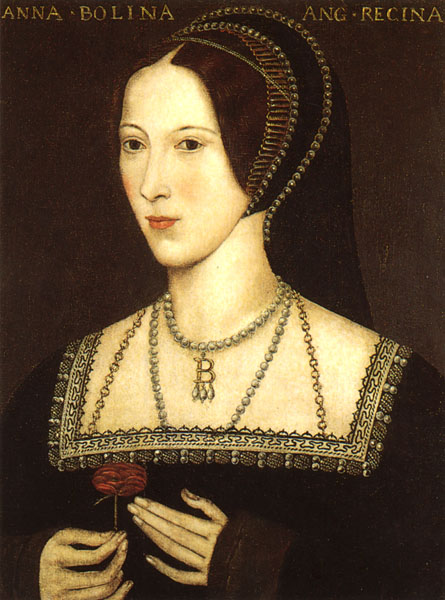
Queen Anne Boleyn
Artist Unkown

__________________________________________________

In late morning, the King was being dressed by his Gentlemen of the Chamber. His attire for this day would be especially magnificent, with a white velvet doublet edged in gold thread, white silk shirt puffed through slashes in the doublet. His jewelry would be well coordinated with the clothing, all in diamonds and gold. He would look every inch the splendid monarch his subjects expected. In the Queen’s closet, his wife and consort Queen Anne Boleyn was preparing for her appearance, and she was not to be outshadowed by her husband. Wearing a gown of deep Tudor green velvet, she too was accented with white satin and powdered ermine, and wore a hood edged in pearls. Around her neck was a carcanet of diamonds, and on her fingers were rings of emerald and gold.

Ready at last, Henry strode through the long galleries, accompanied by Henry Norris and George Boleyn. Through the mullioned gallery windows, falling snow was visible. The king entered the Hall to a fanfare of sackbuts and cornets, and delighted applause from the room full of guests awaiting him. There was great anticipation among them, for this gathering marked the giving of gifts from the King to his closest subjects. And, in return, they gave him tokens of their esteem and gratitude. Many were nervous. The King did not always graciously receive his gifts. His degree of appreciation served as a marker of one’s level of good standing with Henry. Nor was it easy to know what to gift a man who truly had everything!

Henry approached his Queen and she honoured him with a deep curtsey. He raised her to standing by placing her hand in his, then lifted her hand to his lips for a kiss. It was clear to all that Henry was still very much in love with Anne. Together, they moved to the dais. Their personal exchange of gifts had taken place in his privy chambers early in the morning. Henry might decide later whether or not to display their gifts for all to see.

__________________________________________________


__________________________________________________

At the signal of the Chief Steward, the many gentlemen ushers rushed to an anteroom to bring forth the King’s gifts, while the courtiers formed a receiving line to process past the King and Queen. The first assembly were the Dukes and Earls of the realm: Lord Chancellor Thomas Cromwell, the dukes of Richmond, Norfolk, and Suffolk, the lord marquis Exeter, the Lord Steward, and the earls of Oxford, Northumberland, Westmoreland, Rutland, Wiltshire, Huntingdon, Sussex, Worcester, Derby, and Essex. To them, Henry presented gilt cups, bowls, and silver and golden basins.

In exchange, each nobleman bowed and offered the King their own gift. Cromwell presented his sovereign with a walking staff, wrought with gold. The duke of Norfolk gave Henry a woodknife, a pair of tables and chessmen, and a tablet of gold. Henry’s close friend Brandon, the duke of Suffolk, smiled as he held out a gold ball which was to hold perfume (which Henry was well known to love). The marquis of Exeter offered a bonnet trimmed with aglets and buttons and a gold brooch. The earl of Shrewsbury gave a 9 ounce flagon of gold for rosewater. The earl of Oxford provided 10 sovereigns in a kidskin glove. The earl of Northumberland deferentially handed the King a stunning gold trencher. The earl of Westmoreland had creatively designed a golden statuette of St George on horseback. The earl of Rutland provided a white silver purse. Thomas Boleyn, the King’s father-in-law and the earl of Wiltshire, gifted a box of black velvet, with a steel looking glass set in gold. The earl of Huntingdon handed the King a set of two silver gilt greyhound collars. The earl of Sussex stepped up next and knelt to the King, holding a doghook of fine gold. The earl of Worcester had made for Henry a doublet of purple satin embroidered in gold. The earl of Derby opened a box, displaying 2 bracelets of gold, worked with blue enamel.

__________________________________________________

Thomas Howard, 3rd Duke of Norfolk
Artist: Hans Holbein the Younger

__________________________________________________

Next came the Lords. The ushers stepped forward to assist in the gift exchange. One by one, they moved past the King and Queen, bowing and offering words of greeting and good cheer on the holiday. They each received from Henry golden and silver gilt bowls, salt cellars, cups, goblets and trenchers. In exchange, they presented gifts of great value and even greater creativity – all wanting to provide ‘the” gift of the festive season. Creating a growing pile in one corner of the room, once Henry and Anne had acknowledged their givers, were satin purses, beautiful carpets, gold swords, books, and fine shirts sewn of cambric.

The ladies of the court next filed past. With great deference Henry greeted them, handing them their royal offerings of golden plate, servingware, goblets and salt cellars. The women tended to give their monarch gifts which they had made themselves, or had been designed for his more personal use.
The old duchess of Norfolk proudly presented a beautiful Nativity scene with carved figurines in a wooden box. The young duchess of Norfolk held out a gold pomander. Lady Marquess Dorset had commissioned a great buckle and pendant of gold, at enormous expense. Lady Wiltshire, Anne’s mother and Henry’s mother-in-law, had completed a coffer of needlework which contained 6 shirt collars, 3 in gold and 3 in silver; a very personal gift for her son-in-law and the father of her beautiful new granddaughter Elizabeth. Lady Westmoreland struggled to hold a brace of greyhounds who strained to break free, but were gratefully acknowledged by the King who prized beautiful dogs. Lady Worcester gifted Henry with two cambric shirts sewn with black work. And on and on it went, the pile of riches growing, and the givers pleased with the King’s smiles and nods of appreciation – even if the gift cost them a significant portion of their earnings.
__________________________________________________

The Court of Henry VIII
Artist: Fortunino Matania
__________________________________________________

Once the parade was completed, the servers laid the tables with food for the hungry and thirsty guests. As they ate, and listened to the music played by the minstrels, they were permitted to ooh and ahh over the gifts which had been exchanged amongst the royal family. Two stewards carefully placed on a front facing table a mere sampling of that which Henry had given to Anne: gilt plate, beautiful gilt pots with round knobs behind the lids, a pair of gilt flagons embossed with the arms of France, 3 gilt salts done in a Parisian style , and golden candlesticks, basins, and chafing dishes. For his new daughter Elizabeth, Henry had commissioned from his goldsmith Cornelius Hayes stunning gilt pots and bowls, beginning her collection of gold plate.

Adding to the wonderment and excess of the day, the end of the meal was marked by a special mummer’s performance. The actors, dressed in disguises of feathers and elaborate masks, entertained the crowd with mimes and stories of Christmas and the saints. The mummers added jests and jokes, and the guests laughed uproariously, thoroughly enjoying themselves.

The day of festive introduction into the new year finally drew to a close as darkness fell. Some may have wandered outside afterward to breathe the crisp air and to throw snowballs, thus continuing the merriment.

The palace staff began to clear the Hall of the remains and the riches. They needed to prepare the Palace yet again for the final celebration of the Christmas season, which was to come: Twelfth Night, held on the 6th of January.

As the harbinger of a promised good year, there was no more magical place to be than in the court of Henry VIII of England on January the first.
__________________________________________________

Sandra Vasoli, author of Anne Boleyn’s Letter from the Tower and Je Anne Boleyn: Struck with the Dart of Love, earned a Bachelor’s degree in English and biology from Villanova University before embarking on a thirty-five-year career in human resources for a large international company.

Having written essays, stories, and articles all her life, Vasoli was prompted by her overwhelming fascination with the Tudor dynasty to try her hand at writing both historical fiction and non-fiction. While researching what would eventually become her Je Anne Boleyn series, Vasoli was granted unprecedented access to the Papal Library. There she was able to read the original love letters from Henry VIII to Anne Boleyn—an event that contributed greatly to her research and writing.

Vasoli currently lives in Gwynedd Valley, Pennsylvania, with her husband and two greyhounds.

__________________________________________________