Showing posts with label Sarah Rayne. Show all posts

Sunday, July 15, 2018

Editors Weekly Round-up, July 15, 2018

by the EHFA Editors

English Historical Fiction Authors brings you posts every week on different aspects of British history, society, and culture. Enjoy the articles for the week ending July 14.
 
by Maria Grace


by Sarah Rayne


Thursday, July 12, 2018

To Catch a Thief...

By Sarah Rayne

I’m keen on atmospheric settings and I’m very keen indeed on houses and buildings with intriguing histories.  In the early stages of drafting a new plot, looking for a hook on which to hang a building (so to speak), I came across a fragment of a very old English law.

It happened by purest chance.  One afternoon having become lost in the depths of the countryside, I drove past a field with a sign on the gate saying, ‘Infanger’s Field’. 

The English countryside is, it must be said, liberally strewn with strange and intriguing names. Quite near to where I live is a village called Coven. It’s an extremely nice place, but its name is always very deliberately pronounced ‘Coe-Ven’. Purists carefully point out that the name derives from the Anglo-Saxon, cofum¸meaning either a cove or a hut, but despite that, there are occasionally dark mutterings suggesting that the place once had witchcraft associations, and that the pronunciation was politely slurred to hide that fact. 

Then there are all those instances of Glue Works Lane and Slaughter Yard. There’s Pudding Lane where the Great Fire of London reputedly started in a baker’s shop. On the other hand, there are places whose names are open to interpretation, such as Cockshutt in Shropshire, which, despite sounding like a venue for a Carry On film, is likely to derive from fowl hunting activities. Other names are satisfyingly rooted in the past: Oxford has Brasenose College and Brasenose Lane – supposedly from the Brazen Nose door knocker of the original sixteenth century Hall. Incredibly, though, the city also once had the now-lost Shitbarn Lane, c.1290, which ran between Oriel Street and Alfred Street.

But Infanger’s Field? 

I made eager notes – I even ventured into the field itself to pace the boundaries, although it was a bit unfortunate that I dropped my notebook in the mud, (I think it was mud – I hope it was mud), and perhaps I wouldn’t have worn scarlet gloves if I had known there was a bull in the field. 

Then I dashed home to scour bookshelves and the internet.

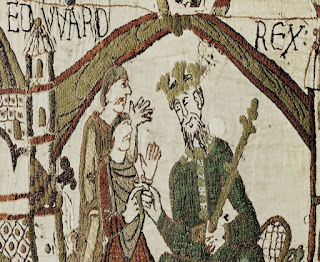
And it seems that the word comes from the Old English infangene-þēof –  ‘Thief seized within’ or ‘in-taken-thief’.  Infangenthief or infangentheof, no matter how you spell it, was an Anglo-Saxon arrangement, supposedly from the time of Edward the Confessor – c.1003-1066, and one of the last of the royal House of Wessex. 

Infangentheof, and its sister law, outfangentheof, apparently permitted the owners of a piece of land the right to mete out justice to miscreants captured within their estates, regardless of where the poor wretches actually lived. On occasions it also allowed the culprits to be chased in other jurisdictions, and brought back for trial. The justice that was meted out was often extremely severe – there was no cheerful Gilbert & Sullivan principle of letting the punishment fit the crime in those days. People were beheaded – limbs were cut off – vagabonds were often whipped and chained in stocks. Others were forced to carry hot stones, or wear bridles over their tongues – a favoured method for troublesome wives, of course. Poisoners might be boiled alive.
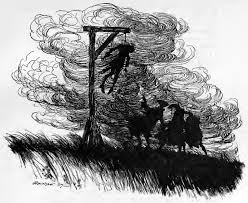
As for murderers, they risked being hung up in a cage, usually after their execution, although occasionally before it, so that people could watch their slow death. It was a day out for the ordinary people; you could take a bit of lunch with you, and it made something to tell the neighbours.
This grisly custom was sometimes useful to those unprincipled (and strong-stomached) souls who were resolved on proving the truth of the ‘Hand of Glory’ ritual – the belief that the dried hand of a hanged man had power. Writing the Ingoldsby Legends in the 1840s, the Reverend Richard Barham paints a deeply macabre image of three crones climbing up a gibbet in quest of such a gruesome fragment.
‘On the lone bleak moor, at the midnight hour,
Beneath the Gallow Tree,
Hand in hand, the Murderers stand,
By one, by two, by three!
Now mount who list, and close by the wrist,
Sever me quickly, the Dead Man’s fist.
And climb, who dare, where he swings in the air,
And pluck me five locks of the Dead Man’s hair.’
The privilege of exercising the law of infangentheof and extorting suitable punishments, was granted to feudal lords, and, inevitably, to religious houses, who generally liked to get their hands on any odds and ends of power that might be up for grabs.  When the Normans came barrelling in, they made cheerful use of most of these laws too, and they particularly liked infangentheof, which they felt helped keep the rebellious Saxons in their place.


The recipients of the privilege usually got a bit of a smorgasbord – as well as infangentheof, the king tended to throw in a few other goodies. The granting of a free borough, could be one, along with things called soke and sake, and toll and team.  Sake, despite sounding like something you’d glug down with your sushi, literally translated as ‘cause and suit’, while soke and team referred to the ‘privilege of holding court’, intended for judging people accused of wrongful possession of goods or cattle.

Toll was then, as it is today, the right granted to a landowner to impose a payment on the sale or passage of goods or cattle on his lands, or, alternatively, to be exempt from the tolls of others. So today’s motorists paying to drive along a particular stretch of motorway, and modern travellers struggling with the complexities of customs and excise (not least the present government in its wrangles with the EU), might justifiably direct their wrath towards the likes of King John. In fact, Henry III, in a Charter to the citizens of Norwich of 1229, makes ceremonious greetings to his subjects starting with bishops and archbishops and going all the way down the social scale to reeves, bailiffs, and the useful all-embracing term of ‘all faithful men’, after which, the courtesies having been observed and all Henry’s titles having been listed, (presumably in case somebody reading the edict didn’t know who he was), goes on to inform his subjects thus –
“… at the request and petition of our venerable father, John, the second [of that name], bishop of Norwich, we have granted and by this present charter confirmed to the burgesses of Lenn, that the borough of Lenn may be a free borough for ever, and they may have soke and sake, toll and team, infangenthief and outfangenthief.”
I have no idea if it was a fragment from the past I encountered with Infanger’s Field that day – perhaps a shred of some long-ago feudal baron who had named a field as a warning to miscreants.  And I’m doubtful if I could find the field again. 

The law itself fell more or less into disuse in the fourteenth century and all-but vanished from England’s history. Thankfully most of the punishments have vanished as well. But fragments of the law can still be found here and there. Such as in the name of a field that now houses only an indignant bull. 

~~~~~~~~~~

Sarah Rayne’s first novel was published in 1982, and since then she has written more than 25 books. As well as being published in America and Australia, her novels have been translated into German, Dutch, Russian, and Turkish. Much of her inspiration comes from the histories and atmospheres of old buildings, which is strongly apparent in many of her settings – Charect House in Property of a Lady, Twygrist Mill in Spider Light, and the Irish cottage,Tromloy, in Death Notes.  Music also influences a number of her plots: the music hall songs in Ghost Song, the eerie death lament ‘Thaisa’s Song’ in The Bell Tower, and the lost music in Chord of Evil that hides a devastating secret from WWII.
Connect with her at http://www.sarahrayne.co.uk/

Sunday, March 18, 2018

Editors Weekly Round-up, March 18, 2018

by the EHFA Editors

Every week, contributors to English Historical Fiction Authors post on various aspects of British history. Enjoy this week's round-up!

by Maria Grace


by Sarah Rayne


Don't forget to follow us on Twitter and Facebook

Wednesday, March 14, 2018

An Ancient Legality that Named a House

By Sarah Rayne

The legal profession has always been a novelists’ treasure house, and lawyers themselves are a gift to writers of fiction. Old documents, particularly ones held by the family solicitor, such as a Will, can provide motives the reader hasn't yet suspected, and extra detail for the author to draw on.

Charles Dickens drew on his time as a solicitor’s clerk and court reporter to weave satirical portrayals of the English legal system, with characters caught like hapless insects in the dusty spider-strands of the law.
 

When, in Oliver Twist, Mr Bumble advised a court that, ‘The law is an ass’, Dickens may have been borrowing from a 17th century play called Revenge for Honour, which is attributed to both George Chapman and Henry Glapthorne, depending on which source you check. Not much seems known about Henry Glapthorne, but apparently Master Chapman signed an agreement for a loan which never materialised. According to the reports, he spent years petitioning Chancery to release him from payment, but at one stage was arrested for debt. (A fate which hovers over many writers to this day). Under those circumstances (supposing the facts to be accurate), it’s hardly surprising that Master Chapman did what a great many other writers have done: he wrote out his frustrations in the plot.

English law is peppered with all kinds of curious legalities – many of which had names that have almost vanished from the dictionaries. There are tithes and torts and peppercorn rents. There’s assumpsit (medieval breach of contract), and gavelkind (a Saxon form of limited land ownership). There’s something called aberemurder (spontaneous and gratuitous murder) and there’s witenagemote, which was an assembly of local elders in medieval England.

And there are one or two ancient laws, whose fragments still crop up…

Some years ago, when writing a novel, I searched for an appropriate house name for the brooding old orphanage/workhouse that played such an integral part in the plot. Names of places matter just as much as names of characters. You can’t call a Victorian asylum Rosemount Manor, or a gaol housing condemned prisoners Summerville Court.

Then I came across mortmain.

In medieval times, kings often had the amiable – if unthinking – habit of bestowing large swathes of land on religious houses. This was excellent for the abbeys and monasteries and churches of course – it resulted in them becoming extremely wealthy. Land yields profits, and in those days there would be all kinds of revenue to be scooped up: tenant farmers, who must pay rent to their overlord – fishing rights on stretches of river, grazing rights on open land. Market days and fairs, for which pedlars could set up stalls – and for which tolls were payable.

But if the abbeys and the monasteries were raking it in, the king was not. The problem was that religious houses do not succumb to mere mortality – they are never under age, neither do they marry, commit felony, or become attainted for treason. They do not, in short, fall victim to any of the fates that generate taxes. Thus, on the death of an abbot, the land simply passed to the next abbot – meaning that it was held in perpetuity, and that the medieval equivalent of modern death duties could not be enforced. This was known as mortmain – from Old French mortemain, and from the medieval Latin manus mortua. Mortmain was the possession of property in dead hands.


As tensions between the church and the Crown increased, ways to close this mortmain loophole were sought.

The first attempt seems to have been made by King John, in 1215, with Magna Carta – that ‘Great Charter of the Liberties’ that came into being at the famous meeting at Runnymede.

Magna Carta was never straightforward. John was not popular with the barons; he had squabbled rather disastrously with the French, and he was resented by the Church, who did not like being told what to do by an Angevin king, and, moreover, a king whom they had excommunicated in 1209. Magna Carta went into several editions, was the subject of many objections, and was tweaked until it squeaked. It almost makes the junketings of Juncker, Barnier and May seem like a parish council tiff.

But one of Magna Carta’s provisions was an attempt to prohibit the form of land ownership known as mortmain. It was unfortunate that John died in 1216 before he could get this fully established, because his son, Henry III, was not over-enthusiastic about enforcing it. Henry liked the Church. He liked its authority, and he liked knowing it was on his side. He was not going to get into tussles with it over the ownership of land and the sneaky side-stepping of taxes.

It was Henry’s son, Edward I, he of the lion-like appearance and warlike demeanour, who took up the cudgels and brought the prohibition of perpetual ownership centre stage. There were two Statutes – in 1279 and 1290 – and the 1279 one has no truck with ambiguity. It prohibits, “any person whatsoever, religious or other, to buy or sell, or under colour of any gift, term or other title, to receive from anyone any lands or tenements in such a way that such lands and tenements should come into mortmain”.

That, thought Edward and his advisors, would put the nuisance firmly in its place. More to the point, it would ensure that the kingdom’s revenues were preserved – and in time, increased.

A sceptic might wonder if a side-aim of this was to check the growing wealth and power of the church, and a cynic might call to mind how vastly expensive wars are, and how helpful taxation is in funding them. And Edward Plantagenet certainly fought a great many wars.

But even with the Statute of Mortmain firmly in existence, the problem persisted. Over the years, wise men and fools – kings and princes and chancellors – expended time and energy trying to break the legal grip of the church. Lawyers pondered and wrangled in leisurely and expensive fashion. It was an irritant and a constant cause of vexation. Not for nothing, does Shakespeare give a character in Henry VI the devout plea, ‘First thing we do, let’s kill all the lawyers’.

It was not until more than two centuries later that matters were resolved. Henry VIII swept aside the old order, gave way to the new, and confiscated Church lands wholesale. Amidst the carnage that was the Reformation, the law of Dead Man’s Hand became more or less obsolete. It was, in fact, finally abolished in 1960.

But whatever mortmain’s complexities, it provided a splendid name for my fictional house in A Dark Dividing.
~~~~~~~~~~


Sarah Rayne’s first novel was published in 1982, and since then she has written more than 25 books. As well as being published in America and Australia, her novels have been translated into German, Dutch, Russian, and Turkish.The daughter of an Irish comedy actor, Sarah began writing in her teens, with plays for the Lower Third to perform in her convent school.Much of her inspiration comes from the histories and atmospheres of old buildings, which is strongly apparent in many of her settings – Charect House in Property of a Lady, Twygrist Mill in Spider Light, and the Irish cottage,Tromloy, in Death Notes.  Music also influences a number of her plots: the music hall songs in Ghost Song, the eerie death lament ‘Thaisa’s Song’ in The Bell Tower, and the lost music in Chord of Evil that hides a devastating secret from WWII.
Connect with her at http://www.sarahrayne.co.uk/
https://www.facebook.com/SarahRayneAuthor
https://sarahrayneblog.wordpress.com/
http://www.youtube.com/user/SarahRayneAuthor

Find out more about Death Notes here: http://www.sarahrayne.co.uk/project/death-notes