Showing posts with label Gildas. Show all posts

Wednesday, July 15, 2020

6th Century Britain – Questions without Answers

By Gareth Griffith

In the age of Google, at a time when physicists are unlocking the secrets of the universe, when there are answers to almost every question, it seems churlish of history to present us with what used to be called “The Dark Ages.” Yet, in respect to Britain at least, that description would still appear to be appropriate for the period between the departure of the Romans, in AD 410, and the 7th century.

Particularly sparse is our knowledge of the 6th century, when the native written evidence is confined to Gildas’ The Ruin of Britain. Gildas was a monk and, as it is often said, his purpose was not to write history but to present a moral and polemical tract addressed to the British kings of his time. It is not known exactly when he wrote, although it likely to have been in the mid-6th century. There is controversy over that issue and also about the interpretation of what he wrote, as discussed, for example, by Guy Halsall in Worlds of Arthur: Facts and Fictions of the Dark Ages (OUP, 2013).

Statue of Gildas - Wiki Commons attribution

That is not to say that archaeologists and historians are completely in the dark about this period of British history, but it is to suggest that the speculative theories and histories of the age have the feel of a parlour game about them – where five archaeologists and five historians are sent out of the room and return with 11 theories of the Anglo-Saxon take-over of lowland Britain. Ideas about how certain Angles and Saxons arrived at and settled one area or another – the Hwicce for instance on the Welsh borders – can be amusingly reminiscent of the brilliant Monty Python sketch, Wrong Way Norris.

Relatively little is known, therefore, about 6th-century Britain and much of what is believed to be known is contested. In terms of literary evidence, according to Peter Heather:
“To supplement Gildas, there are a few more or less contemporary references to events in Britain in continental sources, and some very late, wildly episodic materials gathered together in the Anglo-Saxon Chronicle.” (Empires and Barbarians: Migration, Development and the Birth of Europe, Macmillan, 2009, p 272) 
There are more questions than answers, some large, others more specific: Why did the Anglo-Saxons not become British? What was the scale of the Anglo-Saxon migration to Britain? Was there a mass migration? Is that process best described in terms of conquest and invasion or more as a transfer of elites, with the indigenous population remaining more or less in place?

Possible 5th-century migration pattern Wiki attribution

In attempting to answer such questions, historians have tended to follow the prevailing fashions of historical analysis. The nineteenth century and beyond leaned heavily on the conquest and invasion model, in some cases as evidence of the superiority of Teutonic peoples over their Celtic counterparts. (B Ward-Perkins, “Why did the Anglo-Saxons not become British?” English Historical Review (2000), pp 513-533) As new aerial archaeological techniques revealed evidence that contradicted that model, the view fell into disfavour after 1945, to be replaced by versions of the elite-transfer theory.

From the view that the Anglo-Saxons basically wiped out or expelled the native British population, the pendulum swung towards the displacement of British landowning classes by an Anglo-Saxon warrior elite, led by those who had served as mercenaries in the Roman occupation of the island. It is a caricature admittedly, but we had replaced blood and iron with something approximating a hippy land-grab. It may be that DNA analysis supports that view, whereby the indigenous population remained in place, merely exchanging one ethnic ruling class for another.

A perennially vexing issue for that account relates to language: as Ronald Hutton writes: “If genetics and landscape studies indicate a basic continuity of population all over Britain…linguistic studies do not.” (Pagan Britain, Yale University Press, 2014, p 295). The contrast with the continent, with France in particular, is profound in this regard. To quote Hutton again:
“Old English replaced both the main languages of Roman Britain – the native Celtic one and the official Latin one – completely in the areas that later became England. It did so, moreover, while taking on virtually no loanwords from either tongue.” (p 295) 
In lowland areas at least, 6th century Britain appears to have witnessed “an absolute and abrupt discontinuity of language and culture,” events which, according to Hutton, are “commonly the hallmark of genocide…” (p 296)

The Aedui chief Dumnorix, Museum of Celtic Civilization, Bibracte
The British may have dressed similarly

Rather than deciding between contrasting viewpoints, Hutton’s main concern is to highlight the problems and discontinuities of evidence and interpretation. Calling it “an extreme state of affairs,” he points out that, in this instance, the material data drawn from archaeology and the textual and linguistic evidence do not fit: “In the case of the arrival of the Anglo-Saxons, the two are at present bewilderingly adrift…” (p 297) One is reminded of the comment made by Nicholas Higham in 1994, in reference to the issue of conflicting evidence, that “it has become obvious that archaeologists are capable of producing an almost infinite succession of models, each of which is more or less incapable of either proof or refutation.” (The English Conquest, Manchester University Press, p 2)

In his 2009 book, Empires and Barbarians: Migration, Development and the Birth of Europe, Peter Heather draws together the known and the probable facts of the matter. Like Hutton, he accepts that the key questions about the extent and nature of Anglo-Saxon immigration are not answered in any straightforward way by either the archaeological or historical evidence. (p 275) Nor does he think that DNA testing is likely to fill the gap. Decisively rejected by Heather is the “ethnic cleansing” model, which in his view was not remotely possible given the probable number of people involved, perhaps as many as three to four million. But then, there is the linguistic evidence to be considered, which leaves the argument “more than a little stuck.” (p 277 and p 297)

From this starting point, Heather proceeds to confront from what he calls “the intellectual impasse between mass migration and elite transfer originally generated by the limitation of the traditional historical and archaeological evidence.” (p 277) Taking a comparative perspective, he draws upon evidence from the migrations of the period on the continent, which leads him to several conclusions. One is that the Anglo-Saxon migration to Britain was a long-term process, a “predatory population flow” that occurred over many generations. A related conclusion is that, notwithstanding the obvious transport difficulties, this gradual migration flow included women and children.

Still, by AD 600 the native British population was likely to have outnumbered the newcomers, possibly by a ratio of around 1:4. With the Frankish model before him, Heather’s argument is that an adequate interpretation of Anglo-Saxon migration must combine elements of mass migration, sufficient to establish linguistic and cultural change, with elements of the elite model, whereby land ownership shifted decisively in favour of the incomers and where the mass of the indigenous population, formerly landed or otherwise, were left to accommodate themselves to these new arrangements of subservience.

Of course, none of this is to maintain that the transformation of lowland Britain was peaceful. It is argued that, from the earliest times, the Britons and the Anglo-Saxons perceived themselves as races apart, with Bryan Ward-Perkins commenting:
“…when both peoples came to summarize their dealings with each other, the picture is straightforward and consistent. Two distinct and hostile peoples fight for the same territory; one of them comes by ship from overseas, and gradually expands its power by conquest; the other resists, with greater or lesser success, and awaits the moment when the invaders can be slaughtered and their defeated remnants driven to their boats and 'sent home' over the sea.” (“Why did the Anglo-Saxons not become British?”, p 516) 
To offer my own historical speculation, it seems likely that the Anglo-Saxon takeover was messy and that it varied from one local area to another, in particular as between what is now south-east and south-west England. Whereas a version of the elite-transfer model may apply to the south-east where the scale of armed resistance from the British may have been minimal in the aftermath of the Roman departure, the story in the south-west may have been quite different, with the Saxon advance being marked by a series of pitched battles until they reached what is now the Bristol Channel towards the end of the 6th century. Admittedly, that account may be disputed. On its behalf, it is at least broadly consistent with the account we find in the traditional interpretation of Gildas and with the admittedly sketchy and episodic entries for the period from the Anglo-Saxon Chronicle.

Replica of the Sutton Hoo helmet, from the earlier period of
Anglo-Saxon settlement. Wiki Commons attribution link

Clearly, not everything in those sources can be accepted at face value. But some things ring truer than others. For example, the Anglo-Saxon Chronicle records a major battle fought in AD 577 just north of modern day Bath. There is no other source for the battle which, if true, broke the land-bridge that existed between the Celtic people of modern day Wales and those of Devon and Cornwall. Possibly, the entry which says that three British kings were killed in the battle, those of Bath, Gloucester and Cirencester, can be discounted as a form of aggrandising propaganda on the part of the West Saxons. It is possible. On the other hand, as Heather acknowledges, it is also possible that these events were recalled with “outlined accuracy.” He writes:
Sometimes, too, the events even make sense against the landscape, notably the battle of Deorham in 577, which is said to have brought Gloucester, Cirencester and Bath under Anglo-Saxon control. A visit to the site, now the grounds of Dyrham Park just outside Bath, is enough to show you why. Set on high ground, it dominates the territory around.” (p 272) 
What is beyond question is that the Britons did not relinquish the western regions of the Island to the Anglo-Saxons without a long struggle. If the details are lost to us, the outline is clear enough. The reported Battle of Dyrham occurred over 150 years after the Romans left Britain, which, if true, suggests concerted resistance on a significant scale.

[This post is an Editor's Choice archive post, originally published on EHFA on 7th June 2018]

~~~~~~~~~~

Gareth Griffith was born in Penmaenmawr, North Wales, and now lives in Sydney, Australia with his wife Sue. His career has encompassed teaching, research and writing, including many years working as the manager of research for the parliament of New South Wales. These days, when Gareth isn’t writing, he enjoys reading, music, dark Scandi film and TV, and Dark Age Britain. Although Gareth left Wales at the age of twelve, Wales never left him, and its landscape and history loom large in his imagination and his storytelling.

Find Gareth on his website: https://garethgriffithauthor.com/
and on Twitter: @garethgriffith_

Wednesday, March 4, 2020

Unlucky Usurpers and Proud Tyrants: The Leadership of Fifth Century Britain

by Chris Thorndycroft

Many books have been written on the chaotic period preceding and following the Roman withdrawal from Britain in 410 A.D., and it is perhaps because we know so little about it that there is so much to discuss.

A rough idea of how the four provinces of
Britain (created by the Diocletian Reform)
looked in the fifth century. Their
arrangement is still a matter of debate.
It was a time of invasions and rebellions. The Picts, once held in check by Hadrian’s Wall, swarmed down from the north. The Irish raided and settled in the west. Saxon and Gaulish pirates roved the Channel. To add to this, Britain was a hotbed of rebellion with the legions stationed there choosing their own candidates for the position of emperor leading to the abandonment of posts and lengthy wars on the continent.

Rome responded as best it could. Some sort of reshuffling of the military organization in the mid fourth century is evident in the creation of three new military posts mentioned in the Notitia Dignitatum (The List of Offices). The first is the Comes Britanniarum; commander of the mobile field army on the island. The other two are the Dux Britanniarum (commander of the northern frontier including Hadrian’s Wall) and the Comes littoris Saxonici (commander of the Saxon Shore).

This last one is of interest for it seems to coincide with the building of several shore forts along the south-east coast. These ‘Saxon Shore’ forts may have been so named for their function as a defense against Saxon raiders or they may have been operated by mercenary Saxon frontier troops (foederati).

These measures eventually proved futile for in 407 a soldier stationed in Britain was declared ‘Constantine III of the Western Roman Empire’ and took all his troops with him to prove his point in Gaul, effectively leaving Britain open to attack. He was defeated and executed and in 410, Rome officially washed its hands of the troublesome province when Emperor Honorius told its leaders to “look to their own defences”.

Coin of Constantine III, the Roman general who was declared Western Roman
Emperor and removed the last vestiges of Roman authority from Britain.

But who were these leaders? What sort of government was left in the wake of the Roman withdrawal? With no official bodies connected to the Empire and no promise of military intervention from the continent, surely the island reverted back to a climate of chaotic tribalism?

Perhaps or perhaps not.

Portchester Castle, the Saxon shore fort of Portus
Adurni which became the outer bailey wall of a
Norman castle. Credit: Rob Nunn.
A monk called Gildas wrote his scathing On the Ruin and Conquest of Britain sometime in the sixth century and described some sort of council ruling Britain in those days. He also mentions a ‘proud tyrant’ or ‘unlucky usurper’ who invited a group of Saxons to settle on the eastern shores of Britain in order to repel the Picts.

This mysterious tyrant of the Britons has become a figure of particular interest from the period, as much as Hengest and Horsa and even King Arthur. ‘Vortigern’ is the name often given to him but even that is a matter of debate with various spellings including ‘Gwrtheyrn’, ‘Wyrtgeorn’ and ‘Guothergirn’. We do not even know if this was a personal name or a title but Vortigern seems to have been a figure of considerable power in fifth century Britain.

Bede, who wrote his Ecclesiastical History of the English People in the eighth century, first provides the name as ‘Vertigernus’. It was also Bede who first named the leaders of the Saxons as ‘Hengist and Horsa’. As king of the British people, Vertigernus invites the Saxons to settle in Britain for pay. A condition of this was presumably engagement with the enemy who were “come from the north to give battle” and are later revealed to be the Picts.

This story is elaborated by the Bangor-born monk Nennius in his History of the British People, written sometime in the ninth century. A mixture of history and colourful local legend, this work is to be treated with caution but it does present a fascinating story.

Receiving Hengist and Horsa as friends, Vortigern (named here as Guorthirgirn) hands over the isle of Thanet in exchange for their service as foederati against the Picts. Hengist later sends for more of his countrymen who bring with them his beautiful daughter. A feast is held and Vortigern, plied with drink, falls so in love with Hengest’s daughter that he demands her in exchange for the whole of Kent. This is without the knowledge of Kent’s king; Guoyrancgonus.

So who was Vortigern really? Nennius’s ‘king of the British people’ is unlikely as Britain would have been in the throes of chaos after Rome’s withdrawal and the idea of a single king ruling the entire island is implausible. Gildas’s mentioning of a council is perhaps more probable and something aping the old Roman administrative system is easy to imagine with governors and tribunes devolving over time, back into chieftains and eventually kings.

It is possible that Vortigern is a title rather than a personal name as a literal translation from the Brittonic word appears as ‘overlord’ (‘wor’ = over and ‘tigerno’ = lord). But many scholars insist that this doesn’t prove anything as ‘tigerno’ appears in several personal names like ‘Catigern’ and ‘Kentigern’.

Vortigern’s family is outlined by Nennius who states that he had four sons; Vortimer, Catigern, Pascent and Faustus (son of his incestuous affair with his unnamed daughter). More information might be gleaned from the Pillar of Eliseg; a ninth century monument erected in Denbighshire, Wales by Cyngen ap Cadell, king of Powys.

The Latin text on the Pillar of Eliseg is now illegible due to weathering, but a transcription was made by the antiquarian Edward Llwyd in 1696. It claims that Guarthi(gern) (Vortigern) was married to Severa, the daughter of Magnus Maximus; the usurper who famously rebelled against Emperor Gratian. The pillar names the sons of this union as; Britu and Pascen(t), the latter of which is the ancestor of the kings of Powys.

If Vortigern really did marry Severa, daughter of Magnus Maximus, it would most likely have been before 388, which was when Maximus was defeated and executed (politically speaking, a marriage after this date would have been worthless). Severa could scarcely have been younger than seventy by 447 – the date traditionally associated with the arrival of Hengest and Horsa, making the Guarthi(gern) of the pillar a little old to be the Vortigern mentioned by Bede and Nennius.

Unless it referred to his father.

If Vortigern was indeed a title, it may have passed from father to son, making the Vortigern of later texts the son of the union between Guarthi(gern) and Severa.

So what then, was Vortigern’s real name? The History of the Britons gives his genealogy and his grandfather and great grandfather were called Guitaul (Vital) and Guitolion (Vitalin) respectively. This hints at a common family name that may have been something like ‘Vitalinus’ or ‘Vitalis’. Interestingly, Nennius goes on to say that during the reign of Vortigern, there was a battle between Ambrosius and Guitolinus (Vitalinus). Was this a separate person, or the given name for Britain’s ‘overlord’.

We don’t know what the battle was about or who won, but Ambrosius is a name well attested elsewhere. Gildas first mentions an Ambrosius Aurelianus who “perhaps alone of the Romans, had survived the shock of this notable storm. Certainly his parents, who had worn the purple, were slain by it.”

‘Wearing the purple’ could refer to the imperial colour, or perhaps the purple band worn by Roman military tribunes, so it seems that we are dealing with a noble of imperial stock or a high-ranking military commander. Gildas makes it clear that Ambrosius was some sort of military figure to which the Britons flocked (perhaps the last Comes Britanniarum). His wars with the Saxons ultimately culminated in the siege of Badon Hill (later sources like the History of the Britons credit Arthur as the victor of this battle, not Ambroisus).

As well as the aforementioned war between Ambrosius and Vitalinus, Nennius states that Vortigern eventually handed over all his lands and fortresses to Ambrosius, who granted a large share of them to Vortigern’s son Pascent. It certainly looks like Ambrosius won a significant victory over Vortigern in addition to his success against the Saxons.

The tale of the destruction and eventual death of Vortigern is dominated by the figure of Bishop Germanus of Auxerre. The Life of Saint Germanus, written in about 480 A.D. by Constantius of Lyons, states that Bishop Germanus and his companion, Bishop Lupus of Troyes, originally voyaged to Britain in about 429 A.D. to combat the Pelagian Heresy. There, through debate and preaching, they won many back to the Augustinian teachings.

As with the lives of many saints, miracles were also performed including the healing of a blind girl by the holding of Germanus’s reliquary to her eyes. Germanus even leads a British army against a confederation of Picts and Saxons and, by chanting the “Alleluia”, manages to rout the enemy without even having to strike a blow.

A later chapter reveals that Germanus returned to Britain (possibly around 447 A.D.) as Pelagianism was once again on the rise. A healing miracle is performed once again, this time for the crippled son of Elafius, described as a leading man in the country.

The Life of Saint Germanus makes no mention of Vortigern but Nennius further elaborates on Germanus’s second visit to Britain beginning with his confrontation of a tyrannical king called Benlli. After Benlli’s city is obliterated by “fire from heaven” Germanus raises a peasant called Catel Drunlue (Cadell Derynllug in the Welsh genealogies) to the position of king.

Germanus then goes to the court of Vortigern who has, much to everyone’s outrage, married his daughter and sired a son on her to whom Nennius gives the name ‘Faustus’. Germanus gives the boy razor, scissors and comb and tells him to present them to his true father. The boy gives these items to Vortigern who “arose in great anger, and fled from the presence of St. Germanus, execrated and condemned by the whole synod.”

Vortigern’s son, Vortimer, rises to the position left vacant by his father and wages war on Hengist and Horsa, driving them back to the isle of Thanet. Three more battles take place, the first upon the River Darent, the second at ‘Epsford’ (possibly Aylesford as the Anglo-Saxon Chronicle records the battle as taking place at ‘Agaelesthrep’) where both Horsa and Vortimer’s brother Catigern fall. The last battle was “near the stone on the shore of the Gallic sea, where the Saxons being defeated, fled to their ships.”

Vortimer then mysteriously dies and, in a forerunner to the Welsh tale of Bran the Blessed, commands that his body be buried upon the spot where the Saxons first landed so that they may never land there again. His commands are ignored of course, resulting in the eventual Saxon conquest of most of Britain.

Vortigern returns to power on the death of his son and is invited by Hengist, along with his nobles and military officers, to a feast where, in the original Night of the Long Knives, his men butcher them all. Vortigern alone is allowed to live whom Hengist hopes to ransom for his daughter’s return. More land is turned over to the Saxons including “the three provinces of East, South, and Middle Sex.”

On the run again from the fury of Germanus, Vortigern flees to “the kingdom of the Dimetae where, on the river Towy, he built a castle, which he named Cair Guothergirn” (literally ‘Castle Vortigern’). Fire once again falls from heaven and destroys this castle, killing Vortigern, Hengist’s daughter and all its other inhabitants.

With obscure mentions of leaders like Elafius, a king called Benlli, a council, and a ‘proud tyrant’ called Vortigern, it seems clear that Britain was in a transitional phase at this time and was anything but united. From later genealogies provided in medieval Welsh sources, we can see that the ex-Roman province fragmented into many small kingdoms, each ruled by separate dynasties who could trace their lineage back to the likes of Cadell, the peasant given King Benlli’s throne by Bishop Germanus.

Ambrosius and Vortigern, whoever they were, also figure in genealogies and place names, suggesting that, if some sort of council had tried to maintain control over the island in the wake of the Roman withdrawal, it most likely gave out to laws of blood succession. Personal interests most likely won out as Britain’s leaders began to hoard territory and carve out their own lands which they ruled as kings, much in the same way that their enemies, the Saxons, did in the east, eventually giving rise to what we now call Wales and England.

Sources

William Fairley, Notitia Dignitatum or Register of Dignitaries, in Translations and Reprints from Original Sources of European History, Vol. VI:4 (Philadelphia: University of Pennsylvania Press, n.d.)

Williams, Hugh ed. and trans.: Gildas, The Ruin of Britain &c. (1899), Cymmrodorion Record Series, No. 3

Bede: Ecclesiastical History of the English People, trans. Leo Shirley-Price, (St Ives 1990)

Nennius: The Historia Brittonum, trans. John Allan Giles, in: Six Old English Chronicles, of which two are now first translated from the monkish Latin originals (George Bell and Sons, London 1891)

Constantius of Lyon: The Life of St. Germanus of Auxerre, eds. Thomas Noble and Thomas Head, translators, in: Soldiers of Christ: Saints' Lives from Late Antiquity and the Early Middle Ages, (Pennsylvania State University Press, 1994), pp. 75-106

www.vortigernstudies.org

[This is an Editor's Choice archive post, originally published on EHFA on 20th Jan, 2016]

~~~~~~~~~~~~~

Chris Thorndycroft is the author of the Hengest and Horsa Trilogy which is set in 5th century Britain and involves Vortigern, Ambrosius Aurelianus and a whole host of other real figures of the period. He has also written the ghost story The Visitor at Anningley Hall (a prequel to M. R. James’s ‘The Mezzotint’). Visit his blog here; https://christhorndycroft.wordpress.com/


Wednesday, December 4, 2019

Grumpy Gildas, Saint of Rhuys

By L.A. Smith

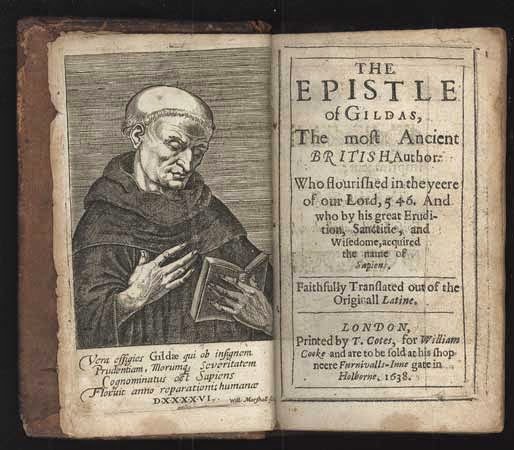
Saint Gildas (AD 500-570), otherwise known as Gildas the Wise, or, the Venerable Gildas, was a 6th century monk who is best known for writing De Excidio et Conquestu Britanniae (The Ruin and Conquest of Britain). This work is a history of Britain which begins with a brief account of the Roman occupation, but is mainly concerned with Britain after the Romans left in the 5th century, and the coming of the Anglo-Saxons from the Continent. It's one of the few near-contemporary accounts we have of this era, and as such, Gildas is an important figure, indeed.

Statue of Gildas nr. the village of Saint-Gildas-de-Rhys, France
Image from Wikipedia

It is, of course, difficult to know much that is certain about Gildas. Other than his literary works, we have two two surviving hagiographies about him. One was written in the 9th century by a monk at a monastery in Rhuys in Brittany. This was a monastery that Gildas himself founded. The second was written much later, in the 12th century, by the Welsh cleric, Caradoc of Llanfaran. The two differ quite a bit, so much so that some scholars suggest there might be two Gildas', but likely the differences between them are in account of the long time between the writing of the two. The earlier Life of St. Gilda from the 9th century is considered to be the most accurate, seeing as it is closest to Gildas' time.

The chapel of Gildas in Brittany - Gildas and a fellow monk,
Bieuzy, were said to have lived in the cave at the base of
this rock. Image by Rhian on Flikr

Interestingly enough, one of the things we don't know for certain is his name. This name, Gildas, is very unusual. In fact, there is only one other person of the times that we know of who has this name, a 5th century Roman Berber hailing from North Africa, who rebelled against the Western Roman Empire. His name was Gildo, which is virtually the same name once translations between languages are accounted for. Gildas is not a Latin name, and although some historians have postulated that the origin of the name is Pictish or Gaelic, there is no consensus on this. This leads some to speculate that the name itself is a pseudonym. Given that he writes in extremely unflattering terms of five British kings, it is understandable that he might use a false name, in fear of reprisals.

From that earlier hagiography we learn that Gildas was one of four sons of the king of the Alt Clut, a kingdom of British Celts in the north (now part of Scotland). His brother Cuillum became king after the death of their father, Caunus. The rest of the brothers became monks. As a child, Gildas studied under Illtud at Cor Twsdws, the great centre of learning in what is now Glamorgan, Wales. Many illustrious Saints studied there, including Saint David of Wales. There is, in fact, a connection between David and Gildas, as Gildas is said to be one of David's tutors when he was young.

It seems that Illtud was fond of Gildas, and thought him to be a good student. Gildas eventually decided to give up the privileges of his noble birth and become a monk. He went to Ireland where he was ordained as a priest, and then returned to northern Britain as a missionary, preaching the Gospel to his former countrymen. It seems, however, that the Irish church had fallen into disarray, and the High King of Ireland, Ainmericus, asked him to come back to get it back in order, so to speak. Gildas obliged, and spent some years travelling over the island, building churches, establishing monasteries, and in general re-establishing the faith, which was in danger of foundering.

He took a pilgrimage to Rome, where his hagiographer says he killed a dragon (as one does, I suppose), and then instead of returning to Britain, settled in Brittany instead, where he lived out the rest of his days. It was at this point that he preached the Gospel to Nonita, the mother of St. David, which she was pregnant with him. He lived an austere and solitary life for a time, but many wished to study under him, and so he eventually established a monastery in Rhuys, in what is now north-west France.

Approximately ten years after leaving Britain he wrote De Excidio. We can't be certain as to when it was written. Dates range from AD 490-AD 540. As to why he wrote it, well, let's hear his own words:
"...let him [the reader] think of me as a man that will speak out of a feeling of condolence with my country's losses and its miseries, and sharing in the joy of remedies. It is not so much my purpose to narrate the dangers of savage warfare incurred by brave soldiers, as to tell of the dangers caused by indolent men."

Those dangers, of course, are spiritual, rather than physical, although in Gildas' mind, the spiritual dangers will also be accompanied by physical ones. God's wrath against the faithless Christian leaders and people of Britain will bring not only spiritual damnation but physical consequences in the form of invasion and destruction.

Gildas is, above all, a teacher, a monk, and a servant of Christ. He muses in the opening section about his distress at hearing of the trials of his native land, and of the waywardness of its leaders, but is not sure if he is the one who should speak. After all, he acknowledges that there are surely some in Britain who would be better placed to speak the truth to power.  But he feels that, because there are so few, they are "bent down and pressed beneath so heavy a burden" and so "have not time allowed them to take breath." Nor, we infer, to fulfill their duties as priests of God and show the wayward leaders the error of their ways.

So Gildas, after a decade of wrestling with the question of whether to write or not, finally decides that he cannot keep silent any longer, and Of the Ruin and Conquest of Britain is born. As a man of God, he felt it was his duty to point out the moral lesson he sees in the downfall of his native land. As we recall that he spent quite a few years in Ireland, strengthening the church there and turning it away from the moral degradation into which it had fallen, it is not surprising that Gildas feels this need to speak.

Britain in the time of Gildas - Wikipedia
Gildas starts his history with the Roman occupation, describing the coming of the Christian faith to Britain's shores along with the legions, and the terrible state of the island after the Romans left. They call for help from Rome but no help comes. The British leader, Vortigern, extends an offer to the Saxons (in Gildas' words, the "fierce and impious Saxons, a race hateful to both God and man.") The offer was to come to Britain and fight as mercenaries on behalf of the British against the Picts and Scots from the north who were overrunning the cultivated and settled Roman British villas and cities in the south. But alas, the promised wages are not enough to keep them happy, and soon they turn on the Britons, ravaging the land and sending more soldiers over to conquer it for themselves.

The next section details the struggles between the Anglo-Saxons and the Roman-British population, as they try to repel the invaders. It is in this section that we get the intriguing mention of Ambrosius Aurelianus, a "man of unassuming character" (i.e. humble), who led the Britons in battle against the Saxons. Ambrosius, is of course, the figure that many associate with King Arthur.

After mentioning the victory of the Britons at Mount Badon, and a time of peace afterwards, Gildas gets into the next section, which is a thundering denunciation of five British kings: Constantine of Damnonia, Aurielus Conanus, Votipore of Demetia, Cuneglas of southern Gwynedd, and Magloclune of Anglesey.

It is not exactly clear who all these kings were, although most can be identified from other records of the time. Gildas writes of them in metaphorical language, echoing the prophetical language of the biblical books of Daniel and Revelation. He describes them as a lion, a lion's whelp, a dragon, a bear, and a leopard. It's also not clear why these five kings were mentioned, and other kings who reigned at the same time in other British kingdoms were not.

It is very clear, however, that Gildas is not impressed by these kings. He starts off the section on the kings with this introductory sentence:
Kings Britain has, but they are as her tyrants: she has judges, but they are ungodly men: engaged in frequent plunder and disturbance, but of harmless men: avenging and defending, yea for the benefit of criminals and robbers.
He accuses them of fornication, adultery, robbery, murder, and betrayal. He pleads with them to turn away from their evil deeds, but also warns them in no uncertain terms what will happen to them if they do not repent:
That dark flood of hell shall roll round thee with its deadly whirl and fierce waves; it shall always torture and never consume thee.
Hence, grumpy Gildas, as I have named him in this article. He is stringent and uncompromising in his role as a prophetic voice of doom to those who are in charge of both the church (he has some things to say to wayward church leaders, too) and the kingdoms of Britain. The polemical nature of the writing does get a little tiresome, to be sure, but one has to keep in mind his purpose: to show how immoral behaviour and leadership will lead to disaster, invasion, and death to those under that leadership. Agree or disagree with his premise, you have to admire his passion.

Maelgyn Gwynedd, one of the kings Gildas railed
against, from a 15thC Welsh translation of Geoffrey
of Monmouth's Historia Regum . Image from Wikipedia

Later historians such as Bede and Alcuin draw on Gildas' work when they write their own histories of England. His work was thus very influential for many years after he wrote it, and indeed, is still very important today. Gildas gave us a picture of what happened in England between the fall of Rome and the coming of the Anglo-Saxons, one that we would not have had if he hadn't written his account.

Grumpy or not, we owe him a great debt.

~~~~~~~~~~

L.A. Smith was born in Alberta, Canada, where she has lived all her life. She honed her writing skills with short stories and found publication for many of them in various online and print magazines. After many years of research and writing, The Traveller's Path was born, an adult historical fantasy series set in 7th century Northumbria. Wilding is the first book in the trilogy, and was published in May 2019. The second book, Bound, will be published in spring of 2020.

Besides writing, L.A. Smith loves reading, knitting, drinking tea, and walking her dog. Most days, not all at once.

You can connect with L.A. Smith on Facebook, Twitter @las_writer and at lasmithwriter.com.

Wilding can be purchased at all the online retailers, including Amazon.com, Barnes & Noble, Apple Books, and Kobo.


Wednesday, June 12, 2019

Latin in Post-Roman Britain – An Old Debate Revisited

By Gareth Griffith

The current orthodoxy among historians of post-Roman Britain would seem to be that Latin was spoken and written widely in the century or so after the departure of the legions in around 410. This applies with particular force in what is called the Lowland Zone, the region in the south of the country where villa civilization proliferated. 


The issue is significant, not least because former assertions of the widespread displacement and even genocide of the native British population were sometimes based in part on the lack of Brittonic loan-words in Anglo-Saxon (for example, Ronald Hutton, p 296). But if Latin was the most common language encountered by the incoming Germanic people, at least in lowland Britain, then such assertions must look to new and different evidence. 

An example of the contemporary approach is found in Guy Halsall’s 2013 book, Worlds of Arthur: Facts and Fictions of the Dark Ages, where language is only one part of a larger and novel re-interpretation of the period. Halsall challenges the assumption, “still more or less universal,” he claims, that the people the Anglo-Saxons encountered in the Lowland Zone spoke Brittonic or Brythonic. He argues that: “This is very rarely questioned but it is more than a little problematic, being based upon absolutely no evidence.” Halsall’s view is that, while Brittonic was indeed the main language of the highland regions, the same cannot be said of what he calls “the lowland villa-zone.” By analogy with northern Gaul, he maintains that, after 400 years of Roman rule, in this zone “the local Celtic language was replaced by low Latin.” If that was so, then the “Anglo-Saxons’ lack of contact with British speakers would be entirely unsurprising.”

According to Halsall:
If we look for Latin loan-words in Old English, we find hundreds: about as many as there are in Old Welsh. It is usually claimed that these words were introduced during the Anglo-Saxons’ conversion to Christianity, yet that argument is itself founded ultimately on two propositions. 
One proposition is that, because the British spoke Brittonic, these Latin loan-words could not have been introduced earlier. The other is that Christianity died out in the lowland region before Augustine’s mission in 597. “Neither assumption is secure,” Halsall asserts. 

A similar, if less categorical version of this argument is found in Nicholas J Higham’s most recent book, King Arthur: The Making of the Legend. His conclusion is that, “Latin was widespread in late Roman Britain, particularly in the Lowland Zone, and literacy along with it, but Celtic was still heard everywhere and was for many their first language – particularly in the north and west.” 

In Wales and the Britons 350-1064 TM Charles Edwards wrote that in 400: 
…many Britons then spoke Latin, though many of them would also have been able to speak British…In the sixth century, Gildas referred to Latin as ‘our language’, contrasting it with the Germanic of the Anglo-Saxon settlers. 
This language issue is not new. For that reason, it is worth looking at it in a wider context, that of the development of scholarly thinking on the Latin question. Taking a step back a few generations, therefore, the issue of the use of Latin in post-Roman Britain, from around 410 to 600, can be viewed through the prism of Kenneth Jackson’s seminal 1953 book, Language and History in Early Britain
In Chapter 3, in his discussion of Roman Britain, Jackson looked back at the state of scholarship in the late 19th century. He noted: 
Since it was a Roman province, like the others [Gaul and other provinces], the natural tendency was to assume a priori, that Latin was the regular language everywhere, except for a few remote half-barbarous peasants who may have clung to their Celtic tongue in the East and (because of the existence of Welsh and Cornish) admittedly must have done so in the West. 
Jackson then commented that since the First World War, with the growing “interest in the Celtic side of all questions,” the pendulum swung the other way, possibly “a little too far.” Taking recent developments into account, Jackson presented a nine-point summary of the “probable situation” of the Latin and British languages in Roman Britain, as follows:
Latin was the language of the governing classes, of civil administration and of the army, of trade, of the Christian religion, and very largely (but perhaps not entirely) of the people of the towns. The rural upper classes were bilingual; the peasantry of the Lowland Zone, who constituted the great bulk of the population, spoke British and probably spoke little Latin; and the language of the Highland Zone (apart from the army and its native camp followers) was to all intents and purposes exclusively British. 
On this account, the speaking of Latin “coincided roughly with the ability to read and write,” making it largely “a polite tongue of the upper classes,” which for Jackson accounted for the “peculiarities of British Vulgar Latin.” On a technical note, Jackson was of the view that the superior British Latin from which loan words in Brittonic were derived was “quite different in certain important respects from Continental Vulgar Latin.” He estimated that Latin remained the “official” language up until around 450, after which it found refuge for a time in the Highland Zone; in the same period, the “British language came into its own among the upper classes in the Lowland Zone, as it had always been among the lower.”

Armed with this interpretation, Jackson then proceeded in Chapter 6 to analyse in more detail the situation in post-Roman Britain, as regards the influence of Latin on Anglo-Saxon. Jackson’s main point of departure was the work of the German scholar K Luick (Historische Grammatik der Enlischen Sprache, 1914). Luick divided Latin words in Anglo-Saxon into two main groups, as follows: firstly, popular oral borrowings from colloquial Vulgar Latin, which were early and almost all taken to belong to pre-Christian times; and secondly learned loan words, chiefly from the ecclesiastical spoken and written in Latin, which were late and subsequent to the conversion of the Anglo-Saxons to Christianity.

The first early group, Luick further divided into two classes: (1) those loanwords adopted on the Continent by the West Germanic peoples during the Empire and inherited by the Anglo-Saxons prior to their coming to Britain; and (2) those loanwords which came into Anglo-Saxon between around 450 and the 7th century. Distinguishing between these two classes of loan words was far from straightforward, with Jackson describing the criteria for words in the (2) class as “vague and unreliable.” There was also the question of the extent of Anglo-Saxon intercourse with the Continent in this period, which could well have meant that some Latin words were derived from the spoken Latin of Gaul. He continued:
…the existence of the group (2) loanwords cannot be taken as positive proof that Latin was at all widely spoken in the Lowland Zone of Britain in the fifth and sixth centuries. 
In 1939, Sir Ivor Williams had argued that the larger number of borrowings from Latin than from Brittonic into Anglo-Saxon was evidence that the Lowland Zone was Latin rather than Brittonic in speech. Jackson disagreed:
But even if all the group (2) loanwords were adopted in Britain (and it is possible that none or almost none of them were), it would still not be safe to come to any such conclusions, because we are dealing with such small figures on both sides – about eighteen Brittonic versus a round two dozen Latin at most – that proportions are of little significance.  
Jackson went on to say:
Besides, assuming that the Latin words were taken over in Britain, some such relative number is only what would be expected, for Latin was the speech of an admired and superior culture, with expressions for ideas not existing in Germanic…. 
The conclusion arrived at by Jackson was that: “although it does not prove anything for certain, the heavy accumulation of negative evidence does seem to suggest strongly that the English met very few people who talked any sort of Latin at all during the course of the occupation of Britain.”

From this account, it would seem that Jackson’s views are not consistent with those of such contemporary historians as Guy Halsall whose argument is, in part, based on the evidence of Christian loanwords, which he claims were pre- and not post-600.

A number of questions and observations follow. One question is how persuasive is that element Halsall’s argument, bearing in mind that even if ecclesiastical words were imported early into Anglo-Saxon, many of these could very easily have been loaned from the Latin of Gaul. After all, modern historians are inclined to take a less insular view of this period of British history, with a new focus on links between the Anglo-Saxons and the continent of Europe. Moreover, even if British Christianity did endure in the Lowland Zone, might it not have been the case that Latin was primarily, if not exclusively, the language of the church, as it proved to be subsequent to the conversion?

More broadly, are contemporary interpretations of the prevalence of Latin in post-Roman Britain based on new evidence, sufficient to set aside the obvious counter arguments. If so, what is the nature of this evidence? Is it archaeological? Does it rest on new linguistic interpretation of a technical nature? Discounting Christian loanwords, Jackson counted a mere two dozen Latin imports into Anglo-Saxon in the period 450 to 600. Have more now been identified? For Jackson, the evidence was still largely a priori, which is to say based on deduction, using inference and analogy in place of inductive empirical proof. How far advanced are we since 1953 along the inductive route as far as the language question is concerned? Whereas other questions may lend themselves more to the archaeological and other tools available to contemporary research, language would appear to be a more recalcitrant customer, leaving room for continuing doubt and debate. The less than categorical conclusions reached by Nicholas J Higham would seem to indicate as much.

From Kenneth Jackson to the contemporary historians cited, there would seem to be broad agreement that Latin was the language spoken by the reading and writing classes of the Lowland Zone; that is, the administrators, traders, the army and the like. The difficult question is how far down the social scale did Latin reach? Was Latin the more or less universal language of the Lowland Zone in Roman and, for a time, in post-Roman Britain? Is there a case to be made, as Jackson thought, for bilingualism, at least outside the cities of Southern England? If bilingualism did endure in the country areas, did it conform to the model of social hierarchy suggested by Jackson? Was it the case that Brittonic displaced Latin in the 5th century as the spoken language of all classes of the native population in the former Lowland Zone? Alternatively, was Latin still the dominant language, to be replaced ultimately by Anglo-Saxon? For Gildas, writing in the 6th century, Latin was still “our language.” But then, Gildas was writing in a rhetorical vein, very much from an educated, Christian standpoint.


One thing we can say with assurance is that Kenneth Jackson was of the view that the evidence he had at hand in 1953 did not “prove anything for certain.” Has much changed in the intervening 66 years? It seems the language question will not go away. It has long been and still remains an important aspect of any analysis of the post-Roman era.

Reading
Kenneth Jackson, Language and History in Early Britain, Edinburgh University Press 1953
Ronald Hutton, Pagan Britain, Yale University Press 2014
Guy Halsall’s 2013 book, Worlds of Arthur: Facts and Fictions of the Dark Ages, Oxford University Press 2013
Nicholas J Higham, King Arthur: The Making of the Legend, Yale University Press 2018
TM Charles Edwards, Wales and the Britons 350-1064, Oxford University Press 2013

Images
A replica of the Old Roman Cursive inspired by the Vindolanda tablets, the oldest surviving handwritten documents in Britain - public domain via Wikipedia
Historische Grammatik der Enlischen Sprache, 1914 Image from Internet Archive.Org
Statue of Saint-Gildas. It on the shore line in a small bay near the "Grand-Mont" (Morbihan, France) Via Wiki commons

~~~~~~~~~~

Originally from Penmaenmawr, North Wales, Gareth Griffith now lives in Sydney, Australia with his wife Sue.

His career has encompassed teaching, research and writing, including many years working as the manager of research for the parliament of New South Wales. He has a PhD from the University of Wales. His academic publications include a study of George Bernard Shaw's politics, published by Routledge, and several publications on the study of parliament and constitutional law.

 These days, when Gareth isn’t writing, he enjoys reading, music, dark Scandi film and TV, and Dark Age Britain. Glass Island is his first historical novel.

Wednesday, March 8, 2017

So, Who is Ambrosius Aurelianus?

by Tim Walker

Ambrosius Aurelianus, to give him his full name, was a high king of the Britons in the early Dark Ages, some time after the exit of the Romans in the year 410. The exact dates of his reign, chronological details and physical evidence remain scant, and we must rely on the written accounts of three monks – Gildas (c. 650), Nennius (c.750) and Bede (c. 790), as well as the more fantastical History of the Kings of Briton by Geoffrey of Monmouth (c. 1140). The Britons shared a culture and language with similar Celtic tribes across northern Europe, a language similar to modern day Welsh.

The closest in time of the surviving accounts of events in the fifth century come from the gloomy On the Ruin of Britain by Welsh monk Gildas, written around the year 550. Here is what he said about Ambrosius:

The poor remnants of our nation… that they might not be brought to utter destruction, took arms under the conduct of Ambrosius Aurelianus, a modest man, who of all the Roman nation was then alone in the confusion of this troubled period by chance left alive.

The Roman legions marched away between 409-410 never to return, and the Britons were left to defend themselves from various ‘barbarian’ raiders – the Angles, Saxons and Jutes from modern day Denmark and northern Germany, are not deemed to be invaders because they were employed to fight by an early high king named Vortigern (quite possibly a continuation of a tactic employed previously by the Romans). They clearly developed ambitions to settle having seen how green and pleasant England’s countryside was in comparison to their own salty marshes. They were also under pressure in their lands from other barbarian tribes pushing westwards.

Geoffrey of Monmouth is responsible for popularizing the legend of King Arthur and his knights, although there are earlier mentions of Arthur in the writings of Nennius in the eighth century. He more or less has a fifth century line-up of kings of Britain, starting with Constantine, who ‘wore the purple’, presumably as a provincial governor, and who was quickly murdered by ‘cruel and sly’ Vortigern. Vortigern is then defeated by Ambrosius Aurelianus and his brother Uther Pendragon. Uther then succeeds Aurelius, and is in turn succeeded by his son Arthur, with much sorcery from Merlin thrown into the mix. All of this is unproven in terms of hard archaeological facts. What happened where and when and who were the key players remain unanswered questions.

Taking up the story of Ambrosius from Geoffrey of Monmouth, we find the sons of Constantine, Ambrosius and Uther arriving in Britain from Gaul with an army to confront Vortigern. He was already unpopular with the people for his brutal acts, constant wars and for employing Saxons to fight in his mercenary army:

As soon as news of his [Ambrosius’s] coming was divulged, the Britons, who had been dispersed by their great calamities, met together from all parts… having assembled together the clergy, they anointed Ambrosius king, and paid him the customary homage.

The brothers defeat Vortigern in battle and pursue him to his fortress, called Genoreu, where their attempt to burn him out results in his death. Ambrosius is then the unchallenged high king of the Britons, and ready to form resistance to the spread of the Saxon, Angle and Jute colonists, under brothers Hengist and Horsa.

Therefore, the Saxons, in fear of him, retired beyond the Humber, and in those parts did fortify the cities and towns… this was good news to Ambrosius, who augmented his army and made an expeditious march towards the north.

Geoffrey goes on to describe the two armies meeting in battle on a field called Maisbeli, though to be somewhere in South Yorkshire. Again, a date and exact location of this battle is unknown. Another major battle in the late fifth century between the Britons and the Saxons often mentioned is Badon Hill, but again where this is and on what date it happened, and who commanded the Briton army – Ambrosius, Uther or Arthur – remains unknown.

It is widely thought that Geoffrey of Monmouth had supplemented the written sources of information he could muster with a fanciful imagination, perhaps also setting down folk legends that had been passed by word of mouth for generations. It is a masterful work, and all the more tantalising for the sparseness of other historical evidence of those misty days after the Romans departed and before Saxon kingdoms were established.

In my historical fiction series, I have woven a family saga – the Pendragons - taken from the writings of Gildas, Nennius and Geoffrey, surmising that if King Arthur was a real military leader who may have died around the year 537 at the Battle of Camlann (as mentioned in two sources), then there is 127 years of mayhem leading up to this point from the date of the Roman’s departure. My guesswork is that Vortigern ruled some time from 410-440, followed by Ambrosius, perhaps 440-470, then Uther from 470-500 and Arthur from 500-537. This is a conjectural framework for my storytelling in my three-part series, A Light in the Dark Ages.

~~~~~~~~~~~

Tim Walker is an indie author based near Windsor in the UK.

His latest book is an historical fiction novel, Ambrosius: Last of the Romans, set in Britain in the fifth century. This is book two in a series - A Light in the Dark Ages - and follows on from book one, Abandoned! Part three of the series is a work in progress, which will be entitled, Uther's Destiny

He lives in Datchet Village, near Windsor, beside the River Thames, the inspiration for his book of short stories, Thames Valley Tales. His thriller novel, Devil Gate Dawn, was exposed on the Kindle Scout programme in March/April 2016, and is doing well due to its predictions of a post-Brexit Britain beset by political turmoil.

Download the e-book, Ambrosius: Last of the Romans from Amazon here:-
http://amazon.com/dp/B06X9S7XQ7
http://amazon.co.uk/dp/B06X9S7XQ7

Find Tim on his Website

Thursday, November 6, 2014

The Importance of Lying Toads and "Irrelevant" Information

By Rosanne E. Lortz

More than once I have heard medieval chroniclers affectionately, or not so affectionately, referred to as “lying toads.”

For some, the appearance of a few (or more than a few!) non-factual statements is reason to steer clear of these primary sources. Better to turn to the “experts”, the modern historians who have sifted the wheat from the chaff and can tell us what really happened.

This has always puzzled me. Certainly, the medieval chroniclers do tell a tall tale now and then, but there are far more important reasons to read them than to find out what actually happened. We need to find out what the medievals think happened. We need to find out why they think it happened. We need to study what they wrote as a means of studying them.

An example would be concerning the size of armies. Medieval chroniclers are notorious for inflating the size of armies when discussing a battle. But instead of throwing the book aside in disgust, it is worthwhile to contemplate why the numbers are inflated. What does this exaggeration tell us about the society in which the chronicle was penned? Is there a standard trope for describing battles that the writers are adhering to?

Because of these obvious inaccuracies, some historians are tempted to ignore the chronicles entirely and only use “official” sources for their research—purchase records of the king’s court, statutes enacted in important cities. In The Autumn of the Middle Ages, early twentieth-century historian Johan Huizinga warns against this, saying:
Medieval historians who prefer to rely as much as possible on official documents because the chronicles are unreliable fall thereby victim to an occasionally dangerous error. The [legal] documents tell us little about the difference in tone that separates us from those times; they let us forget the fervent pathos of medieval life…. This why the authors of the chronicles, no matter how superficial they may be with respect to the actual facts and no matter how often they may err in reporting them, are indispensable if we want to understand that age correctly.
Another objection to using the medieval chronicles for research is that so often they don’t tell us the history that we’re interested in knowing. Sometimes what we consider the “real history” in chronicles will be blended with something else entirely. We have to skim through reams of non-pertinent information to get to the nuggets of fact about who ruled when and who fought whom.

But this presupposes that the things that are important to us today are the same things that should have been important to them then. The reams of “non-pertinent” information are things they wrote down on expensive parchment or vellum because they wanted them preserved for posterity.


Gildas was a sixth century monk who documented the Saxon invasions of Britain. He mentions Ambrosius Aurelianus, who is a piece of Arthurian legend. Frequently, scholars will pull these Arthurian fragments out of his work De Excidio et Conquestu Britanniae and discard the rest as the crazy polemic of a bitter old monk.

But instead of skimming through all the “boring” parts where Gildas is blaming the Britons for their sins and explaining the Saxon invasion as a punishment for their iniquities, it is useful to consider why Gildas included this. What does it tell us about Gildas? Is he an anomaly in his society or is his line of reasoning shared by many?

Bede, in his Ecclesiastical History of England written a century and a half later, echoes Gildas’ sentiments, saying that the invasion of the Saxons was punishment on the Britons for not sharing the Gospel with other peoples. It seems that this subject was of prime importance to at least the monastic portion of society. Was this opinion shared by society at large?

When we accept medieval chronicles on their own terms, not blindly accepting every word as fact but also not casually dismissing everything we find wrong or irrelevant, that is when we truly begin to learn about the society in which these chronicles were written. When we extend them the same courtesy that we would to a living grandparent, sitting at their feet, learning about what was important to them in “the old days”, that is when we come across the nuggets of gold that we didn’t even know we were looking for.
____

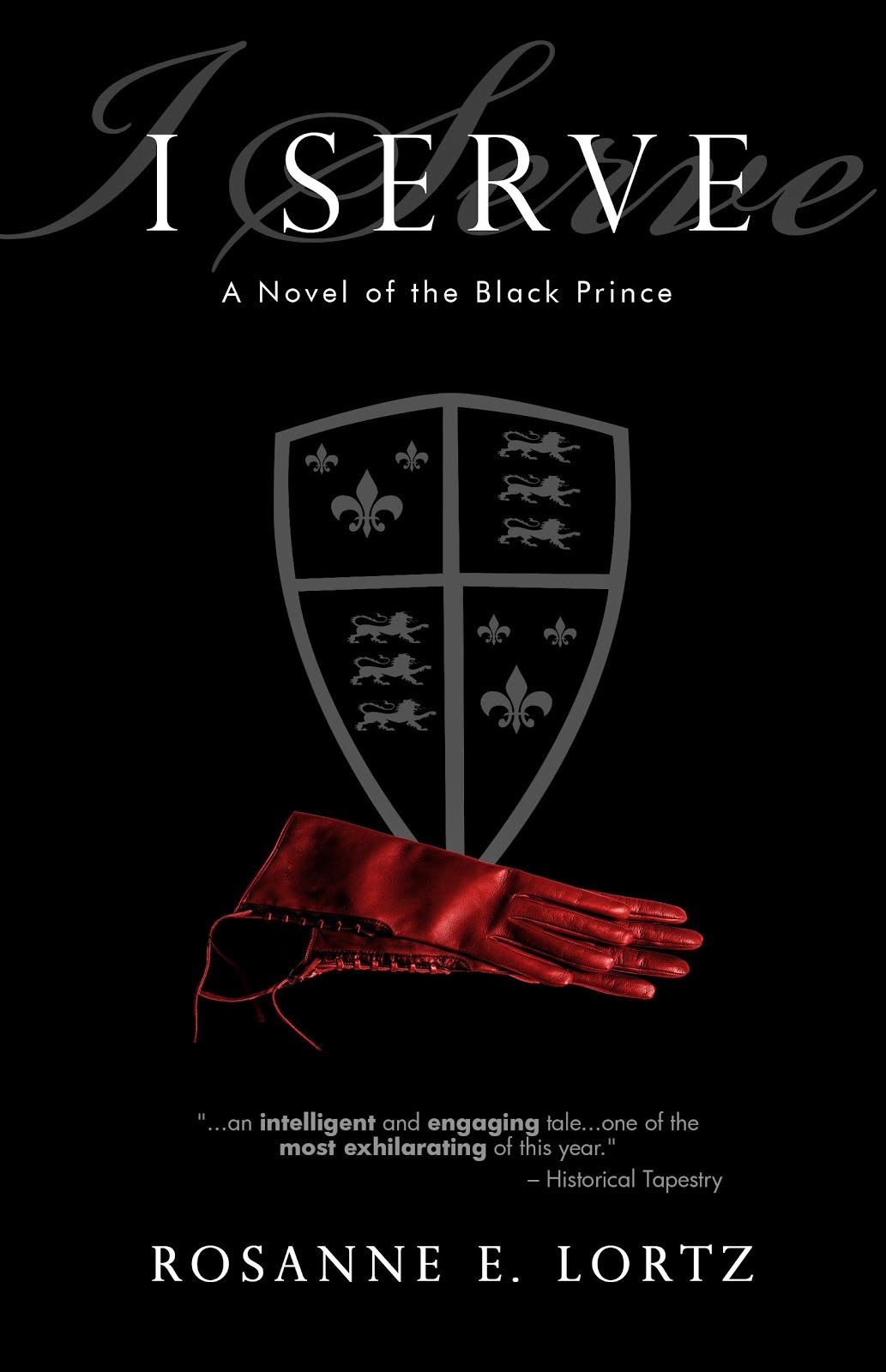
Rosanne E. Lortz is the author of two books: I Serve: A Novel of the Black Prince, a historical adventure/romance set during the Hundred Years' War, and Road from the West: Book I of the Chronicles of Tancred, the beginning of a trilogy which takes place during the First Crusade.

____

BIBLIOGRAPHY
Huizinga, Johan. The Autumn of the Middle Ages. Translated by Rodney J. Payton and Ulrich Mammitzsch. Chicago, IL: University of Chicago Press, 1996.