Showing posts with label Orkney. Show all posts

Wednesday, February 19, 2020

Beowulf: The Mound and the Dragon

By Mark Patton.

In earlier blog-posts, I explored the survival of the Anglo-Saxon poem, Beowulf, and the likely contexts for the poem's performance in the mead-halls of Anglo-Saxon royal courts. Kim Rendfeld has also discussed the origins of the two monsters that the eponymous hero has to defeat in the early stages of the poem, Grendel and his terrifying mother. These early conflicts represent a rite of passage that rulers in the real world of the early Middle Ages had to go through as they came of age. Beowulf is of royal blood, but must prove himself in battle before he can take his rightful place as his father's heir: a king who could not deliver victory in battle was not a king worthy of the title at all.

In the final section of the poem, however, Beowulf is, in his own right, King of the Geats (a people who lived in part of what is now Sweden), a successful warrior and respected ruler. One might think that he had nothing more to prove, but that's not how early Medieval kingship worked: a king always had something to prove, and the final proof was that of his own mortality, something that hangs particularly heavily over Beowulf and his people, since he has no son or heir to succeed him.

Beowulf's last encounter is with a different sort of monster, a dragon:

" ... the wide kingdom reverted to Beowulf. He ruled it well
for fifty winters, grew old and wise
as warden of the land
until one began
to dominate the dark, a dragon on the prowl
from the steep vaults of a stone-roofed barrow
where he guarded a hoard; there was a hidden passage,
unknown to men, but someone managed
to enter by it and interfere
with the heathen trove. He had handled and removed
a gem-studded goblet; it gained him nothing,
though with a thief's wiles he had outwitted
the sleeping dragon; that drove him into rage,
as the people of that country would soon discover."
(Translation by Seamus Heaney).

The awakened dragon wreaks vengeance on the entire community, and, although he was not the thief, it is Beowulf's duty, as protector of his people, to deal with it, even at the cost of his own life.

The "barrow" is recognisable as a burial mound, thousands of years older than the Seventh or Eighth Century poem. Since it is in Scandinavia, it is probably a Neolithic "passage grave," built by early farming people between five and six thousand years ago, but the "long-barrows" of England and Wales are of similar antiquity and significance.

The "passage grave" of Tustrup, Denmark. Photo: Malene Thyssen (licensed under GNU).

The "long barrow" of Wayland's Smithy, Oxfordshire. Photo: Dick Bauch (licensed under CCA). Wayland the Smith is a figure from Anglo-Saxon and Nordic mythology, so the monument must have been known to the contemporaries of the Beowulf poet. 


Although the Stone Age people who built these monuments had no knowledge of metal-working, objects of bronze and gold were sometimes placed in them by later people, either as ritual offerings or for safekeeping. There are also individual burial mounds, "round barrows," built during the Bronze Age, three to four thousand years ago, both in England and Scandinavia.

"Round barrows" on the Dorset Ridgeway. Photo: Jim Champion (licensed under CCA).


For the people of the Middle Ages, prehistoric burial mounds (whether "passage graves," "long barrows," or "round barrows") were distinctive features of the landscape, places of mystery and fear, but also places where a man, if he were brave enough, might dig in search of treasure.

The Rillaton gold cup dates to the Bronze Age (1700-1500 BC), and was found in a "round barrow" in Cornwall. Photo: Fae (licensed under CCA).

The Ringlemere gold cup is of similar antiquity (it may even have been made by the same goldsmith), and was found on a site in Kent where Anglo-Saxon burial mounds sit alongside those of the Bronze Age. Photo: Dominic Coyne (licensed under CCA).


The "passage grave" of Maes Howe, on the Mainland of Orkney, provides a remarkable parallel to the story of Beowulf. The Orkneyinga Saga tells how, in the year 1153, a party of Norsemen entered the monument, and took refuge there: "On the thirteenth day of Christmas they traveled on foot over to Firth. During a snowstorm they took shelter in Maeshowe, and two of his men went insane, which slowed them down badly, so that, by the time they reached Firth, it was night time."

The "passage grave" of Maes Howe. Photo: Tim Bekaert (image is in the Public Domain).


The archaeological evidence shows that Maes Howe really was entered, on at least one occasion, by Medieval Norsemen, who carved runic inscriptions on the stone walls. Some of these are timeless and predictable graffiti: "Inigerth is the most beautiful of all women ... Thorni f****d, Helgi carved." Others, however, refer to treasure: "Crusaders broke into Maeshowe: Lif, the Earl's cook, carved these runes. To the north-west is a great treasure hidden. It was long ago that a great treasure was hidden here. Happy is he that might find that great treasure. Hakon alone bore treasure from this mound, signed, Simon Sirith."

Runic inscriptions at Maes Howe. Photo: Islandhopper (licensed under GNU).

The"dragon" of Maes Howe. Image: Islandhopper (licensed under GNU).


There is even a picture of a dragon. Was it fear of this that drove later intruders insane? Did Hakon and Simon Sirith really find treasure, or had their imaginations been ignited by an oral performance of Beowulf, or a similar poem? Might it really still have been being performed (almost certainly in another language - Old Norse, rather than Anglo-Saxon), five centuries after it was composed, and one hundred and fifty years after the only written version to have survived was placed in a monastic library? Neither history nor archaeology provide definitive answers to these questions, but fiction can travel where the historian and archaeologist cannot go.
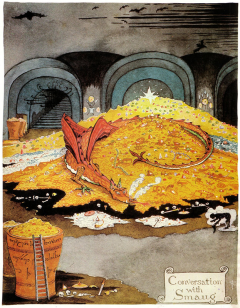
"Conversation with Smaug," by J.R.R. Tolkien ("The Hobbit"). Tolkien, who taught Anglo-Saxon at Oxford, and translated "Beowulf," drew extensively on the poem, and on the tradition to which it belongs, in his own fictional writing (image reproduced under fair usage protocols). 

[This is an Editors' Choice post, originally published on 17 August, 2017]

~~~~~~~~~~

Mark Patton blogs regularly on aspects of history and historical fiction at http://mark-patton.blogspot.co.uk. He is a published author of historical fiction and non-fiction, whose books can be purchased from Amazon.

Thursday, January 19, 2017

Prehistoric Argonauts of the North Sea: The Human Settlement of the Orkney Islands

By Mark Patton.

Readers living in the United Kingdom may have been following a new series on BBC Television recently, entitled "Britain's Ancient Capital: Secrets of Orkney" (those elsewhere may very well have the chance to see it at a later stage). Britain is unlikely to have had a "capital," in anything like the modern sense, before Roman times, or to have existed as any form of unified political entity: but some specific places are identifiable, from the archaeological record, as having had a social, political, or religious significance extending beyond the local level. The archaeological site around which the series is structured, the Ness of Brodgar, is certainly one of these, and the excavations currently being undertaken there have provided some of the most exciting archaeological revelations of my lifetime. Taken on their own, however, these revelations tell only part of the story.

Viewers of the first programme in the series were introduced to an enigmatic little rodent, the Orkney Vole (Microtus arvalis orcadensis), a subspecies of the Common Vole which exists nowhere except on the Orkney Islands.

The Orkney Vole. Photo: Hauke Koch (licensed under GNU).


It is quite common for animals separated from their parent populations, and stranded on small islands, to evolve in their own distinctive directions (the giant tortoises of the Galapagos Islands, and the lemurs of Madagascar, are among the most famous examples), but the voles cannot have made their own way to the islands. Since their bones have been found on prehistoric sites, it has long been assumed that their ancestors were accidental stowaways on the boats that brought the first human colonists, between five and a half and six thousand years ago.

It used to be thought that these human colonists traveled to the Orkney Islands from Iberia and western France, via the Irish Sea, and some may, indeed, have done precisely this, but the most recent DNA sequencing of the voles themselves suggests that their ancestors probably came from Belgium. We must therefore imagine a series of voyages around the coasts of the North Sea. Having made the crossing from the continent to southern England, these people could have followed the eastern coast to the northernmost tip of Scotland without venturing out of sight of land.

The English Channel and North Sea. Photo: NASA (Public Domain).


The Orkney Islands are visible from Scotland's Dunnet Head and John O'Groats, but the stretch of water between the mainland and the islands is among the most dangerous in Europe: the Atlantic tides coming in from the west meet the North Sea tides coming from the east to create treacherous eddies and whirlpools in the narrow channel of the Pentland Firth.

The Pentland Firth. Image: Kelisi (licensed under GNU).


The Orkney Islands seen from Dunnet Head. Photo: Posedlf (licensed under GNU).


The Neolithic ancestors of the Orcadians, however, not only crossed the water, but brought with them domesticated cattle, sheep and pigs (as well as the probably accidental voles), and seeds of wheat and barley. In the second programme of the television series, it took members of the production team, together with local volunteers, five hours to cross the Pentland Firth in a skin-covered boat similar to that which may have been used by prehistoric colonists (and almost identical to those used by the Neolithic characters in my novels, Undreamed Shores and Omphalos). These latter-day argonauts, however, carried no animals in their boat (a bull, boar or ram would present quite a significant challenge)!

A skin-covered boat (currach) of the sort that may have been used by Neolithic colonists. Photo: Simon Speed (Public Domain).


It is, perhaps, significant, that one of the earliest dated settlements on the islands, The Knap of Howar, is in one of the most remote locations, the tiny northern island of Papa Westray, suggesting that, by around 3700 BC, these colonists had fully mastered their island environment. Unlike their counterparts in many other parts of Europe, their embrace of the "Neolithic" way of life, with crops and domestic animals, did not lead them to abandon the resources on which their hunter-gatherer ancestors would have depended: the rubbish heaps at the Knap of Howar include oyster-shells, and the bones of fish and marine mammals, as well as the bones of cattle, sheep and pigs.

The Knap of Howar Neolithic settlement (c3700 BC). Photo: Me677 (Public Domain).
The Knap of Howar Neolithic settlement (the stone in the foreground is a quern, for grinding grain). Photo: Drewcorser (licensed under GNU). 


These people may have ferried the bodies of their dead across to the neighbouring island of Holm of Papa Westray, building elaborate communal tombs for them, which endure to this day. Their reliance on a broad spectrum of resources, and their mastery of stone architecture and engineering, would allow their descendants to establish a civilisation that would last for the best part of a thousand years.

Neolithic tomb on the Holm of Papa Westray. Photo: Adam Ward (licensed under CCA).

Neolithic tomb on the Holm of Papa Westray. Photo: Hayley Green (licensed under CCA).

Mark Patton blogs regularly on aspects of history and historical fiction at http://mark-patton.blogspot.co.uk. He is a published author of historical fiction and non-fiction, whose books can be purchased from Amazon.

Wednesday, October 5, 2016

The Isles' First Gold Rush

By J.S. Dunn

What was daily life like in prehistoric Prydain (Britain) or Eriu (Ireland)? Now that the Isles' academics are busily digging in their own back garden, rather than the Mideast or Greece per the 19th century, exciting local discoveries seem to pop up every week. A drastically revised picture of the ancient Isles emerges, and with it a new paradigm for the Isles that contrasts with the old construct for 'Celts' and the origin of Gaelic language and culture.  In order to write convincingly of that ancient setting, one should have an overview of the years 3000 BCE forward, well before the Iron Age or any Roman influence. The Isles' tribes were hardly the backward brutes depicted by Roman authors as of the late Iron Age. The neolithic era rocked! By around 3000 BCE, little Orkney held sway as a north Atlantic power center, at its massive temple complex of expertly fitted stone. Excavation at Orkney continues; exciting finds include painted walls and a humanistic figure (both firsts in Isles prehistory).

In fact, the Isles had sophisticated marine trade networks with the Continent as early as the neolithic. Jadeite stone axes from the Alps have been found in the UK and Ireland.  A cultural influence from Iberia was the megalith.  Megaliths played a focal role and dramatically changed the landscape. The passage mounds range from Iberia, to the Morbihan, and Bru na Boinne/Newgrange, and up to Maes Howe at Orkney. Megaliths erected during the neolithic reveal a culture of astronomy lovers. The intricately carved boulders and inner orthostats are acknowledged to be engineered observatories for movements of sun, moon, and constellations.

Image - public domain via Wikipedia

Most still accurately track celestial events of solstice, equinox, lunar phases, and other phenomena. The great passage inside Newgrange, the central mound at Bru na Boinne, runs over nineteen meters (60 feet) in length, and still welcomes the rays of winter solstice sunrise after more than 5,200 years. Stone circles such as Stonehenge reflect a later tradition emphasizing solstice, a solar event. Further study at Orkney may indicate why the culture shifted from emphasizing passage mounds and use of interior sunlight, to stone circles where the megalith casts a shadow. Obviously, more of the people could attend and witness an outdoor ritual than inside a passage mound chamber. Stonehenge has evidence of large feasts. We might not understand what the ancients believed or worshiped, but we can count the bones they left behind after feasting!

Note that at this time, Troy did not exist or was a few rudimentary huts; certainly, Carthage and Rome did not exist. The rivals for astronomy, if any, would be in Egypt but the Giza pyramids had not been constructed. Feel that paradigm shifting?

Around 2400 BCE, showy gold neckpieces – GOLD!– called lunulae due to the wide crescent shape, spread from Eriu to Wales and Cornwall,  and to Brittany and the Continent. One such lunula is shown below. A gold rush began in the Isles.  During that time the massive stone-lined passage mounds from Orkney, Newgrange, Anglesey/Ynys Mon, the Morbihan, and down to the Tagus river in Iberia, fell into disuse. What happened to the neolithic starwatchers?

https://commons.wikimedia.org/w/index.php?curid=15931350
Author - Johnbod

The answer appears to be: warriors. Metal daggers of copper made their first appearance in the Isles, again in Eriu then along Wales and Cornwall coasts.  The introduction of metal smelting brought great social changes. Genetically, the metal-using newcomers have been identified with archaeology's Beaker people. They used distinctive flat-bottomed pots and drinking cups, the latter being part of a warrior's equipment. These brave lads jumped onto little more than a bread board in northern Spain and set off for Eriu and the Isles to scout for gold and copper and tin. The warrior culture they brought with their long knives of copper and bronze remained with the Isles up to the Iron Age.


Try this: imagine you stand on Iberia's northwest corner ( on the costa verde) looking due north. Sailing north lands your vessel on the southwest corner of Ireland.  That is where northern Europe's earliest copper mine, circa 2500 BCE, has been excavated. Shortly after the copper find, a flood of gold was moving around the Isles; from Irish sources and later, gold also in Wales and Cornwall. It is possible the early mariners moved along the Bay of Biscay and up around Brittany (Ar Mor) and then to Ireland's southwest.  At any rate, a Beaker pot when analyzed showed chemical traces from Brittany; that pot was found at Lough Lein, Ireland.

Welsh and Irish mythology, the oldest in western Europe, contain embedded clues to cultural origins and dating. These heroes are not ethereal figures lolling on clouds and directing the fate of mortals below; these are sweating, swearing, fornicating, men and women who live to the fullest. There is rebellious Cliodhna, who left the 'copper coast' of Eriu in a boat with a lover only to be drowned; her myth says the boat had a copper stern.  And the myth of the smith Lein, who worked at the Lake Of Many Hammers.  When archaeologist William O'Brien dug in at Lough Lein (Ross Lake) in county Kerry,  he discovered the oldest copper mine in the Isles.  The myths' references to copper dates to the second millennium or very ancient folk memory in Cork and Kerry; after around 1600 BCE copper was no longer mined there! That date is well before the prior paradigm for when Gaelic was spoken in Eriu or Wales. So what language was being spoken, by the newcomers who mixed with the indigenous tribes?

Linguist John Koch asserts, with others, that Gaelic language and culture were incubating in the Isles, and carried from the Isles to the Continent by marine traders. Gaelic thus began on the coasts, that is to say in the west and in the Isles.  Protogaelic language and culture moved from west to east.  Trade moved on rivers like the Loire from west to east.  Also, Gaelic developed much earlier than had been imagined by 19th century theorists; Gaelic developed during the Bronze Age from the early second millennium forward, and not during the later Iron Age.  Research by Koch on inscriptions in southwest Iberia has shown that rudimentary Gaelic was in use well before the Romans came along and prior to any 'invasion' of Celts.


Finally, the genetic evidence shows no big wave of invaders swamping the natives at any time.  There is a substrate from the neolithic; a new blip occurs on the genetic radar with the Beaker people in the mid third millennium BCE, and then no new genetic infusion until the Vikings and Saxons. Many areas of Ireland, and west Scotland and Wales, have retained a strong neolithic genetic signature.  If your father's or brother's genetic Y haplotype is R1b1b2 (also termed M269), congratulations: you're stone age.  The old model of waves-of-invading-Celts just doesn't hold up in the Isles or in Iberia.

Chasing down the details of prehistory need not be dull and not all the research is serious; for example, on the subject of the fulacht fiadh (pronounced foolah fee). This item is a wooden trough sunk into the earth and usually associated with a nearby pile of cracked and burned rocks. For years, academics debated whether the trough was used for a) cooking a joint of beef by adding red hot stones to hot water, or b) having a bath either after or in lieu of the beef feast, or c) brewing beer.  Since these cooking pits are almost all found in Ireland, research eventually explored option c, the brewing, with happy results duly written up and reported in a professional journal.

That grinding hum in the background is the old paradigm shifting. 'Celtic' as a term may survive with reference to a swirling, organic style of surface decoration that was widespread during Europe's Iron Age, and for certain US sports teams. Sir Barry Cunliffe, emeritus head of European Archaeology, Oxford, advocated for Celtic-from-the-west as a new model beginning in his 2001 volume, Facing The Ocean: The Atlantic and Its Peoples 8000BC-AD 1500.  Cunliffe's monograph is hefty and costly, but totally worth the read if not indispensable.  Reading old material on 'Celts' or prehistory of the Isles that was published prior to this decade is risky. The new finds in field archaeology, the archaeolinguistics, and archaeogenetics, are just that stunning and deserve awareness if not understanding. Similarly, it pays to keep up with current archaeology noting that individual sites and finds should be put into the larger context as they arise.

The gold said to be hidden in the Isles' ancient mounds can be seen as renewable, for it is the inspiration from the starwatchers and the brave marine voyagers.


[image of knife and shield courtesy of Both images courtesy of Neil Burridge, Cornwall bronze craftsman.
See Burridge website at  http://www.bronze-age-swords.com/]

~~~~~~~~~~

J. S. Dunn resided in Ireland during the past decade, and from there pursued early Bronze Age culture along the Atlantic coasts of Spain, France, Wales, Cornwall where the author poured a bronze sword, Orkney, and Ireland. The author is a huge fan of RyanAir for jetting around to unusual places.
Numerous archaeologists and experts vetted the details of BENDING THE BOYNE. A second novel set at 1600 BCE, STEALING TARA, is forthcoming.
See updates at:  https://www.facebook.com/BendingTheBoyne