Showing posts with label Prince Albert. Show all posts

Wednesday, May 6, 2020

John Brown: Victoria's Lover or Rasputin-like Figure?

By Emma Rose Millar

Since first watching Dame Judi Dench and Billy Connolly in the 1997 film, Mrs Brown, I have been intrigued by Queen Victoria’s relationship with her ghillie: were the pair really lovers, or was he simply her loyal servant and protector?


There is no doubting Victoria’s early love for Albert. She was an obsessive letter writer and journal keeper. Aged twenty, she wrote in her diary about her first evening of married life:
“I never ever spent such an evening! My dearest, dearest, dear Albert sat on a footstool by my side, and his excessive love and affection gave me feelings of heavenly love and happiness I never could have hoped to have felt before! He clasped me in his arms and we kissed each other again and again! His beauty, his sweetness and gentleness—really how can I ever be thankful enough for such a husband.”
She often wrote of her pride in his achievements, particularly the Great Exhibition of 1851. Albert was indeed intelligent and enterprising, and often, especially in the early years, he was frustrated by his lack of power. However, as Victoria became increasingly occupied with her children, Albert took on more responsibilities. Victoria sometimes resented Albert’s authority, and fierce arguments between the couple were a regular occurrence. Frequently, they would cease to be on speaking terms and communicated only in writing. Many of these letters survive and have given us a fascinating insight into their relationship.

When Albert died of typhoid fever in 1861, Victoria was devastated. She wrote to her eldest daughter, also called Victoria, asking: “How I, who leant on him for all and everything – without whom I did nothing, moved not a finger, arranged not a print or photograph, didn’t put on a gown or bonnet if he didn’t approve it shall go on, to live, to move, to help myself in difficult moments?”


For years Victoria mourned Albert, retreating from public life and wearing black for the remaining forty years of her life. After his death, whenever decisions needed to be made, Victoria felt the absence of Albert acutely. She attempted to guess what the Prince Consort would have advised and attended many séances in order to communicate with him directly. Victoria famously consulted Daniel Dunglas Home, one of the most lauded mediums of the era, and Georgiana Eagle, whom she gave an engraved watch, for supposedly channelling Albert’s ghost.

In 1861, a 13-year-old medium, Robert James Lees, held a séance in Birmingham during which he went into a trance and delivered a message from the Prince Consort that he wished to speak with his wife, the Queen. One of the sitters there was a professional editor, who published his account, which was subsequently brought to Victoria’s attention. The Queen’s position dictated a cautious approach. She sent two courtiers to Lees’ next séance in her place, instructing them that they were not to reveal their identities. During the séance, Lees again went into a trance and produced a voice phenomenon which the courtiers instantly recognised as Prince Albert. The spirit then addressed the courtiers by their real names and gave intimate details of life at the palace, which they considered only Albert could have known.

Following the séance, Lees wrote a letter to the Queen, using the supposedly supernatural gift of automatic writing, where the spirit takes over the body of the spirit medium long enough to write a message. Lees’ letter was filled with personal details and signed by a pet name used only between Albert and Victoria. Victoria was utterly convinced that the letter was genuine and sent at once for Lees, who conducted a further séance at the Palace, again channelling Albert’s voice.

Lees as an older man

According to Lees’ children, he performed another nine séances, impressing the Queen so much that she invited him to join the Royal household. However, he refused the offer on the advice of his spirit guides. Speaking through Lees, Albert’s final words of comfort were, “You will still be able to receive messages from the boy who used to hold my gun at Balmoral.”

The boy who carried Albert’s gun was John Brown.

After Lees revelations, Brown was sent for to become the Queen’s personal groom at Osbourne, her house on the Isle of Wight. The relationship between John Brown and Queen Victoria remains a source of conjecture. Her courtiers were pleased at first that he was able to coax her out of her misery, but they soon became concerned that she had fallen utterly under his spell.

Brown immediately adopted a bullying and familiar manner with the Queen that astonished courtiers and caused her daughters to refer to him as ‘Mama’s lover.’ He became increasingly domineering, towards the rest of the royal household. Other servants came to despise him, and secretly dubbed Brown ‘the Queen’s stallion.’ Brown encouraged the Queen to drink whisky with him, Begg’s Best being their preferred tipple. She was soon referring to him as ‘fascinating Johnny Brown’.

A shocked Foreign Secretary, the Earl of Derby, recorded that ‘contrary to etiquette and even decency,’ Queen Victoria and John Brown slept in adjoining rooms, with only a door between them. Some sources suggest that the pair even married in secret. Lewis Harcourt, First Viscount Harcourt’s diaries state that one of the Queen's chaplains, Rev Norman McLeod, made a deathbed confession repenting his action in presiding over Queen Victoria's marriage to John Brown. Victoria was buried with a lock of Brown’s hair, his photograph, Brown’s mother's wedding ring, along with several of his letters.

However, Irish author, J. H Brennan claims in his book, Whisperers, the History of the Spirit World that far from being lovers, John Brown was a spirit medium who was channelling messages from Albert’s ghost. In the blue room, which Victoria had turned into a shrine to her late husband, she would sit with Brown and a few trusted courtiers, in the dark, where she would sit and wait. John Brown would then begin to speak, not in his own voice, but in the voice of the Prince Consort, telling Victoria what she should do.

After John Brown’s death in 1883, Victoria wrote to the Earl of Cranbrook, “the Queen feels that life for the second time is become most trying and sad to bear deprived of all she so needs.” This letter could perhaps be alluding to her losing Albert for the second time – she was no longer able to communicate with him through Brown.

Whether or not John Brown was behind Lees’ claims to be able to channel Albert’s spirit, we do not know, although it is telling that when recounting his first experience of Spiritualism, Lees wrote:
“I am personally aware that as a child I cried at being left in the darkness unless I saw a mysterious and to others invisible kilted Highlander who remained beside me talking or singing till I fell asleep. And even now, after a lapse of half a century the vivid memory of his strong but kindly face is as freshly recalled as if he had sat beside me whilst this New Year was born.”

[This is an Editor's Choice archive post, originally published on EHFA 29 October 2018]

~~~~~~~~~~

Emma Rose Millar writes historical fiction and children’s picture books. She won the Legend category of the Chaucer Awards for Historical Fiction, with FIVE GUNS BLAZING in 2014. Her novella THE WOMEN FRIENDS: SELINA, based on the work of Gustav Klimt and co-written with author Miriam Drori was published in 2016 by Crooked Cat Books, and was shortlisted for the Goethe Award for Late Historical Fiction. Her third novel, DELIRIUM, a Victorian ghost story, published by Crooked Cat Books was shortlisted for the Chanticleer Paranormal Book Awards in 2017.

Delirium
1881

Saint Anne’s Lunatic Asylum, London.

One woman whose secret has driven her to the brink of insanity; another who claims she can tell fortunes and communicate with the dead. With seemingly no way out – and everything at stake – only one of them has the tenacity to survive.

Lies, murder, obsession... Delirium.

Find Delirium on Amazon
Follow Emma Rose Millar on Twitter
On Facebook
On Goodreads


Wednesday, October 23, 2019

More about the Crystal Palace

By Judith Taylor

Following on from her post about the creation of the Crystal Palace, Judith picks up the story again:

It is hardly surprising that an event like the Great Exhibition and a building of such magnitude and glamour as the Crystal Palace would linger in one’s mind, “agitating the little grey cells”. There is still a great deal to be learned about it and even with intense application one would only scratch the surface. There is the prosaic matter of how the exhibition was paid for and the steps taken after it closed. With all the effort put into getting show ready it is hard to believe the exhibition only lasted for six months from May to October 1851. Queen Victoria took her family to see it three times. We need to put aside the seductive charms of ancient greenhouses and cast iron and think about drier things.

To refresh everyone’ memory, some visionary senior officials wanted to create a great exhibition of the world’s arts and manufactories to celebrate Britain’s imperial dominance. Prince Albert is usually considered to be the prime mover but he was always very wary of butting into potential political minefields. His enthusiastic scientific friends and colleagues planned to open the show on May 1, 1851.


The timing was not coincidental. Think about it. The date was precisely half way through the century. Then there were the recent troubles in Europe. In 1848 the Continent had seen major radical uprisings with the Communes in Paris, Berlin, Brussels and Budapest. England watched its citizens very carefully and probably breathed a big sigh of relief when very little happened there. The worst that  occurred was the movements of the Chartists.

One way the English authorities defused the situation was to offer the masses a few perks to distract them from their miserable conditions. The unprecedented creation of free public parks and the privilege of using formerly private parks was one of them.

The leading lights of the Royal Society for the Encouragement of the Arts, Manufactures and Commerce began the process but when it did not move very quickly they managed to persuade their president, Prince Albert, to use his personal charm and get the government to set up a royal commission to turn the idea into reality. He had no statutory authority. The French had been holding similar exhibitions of their own products every year since 1798. Sir Henry Cole and the commissioners took their task very seriously, setting up an architectural competition for a building.

The Commissioners, 1851

The next big question was where to put it. London in the late 1840s was not built up the way it is now but even so, finding enough open land was a challenge. The established open spaces such as Hyde Park or Regent’s park had originally been closed royal property and had only recently become available to the larger public.

In the early 19th century London was still bounded to the west by Park Lane, Marylebone Road to the north, the South Bank of the Thames at Southwark and Bethnal Green and Spitalfields to the east. Technically, the City of London, with the great cathedral of St Paul’s which qualifies it for the title of city and being the seat of banking and finance, had its own ancient boundaries. Surrounding the capital were villages such as Hampstead and Kensington.  Westminster with Parliament and the Abbey was a separate city. The rest was open country, part of manorial land and parish titles. West of the park, William Kent had started the trend for commercial nurseries in places like Brompton.

Most of the land surrounding London was still owned by families such as the Harringtons, Alexanders and Lees. There were also smaller holdings. A massive increase in population led to the development of suburbs like St John’s Wood and Blackheath. London began to gobble up Middlesex and Surrey. There were one million people living in the city.

Railway Map of Central London, 1899

Speculative builders bought up as much land as they could and developed mainly two kinds of housing: large villas equipped with clean running water and plenty of space for a family with servants such as the Jekylls and much more modest terraced houses where the white collar employees of such family businesses could live.

Geography and architecture both helped to extend the separation of social classes, giving London its character. Upper class people lived in the West End or near it and really poor people in the East End. They had no running water. This is a huge oversimplification but handy for the moment.

In the end the commissioners chose Hyde Park for the exhibition but prudently set about buying the parcels of land they would need for the second phase of the plan. This land lay to the west and south. It was essentially Kensington, with parts of Chelsea and Westminster included.

The financing of the project held it up for a long time. This was why the prince had been so circumspect. He was concerned that he would be accused of wasting public funds for a pet project. When preparatory talks began in late 1849 the press was against the idea. The commissioners had very little choice but to attract private funding. They signed a contract for £20000 with Messrs. J. and G.  Munday, a large firm of public works contractors.

The press now changed its attitude. A project created by a royal commission could not be seen to rely on private funds. If it were successful the backers could make a lot of money out of a national event and that was thought to be unseemly. Leading bankers, traders and merchants in the City issued a resolution in January 1850 condemning the private contract with the Mundays and insisted it be voided. Funds from the Department of Works would cover the initial steps. This decision was eased by the fact that one of the commissioners was able to explain the concept of pay as you go with money coming in as well as going out.

They then took the whole idea a step further. Considering this was to be a national event it was decided to encourage as many groups as possible to contribute voluntarily, primarily organized by municipality. The City of Glasgow sent £2666, Bradford gave £1605 and Rochester £13. The City of London contributed £26632. This can be considered to be an early version of “crowd funding”.

Land obtained for the Museum Quarter

By now the prince was fully on board and showed his vision for the future. The Great Exhibition was just the first salvo in his mind. Once the exhibition ended they would move the building to another, permanent site. In 1852 the commission used the profits from the exhibition, more than £180 000, to buy the land on which to build permanent artistic and cultural institutions which thrive to this day. These were the Victoria and Albert Museum, the Royal Albert Hall, the Science Museum and the Imperial College. The road which is the axis of their locations is Exhibition Road. This is the district now known as South Kensington but sometimes called “Albertopolis”.

Prince Albert died in 1861 and did not live to see the final results of his vision. Of all his descendants, only Prince Charles has shown similar interests.


References

Coleman, Eliza
https://greatexhibition1851.blogspot.com/2011/09/financing-of-great-exhibition.html


~~~~~~~~~~

Judith M. Taylor MD is a graduate of Somerville College and the Oxford University Medical School and is a board certified neurologist. She practiced neurology in New York and since retiring has written six books on horticultural history as well as numerous articles and book reviews on the same subject.

Dr Taylor’s books include The Olive in California: history of an immigrant tree (2000), Tangible Memories: Californians and their gardens 1800 – 1950 (2003), The Global Migrations of Ornamental Plants: how the world got into your garden (Missouri Botanical Garden Press 2009), Visions of Loveliness: the work of forgotten flower breeders (Ohio University Press 2014) and An Abundance of Flowers: more great flower breeders of the past (Ohio University Press  2018).  In 2019 she published A Five Year Plan for Geraniums: growing flowers commercially in East Germany 1946 – 1989.
Dr Taylor’s web site is: www.horthistoria.com

Friday, August 16, 2019

Joseph Paxton, Creator of the Crystal Palace

By Judith Taylor

I have paid homage to two great Victorian men so far in this column but Joseph Paxton, 1803 – 1865, may be the granddaddy of them all. He rose from being the son of a middling farmer who died when the boy was only seven years old to a knight of the realm and confidant of one of the wealthiest and most powerful noblemen in England at a time when such things counted, the Duke of Devonshire.

Joseph Paxton

A slight digression on the topic of the duke, George Spencer Cavendish, sixth duke of Devonshire, 1790 – 1858, is in order here. It was the duke who ignited the latent forces in Paxton and fostered his development all his life. Throughout her married life, Sarah Paxton knew that whatever the duke wanted would always take precedence. She was a sensible woman and understood the situation. The duke’s mother was the infamous Georgiana, duchess of Devonshire. In spite of his great wealth and position he was a shy man, hampered socially by being deaf. That could be the reason he never married. He suffered from the occupational disease of dukes, boredom.

That ended when an Oncidium orchid pierced his soul and he was smitten for life. The careful reader will remember that this was what happened to Dean Hole, only in his case it was a rose. The duke was always a very dutiful steward of his great estates but he began to improve his gardens and devoted his life to creating lasting beauty.

His home in London lay next to the London Horticultural Society’s garden at Chiswick. He enjoyed wandering around that garden and asked the superintendent in 1826 if he could recommend a suitable young man to take charge of his grounds at Chatsworth in Derbyshire. The estate is near the town of Chesterfield in the foothills of the Peak Country. The superintendent recommended Joseph Paxton, still young and untried but clearly ready to take on larger responsibilities.

Chatsworth, Derbyshire

Poor children were not always able to spend much time at school in country villages but perhaps because Joseph was the youngest child he stayed in school long enough to learn to read and write proficiently. This gave him an edge when he applied to become a gardener at the society’s premises. There is a record of his entry in their literacy test. In it he also wrote that he was three years older than he actually was. By the time the duke took him on he was still only twenty.

Paxton left an accurate account of his first day at Chatsworth which is quoted very frequently but which is nonetheless worth repeating here for its great charm.

“I left London by the Comet Coach for Chesterfield and arrived at Chatsworth at half past four o’clock in the morning of the ninth of May, 1826. As no person was to be seen at that early hour, I got over the greenhouse gate by the old covered way, explored the pleasure grounds and looked round the outside of the house. I then went down to the kitchen gardens, scaled the outside wall and saw the whole place, set the men to work there at six o’clock; then returned to Chatsworth and got Thomas Weldon to play me the water works, and afterwards went to breakfast with poor dear Mrs Gregory and her niece. The latter fell in love with me and I with her and thus completed my first morning’s work at Chatsworth before nine o’clock”.

One can only imagine the expression on the gardeners’ faces when their new boss appeared over a wall and gave them their marching orders. He married Sarah Bown the following year. She was a bit older than he was and not particularly pretty but she was a solidly good person with the added advantage of a substantial legacy. In the parlance of the time according to Trollope’s clerical hierarchy, she was “WOM” (wife own money).

The duke worked ceaselessly to improve his gardens with Paxton. As a torrent of rare and exotic new plants were flooding into Britain from the rest of the world the duke bought everything he could lay his hands on to satisfy this new lust. He even joined the movement for private individuals to send out their own collectors but in his case that ended in tragedy and he never did it again. Two of his nice young gardeners went to the Pacific Northwest region of America and were drowned in the Columbia River.

Many of the imported plants were either tropical or sub-tropical and that led to the need for glasshouses. Paxton had already shown his flair for architecture with other structures at Chatsworth. This was a fortuitous time. The ridiculous tax on glass was repealed in 1845. James Hartley patented his method for making large flat panes of glass which were vastly superior to any previous glass in 1847. Paxton had warmed up by building a wondrous huge glasshouse at Chatsworth, “The Great Stove”, a few years earlier. Dozens of people visited it to marvel at its beautiful structure.

The Conservatory/Glasshouse at Chatsworth

There was one influential person who did not share this opinion; our friend John Claudius Loudon. He spent a lot of time traveling throughout the country visiting gardens and writing about them. These systematic reviews led to improvements in garden design and function. It is possible he felt threatened by the rapid rise and success of Paxton and his “Horticultural Register and General Magazine” founded in 1832 but the review Loudon wrote in his “Gardening Magazine” was laced with bile and spite.

“(Chatsworth) has always appeared to us an unsatisfactory place” was just for openers. He found fault with everything of which Paxton was the proudest. One of his criticisms was that Paxton had used wood to frame the glass panes whereas Loudon had invented an iron glazing bar and believed that to be the better material. Paxton handled himself with immense dignity and eventually the two men saw the value in the other’s views. Paxton used iron to build the Crystal Palace.

Paxton had been steadily rising in the social scale by his sheer skill and ability to get things done. He was no longer a mere gardener in a nice cottage but a builder and a man of business. Before long the duke had invited him to dine at the big house and introduced him to useful people. The old saw about going to a busy person when you needed something done was true in his case. One could rely on Paxton. He was rewarded by increasing social acceptance as well as money. The duke never prevented him from taking on commissions outside Chatsworth. All this was the backdrop to him being chosen to design the Crystal Palace. The queen would knight him in 1852.

The idea of holding “The Great Exhibition of the Works of Industry of all the Nations” to celebrate the achievements of the British Empire in manufacturing and all associated arts had been mooted by very serious senior officials but it needed the imprimatur of royal involvement to get it going. Prince Albert stepped in.

He formed a royal commission in 1850 which promptly set up a competition for a building to hold the show. The committee received over two hundred and forty-five submissions in three weeks. Probably out of sheer frustration they ended up choosing a plan by Isambard Kingdom Brunel. Time was becoming very short. All of this was closely followed in the press and Paxton was paying attention. The exhibition was supposed to open in October 1851.

Brunel’s design was very pedestrian, mainly built of brick. Not only was it ungainly, the cost was astronomical. Another defect was that it would be permanent, destroying much of  Hyde Park for good. There was a public outcry. Even though the official entry period was over members of the commission listened to Paxton very carefully. Not only was his design very attractive it was also far less expensive than the others.

Prince Albert has never quite had his due, playing second fiddle to the queen but he was extremely intelligent and well informed. Once the exhibition had ended it was he who came up with the idea of creating the museums and other major institutions in South Kensington using the space and materials left behind.

In 1849 Paxton had built a small new glass house at Chatsworth when the duke received seedlings of the fabled giant water lily, Victoria amazonica, known at that time as Victoria regia,  from Sir William Hooker at Kew. Its leaves spanned six feet. A child could stand on one of them perfectly safely. There was a race all over Europe to see who could get it to flower first in a temperate country. The duke won.

Paxton's daughter on a leaf of Victoria amazonica in  1849

The story goes that Paxton was at a meeting of the board of the Midland Railway when the idea for the Crystal Palace came to him. He sketched out the now familiar design based on the model of the house he had built for the lily. There is also a possibility that part of the inspiration came from the extraordinary system of veins under the lily leaves’ surface, providing their tensile strength.

The genius of Paxton’s work was that all the parts could be reliably prefabricated of cast iron, vastly decreasing the time needed to erect the complicated building. It was possible to build on a gigantic scale and still support all the expected weight and maintain stability in the face of high winds across Hyde Park. Paxton worked rapidly with skilled draftsmen and engineers to get the drawings ready for the commissioners in a very short time.

A bald recital of the dimensions and materials for the exhibition building is very telling. It was 1848 feet long, (not 1851 which plays on the date), 456 feet wide and 108 feet high at the transept. The surface area covered more than twenty acres allowing for more than ten miles of actual exhibition space within. All this was supported by slender cast iron pillars.

The concept was not new. Glass houses went back a long way in British gardening history from the early orangeries with tiny panes of glass to Turner’s great Palm House at Kew in Britain. There were also fine glass houses on the continent.

The Crystal Palace

The building was constructed remarkably quickly in just seven months. The queen opened it on time. Both the building and the exhibition itself  were an overwhelming success. Paxton did not sit around basking in this new glory but was very busy with the vast number of new commissions it engendered. He worked on Mentmore for the Rothschilds and at one of their French estates. He traveled widely all over the continent and even visited the United States.

The new Lady Paxton remained steadfastly at Chatsworth with the children, five girls and one boy, overseeing the expenses of the garden for him and checking everything carefully. She knew she could not participate in his new social circles.

Paxton grew really rich and was able to hang onto this money unlike so many men of his class. He had one severe disappointment in the behavior of his only son, George. All his life the boy was rebellious and would not accept discipline at home or at school. His parents tried everything they could think of in those as yet unenlightened times but nothing worked. Occasionally Paxton would take George with him on one of his tours but was constantly embarrassed and chagrined by his ill-tempered outbursts and rude manners. One can invoke psycho-babble and consider how a boy would feel whose father was so consistently successful, completely eclipsing anything the child could accomplish.

Early in 1865 Paxton had what was probably a heart attack and never really recovered. Six months later, on June 8, he was dead. Very little is known of what became of George, even the date or place of his death though he did have some children that Paxton enjoyed seeing. The estate was valued at £180 000.


References: Colquhoun, Kate  2006  The Busiest Man in England: a life of Joseph Paxton,  gardener, architect and Victorian visionary
Boston      David R. Godine

All images: Wikpidia in the Public Domain

~~~~~~~~~~
Judith M. Taylor MD is a graduate of Somerville College and the Oxford University Medical School and is a board certified neurologist. She practiced neurology in New York and since retiring has written six books on horticultural history as well as numerous articles and book reviews on the same subject. 
Dr Taylor’s books include The Olive in California: history of an immigrant tree (2000), Tangible Memories: Californians and their gardens 1800 – 1950 (2003), The Global Migrations of Ornamental Plants: how the world got into your garden (Missouri Botanical Garden Press 2009), Visions of Loveliness: the work of forgotten flower breeders (Ohio University Press 2014) and An Abundance of Flowers: more great flower breeders of the past (Ohio University Press  2018).  In 2019 she published A Five Year Plan for Geraniums: growing flowers commercially in East Germany 1946 – 1989.
Dr Taylor’s web site is: www.horthistoria.com

Saturday, April 29, 2017

Baroness Lehzen, Victoria's Governess

by Lauren Gilbert

Too often, when we consider Queen Victoria, we consider the Widow of Windsor dressed in black, or, if we're in a romantic mood, Albert's young bride.  It's easy to forget that she was once a little girl, and a singularly isolated and put-upon one at that.  One constant through her childhood, youth and young married life was Louise Lehzen.  Lehzen was first her governess and protector, then her lady-attendant and only friend.  Lehzen was one of the very few people around Victoria who was motivated solely for the love of and best interest of Victoria herself.  In return, she has gone down in history as a strong influence on the queen during the first several years of her reign.

Louise Lehzen was born October 3, 1784 to Joachim Friedrich Lehzen, a distinguished Lutheran pastor, and his wife Melusine Palm in Hanover. At birth, her name was recorded as Johanna Clara Louise Lehzen. She was the youngest of nine children. Available data indicates that family finances required her to go to work as early as possible. There is little information about her schooling, but she was reputed to be at least adequately educated, possibly at home by her father. Her first situation was that of governess to the daughter of Baron von Marenholtz in Brunswick. In this position, she was treated as a member of the family, and was valued for her knowledge, excellent character and behaviour. This period of employment resulted in excellent references.

In 1818-1819, Lehzen entered the household of Princess Marie Luise Victoire of Saxe-Coburg-Saalfeld, widowed Princess of Leiningen who married Edward, Duke of Kent (fourth son of George III), to serve as governess of the princess’s 12-year-old daughter Princess Feodora of Leiningen. (Known as Victoire, the new duchess was the sister of Prince Leopold, the Prince Regent’s son-in-law.) Victoire obligingly became pregnant, and Edward was determined that his child would be born in England. The household (including a midwife) was moved to London when Victoire was almost due to give birth. Her son Charles (Carl), now Prince of Leiningen, had to stay behind.

Princess Alexandrina Victoria was born in Kensington Palace May 24, 1819, fifth in line to the throne. She was not yet considered a real contender for the throne, as George III was still living and had three living sons ahead of her father. (Princess Charlotte, daughter of the Prince of Wales, had died at age 21 in 1817.) However, she was ahead of two uncles, younger than her father, who were eligible for the throne: Ernest, Duke of Cumberland, and Adolphus, Duke of Cambridge, both of whom had sons named George close in age to Alexandrina. The birth of Alexandrina Victoria stirred up a great deal of bad feelings between the Prince Regent, her father and the other brothers, resulting in Edward and his family being somewhat isolated from the royal family. This, in turn, allowed the child’s parents, and in particular her mother, to have greater opportunity to make their own decisions concerning her care.


Princess Victoria Aged 4
by Stephen Poyntz Denning, 1823

Edward died in January 23, 1820, leaving his wife as sole guardian of Alexandrina, an unusual arrangement. His friend, Captain John Conway, was one of the executors of Edward’s will and became comptroller of his widow’s household. 

When George III died January 29, 1820, his eldest son George, Prince of Wales and Prince Regent, became king as George IV. Neither he nor his next two surviving brothers had living children, and the little girl was now fourth in the succession. George IV resented that she was potentially an heir to the throne as he intensely disliked the Duke and Duchess of Kent and Prince Leopold, and preferred that his niece Alexandrina live in seclusion. As when her first husband died, the Duchess of Kent inherited debts so she and her children were virtually destitute. The Duchess of Kent was reliant on her brother Prince Leopold, his man of business Baron Christian Stockmar, and Captain John Conroy. While Leopold, and Stockmar, assumed direction of the duchess’s affairs, they were frequently absent due to political matters. As a potential heir to the throne, Alexandrina Victoria needed to stay in England. Leopold helped the duchess get permission to have Edward’s rooms in Kensington Palace, gave her an income, and helped her get loans to establish her household. Conroy stayed with the household, and the duchess became very dependent on him.

When Conroy became comptroller, he took control of all of the finances for Duchess of Kent and her daughters. Neither George IV nor any of the royal family provided any financial assistance. (George IV basically snubbed the child and her mother, and would have been delighted had they moved to Germany as dependents of Prince Leopold.) While in Kensington Palace, Conroy met and befriended Princess Sophia, George IV’s sister. It is believed Conroy guaranteed the Duchess of Kent’s debts (which were huge) with his own fortune and kept her creditors at bay in exchange for the duchess’s promise of reimbursement when her daughter inherited the throne. (Obviously, they were playing a long game.) He also acted as her secretary and general factotum. The Duchess of Kent was determined to devote herself exclusively to the raising of Alexandrina. Under the “Kensington system,” Alexandrina was never allowed to be alone; she slept in her mother’s room, she was never allowed to talk to anyone without a third party present (usually her mother or Lehzen), and was continually monitored. She was isolated from the outside world. She had only occasional visits from children from outside of the household. Her sister Feodora was her only friend, and the sisters were very close in spite of the age difference. Household rules required that employees not maintain diaries or mention household matters in correspondence (Lehzen complied). Conroy’s family was in the household, and his children, particularly his daughter Victoire who was about Alexandrina’s age, were thrust on her frequently. She did not like or trust Victoire (or anyone connected to Conroy) and deeply resented having his family forced on her.

When Mrs. Brock, Alexandrina Victoria’s nurse, was dismissed in 1824, Lehzen became governess to Alexandrina Victoria (at age 17, apparently Princess Feodora no longer needed a governess). The Duchess of Kent and Conroy, her comptroller, appointed her to this position because they assumed, as a dependent in a foreign country, she would be submissive and obedient to their instructions. Lehzen read to Alexandrina, and worked hard to engage her attention on her studies. Available data indicates that Lehzen was considered stern in appearance (pictures show an attractive woman) and quite disciplined; young Alexandrina was in awe of her new governess. Sources indicate that Lehzen gave Alexandrina a good grounding in the basics. More to the point, Lehzen worked with the Duchess of Kent, and became extremely close to Alexandrina. Lehzen and Alexandrina spent a great deal of time alone. The education envisioned by the duchess (and Conroy) was not the education of one expected to rule a kingdom, but was similar to that of the duchess herself or any other well-born girl, emphasizing accomplishments rather than real knowledge. Lehzen avoided the infighting of the household and focused on Alexandrina. She was firm with the child, and earned her respect. She devoted herself to Alexandrina; the two spent hours together, reading, making dolls (dressing them, naming them and imagining lives for them), forging a closeness that resulted in Alexandrina considering her a second mother. It speaks volumes for Lehzen’s tact and discretion that she outlasted George IV’s threat to send her back to Germany, avoided arousing the jealousy of the Duchess for her closeness to the child and avoided (for the most part) hostilities with Sir John Conroy. It seems clear that Lehzen’s primary functions were basic education and personal care for the child. It’s to Lehzen’s credit that, working within the “Kensington system”, she was able to meet the Duchess’s requirement that Alexandrina never be left alone without incurring Alexandrina’s resentment. Her loyalty to Alexandrina, and Alexandrina’s trust in her, became absolute.
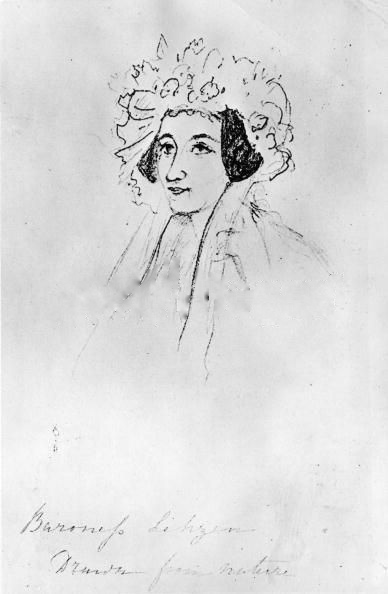
Baroness  Louise Lehzen,
drawn by Princess Victoria 1835

When Alexandrina Victoria became undoubted heiress to the throne, George IV grew concerned about her education. Alexandrina spoke German with her mother and Lehzen and knew English. In 1825, he requested that Parliament grant an additional 6000 pounds per year each to Alexandrina and to her cousin George Cumberland specifically for their education. In 1827, George IV appointed Rev. George Davys to be Victoria’s tutor, at which point her more formal education began. His lessons included religion, ancient history and Latin. It’s important to note that Alexandrina had other tutors (she was taught French and Italian, penmanship, dancing, piano and singing; she was taught to draw by Richard Westall, R.A., and enjoyed mathematics). 

At the request of his sister Princess Sophia, George IV made Lehzen a baroness in the kingdom of Hanover, to reconcile Lehzen to this appointment. (Captain Conroy became Sir John Conroy, Knight Commander of the Hanoverian empire, at this time as well, also at Princess Sophia’s request.) There are suggestions that Lehzen’s elevation was designed to eliminate “commoners” from serving the princess, as well as to ameliorate any disappointment. 

Lehzen remained with Alexandrina as lady-in attendance, and cooperated with Rev. Davys and the other tutors. Princess Sophia had previously given Conroy an estate worth 18,000 pounds in 1826. Alexandrina experienced a great loss when Feodora married Ernst, Prince of Hohenlohe-Langenburg, in 1828. (Feodora was eager to leave Kensington Palace and Conroy.) Alexandrina and her sister remained close throughout their lives. When Alexandrina Victoria reached the age of 10, she became known as Victoria. During these years, as the Duchess became more dependent upon him and he obtained more and more authority, Sir John Conroy became more overbearing and arrogant, looking for slights and determined, with the Duchess, to control Victoria.

George IV died June 26, 1830 and was succeeded by his brother William, who reigned as William IV. William and his wife Adelaide had always been fond of Victoria. Unfortunately, the duchess and Conroy immediately created friction and bad feeling by demanding more money, more prestige, formal recognition of Victoria as heir apparent, and that the duchess be made her regent. These demands offended William IV, and made him suspicious not only of the duchess and Conroy, but of Victoria herself. He was not comfortable in his role as king, preferring a simple life, and found the duchess and Conroy a great and perpetual vexation. The Duchess of Kent, in her turn, prevented Victoria from participating in the coronation procession and ceremony. 

At the king’s behest, Charlotte Percy, Duchess of Northumberland became Victoria’s official governess in 1831. Also in 1831, Prince Leopold, who had been less and less in sight, became king of Belgium, and Stockmar was needed in Coburg. Victoria was by this time aware that she was heir to the throne, and was increasingly confined. Lehzen continued to support and encourage her. Her mother and Conroy quarrelled with each other, and the pair of them continually quarrelled with the King, his ministers and the court at large. Victoria became skilled at hiding her feelings from her mother, Conroy and others in her household. The Duchess of Northumberland was dismissed in 1837 by the Duchess of Kent over her objections to the “Kensington system” and her refusal to submit to Sir John Conroy. Rev. Davys continued in his position until the death of William IV. Tensions and changes in the household strengthened the bonds between Victoria and Lehzen, and Lehzen’s influence. Lehzen encouraged Victoria to be informed and strong-minded, even though the Princess disliked learning. (Lehzen envisioned Victoria ruling as a strong, independent and unmarried queen.)

The duchess and Conroy continued their campaign to control Victoria. The duchess was determined to be appointed regent, in the event Victoria was under age when the king died, while Conroy had ambitions to be Victoria’s personal secretary and to have control over her, her household and her money. Conroy bullied the household, acting as master. Even as they quarrelled, the duchess did not prevent his domineering over Victoria. 

Victoria grew to hate Conroy and to deeply resent her mother for allowing him to abuse her. This resentment caused Victoria to withdraw into herself and created an estrangement between Victoria and her mother, long before the duchess was aware of it. Victoria was isolated except for Lehzen. In 1835, when Victoria was 16, she became ill typhoid and almost died. William IV was frail, and there were fears of his sanity. In an effort to establish his position firmly, Conroy went to Victoria as she lay extremely ill and tried to browbeat her into appointing him her personal secretary. When she refused, he brought her mother in to support his demands which Victoria continued to withstand. Angry and frustrated, Conroy apparently raged at both Victoria and Lehzen, for not giving in to his demands. This episode seems to have hardened her determination to stand her ground. She also began to read and study more on her own, preparing for her future. Even though her mother and Conroy continued their efforts, they were unable to shake her. 

Now in her teens, Victoria knew her marriage was an issue of concern and speculation. At one point, she had said she would not marry, but it was considered essential that she marry a suitable consort. William IV favoured a match with her cousin George Cambridge and, in 1833, brought George and other potential acceptable suitors together at a ball for her birthday (she was 14 years old). German cousins also began appearing for consideration. Her mother and her Uncle Leopold were in favour of her marrying her cousin Albert of Saxe-Coburg-Gotha. She was in no hurry to decide. William IV was determined that he would choose a husband for Victoria and settled on Alexander of Orange, younger son of the Prince of Orange, and arranged for Alexander and his brother to come to England to meet Victoria in 1836. Unfortunately for the king’s plan, Victoria did not take to Alexander, especially in comparison to Albert and his brother Ernest, who met Victoria a short time later. Their visit lasted 3 weeks, at the end of which Victoria wanted Albert to be her husband, even though nothing was discussed or settled at the time. Lehzen and her Uncle Leopold were her only allies through this year, as her mother and Conroy continued their program of bullying and keeping Victoria under their control and badgering the king and court to acknowledge Victoria’s status.

Victoria, Duchess of Kent (1786-1861),
mother of Queen Victoria,
by Sir George Hayter, 1835
William IV was bitterly aware of the Duchess of Kent’s ambitions to be regent and was determined to live until Victoria was 18 years old, and could inherit the throne without a regent. Victoria turned 18 on May 24, 1837. Despite being watched, she managed to meet with Lord Liverpool to discuss her situation. She also had the benefit of counsel from Baron Stockmar, sent by her Uncle Leopold to advise her. As always, Lehzen was present to support and encourage her in her stand against Conroy’s and her mother’s machinations. William IV died June 20, 1837, succeeding in thwarting the duchess’s (and Conroy’s) ambitions.

When the princess took the throne as queen, she took the name Victoria. Her first act, even before being crowned, was to have her bed removed from her mother’s room to her own room. Victoria relied on Lord Melbourne and on Lehzen for support. When Victoria moved to Buckingham Palace, Louise Lehzen accompanied her, acting as an unofficial personal secretary and unofficial head of Victoria’s household, with rooms adjoining the queen’s apartments. (Lehzen refused an official status.) Her mother had a suite of rooms much further away.

Conroy was dismissed from Victoria’s household, but continued to handle the duchess’s affairs. He was around on the duchess’s business but had no standing or influence at court, as Victoria banned him from approaching her. The duchess was present for the coronation but Conroy was not allowed to attend. Victoria acknowledged Lehzen during her coronation, and kissed Queen Adelaide and shook hands with her mother after the ceremony. Conroy was made a baronet in 1837, but the government (under Prime Minister Robert Peel) refused to create him an Irish peer. Conroy resigned his position with her mother in 1842 and left court. Victoria’s relationship with her mother improved slightly but remained distant due in part to the duchess’s continuing demands and complaints.
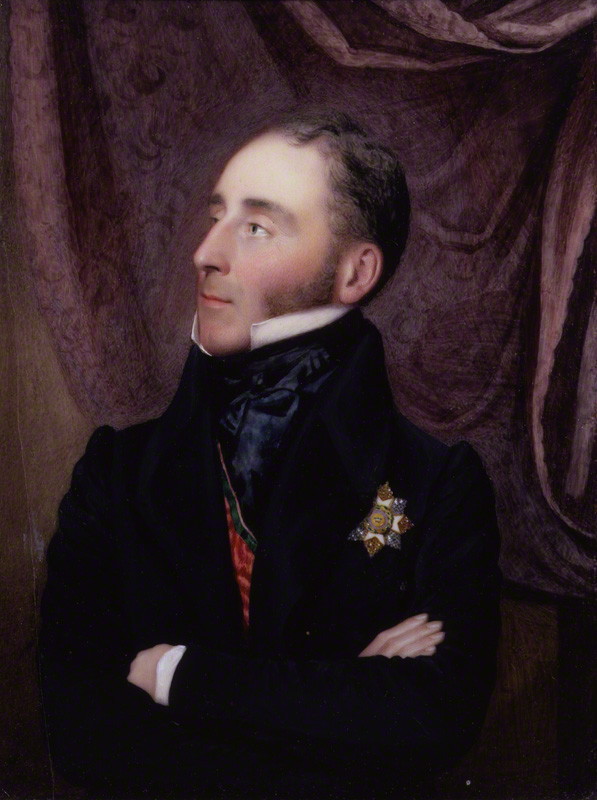
John Conroy, British Army Officer
and royal official by Alfred Tidey, 1836
Victoria considered Lehzen her only friend and intimate. Lehzen had unparalleled access and a definite influence over Victoria, that was maintained until Victoria’s marriage to Albert in 1840. Lehzen had envisioned Victoria ruling unmarried, as another Virgin Queen, and did not approve of her marriage. Lehzen did not think Albert was a good choice for Victoria’s consort. She particularly disapproved of Albert’s lack of position, money and influence; he gave nothing and received everything in her view. She was also jealous of Victoria’s love for Albert. Albert, in turn, disliked Lehzen and her continued influence over Victoria, considering her a servant who did not know her place and who was interfering in his marriage. Lehzen blocked various changes in the household that Albert wanted to make, and was not above going to the queen over his head. He in turn was jealous and resented Lehzen’s influence and Victoria’s reliance on her. (He wanted to be the head of his household, and had ambitions of his own, which required that he have Victoria’s full trust and dependence. Lehzen encouraged Victoria’s independence as queen.)

Albert got along with the Duchess of Kent, and supported a rapprochement between her and her daughter; he did not approve of Victoria’s intimacy with a servant and encouraged her to improve her relationship with her mother. He particularly resented Lehzen’s control spreading into various areas of the household over the heads of those appointed, especially the nursery. He had definite ideas of how he wanted his children raised, and they did not include Lehzen. A power struggle ensued between Albert and Lehzen, which was only resolved when Victoria’s and Albert’s first child became ill and almost died in the care of Dr. John Clark (court physician and part of the Flora Hastings case) who was summoned by Lehzen. Torn between Albert and Lehzen, Victoria finally conceded to Albert and Lehzen was let go as a result of this situation.
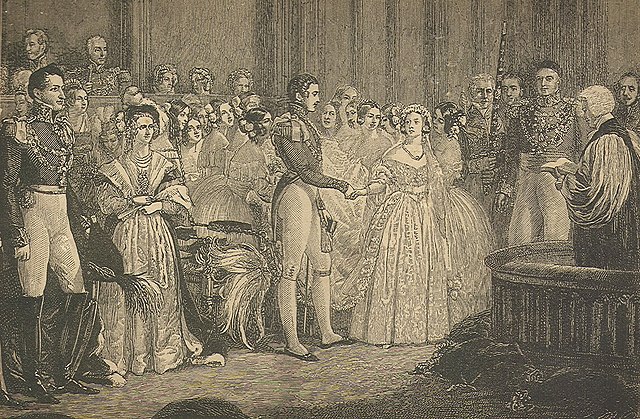
Marriage of Queen Victoria and Prince Albert.
Engraving from the book "True Stories of the Reign of Queen Victoria"
by Cornelius Brown, 1886

Lehzen left court in September 1842, ostensibly for her health, and returned to Germany with a generous pension. She lived with her sister, until her sister’s death, after which she continued to support her sister’s children. In 1858, Victoria was in Hanover and Lehzen was on the train platform, waving as Queen Victoria’s train passed, which the queen acknowledged. Much has been made of her estrangement from Queen Victoria but, in fact, she remained in regular correspondence with the Queen, and was visited by the Queen on a couple of occasions.

Louise Lehzen died September 9, 1870 in Buckeburg, Schaumberger Landkreis, Lower Saxony and was buried in the Jetenberger Cemetery. On her monument (raised by Queen Victoria), her name was shown as “Louise Clara Johanna von Lehzen.” Victoria did not significantly repair her relationship with her mother until after the death of Sir John Conroy March 2 1854, long after Louise Lehzen had left court.  It is worthy of note that, after the death of her mother, Victoria did not seem to have another intimate nurturing female relationship (other than with her daughters, which is different-she was queen and  mother in those relationships).  She relied on Albert for support and security, then John Brown, and then Abdul Karim (her Indian servant known as the Munshi).  After all is said and done, Lehzen was her safest and most trusted female friend and mentor.
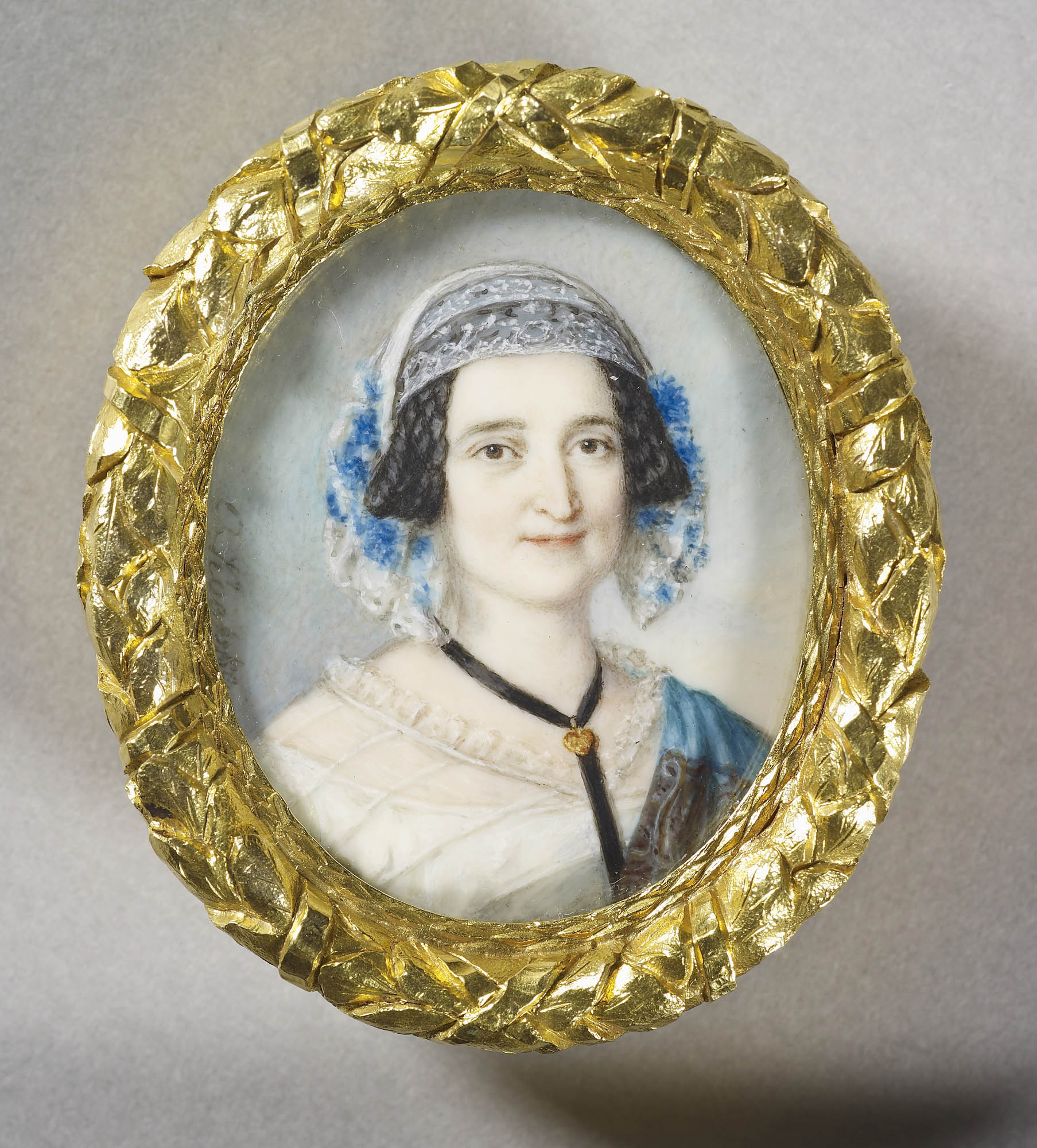
Baroness Louise Lehzen, 
Governess and Companion to Queen Victoria, 
by Koepke, 1842


Sources include:

Erickson, Carolly. HER LITTLE MAJESTY The Life of Queen Victoria. New York: Simon & Schuster, 1997.

Gill, Gillian. WE TWO: Victoria and Albert: Rulers, Partners, Rivals. (Kindle edition.) New York: Ballantine Books, an imprint of the Random House Publishing Group, 2009.

Images are all in the public domain, found in Wikimedia Commons.

Express.co.uk. “The Women Who Really Raised The Royals” by David Cohen. November 16, 2012. Here.

FamPeople.com. “Louise Lehzen, biography.” Here.

FindAGrave.com. “Louise Von Lehzen.” Posted by Dieter Bierkenmaier, April 27, 2013. Here.

Google Books. Lee, Sidney, Ed. DICTIONARY OF NATIONAL BIOGRAPHY. Supplement Vol. 3. “Victoria,” Pp. 389-500. New York: Macmillan Co. 1901. Here.

Google Books. ENCYCLOPAEDIA BRITANNICA A Dictionary of Arts, Sciences, Literature and General Information, 11th Edition, Vol. 28. “Victoria, Queen” by H. CH. (Hugh Chisholm). Pp. 28-37. New York: Encyclopaedia Britannica Company, 1911. Here.

The Esoteric Curiosa. Raising A Queen; An 1840's Thumbnail Of The Initial Lady Behind The Throne Of One Of Histories Greatest Monarchs; Johanna Clara Louise Lehzen, Better Known As Baroness Lehzen, Governess, Adviser & Companion To Her Imperial Majesty The Queen Empress, Victoria! November 12, 2013. Here.

Queen Victoria’s Scrapbook. A Letter to Queen Victoria from Baroness Lehzen from 1867. Here.

Victorian Gothic. “Louise Lehzen, Governess to Princess Victoria” April 9, 2011. Here.

Victoriana Magazine on-line. “Queen Victoria-A Very Naughty Princess.” July 13, 2014. Here.

Web of English History. “Louise Lehzen (c1784-1870)” by H. G. Pitt, 1993. Here.

Web of English History. “Sir John Ponsonby Conroy, first baronet (1786-1854)” by Elizabeth Longford, 1993. Here.

Wikiwand. “Louise Lehzen.” Here.

~~~~~~~~~~

Lauren Gilbert has a bachelor's degree in English, and a life-long love of reading. Her first published book, HEYERWOOD: A Novel, was released in 2011. Her second, A RATIONAL ATTACHMENT, is due out soon. She lives in Florida with her husband Ed. Visit her website here for more information!