Sunday, February 27, 2022

Lady Mary Wroth, Author and Courtier

 By Lauren Gilbert

Lady Mary Wroth c 1620


Born Mary Sidney, she was the daughter of Robert Sidney, Earl of Leicester & Viscount de L’Isle and his wife Barbara Gamage, a Welsh heiress. She was born about 1587 (possibly October 18) possibly in Penshurst Place in Kent or in Baynard’s Castle, London (the Sidney family’s London headquarters). Robert Sidney was the younger brother of Sir Philip Sidney and Lady Mary Herbert, Countess of Pembroke. Robert Sidney was also a poet. He was appointed Governor of Flushing, the Netherlands, in 1588, where his wife and daughter Mary accompanied him. A brother, William, was born there. When she couldn’t accompany her parents, Mary was in the household of the Countess of Pembroke for much of her childhood.

Out of eleven pregnancies, Lord and Lady Leicester had six surviving children including Mary, and seemed to have an affectionate family unit. When at home together, the children had a tutor, who apparently gave the children a good education. When staying in the household of her aunt, the Countess of Pembroke, Mary shared her cousins’ tutor. She was known to have talent for writing, playing the virginals and dancing. In 1602, Mary danced at court, before Queen Elizabeth, whose reign would end at her death the next year.

When James I succeeded in 1603, he appointed Lord Leicester as Lord Chamberlain of Queen Anne’s household. His increased status put Mary, now about fifteen or sixteen years old, in a position to attend court as one of Queen Anne’s attendants. Mary was married in 1604, at about age seventeen to Sir Robert Wroth, who at about age twenty-seven, was about ten years older. He was a wealthy landowner and one of the king’s many hunting companions. He had been knighted in 1603. In 1613, he was chosen to be sheriff of Essex.

There are suggestions that the couple was unhappy, possibly an arranged or forced marriage. There were rumours of incompatibility early on. There are also suggestions that he was a profligate spender and womaniser. Lord Wroth inherited Loughton House and Durrants in Essex from his father c. 1605-1606. (Loughton House was a family home, and Durrants a hunting lodge.) Lady Wroth continued to attend court after her marriage, although she was not a member of the Queen’s household, and acted at Whitehall in one of Ben Jonson’s masques, The Masque of Blackness” on Twelfth Night 1605. This introduced her into literary society.

Lord and Lady Wroth had one child, a son named James, born in February 1613 or 1614, after about ten years of marriage, suggesting a possible rapprochement. Lord Wroth died March 14, 1614. She was left a widow with a very young child, a jointure of 1200 pounds per year (about $320,220.00 USD today), and debts totaling 23,000 pounds (approximately $6,138,000.00 USD today). Although there were three trustees involved, it appears she managed her estates herself, and wasn’t very good at it. She lived primarily at Loughton House, a widow the last forty years of her life. Sadly, little James died in July 1616, which resulted in Lady Wroth’s losing many of her rights as widow regarding her late husband’s estates.

As with many court ladies, there were rumours about Lady Wroth. One was a rumoured affair with Ben Jonson, for which there seems to be no evidence, so that is likely untrue. (He dedicated his play The Alchemist to her in 1612. He also wrote a sonnet, “A Sonnet to the Noble Lady, The Lady Mary Wroth,” which was not published until after his death, and was known to seek and receive patronage from Lady Wroth’s mother as well as Lady Wroth.) It is worth noting that Jonson was not the only poet to write poetry to her.

Lady Wroth did have an affair with her cousin, William Herbert, 3rd Earl of Pembroke (1580-1630). He was her first cousin (son of Mary Herbert, Countess of Pembroke). When children, Lady Wroth and her cousin were close, and there is an indication that they may have been more than friends. Lord Pembroke was a wealthy and powerful courtier (even though he was not a favourite of King James). He was also a poet in his own right-his poems were collected and published by John Donne.

It is not known when Mary and William became lovers (there is an implication that the affair began while her husband was still living). Whenever it started, their affair lasted until the mid-1620’s. Lady Wroth had two children by William: a son William who died in the 1640s fighting as a Royalist in the English civil war, and a daughter Katherine who survived her mother. Lord Herbert never acknowledged these children as his, and there are no records of these children in the Wroth family records.

Lady Wroth was an accomplished writer-her poetry was noticed as early as 1613. She predated Aphra Behn (c. 1640-c. 1689), who wrote plays, poetry, and other works during the Restoration. (It has been suggested that Lady Wroth may have been Behn’s grandmother through her daughter Katherine, who married twice. I am unable to address this as so little is known of Aphra Behn’s personal history and much is contradictory.) Lady Wroth’s writings addressed themes of love, faithfulness, loyalty, and questions of power and gender.

Around 1617-1619, Lady Wroth wrote a play, a romance titled “Love’s Victory” and gave a bound, hand-written copy to Lord Pembroke before their affair ended.* The play was not published. It was, however, performed at Penshurst in 2008, the first professional performance.

Her most famous work is “The Countess of Montgomerie’s Urania” for which she was issued a licence to publish July 13, 1621. A lengthy novels, this was her first and only published work and was based extensively on the lives of her family and fellow courtiers, including her affair with the Earl of Pembroke. Considered a forerunner of the modern novel, it also created a huge scandal.*  “Mad Madge”, Margaret Cavendish, Duchess of Newcastle (an author herself) made fun of it. Edward Denny, the Baron of Witham accused Lady Wroth of slander-he was so angry about it, he wrote scurrilous verses about her in 1623. She ended up withdrawing it from sale by December of 1621. Because of this work, Lady Wroth is considered the first English woman novelist.

The title page of Lady Mary Wroth's The Countesse of Mountgomeries Urania 1621


Lady Wroth wrote a sequel to Urania, which hinted at her affair with the Earl of Pembroke and the fact that he fathered her children, but did not publish it. (It was published in 1999, and the manuscript is held at the Newberry Library in Chicago.) 

Lady Wroth owned a translation of Xenon’s CYROPAEDIA (biography of the Persian Emperor Cyrus the Great) which was published in 1632. She also wrote poetry. In “The Countess of Montgomerie’s Urania”, the heroine of her novel wrote sonnets to the hero. Lady Wroth also wrote other poetry. Considered to be one of the first women to write a sonnet sequence, over 200 of her poems are known, and there may be others not yet discovered.

After her affair with the Earl of Pembroke ended, Lady Wroth no longer attended court, apparently going into seclusion. She was heavily in debt, and received help more than once from the king to stave off creditors. Another blow came when William Herbert, Earl of Pembroke died in 1630. She died in March of 1651 (or 1653), at age 53. After her death, some of her possessions, including some writings came into her daughter's hands and were preserved.*. Her primary home, Loughton House, which included her library, burned down in the 1800s.

*See "The Secret Codes of Lady Wroth, The First Female Novelist" by V.M. Braganza.  

Sources for Lady Mary Wroth, Author include:


Waller, Gary. THE SIDNEY FAMILY ROMANCE Mary Wroth, William Herbert, and the Early Modern Construction of Gender. 1993: Wayne State University Press, Detroit.

Early Modern Women Research Network. “Mary Wroth, Biography.” here

Goucher College online. “Lady Mary Wroth, The Countess of Montgomerie’s Urania (including “Pamphilia to Amphialanthus”) (1621).” (No author or post date.) here

Luminarium.org “Lady Mary Wroth (1587? -1651?)” by John Butler and Anniina Jokinen. (No post date.) here

Orlando Project, Cambridge University. “Lady Mary Wroth Entry.” Overview. here

Smithsonian Magazine. “The Secret Codes of Lady Wroth, the First Female English Novelist,” by V. M. Braganza, September 2021. [Print version title: “Decoding Lady Wroth”], here

The Monstrous Regiment of Women blog. “Mary Sidney Wroth, Pamphielia, Poetry, and Prose,” posted on October 18, 2015 by Sharon L. Jansen. here

The Sidney Homepage online. Biography. “Lady Mary Wroth,” by Nandini Das. (No post date.) here

University of Saskatchewan, Digital Research Center. “Lady Mary Wroth, Biographical Introduction.” (No author shown.) Revised June 8, 1998, contact person Ron Cooley, Dept. of English. here

Wikisource.org DICTIONARY OF NATIONAL BIOGRAPHY, 1885-1900. “Wroth, Mary” by Sidney Lee. here

Images
Lady Mary Wroth (Public domain) here
The Countess of Montgomerie's Urania Title Page (1621) (Creative Commons) here

An avid reader, Lauren Gilbert was introduced to English authors early in life. Lauren has a Bachelor of Arts degree in liberal arts English with a minor in Art History. She has presented several programs for the Palm Beaches Region of the Jane Austen Society of North America, and recently for the Jane Austen Fest in Mt. Dora, FL. She lives in Florida with her husband. Her most recent novel, A RATIONAL ATTACHMENT, is available at Amazon, Barnes and Noble and more. She is currently working on a non-fiction book. For more information, visit her website at here , her Facebook page here and her Amazon page at here.

Sunday, January 9, 2022

Unwanted Pregnancies in the Middle Ages

by Jeri Westerson

We’ve read about some pretty bold women in the Middle Ages; Eleanor of Aquitaine, Queen Elizabeth, Kathrine Swynford. They made their destinies, though they might have had trouble achieving it in early life…or as in the case of Eleanor was consigned to what amounted to house arrest in the latter part of her life.

But for the average medieval woman, when one could be married off to secure alliances, gain property for the family, or to be sent to nunneries—there was surprisingly little impediment when it came to some control of their lives. For them, it was whether to remain pregnant or not. Granted, for some women, giving birth to an important man’s child meant a place at court or court adjacent at the very least, as well as funds to raise that bastard child, but other women who got into a family way through country matters needed a way out.

It’s a modern idea to consider an embryo a person, something that didn’t worry the medieval mind in so far as the Church was concerned. Much of the physician’s art in the Middle Ages favored Greek philosophers and ancient physicians, who had nothing to go on but their own feelings on the matter, and a certain tradition among them. Certainly nothing scientific.
Many of these men—and they were most often men—were of the opinion that an embryo was plantlike until birthed and took its first breath. Indeed, this was the medieval Hebrew philosophy as well, citing Adam: mere clay until God breathed life into him to become a human being.

Hippocrates, on the other hand, forbade ending pregnancies. In his oath he mentions, “I will not give to a woman an abortive remedy”, but then again, he also stated that the fetus was only viable from the moment its various organs – their structures – were already formed, which puts the kibosh on only later abortions, just not earlier ones. This was also what the famous ancient physician, surgeon, and philosopher Galen (c. 129 CE) expressed.

Aristotle viewed abortion as population control for a well-ordered society, but only before the embryo achieved animal life, or was recognizably human. “The line between lawful and unlawful abortion will be marked by the fact of having sensation and being alive,” he stated. Before that, Aristotle did not regard abortion as the killing of something human. (It should be understood that the “unlawful” aspect leaned heavily as to whether the husbands wanted to end this pregnancy). Unmarried women would find less opposition. Including (or perhaps even especially) prostitutes.

In Greece and ancient Rome, various instruments—curettes, hooks, other scraping tools—might be used to extract a fetus, but early physicians were worried that these instruments—and rightly so—could perforate the organ. A woman’s life over the unborn was
always utmost in cases of these operations.

By the time we reached the Middle Ages, such procedures, though still practiced, were not preferred. Herbalists/apothecaries were easier and no doubt more inexpensive to consult. Female apothecaries were often nuns in monasteries with access to the herbs grown on convent grounds. Midwives, too, were experts on such herbs for contraceptives and all stages of pregnancies, both wanted and unwanted.

An amazing array of proscribed methods such as bloodletting, fasting, diuretics, emmenagogues (herbs that stimulate menstruation), and enemas, were used. Jumping up and down. Carrying heavy objects. Heavy horseback riding. A painful massaging of the abdomen, and similarly binding the abdomen tightly.

Did any of these approaches work? Was there a scientific method involved? Not so much. These were from those same unscientific ancient physicians, folk remedies, “old wives’ tales”, and any number of shamanistic methods that came down to medieval woman from very old sources indeed (the first recorded evidence of induced abortion is from an Egyptian papyrus recorded in 1550 BCE.)

Perhaps these methods worked coincidentally. Or the embryo wasn’t viable to begin with. Or poor nutrition contributed to a spontaneous abortion. Or the woman wasn’t pregnant in the first place. Whatever the situation, women, herbalists, apothecaries, and physicians of the day believed in it, and proscribed them again and again.

An apothecary administering 
pennyroyal to a patient. 
Public domain

The variety of concoctions of herbs used was breathtaking; pepper, myrrh, thyme, rue, catnip, dittany, savory, sage, watercress seed, parsley, soapwort, hyssop, marjoram, tansy, juniper, hellebore, and pennyroyal (the last two of which contain some properties that actually can be used as an abortifacient. But beware. Too much pennyroyal or hellebore can cause death. Consult your apothecary).

These herbs and essential oils used in conjunction with one another could be drunk with hot water in a kind of tea with honey. Mostly, they were to induce menstruation to begin again, which would expel the embryo.

Hildegard von Bingen
Public domain

Even Hildegard von Bingen, the saint and mother superior of her convent in the twelfth century who wrote sacred music, works of theological philosophy, and scientific works on botanicals and their medicinal properties, got into the act and described a particular treatment (tansy) to restore menstruation in her treatise De Simplicis Medicinae. 

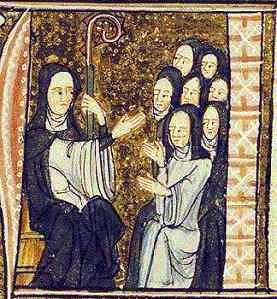
Were there medieval laws against a woman obtaining an abortion? In a word, no. The Church seemed to prefer not to meddle into what amounted to “women’s complaints”. So women consulted other women to help them with these life-changing difficulties. It was a natural for nuns to work as apothecaries to help in the physicians’ art and to administer to other women, including their own nuns in the convent who might also get into a family way. After all, it wasn’t all prayer and meditation. Not everyone could be a St. Hildegarde.

~~~~~

Jeri Westerson


  • Jeri Westerson is the author of fifteen novels in the Crispin Guest Medieval Noir mysteries that just concluded the series with The Deadliest Sin that deals with nuns administering abortifacients; the Enchanter Chronicles, a gaslamp fantasy-steampunk trilogy; Booke of the Hidden, an urban fantasy series, and several standalone historical novels. Be looking for her newest mystery Courting Dragons, the first in her King's Fool Mysteries with Henry VIII's real court jester Will Somers as the amateur sleuth. See all her books at jeriwesterson.com.


Tuesday, January 4, 2022

Tuesday, December 29, 2020

An Amiable Wife

 By Lauren Gilbert

Portrait of Anne Law, nee' Towry, 1st Lady Ellenborough by John Linnell


As a female, I cannot help being interested in the lives of women of earlier times. Finding information about some is easy, thanks to published letters and memoirs, newspaper archives, and (because of their own personal status or accomplishments or notoriety) even biographies. With others, it is a challenge, and we may find ourselves finding that little data is available, and that as side details provided in the information related to a father, husband or other male relative. One such lady is Anne Law, Lady Ellenborough. The November/December issue of JANE AUSTEN’S WORLD magazine included a reference to her in “What Made The News in November & December 1812” that caught my attention.

Anne was born about 1769, and possibly christened in St. Pancras Church in London. Her father was George Phillips Towry and his wife Elizabeth More. Mr. Towry served in the Royal Navy, commissioned a lieutenant in 1757. He inherited an estate from his uncle in 1762, and subsequently married the well-to-d0 and well-connected Miss More (possibly descended from Sir Thomas More) in June 1766 at St. Martin’s in the Fields. She had two brothers George Henry and Charles George. Elizabeth died, and her father remarried on April 3, 1770 to Susannah Haywood. In November of 1770, Mr. Towry won 20,000 pounds in a lottery. He became a Commissioner of the Naval Victualling in 1784, rising to Deputy Chairman of the Victualling Board November 4, 1803. He was considered an able administrator.

I found no information about Anne’s youth or education or her introduction to society. She was considered a great beauty, with regular features, rosy complexion, and a good figure. She was painted by Sir Joshua Reynolds in March of 1789, but that portrait was lost at sea. She had numerous admirers, among them a successful lawyer named Edward Law.


Mr. Law was the son of the Bishop of Carlisle, had attended school at the Charterhouse, and went on to Cambridge, obtaining a B.A. and an M.A. He decided to pursue law and was admitted to Lincoln’s Inn as a student in 1769. In 1771, he studied in London with George Wood (a special pleader (a lawyer who specialised in drafting statements of cases, give opinions, and prepare papers for various court proceedings) who was knighted, taught many students, and became famous). In 1775, Mr. Law became a special pleader himself, and was called to the bar in 1780. He built a successful practice and was elected to the Inner Temple in 1782. He gained a level of fame as leading counsel for Warren Hastings, a long-drawn-out trial that began in February of 1788. Although he was not handsome and was apparently socially awkward, he had acquired the reputation as something of a rake (and kept a mistress), prior to meeting Anne Towry. He pursued her fixedly, and asked her father for her hand. Being of good family and successful in his work, her father gave his consent to Mr. Law’s courtship.

Regardless of her father’s approval, Anne Towry refused his hand as she had already refused other suitors. In fact, she refused him three times. Each time, Mr. Law continued to court her despite her determined refusal. Finally, Anne consented to marry him the fourth time of asking. There is a suggestion that, at this point, members of her family pressured her to reconsider because he was such a promising suitor. According to THE LIVES OF THE CHIEF JUSTICES OF ENGLAND From the Norman Conquest Till the Death of Lord Tenterden, “…her aversion was softened, and she became tenderly attached to him.” (1) They were married by special license at her father’s home in Great Ormand Street on October 17, 1789.

On all counts, the marriage was successful. The couple had their first child, a son named Edward, about September of 1790. He was the first of thirteen children. Mr. Law’s career continued successfully-he became quite wealthy, he was involved with numerous high-profile cases and was instrumental in the ultimate acquittal of Mr. Hastings in 1795. He became Attorney General February 1801, and was knighted February 20, 1801 by George III. Shortly after being knighted, Mr. Law was returned as member for the borough of Newtown, Isle of Wight, to the House of Commons. His career in the House was short-lived, as he was appointed Lord Chief Justice April 11, 1802. On April 19, 1802, Mr. Law was created Baron Ellenborough in the county of Ellenborough, sworn a member of the privy council on April 21, and took his seat in the House of Lords on April 26th.

What little data is available indicates that Anne was busy with home and children, acting as her husband’s hostess. After their marriage, she was known to have retained her beauty, causing her to be pursued by followers at social events, and strangers gathering to watch her tend her flowers at their home. Their marriage was considered an affectionate and harmonious one. (2) She was painted by Sir Thomas Lawrence in 1811 and again in 1813, and by other artists. In addition to residence in London, the couple also had for some years a principal residence at Waldershare in Kent near Dover. This property was owned by the Earl of Guildford, and apparently leased by Lord Ellenborough.

The reference to Anne as Lady Ellenborough in JANE AUSTEN’S WORLD occurred in December of 1812: because of her generosity, one hundred poor women and girls were completely clothed, taken to church and then back to the mansion where they were provided with soup to take home and a shilling each. (There were 12 pennies in a shilling; in 1812, a pound of cheese cost about 9 pence.) This action was mentioned in the SUN (London) of Wednesday, September 16, 1812, in which Lady Ellenborough was described as “the amiable hostess of Waldershare-house”. While similar acts of charity were not uncommon, one of the things that struck me about this was the specific focus being on women and girls.

In early 1816, Lord Ellenborough began experiencing health problems but continued working. Anne’s father died March 12, 1817. His obituary describes him as “Commissioner of the Victualling-office, father of Lady Ellenborough.” Lord Ellenborough went abroad in the fall of 1817 in an attempt to improve his health, and returned to the bench on his return. He was very upset about the acquittals resulting in the winter of 1817, and his health deteriorated to the point that he was periodically absent from court. In September of l1818, he gave notice of his intent to resign, and executed his deed of resignation on November 6, 1818. He died December 13, 1818 at home in St. James’s Square. He was buried in the chapel of the Charterhouse, and a monument was raised there in his honour. At the time of his passing, he was survived by nine of his children with Anne, including their son Edward (now married) ranging to their youngest a daughter named Frances Henrietta born in 1812. (It appears he was also survived by some children born out of wedlock.) Anne was left a very wealthy widow.

The house at Waldershare was no longer in their possession, as it appears to have been occupied by the Earl of Guildford at the time of Lord Ellenborough’s death. Anne was seldom mentioned in print, other than at attendance at weddings. She outlived her husband by almost 25 years and never remarried. She apparently suffered ill health before her death at her home in Stratford-place in London. She died August 16, 1843. She left a rather detailed will, in which she left specific requests of jewelry to her daughters with other provisions, which was proved September 13, 1843. 


FOOTNOTES:

1. Campbell, John Lord, LLD, FRSE, THE LIVES OF THE CHIEF JUSTICES OF ENGLAND FROM THE NORMAN CONQUEST TILL THE DEATH OF LORD TENTERDEN. P. 164

2. Ibid.


Sources include:

JANE AUSTEN’S REGENCY WORLD. November/December 2020, Issue 108. “WHAT MADE THE NEWS IN NOVEMBR & DECEMBER 1812”, compiled by Judy Boyd from the British Newspaper Archives.

Britishnewspaperarchive.com.uk  Numerous articles including the Hereford Journal for Wednesday, October 28, 1789; the Derby Mercury for Friday, December 7, 1770; the Leeds Mercury for Saturday, December 19, 1818; the Kerry Evening Post for Saturday, October 23, 1841; the Lincolnshire Chronicle for Friday, August 25, 1843; the home page is HERE

Thegazette.co.uk  THE LONDON GAZETTE for Tuesday February 17 to Saturday February 21, 1801. P. 202. https://www.thegazette.co.uk/London/issue/15338/page/202 ; THE LONDON GAZETTE FOR TUESDAY APRIL 13 to SATURDAY April 17, 1802. P. 386. HERE

Books.google.com FRAGMENTIA GENEALOGICA, Volume 10. Great Britain: Private Press of Frederick Arthur Crisp, 1904. P. 43 HERE ;  The Annual Register or A View of the History and Politics of the Year 1843. London: F. & J. Rivington, 1844. P. 286.HERE ; THE UNIVERSAL MAGAZINE, NEW SERIES. VOL. XVIII. July to December, Inclusive. 1812. London: Sherwood, Neely, and Jones. P. 521 HERE; THE ROYAL KALENDAR AND COURT AND CITY REGISTER FOR ENGLAND, SCOTLAND, IRELAND, AND THE COLONIES FOR THE YEAR 1820. London: William Stockdale. P. 31. HERE

Minnesotalegalhistoryproject.org Campbell, John Lord, LL.D, FRSE. THE LIVES OF THE CHIEF JUSTICES OF ENGLAND FROM THE NORMAN CONQUEST TILL THE DEATH OF LORD TENDERDEN. Third Edition. In Four Volumes-Vol. IV. London: John Murray, 1874. Pp. 163-164. (PDF) HERE

Wikisource.org THE DICTIONARY OF NATIONAL BIOGRAPHY 1885-1900, Vol.32. “Law, Edward (1750-1818)” by George Russell Barker. HERE

Images:

Anne Law, nee’ Towry, 1st Lady Ellenborough by John Linnell. Wikimedia Commons. Photo by Wmpearl, May 21, 2012. HERE
Edward Law, 1st Lord Ellenborough by Sir Thomas Lawrence. Wikimedia Commons. Photo by Donan.raven, November 20, 2012. HERE

~~~~~~~~~~

Lauren Gilbert lives in Florida with her husband. She earned a B.A. degree in liberal arts English, minoring in Art History. She has presented programs for the South Florida region of JASNA. Her first book, HEYERWOOD A Novel, is still in print, and her second novel,  A RATIONAL ATTACHMENT, is out now. She has articles in both volumes of CASTLES, CUSTOMS AND KINGS: True Tales by English Historical Fiction Authors. She is also working on a non-fiction book about seven powerful women.  Please visit her website for more information. 


Tuesday, December 22, 2020

Behind the Scenes of Charles Dickens' 'A Christmas Carol'

by Nancy Bilyeau

It may well be the most beloved Christmas story ever written. Charles Dickens' novella, originally titled Christmas Carol. In Prose. Being a Ghost Story of Christmas, was published on December 19, 1843, and sold 6,000 copies by Christmas Day. It has never gone out of print and is the basis for countless adaptations, giving way to debates over who is the best Ebeneezer Scrooge: Alastair Sim or Reginald Owen, George C. Scott or Patrick Stewart.

Autographed manuscript of the title page of 'A Christmas Carol,' signed by Dickens. Purchased byJohn Pierpont Morgan before 1900. Image courtesy of Morgan Library & Museum Media Department.
While the story itself is both touching and mythic, taking a closer look at Dickens' decision to write the book and the personal history that he poured into it is illuminating.

Dickens, to put it bluntly, wrote A Christmas Carol because he needed the money. He'd found literary fame due to the success of The Pickwick Papers and Oliver Twist, but his new book, Martin Chuzzlewit, was not as successful.

Dickens had a wife and four children to support; his wife, Catherine, was pregnant with their fifth. He came up with the idea to rent the family’s London home and live on the Continent for a year. A Christmas Carol was written to fund this move. A story of spirits who appear at Christmastime was not invented by Dickens. For centuries, during the longest and darkest nights of the year, it was thought that the barrier between this world and the afterlife was at its thinnest. This was the time for ghosts to show themselves to the living.

The original cover of A Christmas Carol. Dickens insisted that it be bound in crimson morocco, a  durable goatskin leather. The binding is elegantly decorated in gilt with the name "Thomas Mitton Esqre." Dickens presented the bound manuscript to Mitton, his close friend and creditor, possibly as a Christmas gift. From the J.P. Morgan collection, courtesy of the Morgan Media Department 

Dickens penned the book in six weeks. He wrote in a concentrated burst from 9 am to 2 pm every day. Writing would be followed by long brainstorming walks.

He scribbled many notes in the margins as he went, making swift corrections. According to curators of a Dickens exhibit at the Morgan Library & Museum, owner of the original manuscript, "Deleted text is struck out with a cursive and continuous looping movement of the pen and replaced with more active verbs—to achieve greater vividness or immediacy of effect—and fewer words for concision. This heavily revised sixty-six-page draft—the only manuscript of the story—was sent to the printer in order for the book to be published on 19 December, just in time for the Christmas market."

Page 2 of the original manuscript of A Christmas Carol,
showing Dickens' corrections.
From the collection of the Morgan Library & Museum,
image courtesy of the Media Department 

Literary historians believe that because he needed to write so fast, Dickens focused on a topic already close to his heart. He fueled the story with his own feelings about the terrible conditions for the poor in England. The 1834 New Poor Law went far toward criminalizing poverty. Dickens was furious about the grim fate of the working class, and he used this novella to write about it.

As for the book's characters, debates go on about which real-life "misers" Dickens based the elderly Ebeneezer Scrooge on or his partner Jacob Marley. When it comes to the younger Scrooge, though, Dickens' own youth can be seen in glimpses. His years of loneliness and resentment come through.

In the story, the boy Ebeneezer Scrooge has been sent away to a boarding school (one with dirty rooms and cracked windows) by a father who seems to want nothing to do with him.

 Dickens had a complicated relationship with his father, John Dickens. When he was 12, Charles Dickens was removed from school and forced to work at a blacking factory for 10 hours a day, six days a week. The reason: his father, John Dickens, had been sentenced to Marshalsea Prison because he was unable to pay a debt of 40 pounds; his wife and younger children joined him there, while Charles lived alone in lodgings. 

This means that when still a child, Charles Dickens was under intense pressure to make money and relieve this debt. It was the family's only way out of prison. These memories never left Dickens: “My whole nature was so penetrated with grief and humiliation,” he told a friend.

Charles Dickens,
photo courtesy of the Morgan Library & Museum, media department.
The character of Bob Cratchit, Scrooge's weak, hapless, but warm-hearted clerk, bears some resemblance to Dickens' father. This makes Scrooge's abuse of Cratchit in the first three-quarters of the story all the more interesting.

A crucial character in A Christmas Carol is Scrooge's older sister Fan, who is the only person to love him unconditionally but dies as a young woman after giving birth to her son, Fred.

"Always a delicate creature, whom a breath might have withered," said the Ghost. "But she had a large heart."
"So she had," cried Scrooge.
Fan, it seems clear, was based on Dickens' older sister Frances, known in the family as Fanny, who was close to her brother when they were children. 

She was "clever and accomplished," according to Dickens biographer Claire Tomalin. A talented musician,  in 1823 she became a student at the Royal Academy of Music in London.  She was expected to become the star of the family, not Charles. Biographers believe that he was often envious of Fanny.

According to the Charles Dickens Museum, "Fanny’s schooling was, however, often marred by her father’s inability to pay her fees. A letter survives from John Dickens, dated 25 May 1826, in which he suggests a payment plan, offering to pay '£10 quarterly from the 24th June next and the same to continue until the account is finally closed.' "

 Christmas Carol, London: Chapman & Hall, 1843
Illustration by John Leech depicting Marley's Ghost.
Photo courtesy of Morgan Library & Museum, media department
Fanny did have a career as a professional singer, with a "pure" singing style. In 1837, she married a fellow musician and they settled in Manchester. The couple had two sons. Harry was a bright child with some sort of physical handicap. "Once Fanny Dickens married and had children, her career declined," wrote Tomalin.

Fanny became ill with tuberculosis and went into a long decline. When Fanny died, Harry passed away shortly afterward at the age of 8. Some have speculated that the child was Dickens' inspiration for Tiny Tim.

Such family tragedies would seem to provide strong inspiration for Dickens in his character creations of Fan and Tiny Tim. What is chilling is that Fanny and Harry died years after Dickens wrote A Christmas Carol.  

By the time his sister fell ill, Dickens was in a much better financial position. He hired the best doctors for Fanny, but nothing could save her. She died at the age of 38 on September 2, 1848. Dickens arranged for her burial in Highgate Cemetery. Harry was buried there too, as were Charles Dickens' parents and other members of his family.

Charles Dickens, the great writer, did not join them. He is buried elsewhere.


Highgate cemetery, where many members of Dickens' family were
buried, including his sister Fanny and his nephew Harry

~~~~~~~~~~~~
Nancy Bilyeau is a novelist and magazine editor. She has published four historical novels. Nancy recently published a novella, The Ghost of Madison Avenue, set in 1912 New York City and telling a Christmas story. For more information, visit Nancy's website at http://www.nancybilyeau.com/.

Tuesday, December 15, 2020

“Good fences make good neighbours”: Enclosure in Georgian England

By Elizabeth Grant

A lawn sweeping down to a stream, expanses of undulating turf dotted with clumps of trees rising to a wooded skyline, a bridge giving focus to the scene – it is the quintessential English landscape. 

View from Chatsworth House, Derbyshire

In fact, it is a man-made park. The harmonious view reflects the ideas and style propagated by the dominant figure of eighteenth-century gardening history, Lancelot “Capability” Brown (1716–1783). It also reflects a social order dominated by landowners, because laying out the grounds in this style required exclusive ownership of vast tracts of land. And that meant enclosing.

Enclosing describes a process by which small or fragmented parcels of land are merged into homogeneous blocks, absorbing the common land that lies in-between. On the ground, that meant building fences. The common land previously accessible to all was now reserved for one deeded owner. At the political level, enclosing required an Act of Parliament. This was easy to obtain in a country where political power was tied to land ownership.

Enclosing meant building fences

Good fences make good neighbours: the Oxford Dictionary of Quotations traces the proverb cited in the heading back to the mid-seventeenth century. This was the time when enclosure, which had begun in the Tudor era, reached a significant scale. It intensified during the Georgian period, with around two thousand Enclosure Acts passed during the French revolutionary and Napoleonic wars. From 1760 to 1800, approximately 21 million acres of land were enclosed by statute. The process accelerated still further after 1800. (Charles Quest-Ritson, The English Garden: A Social History, London 2001, pp. 13, 137)

Was England a nation of wealthy aesthetes, then, desperate to improve their view? Garden historian Charles Quest-Ritson explains: “Landscaping the grounds of an estate was … closely linked to other forms of improvement – above all, better economic use of the land. It may seem at first that there is an obvious contradiction between improving the income of the estate and turning much of it into an extensive landscaped park. But, in fact, the opposite is true.” (Quest-Ritson, p. 137)

Compact land holdings were much easier to administer and improve. Enclosing made it possible to reorganize the farms on an estate and free up space around the landowner’s house for a landscaped park. Parks were ornamental and expensive to build, a perfect status symbol. But once a park had been created, it could be highly profitable. Not only was it low in maintenance – the mowing or grazing by deer, sheep or cattle which it required actually generated income. The rents from pasture exceeded rents from agriculture by up to 50 per cent. Stock-breeding became an elegant fashion, seen as a leisurely pursuit far removed from the more energetic arable farming. The handsome copses and clumps of wood dotting the pasture produced firewood, props, poles and hurdles. Their valuable hardwoods would swell the purse of the landowner’s descendants when cut and sold seventy or ninety years hence. (Quest-Ritson, pp. 140ff.)

Enclosing made huge pastures available for profitable
sheep farming

Agricultural improvement, in turn, was slow to gain ground. Most landowners concentrated their efforts on increasing their land holdings rather than increasing the yields of the land they already had – even though they were living in a time of profound demographic change, and knew it. Thomas Malthus had published his Essay on Population in 1798, and in 1817 Lord Liverpool wrote to Sidmouth: 
“If our Commercial Situation does not improve, Emigration, or Premature Deaths, are the only Remedies. Both must occur to a considerable Extent. It would be most inhuman in such Case, to encourage the latter, by prohibiting the former.” (John Plowright, Regency England: The Age of Lord Liverpool, London 1996, p. 8).

Historian Boyd Hilton asks the pertinent question, “How on earth did agricultural output manage to rise to meet the needs of townsfolk?” And explains, 

“This was a period of agricultural expansion rather than revolution. The number of acres increased from around 10 to 15 million between 1770 and 1850, while the area under wheat rose from about 2.8. million to 3.8 million … Most of the increase took place between 1790 and 1812, when scarcity prices due to population pressure and the difficulty of importing food in wartime led the margin of cultivation to be pushed up the hillsides.” (Boyd Hilton, A Mad, Bad & Dangerous People? England 1783–1846, Oxford 2006, p. 8)

You will object that there are no fences to be seen in the view from Chatsworth House, nor from scores of similarly grand or less grand houses in England. That’s because they’re hidden behind the trees. But they’re there all right. While historians continue to argue about the actual value and yields of the enclosed land, most of them agree that the social consequences were dire. Local labourers had customary shared-use rights to grazing, crops, brushwood, and fuel from the common land. You could graze a couple of goats on the commons, or a flock of geese. You could drive your pigs into the woods to fatten on acorns or beech mast. You could collect firewood or cut staves to repair your house or your fences. You might even fish or make hay (Wikipedia, s. v. common land). 

To claim compensation for lost use, however, you needed to be able to claim a legal right which few possessed. And even if they did, the compensation mostly came in the form of small allotments that could never yield the benefits a large tract of common land could. (Hilton, pp. 8f.). The Honourable John Byng, later the fifth Lord Torrington, wrote in 1781: “I hate enclosures, and as a citizen I look on them as the greedy tyrannies of the wealthy few to oppress the indigent many, and an iniquitous purchase of invaluable rights” (see Quest-Ritson, p. 138).

~~~~~~~~~~

Elizabeth (Elsie) Grant
writes romantic fiction set in the early nineteenth century. Her first novel, An Independent Heart, takes place in a country house surrounded by just the kind of park described here. It also involves an enclosure scheme, parliamentary ambitions, and the landed interest, but never fear – these only form a sketchy background against which the romance is painted in delicate hues.

Elsie grew up in Germany, Yugoslavia (as it was then), and the United States. After studying languages in Glasgow and Berlin, she went on to work as a translator and proofreader, specializing in medieval art and contemporary architecture. She is currently working on her second novel, which revolves around a bright young heiress and a one-armed sea captain and is partly set in Greece.

An Independent Heart is available at:

Bod Buchshop

Amazon UK

Amazon.com

Please visit Elsie at elsiegrant.blogspot.com

Or follow Elsie on Facebook


Sunday, December 13, 2020

Quaker Women in the Seventeenth Century

 By Maren Halvorsen

The image of the Quakeress, from the 18th century on, is the very picture of decorum: a woman dressed in gray, solemn, even dour, her head covered, her eyes lowered. Quakers in general were seen, and are understood even now to be, plain and quiet. Even the Quaker women of the 19th century, active in their opposition to slavery and advocates of their own liberation, displayed a public image of rectitude and sobriety. The modern weekly Meeting can often be a peaceful place of utter silence, as the participants, men and women, wait for God’s Light to speak through them.  


But when we take a close look at the first generation of Quakers, those who followed the Quaker leader George Fox (1624-1691) as the movement swept like fire through the North of England and beyond, we are confronted with a very different picture. At the heart of the theology of the Society of Friends was, and is, their belief in the spiritual equality of all, and this belief trumped everything else. They refused to use honorifics, refused to doff their hats to their “betters,” and insisted on the primacy of faith over the concerns of this world. They adhered so closely to a literal interpretation of Scripture that they refused to take oaths,and insisted that “the sprinkling” (baptism) did no good. Some early Quakers took to heart Fox’s exhortation to “run naked for a sign,” stripping off their clothes and running naked through towns as a way of protesting worldly wealth. Their refusal to take oaths, combined with their disregard for earthly governments, made them suspect to the authorities, and for most of the 17th century they were subject to arrest and imprisonment.  

Fox by Lely

A key aspect of the egalitarianism of the Society of Friends was the inclusion of women as central figures in the spread of the movement. The most famous of these early converts was Margaret Fell (1614-1702).  Married to a barrister, prominent and wealthy, Margaret Fell met Quaker founder George Fox in 1652 and became an early member of his movement. She was sufficiently active as a proselytizer to be arrested more than once, her imprisonment lasting years as she continued to write pamphlets and letters to encourage her fellow Friends and win over new believers. After the death of her husband Judge Fell, Margaret married George Fox in 1669. Her subsequent canonization as the “Mother” of the faith lends her a propriety and formality that is at odds with her vibrant, fiercely iconoclastic defense of the movement. In fact, even her marriage to Fox was unconventional; they spent most of their married life either in jail or separate, as Fox continued to preach all over the British Isles until his death in 1691. It is worth noting that Fell was very much opposed to the plain “uniform” that was beginning to be adopted by the Quakers and instead celebrated her own fashion sense at every opportunity.  


Margaret Fell

In 1666 Fell wrote an essay answering St Paul’s injunction against women speaking in church. Women's Speaking Justified cites the numerous examples of powerful women in the Bible, from Judith and Sarah of the Old Testament to Mary Magdalene’s discovery of the empty tomb in the New. A century ahead of such early feminists as Mary Wollstonecraft, Fell demanded that women’s voices not only be heard but that they be central to the Quaker movement. By highlighting the discovery of the empty Tomb, one of the most significant moments in the development of the Christian faith, along with Mary Magdalene’s role, Fell is insisting upon the value and power of women’s speech. Parsing the language of Scripture, she argued that while women should seek the advice of their husbands before speaking in church, they themselves were the final arbiters of their decision to speak. 

While Margaret Fell was perhaps the most prominent, there were several other first-generation Quaker women who were viewed as leaders during that time of persecution and prophecy, both in England and the Colonies, including Elizabeth Hooton (1600-1672), Mary Fisher (c. 1623-1698), and Mary Penington (1623-1682). It’s easy to imagine the exhilaration and sense of possibility that these early Quaker women felt, being part of a new movement that at its very core rejected many of the societal values they had been raised to accept.  The days of the week were renamed, and the religious holy days that marked even the Protestant calendar were gone. Mary Penington, in her brief memoir written for her children, talks of a youth and young adulthood of spiritual seeking, resisting the religion of her family, and eventually finding her way to the Friends after her second marriage. There is a powerful sense of agency in her narrative, refusing to attend the church of her guardians, composing her own prayers, and eventually, as a young widow, refusing to have her own daughter baptized. During her second marriage, to Isaac Penington the Younger (1616-1679), she devoted much of her time to the design and reconstruction of their home near Chalfont St. Peter while Isaac was continually hauled off to jail for his religious writings and for his refusal to show proper deference to a local nobleman. Her daughter by her first marriage later married William Penn.  

Margaret Fell and Mary Penington exemplify the radical nature of that first generation of Quakerism, as it spread throughout the British Isles in the 17th century. Its appeal, for many, lay in its rejection of the rigid hierarchy of power, both spiritual and material, which the Quakers saw as oppressive and false. Unlike Fell and Penington, most new converts to the Friends tended to be from the lower or middling classes. They found in its message a powerful critique of the established order. For women too, there was a clear hierarchy that many chafed against. The Society of Friends was the pathway to making their voices heard.  

To some extent this seizure of power was short-lived: the Women’s Meeting, originally a feature of Quakerism fought hard for by women such as Penington, and seen initially as a symbol of women’s power within the movement, quickly became more of a women’s auxiliary, focused mostly on “women’s issues” having to do with children, family, and service. Indeed, the writings of Mary Penington likely only survived because of the fame of her husband and her son-in-law (see Norman Penney’s introduction to her memoir in Experiences in the Life of Mary Penington, Friends Historical Society, 1992). On the other hand, the potential was there, and we see a “second wave” of Quaker feminist activism especially in the United States, mostly linked to the abolitionist movement of the 19th century. Lucretia Mott (1793-1880) and the Grimke sisters (Sarah, 1792-1873, and Angelina, 1805-1879) went well beyond finding their place within the faith to making real change in the world around them.

~~~~~~~~~~

Maren Halvorsen is a novelist whose most recent manuscript, The Bailiff’s Wife, was a Finalist in the category of historical fiction at the Pacific Northwest Writers Association annual literary competition.  Earning her Ph.D. in History at the University of Washington in 2002, she is a specialist in Medieval and Early Modern Europe.  She currently lives on the Olympic Peninsula in Washington State.