Showing posts with label edward vi. Show all posts

Friday, February 21, 2020

A Thought for Edward VI on a Difficult Day for Him

by Janet Wertman

Despite his enormous promise, Edward VI was a tragic figure, on so many levels.

The first level involves the wrongs his father did to get him. Henry VIII firmly believed he needed a male heir. When his first wife, Catherine of Aragon, proved unable to fulfill this obligation after twenty years of marriage, Henry abandoned her. That the Pope disagreed didn’t matter – Henry abandoned the Catholic Church as well, founding the Church of England to seal his right to remarry. Then when Henry’s second wife, Anne Boleyn, birthed only a daughter and experienced several miscarriages, Henry had her executed on trumped up charges to pave the way for the third wife who would finally give him the son he craved. Jane Seymour, Edward’s mother, is often said to have “walked through Anne’s blood” for her title. In Jane’s defense, we must remember that she paid for the privilege with her life.

The second level involves the circumstances of Edward’s youth. His mother died in childbirth, and his first two stepmothers were little involved in his life. Edward got lucky with his third stepmother, Katherine Parr, who finally gave the five-year old prince a real experience of family life. Life further opened up to him as other children were brought into his household to share his life and his education.

Barnaby Fitzpatrick, the son of an Irish peer, became his whipping boy (since Edward’s teachers could not in good conscience administer corrective beatings to “this whole realm’s most precious jewel”). Still, the fear that surrounded the young prince must have been oppressive: Henry was terrified that something would happen to his only son. Very few people were allowed to visit Edward’s household out of fear of the plague. All of his food was tasted. Every servant was schooled in the rigorous standards of security and cleanliness that Henry imposed. Such constant caution would inevitably be deeply internalized.

Even when Edward acceded to the throne, things did not improve by much. He was so young, only nine years old. This is wonderfully captured in many of the unintentionally poignant entries in his Chronicle (which was, in the words of Wilbur Kitchener Jordan, “in part private diary, in part an educational exercise, and in part considered notes on policy and administration”), like the one he wrote about his coronation, in which he proudly described how he had dined with his crown on his head. Yet the real power belonged to his uncle, Edward Seymour Duke of Somerset, who was named Lord Protector to rule while Edward was still a minor. Importantly, this went against Henry VIII’s wishes – Henry hadn’t wanted anyone to be in a position to divert power from his son: he had envisioned a “Regency Council” that would rule collectively. Nevertheless, Somerset was able to quickly seize control thanks in large part to a last-minute “unfulfilled gifts clause” added to Henry’s will under the dry seal that allowed the executors to distribute lavish gifts to their friends.

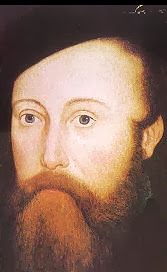
Unfortunately, Somerset was not as respectful of his young nephew as he should have been. Somerset was proud and self-interested and kept the young King dependent on him for as much as he could. This encouraged Somerset’s younger brother, Thomas Seymour, to hatch a scheme to replace Somerset as proxy ruler. In the middle of the night on December 16, 1549, Seymour tried to break into the sleeping King’s apartments at Hampton Court Palace. He made it into the privy garden (he had keys), but one of the King’s pet spaniels started barking. Seymour shot and killed it, which brought guards running. There was no defense for being outside the King’s bedroom in the middle of the night with keys and arms – and using them both. It was alleged that Seymour’s plan was to kidnap the King, perhaps force him to marry Lady Jane Grey (Seymour’s ward); this was treason enough. It was suspected that he might himself marry the King’s sister Elizabeth then kill the King and seize the throne. There could be no mercy. Thomas Seymour’s was the first death warrant that Edward VI had to sign, and today is the anniversary of Seymour’s execution (a topic I have covered in a companion post on my own blog, I hope you’ll visit!).

And as if sentencing one uncle to death wasn’t bad enough, less than two years later the not-even-fifteen-year-old King had to do it again. John Dudley, Earl of Warwick, engineered a coup d’etat against Somerset. The charges were less clear than the ones against Thomas Seymour, but no less deadly. Edward himself summarized them in his Chronicle as "ambition, vainglory, entering into rash wars in mine youth, negligent looking on Newhaven, enriching himself of my treasure, following his own opinion, and doing all by his own authority, etc." Although Somerset survived this plot, he tried to fight back against Warwick (who had by then become the Duke of Northumberland) – and lost. That was fatal. To use Edward VI’s own words again, on January 22, 1552 "the duke of Somerset had his head cut off upon Tower Hill between eight and nine o'clock in the morning".

The next year was a good one for Edward VI – Northumberland made every effort to incorporate him into the running of the government. But then the young King fell ill from what is now believed to have been tuberculosis. As death approached, the fervent Protestant grew terrified at the idea that his staunchly Catholic sister Mary would inherit his throne. He created his own Devise for the Succession which bypassed both his sisters, Mary and Elizabeth, and settled the crown on his cousin, Lady Jane Grey. It is not clear whose idea this was, but we do know that Northumberland stood to benefit greatly from this arrangement: Lady Jane Grey was married to his son. Regardless, the Devise failed when England rallied behind Mary as the next rightful heir (in case you were wondering, Northumberland was the first person executed during Mary’s reign).

Tragic all around.

***

SOURCES:


Wilbur Kitchener Jordan, England’s Boy King: The Diary of Edward VI (1966)

Wikipedia, Luminarium

This Editor's Choice was originally published on March 19, 2015.
~~~~~~~~

Janet Wertman is a freelance grant writer by day and a writer of historical fiction by night. Books 1 & 2 of the Seymour Saga will be joined in 2020 by The Boy King, which will cover the reign of Jane’s son, Edward VI.

Janet regularly blogs about the Tudors and what it’s like to write about them. Connect with Janet:  Website: https://www.janetwertman.com
Facebook: https://www.facebook.com/janetwertmanauthor/

Wednesday, March 9, 2016

Blank Tudor Faces

Judith Arnopp

 We have all become so familiar with royal Tudor images that we no longer really see them. One glance tells us who they are. We think we know them. They exude power, majesty and the iron fist of mastery.

Earlier portraits of the Plantagenet kings, and even the early portraits of Henry VII are very different to that of his son and grandchildren. But it was Henry VII, the first ‘Tudor’ king who began to develop the ‘Tudor’ brand.

The royal portraits of Henry VI, Edward IV, Richard III are all quite sombre, the artist doing his best to portray an ordinary man who was king. Even this portrait of Henry Tudor has nothing overtly regal about it; there is even a glimpse of personality, perhaps a measure of distrust, cynicism, impatience, or is it amusement? However you interpret his expression, it is a portrait of a human being, not a representation of royal supremacy.

 In the early days of Henry’s reign his position was unstable, he was an unknown quantity. There were no guarantees of peace and there were several Yorkist attempts to take his throne. The Tudors were the new kids on the block; nobody could foresee what sort of king Henry would make and his popularity depended very much on that of his wife, Elizabeth of York. Yorkist propaganda demeaned his claim to the throne, declaring that his mother’s line was illegitimate and that Lancaster had stolen the crown in 1399. They also sneered at his great grandfather who had been a lowly innkeeper.

Henry, realising he needed to reinforce his hold on the country, invented (or perhaps ‘embellished’ is a better word) his family history to create an impressive Tudor dynasty. He stressed the royal connection of his mother, Margaret Beaufort, and her descent from John of Gaunt and, to strengthen his claim further, he legally removed the stigma of bastardy from the family. He reiterated the royal descent of his grandmother, Katherine of Valois and, more surprisingly, claimed descent from the ancient Welsh King Cadwaladr, and King Arthur. To further cement his link to Arthur he named his first born son in his honour and embellished the round table at Winchester with the Tudor rose.

With the blood of both York and Lancaster flowing in the veins of his two sons and several daughters the Tudor line looked set to continue but Arthur’s sudden death in 1502 taught Henry that a king can never have too many sons. He lost no time in teaching his remaining son, later to become Henry VIII, the finer points of kingship. He stressed the importance of his role, the unreliability of the fickle populace, and the crucial need for strong male heirs to perpetuate the dynasty. The importance of heirs was a lesson young Henry never forgot, and one he fought tooth and nail for the rest of his life to achieve.

The blooming of the Renaissance and the introduction of men like Holbein to the royal court helped to reinforce this new Tudor image, and during Henry VIII’s reign new style of royal portraiture began.

I think of them as ‘power portraits’ that were loud declarations of Tudor permanence and dominance.
This one was painted by Holbein the younger after 1537, at a time when Henry was at the height of his power. He had freed himself from Anne Boleyn and the Pope, and Jane Seymour had finally provided the son and heir he’d been craving.

Today, we are used to seeing this image and others like it but imagine its impact in a world in which images were rare and people’s lives were not dominated by photographs or colour. Everything in this portrait is designed to impress; we cannot take our eyes from the breadth of shoulder; the sumptuous quality of his clothes; his immovable stance; the potent codpiece, and the unflinching expression in his eye. The portrait exudes wealth, power and uncompromising control. It is an unspoken declaration. ‘I am the king; it shall be as I say.’ There is not the slightest hint of insecurity, yet Henry was very insecure.

We all know about Henry; his failed marriages, his quest for an heir, his break with Rome, his megalomania, and ruthless rule but, what about the man behind the grandeur? Take a closer look at his face. What does it tell us about the inner man?

He looks bullish at first glance but on closer inspection you will see his eyes are blank, his expression closed. You might say he looks belligerent or mean but is that really what we are seeing, or is that a preconceived idea, because of what we already know? Personally, I think his inner feelings are obscured by my pre-knowledge but, if I try to wipe my mind and focus solely on his face, I see ennui, and sadness. As if he is hiding behind his own splendour.


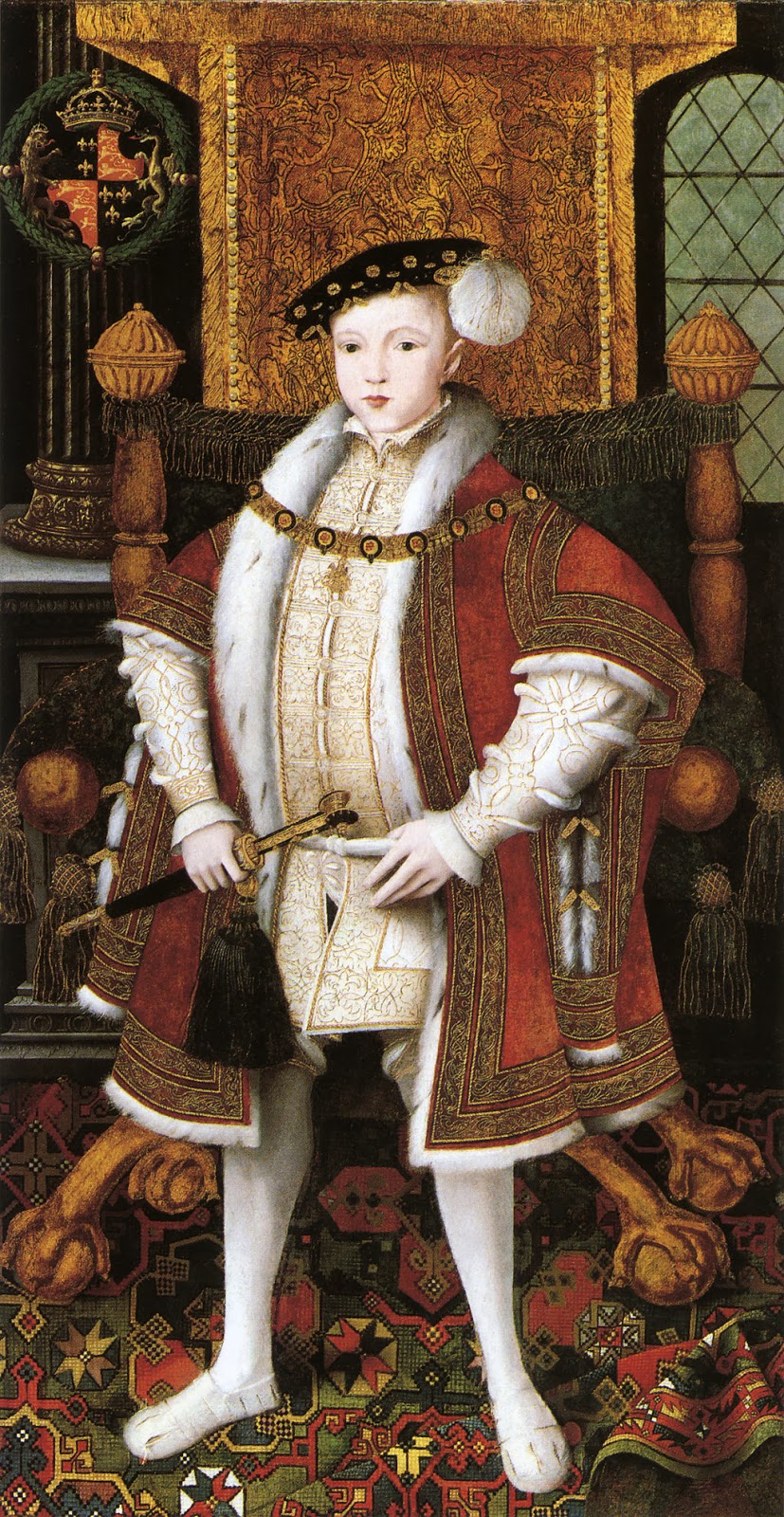
All the Tudor monarchs have this same expression. The portraits as a whole are only concerned with an outward show of majesty, a declaration of authority. Edward VI was ten years old when he became king, a young skinny boy with a burgeoning ego that would soon match his father’s. Here he is carefully painted in a similar stance to Henry. He is well-padded and embellished in satin and fur, and a much smaller cod-piece than his father’s promises future virility and heirs to carry on the Tudor name. But again, it is the image of a king with an empty face. ‘I may be young,’ he is saying, ‘but do not underestimate me; I am my father’s son.’

Edward’s short reign was one of religious persecution as the Protestant king tried to terrorise his subjects into following his will. His premature death was greeted with relief by many Catholics for now it was the turn of the Protestants to be subjected to the will of Mary Tudor.

Unlike her father and brother, Mary is seated, but her portrait is no less authoritative. Her erect posture and uncompromising stare are enough to turn living flesh into stone but there is little to be read there; we cannot see beyond her steely gaze to the woman within.

Her attempts to reinstate the Catholic religion and wipe out the much newer Protestant religion resulted in the burnings and torture that earned her the posthumous name ‘Bloody Mary.’ But viewed more objectively, her personal sorrows were immeasurable. Mary had lived a sorry life; rejected by her father, disinherited from the succession, stripped of her title ‘princess’, separated from her mother, Katherine of Aragon, Mary channelled all her frustration and anger into her religion. Her devotion to God and the Catholic Church was matched only by her passion for her husband, the reluctant Philip of Spain, and her wish for a son to follow after her.

Her health was never good; there is some evidence that her menstrual cycle was erratic and she suffered both physically and mentally from a young age. In later years her failure to conceive, her phantom pregnancies and failing marriage compounded her misery until she died a painful death in 1558 leaving no heir. Mary, who had gone to extreme lengths to rid England of the new religion, was now forced to leave the realm in the hands of a Protestant queen, her sister Elizabeth.


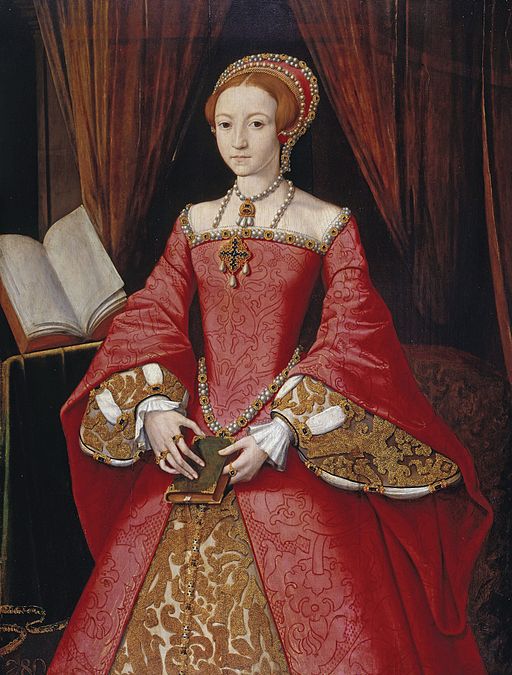
Elizabeth was the greatest Tudor of them all and the one who exploited royal portraiture to the full. The queen was very aware of the power of image and iconography. Encouraged by her adviser, John Dee, her portraits became more and more extreme. In every image she is majestic and fabulously dressed, her tiny frame all but obliterated by satin, velvet, lace and jewels. In looks Elizabeth resembled her great grandmother, Margaret Beaufort and her grandfather, Henry VII but by nature she was very much like her father.

If her grandfather and father had coveted England and parts of Europe, Elizabeth's ambitious eye went further - to the New World. In the Armada painting below, her hand rests on a globe and, just in case the viewer should forget who wears it, the crown of England is just above. If you look closely, her famously long, white fingers are covering the Americas and behind her are commemorative paintings of the Spanish fleet being driven onto a rocky shore by a storm that became known as the 'Protestant Wind,' suggesting God's approval of England's victory over Catholic Spain. Elizabeth is proclaiming herself the saviour of her people; the mother of her expanding empire: a victorious, virgin queen, blessed by God.


These are the things the Tudors wanted the world to see and believe. Their private 'selves', their inner thoughts and feelings were none of our concern and so they turned their faces into masks - a blank page devoid of personality yet replete with majesty.


Although the Tudors are well-documented and easily accessible through portraits and records, writing about them is not easy. We know what they did and when they did it; we know the relationships they had, the political scene, the style of their clothing, the shade of their hair and eye colour but there are only the tiniest glimpses of their inner selves. In order to populate my novels with believable characters I have to mentally prise off their masks, strip off their rich finery, and try to reach inside their minds. What is left are people as ordinary as you and I. In their natural state it is easier to consider these icons of monarchy as human beings, and imagine the emotions that triggered their most bizarre behaviour.  Each Tudor monarch had hopes and fears (mostly of failure) and insecurity, and they had dreams too, and a vast self-disappointment that ate away at them all.

For all their power, all their wealth and status, they could not have or hold the things they most desired: fidelity and adulation.

Photographs in the public domain from Wikimedia Commons


Judith Arnopp is the author of eight historical fiction novels including:

The Beaufort Bride: Book one of The Beaufort Chronicles - Available to pre-order NOW

A Song of Sixpence: the story of Elizabeth of York and Perkin Warbeck

Intractable Heart: the story of Katheryn Parr

The Kiss of the Concubine: a story of Anne Boleyn

The Winchester Goose: at the court of Henry VIII

The Song of Heledd

The Forest Dwellers

Peaceweaver


For more information please visit the webpage

Author page: click here

or look for her on Facebook.

Monday, April 7, 2014

The Admiral’s Tale: Thomas Seymour

by Judith Arnopp

Thomas Seymour; Baron Sudeley
A new narrator popped into my work in progress the other day; a voice that wants to be heard, and who am I to deny him?

Thomas Seymour is often portrayed in historical novels as a brash adventurer, a power hungry molester of young girls but, when writing history, it is important to stay true to the time in which the events take place.

Elizabeth Tudor was fourteen at the time Seymour married Katherine Parr and, although to us the alleged relationship between him and his step daughter is shocking due to her age, at the time, fourteen was regarded as ‘marriageable.’ There was no undue public outrage and he was not labelled as an abuser. What was shocking to the 16th century mind-set was Elizabeth’s status. Mistresses were perfectly acceptable, royal princesses were definitely not.

Even when added to his other alleged ‘crimes’ Seymour still doesn’t emerge as a ‘monster’. He was misguided perhaps, driven by his baser instincts, very human in fact.

Thomas and Katherine Parr were on the brink of marriage when she was spotted by the king as a potential wife but Thomas gallantly gave way to his monarch. But, after Henry VIII’s death Seymour lost no time in marrying his former sweetheart.

Seymour was the uncle of the young king Edward VI, but it was his elder brother, Somerset, who had control of the king's leading strings. Although Thomas was made Lord High Admiral and 1st Baron of Sudeley, it was his brother who became Lord High Protector and held all the power that Thomas craved.

Feelings between the siblings were not sweet. After the death of Henry VIII the Lord Protector seized the crown jewels from Katherine, including some personal pieces of her own, not belonging to the crown. This infuriated Thomas and he spent the rest of his wife’s life trying to regain her rightful possessions. This fury was ignited further by the continual snubbing of Katherine by Edward’s wife, Anne Stanhope.

Amid this family unrest Elizabeth Tudor, second in line to the throne, took up residence with her step-mother and her new husband, Seymour, at Katherine’s home in Chelsea, later moving to Seymour’s holding at Sudeley Castle. Katherine and Elizabeth were close, sharing a love of learning and religion but during this time rumours emerged involving Seymour and the fourteen year old Elizabeth.

Elizabeth Tudor
There were reports of him entering the girl’s bedchamber early in the morning to tickle and slap her. In some instances Katherine joined him, whether to protect her step daughter’s virtue or to aid and abet him is unclear. One has to look to the other aspects of Katherine’s character to judge her possible motive.

These unusual events have been variously depicted as innocent horseplay and sinister abuse. Whatever the truth of the matter is, there are no reports of undue outrage at the time. Ultimately, Elizabeth was sent away but her relationship with her step-mother remained strong and they corresponded regularly.  Katherine and Thomas remained at Sudeley, awaiting the birth of their first child. Katherine gave birth to a daughter, Mary, but died a short time later; sadly the records of her long-awaited daughter’s life fade out after just two years.

It is after the death of Katherine that Thomas seems to have become more ungovernable. He began an alleged campaign against his brother, trying to usurp the influence Somerset had over the boy king. He started to provide his nephew with pocket money, trying to win his favour by playing the popular fun loving uncle. At the same time he abused his position as Lord High Admiral by encouraging piracy, criticising his brother’s policies and, most outrageous of all, bribing the Vice treasurer of the Bristol Mint to finance an alleged coup against the Protectorship.

In 1548 he was called to appear before the Privy Council to explain his actions. To Thomas, it must have seemed that the world was against him. All he wanted was an audience with the king, to explain his behaviour and point out the error of Somerset’s ways. He wanted, once and for all, to put an end to his brother’s Protectorship. Thomas was convinced he would do a much better job. In the end he went so far as to hatch a desperate plot to gain access to Edward VI.

Edward VI
On the 16th January 1549 Seymour, by way of the privy garden, broke into the royal apartments at Hampton Court. The story goes that as he crept into Edward’s bedchamber his favourite spaniel woke up and began to bark. Seymour, without thinking, silenced the yapping, snarling dog by drawing his pistol and shooting it dead. It was against all royal etiquette to draw one’s pistol in the presence of a king and the act, together with the death of the royal pet, sealed Thomas’ fate.

Thomas Seymour was sent to the Tower, accused of attempting to kidnap the king, and plotting to marry the King’s half-sister, Elizabeth and put her on the throne in Edward’s place. In all, thirty three separate counts of treason were brought against him and, with the murder of his pet probably uppermost in his mind, Edward had no hesitation in signing his Uncle Thomas’ death warrant.

He was executed on 20th March 1549, dying bravely on the scaffold, leaving as his legacy a poem, which hint that his motives may have been more honourable than his actions.

“Forgetting God to love a king
Hath been my rod or else nothing:
In this frail life being a blast
of care and strife till in be past.
Yet God did call me in my pride
lest I should fall and from him slide
for whom loves he and not correct
that they may be of his elect.
The death haste thee thou shalt me gain
Immortally with him to reign
Who send the king like years as noye
In governing his realm in joy
And after this frail life such grace
As in his bliss he may have place.”

(Taken from Skidmore: Edward VI))

For all his faults and intemperate actions Seymour was popular with many of his contemporaries. There was unrest at his sentencing and Somerset was proclaimed ‘a bloodsucker and a ravening wolf.’ (Skidmore) Measures were taken to calm the situation, the most effective method proved to be the blackening of the Admiral’s character.

The council accused him as an atheist, a traitor, a lecher, and circulated rumours that he had encouraged rebellion, writing to Elizabeth and Mary urging them to rise up against the Protectorship. On the order of the council Hugh Latimer emphasised that Seymour was ‘a wicked man, and the realm is well rid of him.’

Katherine Parr
The ordinary people, however, seemed to hold a different view. Seymour was loved by many people, particularly the women. His love for Katherine Parr seems genuine; bowing out of the relationship to make way for King Henry and not hesitating to rekindle it once she was widowed. The stories about Elizabeth are the only stain against him, and then we are judging by 21st rather than 16th century standards. Better men than Thomas Seymour took mistresses and better men than him have been led astray by the charms of a young girl.

And as for Elizabeth? Maybe her love for Thomas was genuine. Perhaps it was her experience with Seymour and his subsequent death (that was so akin to her mother’s) that made her shun sexual relationships from that day on. David Starkey points out that ‘almost all of the men she subsequently loved, or pretended to love, resembled Seymour.’

Most of the detrimental stories of Thomas Seymour date from after his death. Like so many others executed in this period, his name has been blackened by those who survived him. Brother of a queen, uncle of a king, husband of a dowager queen, Seymour may have craved power in his own right but that is not a monstrous crime.

He was man who believed he could serve England better than his brother; a headstrong man who made unwise decisions; a man who dallied with a royal princess; a man who shot the king’s dog.

If Thomas had a flaw it was that he was driven by human failings. In the words of Sir Nicolas Throckmorton Thomas Seymour was, ‘… fierce in courage, courtly in fashion, in personage stately, in voice magnificent, but somewhat empty of matter.’

Not the most becoming epitaph but in my forthcoming novel, Intractable Heart, Thomas Seymour has a section of the narrative to himself; a chance to redress the balance and provide his own version of his extraordinary life.

Further reading

Susan James, Catherine Parr
Linda Porter, Katherine the Queen
Elizabeth Norton, Catherine Parr
David Starkey, Elizabeth
Anne Somerset, Elizabeth I
Alison Plowden, The Young Elizabeth
Chris Skidmore, Edward VI

For more information about me and my novels please visit my website.

Photographs from Wikimedia Commons.


The Kiss of the Concubine UK link

US link


The Winchester Goose UK link

US link


The Forest Dwellers UK Link

US link


Tuesday, October 2, 2012

The Demise of the Medieval Rood Loft


Judith Arnopp

Before the Reformation the focal point of all churches, even small ones, was the Holy Rood; a great crucifix that stood high above the congregation upon the Rood beam above the chancel. The cross was often accompanied by figures of Mary and John where candles were kept burning, paid for by the many bequests for 'the light to burn before the Rood.’ 

Access to the beam was by way of the Rood Loft, usually an ornately carved and painted structure set just above the Rood Screen beneath the chancel arch.  On occasion the priest would preach from the loft, lit by the candles about the Rood, the added height and position providing extra impact to his sermons.

During the Reformation of the Church the changes did not at first, affect the Roods although it was ordered that the accompanying images be removed.  There were those at this time who saw the Rood as a prime object of idolatry and instances of vandalism are recorded, but the Rood was allowed to remain and there was no major demolition of the Roods until the reign of Edward VI.

Early in his reign his zealous reforms called for the removal of all shrines, images, candlesticks, painted images on walls, screens and even on the stained glass windows. This general destruction began in London in 1548 and spread throughout the realm.

Although many reformers regarded them as Popish idolatry the figures about the Rood were highly valued in most parishes. When they were ordered to be destroyed many parishes, unable to face their ruin, hid their prized images away and later, at the time of Queen Mary’s reversal of the reforms, they were simply brought  out of hiding and reinstated in the church.

It was during the Elizabethan Injunctions that irreversible damage occurred when anything connected with the old religion was ripped out and burnt on huge bonfires.

With the Roods and Rood figures gone, the loft itself had little use and in the following years most of them slowly decayed until they were removed altogether. The stairs that led to them were largely blocked up and plastered over but in a few churches, the stairs still remain today, built into the solid walls, leading nowhere, a reminder of our medieval past. 

There are no Rood Crosses left in Britain today but some Screens remain, often ornately carved and painted. They stand as testament to the changes the church has endured and marking the medieval divisions between the earthly and divine. Very few Rood Lofts are left although some have been reconstructed, as only a small amount survived the upheavals of reform.

I recently had the good luck to visit The Church of Merthyr Issui at Patricio in Mid-Wales which houses a splendid unspoiled example of an intact Rood Loft and Screen.

Patricio is a tiny church nestling on a hillside in a wooded valley; a valley infused with natural peace where the only sound is of grazing sheep and birdsong. The building has no ostentatious grandeur, no opulent riches on display but for me, the simplicity adds to its charm. It is the sort of place that makes an atheist pause and begin to question his convictions.

Somehow, possibly due to its remote location, Patricio escaped the devastation of church reform and stands today pretty much as it did in the medieval period. On opening the door you are assailed by cold, the smell of damp and the impact of a thousand years of prayer. 

The floor is slate, the walls are stone and, here and there, a wall painting peeps from beneath the layer of white wash. There is the depiction of Time, a skeleton with scythe and hourglass, reminding us of our mortality; the Royal coat of Arms; a biblical text in thick, black, forbidding script … but it is the Rood Screen and Loft that draws your eye and pulls you toward the altar.

It lies beneath the chancel arch, stretching the width of the church, a masterpiece of craftsmanship, laden with carved  leaves and flowers concealing a dragon, the emblem of evil, consuming a vine, the emblem of good.  

The loft and screen are in an unpainted state, it has never been painted, the Irish oak has  been left to flaunt its own natural beauty which makes it, as far as I know, quite unique. You are forced to stand and stare until, at length, you stretch out a finger to trace the path of the ancient chisel.

A short stone stairway is cut into the wall, the Tudor headed doorway suggesting it was added later than the two stone altars which have also somehow escaped the destruction ordered in the Elizabethan period.

I love this place. I do not want to leave. My camera clicks, recording what I see but there are things the lens can never quite capture; the serenity of the graveyard, the cool tranquility of the interior, the brush strokes of long dead painters, the chisel marks of the carpenter on the Rood Loft and Screen, the antiquity of the incised consecration crosses on the altars. And, most of all, it can never capture the whispering echoes of  the prayers of the long dead congregation. 
You will have to make the journey there to experience that.

Photos by the author. For information about Judith's novels and work please visit her webpage: www.juditharnopp.com