Showing posts with label Tudor England. Show all posts

Thursday, February 2, 2023

Elizabeth I at Table

 by Sandra Byrd

"Queen Elizabeth was an intellectual," Colin Spencer tells us in his book British Food: An Extraordinary Thousand Years of History, "highly civilised, and greatly disdained soporific indulgence in huge banquets and orgies of drinking. The menu for her dinner on 17 November 1576, a date that marked the eighteenth anniversary of her succession, was not a special one... A first course of choice of beef, mutton, veal, swan or goose, capon, conies, fruit, custard and fritters, manchet (the best white bread made up in small loaves) ale and wine.  Second course provided lamb or kid, herons or pheasants, cocks or godwits, chickens, pigeons, larks, tart butter and fritters."

Although this may seem like quite a bit of food to us, historian Eric Ives tells us in The Life and Death of Anne Boleyn that at a feast held at the 1532 Field of the Cloth of Gold celebrated by Elizabeth's father, Henry VIII, there were 170 dishes.  As can be seen by the regularly increasing size of Henry's armor (his waist measured 52" at the end of his reign!) these dishes were not only presented to display his wealth but were regularly indulged in. Elizabeth, on the other hand, wore her small rings clear through to the end of her reign.

She cared, too, that her friends ate well for their health. Toward the end of his life, the queen teased her favorite Robert Dudley about his girth. Author Anne Somerset, in her biography, Elizabeth I, says the queen "chaffed him that he should cut his daily meat consumption to 'two ounces of flesh ... and for his drink the twentieth part of a pint of wine.'"

Syllabub
If the Queen herself indulged immoderately in any course it was sweets.  She was known to prefer syllabubs: sweetened wine or cider blended with milk and sugar and whipped into a light, sweet foam, as well as marchpane, an almond paste candy most often known to us as marzipan. Tradition tells us that Elizabeth had bad teeth and that for a while, women attempted to blacken their teeth cosmetically to fit in with her royal appearance.

Elizabeth's sparse eating habits likely contributed to her long life, but her sweet tooth may have brought about her end.  Biographer Alison Plowden says, "The immediate physical cause of the queen's last illness seems to have been a streptococcal throat infection, possibly connected with dental sepsis."

Spencer says, "Elizabeth was keen to bolster the fishing industry by making sure that people consumed fish in Lent and on fast days, because her fleet partly depended on the availability of the fisherman and their craft."  According to author Richard Balkwill in Food and Feasts in Tudor Times, the fish the queen ate so often of would have been kept fresh by being wrapped in cool seaweed and stored in a wet larder at Hampton Court Palace.  England's first sushi?
Hampton Court Kitchens

By the end of the Tudor era, food choices for all were not so much predicated by religious calendars and royal decree as by the wealth of the individual. Author Spencer writes, "It was now becoming possible for individuals to rise in the world, and if you had money, you flaunted it." Sumptuary laws were flouted, and "nothing could stop the gentry from flaunting their riches in food and clothing."  Which meant, of course, black teeth properly earned for the well-to-do of any rank.

~~~~~~~~~~~~

The author of more than fifty books, Sandra’s work has received many awards, nominations, and accolades, including a starred review from Publisher’s Weekly and multiple starred reviews and Best Book selections from Library Journal. Other awards include the Historical Novel Society’s Editor’s Choice award, two Christy Awards finalists, a Bookpage Top Pick for Romance, and inclusion on Booklist’s Top Ten Inspirational Books of the Year list.

As an editor and an in-demand writing coach, Sandra is passionate about helping writers develop their talents and has mentored hundreds of writers at all stages of their writing careers. 

A dedicated foodie, Sandra cooks through the topic and location of every book she writes. In addition, she collects vintage glass and serve ware in her free time, loves long walks with her husband, and Sunday Suppers with her growing family. 


Find the Tudor Ladies in Waiting series here.

Thursday, March 14, 2019

Lower Brockhampton Estate

by Judith Arnopp


Lower Brockhamptom is timeless. The timber-framed house and gatehouse nestle in a valley, ringed by a damson orchard and historic woodland. The house emerges as you walk up the drive and the sight halts you in your tracks and mesmerised, you reach for your camera. 

The manor was home to the same family for 900 years. The land has been occupied since Anglo Saxon times, with the house first mentioned in the 12th century, and the current dwelling dating back to the late medieval, extended further in the Tudor period.


As an author writing in the medieval/Tudor period, places like Lower Brockhampton are invaluable. I prefer to visit out of season, when there are fewer tourists, less intrusive signage and visitor attractions to distract from the past I am trying to locate.


I entered the gatehouse first. It was clearly built for status, not defence and according to the guidebook, may have been a ‘visual pun’ in its mirroring of the manor behind. From the outside the gatehouse is a wonky, half-timbered delight, the diamond casements twinkling a welcome.


I passed into the shadow of the gate. There have been many repairs and alterations over the years; the staircase is 17th century, the bargeboards on the south gable are modern copies from restoration in 1999. I run my fingers over the magnificent studded door and instinct tells me it is original. The guidebook confirms this and directs me to examine the bargeboards to the north, also original, the carving still remarkably vivid for its age.


The upper floor is uneven, the beamed ceiling aged to a glorious golden brown. On the walls you can trace the vague shadow of religious marks symbolising the Virgin Mary which, again according to the guide book, support the rumours of illegal Catholic masses held there during the Protestant years. I look around at the evidence of summer swallows and house martins, the ancient floors now trodden only by modern tourists, and wish those praying Catholics would show themselves and tell me how things really were.


Inside the main house, the National Trust direct visitors along a trail that follows the history of the manor’s inhabitants. The great hall for instance is laid out in 17th-century style but it is possible to see how it worked as a medieval hall. As you move through the building, the artefacts and the manner in which the rooms were used become more familiar. Close to the end of the trail, the Lounge looks just like my grandmother’s house once did with a fireplace, a writing desk, a radio and a three piece suite. Being contrary by nature, I walked round in the opposite direction so I could emerge with the earlier period fresh in my mind.


It was the outside that made my creative juices begin to flow. I strolled around the moat, examined the much plainer architecture at the back of the building, craned my neck to see the vast Tudor chimneys and was lured toward the silent peace of the ruined chapel.


In the undergrowth were small scurrying creatures whose way of life at Lower Brockhamptom hasn’t altered at all. The crows in the wood, the ducks on the moat, the moles who have dug up the meadow and garden provide the sights and sounds that remain unchanged.


It was particularly cold, even for late March, with huge cumulonimbus clouds decorating the blue sky. Every so often, the sun burst from their cover, stimulating reflections on the moat that mirrored the manor, the gatehouse, the sky – revealing another world beneath; a world very much like this one but enticing – the place I’d been seeking, the house where my characters dwell. I sat down, took out my notebook and asked if I could join them ...


~~~~~~~~~~


Judith Arnopp writes historical fiction set in the medieval and Tudor period. She writes from a female perspective featuring women like Margaret Beaufort, Anne Boleyn, Elizabeth of York and Katheryn Parr. Her most recent novel, Sisters of Arden, traces the fate of three nuns during the dissolution of the monasteries

You can find out more on her webpage: www.judithmarnopp.com
or her author page: author.to/juditharnoppbooks

You can also follow her on social media.
Photographs © Judith Arnopp

Friday, October 7, 2016

The Tragic Life of Catherine Gordon

by Samantha Wilcoxson
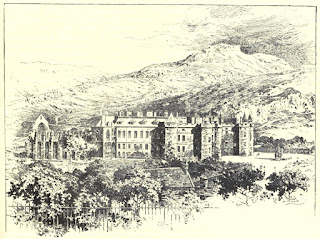
Holyrood Palace, Edinburgh
Little is known about Catherine Gordon's early years, as history is much more careful about recording tragedy and scandal than everyday life. As a great-granddaughter of King James I of Scotland and daughter of the Earl of Huntley, Catherine likely enjoyed a charmed childhood and looked forward to a bright future. That vague dream of imminent prosperity became defined for her in a handsome young man proclaimed to be Richard of York.

Catherine is one of those women who would be wonderful to sit down to tea with and ask many of those questions that drive history enthusiasts mad. Did she think her Richard was truly Perkin Warbeck, the name later assigned to him by Henry VII? What was her impression of the first two Tudor kings? Catherine lived during fascinating times with close connections to some of the historical figures who continue to intrigue us the most. However, as with many who lived during the Tudor era, her life is a complex blend of joys and sorrows.
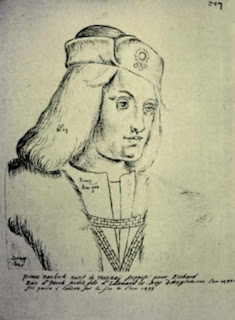
Perkin Warbeck
Whatever Catherine eventually ended up believing about her first husband, at the time of her marriage she would have been confident that she was marrying a Prince of England, one who was preparing to reclaim his kingdom with her at his side. The fact that Catherine was given to Warbeck in marriage is a significant indication of his belief in his claim.

While Warbeck was undoubtedly pleased with the status that Catherine gave him, he also seems to have been in love. A letter believed to be written by him states, "whoever sees her cannot choose but admire her, admiring cannot choose but love her, loving cannot choose but obey." Catherine appears to have returned his affection, accompanying him when he set out to invade England though she most likely was either pregnant or had a small child with her.

So began the string of tragedies in this lovely young woman's life.

Warbeck's 1497 invasion failed almost before it began, and Catherine was taken captive at St Michael's Mount where she awaited news of her husband's victory. Found wearing mourning clothes, it is believed that Catherine had suffered a miscarriage during her five weeks there. Records being unclear in the details, Catherine may have alternatively suffered the loss of a young child rather than a miscarriage. Either way, Catherine would bear no more children.
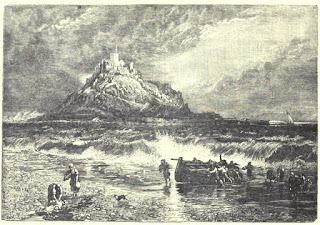
St Michael's Mount, Cornwall
Catherine was treated with respect by Henry and became an attendant for his wife, Elizabeth of York. She was informed that her husband was a pretender. What Catherine thought of all this, we can only imagine. The fact that records exist stating that "Henry was treating the couple well enough, but would not let them sleep together," indicate that Catherine still loved her husband, whoever he really was. She remained at the Tudor court, whether she was a well-treated prisoner as her great-grandfather had been or she chose this path is unknown.

In 1499, Warbeck was executed under suspicious circumstances, and Catherine found herself a childless widow of twenty-five at a foreign court. Catherine became close to the royal couple, serving as one of Queen Elizabeth's ladies and eventually mourner at her funeral in 1503. She remained with Henry after he lost his wife, indicating that she had forgiven him for any wrong she may have felt he had done to her or her first husband.

Catherine Gordon before Henry VII
After the first Tudor king's death, Catherine became a member of Katherine of Aragon's household. This Katherine had, too, already seen a small portion of the tragedy that her life would include. Already married and widowed by the first Tudor prince, Katherine of Aragon married the brother who had become Henry VIII.

Around this time, Catherine married her second husband. Little is known of James Strangeways besides the fact that he was Gentleman Usher of the King's Chamber and that he did not survive long after his marriage to Catherine. By the summer of 1517, Catherine was married a third time. This marriage and a role in Princess Mary's household took Catherine a greater distance away from the English court than she had been in twenty years.

Matthew Craddock was a Glamorganshire knight with holdings in Wales. Catherine was able to divide her time between Princess Mary's household at Ludlow and that of her husband. Catherine loved to explore her estates on horseback, and this is an activity she found great refuge in throughout her life. Based upon Catherine's will, written in 1537, Craddock held a special place in Catherine's heart. Though the document refers to Catherine as the "sometime wife" of Strangeways, Craddock is referred to as her "dear and well beloved husband."

Catherine served as Chief Lady of the Privy Chamber for Princess Mary while Margaret Pole served as Governess. These two women were of an age together and likely struck up a friendship at this point if they had not previously. They would be protective of their charge as the political environment deteriorated, causing the downfall of Mary's mother, friend of both women, Queen Katherine of Aragon. Catherine served in this role until 1530, but Margaret stayed until she was forced to leave in 1533.

In the meantime, Catherine had lost her third and gained a fourth husband. Craddock's death in 1531 may be an indication that Catherine had left Princess Mary's household when she did in order to care for him. It is not known precisely when Catherine married her final husband, but he would be the one to survive her.
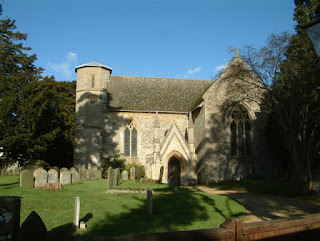
Fyfield Parish Church
Final resting place of Catherine Gordon
Christopher Ashton, another Gentleman Usher, was from Berkshire, where Catherine held lands that had been gifted to her by Henry VII. When not at court before her move to Wales, this is where she had taken up residence. Her final marriage was brief and little is recorded of it besides Catherine's final will and resting place.

When Catherine died on October 14, 1537, she was sixty-three years old. A surviving monument to her exists within the Parish Church of Fyfield in Berkshire where she is buried. Another monument had been raised by Craddock in Swansea, indicating his doubts that she would remarry after his death. Her will makes no mention of her first husband, and there is no existing record of her discussing him at any point in her life after his death. Whatever she thought of Perkin Warbeck had died with him. Eventually, Ashton was the husband to be buried next to the much admired Scottish noblewoman when he died in 1561.    

Photo Credits:
Holyrood Palace: Cassell's History of England, 1901
Perkin Warbeck: Unknown Artist, Public Domain
St Michael's Mount: Cassell's History of England, 1901
Catherine Gordon before Henry VII: Cassell's History of England, 1901
Fyfield Church by Colin Bates [CC BY-SA 2.0 (http://creativecommons.org/licenses/by-sa/2.0)], via Wikimedia Commons

Additional Reading:
The Last White Rose: Secret Wars of the Tudors by Desmond Seward
Margaret Pole, Countess of Salisbury by Hazel Pierce
Winter King: Henry VII and the Dawn of Tudor England by Thomas Penn

~~~~~~~~~~~~~~
About the Author:
Samantha Wilcoxson is a first generation American with British roots. She is passionate about reading, writing, and history, especially the Plantagenet dynasty. Her novel, Plantagenet Princess, Tudor Queen: The Story of Elizabeth of York has been recognized as a Historical Novel Society Editor's Choice.

The Plantagenet Embers series continues with Faithful Traitor: The Story of Margaret Pole and will conclude with Queen of Martyrs: The Story of Mary I in 2017.

Samantha has also published two middle grade novels, No Such Thing as Perfect and Over the Deep: A Titanic Adventure.

When not reading or writing, Samantha enjoys traveling and spending time at the lake with her husband and three children. You can connect with Samantha on her blog, Twitter, Goodreads, Booklikes, and Amazon.


Monday, September 5, 2016

For Sale: Rich Orphans - The Tudor Court Of Wards

by Barbara Kyle 
       

       In the late 1400s a young woman named Jonet Mychell was abducted. Her step-father, Richard Rous, wrote to the Chancellor of England asking for help. According to Rous, Jonet had been living with her uncle in London when some "evil disposed" people led by one Otis Trenwyth took her away so that "neither father nor mother, nor kin nor friend  that she had could come to her, nor know where she was." She was subsequently forced to marry against her will to "such a person that was to her great shame and heaviness."

       To modern eyes, the crime of a man abducting a young woman is a sexual one. But Tudor eyes saw things differently. The main dispute in Jonet Mychell's abduction was about wardship and marriage, and what those two things entailed, above all, was money. What concerned Tudor bureaucrats was the abduction of young women who were heirs to property.

Henry VII
 Abduction of heiresses was not uncommon. Certainly it occurred frequently enough to necessitate a statute passed in 1487 under Henry VII, the first Tudor monarch:  "An Act Against Taking Away of Women Against Their Will."  A stolen heiress meant lost revenues for the Crown.

The revenue stream went back for centuries. The wardship of minor heirs of any tenant-in-chief was one of the king's ancient feudal rights, a royal prerogative dating back to the feudal principle of seigneurial guardianship. It entitled the king to all the revenues of the deceased's estate (excluding lands allocated to his widow as dower) until the heir reached the age of majority: twenty-one for a male, fourteen for a female. The king generally sold the wardships to the highest bidder or granted them gratis to favoured courtiers as a reward for services.
       
        In other words, all orphans, male and female, who were heirs to significant property became wards of the king, who then sold the wardships. Gentlemen bid for these sought-after prizes, because control of a ward's income-generating lands and their marriage was a significant source of revenue. The guardian pocketed the rents and revenues of the ward's property until the young person came of age, at which time the guardian often married the ward to one of his own children.
Henry VIII
       
        When Henry VIII, the second Tudor monarch, came to the throne he fully exploited the royal right of wardships. Monarchy had to be a money-making business, and wardships provided an excellent way to replenish the royal treasury. Surveyors were appointed to search for potential royal wardships throughout the realm. Managing all of this was a Master of the King's Wards who supervised royal wardships and administered the lands and revenues of wards during the period of crown control, and sold those not to be retained. The revenues went into the king's private funds.
       
       In 1540 Henry VIII replaced the office of Master of the King's Wards with the Court of Wards, which assumed complete control of wards and the administration of their lands and the selling of the wardships. Eventually, the Court of Wards became one of the Tudor crown's most lucrative ministries. In the reign of Elizabeth I, the last Tudor monarch, the Court of Wards was supervised by Sir William Cecil (later Lord Burghley) who exerted enormous control over this court, keeping several lucrative and important wardships for himself.
      
       I became familiar with the situation of royal wardships when I wrote The Queen's Lady. My book features Sir Thomas More, Henry VIII's chancellor, who famously went to the execution block rather than swear the oath that Henry was supreme head of the church in England, a title Henry created in order to divorce Catherine of Aragon and marry Anne Boleyn.

Sir Thomas More
 Sir Thomas More had two wards, Anne Cresacre and Giles Heron. He brought them up in his household where they were educated alongside his children. Eventually Anne married More's son John, and Giles married More's daughter Cecily. The marriages seem to have been happy ones.

Sir Thomas More and Family

Anne Cresacre (sketch by Hans Holbien)
       
       Anne Cresacre's story inspired me to create another ward for Sir Thomas More: Honor Larke, the heroine of my novel The Queen's Lady. Honor grows up revering More and becomes a lady-in-waiting to Catherine of Aragon. Forced to take sides in the religious extremism of the day, Honor fights to save the church's victims from death at the stake, bringing her into conflict with her once-beloved guardian. She enlists Richard Thornleigh, a rogue sea captain, in her missions of mercy, and eventually risks her life to try to save Sir Thomas from the wrath of the King.

                         ____________________________________________

Barbara Kyle is the author of The Thornleigh Saga series:


Visit Barbara at www.barbarakyle.com.

Coming November 2016: 
Page-Turner: 
Your Path to Writing a Novel 
That Publishers Want and Readers Buy


Wednesday, May 18, 2016

Vagrants and Vagabonds in Tudor England

by Deborah Swift


Jacques Bellange (c. 1575–1616)
The Beggar Looking Through his Hat 
Hark! Hark! The dogs do bark!
The beggars are coming to town:
Some in rags, some in jags*
And one in a velvet gown 


Some gave them white bread,
And some gave them brown,
And some gave them a horse-whip,
And sent them out of town.


Tudor London attracted vagrants and beggars from all over England, who were in search of the rich pickings of the city. The Dissolution of the Monasteries in 1536 led to an increase in the number of vagrants, as the monasteries had been the chief source of charity, and had also provided employment for vast numbers of people who worked for them as agricultural labourers. The nursery rhyme above is attributed to this time. Because travel by horsepower was so slow, it was unusual for people to reside outside their birth town, and so all migrant travellers were treated with a degree of suspicion, especially if they were poor. This is why travelling actors had to procure a licence.

Sites of the Monasteries
There was of course, no police force, so crime was an enormous problem, tackled by extreme punishments designed to act as a deterrent. More than 70,000 people were executed during the reign of Henry VIII, many for what we would consider minor offences. Stealing was a hanging offence, and begging outside your home area was punishable by being tied to a cart and flogged, or locked in the stocks to be pelted by passers-by.

Village Stocks in Beetham Lancashire

There were so many beggars that a law was passed in 1547 which stated that anyone who was homeless could be made to be a slave for a period of two years. Should they run away from their master, they would then be branded with a 'V' and committed to slavery for life. This law was, unsurprisingly, extremely unpopular, and was revoked three years later in 1550. The 1563 Act reaffirmed the policy of whipping able-bodied beggars, but to prevent offenders from persistent begging a further Act stated that vagabonds should be burned through the right ear and, if they were arrested again, they could be imprisoned and executed. These policies of ear-boring and hanging remained the law until 1593.


With draconian punishment the order of the day, many turned to crime. A book published in 1552, 'A Manifest Detection of Diceplay' gives the first written evidence of the criminal underworld operating in Tudor London, and says that 'sleight and crafty deceit ... is common in every corner.' There were five prisons in London, to house the burgeoning number of petty criminals: The Clink, The Compter, The Marhalsea, The King's Bench and the White Lyon. The underworld looked to its own, however, and specific areas, such as Alsatia, and Southwark, became known as places where those on the run from the law could find refuge. And of course they were also the places where any rich man needed to guard his purse.

Beggar being whipped through town

The Poor Relief Act of 1576 was supposed to be the solution, but in fact it divided the poor into two categories:

The Deserving Poor This category was for those people who wanted to work but were unable to find suitable employment. The first category included the old, the sick, and widows, who were provided accommodation in almshouses and orphanages with a productive but sedentary activity such as spinning or weaving, by which they earned their Poor Relief, which was provided by each parish through taxation.
The Undeserving Poor Also called 'sturdy beggars', this category was for those who were physically able to work but chose not to. They gained no sympathy and were to be whipped through the town until they learnt the error of their ways. Many poor workers were harried from town to town as they sought work, and many feigned sickness in order to fall into the category where they would qualify for Poor Relief. The alternative for these people was the 'house of correction', where the able-bodied but persistently unemployed or in debt could be punished.

The first house of correction was Bridewell in London, and many other such institutions were called 'bridewells' after it. Bridewell was opened in 1533 in a former royal palace on the banks of the Fleet River and also housed homeless children. Because of this, it also became the first major charitable institution. The picture below shows it in Tudor times - after the Great Fire of London in 1666, it had to be rebuilt.
Bridewell 

However, the main purpose of a house of correction was to punish offenders, so they would correct their behaviour, and not just to be a depriver of liberty. Punishment was usually either hard labour, or whipping which could be observed as entertainment from the public gallery. The most common charges against prisoners were prostitution, petty theft, and something called 'loose, idle and disorderly conduct'. More than two-thirds of the prisoners were female, and many were recent migrants to London. These women, often widows trying to support their families, were also put to hard labour, and a common task for female offenders was beating hemp to make linen. 

The 1597 Act required each town to provide a prison, such as Bridewell, for vagrants and thieves, and paid for by local taxes. In the Tudor mind, there was barely a distinction between a beggar and a thief. Beggars caught offending were punished and then returned to their native parish.This system caused a great burden on parishes where harvests had failed, and whole populations were condemned to one area, unable to seek sustenance elsewhere. Surprisingly, most prisoners in houses of correction were released within a week of their imprisonment, so they could return home and to make room for others who needed this short, sharp shock of a punishment. 


Matters were made worse by a series of bad harvests in the 1590s, and the fact that during the reign of Elizabeth I, the population grew by a third - from three to four million people. By now, London was the biggest city in Europe with a population of somewhere between 130,000 and 150,000. To deal with this, The 1601 Poor Law consolidated all these various acts and laws to form one cohesive whole. It remained largely in place until the 18th-century workhouse movement began at the end of the 17th century. 

Giacomo Ceruti 1720  Little Beggar Girl and Woman Spinning
* Jags - Slashes or slits exposing material of a different colour, and popular during the Tudor period.

Sources:
The Elizabethan Underworld by Gamini Salgado
Everything You Wanted to Know about The Tudors, But Were Afraid to Ask by Terry Breverton
Life in Tudor England by Penry Williams 
BBC The Tudors
Pictures from Wikpedia, or my own unless otherwise linked.

Deborah Swift is an ex-costume designer for the BBC, and the author of four historical novels, and three more for young adults. She lives in the north of England in a 17th century village, with her husband and lucky black cat. Find out more on her website www.deborahswift.com , where she has a historical fiction blog or follow her on Twitter @swiftstory

You might also like Lowlifes of Elizabethan London, also on this blog.

Saturday, March 12, 2016

A Royal Affair: Henry VIII’s first ‘mistress’

By Lauren Johnson
Whether justly or not, when we think of Henry VIII we think of romantic intrigues. Even schoolchildren can recite the fates of his six wives: divorced, beheaded, died, divorced, beheaded, survived. Although Henry had the rather unusual habit of marrying his mistresses, there were other women in his life who have been forgotten. It is a little verbose to remember all of these romances: ‘divorced, affair, illegitimate child, possible illegitimate child, beheaded...’ doesn’t have such a ring to it. One of these forgotten women is Lady Anne Hastings - the young king’s first extramarital dalliance.
It was spring 1510. The eighteen year old Henry VIII had been a king and a husband for less than a year. His wife, Catherine of Aragon, was sequestered with her ladies for her first ‘confinement’ - the final stages of a pregnancy that was to prove false. As the weeks passed and still no child appeared, Henry grew restless. He began to seek female attention elsewhere. His eye fell on the darkly attractive Lady Hastings.

Anne, Lady Hastings (wikimedia commons)
She was born Anne Stafford, daughter of that infamous Duke of Buckingham who had supported the usurpation of Richard III and then raised a rebellion against him. By Henry VIII’s reign the Staffords were at the heart of court politics. Anne’s brother Edward now held the title of duke, making him the senior nobleman in the country. Their sister Elizabeth, Lady Fitzwalter, was one of Catherine’s senior ladies in waiting, her experience of pregnancy proving particularly useful as she kept her mistress company in the royal chambers. And Anne herself was recently married - for the second time - to another prominent courtier, Lord George Hastings. Henry had given her a wedding gift of a few shillings last December. It was not a mark of particular attention, but by May 1510 the Spanish ambassador, Luis Caroz, was reporting that the king had become very interested in Anne indeed. She was ‘much liked by the King,’ said Caroz, so he ‘went after her’.
Henry was aided in this endeavour by his childhood friend and now Groom of the Stool - the most trusted royal body servant - William Compton. Compton carried messages between the pair, even visiting Anne’s private chambers to do so. It was not long before rumours about the relationship started to seep out. So closely was Compton embroiled in the affair, in fact, that there was some confusion as to who exactly was wooing Anne.
‘Another version’ of the story, Caroz reported, ‘is that the love intrigues were not of the king, but of [Compton], his favourite.’ However, Caroz was unconvinced of this, thinking it more likely that Compton ‘carried on the love intrigue, as it is said, for the king... That is the more credible version.’
When Anne’s family learnt that their married sister was being courted by a king they immediately stepped in to end the affair. Curiously, Anne’s husband was not the first to react. Perhaps he hoped to gain something from this royal attention. Instead, the Staffords closed ranks. Whispers of the affair had reached as far as the Queen’s cloistered chambers, coming to the ear of Anne’s sister Lady Fitzwalter. Whether eager to protect her royal mistress or to preserve the family honour, Lady Fitzwalter leapt into action, organising an ‘intervention’. She made the mistake of inviting her brother.

Edward Stafford, duke of Buckingham (wikimedia commons)
The third Duke of Buckingham was an infamously proud and choleric man. When he learnt that his sister’s name was being associated not only with the king but with his servant, he was outraged. He stormed to Anne’s chambers. By spectacular ill fortune, his visit to his sister coincided with the arrival of William Compton. Buckingham ‘intercepted [Compton], quarrelled with him, and the end of it was that he was severely reproached in many and very hard words’.
Compton did not take this treatment lying down. He reported it immediately to the king who - rather confirming Caroz’s suspicion that Henry himself was the lady’s suitor - ‘was so offended at this that he reprimanded the duke angrily.’ Buckingham fled from the king’s presence in a fierce temper. Lord Hastings, perhaps inspired by the duke’s affirmative action, had Anne spirited away ‘and placed her in a convent sixty miles’ away.
Worse was to follow for the Staffords. When Henry discovered that the source of all this trouble was his queen’s servant Lady Fitzwalter he had her and her husband turned out of court. By now the whole situation was getting out of hand. In his frustration at the loss of Lady Hastings, Henry was threatening the jobs of half the royal servants.
‘Believing that there were other women in the employment… [sneaking] about the palace insidiously spying out every unwatched moment, in order to tell the queen [stories], the king would have liked to turn all of them out, only that it has appeared to him too great a scandal.’
Inevitably, the queen learnt of the dalliance. Recently emerged from her miserable lying in with no child to show for it, and still only months into her marriage, Queen Catherine did not take news of her husband’s infidelity well. ‘Almost all the court knew that the queen had been vexed with the king,’ reported Caroz, ‘and the king with her, and thus this storm went on between them.’
In the fullness of time Catherine forgave Henry and during her next confinement we do not hear of any further adulterous intrigues around the king. The Staffords returned to court. The ‘storm’ subsided.
As far as we know, the relationship between Henry and Anne never went beyond flirtation. Indeed, after 1510 we never hear of their names being associated again. Henry would go on to have other mistresses - Bessy Blount, Mary Boleyn, those infamous wives - but his feelings for Anne seem to have been cooled by the furore his attentions had caused.
The same is not true, however, of Anne and Compton. Despite both being married - apparently contentedly - the pair continued to enjoy a close relationship for years to come. So close, in fact, that in 1527 Compton was forced to swear on the sacrament that he had not committed adultery with her. Perhaps that was true. But the will he wrote in 1523 suggests that even if their relationship was not physical, it was certainly very affectionate. This will - written shortly before he went to war on the Scottish borders - asked that, in the event of his death, prayers be said for himself, his wife and Anne. It also gave Anne a life interest in some of his estates. Such generosity to a woman outside one’s kinship group was very unusual. It suggests that while the royal affair swiftly blew over, Anne’s relationship with Compton was deeper and more abiding. The king’s first ‘mistress’ was not an easy woman to forget.


Henry’s relationship with Lady Hastings features in Lauren’s new book, So Great a Prince: England and the Accession of Henry VIII (Head of Zeus). The book explores the year 1509 from the perspective of both king and country.


She is also the author of The Arrow of Sherwood (Pen & Sword Fiction) and wrote the play Lady Unknown.

She blogs at laurenjohnson1, tweets @History_lauren and facebooks at Lauren Johnson: Author & Historian. Her website is Lauren-Johnson.com.

Amazon US