Showing posts with label Dr. John Dee. Show all posts

Wednesday, March 9, 2016

Blank Tudor Faces

Judith Arnopp

 We have all become so familiar with royal Tudor images that we no longer really see them. One glance tells us who they are. We think we know them. They exude power, majesty and the iron fist of mastery.

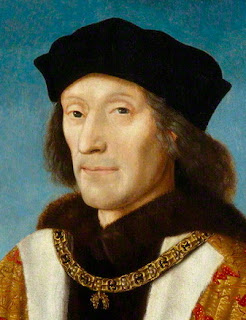
Earlier portraits of the Plantagenet kings, and even the early portraits of Henry VII are very different to that of his son and grandchildren. But it was Henry VII, the first ‘Tudor’ king who began to develop the ‘Tudor’ brand.

The royal portraits of Henry VI, Edward IV, Richard III are all quite sombre, the artist doing his best to portray an ordinary man who was king. Even this portrait of Henry Tudor has nothing overtly regal about it; there is even a glimpse of personality, perhaps a measure of distrust, cynicism, impatience, or is it amusement? However you interpret his expression, it is a portrait of a human being, not a representation of royal supremacy.

 In the early days of Henry’s reign his position was unstable, he was an unknown quantity. There were no guarantees of peace and there were several Yorkist attempts to take his throne. The Tudors were the new kids on the block; nobody could foresee what sort of king Henry would make and his popularity depended very much on that of his wife, Elizabeth of York. Yorkist propaganda demeaned his claim to the throne, declaring that his mother’s line was illegitimate and that Lancaster had stolen the crown in 1399. They also sneered at his great grandfather who had been a lowly innkeeper.

Henry, realising he needed to reinforce his hold on the country, invented (or perhaps ‘embellished’ is a better word) his family history to create an impressive Tudor dynasty. He stressed the royal connection of his mother, Margaret Beaufort, and her descent from John of Gaunt and, to strengthen his claim further, he legally removed the stigma of bastardy from the family. He reiterated the royal descent of his grandmother, Katherine of Valois and, more surprisingly, claimed descent from the ancient Welsh King Cadwaladr, and King Arthur. To further cement his link to Arthur he named his first born son in his honour and embellished the round table at Winchester with the Tudor rose.

With the blood of both York and Lancaster flowing in the veins of his two sons and several daughters the Tudor line looked set to continue but Arthur’s sudden death in 1502 taught Henry that a king can never have too many sons. He lost no time in teaching his remaining son, later to become Henry VIII, the finer points of kingship. He stressed the importance of his role, the unreliability of the fickle populace, and the crucial need for strong male heirs to perpetuate the dynasty. The importance of heirs was a lesson young Henry never forgot, and one he fought tooth and nail for the rest of his life to achieve.

The blooming of the Renaissance and the introduction of men like Holbein to the royal court helped to reinforce this new Tudor image, and during Henry VIII’s reign new style of royal portraiture began.

I think of them as ‘power portraits’ that were loud declarations of Tudor permanence and dominance.
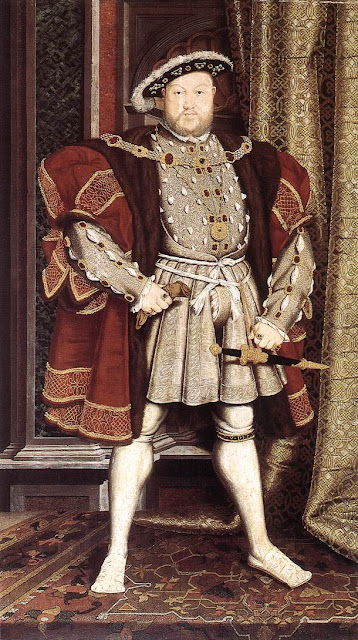
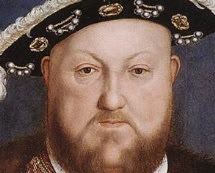
This one was painted by Holbein the younger after 1537, at a time when Henry was at the height of his power. He had freed himself from Anne Boleyn and the Pope, and Jane Seymour had finally provided the son and heir he’d been craving.

Today, we are used to seeing this image and others like it but imagine its impact in a world in which images were rare and people’s lives were not dominated by photographs or colour. Everything in this portrait is designed to impress; we cannot take our eyes from the breadth of shoulder; the sumptuous quality of his clothes; his immovable stance; the potent codpiece, and the unflinching expression in his eye. The portrait exudes wealth, power and uncompromising control. It is an unspoken declaration. ‘I am the king; it shall be as I say.’ There is not the slightest hint of insecurity, yet Henry was very insecure.

We all know about Henry; his failed marriages, his quest for an heir, his break with Rome, his megalomania, and ruthless rule but, what about the man behind the grandeur? Take a closer look at his face. What does it tell us about the inner man?

He looks bullish at first glance but on closer inspection you will see his eyes are blank, his expression closed. You might say he looks belligerent or mean but is that really what we are seeing, or is that a preconceived idea, because of what we already know? Personally, I think his inner feelings are obscured by my pre-knowledge but, if I try to wipe my mind and focus solely on his face, I see ennui, and sadness. As if he is hiding behind his own splendour.


All the Tudor monarchs have this same expression. The portraits as a whole are only concerned with an outward show of majesty, a declaration of authority. Edward VI was ten years old when he became king, a young skinny boy with a burgeoning ego that would soon match his father’s. Here he is carefully painted in a similar stance to Henry. He is well-padded and embellished in satin and fur, and a much smaller cod-piece than his father’s promises future virility and heirs to carry on the Tudor name. But again, it is the image of a king with an empty face. ‘I may be young,’ he is saying, ‘but do not underestimate me; I am my father’s son.’

Edward’s short reign was one of religious persecution as the Protestant king tried to terrorise his subjects into following his will. His premature death was greeted with relief by many Catholics for now it was the turn of the Protestants to be subjected to the will of Mary Tudor.

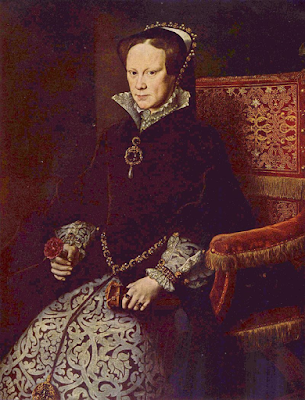
Unlike her father and brother, Mary is seated, but her portrait is no less authoritative. Her erect posture and uncompromising stare are enough to turn living flesh into stone but there is little to be read there; we cannot see beyond her steely gaze to the woman within.

Her attempts to reinstate the Catholic religion and wipe out the much newer Protestant religion resulted in the burnings and torture that earned her the posthumous name ‘Bloody Mary.’ But viewed more objectively, her personal sorrows were immeasurable. Mary had lived a sorry life; rejected by her father, disinherited from the succession, stripped of her title ‘princess’, separated from her mother, Katherine of Aragon, Mary channelled all her frustration and anger into her religion. Her devotion to God and the Catholic Church was matched only by her passion for her husband, the reluctant Philip of Spain, and her wish for a son to follow after her.

Her health was never good; there is some evidence that her menstrual cycle was erratic and she suffered both physically and mentally from a young age. In later years her failure to conceive, her phantom pregnancies and failing marriage compounded her misery until she died a painful death in 1558 leaving no heir. Mary, who had gone to extreme lengths to rid England of the new religion, was now forced to leave the realm in the hands of a Protestant queen, her sister Elizabeth.


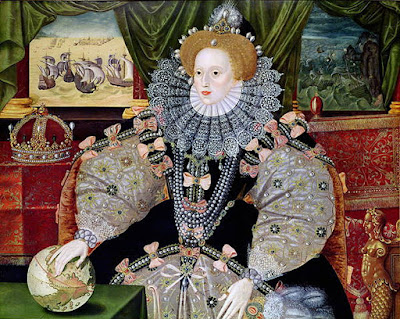
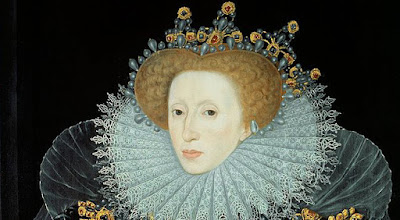
Elizabeth was the greatest Tudor of them all and the one who exploited royal portraiture to the full. The queen was very aware of the power of image and iconography. Encouraged by her adviser, John Dee, her portraits became more and more extreme. In every image she is majestic and fabulously dressed, her tiny frame all but obliterated by satin, velvet, lace and jewels. In looks Elizabeth resembled her great grandmother, Margaret Beaufort and her grandfather, Henry VII but by nature she was very much like her father.

If her grandfather and father had coveted England and parts of Europe, Elizabeth's ambitious eye went further - to the New World. In the Armada painting below, her hand rests on a globe and, just in case the viewer should forget who wears it, the crown of England is just above. If you look closely, her famously long, white fingers are covering the Americas and behind her are commemorative paintings of the Spanish fleet being driven onto a rocky shore by a storm that became known as the 'Protestant Wind,' suggesting God's approval of England's victory over Catholic Spain. Elizabeth is proclaiming herself the saviour of her people; the mother of her expanding empire: a victorious, virgin queen, blessed by God.


These are the things the Tudors wanted the world to see and believe. Their private 'selves', their inner thoughts and feelings were none of our concern and so they turned their faces into masks - a blank page devoid of personality yet replete with majesty.
Although the Tudors are well-documented and easily accessible through portraits and records, writing about them is not easy. We know what they did and when they did it; we know the relationships they had, the political scene, the style of their clothing, the shade of their hair and eye colour but there are only the tiniest glimpses of their inner selves. In order to populate my novels with believable characters I have to mentally prise off their masks, strip off their rich finery, and try to reach inside their minds. What is left are people as ordinary as you and I. In their natural state it is easier to consider these icons of monarchy as human beings, and imagine the emotions that triggered their most bizarre behaviour.  Each Tudor monarch had hopes and fears (mostly of failure) and insecurity, and they had dreams too, and a vast self-disappointment that ate away at them all.

For all their power, all their wealth and status, they could not have or hold the things they most desired: fidelity and adulation.

Photographs in the public domain from Wikimedia Commons


Judith Arnopp is the author of eight historical fiction novels including:

The Beaufort Bride: Book one of The Beaufort Chronicles - Available to pre-order NOW

A Song of Sixpence: the story of Elizabeth of York and Perkin Warbeck

Intractable Heart: the story of Katheryn Parr

The Kiss of the Concubine: a story of Anne Boleyn

The Winchester Goose: at the court of Henry VIII

The Song of Heledd

The Forest Dwellers

Peaceweaver


For more information please visit the webpage

Author page: click here

or look for her on Facebook.

Monday, January 12, 2015

Nostradamus, Dee, Agrippa: The Secrets of the Tudor-Era Seers

By Nancy Bilyeau

On January 12, 1559, Elizabeth Tudor entered the Tower of London to prepare for her coronation as Queen of England. Her half-sister, Mary I, had died on November 17th and Elizabeth seized the reins of power immediately, but the all-important coronation was not set to take place until nearly two months later.

The date when Elizabeth would ride through the city of London to Westminster Abbey was January 15th. At the suggestion of Robert Dudley, Elizabeth consulted Dr. John Dee, the astrologist and scholar who later served as Shakespeare's inspiration for Prospero in The Tempest. Dee chose the date as most favorable to a successful reign.

Elizabeth's years of reliance on Dee puzzles some people today. How could the Tudor queen, educated, enlightened and brilliant, known for saying, "I would not open windows into men's souls," make decisions based on an astrologer? But to wonder that misreads the importance of men like John Dee in the 16th century. The more well versed in the Renaissance the ruler was, the more he or she favored the educated seers and wizards.

The career of Dee echoes that of Nostradamus in France and Heinrich Cornelius Agrippa in Germany. By looking at them together, the life of a seer comes into focus.

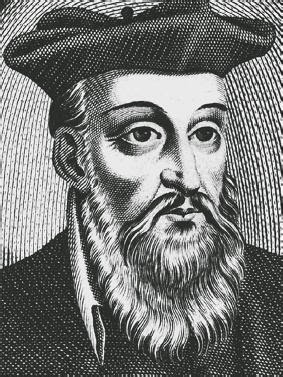
Nostradamus

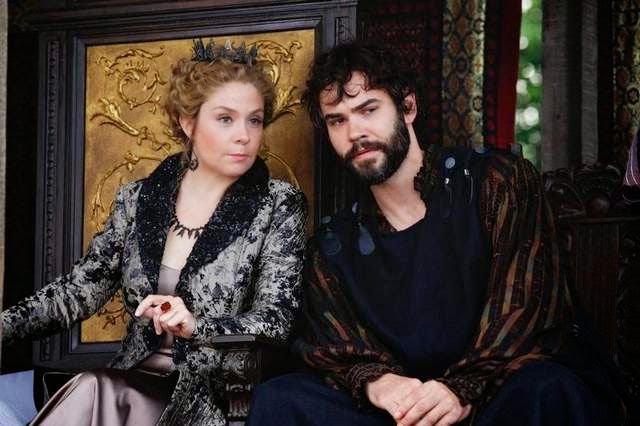
Of all the mystics who exerted influence in the 16th century, Nostradamus is the most notorious today. He has been the subject of hundreds of books and several recent television documentaries and is even portrayed by Rossif Sutherland (Donald's son) in a key role in the popular TV series Reign.

Catherine de Medici advised by Nostradamus (Sutherland) in Reign

Historians believe that Michel de Nostredame came from a family of Provence forced to convert from Judaism to Christianity. After years of censure, taxation and increasing acts of violence against Jews in both Spain and France, King Louis XII ordered the exile of all Jews from Provence in an edict published in 1500. The Gassonet family did not leave; they had already converted to Christianity, with their name changing from Gassonet to Nostredame, arguably one of the most Catholic names imaginable. Michel was born on December 14th in Saint-Remy-de-Provence.

Birthplace of Nostradamus in Saint-Remy
Michel definitely showed academic promise, learning Greek, Latin, Hebrew, logic and mathematics as well as medicine. At the age of 15 he entered the University of Avignon. But he was also drawn to the study of astrology, a respected practice in the 16th century, and herbal medicine. In his 20s, he achieved fame as a physician whose patients survived the plague more than average. In a time when medicine hurt more than it helped, Michel believed in fresh air, clean water and hygiene for patients--most unusual concepts--and prescribed a pill made of crushed rose petals. But after his own wife and children died of the plague despite his efforts to save them, he seems to have moved away from medicine and toward the arts of the occult. He wandered through Europe for years, and unfortunately became of interest to the Inquisition, who persecuted both conversos and those who dabbled in heresy. Somehow he managed to survive his Inquisitors, and subsequently became more--not less--interested in prophecy and mysticism. He Latinised his name to "Nostradamus."

In 1555, the first of Nostradmus's collections of prophecies foretelling the history of the world were published. The Queen of France, Catherine de Medici, who has gone down in history as a conniver and a poisoner, was also a passionate supporter of the arts, particularly architecture, and like other Renaissance patrons, was intrigued by prophecy. Many 16th century seers studied the philosophy of the ancient Greeks (as well as the Kabbalah and Arabic texts). The Queen summoned Nostradamus to the French court, and he advised her, on and off, until his death in 1566.

In the 16th century the most famous Nostradamus prophecy was a published quatrain:
"The young lion will overcome the old,
In a warlike field, in single combat,
In a cage of gold, he will pierce his eyes;
Two wounds being one he then dies a cruel death."
Based on contemporary sketch
In 1561, France's King Henry II died after being injured in a tournament joust. He was struck in the face, through his visor, by an opponent whose coat of arms included a lion. The lance drove into his brain just above his eye and he died days later, in agony. (In recent years, this chilling prediction has come under fire, as some say the quatrain came to light after the death of the Valois king, not before.)

Many of Nostradamus' prophecies seem to have been drawn from ancient end-of-world writings by Livy and Plutarch, among others, with astrological twists. Believers credit him with predicting everything from the French Revolution and American Civil War to the assassination of John F. Kennedy and World Trade Center attacks ("earth-shaking flames from the world's center roar"). But critics say his writings were vague enough to allow for just about any interpretation. Whether Nostradamus obscured his sincerely-meant prophecies to protect himself from the Inquisition or because they were cynically concocted wholesale inventions, we can never know.

Heinrich Cornelius Agrippa

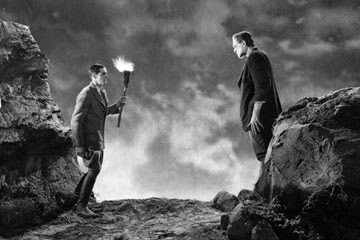
In 1818's Frankenstein, Mary Shelley writes of an impressionable young medical student's fateful moment of discovery:
"In this house I chanced to find a volume of the works of Cornelius Agrippa. I opened it with antipathy; the theory which he attempts to demonstrate and the wonderful facts which he relates soon changed this feeling into great enthusiasm. A new light seemed to dawn upon my mind, and bounding with joy, I communicated my discovery..."
And so Victor Frankenstein was lost to his obsession--the creation of life.

Frankenstein: The man and his creation

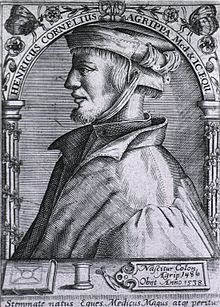
The name Agrippa was not a fictional one but belonged to Heinrich Cornelius Agrippa, a 16th century German theologian, alchemist, philosopher and magician. Shelley's use of Agrippa's beliefs to fuel her tale is not as strange as it may seem at first glance. He also played an important part in a nonfiction book written by her journalist-philosopher father, William Godwin: Lives of the Necromancers. It's clear that this group of mystical thinkers--Godwin's list includes  not only Agrippa and Nostradamus but also Albertus Magnus, Roger Bacon,  and a dozen others--proved fascinating to the poets and philosophers of the Enlightenment.

Heinrich Cornelius Agrippa

Godwin wrote of Agrippa:
"He was one of the most celebrated men of his time.... It is more than probable that Agrippa was willing by a general silence and mystery to give encouragement to the wonder of the vulgar mind. He was flattered by the terror and awe which his appearance inspired. He did not wish to come down to the ordinary level." 
Like Nostradamus, Agrippa was a precocious student. Born in Cologne in 1486, he mastered six languages and studied medicine and law as well as the work of the Humanists. Alchemy was his passion rather than astrology, and he believed "magic comprises the most profound contemplation of the most secret things, their nature, power, quality, substance and virtues." He published De Occulta Philosophia, three volumes on magic, an influential collection still in print.

Page from Agrippa's book

Contradictions abound in the life of Agrippa. He served the Holy Roman Emperor Maximilian in various capacities--as secretary, soldier and perhaps spy--and dedicated a book to the Hapsburg Emperor's respected sister, Margaret of Austria. Eustace Chapuys, the erudite Imperial Ambassador to Henry VIII, was Agrippa's student, friend and correspondent.

And yet the aura of the black arts clung to Agrippa. Godwin repeats the oft-told tale that a black dog accompanying Agrippa on all his travels was "a devil attendant." And it is in Lives of the Necromancers that a bizarre story is told, of Agrippa meeting Henry Howard, Earl of Surrey, in Germany and showing him, in a "magic glass," the image of his far-away mistress. For other noblemen, Agrippa summoned up the images of Ovid and "the whole destruction of Troy in a dream."

Despite his writings on magic and being a vocal critic of witchcraft trials, Agrippa was never persecuted for his beliefs, perhaps because he was protected by the Hapsburgs. He died in Grenoble in 1535.

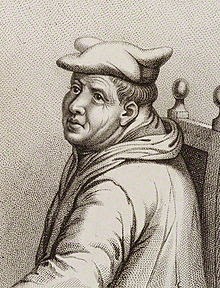
Dr. John Dee

If Agrippa is tainted with black magic, Dr. John Dee is associated with white magic--angels, to be specific. He spent years of his life trying to decipher the language of the angels.

Of all of his mystic contemporaries, Dee was perhaps the most brilliant. Along with his spiritual studies, he is believed to have coined the phrase "British Empire" and urged both Tudor queens to create a national library (they both said no, so Dee built up the finest private library in England, if not all of Europe).

Born in 1527, Dee attended Cambridge and studied mathematics and the sciences as well as astrology and alchemy. In his twenties, he worked as a tutor and advisor for the Herbert and then the Dudley families, two powerful Protestant clans in the reign of the boy King, Edward VI.

But on the death of Edward and accession of Queen Mary, the power structure turned inside out, and Dee received a chilling lesson in loyalty. He was arrested in 1555, charged with casting the horoscopes of Queen Mary, her new husband, Philip of Spain, and Mary's half-sister Elizabeth. To look into the future of the royals, forecasting their deaths, was treason, and people had perished for such acts in the reign of Henry VIII. Moreover, Dee, a Protestant, was suspected of sympathy with the Princess Elizabeth, held in prison for her possible involvement in the Wyatt Rebellion.

Elizabeth Tudor

Informers were found who said Dee "endeavored through enchantments to destroy Queen Mary." He was interrogated, found wanting, and referred to the Star Chamber. Though he defended himself well, Dee was then charged with heresy and delivered to the Bishop of London, Edmund Bonner, one of the most diligent persecutors of heretics, later dubbed "bloody Bonner" by John Foxe.

Edmund Bonner, bishop of London

Things couldn't have looked bleaker for John Dee. Yet somehow he survived, not only convincing Bonner of his innocence and becoming a Catholic chaplain but even assisting Bonner in some of his interrogations of other Protestants. (He took on the "Dr." honorific because he was ordained by Bonner.) When Elizabeth took the throne, Dee rapidly switched back to the Protestant side, becoming Elizabeth's cherished special advisor, while Bonner, holding fast to his Catholic beliefs, ended up dying in prison.

Throughout his long, colorful, often controversial career, Dee would need to show nimble survivor tactics time and again, though perhaps none quite so extreme as this. Nonetheless, Dee, despite his partnership with necromancer Edward Kelley (see below), is a benevolent figure in today's pantheon of seers. In fact, it is his tall, thin, white-bearded visage and scholarly, mentorish demeanor that seems to have inspired the wizards created by J.R.R. Tolkein and J.K. Rowling.

John Dee

It is a legacy that, one feels, John Dee would have entirely approved of.


-----------------------------------------------------------------------------

This is the latest in a series on magic in history:

From Homer to the Hobbit, the History of the Necromancer

Henry VII and the Curse of Prophecy

The Strange Life of Edward Kelley


Nancy Bilyeau is the author of the award-winning historical thriller trilogy The Crown, The Chalice and The Tapestry.

The Crown and The Chalice have been published by Simon & Schuster in North America, Orion in the United Kingdom, and DTV in Germany. The Crown was an Oprah pick for 2012 and The Chalice won the RT Reviews Award for Best Historical Mystery of 2013. The Tapestry was published this year in North America and the United Kingdom by Simon & Schuster. Follow Nancy's updates and tidbits on the world of Tudor England on Twitter @tudorscribe. For more information, go to www.nancybilyeau.com

The Tapestry goes on sale 3/24/15