Showing posts with label WWI. Show all posts

Wednesday, June 24, 2020

Maud Has No Statue

By Dr John Little

In these days of falling statues we have a timely reminder that such public edifices are erected for a purpose.

The Romans put up statues of all of their gods, and just in case they had missed one out, they also bought insurance against divine wrath by erecting one to the ‘unknown god’. There are lessons to be learned as well, from those people that society did not choose to honour in such a way. The First World War was the cause of many statues being subscribed for, and many of the great commanders now stand in bronze, in marble and acting as rests for weary pigeons. In Whitehall we see General Haig on horseback, whilst Foch sits outside Victoria Station. Joffre has his statues, and Admirals Jellico and Beatty have their busts in Trafalgar Square. To complete the set of armed forces commanders the founder of the RAF, Lord Trenchard, has his own likeness towering by the embankment. It is ironic that perhaps the most successful commander on the Western Front from 1914- 18 has no statue, her contribution being marked solely by a blue plaque on the wall of her former home. Equally ironic is that whilst some of the others are still virtually household names, hers has been almost forgotten.


Dame Emma (Maud) McCarthy already had a distinguished career behind her as matron of large military hospitals before the War Office appointed her principal matron of the British Army in 1910. Born in Australia, she commenced a nursing career in 1891 but then left the London Hospital to serve in the Boer War in South Africa. To say that her service was outstanding would be a small understatement as her actions won her the King’s medal for nursing, the Queen’s medal for nursing, and the Royal Red Cross. She was also very active in the setting up of Queen Alexandra’s Imperial Military Nursing Service. (QUAIMNS)

When she arrived in France in August 1914, there was no organization in place that could possibly cope with the rapid expansion  of the British Army from 200,000 to 2.5 millions within the space of eighteen months. The scale of the casualties and the accompanying medical requirements were gargantuan. To be sure the Royal Army Medical Corps (RAMC) had doctors and began to set up hospitals, but as with so many things it could have been chaotic. A casualty on the Western Front would receive their first medical attention at a regimental aid post run by the RAMC. There were no women there as essentially they were on the battlefield. From the aid post they were stretchered to Casualty Clearing Stations (CCS); here were doctors under the command of the army surgeon general, and nurses who now came under the command of Maud McCarthy. There were fifty six CCS’s in France staffed by QUAIMNS and Red Cross nurses. Later in the war, selected and suitably trained volunteers from the Voluntary Aid Detachment (VAD) were also allowed into the CCS’s.

From a CCS, casualties were taken either by hospital barge or train to a base hospital; each barge and train was staffed by nurses. The casualty would arrive at one of ninety eight general or stationary hospitals; some were Red Cross, some were QUAIMNS and some were funded privately by organizations such as City of London Guilds like the Drapers. Other hospitals were slotted into the organization as they arrived from places like Canada and Australia. All had to be kept up to numbers with staff, supplied, fed, billeted  and their comforts looked after. Procedures had to be standardized, standards had to be kept up and medical supplies had to be assured. The responsibilities attached to the task of coordinating all this were almost endless. From the Mediterranean Sea to the Western Front Maud McCarthy was directly responsible to the War Office in London and over this vast area commanded over six thousand nursing staff. She was everywhere and soon had a name for the most ferocious efficiency, though she herself was quiet and softly spoken.

One army general reportedly said of McCarthy: “She’s perfectly splendid, she’s wonderful … she’s a soldier!… If she was made Quartermaster-General, she’d work it, she’d run the whole Army, and she’d never get flustered, never make a mistake.” Her base was at Abbeville and many of the base hospitals were within easy reach, but she was no remote administrator. She toured the front and the back areas constantly and local matrons never knew when the Matron in Chief was about to descend on them. She was no shouter, but had her own quite standards upon which she insisted. She did not baulk at taking on authority either; she reported directly to the Secretary for War and regarded herself as being of equal rank to any general in her own field.

As she toured she carried on a practice which she was long used to, and kept a diary. This begins from when she was first posted to France and may be found here. It is a revealing testimonial to the ability and energy of the woman.

She did not choose to limit her visits to safe areas as this extract perfectly illustrates.

07.01.18
‘Left for Ypres – thawing and fearfully muddy. Arrived at about 11 o’clock and drove and walked all round the town, inspecting the ruins and all the terrible desolation. We were constantly stopped and asked whether we were in possession of steel helmets and gas helmets. We tried to visit the cemeteries and see the graves of some of the officers and men who fell at the First Battle of Ypres, but it was not considered safe to do so as the bombardment was considerable. ‘

Her inspections included hospital ships, laundries and facilities of any kind that were concerned with the care of the wounded, and she was determined to impose the highest possible standards wherever she went. This was especially so in the well being of her nurses, who were not always given the attention they deserved. One ongoing problem was the distance her staff were expected to walk from their quarters to their work.

‘The same difficulty exists as always here and that is the long distance the nursing staff have to go to their quarters. I asked the OC to see if it could not be arranged to transfer the huts on the top of the hill to the open space in the compound left vacant by No.30 CCS.’

Some of the abuses she had to deal with were more blatant and she did not hesitate to ring General Haig to complain in person. This was in January 1918 and the nurses must have been frozen during their mealtimes.

“The nursing staff are accommodated in small rooms at the ends of the big wards and their mess and ante-room was in a single-lined marquee in the grounds, badly lighted and with not even suitable or adequate heating conveniences, whereas the Medical Officers had a large hut, with kitchen, scullery, ante-room and mess, with fine big open brick grates in each room. Here we had lunch. I reported this matter to the General later as it is one of the exceptions in all the Armies where the Medical Officers have failed to consider the comfort and actual necessities of the nursing staff.”

She did not scruple about what she thought either and if necessary said it; this of one hospital,

‘The sick officers’ accommodation at this unit is not satisfactory. The division is at the top of the hotel and is not in any way up to the standard of other hospitals in France. There is a lack of interest and a want of knowledge of what is really required for officers.’

Of another, 

‘There is a great deal which requires improvement in this unit. The few wards I went into were not up to the mark. I pointed out that the Matron must do more inspections and must look into cupboards, etc. The Officers’ equipment had been certainly neglected and the femur wards were not satisfactory in any way.’

Sloppy nurses were interviewed and grilled as to their reasons for not doing their job properly. Dancing was forbidden, as were bicycles. Nurses were in France for a serious purpose and the job came first.

Maud was not above a touch of professional pride either. The Harvard Medical Unit was an American outfit which did some cutting edge and pioneering surgery, but it fell under Maud McCarthy’s aegis when she inspected it at the beginning of 1918. Her exchanges with the American nurses are quite revealing.

No.13 General Hospital (5th Harvard Unit, USA). The difference in the organisation and management was remarkable, and the American ladies kept whispering to me why was it that our units were so different to those run by American personnel. I explained that they had all to learn and get into the ways of military and active service conditions, which it had taken us many years to accomplish.’


The organization of the nursing force in France and Belgium from 1914-1918 stayed in Maud McCarthy’s hands almost the whole time save for one bout of illness when she had to take time to recover. The formidable administration she built up simply kept functioning. There can be little doubt that hundreds of thousands of wounded men, whose lives were saved because of the efficient medical care she organized and ensured, owe their survival to her. A general, as Ambrose Burnside said in the US Civil War, wins battles by getting there fustest with the mostest. That is exactly what Maud McCarthy did; as much a soldier and a warrior as Haig or any of the others, her enemies were infection, wounds, pain, suffering and disease. In a hard campaign she won many battles against them, her final struggle being against the great flu epidemic that gripped the armies in 1918 and even in this she had some success, one of hospitals even producing its own pioneering vaccine.

Maud ended the war in 1919 and went home to Chelsea; she was seen off in a ceremony where representatives of the French government and medical services did her honour. She also had a chest full of medals and had been created a Dame. It does seem strange that there are so many statues to men who organized the mass slaughter of thousands, yet a woman who organized and enabled the saving of hundreds of thousands does not have even one. Maud McCarthy never married and died in 1949 at the age of 89.

Perhaps on this one we need to examine what society’s parameters are for meriting such a thing?

~~~~~~~~~~

Dr John Little spent almost forty years teaching in various schools in London and the South East. He was head of History at Meopham School and Rochester Independent College. He gained the first History PhD  awarded in the University of Westminster.
He has written nine books, mostly novels, and has settled into historical fiction as his favoured genre. His work is based on real evidence, people and events contained in plausible narratives. He also gives talks and presentations on the topics about which he writes. Maud McCarthy features in his book, The Light Over The Solway

Thursday, July 7, 2016

Shell Shock Explodes in WWI

by M.K. Tod

Now working on my third novel set during WWI, I’ve had plenty of time to consider the horrific conditions and consequences for those who served. With trenches that were hellholes, deafening, bone-shaking noise, inadequate equipment, gas attacks and the prospect of death from shelling at any moment, it’s hardly surprising so many soldiers suffered from shell shock. Given this year’s centennial commemorations for World War One, it seems fitting to explore the topic.

Victorian and Edwardian times that preceded the war celebrated a particular masculine ideal, one where men had absolute power over the family, on the grounds that men were not only stronger but also nobler than women. Society expected men to rule the home with wisdom, benevolence and compassion. In the late Victorian period a renewed emphasis was placed on the physical elements of manliness linked to the state of fitness and alertness needed to defend and extend the empire. Hard work and thrift, the desire to improve one’s circumstances, self-reliance, duty and strength of character were seen as desirable attributes for men. Charles Darwin’s work popularized the notion of self-help and survival of the fittest; public school education instilled values of military discipline, duty, service and team spirit. These were the expectations of those who went to war.

In the medical realm, psychiatry had emerged as a specialty; however, medical schools offered little in the way of instruction or practical experience. Those deemed to suffer from mental illness were often incarcerated in asylums and the prevailing attitude was ‘once a lunatic always a lunatic’. Compared with other countries, Britain lagged behind most of the civilized world in the treatment of mental disease.

As early as December 1914, the British army estimated some 7 to 10% of all officers and 3 to 4% of other ranks were casualties of nervous and mental shock. Captain Charles Myers of the Royal Army Medical Corps first used the term shell shock in February 1915 citing symptoms of reduced field of vision, loss of smell and taste, and loss of memory. These symptoms were thought to be caused by severe concussive motion of the brain brought on by exploding shells. In other words, a physical condition.

In contrast, by May 1915, Dr Aldren Turner, dispatched by the War Office to investigate, offered this description of shell shock:
“ . . . a form of temporary 'nervous breakdown' scarcely justifying the name of neurasthenia, which would seem to be characteristic of the present war . . . ascribed to a sudden or alarming psychical cause such as witnessing a ghastly sight or a harassing experience . . . the patient becomes 'nervy”, unduly emotional and shaky, and most typical of all his sleep is disturbed by bad dreams . . . of experiences through which he has passed. Even the waking hours may be distressful from acute recollections of these events.” A nervous condition.

In late 1915, the Army classified shell shock as a wound and rather than risk ‘lunatics at the rear’ organized rapid evacuation of such cases from the front. However, as war progressed, shell shock reached epidemic proportions such that after the Battle of the Somme in July 1916 where some 40% of casualties were deemed to be shell shock, the need for prevention and rapid treatment became paramount otherwise the very success of the war effort was threatened. The British government of the time favoured a psychological model that blamed the individual rather than conditions of war, while the Army considered shell shock a condition of the weak. The medical profession, divided on causes and treatment protocols, was inadequately prepared to handle the volume of cases.

By 1917, medical officers were told to avoid the term shell shock and to refer to cases as Not Yet Diagnosed (Nervous). If the disorder was nervous rather than physical, soldiers did not warrant a wound stripe, and if unwounded, could return to the front as quickly as possible.

As a general statement, the British army considered those affected to be weak and cowardly; the ideal soldier was heroic, masculine and fearless. Veterans of earlier wars such as the Boer War – often senior officers or NCOs – felt that shell shock was simply a loss of nerve. Similarly, the French army considered traumatized soldiers to be malingerers, while the German army considered them unworthy and unpatriotic. Beyond military concerns, and in some ways even more galling, the British government worried about long term pension implications for those suffering shell shock.

Alcohol was used to combat fear and prevent the build up of horrible memories. Colonel JSY Rogers, 4/Black Watch stated that 'Without the rum ration we would have lost the war'. Passchendaele was another case of wholesale slaughter. For soldiers suffering shell shock during that battle, the army took speedy action to evacuate them away from the front so they could have temporary respite from battle, quieter conditions, sleep, food and a modicum of comfort. Within a few days they were returned to active duty.

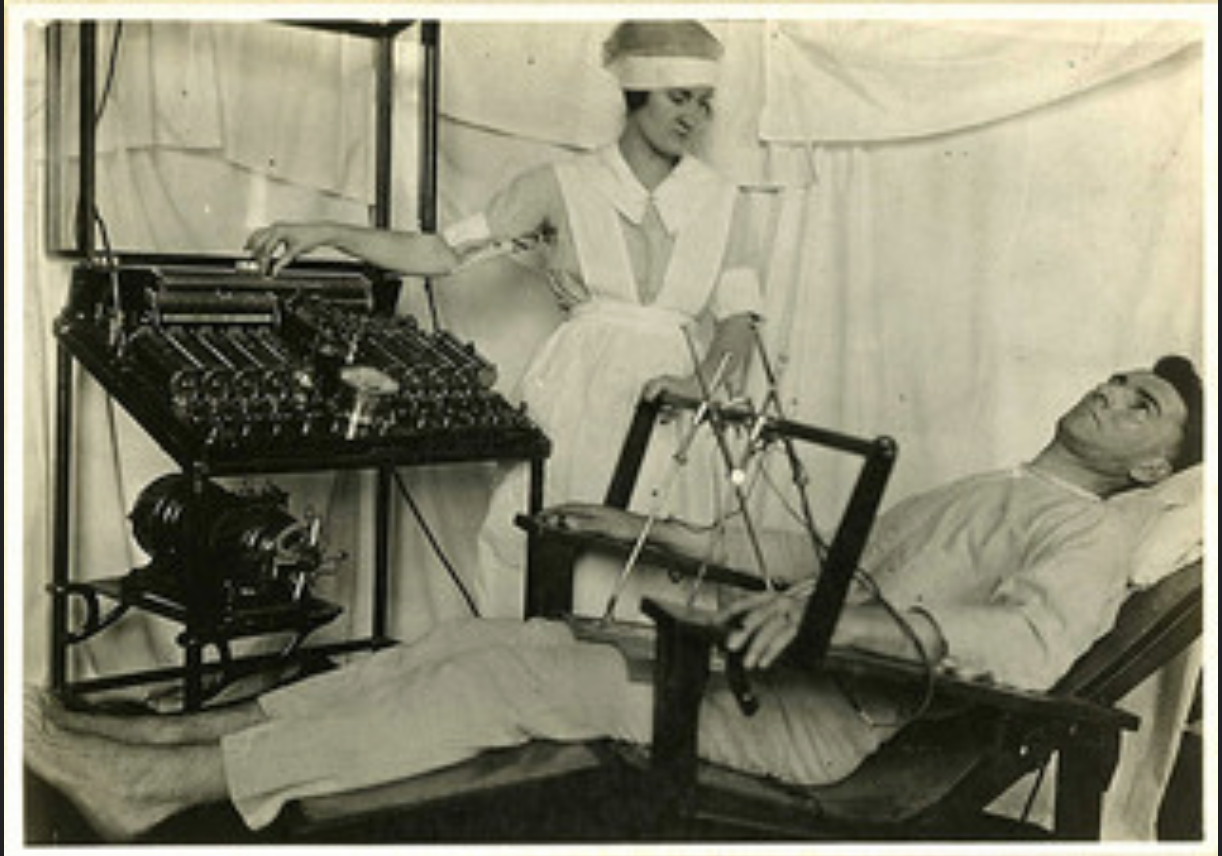
Shell shock was very real. Symptoms included palpitations, fear of fainting, feelings of suffocation, throat constriction, depression, insomnia, nervousness, lassitude, loss of memory, diminution of self-confidence and self-control, and terrifying dreams. Some were struck with physical symptoms such as blindness, loss of hearing, facial and body tics, convulsive movements similar to epileptic fits, and limbs that could not move. As noted earlier, treatment protocols varied not only as war progressed but also physician to physician and facility to facility. Treatments included electric shock therapy, electric heat baths, milk diets, hypnotism, clamps and machines that physically forced limbs out of their frozen positions, rest, peace and quiet, calming activities and psychotherapy sessions. In a 1917 article written by Dr. G.E. Smith, the author describes an ideal treatment plan: firmness and sympathy, limited periods of isolation, suggestion and hypnosis, rational treatment (by which he means probing the individual to discover fundamental causes of the condition), and the therapeutic value of work. Sadly, many of those who suffered were not given the benefit of this approach.


Otis Historical Archives National
Museum of Health and Medicine
https://www.flickr.com/photos/27337026@N03/
The numbers are staggering. By the end of World War One, the British army had dealt with approximately 80,000 cases of shell shock. Four out of five cases were unable to return to active duty.  A decade after the end of the war, over 74,000 cases were registered with the Ministry of Pensions. As estimated 10% of over 1.6 million military wounded of the war were attributed to shell shock. Shocking to say the least.

During the war, Siegfried Sassoon was sent to Craiglockhart Hospital, a treatment centre for officers suffering from shellshock. He wrote many poems, one of which is called Survivors.
No doubt they’ll soon get well; the shock and strain
Have caused their stammering, disconnected talk
Of course, they’re ‘longing to go out again’
These boys with old, scared faces, learning to walk.

They’ll soon forget their haunted nights; their cowed
Subjection to the ghosts of friends who died
Their dreams that drip with murder; and they’ll be proud
Of glorious war that shatter’d their pride…
Men who went out to battle, grim and glad;
Children, with eyes that hate you, broken and mad.

~~~~~~~~~~~~~

This is an Editors' Choice post, originally posted on Tuesday, December 2, 2014 and now updated by the author.

Sources:
Shell shock, Gordon Holmes and the Great War, by A.D. Macleod in JRSM

The Shock of War, by Caroline Alexander in Smithsonian Magazine, Sept 2010

Shell Shock during World War One, by Professor Joanna Bourke, www.bbc.co.uk

Shellshock and Its Lessons, by G.E. Smith and T.H. Pear, Manchester University Press, 1917

Masculinity, Shell Shock, and Emotional Survival in the First World War, by Dr Tracey Loughran, Reviews in History, http://www.history.ac.uk/reviews/review/944


M.K. Tod writes historical fiction and blogs about all aspects of the genre at A Writer of History. Her latest novel, TIME AND REGRET will be published by Lake Union on August 16, 2016. Mary’s other novels, LIES TOLD IN SILENCE and UNRAVELLED are available from Amazon and in e-book formats from Amazon, Nook, KoboGoogle Play and iTunes Mary can be contacted on
FacebookTwitter and Goodreads 


Saturday, January 30, 2016

The Lusitania Cover-Up

By Greg Taylor

The Lusitania Cover-Up was published in July in i-Magazine in the UK.

Nearly 100 years after the 9/11 of its day, the truth comes out.

On May 1st last year, the government archives at Kew released declassified documents. What documents are kept secret? Those that are dangerous or embarrassing to the government. In the case of documents related to RMS Lusitania released on May 1st 2014, both are true.

The sinking of the Lusitania was the 9/11 of its day. On May 7th 1915, the 31,550-ton Cunard Liner was en route to Liverpool from New York with 1,959 souls aboard when a German U-Boat torpedoed her just 11 miles off the coast of Ireland.

Everyone is familiar with the tale of the Titanic but what about the Lusitania?

She was launched into the River Clyde to the strains of “Rule Britannia” on June 7 1906, the largest moveable object ever created by man. On the Lusitania rested the hopes of the Empire and Cunard Lines that Britain would reclaim from the German liners the Blue Riband for the fastest crossing of the Atlantic.

By George Grantham Bain [Public Domain]
via Wikimedia Commons

She was financed with government loans on the condition she be available for troop transport in time of need. Despite this, the Lusitania was fitted out to a standard of luxury never seen before. She reclaimed for Britain the Blue Riband on her third Atlantic crossing with a speed of 23.99 knots.

Dining Saloon RMS Lusitania,
[Public Domain] Wikimedia Commons

In 1915, the Lusitania was the fastest, most luxurious ship making the transatlantic run. When she sailed from New York on May 1st 1915, the New York Times and other papers carried a warning from the German Embassy. Everyone ignored it - confident the fastest ship in the world could outrun any German submarine that might dare to threaten a passenger liner travelling from a neutral country.

Submarines of that period had a top speed underwater of only nine knots. They could reach speeds of fifteen knots on the surface but were vulnerable of being rammed. This led the Admiralty to issue such instructions to the merchant fleet in February 1915, a command that was intercepted and known to the German High Command.

The U20 spotted the Lusitania on the 7th of May, the last day of her crossing. The submarine nearly lost her due to the liner’s superior speed but a last minute change of direction gave the U20 an excellent shot. After being hit by a single torpedo, the Lusitania sank in eighteen minutes at a list so severe that only eight of the forty-two lifeboats were launched. Due to the thirty-degree list, the lifeboats on the port side smashed into the decks below, while those on the starboard side hung eight feet from the doomed ship.

Knowing the speed of the Lusitania might flip lifeboats put into the water, Captain Turner ordered the boats lowered to the Promenade Deck and kept empty until the ship slowed. He did not realise that he and his passengers would have only eighteen minutes before the stern slipped under the water.

By Winsor McCay (Living Lines Library)
[Public Domain] Wikimedia Commons

Kapitänleutnant Schwieger, who ordered the torpedo strike, was shocked when he saw through his periscope a second, much larger explosion. He refused to permit his crew to look at the drowning passengers of the Lusitania.

To this day, experts continue to debate the cause of the second explosion that sealed the Lusitania’s fate after the torpedo struck. Imperial Germany immediately claimed the ship was loaded with explosives destined for the front.

In June 1915, during the official inquiry into the sinking of the Lusitania, the Admiralty manipulated testimony so that Lord Mersey reached an erroneous conclusion that multiple torpedoes struck the ship. The Admiralty knew from an intercepted message that Kapitänleutnant Schwieger had fired only a single torpedo. It was important to many that the inquiry blame only Imperial Germany. Lord Mersey waived his fees for the case and formally resigned two days after the verdict, saying, "The Lusitania case was a damned, dirty business!" Documents related to the closed sessions of the inquiry have never been released and Lord Mersey’s personal copy is claimed to be lost.

The Admiralty had withdrawn the Lusitania’s escort ship, HMS Juno, once the submarine threat became known. Like the Lusitania, the Juno was built with longitudinal coal bunkers that protected vital machinery from shellfire but made the ship vulnerable to listing when hit by a torpedo. It was also known that First Sea Lord Winston Churchill had remarked that the loss of an ocean liner such as the Lusitania might help bring America into the war on the side of Britain.

Beginning in 1922, Germany repeatedly requested international dives on the Lusitania wreck to determine whether the second explosion was a result of contraband munitions on board. The alleged use by the British Navy of the site for testing depth charges is considered by some an effort to destroy evidence.

What was in the documents released at Kew last year?

Under the 30 Year Rule, the British National Archive released internal memoranda between the Commonwealth Office and Ministry of Defence that showed that in 1982 the Government was concerned that divers to the Lusitania wreck were at risk because the wreck contained explosives. One of the memos went so far as to say that this disclosure might “blow up on us all”. The British government was worried about ramifications for British-American relations because the discovery of explosives on the wreck would imply the Lusitania had been a legitimate target.

The novel, Lusitania R.E.X, weaves fiction around the known facts to create a plausible explanation of some of the mysteries surrounding the sinking. The story is centred on one of the wealthiest men in the world, Alfred Vanderbilt, who lost his life after giving his lifebelt to a woman passenger. This historical fiction is replete with spies, secret societies and superweapons, as well as millionaires, monarchs and martyrs. In the book, Alfred and his fellow members of Skull and Bones, a Yale secret society that in 1911 included the President of the United States, the Secretary of War and the Secretary of the Treasury, have taken a secret cargo aboard the ship. The story unfolds on both sides of the Atlantic Ocean in settings that range from gilded palaces and the Lusitania to the blood-soaked trenches of Ypres.

~~~~~~~~~~~~~
Greg Taylor is the author of Lusitania R.E.X and the inaugural winner of the M.M. Bennett's Award for Historical Fiction. Lusitania R.E.X is also a finalist in the People’s Book Prize. For more information, visit his website at www.lusitaniarex.com