Showing posts with label Louisa Adams. Show all posts

Wednesday, December 27, 2017

Christmas Vacation Treat - Louisa Catherine Adams Parts I, II, III and Conclusion

Our Editorial Team is taking a break over Christmas, but we've selected a few highlights from the last twelve months for you to re-read in between bouts of turkey-consumption and games of charades.

Earlier this year, Lauren Gilbert brought us the story of Louisa Catherine Adams, the fifth First Lady of the Unites States, who was an Englishwoman:


Read Part I HERE

Read Part II HERE

Read Part III HERE

Read Conclusion HERE


The Editorial Team wishes you all a very Happy Christmas and we will be bringing you lots more articles in the New Year!

Wednesday, February 8, 2017

Louisa Catherine Adams: The Fifth First Lady of the United States (Conclusion)

by Lauren Gilbert

In Louisa Adams’s day, women seldom (if ever) made extensive journeys on their own. When John Quincy had to go to Paris for a peace commission to end the war between Great Britain and the United States, he (rather surprisingly) left her in charge of everything, and she had been enjoying that freedom even though she was tired of the long separation. Then came his instructions in a letter which she received January 20, 1815, to sell everything she did not want to keep and bring their son to meet him in Paris. Breaking up a household and preparing for a 2000 mile journey from St. Petersburg to Paris, in the dead of winter, would have been a daunting task for the most seasoned individual. For Louisa, taking on this task and completing it to John Quincy’s approval must have been almost overwhelming. However, she rose to the occasion, sold what she deemed appropriate, packed up the furniture, books and other items to be stored until shipment to them was possible, selected the carriage (a Russian carriage, complete with runners for use on snow) and prepared accordingly for her journey.

St Petersburg as Louisa would have seen it

On February 12, 1815, she left St. Petersburg with her seven-year old son Charles, his nurse (hired that day) and two servants. The journey required passports for Russia, Prussia and France. Not only was she travelling with her party in winter, she went through areas ravaged by the Napoleonic wars. Louisa made all of the decisions, including the route and stops. Later in life she wrote “Narrative of a Journey from St. Petersburg to Paris in February, 1815,” describing the trip, based on her diaries. 

It was a very hazardous trip, between the weather and the war. The risk of robbery or worse was high. She endured many sleepless nights, afraid to sleep while her son and servants did. The destruction and death resulting from the war was agonizing to see. Despite her health, she kept her head and continued into France, to be greeted on the road by a group of Imperial Guards who were on their way to rendezvous with Napoleon. Seeing her Russian coach, they assumed the party was Russian and an enemy. Louisa had the presence of mind to show her passports and establish she was an American. After an exchange of cheers “Vive les Americains” and “Vive Napoleon”, the Imperial Guard allowed her to continue on her way, escorting her and her party to a post house where it was arranged for her to spend the night and advice about her travel the next day given. Her health issues plagued her but she carried on in spite of them, finally arriving at the meeting place, the Hotel du Nord in Paris, on March 23, 1815. She and Charles were reunited with John Quincy after an eleven-month separation and a journey of forty days.


The Insurrection of the Decembrists
at Senate Square, St Petersburg, on 14th December, 1825
by Karl Kolman (1786-1846)[Public Domain] 
via Wikimedia Commons

Both Louisa and John Quincy were serious diarists as well as letter writers, and noted their reunion. Sadly, their recollections do not agree: he remembered his wife and son arriving shortly after he returned to his rooms from a play, while she remembers that he was out when they arrived.


Sources indicate that John Quincy did not record any information about her journey. Indeed, he took his wife and son sightseeing the next day, and swept her into his social rounds as if nothing extraordinary had occurred. While John Quincy apparently regarded his wife's journey as insignificant, Louisa should have felt justifiable pride and a feeling of self-confidence in accomplishing a difficult journey, handling every aspect on her own. Interestingly, when the family left Paris May 16, 1815 for England, travelling to Dover under John Quincy’s guidance, her fatigue and fragility again affected her, and caused delays in their journey. One source speculated that managing on her own in St. Petersburg and on the journey to Paris exhausted her strength. However, it seems equally possible to me that she behaved in a manner that met John Quincy’s expectations. 

When John Quincy and Louisa reached London on May 25, the two older sons George (age fourteen) and John II (almost twelve) were at the hotel; the boys had not seen their parents for six years. John Quincy was assigned as minister to the Court of St. James, so the reunited family had a chance to get used to each other again. They rented lodgings from May to July, searching for more comfortable housing that they could actually afford.


US Passport issued by Adams in London, 1815
By Huddyhuddy (Self-scanned)
[CC BY-SA 3.0] via Wikimedia Commons


Finally, Louisa looked at a house named Little Boston House in Little Ealing, which turned out to suit their family well. John Quincy’s diplomatic duties were not particularly onerous, involving mostly correspondence and reports. Unfortunately, in October, an infected hand and inflamed eye seriously disabled him, as he was in great pain, could not hold a pen or write, and could not read. Louisa cared for him, managed the staff, took care of the boys, went into London when necessary and entertained visitors. She also kept information for John Quincy’s use, helped him with his correspondence and managed her own. In early 1816, John Quincy was apparently able to resume at least some of his public functions and Louisa was presented to Queen Charlotte in one of the queen’s drawing rooms. Unlike her previous experiences at their earlier diplomatic posts in Berlin and St. Petersburg, Louisa did not seem to enjoy the diplomatic scene very much, at least in part because they held a lower status and because their residence outside of London made entertaining (including returning invitations) difficult. They also knew that many of the invitations received were a matter of protocol more than anything else. They did make friends, and sources indicate that Louisa enjoyed the parties and hectic schedule. All in all, this was a time of contentment for the family.


Charles Bird King portrait of Louisa Adams.jpg
Louisa Adams by Charles Bird King
[Public Domain] via Wikimedia Commons

On November 1, 1816, James Monroe was elected president. There were rumours that John Quincy would be appointed Secretary of State, and Louisa, at age 42, was once again pregnant, and this pregnancy was yet another difficult one. On April 16, 1817, after much speculation, John Quincy received the letter indicating he had been appointed as Secretary of State and that his appointment was confirmed by the Senate. Given Louisa’s condition, there was concern about her making the voyage. Despite the risks, she accompanied John Quincy and their sons when they took ship for America, departing June 15, 1817. Sadly, she miscarried on the voyage. They landed in New York City on August 6, 1817. Louisa once again was a political wife but this time was a bit different: she had more experience, she had more self-confidence and she had more ambition for her husband.

Rather than get into a detailed discussion of John Quincy’s career from Secretary of State to the Presidency in 1825, and on to the House of Representatives in 1830, I am going to focus on Louisa’s role as political wife. First of all, it is important to understand that, at this time, appointment to the position of Secretary of State was an indication of a future presidential candidate, which John and Abigail Adams would have recognized and would have become clear to Louisa in short order. As the wife of the Secretary of State, everything Louisa did had to be done with an eye to the future. It did not help that John Quincy was not interested in running a campaign; he apparently felt that, if the electorate felt he deserved the presidency (as he himself felt he did), they would reward him by voting for him.

Louisa did not see much of John Quincy, as he was overwhelmed with State Department work, including everything from foreign policy to the standardization of weights and measures. She was, however, involved with the social aspect of life in the capitol. They got off to a bad start by not initiating calls, which generated criticism and a boycott of Louisa’s parties by other wives. Elizabeth Monroe, the president’s wife, let her know of their error. Louisa was also a keen observer of how things got done and the impact of an emotion or a personal appeal. She and John Quincy made a virtue of not initiating calls as an indication of humility.

Louisa returned calls, hosted dinner parties, and observed other hostesses. Her upbringing and her experiences as a diplomat’s wife fitted her for her role as the wife of the Secretary of State (and future president) and his campaign manager. It took time, but she gained acceptance among the other political wives. She was invited to more functions, and her invitations to her own dinners and parties were increasingly accepted, increasing her sphere of influence. She watched Mrs. Monroe, and was influenced by Dolley Madison’s style of entertaining. Louisa was still considered by some to be too foreign, but was greatly admired as a charming hostess who kept the conversations going and the guests circulating.

Louisa had grown increasingly close to John and Abigail Adams, and had taken over her husband’s correspondence with his parents. She and John Quincy were grief-stricken when Abigail died at the end of 1818.
Abigail.jpg
Abigail Adams
[Public Domain]
However, she was a great comfort to her father-in-law, who had lost his “dearest friend” [1]. Her sons were away at school and she wrote to them frequently as well. She read constantly on a wide range of subjects from poetry to religion to the classics to A Vindication of the Rights of Women by Mary Wollstonecraft (she liked Mary Wollstonecraft’s work).[2] Her earlier reading gave her a sound base for her on-going studies. She was very intelligent and somewhat introspective, and her letters to John and to her sons, as well as her journals, reflect the range of her thoughts.

Her periodic bouts of illness (which included erysipelas, a bacterial skin infection that involves an extremely painful rash) caused her to miss parties, and were exacerbated by John Quincy’s autocratic tendency to make decisions concerning their sons without consulting her. Things began to turn around when she took her brother Thomas Johnson to Philadelphia for medical treatment in June 1822. She had many friends in Philadelphia and, as her brother’s health (and her own) started showing improvement, she began socializing again. Philadelphia had been the original capitol, and was the second largest city in the United States and still attracted many important people, many of whom visited Louisa. Louisa was able to resume her activity on her husband’s behalf, and became a conduit of information in her letters to him. They corresponded regularly and warmly. She worked hard on his behalf, and tried to compel him to campaign for himself (which was largely unsuccessful). She returned to Washington in October of 1822.

An increasingly tense political situation arose with three contenders for the presidency: Andrew Jackson, Henry Clay and John Quincy Adams. The election in 1824 did not result in a clear winner based on a majority of the electoral votes, so the House of Representatives had the responsibility to pick the president. John Quincy finally got active in the fray, while Louisa continued her activities. On February ninth, 1825, the House of Representatives voted and John Quincy Adams became the fifth president of the United States. Louisa did not attend the inauguration of March 4 due to ill health. Shortly after, John Quincy and Louisa moved to the White House. Unlike today, they did not move into a clean, furnished and staffed White House; the new First Lady was not greeted and prepared. The White House needed cleaning, decorating and repairs, and Louisa had to use her own instincts and experience.

Layout of the White House 1807
by Benjamin Henry Latrobe
Library of Congress [Public Domain] 
via Wikimedia Commons

John Quincy’s presidency was a difficult period for them both. A particular issue that was fraught with pitfalls for them both was the subject of slavery. Both considered themselves against slavery, yet found it a difficult subject as Louisa’s family had owned slaves, the White House was built by slaves and slaves were common in Washington D.C., and John Quincy’s family in Massachusetts had also had a female slave in residence (according to an 1820 census-John and John Quincy are on record as non-slave owning presidents, but another family member or guest may have owned her) [3].   It was a painful, difficult and contentious matter personally and politically. John Quincy was (again) extremely busy, and Louisa spent more time on her own, more isolated than in her previous positions. Louisa continued writing and began an autobiography she initially called “Record of a Life” in which she ruminated on her marriage, as well as writing poetry. It was a difficult period, as John Quincy’s agenda was repeatedly stymied by Congress, and Louisa’s health appeared to deteriorate. (The effects of multiple miscarriages were undeniable, and the erysipelas was unabated.)

First Lady Louisa Adams.jpg
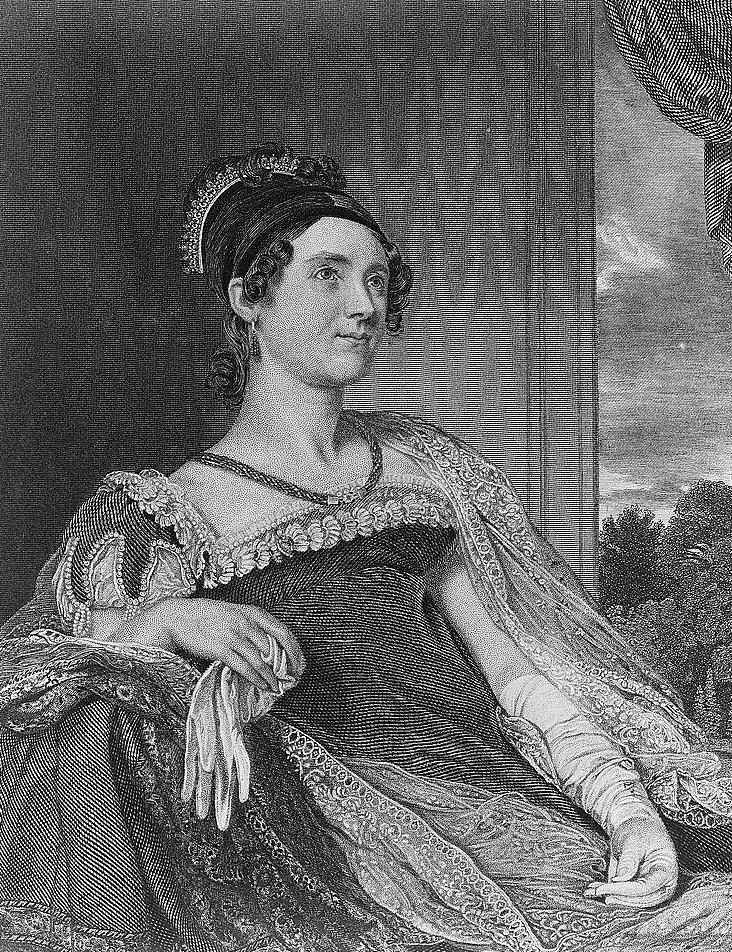
Louisa Adams by G.F Storm
Library of Congress [Public Domain]
via Wikimedia Commons
Another blow struck when John Adams died July 4, 1826. This was a devastating blow to John Quincy, personally and financially. Although he inherited the bulk of the estate and was executor, the costs of administering the terms were very high, much of which John Quincy had to pay out of pocket, which he decided to do in spite of Louisa’s objections and concerns. This left them basically having to support his brother Thomas and family. The whole situation angered and worried her greatly [4].  John Quincy was in Massachusetts, and was caught up in estate business, assisted by his two older sons George and John. Louisa joined John Quincy in August. Neither of his older sons lived up to John Quincy’s expectations, and during this time George’s health declined and Louisa went to Boston to care for him there. They returned to the Adams’ residence in Quincy later. The difficult relationship between her sons (especially George) and their father was painful for Louisa, and this combined with the tensions of the estate caused a rift between John Quincy and Louisa. She left for Washington, made it to Boston, and became ill again. John Quincy and Louisa were back in Washington in October, but the situation within the family did not improve, and tension remained between the couple. John Quincy’s mood was exacerbated by his political difficulties, and Louisa was unable to help with these. In spite of her health, Louisa continued to entertain and attend social functions.

JQA Photo.tif
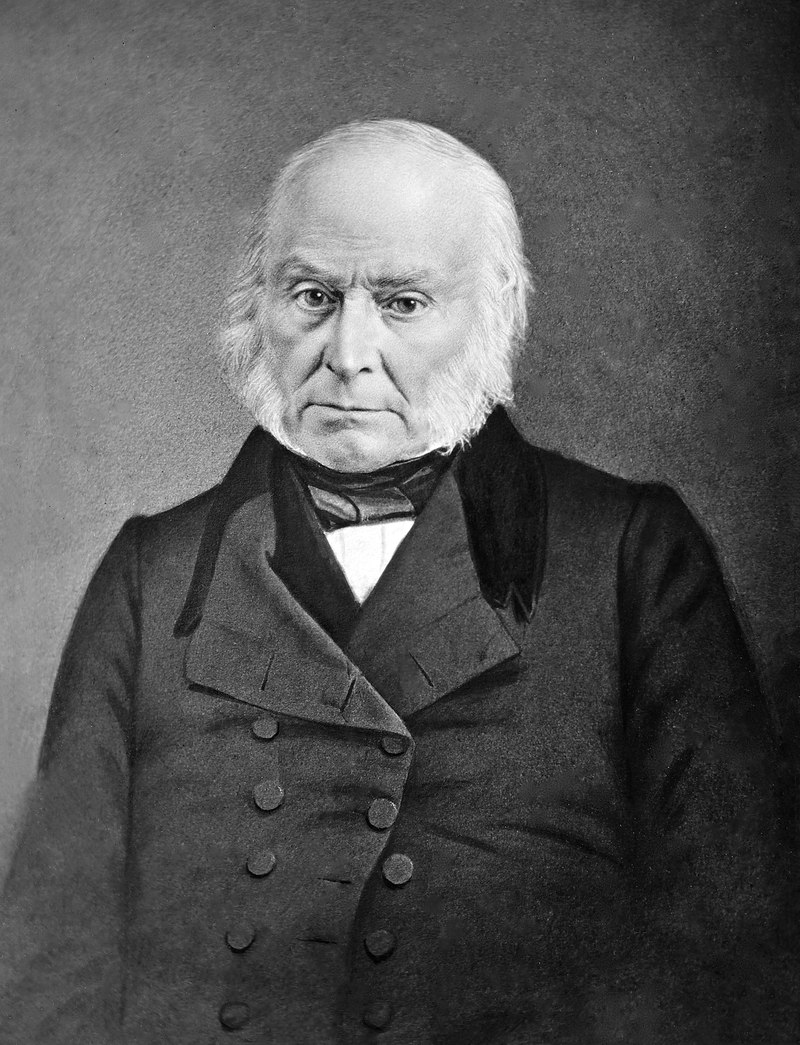
John Quincy  c1860
National Archives [Public Domain]
via Wikimedia Commons
John Quincy ran for re-election in 1828, and lost to Andrew Jackson. At once disappointed and relieved, John Quincy left the White House. Their personal relationship improved, and their family expanded with grandchildren. Tragically, George (who had not been doing well) died when he went overboard from the steamboat on which he was travelling to join his parents on April 30, 1829. His body was not found for a month. George’s death was a blow that John Quincy and Louisa bore together. John Quincy and son John went to Massachusetts to wrap up George’s affairs. In May of 1830, the family as a whole moved back to Quincy to stay, permanently she thought. This was not to be. In September of 1830, he was nominated for the House of Representatives for the Plymouth district. There is no indication he discussed it with Louisa. He won handily, and was very pleased. Unfortunately, Louisa was not and initially refused to return to Washington. However, she did go.

Their son John and his wife and children lived with her, and son Charles also married and had children. She was not under the same constraints as a congressman’s wife that she had been as First Lady. John Quincy remained in office as a Representative for the rest of his life, winning re-elections, and was active in his career. They spent the summers in Quincy, and winters in Washington D.C. for the Congressional terms. However, in 1834, she stayed in Washington D.C. to take care of her brother Thomas and son John who were ill until July when she went to Quincy without him. In October, they were notified that John and his wife were both ill. John Quincy went to Washington himself as Louisa was ill. Sadly, John died at age 31 on October 23, 1834. This dealt Louisa a cruel blow from which she barely recovered. She wrote her diary and in 1836 her narrative of her journey from St. Petersburg to Paris.

John Quincy was active in the House, fighting (among other things) the notorious gag rule passed in 1836 that prevented the discussion of slavery. Louisa was present February 26, 1837 when John Quincy introduced a petition to prohibit the slave trade in Washington D.C. which released a storm of conflict in which she was swept up. At about the same time, she also began reading about women’s rights and was sympathetic with much of what she read. In 1840, she began writing her autobiography, which she called “The Adventures of a Nobody.” (A depressing and misleading title, as she was certainly not nobody.) John Quincy continued his service in the House, fighting slavery and in 1844 seeing the revocation of the gag rule. He was the oldest member of Congress, and his health began to decline. On February 21, 1848, he collapsed on the floor of the House, was carried to the speakers room, and he died the next day. Louisa had been called and had been with him but had been sent home. She was not with him when he died on February 23, a source of bitterness. They had been married almost 51 years. She had a stroke March 18, 1849. She had a limited recovery and passed away May 15, 1852 at the age of 77. She was finally buried in Quincy, where their only surviving child Charles had both his parents’ bodies interred together.

For earlier installments of the life of Louisa Catherine Adams, see Part IPart II and Part III

Notes:

[1] John and Abigail referred to each other as “My Dearest Friend” in their voluminous correspondence-see Lynn Withey, DEAREST FRIEND.

[2] Thomas, Louisa. LOUISA The Extraordinary Life of Mrs. Adams. P. 281

[3] Newyork.com, “So Palpable a Stain” by Louisa Thomas.

[4] Thomas, Louisa. Op Cit pp. 343-345.


Sources:

See sources listed previously in Parts I, II and III.

Newyorker.com “So Palpable A Stain:The Adams Family and Slavery in Washington, D.C.” by Louisa Thomas, April 25, 2016.

Scribner’s Magazine, Vol. XXXIV July-Dec, 1903. “Mrs. John Quincy Adams’s Narrative of A Journey from St. Petersburg to Paris in February, 1815 With an Introduction by Her Grandson, Brooks Adams.” New York: Charles Scribners Sons, 1903. Pages 448-463.

ShannonSelin.com “Louisa Adams, Social Charmer” by Shannon Selin, post date not shown.

The Beehive. “Abigail’s Window” by Sara Georgini, Adams Papers, July 30, 2016.

~~~~~~~~~~

Lauren Gilbert is the author of Heyerwood: A Novel, released in 2011. A second novel A Rational Attachment is in process. She lives in Florida with her husband, with some roses (white ones are blooming) and gardenias, herbs and pineapples. Please visit her website at www.lauren-gilbert.com for more information.

Tuesday, January 31, 2017

Louisa Catherine Adams-The Fifth First Lady of the United States (Part III)

by Lauren Gilbert

Louisa Catherine Johnson Adams by Gilbert Stuart 1821-1826


Part I can be found HERE
Part II can be found HERE

As we’ve seen, Louisa Johnson married John Quincy Adams on July 26, 1797, and discovered her father, who went back to America with the rest of her family shortly afterwards, was in debt to the wide and did not pay her dowry of 5000 pounds. According to some sources, John Quincy turned the household accounts, normally handled by a wife, over to his valet and left her feeling  that he included her in his disillusionment with her father and family resulting from his being approached by Joshua Johnson’s creditors. Although they shared some interests, including reading, and were genuinely in love, theirs was a difficult union: two insecure and extremely sensitive people, one of whom considered himself the master, to teach and lead the other (John Quincy) while the other yearned to be a partner with a voice who was not afraid to stand up for herself (Louisa). On top of this, Louisa became pregnant almost immediately. By all accounts, this was a difficult pregnancy; John Quincy’s own diaries make frequent references to Mrs. Adams’ sickness. It is also pertinent to remember that Napoleon was making himself felt on the continent. They finally left for John Quincy’s posting in Berlin on October 18, 1797, requiring a difficult sea crossing and an equally difficult land journey to Berlin which took six days. Shortly after settling into a hotel, Louisa suffered the first of multiple miscarriages almost immediately after their arrival. It was a long-drawn-out and excruciatingly painful ordeal for which the doctors could do little. To his credit, John Quincy was a support and took great care of Louisa during this time, and the situation united them much more closely. They settled into lodgings, and Louisa began her recovery; John Quincy presented his credentials, was presented and immediately began participating in the Prussian court society. 

Louisa, left to herself in the lodgings, became very lonely as she received no visitors and no invitations, while John Quincy made no effort to have her presented at court. Discovering that Queen Louise was starting to think that John Quincy and Louisa were not married, John Quincy escorted Louisa to the theatre one evening when the King and Queen of Prussia were expected to attend, and Louisa drew considerable attention. Subsequently, she was presented to Queen Louise, with whom she became quite friendly. Close in age to Louisa, Queen Louise was renowned for her beauty and charm, and she was also extremely kind. Louisa’s background, between her family’s social activities and her involvement with Anglo-American circles with Mr. and Mrs. Pinckney in London, fitted her to shine in diplomatic society abroad. Her fluent French was also an advantage. Unbeknownst to John Quincy, she became a significant asset to him, especially since diplomacy was (as it still is) conducted in social settings almost as much as in conference rooms. While he was waiting for her to make a mistake and cause him embarrassment, Louisa was busy becoming a success, meeting people and smoothing his way. This would become a recurring theme throughout their marriage. In the meanwhile, John Quincy worried about her acquiring monarchical tendencies, too fond of pomp and circumstances for American tastes (especially his mother’s). Ironically, because John Quincy was the son of the American president as well as an ambassador, they were given a higher place in court protocol than may have been expected. Of course, this meant they had to entertain as well as attend court functions (which meant appropriate apparel for both) on an extremely limited budget and while Louisa continued to experience poor health. She apparently had difficult menstrual cycles and suffered multiple miscarriages which deeply pained her and John Quincy both. It was during this time that she developed the on-going health problems for which she was subsequently know, which included debilitating headaches and fainting spells.  

In February of 1801, they received news of two painful events: John Adams lost the presidency to Thomas Jefferson, and John Quincy’s brother Charles died. The bright spot came on April 12 of 1801, when Louisa delivered a living son whom they named George Washington Adams, after yet another difficult and painful labour. Although she subsequently suffered a high fever and was very ill, she was recovering when John Quincy and his family were ordered to return to the United States. They left Berlin on June 17, 1801. Louisa was on her way to America, a place she had never visited even though she was a citizen. Apparently, during the trip, John Quincy also told her all about Mary Frazier and his failed courtship, which could not have helped her feel more confident. Upon arrival, John Quincy went to Massachusetts to his family home, and she took baby George and went to see her family in Georgetown, near Washington. The visit was not very happy by all accounts: Mr. Johnson’s financial problems were known, he was in poor health, and John Quincy’s absence was noted. In October, John Quincy came to get her and George to bring them home to John and Abigail Adams’ house.

Louisa’s entrance into the Adams’ family was not easy. John and Abigail made no pretence of sincere friendliness; with her foreign upbringing, she felt equally out of place with them. Abigail in particular disapproved of Louisa as a fine lady, and Louisa had no training to be the kind of housewife that Abigail would find suitable. Abigail was also concerned about Louisa’s poor health. Louisa herself was very aware of the differences between her upbringing as an American in England, and felt the differences keenly. Eventually, her intelligence, love of reading and genuine desire for approval won over John Adams and they did develop a close friendship. Her relationship with Abigail was much more difficult, as John Quincy developed a bad habit of discussing his household issues with his mother, then informing his wife of the decisions that he and his mother made. Louisa, of course, would make known her objections, and then ultimately go along. It cannot be a coincidence that her health issues, particularly the headaches and fainting spells continued. They moved into their own home in Boston, but issues did not improve as Louisa did not know how to manage the household, especially as she was expected to participate in the work of the household. Money was, as always , short, and John Quincy kept track of every cent and never hesitated to  show his aggravation. John Quincy was extremely busy with his law practice and in May of 1801 became a representative to the state senate. Louisa was left on her own increasingly. In February of 1803, he was appointed to the United States Senate by the legislature. Louisa, pregnant again, discovered she would be going to Washington just when she was starting to feel settled. Their second child was born July 4, 1803 and named John. The family arrived in Washington on October 20, 1803. This was the beginning of Louisa’s life as a political wife.

Their children were a special bone of contention. In the fall of 1805, John Quincy decided to leave their two sons in Massachusetts, without consulting Louisa and with Abigail’s complicity, while he and Louisa went to Washington.  Louisa was upset but went along. In addition to missing her children, she was experiencing a difficult pregnancy. Because of her pregnancy, John Quincy left her in Washington when he returned to Massachusetts for the summer (now without him AND her children). Sadly, her pregnancy resulted in a still birth.  Louisa finally made it home to Massachusetts in August 1806. The next term of Congress, she and the children stayed in Boston in miserable lodgings, again without consultation with Louisa. Clearly, John Quincy had no intention of allowing Louisa a voice, even though he consulted regularly with his mother. Equally clearly, Louisa made her anger at being so treated known, but went along anyway. During the summer of 1807, Louisa was pregnant again and she gave birth to a third son after yet another excruciating labour (the baby, named Charles Francis, was breech). When John Quincy took his family back to Washington for the 1807-1808 term, she was allowed to take the new baby; the two older children again stayed behind, this time boarding with John Quincy’s aunts (Abigail’s sisters) individually (George with Elizabeth Peabody and John with Mary Cranch). Louisa submitted, but not happily, and she did not agree that child rearing by proxy was good for her children. Given the number of miscarriages she had and the difficult labours she experienced, her attachment to her living children must have been particularly intense.  

Increasing political activity stemming from tension with Great Britain took John Quincy away even more and resulted him changing parties from the Federalists to the Republicans in support of Thomas Jefferson and James Madison. This resulted in his resigning his Senate seat and the family returning again to Boston in 1808, only to face social ostracism. Even John and Abigail Adams were upset about his change. He went to Washington to conduct three cases before the Supreme Court, again leaving Louisa and his children behind. She had become  pregnant again but lost the baby early in 1809 while John Quincy was away,  when she slipped and fell on ice. They had argued before he left, and conducted a bitter exchange of letters, even after the miscarriage. In July of 1809, the Madison administration offered John Quincy the position of minister plenipotentiary to Russia, which he accepted. Despite their friction, John Quincy wanted Louisa with him. He made arrangement, again with Abigail, to leave the two older boys with an aunt and uncle, while Louisa and little Charles accompanied him. There is no indication Louisa had any participation in deciding who would go with them and who would stay behind. This time, Louisa’s sister Kitty was among the party to go so at least she had a family member with her when they took ship on August 5, 1809, beginning an eighty-day voyage.  

Their arrival was difficult, as they had only the clothing they stood up in as, after they got off the ship in Kronstadt, it floated back out to sea with all of their belongings. They had to go on to St. Petersburg. The beginning of John Quincy’s mission was not going well: the drinking water had affected everyone (diarrhea), and they discovered that their luggage had been ransacked when it was finally returned. Again, as an ambassador, John Quincy and his wife were expected to be part of the social scene and, again, John Quincy was focused on their lack of money. Even though he was much more than he had been in Prussia (Louisa Thomas indicates only the president was paid more [1]).  Unfortunately, the Russian court was vastly wealthier, the social duties were heavier (almost nightly), and the entire party needed complete new wardrobes-they had to keep up with the Joneses with a vengeance, so to speak.

John Quincy’s assignment included fostering good relations with the Russians and there was no way for him or for Louisa to evade their social responsibilities. The expenses of daily living, combined with the costs of wardrobe suitable for court brought Louisa’s anxiety about her dowry to the forefront again. However, in spite of the financial hemorrhage resulting, Louisa enjoyed parties and dancing. She did not enjoy the high status she had held in Prussia (thanks largely to her friendship with Queen Louise) but did succeed in charming the Russian court and once again being an asset to John Quincy. The high-waisted flowing style we now associate with the Regency era in England was popular in Russia, and Louisa became very creative in stretching her and Kitty’s wardrobe funds as much as possible, not least in sewing their own gowns. Both John Quincy and Louisa bemoaned the exorbitant costs of living in Russia at this time, while carrying out their duties. Louisa suffered another miscarriage in February of 1810, but got back into her routine as quickly as possible. In the spring of 1811, John Quincy was offered a position on the Supreme Court. However, he declined, using the fact that Louisa was pregnant as an excuse. On August 11, after an uneventful pregnancy and labour, she delivered a little girl, who was named after her mother, Louisa Catherine. Louisa and John Quincy were both entranced with their daughter. John Quincy had sent for their sons in March of 1812, but war being declared with Great Britain, their trip was postponed indefinitely. The vast distance delayed news between the United States and Russia, and Louisa was much more experienced with separation from her family and children, so she was able to take comfort of Charles and Louisa Catherine.  Sadly, Louisa Catherine became ill and, after a long illness died September 15, 1812, the same day Napoleon rode through Moscow.
 
Both John Quincy and Louisa were devastated by her death. John Quincy was able to find some comfort in his work, but Louisa’s grief did not abate. John Quincy’s response was to buy her a book by Benjamin Rush, MEDICAL INQUIRIES and OBSERVATIONS, UPON DISEASES of the MIND. Not exactly a sensitive gift. She blamed herself for her child’s death and missed her two sons left behind more than ever; these feelings rekindled her anger with John Quincy. He was relieved when he asked to be part of a peace commission, which resulted in his departure April 28, 1814 and which was to keep him away for several months, leaving Louisa and Charles in St. Petersburg. Her health was never robust. Ironically, during her time in Russia, Louisa and her mother-in-law drew closer than they had ever been by letter. John Quincy’s departure left Louisa in complete charge of the household, while expecting her to maintain her social responsibilities. After years of not being allowed to handle anything, it is not unreasonable to assume that Louisa doubted her own abilities. However, she rose to the occasion and even enjoyed being in charge. Their letters indicate that they seem to have reconciled their differences at least to some extent, and showed a mutual affection. However, the prospect of yet another Russian winter, this time with John Quincy away, put a further strain on her. The peace commission took longer than anyone anticipated, but peace with Great Britain was finally concluded in December 1814. At that point, John Quincy dropped a bombshell on her: he informed her that he would not be returning to Russia and ordered her to sell everything she did not want to keep for the best price possible, and bring their son to join him in Paris as soon as she was able.  This put Louisa in position for a journey that was a defining experience in her life, and an illustration of the strength and character of this fascinating woman.


Part IV will discuss Louisa’s journey from St. Petersburg to Paris, her further career in Washington as the wife of Secretary of State and as First Lady, and our conclusion.

Notes:
[1] Thomas, Louisa.  LOUISA  The Extraordinary Life of Mrs. Adams. P. 172.

Sources include:
See sources listed in Parts I and II and

Caroli, Betty Boyd.  THE FIRST LADIES from Martha Washington to Michelle Obama 4th edition.  New York: Madison Park Press (an imprint of Direct Brands, Inc.), 2009.

Heffron, Margery M. LOUISA CATHERINE The Other Mrs. Adams.  New Haven: Yale University Press, 2014.

Roberts, Cokie.  LADIES OF LIBERTY The Women Who Shaped Our Nation.  New York: HarperCollins, 2008.

Thomas, Louisa.  LOUISA The Extraordinary Life of Mrs. Adams.  New York: Penguin Press, 2016.

Withey, Lynne.  DEAREST FRIEND A Life of Abigail Adams.  New York: Touchstone/Simon & Schuster, 2001 (originally published 1981 by the Free Press).

Image: Wikimedia Commons, HERE

About the author: Lauren Gilbert is the author of HEYERWOOD: A Novel, released in 2011.  A second novel A RATIONAL ATTACHMENT is in process.  She lives in Florida with her husband, with some roses (white ones are blooming) and gardenias, herbs and pineapples.  Please visit her website at www.lauren-gilbert.com for more information.


Sunday, January 15, 2017

Louisa Catherine Adams-The Fifth First Lady of the United States (Part I)


by Lauren Gilbert


Louisa Catherine Johnson 1794

Best known for being the first and (until inauguration day January 20, 2017) the only foreign-born first lady, Louisa Adams did not see the United States until she had been married four years.  She was married to John Quincy Adams, son of John and Abigail Adams, in spite of their and her father’s disapproval, and her own doubts.  Known for ill health and physical delicacy, she was also capable of decisive action when the situation required.  In their long marriage (from July 26, 1797 to John Quincy’s death February 23, 1848), they had several periods of separation and serious points of disagreement; however, she did everything she could to further his career and their letters show an on-going attachment.  Her life was a long and fascinating life, filled with adventures, trials and successes.   What intrigues me most about her is her rather unique point of view and her inner dialogues.

Louisa Catherine Johnson was born February 12, 1775 to Joshua Johnson and Catherine Newth or Nuth.  She was the second child, and second daughter, born in a family of nine children (eight girls and one boy).  Born in Maryland, Joshua Johnson was an American merchant, whose business was originally located in Maryland, arrived in England in 1771 at the behest of his employer Charles Wallace to act as the representative of Wallace, Davidson and Johnson, an importing firm they started in Annapolis MD, trading tobacco and mercantile goods.  Catherine Nuth was an English woman and possibly the daughter of a shoemaker who was known for her beauty and wit.   In November of 1773, their first child Ann (known as Nancy) was born.  Joshua’s business practices were highly speculative.  In 1778, at the height of the hostilities between America and Great Britain, Joshua took his family to Nantes, France. Louise was placed with Nancy in a convent school where she learned fluent French and was exposed to the Roman Catholic faith.  The family returned to London after peace was established, about 1783. 

After their return to England, Louisa had to relearn the English language.  Louisa was enrolled in boarding school with two sisters, where she did not fit in well, coming out of a French convent school.    Her studies included mathematics, stitching and embroidery, drawing and (interestingly) philosophy.  While at school, Louisa experienced a period of illness (including fainting) after which she was removed from school and was placed with some family friends, John and Elizabeth Hewlett. Both were highly intelligent and rather radical.  John helped wean Louisa from the Catholic ideas she had acquired in France to a more normal Anglican tradition, and Elizabeth was a strong minded woman (not the passive, dependent type admired by Louisa’s father and portrayed in current literature).   When Louisa returned to school, she came under the influence of a teacher, Miss Young, who encouraged her to read widely and think for herself and to express her thoughts.  An intelligent girl, she developed an interest in science, read controversial authors of the day, and questioned herself and her beliefs as well as her place and the place of women in general in her world.  She spent her pocket money on books.   After a few years, she and her sisters were removed from school in 1788 due to her father’s facing bankruptcy, about which the girls were kept in ignorance.  The girls then had a governess.  After some dispute (including concerns about Joshua’s lavish lifestyle), Joshua’s business partnership was extended, but financial problems resulted in the partnership being dissolved in 1789.  Joshua established himself on his own.  However, things weren’t the same, at least in part due to a decline in the Maryland tobacco trade and increased manufacturing of goods in America. 

An interesting side note: a marriage record exists showing that Joshua Johnson married Catherine Newth on August 22, 1785 in Westminster.   She had been known as Catherine Johnson, wife of Joshua Johnson, for years, and all of their children’s births were recorded as legitimate accordingly; there is no indication that she was not Joshua’s wife.  Certainly, there is no indication that neighbours, friends or their children were aware of any irregularity.  However, there is also no known record of an earlier marriage.  At least five of their children were born before the recorded marriage in 1785.  If that was in fact their only marriage, discovery could have meant scandal if not ruin for Joshua Johnson and his family.  Joshua was appointed consul by then-President Thomas Jefferson to act for America in England in 1790 (an appointment which would have been very unlikely if there had been questions about his marriage).  This appointment required him to report information about British shipping and preparations for war and locations of British fishing and whaling fleets.  He was also to help American seaman who had been impressed by the British when possible and to provide local intelligence of a political nature.  In return, Mr. Johnson made it clear that being in that position was expensive and had no hesitation in pursuing remuneration from Mr. Jefferson and Congress.

Mr. Johnson considered himself an American wholeheartedly, and there is an act recorded in the annals of the Maryland senate stating that he and his children were American citizens.  He intended, at some future point, to take his family to America and intended his daughters to marry Americans (preferably from the south).  Joshua had a very traditional view of the role of women.  However, his daughters were raised as proper English girls of well-to-do families were raised: they were educated, taught to sing, play an instrument and dance, how to speak French and how to supervise servants.  Although learning to manage servants included learning to cook and to make and mend clothes, the young ladies’  “work” was primarily decorative embroidery.  They were prepared for courtship and marriage, to be fine ladies who were cared for, not to be help meets.  She and her siblings experienced none of the alarms, privations and practical experience of girls raised in America during the Revolutionary period.  This difference in upbringing and outlook would affect Louisa’s entire life.  Louisa and her two  sisters Nancy and Caroline basically made their social debuts more or less at the same time, with Louisa being fifteen years old and Caroline a year younger.  Louisa was a pretty girl, more slender than was strictly fashionable, with large dark eyes.  Louisa was known to be shy and somewhat retiring but was very observant of what was going on around her.  In spite of Mr. Johnson’s financial fluctuations, the family entertained but, because no formal diplomatic relationship had been established between the United States and Great Britain, Johnson’s access to Parliament or court was restricted to secretaries and lower level officials, limiting his activities as consul as well as his family’s social access. 

It wasn’t until August of 1792, when Thomas Pinckney, appointed minister plenipotentiary, finally arrived in London with his wife Elizabeth that the social opportunities arose for the Johnson family.  Louisa became a favourite of Mrs. Pinckney and was allowed to visit and stay with her.  Mr. and Mrs. Pinckney were welcomed into Anglo-American society and, as a result, the Johnson family also had some access to that society, mingling with members of Parliament, artists and other notables.  Pretty, well dressed and well mannered, Louisa and her sisters were allowed to attend the social functions when invited, gaining a social polish and understanding of status.  Sadly,   Elizabeth Pinckney died two years after arriving in London, to Louisa’s sorrow.  Louisa, Nancy and Caroline all had beaus and flirtations. However, Mr. Johnson was quite selective on his daughters’ behalves, discouraging multiple suitors of each.  Although not wealthy, the young ladies were raised to expect a dowry of 5000 pounds each, so had no reason to expect that there would be difficulty receiving suitable offers.  (There is nothing to indicate that Mrs. Johnson or any of her daughters were aware of the vagaries of Mr. Johnson’s finances.)  Louisa did not seem to have been in a hurry to marry, enjoying the social activities and engaging a variety of individuals with her singing and conversation. Interestingly, she felt her intelligence and wide reading was not an asset for a young woman seeking a marriage partner, so she concealed that aspect of herself. It was as a polished young lady that Louisa met John Quincy Adams, resident minister to Holland and son of John and Abigail Adams.


In Part II, we will discuss Louisa’s marriage to John Quincy, her feelings and her experiences.

Sources include:
Britannica.com  “Louisa Adams American First Lady” by Betty Boyd Caroli, May 28, 2004. Here.

 Find-a-grave on line.  “Louisa Catherine Johnson Adams,” biography by William Bjornstad (no post date).  Here.

Firstladies.org  “First Lady Biography: Louisa Adams.” (No author or post date shown) Here.

Nps.gov  “Louisa Catherine Adams  (1775-1852).”  (no author or post date shown)  Here.

Smithsonian.com “Meet the First and Only Foreign-born First Lady: Louisa Catherine Adams” by Jackie Mansky, May 25, 2016. Here.

White House Historical Association on-line. “Louisa Adams.” (no author or post date shown.)  Here. 

Zocalopublicsquare.org  “From a London Alley to the White House” by Louisa Thomas, October 31, 2014.  Here. 

Heffron, Margery M. LOUISA CATHERINE The Other Mrs. Adams.  New Haven: Yale University Press, 2014.

Thomas, Louisa.  LOUISA The Extraordinary Life of Mrs. Adams.  New York: Penguin Press, 2016. 

Image Credit
By Edward Savage [Public domain], via Wikimedia Commons, https://commons.wikimedia.org/wiki/File:Louisa_Catherine_Adams.jpg

~~~~~~~~~~~~
About the author: Lauren Gilbert is the author of Heyerwood: A Novel, released in 2011.  A second novel, A Rational Attachment, is in process.  She lives in Florida with her husband, with some roses and gardenia, herbs and pineapples.  Please visit her website here  for more information.