Showing posts with label Judith Taylor. Show all posts

Wednesday, July 22, 2020

Lionel de Rothschild's Azaleas at Exbury

By Judith Taylor

Azalea is now an anachronistic term, purely descriptive. We are no longer allowed to refer to azaleas by the flower police. Modern taxonomy has shown that they are not a separate genus but actually rhododendrons. Pity.

Putting that cavil behind us let’s turn to Lionel de Rothschild and his gorgeous shrubs. He was born in 1882, the son of Leopold and Marie née Perugia de Rothschild and a great grandson of Mayer Amschel Rothschild, the founder of the dynasty in Frankfurt.  By then the Rothschilds had been established in England for almost eighty years and were completely Anglicized. The one thing they adhered to was their faith. The story of Nathan Mayer Rothschild finally being allowed to take his seat in Parliament on July 26, 1858, without having to swear on the New Testament, remains alive in English Jewish history. The House eventually permitted him to remain hatted and swear by Jehovah, not Jesus. He had been elected on two previous occasions but would not betray his religion.

Lionel de Rothschild in uniform, WWI

His parents sent Lionel to Harrow and later Trinity College, Cambridge and as the eldest son he was groomed to work in the family bank. Leopold was an affable and genial man who lived for hunting, shooting and horse racing. Lionel gradually lost interest in these pursuits even though he was a skilled shot.

What he loved was speed. Whenever he had a chance he would take one of his fast cars out for a spin. He spent a lot of time at race car tracks. While exciting this was an unproductive pastime. Fortunately it was later replaced by the very constructive passion for horticulture which absorbed the main part of his adult life but which could be traced back to his childhood. Even as a small boy he had been attracted to the rhododendrons in his father’s gardens at Ascott in Leighton buzzard. Unlike so many children he made good use of the little garden plot they let him have when he was five.

“Mr Lionel”, as all the staff called him, even senior managers, married the composer Meyerbeer’s grand daughter Marie Louise Beer in 1912. In 1919 Rothschild bought the Mitford estate at Exbury in Hampshire on the Beaulieu River. The property had been owned by the descendants of Walter Mitford, not David Freeman-Mitford, Lord Redesdale. Mitford’s grandson had called it an “earthly paradise”.

Azaleas at Exbury

The estate was heavily wooded and required an army of more than two hundred gardeners to clear out the excess undergrowth. Rothschild prevented the men from destroying the mature trees. Some of the cypresses had been grown from seed cones in the Duke of Wellington’s funeral wreaths in 1853. It was clear he already knew what he wanted to do.

Rhododendrons do best in partial to full shade. If you drive past wild ones in the Pacific North West the colours get deeper and richer the farther away you get from the road. A wood is the ideal place to raise them. A dairyman in Pennsylvania, or “cow feeder” as Sir Walter Scott called them, Joseph Gable, only had very modest means but did own a lot of untouched woodland. That enabled him to become one of the leading breeders of new rhododendrons of his generation. Later when he gave up farming and bred rhododendron full time someone asked why he had switched. Gable replied “Well, I never did like being nursemaid to a cow”.

Those decades were very fruitful for new plants. Since the nineteenth century various British syndicates and large nursery firms had sent explorers to very remote parts of Asia to bring back new and unknown plants. The syndicates dispersed their trophies amongst each other for gentle competition and enjoyment. The nurseries made fortunes from selling the exotic finds.

The explorers worked in different ways. Many of them were very tough Scots. They hired Chinese porters and stayed wherever they could, often in very rough conditions. One or two climbed to fifteen thousand feet in the Himalayas to reach the plants. At that altitude a rhododendron grows prostrate along the ground.  Their presence aroused dismay among Buddhist lamas and the latter tried to chase them away, attacking them violently.

The French missionary fathers in the region, who were very capable plant collectors themselves, had been too successful with their missionary efforts. Buddhists were becoming Christian. In the lamas’ minds all white men were devils. Plant explorers like George Forrest were not so easily intimidated. Their entire lives had been one of unmitigated hardship at the hands of the Scottish head gardeners.

In some cases Europeans already living and working in those countries were enthusiastic collectors. For example Nathaniel Wallich in India, a Danish surgeon who became an Englishman as a result of one of the many petty local wars of the time, sent back the enormous Rhododendron arboreum with its crimson flowers. Nothing like that had ever been seen before in England.  The few native European and Eurasian rhododendron species were in pastel colors. The lavender R. ponticum is one of those. The big challenge for the plant breeders was to keep the deep crimson colour but reduce the size of the trunk and branches.

Rhododendron arboreum

British gardens already had numerous azaleas from the eighteenth century exploration of North America such as R. catawbiensis. Trying to find more of the genus in Asia was a natural extension of this process. In the foundational epoch of the planet the single ur-continent of Pangaea is thought to have split into Asia and North America billions of years ago but still after the development of the flowering plants.  Plants of the same family which had been growing together in the mother continent were now separated and developed along their own lines. This was true of more than one genus, including magnolias and maples.

As a class of plants most rhododendrons require acid soil and many are very tender. They are endemic to the warmer southern parts of the United States and sub tropical China. Gable’s life work was to make them more winter hardy. Some breeders also tried to develop hybrids which might grow on chalky soil. The hardiness which came from the high alpine species was lost as a result of much breeding.

Rothschild wanted to breed in new color, dimensions and fragrance. When he died in 1942 he left 1024 new cultivars, immensely enriching the entire world by his work. He won many cups and medals in his life time but in 2001 the American Rhododendron Society gave him a posthumous Pioneer Achievement Award.  His death in the middle of World War II allowed the Admiralty to requisition his house and estate to be the headquarters for Navy shipping along the Beaulieu River. Lionel’s family vacated the house at forty eight hours notice.

Back in 1920, with the property cleared, he began construction. Winding paths were carved out. A large water tower emerged, the source of miles of irrigation pipes. That particular micro -climate was very dry. Rothschild built a small private railway to bring in the heavy rocks and stone he needed for his glens and dells. Later that came in very handy for rebuilding the dwelling house on the property. There were two small steam engines which are still an attraction now.

The final step was acquiring the plants to begin his great adventure. He did not always have to start from scratch. Knap Hill Nursery in Surrey was the source of many valuable hybrids on which he could build and the Belgian breeder Mortier had already introduced the  ‘Mollis’ azaleas.

One of the most striking elements of his work came from an obscure Japanese species only to be found growing on the top of a hill on a small island off the coast, R. yakushimanum. The moment it was presented to him by Koichiro Wada, a dedicated Japanese nurseryman, in the 1930s he saw its potential. The entire plant can only be about eighteen inches to three feet tall and is very hardy. This gave him a dwarfing gene with which to modify so many of his prospective hybrids. 

R. yakushimanum

During his active years he meticulously planned the crossings he wanted done to reach his goals. Unless a breeder has a strong notion of what he is trying to accomplish simply making crossings for their own sakes can be a meaningless exercise in futility. Other wealthy men used the same discipline with their flocks of pedigree sheep or their Arabian horses. Rothschild followed the advice he was intelligent enough to seek from experts like J. C. Williams at Caerhays in Cornwall. They often participated in the same plant exploring syndicates.

Every Friday he drove down from London to spend his time gardening. “Gardening” in his vocabulary did not mean putting on an old tweed jacket and wellies, then sallying forth with a hoe. No, this was a strategic planning meeting with the head gardener, laying out the genealogical background of each plant he wanted crossed. He had spent much of the time at the office working out these plans.  He himself performed the hand pollination of each cross but then told the staff where he wanted the older saplings to go. Once he had quipped that he wanted his epitaph to read “A gardener by profession and a banker by hobby”.

The head gardener issued his instructions to the thirteen gardeners at his disposal. Some of the exquisite results were R. ‘Albatross’, ‘Avalanche’, ‘Brocade’ and more in the alphabetical order he chose his names.

R. Albatross

There is actually much more to be said about the gardens at Exbury than is possible in this short essay. Rothschild liked almost all trees and plants. He created an arboretum of England’s trees on his land and dabbled in breeding narcissus. The distinguished forester W. J. Bean advised him about the arboretum.

After World War Two ended his son Edmund tried to maintain the estate but there were almost no men available to work in the gardens. As I write this I realize how little the idea of women working as gardeners had penetrated the wider consciousness. Beside this concern there were the issues of taxation and general maintenance which even the Rothschilds could not ignore. Edmund de Rothschild donated the estate to the public and set up a registered charity to take care of it. In that way the rhododendrons were kept in their natural habitat and many visitors would enjoy the cool charm of the winding paths and long vistas.


REFERENCES

Philips, C. E.  Lucas and Peter N. Barber 1979  (revised edition)  The Rothschild Rhododendrons

London                Cassell


Taylor, Judith M. 2014  Visions of Loveliness: great flower breeders of the past”

Athens, Ohio       Ohio University Press

~~~~~~~~~~

Judith M. Taylor MD is a graduate of Somerville College and the Oxford University Medical School and is a board certified neurologist. She practiced neurology in New York and since retiring has written six books on horticultural history as well as numerous articles and book reviews on the same subject.

Dr Taylor’s books include The Olive in California: history of an immigrant tree (2000), Tangible Memories: Californians and their gardens 1800 – 1950 (2003), The Global Migrations of Ornamental Plants: how the world got into your garden (Missouri Botanical Garden Press 2009), Visions of Loveliness: the work of forgotten flower breeders (Ohio University Press 2014) and An Abundance of Flowers: more great flower breeders of the past (Ohio University Press  2018).  In 2019 she published A Five Year Plan for Geraniums: growing flowers commercially in East Germany 1946 – 1989. This book has recently been shortlisted for a prize from the Council on Botanical and Horticultural Libraries.
Dr Taylor’s web site is: www.horthistoria.com

Wednesday, July 1, 2020

Schools of Gardening for Ladies

By Judith M. Taylor

“Ladies” are rather thin on the ground these days but in the late Victorian and Edwardian eras middle and upper class women were usually known as ladies. We are all staunchly just “women” now. That had nothing to do with any sort of special title but was purely a matter of upbringing and status. As such they were largely unable to do many things we all enjoy today because it is was not “ladylike”. Only men were supposed to earn the family’s living. Overcoming that taboo began gaining traction during the time that women’s suffrage was on the horizon. I do not believe that was coincidental.

Until the recent past an unmarried woman of the more refined classes could not look forward to a rich and fulfilled life. If she lacked a dowry she was out of luck. The work open to her was very restricted. All that the Bronte sisters could do officially was to become teachers or governesses. The other choice was to become companion to a wealthy woman, as a “gofer”. Both occupations were lonely and considered declassé.  These women were invisible. Think of the poignant scene in “Jane Eyre” when the county ladies and their guests from London visit Mr Rochester in their elegant riding habits. Jane simply shrivels up.

An alternative title for this essay could be “Headstrong Women of Means”. Two such characters emerged in England at about the same time with very similar goals.  Both had the idea that training women of that sort to be gardeners would allow them to find rewarding work.

Frances, Viscountess Wolseley

Frances, Viscountess Wolseley, 1872 – 1936, viewed these women with a very sympathetic eye. She did not hesitate to call them bluntly surplus but unlike some of her consoeurs she took action. In her case she saw salvation for them through horticulture. Although she had been presented at court she never wanted to marry but instead devoted her life to horticultural education. She wrote several books but “Gardening for Women” and “ Women on the Land” are the best known and most germane. Her father, General Sir Garnet Wolesley was elevated to the peerage for his services to the country. She was his only child and quite unusually was allowed to inherit the title. After her death it went into abeyance.

Frances Evelyn Maynard, Countess of Warwick, always known as “Daisy”, 1861 – 1938, inherited very large fortunes from both her father and grandfather at the age of three, providing an income of £30,000 per annum, an astronomical sum back then. When she married Lord Brooke, who became the Earl of Warwick, this money was combined with that of her husband, also a very wealthy man.
At first she used the money to enjoy herself, throwing extravagant parties and disporting herself with men like the Prince of Wales. Contemporary portraits show her to be a very lovely young woman. She also wanted to create beautiful gardens and displayed her skill at the family estate at Easton in Essex.

Countess of Warwick - c. 1895

A severe scolding by the editor of the Socialist newspaper The Clarion, Robert Blatchford, about her wastefulness and how the money used for such a party could have fed hundreds of poor people or helped to educate some of them in the 1890s opened her eyes.  She had naively thought that the classic “trickle down” system would help to alleviate poverty in her area. It is eternally to her credit that she took the criticism to heart and mended her ways. Countess Warwick became a card carrying Socialist and thus an enemy of her class.

In a strange echo of Ellen Willmott’s fate she too ended up quite poor but for different reasons. The bulk of her income came from the products of her lands. When the agricultural depression hit in 1893 and lasted for several years her income dropped sharply. Huge quantities of grain from Ukraine and Canada were a glut on the market, driving   down prices. She also spent very freely but not as wantonly as Miss Willmott. She used her money to benefit others less fortunate than she was. Her younger son only inherited the rather paltry sum of £37,000 when she died.

Among her significant projects were a school for fine needlework to encourage young women to earn a living and the school for agriculture and gardening which she began in Reading but later transferred to her husband’s estate at Studley in Warwickshire. This was not too far from Birmingham. The countess campaigned for better housing and many basic improvements in the Darwinian world of late Victorian Britain.

From about 1890 to 1930 schools of this type thrived. They were not unique to the British Isles but could be found on the Continent and to a lesser extent in the rest of the English speaking world. Some graduates did indeed go on to find work but it took time to overcome built in prejudice. Sir William Thistelton -Dyer, who took over direction of the Royal Botanic Gardens at Kew from his father in law Sir Joseph Hooker, grudgingly hired a small group of women as general gardeners in about 1900. To keep prurience at a minimum he insisted they wear long brown knickerbockers and strong boots while they worked. This policy backfired. It is said that trainloads of frisky men would travel down to the gardens and leer at the women as they worked.

Dyer expected the women to do exactly the same work as the men and gave them the same pay. In the evenings they had to join study groups and improve their education.  It could be a very long day. The experiment lasted for a few years. Some women left to get married, some found gratifying work but a small number stayed on to enjoy tiny promotions. They came back into their own very strongly once Word War I got under way. The men all left to sign up for the forces and women became essential to keep the garden running.

Eventually it was no longer bizarre for women to hold important gardening positions both private and public and the schools started to merge with colleges and universities or other large organizations which now would accept their candidates.

In all there must have been between twenty five and thirty schools. The number is not exact as some schools run out of her own house by an amateur only lasted two or three years and were not counted. Some graduates left to found their own schools in the United Kingdom and abroad. A graduate of the Studley School, Miss Judith Waldron-Skinner, founded the California School of Gardening for Women in Hayward, California, not far from San Francisco. It lasted from 1921 to 1936 when it merged with Stanford University. The premises are now a shopping mall with its parking lot.

One of the most famous of these schools, Waterperry near Oxford, was started in 1932 by Miss Beatrix Havergal, a graduate of Studley. She was taken on as the groundkeeper at a private boarding school for girls where she laid out the tennis courts. While there she became friends with the woman in charge of the housekeeping. They left together and pooled their savings to start their own school of gardening. Vita Sackville West,1892 – 1962. creator of the astonishing gardens of Sissinghurst Castle in Kent, managed to snag two of Miss Havergal’s best students, Pamela Schwerdt and Sybille Kreuzberger. They ran Sissinghurst for more than thirty years after Vita’s death. Waterperry closed at the end of 1970 and Miss Havergal died in 1971.

Beatrix Havergal


Lady Wolesley opened her school in 1901 at her own estate in Sussex, Glynde. At first she ran it from her house but two years later took on property about five miles away to be the college proper. All the schools required a certain level of discipline in order to function but the pupils were there by choice, paying hard earned money and not likely to mess about. Lady Wolesley came from a military background and set up much stricter rules with rewards and punishments for good or bad behaviour. She created a board of very prominent honorary directors to indicate the high level of her aspirations. They included Gertrude Jekyll, William Robinson and Ellen Willmott. The latter was rather a joke as Ellen Willmott wanted no part of women gardeners at any time.


The curriculum at each school tended to be much the same but there was a broad range of optional subjects which varied with the vision of the principals and what was available in their districts. Apart from botany and all the requirements to pass the examinations of the  Royal Horticultural Society, young women could learn how to manage a market garden, keep bees, keep poultry or run a dairy farm. Market gardening was an important reality. In some cases selling their produce at local market helped to fund the school. That was the case with Miss Havergal at Waterperry. Formal landscape architecture was also taught by specialists like Edwin Lutyens who came just for those sessions.

All these private schools required a fairly substantial fee for several reasons. It could be up to £100 per annum which was a lot in those days. One reason was simply to pay the expenses. The other was to keep the clientele at a distinct social level. The daughter of a farm labourer or cook could never save up enough money to enroll in such a school.

 In 1870 Parliament passed the Education Act. While it had many shortcomings it was the first step in making public education free for all children up to the age of fourteen. Previously elementary education had been solely in the hands of the Church of England which only let go kicking and screaming. Groups like the Fabians were also busy trying to get adult education adopted as a principle. 

The London County Council was an enlightened body and set up institutes for adult learning at strategic points across the city. It was there that a shop assistant or solicitor’s clerk could go after work and learn enough to get a better job. Gardening and horticulture were taught at some of these places, mainly in the south of London. For a fee of five shillings rather that many pounds they could learn botany, nature study, elementary gardening skills and other necessary subjects. As it is stays light until 10 pm in the summer such classes were possible.

Another public institution accepted women graduates very early. The University College at Reading had an agricultural department whose classes were open both to men and women over sixteen years of age from 1893. The director was the highly qualified John Percival from Cambridge. This college had very extensive grounds and also took advantage of its proximity to a major seed company, Messrs Sutton and Son. The field trips were very educational. Eleven acres were devoted to orchards and the curriculum was broad. Students were prepared for the higher horticultural examinations. The  cost was intermediate between the expensive private schools and the subsidized LCC classes.

Recalling this era is a labour of love. Women were really getting into their stride. If you wanted to earn your own living in an honorable and productive way what better than to become a professional gardener. Its freedom compared very favourably with working in shop or an office. The results were very rewarding in so many ways and quite often included a nice cottage on the bigger estates.

REFERENCES

Wolesley, Viscountess Frances Garnett 1908, re issued  2012

Gardening for Women

London               Forgotten Books     


Way, Twigs  2006

Virgins, Weeders and Queens

Gloucester        Sutton Publishing Limited

~~~~~~~~~~

Judith M. Taylor MD is a graduate of Somerville College and the Oxford University Medical School and is a board certified neurologist. She practiced neurology in New York and since retiring has written six books on horticultural history as well as numerous articles and book reviews on the same subject.

Dr Taylor’s books include The Olive in California: history of an immigrant tree (2000), Tangible Memories: Californians and their gardens 1800 – 1950 (2003), The Global Migrations of Ornamental Plants: how the world got into your garden (Missouri Botanical Garden Press 2009), Visions of Loveliness: the work of forgotten flower breeders (Ohio University Press 2014) and An Abundance of Flowers: more great flower breeders of the past (Ohio University Press  2018).  In 2019 she published A Five Year Plan for Geraniums: growing flowers commercially in East Germany 1946 – 1989. This book has recently been shortlisted for a prize from the Council on Botanical and Horticultural Libraries.
Dr Taylor’s web site is: www.horthistoria.com

Wednesday, April 1, 2020

Miss Willmott’s Ghost

By Judith M. Taylor

“Miss Willmott’s Ghost” is the vernacular name of Eryngium giganteum, a large prickly ornamental thistle but by now I am afraid Miss Willmott herself has become something of a ghost too. Born the eldest of three sisters into a wealthy family she managed to spend her entire fortune on her gardens and ended up in grave financial difficulties. Not only did she inherit the family estate but her godmother left her a lot of money at her death.  Ellen Willmott, 1858- 1934, had no internal governor or compass, otherwise known as “common sense”, nor did she employ an external one such as a financial adviser. If she did she ignored whatever advice she received.

Portrait of Ellen Ann Willmott
(Rosina Mantovani)

Already the possessor of two estates with stellar gardens, one in England and one in France, in 1905 she insisted on buying a third in Italy, making the total number of gardeners she employed more than one hundred. Even Rockefeller might have thought twice about that. All her gardeners were men. She had nothing but contempt for women gardeners. The men were frightened of her as she was both autocratic and arbitrary. In old age this behavior hardened into eccentricity. For the last few years of her life she carried a revolver everywhere with her.

While still young she learned a great deal about plants and began to import new and exotic ones from all over the world. She herself never went on such expeditions but contributed to syndicates which did. Horticulture was her life and her world. This single-minded focus earned her a lot of respect in the garden community. She was the first woman to receive the Victoria Medal of Honour at the Royal Horticultural Society in the same year as Gertrude Jekyll, 1897. That was the first year the medal was awarded, an even greater honour. More than sixty plants are named for her personally or for Warley, her estate.

Warley Place

Ellen Willmott was particularly expert in roses, writing a well received monograph, “The Genus Rosa”, which is still useful today. The book was published in two volumes between 1910 and 1914 and dedicated to Queen Alexandra. Miss Willmott commissioned Alfred Parsons, a well known watercolorist, to illustrate her book and she later got him to paint many of her plants. The book came at a later phase of her life.

When she was younger narcissus fascinated her. Warley Place had thirty three acres, an expanse which allowed her to experiment with dozens of species of narcissus on a very grand scale. Ancient drifts of Narcissus pseudonarcissus had covered the hillsides. At first Miss Willmott added more and more species narcissus to the land offering varying hues of gold, yellow and white to occupy the eye at different times: N.incomparabilis, N. pallidoflorus and N. campernelii among many others. The gardeners loaded the bulbs on to wheel barrows and let their gleeful children toss handfuls of them all over the grounds. It was licensed pandemonium. The bulbs grew where they fell and then multiplied every year. She followed a similar course with crocus.

Ellen Willmott kept very careful notes, following each bed and site to see how the bulbs grew in different months. She crossed some species and once she found a hybrid she thought worthy she handed it off to commercial nurserymen to test further. Eventually they bulked it up and offered it for sale. This skill and expertise was the reason the royal Horticultural Society elected her a fellow in 1894. She served on their bulb committee for many years. Her complete mastery of the subject impressed the members of the society.

A Plan of Miss Willmott's House & Garden at Great Warley, 1904

In 1903 Miss Willmott played a big role in persuading Sir Thomas Hanbury to donate sixty acres of his property in Wisley, Surrey to the society to found an experimental site outside London.  The grounds at Chiswick had become too small. RHS Wisley now flourishes in its own right and recently built new science and visitors’ centres and other essential structures. All the trials of new flowers and vegetables are carried out in their grounds. Every year they make a very brave show.

Ellen’s father, Frederick Willmott, came from a very respectable family of pharmacists but he decided to become a solicitor. Although always very genteel in his behaviour he knew exactly where he was going and what he wanted. He married a woman slightly above him in the social scale, Ellen Fell. Both families were English Catholics. His three daughters were  brought up in the church, going to convent schools and spending much time in the company of religious women. The girls’ godmother Helen Tasker was very wealthy and each year presented the children with a thousand pounds each for their birthdays. At her death they inherited most of her money. The youngest daughter, Ada, died of diphtheria as a child leaving only Ellen and her younger sister Rose. It took the family a long time to recover from the shock of her death.

When Frederick began to make serious money he bought a fine estate in Essex, Warley Place. At the time it was quite far into the country side, though on the train line but now it is subsumed into Brentwood and the property is a public nature reserve. Mrs Willmott took the neglected garden in hand and made it handsome. She did not care for carpet bedding and used a more naturalistic style.

The family had a very active social life. Ellen played tennis very well and was also an accomplished violinist. Because she had complete access to her own money she began to buy expensive objects very early. She started by purchasing four very valuable string instruments, two violins, a viola and a violoncello, made by old Italian masters. She allowed an eleven year old prodigy, Lionel Tertis, to play the viola. Tertis was the first musician to be a virtuoso on the viola, an instrument so often neglected for the other strings.

Women were discouraged from playing the violin at that time because it brought the bosom into great prominence and was thus unladylike! It says a lot for the wisdom of her parents that they did not intervene but allowed her to study the instrument.

The Willmotts travelled together on the Continent every year and enjoyed all the delights that these journeys offered.  They had favourite haunts and particularly liked the countryside around Aix – en – Provence. Tresserve was a sleepy hamlet which had caught Queen Victoria’s eye. The monarch wanted to buy property there but the negotiations failed leaving Miss Willmott to snap it up in 1899.

Ellen Willmott was too intelligent and uncompromising to attract the sort of man likely to marry her and remained single all her life. Her sister married into the Berkeley family, also Catholic but actual gentry. There were some awkward moments due to snobbery. Rose Willmott Berkeley was also a good gardener and the grounds at Spetchley Park were made  to resemble those at Warley Place.

When Ellen was twenty-one she told her father she was going to build a rock garden in a corner of the Warley Place garden. He was very complacent and paid very little attention to what she was spending. All he asked her to do was to build it nowhere near his study so he was not bothered by the work.

The well known Yorkshire nursery of Backhouse laid down the rocks and planted the new grotto. The excavations led down to a small stream which supplied the necessary water. The plants have died and the stream now runs dry but the rocks remain showing how handsome the garden must have been. Ellen had learned how to do this by careful study in her growing library. She also sought advice from many known experts. It was the opening salvo in her future career. In view of Willmott’s interest in narcissus it is worth noting that Sarah Backhouse, sister in law of the owner, bred one of the signature new narcissi of the epoch, N. ‘Mrs R. O. Backhouse’ . It was an early pink type.

Many of the Warley hybrids were bred to championship levels. Ellen Willmott won a series of awards of merit and first class certificates at the Royal Horticultural Society shows for her narcissus. Perhaps her favourites were the ‘Triandus’ type, with three stamens. She named some of them for her sister and brother in law and one for her dead baby sister, Ada.

In 1923 her sister Rose died of cancer. Although the Willmotts were not demonstrative people Ellen and her sister were always close and it was assumed that she as the elder sister would die first. The loss was very grievous and may have contributed to her psychological unravelling as time went by. Poor management and profligate behaviour led to the dwindling and eventual loss of her fortune. Very reluctantly she was forced to sell first Tresserve and then Boccanegra.

Painting Ellen and Rose Willmott (Spetchley House)

Her almost encyclopaedic knowledge of horticulture won her many more awards even from the French and Italian organizations but her personality was to be her downfall. In spite of many individual acts of charity she was prickly, intolerant and always had to be right, no matter how misguided her point of view was. When she absent-mindedly left a shop in London without the receipt for her purchase the store detective called a policeman.

By then she was no longer smartly dressed and was assumed to be a poor thief. Within a very short time some of her highly placed friends rallied around and pointed out the mistake. The shop was ready to apologize and close the incident. Something in her nature made her reject that face saving measure. She insisted on going to jail for the night and being heard in court the next morning to be vindicated. This was to be a Pyrrhic victory. Foolish financial decisions had begun as early as 1907 when she bought more than even she could afford and began to borrow money.

By the mid 1920s she did not have enough money left with which to pay taxes and tried to sell some of her valuable things to scrape by. There was nowhere nearly enough of value for the sums involved. In spite of all her reverses Miss Willmott still attended meetings at the Royal Horticultural Society regularly though she no longer competed in the shows.

She died very abruptly in the night on September 26, 1934, at the age of seventy six. The loyal butler who had stuck with her throughout found her in the morning.

Eryngium giganteum 'Miss Willmott's Ghost'


Reference

Le Lievre, Audrey  1980      Miss Willmott of Warley Place
London and Boston         Faber and Faber

~~~~~~~~~~

Judith M. Taylor MD is a graduate of Somerville College and the Oxford University Medical School and is a board certified neurologist. She practiced neurology in New York and since retiring has written six books on horticultural history as well as numerous articles and book reviews on the same subject.

Dr Taylor’s books include The Olive in California: history of an immigrant tree (2000), Tangible Memories: Californians and their gardens 1800 – 1950 (2003), The Global Migrations of Ornamental Plants: how the world got into your garden (Missouri Botanical Garden Press 2009), Visions of Loveliness: the work of forgotten flower breeders (Ohio University Press 2014) and An Abundance of Flowers: more great flower breeders of the past (Ohio University Press  2018).  In 2019 she published A Five Year Plan for Geraniums: growing flowers commercially in East Germany 1946 – 1989.
Dr Taylor’s web site is: www.horthistoria.com

Sunday, November 17, 2019

Editors Weekly Round-up, November 17, 2019

by the EHFA Editors

Contributors to English Historical Fiction Authors bring us posts that delve into various aspects of British history. Enjoy these fascinating stories, and never miss a post on EFHA when you follow us on Facebook, Twitter, or via email.

by Maria Grace


by Judith Taylor

Thursday, November 14, 2019

John Maynard Keynes and the Dahlia

By Judith Taylor

Possibly the greatest economist of modern times, John Maynard Keynes (1883 - 1946), was born with a silver dahlia in his mouth and grew up in very affluent circumstances. He was the elder son of John Neville Keynes, an economist at Pembroke College, Cambridge and a lecturer in moral sciences at the university. Keynes’ mother, Florence Ada, née Brown, was intellectually and socially active, ultimately becoming the mayor of the city of Cambridge. Most dons had only been allowed to marry since 1871 but at some colleges it was later than that.

John Maynard Keynes

Professor Keynes grew up in Salisbury where his father, also John Keynes, owned a very successful nursery. At one point the father was mayor of the city. The basis of his fortune lay with the dahlia. Keynes had a very good sense of what was popular and profitable. Dahlias became both quite early after their introduction into England and remained so during his lifetime. A semi-tropical flower from Mexico seems like a very fragile basis for wealth and when John Maynard grew up he examined his grandfather’s business affairs very closely.

Neville Keynes
He found that his grandfather had taken the profits from the nursery and invested  shrewdly in land. His investments happened to coincide with the growth of the railways and many of his holdings were in strategic parts of the country where the railways had to     buy land for their tracks. With that under his belt John Keynes also went into banking.

The result was that after the grandfather died and the business was wound up his son Neville inherited an annual income of £800 a year, very serious money indeed. It allowed him to live comfortably and educate his sons at the best schools. John Maynard’s younger brother Geoffrey was a very innovative and distinguished thoracic surgeon. Their sister, Margaret, did what was expected of her by marrying a first class chap, Archibald HiIl.

Like at least two other gorgeous plants from Mexico, the poinsettia and the marigold, the history of the dahlia in England comes down to us shimmering with myth. The facts are a little more prosaic but it is hard to resist a story that the empress Josephine of France had a monopoly on the dahlia and as soon as someone wanted to grow it elsewhere threw one of her alarming tantrums. She threatened to tear out all the plants and burn them. Alas, that is not true.

The first European to record the flower we now know as the dahlia was Francisco Hernandez, a physician/botanist dispatched to Mexico in 1570 by Phillip II of Spain to collect as many useful plants as he could. The local people, Aztecs, showed him three varieties of the plant they called “acocotli, cocoxochitl and acocoxochitl", ie “water pipe”, ”hollow-stem flower” and “water pipe flower”. Each had a specific use. The Aztecs ate the edible bulbs. They used the hollow stem ones as pipes. The flowers did not interest them particularly. They were pretty but that was all. This was all included in Hernandez’s report together with line drawings.

Live seed did not reach Europe until 1789.  Abbé Cavanilles at the Madrid Botanical Garden planted it and everyone was stunned by the tall handsome flowers. He shared the seed with colleagues in Germany and named it Dahlia for Anders Dahl, a Swedish botanist who worked in Berlin. The German scientists sent seed to Paris and from Paris it reached England in 1798.

It shows the power of collegiality among plantsmen that in that apocalyptic decade they were still able to stay in touch with their “enemies” and exchange seed. “Mrs Fraser of Sloane Square” was credited in 1804 with growing the first dahlias in England, Dahlia coccinea, the red dahlia.

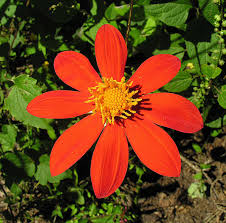
Dahlia coccinea

The field was rapidly enlarged by new finds. Alexander von Humboldt sent seed of species he found in the Mexican mountains, much shorter in height and thus more manageable. In London the Horticultural Society sent its own man, Karl Hartweg, to find even more new species. All this allowed the often fanatical breeders to come up with many more colours than just red.

At that stage dahlias had some of the mystique of seventeenth century tulips in The Netherlands or orchids for most of the nineteenth and twentieth centuries. In the 1840s a rich iron master in Birmingham might pay two hundred guineas for a unique tuber such as ‘Yellow Defiance’. That was at the time when a kitchen maid in a big house was lucky to earn ten pounds a year.

One of those breeders was John Keynes, 1805 -1878. As noted above he was a very astute businessman who had not wanted to go into his father’s brush factory. He enjoyed gardening as a youth, even winning a prize for the pinks he had grown. Dahlias caught his imagination. He began working with them in 1833. In 1841 he held a one man show of his new cultivars at Stonehenge. It was a sellout. When a winner came up he focused almost entirely on propagating that and did not waste time or effort on other less valuable plants.

Even after John Keynes died the firm continued to introduce new cultivars, suggesting they had a professional hybridizer.

At that time Stonehenge was privately owned and had not yet come into its own as the unique archaeological treasure it is considered to be now. Here is the earliest known picture of it, painted by Lucas de Heere in the mid 1570s.


While John Keynes used it as a setting for his dahlias the local people casually used it for many humdrum purposes.


The flower could have double petals, come in many colours, be tall or short, even miniature but for several decades the general impression of them en masse was “’footballs on stalks”. By the end of the nineteenth century the gardening world was ready for new shapes. The plant explorers obliged. D. juariezii also came from Mexico but had graceful recurved petals and was the first of the “cactus dahlias”.

Other British nurserymen began to develop and grow new kinds of dahlias too. Charles Turner in Slough is best known for his roses and carnations but he and Keynes collaborated on setting up the first National Dahlia Show in London in 1858. The National Dahlia Society was not formed until 1882 but dahlias were on show at the Great exhibition.

The flowers are now part of the standard gardening repertoire of any amateur and the corms are easily available at any garden centre. They make a very bold statement and remain dramatic, not unlike John Maynard Keynes himself. He was an undergraduate at Kings College, Cambridge and became a fellow there too. Keynes was a member of the secretive Apostles at the university, most of its members becoming famous later in life. Many of them were gay and he seemed to be so too yet in 1925 he married a Russian ballerina Lydia Lopokova, one of Serge Diaghileff’s teenage company, Ballets Russes de Monte Carlo from the 1920s and remained very happy with her for the rest of his life. His former lover Duncan Grant was best man.

John Maynard Keynes was 6 feet 7 inches tall. Lopokova was just about 5 feet. He played an important role in the negotiations after the first world war and wrote a seminal book, “The General Theory of Employment, Interest and Money” (1936), explaining why governments had to supply money to replace the failing demand of the impoverished pubic in times of crisis. That was the only way to get factories rolling again and business running.

Keynes also seemed to have inherited his grandfather’s head for business. He built up a private fortune and invested in art among other things. Oddly enough he failed to foresee the Great Depression of 1929 and lost most of his money only to recoup it later. It is a great pity he left no children. His ideas had helped millions of people around the world.


REFERENCES

Skidelsky, Robert  1983   John Maynard Keynes: Hopes Betrayed 1883 – 1920  vol 1
London      Picador 


Taylor, Judith M.  2014   Visions of Loveliness: great flower breeders of the past
Athens, Ohio            Ohio University Press

~~~~~~~~~~

Judith M. Taylor MD is a graduate of Somerville College and the Oxford University Medical School and is a board certified neurologist. She practiced neurology in New York and since retiring has written six books on horticultural history as well as numerous articles and book reviews on the same subject.

Dr Taylor’s books include The Olive in California: history of an immigrant tree (2000), Tangible Memories: Californians and their gardens 1800 – 1950 (2003), The Global Migrations of Ornamental Plants: how the world got into your garden (Missouri Botanical Garden Press 2009), Visions of Loveliness: the work of forgotten flower breeders (Ohio University Press 2014) and An Abundance of Flowers: more great flower breeders of the past (Ohio University Press  2018).  In 2019 she published A Five Year Plan for Geraniums: growing flowers commercially in East Germany 1946 – 1989.
Dr Taylor’s web site is: www.horthistoria.com

Sunday, October 27, 2019

Editors Weekly Round-up, October 27, 2019

by the EHFA Editors

Contributors to English Historical Fiction Authors bring us posts that delve into various aspects of British history. Enjoy these fascinating stories, and never miss a post on EFHA when you follow us on Facebook, Twitter, or via email.

by Lauren Gilbert


by Judith Taylor


Wednesday, October 23, 2019

More about the Crystal Palace

By Judith Taylor

Following on from her post about the creation of the Crystal Palace, Judith picks up the story again:

It is hardly surprising that an event like the Great Exhibition and a building of such magnitude and glamour as the Crystal Palace would linger in one’s mind, “agitating the little grey cells”. There is still a great deal to be learned about it and even with intense application one would only scratch the surface. There is the prosaic matter of how the exhibition was paid for and the steps taken after it closed. With all the effort put into getting show ready it is hard to believe the exhibition only lasted for six months from May to October 1851. Queen Victoria took her family to see it three times. We need to put aside the seductive charms of ancient greenhouses and cast iron and think about drier things.

To refresh everyone’ memory, some visionary senior officials wanted to create a great exhibition of the world’s arts and manufactories to celebrate Britain’s imperial dominance. Prince Albert is usually considered to be the prime mover but he was always very wary of butting into potential political minefields. His enthusiastic scientific friends and colleagues planned to open the show on May 1, 1851.


The timing was not coincidental. Think about it. The date was precisely half way through the century. Then there were the recent troubles in Europe. In 1848 the Continent had seen major radical uprisings with the Communes in Paris, Berlin, Brussels and Budapest. England watched its citizens very carefully and probably breathed a big sigh of relief when very little happened there. The worst that  occurred was the movements of the Chartists.

One way the English authorities defused the situation was to offer the masses a few perks to distract them from their miserable conditions. The unprecedented creation of free public parks and the privilege of using formerly private parks was one of them.

The leading lights of the Royal Society for the Encouragement of the Arts, Manufactures and Commerce began the process but when it did not move very quickly they managed to persuade their president, Prince Albert, to use his personal charm and get the government to set up a royal commission to turn the idea into reality. He had no statutory authority. The French had been holding similar exhibitions of their own products every year since 1798. Sir Henry Cole and the commissioners took their task very seriously, setting up an architectural competition for a building.

The Commissioners, 1851

The next big question was where to put it. London in the late 1840s was not built up the way it is now but even so, finding enough open land was a challenge. The established open spaces such as Hyde Park or Regent’s park had originally been closed royal property and had only recently become available to the larger public.

In the early 19th century London was still bounded to the west by Park Lane, Marylebone Road to the north, the South Bank of the Thames at Southwark and Bethnal Green and Spitalfields to the east. Technically, the City of London, with the great cathedral of St Paul’s which qualifies it for the title of city and being the seat of banking and finance, had its own ancient boundaries. Surrounding the capital were villages such as Hampstead and Kensington.  Westminster with Parliament and the Abbey was a separate city. The rest was open country, part of manorial land and parish titles. West of the park, William Kent had started the trend for commercial nurseries in places like Brompton.

Most of the land surrounding London was still owned by families such as the Harringtons, Alexanders and Lees. There were also smaller holdings. A massive increase in population led to the development of suburbs like St John’s Wood and Blackheath. London began to gobble up Middlesex and Surrey. There were one million people living in the city.

Railway Map of Central London, 1899

Speculative builders bought up as much land as they could and developed mainly two kinds of housing: large villas equipped with clean running water and plenty of space for a family with servants such as the Jekylls and much more modest terraced houses where the white collar employees of such family businesses could live.

Geography and architecture both helped to extend the separation of social classes, giving London its character. Upper class people lived in the West End or near it and really poor people in the East End. They had no running water. This is a huge oversimplification but handy for the moment.

In the end the commissioners chose Hyde Park for the exhibition but prudently set about buying the parcels of land they would need for the second phase of the plan. This land lay to the west and south. It was essentially Kensington, with parts of Chelsea and Westminster included.

The financing of the project held it up for a long time. This was why the prince had been so circumspect. He was concerned that he would be accused of wasting public funds for a pet project. When preparatory talks began in late 1849 the press was against the idea. The commissioners had very little choice but to attract private funding. They signed a contract for £20000 with Messrs. J. and G.  Munday, a large firm of public works contractors.

The press now changed its attitude. A project created by a royal commission could not be seen to rely on private funds. If it were successful the backers could make a lot of money out of a national event and that was thought to be unseemly. Leading bankers, traders and merchants in the City issued a resolution in January 1850 condemning the private contract with the Mundays and insisted it be voided. Funds from the Department of Works would cover the initial steps. This decision was eased by the fact that one of the commissioners was able to explain the concept of pay as you go with money coming in as well as going out.

They then took the whole idea a step further. Considering this was to be a national event it was decided to encourage as many groups as possible to contribute voluntarily, primarily organized by municipality. The City of Glasgow sent £2666, Bradford gave £1605 and Rochester £13. The City of London contributed £26632. This can be considered to be an early version of “crowd funding”.

Land obtained for the Museum Quarter

By now the prince was fully on board and showed his vision for the future. The Great Exhibition was just the first salvo in his mind. Once the exhibition ended they would move the building to another, permanent site. In 1852 the commission used the profits from the exhibition, more than £180 000, to buy the land on which to build permanent artistic and cultural institutions which thrive to this day. These were the Victoria and Albert Museum, the Royal Albert Hall, the Science Museum and the Imperial College. The road which is the axis of their locations is Exhibition Road. This is the district now known as South Kensington but sometimes called “Albertopolis”.

Prince Albert died in 1861 and did not live to see the final results of his vision. Of all his descendants, only Prince Charles has shown similar interests.


References

Coleman, Eliza
https://greatexhibition1851.blogspot.com/2011/09/financing-of-great-exhibition.html


~~~~~~~~~~

Judith M. Taylor MD is a graduate of Somerville College and the Oxford University Medical School and is a board certified neurologist. She practiced neurology in New York and since retiring has written six books on horticultural history as well as numerous articles and book reviews on the same subject.

Dr Taylor’s books include The Olive in California: history of an immigrant tree (2000), Tangible Memories: Californians and their gardens 1800 – 1950 (2003), The Global Migrations of Ornamental Plants: how the world got into your garden (Missouri Botanical Garden Press 2009), Visions of Loveliness: the work of forgotten flower breeders (Ohio University Press 2014) and An Abundance of Flowers: more great flower breeders of the past (Ohio University Press  2018).  In 2019 she published A Five Year Plan for Geraniums: growing flowers commercially in East Germany 1946 – 1989.
Dr Taylor’s web site is: www.horthistoria.com

Sunday, October 13, 2019

Editors Weekly Round-up, October 13, 2019

by the EHFA Editors

Contributors to English Historical Fiction Authors bring us posts that delve into various aspects of British history. Enjoy these fascinating stories, and never miss a post on EFHA when you follow us on Facebook, Twitter, or via email.

by Judith Taylor


by Maria Grace

Sunday, September 22, 2019

Editors Weekly Round-up, September 22, 2019

by the EHFA Editors

Contributors to English Historical Fiction Authors bring us posts that delve into various aspects of British history. Enjoy these fascinating stories, and never miss a post on EFHA when you follow us on Facebook, Twitter, or via email.

by Annie Whitehead


by Dean Hamilton


by Judith M Taylor

Thursday, September 19, 2019

The Hooker Family of Kew

By Judith M Taylor

We take it for granted that the Royal Botanical Gardens at Kew are a permanent institution, part of the fabric of Britain at its best, a place of pilgrimage. Had you been an observant Londoner in 1830 that was not what you would have thought. The brilliant and forceful Joseph Banks , born in 1743, died in 1820 at the age of 77, having built the place into a treasure house.

Sir Joseph Banks, President of the Royal Society,
Director of the Royal Botanic Gardens at Kew

After his death the gardens floundered for lack of leadership. Banks’ energy and drive kept everything going but once he had died no one was sufficiently interested to prevent it all from falling apart.

Everything Banks had done was for the greater glory of king and country. He sent plant collectors all over the world to bring back rare and exotic plants, both ornamental and edible, often paying their expenses out of his own pocket.  As a young man he had sailed to the Antipodes with Captain Cook on HMS Endeavour and brought back some of the first Australian plants himself. Why do you think Australia’s seaboard has a Botany Bay? Ever heard of a Banksia rose, named for his wife?

Without him the royal botanic garden deteriorated into a series of allotments to grow vegetables for the royal table. The government had taken it over and the staff of the Department of Works resented the annual expense for a few potatoes and cabbages. They considered the place to be a nuisance and slated it for closure. Its last minute rescue from the knacker’s yard as it were and its development into a scientific institution of the first order is the reason to celebrate the Hookers’ contributions. If an organization is merely the shadow of its leader, Banks’s shadow was long enough but then came two more, even longer.

Sir William Jackson Hooker

Sir William Hooker and his son Sir Joseph Hooker ran the Royal Botanic Gardens at Kew for a total of forty four years between them, starting in 1841 and continuing until 1885, a strict but benign dynasty. Then as if to top it off, Sir Joseph’s son in law, William Thistleton-Dyer, took over after he died. Thistleton-Dyer was the first person to allow women to work as gardeners at Kew, even if only very grudgingly. They had to wear long dark brown woolen skirts and must have been extremely uncomfortable in the warm weather.

Great, or even merely able and competent men, seem to have two different types of effect on their sons. In one case the son calmly emulates the father’s accomplishments and may even possibly outdo him.  In the other the son suffers atrociously from the realization that there is no way he can ever please his father yet alone match what he has done.

This phenomenon was clearly on view in the same circumscribed horticultural world inhabited both by the Hooker family on one hand and the Paxton family on the other. Sir Joseph’s son George Paxton was a very sad figure. As men have been in charge for most of history there are fewer examples of women being matched by their daughters. Emmeline and Sylvia Pankhurst come to mind. An odd note on this theme is that of a daughter outdoing her father, such as Elizabeth 1 and Henry VIII.

William Hooker realized how significant the gardens at Kew could be with even the pathetic remnants of Banks’ collections. Once he took office he expanded the gardens from ten acres to over seventy five acres. His son Joseph later added even more space. Both men recognized Kew’s role in finding and cultivating new economic crops as well as beautiful ornamental flowers. Quinine and tea are just two of the commodities involved. William set up two way interaction with the British Empire’s botanical gardens, supplying scholarly and technical skill to support the remote centres in return for exciting specimens.

The modest palace at Kew in Richmond had originally been renovated for Frederick,  Prince of Wales, and his wife, Princess Augusta of Saxe- Coburg-Gotha early in the 18th century. Frederick died before he could become king.  Augusta spoke no English but she was very interested in gardening. After being widowed she remained at Kew with her nine children, employing James Stuart, the Earl of Bute, as her manager.  Bute was noted for his skill and competence. The gardens at Kew were a model. In 1987 Diana, Princess of Wales. opened the Princess of Wales Conservatory partly to maintain Augusta’s collection of plants.

Princess Augusta, daughter in law of George I

In due course Frederick’s younger brother George became king and then in his turn, his son George III inherited the crown. The gardens remained a purely royal prerogative and thus safe. They had not yet become a political football.

Sir Joseph Banks advised George III informally about Kew for many years but in 1797 he was appointed to be the director. The appointment of Banks, a man of great intellect, drive, and patriotism, was a stroke of genius. After returning with Captain Cook in 1771 he rapidly showed he was a serious scientist. He was elected president of the Royal Society and remained in that office for forty one years.  He devoted his life to serving his king and the botanical garden was his chief way of showing it.

The day to day work of managing the gardens was done by the Aiton family, again a father and son team. The son, William Townsend Aiton, 1766 – 1849, prepared the first ever catalogue of all the plants in the gardens, an important contribution: Hortus Kewensis. He left Kew when William Hooker was appointed.

William Hooker, 1785 – 1865, was born in Norwich but is always associated with Glasgow in the public mind. His own father was a scholar of independent means and dabbled in botany. William rapidly became expert in botany after leaving Norwich School, having briefly tried entomology and ornithology. Through Sir Joseph Smith, a leading botanist of the time, he came to Banks’s attention and took his advice of visiting Iceland to collect as yet unknown plants.

Coming back to live in Suffolk, Hooker devoted himself seriously to taxonomy and writing, building his reputation so that he was invited to become Regius Professor of Botany at the University of Glasgow in 1820. His skillful piloting of the department and construction of useful new buildings made him a clear leader for the post at Kew.

We have to skip over the political shenanigans surrounding Kew, with Paxton and Loudon being retained by the Department of Public works to examine the relic and presenting a carefully reasoned, unvarnished report about the condition of the royal gardens there and whether it was worth keeping them.

All the thoughtful scientists of the time believed that Britain needed a central botanical garden as a reference institution just as there were in other major European cities. More than one senior botanist believed he was the best candidate to take charge but Hooker emerged as the strongest. The only thing that concerned him was the pay. He had a growing family and had exhausted his patrimony by some injudicious decisions. Even having a banker as father in law was not quite enough.

Hooker’s second son, later Sir Joseph Hooker, 1817 - 1911, had a prodigious career. He too was a paterfamilias, leaving nine children, seven by his first wife and two by his second. Both women were extremely accomplished. Frances Henslow, daughter of Darwin’s mentor, John Henslow, translated books for him from the French. His second wife, the former Lady Hyacinth Jardine, was elected to the Royal Society, an honour reserved for great scientific achievement. The third generation did not reach the same levels. His connection through Henslow brought him close to Charles Darwin. The men were friends for the rest of their lives.

Sir Joseph Dalton Hooker

Joseph Hooker was graduated from Glasgow University in 1839 with a degree in medicine. That enabled him to join the Naval Medical Service and he sailed south with Captain John Clark Ross on a voyage to the magnetic South Pole. Hooker was instructed to collect zoological and geological specimens across the tip of the Southern Hemisphere but also carefully examined the flora. He published the definitive volumes, “Voyage to the Antarctic”, over the next several years.

This was just by way of warming up. In 1847 he left Britain for the Himalayas, eventually spending three years in Sikkim, Bhutan, Assam and northern India itself. The most outstanding parts of his collections were the rhododendrons, never seen in the West before.  He made several other important trips and in 1865 was sufficiently renowned to be selected to take over Kew from his father who had reached retirement age.

Every one of his expeditions was recorded in exquisite detail and some were illustrated by Walter Fitch, a botanical artist trained by Joseph’s father. Joseph received a knighthood for his own achievements, not just as the son of his father.

Palm house at Kew Gardens with parterres 

It was not all smooth sailing. In 1853 Sir Richard Owen, essentially the first scientific paleontologist, objected to the way the Hookers were building Kew up. Owen supervised the herbarium at the British Museum and felt his status distinctly threatened by the rise of the herbarium at Kew. For the uninitiated, the herbarium is the core of any botanical enterprise with every plant carefully dried, identified, named and annotated for future reference. It is the gold standard of all botanical work. Whenever someone brings back specimens from an expedition they can be compared with what is already known and thus unequivocally recognized as new or not.

Owen was very well connected politically and made a huge fuss. Even a man as stalwart and immune to minor irritants as Joseph Hooker was seriously disturbed. He finally prevailed but only after some dreadful periods of distress and anxiety.

The work of father and son catapulted the Royal Botanic Gardens at Kew to world wide prominence. They remain at that pinnacle to this day. Both men are buried in the village cemetery of Kew.


REFERENCES

Allen, Mea  1967 The Hookers of Kew
London        Joseph

Blunt, Wilfrid Scawen  reissued 1978  In For A Penny: Kew Gardens
London  Hamilton

Desmond, Ray  1995    Kew: the history of the Royal Botanic Gardens
London    Havill for the Royal Botanic Gardens

Stearns, W.S ed.    1999  John Lindley
London     Antique Collectors’ Club in association with the Royal Horticultural Society

~~~~~~~~~~

 Judith M. Taylor MD is a graduate of Somerville College and the Oxford University Medical School and is a board certified neurologist. She practiced neurology in New York and since retiring has written six books on horticultural history as well as numerous articles and book reviews on the same subject.


Dr Taylor’s books include The Olive in California: history of an immigrant tree (2000), Tangible Memories: Californians and their gardens 1800 – 1950 (2003), The Global Migrations of Ornamental Plants: how the world got into your garden (Missouri Botanical Garden Press 2009), Visions of Loveliness: the work of forgotten flower breeders (Ohio University Press 2014) and An Abundance of Flowers: more great flower breeders of the past (Ohio University Press  2018).  In 2019 she published A Five Year Plan for Geraniums: growing flowers commercially in East Germany 1946 – 1989.
Dr Taylor’s web site is: www.horthistoria.com