Showing posts with label Feminist Writers. Show all posts

Monday, November 30, 2015

Istanbul, Scandal and Smallpox

by Catherine Curzon


Portrait of Lady Mary Wortley Montagu by Charles Jervas
By Charles Jervas
I cannot remember how or where I first heard of the remarkable Lady Mary Wortley Montagu, but she is a lady with whom I have long been fascinated. Her life was one of adventure and learning and seems, in so many ways, to personify all that is great about the 18th century. She embraced scandal, achieved great things and left behind a lasting legacy of literature, a true woman of her age.

Mary was born in 1689 as Lady Mary Pierrepont to Evelyn Pierrepont, 5th Earl of Kingston-upon-Hull, and his wife, Lady Mary Fielding. Christened at St. Paul's Church in Covent Garden, Mary's mother died when her daughter was just three years old and the little girl, along with a trio of siblings, was sent to live with her paternal grandmother. Upon his death six years later, they were once again living with their father, the Earl, who proved a dedicated and loving father. He took particular delight in the company of young Mary, who had matured into a girl of beauty and good humour, impressing all who knew her with her keen wit and intelligence. When her father took her along to the iconic Kit-Cat Club she took her first tentative steps into salon society and dazzled the assembled patrons. Soon she was a regular fixture of the club, proving more than a match for her more seasoned fellows.


Lady Mary, however, had more on her mind than society and she whiled away long and happy hours in the library at her Thoresby Hall home, dedicating herself to education and working tirelessly on her writing. In fact, by the time she reached adolescence Lady Mary had already penned numerous poems and completed her first novel, quite a feat for one who had regular engagements at the Kit-Cat Club! 


Portrait of Edward Wortley Montagu by John Vanderbank, 1730
Edward Wortley Montagu, John Vanderbank, 1730
Lord Pierrepont recognised that his daughter had value as a society bride and earmarked the wonderfully-named Viscount Massereene, Clotworthy Skeffington as a match. Mary favoured Whig politician, Edward Wortley Montagu, but her father would not hear of it when the alternative candidate was so illustrious and though Mary and Edward corresponded regularly and were exceptionally close, the marriage appeared a hopeless case. 

Mary, however, was not one to be told what to do and rather than marry Clotworthy, she eloped with Edward, marrying him on 23rd August 1712. As Edward's career blossomed  Mary found herself popular once more among the chattering classes, earning illustrious admirers including George I himself, his admiration placing her in the very heart of court. She also gained adoring admirers in the iconic Alexander Pope and his waspish rival, Baron Hervey, a favourite of the queen and sometime best friend, sometime sworn enemy of Frederick, Prince of Wales.

The friendship between Pope and Mary would later collapse in spectacular fashion when she wrote an arch and merciless of parody of one of his works though society gossips whispered that he had declared his love to the lady and she laughed in his face, breaking his heart. Whatever the reason, the writer's love turned to loathing and he turned his most poisonous pen on the woman he had adored, writing vicious and thinly-veiled attacks on Mary and her peers.

Still, Mary was in her element in these exciting, fast-moving surroundings yet when she wrote and published her highly satirical Court Eclogues, she found the society that had adored her suddenly anything but welcoming. Laid low with smallpox in 1715, Mary's fellow courtiers discovered a poem she had written that mocked the Princess of Wales and, unable to return to court and engage in some damage limitation, she was ostracised. When she was well enough to emerge from isolation she left England to accompany her husband to Turkey, where he was to assume the office of Ambassador at Constantinople. It was a rueful departure but a perfectly-timed one, and Mary found herself thrust into a new world, one where she would thrive.

The newly-arrived noblewoman did not shrink from these utterly alien new surroundings but instead plunged headlong into her adopted culture. She wrote prolific letters and journals in which she chronicled life in Istanbul, the people she met, their cultures and the traditions that had excited for centuries. Watching the Ottoman women she discoursed on how free they seemed compared to the restrictions placed on their western counterparts, lamenting on the limitations of dress, ambition and behaviour that so confined her gender. Her writings were published as Letters from Turkey, a hugely influential collection that remain an invaluable record of Turkish art, as well as an inspiration to cultural writers. 
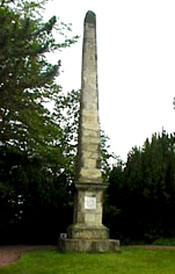


Photograph of the Obelisk at Wentworth Castle
The Obelisk
In addition, Mary memorialised the women she knew in poetry and letters and was at pains not to impress her own ways on this new world, but to respectfully become a part of it. She sought neither publicity nor publication for the majority of the work and instead distributed it to her closest friends, leading William Wentworth, 2nd Earl of Strafford,  to erect an obelisk at Wentworth Castle to celebrate her intellectual achievements.

One particular aspect of life in Turkey that fascinated Mary was the treatment of smallpox, the infection that had so blighted her own life. She was fascinated to learn of the Ottoman Empire's successful experiments with inoculation (known as variolation) and when she returned to England, it was with a passion for this virtually unknown procedure. Mary had her own child inoculated using Turkish method and when George I saw the success of variolation, he permitted members of his own family to undergo the procedure under the care of Charles Maitland, Lady Mary's doctor.


After her adventures in Turkey, English life seemed altogether too staid for Mary and she entertained herself by entering into a romantic correspondence with a French admirer known as Rémond. Far from a knight in shining armour, Rémond proved to be a thoroughly bad sort and first convinced Mary to invest a small fortune in South Sea stock, which she lost; he then came to her for money, threatening to blackmail her with the adoring letters that she had sent him. Mary had no choice but to reveal the truth to her husband and in 1739 she travelled to the continent alone. Although husband and wife did remain on friendly terms, they were eventually divorced. 


Mary engaged in new love affairs but as her health began to fail, her life entered a period of decline and by the age of sixty, she was shadow of herself. Disfigured by smallpox and plagued with ill health, she lived in virtual poverty, only returning to English shores to silence the repeated pleas of her daughter. Their reunion was to be short lived and Mary died that same year.


Portrait of Lady Montagu in Turkish Dress by Jean-Étienne Liotard, 1756
Lady Montagu in Turkish Dress by Jean-Étienne Liotard, 1756


Mary remains a literary force to be reckoned with thanks to her perceptive letters from Turkey; although her days ended sadly, these letters and writings reveal a life well lived and a woman of wit, intelligence and conscience who pushed the boundaries of her time.

References

Halsband, Robert. The Life of Lady Mary Wortley Montagu. Oxford: Clarendon Press, 1956. 
Halsband, Robert (ed.). The Complete Letters of Lady Mary Wortley Montagu. Oxford: Clarendon Press, 1965-67: 
Grundy, Isobel. Lady Mary Wortley Montagu: Comet of the Enlightenment. Oxford University Press,  2001. 


~~~~~~~~~~~~~


Glorious Georgian ginbag, gossip and gadabout Catherine Curzon, aka Madame Gilflurt, is the author of A Covent Garden Gilflurt’s Guide to Life. When not setting quill to paper, she can usually be found gadding about the tea shops and gaming rooms of the capital or hosting intimate gatherings at her tottering abode. In addition to her blog and Facebook, Madame G is also quite the charmer on Twitter. Her first book, Life in the Georgian Court, is available now, and she is also working on An Evening with Jane Austen, starring Adrian Lukis and Caroline Langrishe.

Sunday, January 19, 2014

Catharine Macaulay – a dangerous woman writer in a scandalous marriage

by Diane Scott Lewis

Catharine Macaulay, (née Sawbridge), born in Kent in 1731—and an early advocate for women’s rights—has been discredited and disregarded for years due to her damaged reputation, a woman’s most important asset in the eighteenth century.

Educated by a governess, Catharine later described herself as "a thoughtless girl till she was twenty, at which time she contracted a taste for books and knowledge by reading an odd volume of some history, which she picked up in a window of her father's house."

A female contemporary, after conversing with Macaulay, remarked that she was "more deeply learned than becomes a fine lady."

In 1760 she married a Scottish physician, George Macaulay, and they moved to St. James’ Place in London. Six years later, and after one child, George—almost twenty years her senior—died.

Between 1763 and 1783 Macaulay wrote, in eight volumes, The History of England from the Accession of James I to that of the Brunswick Line. She believed that the Anglo-Saxons had possessed freedom and equality that was lost at the Norman Conquest. To her the history of the English was the struggle to win back their rights that were crushed by the "Norman yoke."  Whigs welcomed the first volumes as a Whig answer to David Hume's "Tory" History of England. In 1768 relations between Macaulay and the Whigs cooled. Volume four of the history was published, which dealt with the trial and execution of King Charles I. Macaulay thought Charles's execution was justified, praised the following Commonwealth and showed republican sympathies. This caused her to be abandoned by the Rockingham Whigs.

Macaulay with the Bluestockings

Macaulay remained one of the leading political activists of her day. She was closely associated with the radical Society for the Supporters of the Bill of Rights. Her final important pamphlet, the 1790 Observations on the Reflections of the Right Hon. Edmund Burke on the Revolution in France, in a Letter to the Earl of Stanhope, supported the French Revolution and its demands for liberty and equality. Her works were critically acclaimed, financially successful and politically influential in her own period—highly unusual for a woman.


She wrote in 1790 in her Letters on Education, as Mary Wollstonecraft (who was tremendously influenced by Macaulay’s work) did in 1792, that the apparent weakness of women was due to their lack of quality education.


Her Letters on Education also dealt with morality, non-violence, and the treatment of children, slaves, and the poor, and she’s remembered as one of the earliest advocates for gender equality and co-education.

In 1778, at the ripe old age of forty-seven, she married William Graham, the younger brother of a close friend. Graham was only twenty-one. The marriage, as well as the increasingly radical nature of her writings—her attacks on the government—damaged her reputation in Britain. She was accused of marrying a man of inferior status, and too many years her junior. The marriage, however, seemed to have been a happy one.

Still popular in America, (she’d criticized the policy of the British Government in the lead up to the American War of Independence) she was associated with the leading Revolutionaries there, even visiting with George Washington at Mount Vernon in Virginia.

Plagued by increasingly ill-health, she died in Berkshire in 1791.

Unfortunately, Macaulay’s status as a scandalous woman writer with a damaged reputation (according to the mores of her time) has allowed her to be disregarded by later historians of eighteenth-century literature and politics. Recently, her significance as a writer and political thinker has been recognized. Her work is thankfully the focus of a growing number of studies.

For further reading on Macauley's writings: http://plato.stanford.edu/entries/catharinemacaulay/#ThoProLibEdu

See more on Diane Scott Lewis.
 

Wednesday, October 16, 2013

Aphra Behn ~ Audacious Playwright and Spy for King Charles II

by Diane Scott Lewis


Though the seventeenth century is not my usual area of study, in my continued search for early feminists, to satisfy the naysayers who insist that women never sought rights before the twentieth century, I came across an interesting subject—the first English professional female literary writer.


Aphra Behn (nee Johnson) was born in 1640, presumably near Canterbury. Little is known about her early life or education. Her father might have been a barber, yet Mr. Johnson was purported to be related to Francis, Lord Willoughby who commissioned him as lieutenant general of Surinam in 1663. Aphra may have traveled with him to Surinam where she met an African slave leader, whose story formed the basis for one of her most famous works, Oroonoko. Her father died soon after, and she returned to England. All this is still conjecture.

Though no records survive, she supposedly married a Mr. Behn in 1664, who conveniently died in 1665. However, it’s been suggested that she never married at all and took on the guise of a Mrs. for propriety’s sake.

She apparently had a Catholic upbringing—she once commented she was meant to be a nun—and had numerous Catholic connections, during a time of extreme anti-Catholic sentiments. She was a monarchist and held a deep sympathy for the Stuarts, and was dedicated to the restored King Charles II.

Charles II
In 1666, Aphra became attached to the court, possibly through the influence of Thomas Culpepper. After the Second Anglo-Dutch War broke out between England and the Netherlands, she was recruited as a political spy (66-67). She was to establish an intimacy with a regicide’s son, and report on the doings of English exiles who plotted against the King.

Her code name was Astrea, a name under which she later published several writings. But the King was notoriously late in paying her, and she served a stint in debtor’s prison. By 1669 an undisclosed source paid her debts and she was released from prison.


After that, Aphra seems to have given up on espionage. To earn money, she began to work for the theatre, the King’s Company, as a scribe. Poetry was her forte by this time, and she cultivated the friendships of many poets as well as playwrights. Her first performed play, The Forc’d Marriage, was produced in 1670. The play was a popular and financial success. This was followed by The Amorous Prince in 1671. In her works, she ranted against women being forced to marry. She also used her increasingly comedic plays to lampoon the Whig-controlled parliament, especially for denying the King funds.

In 1677, her most successful play, The Rover, was produced. Nell Gwyn, famed actress and mistress to the King, came out of retirement to play the lead.

Aphra’s plays became more and more sexually risqué, and she was accused of being a libertine. This perception was reinforced by her friendship with the Earl of Rochester who was infamous for his sexual escapades.

Her success in the theatre incited envy, and a woman in a traditionally male profession was vulnerable to attack. But Aphra continued writing. Her plays were generally popular, but her contemporaries criticized her for their rampant sexual content. Alexander Pope wrote of her:


The stage how loosely does Astræea tread,
Who fairly puts all characters to bed.


Her play, Like Father, Like Son, written in 1682, was a huge flop. The manuscript no longer survives, but Aphra was arrested for a libelous prologue. She was soon released. When the Company where she worked merged with another, playwriting grew non-profitable for her. She now turned to other forms of writing.

Her first book of poetry, Poems Upon Several Occasions, was published in 1684. She also published in 1684 Love Letters Between a Nobleman and His Sister, a Roman à clef  loosely based on a contemporary affair, and she became a pioneer of the epistolary novel. Both works were enormously popular.

Charles II died in 1685 and was succeeded to the throne by his brother, the Duke of York, as James II. Aphra wrote a few plays after this, but in 1688 she penned the short novel for which she is chiefly known: Oroonoko, the story of a noble slave and his tragic love. It was the first English work in print to express sympathy for slaves—and it became an instant success.


The Glorious Revolution of 1688 dethroned James II, the king Aphra supported. By this time she was quite ill. Her own descriptions of her malady, and cruel contemporaries’ vilifications, suggest she had severe rheumatoid arthritis.

She died on April 16, 1689, and was buried in the cloisters of Westminster Abbey, where her stone still rests today in Poets' Corner — a huge honor for a woman playwright in the late seventeenth-century.  


The first person ever to earn a living completely from her writing, Aphra Behn defied the system despite controversy, and lived a life outside the expected boundaries.

~~~~~~~~~~~~
My newest release is a romantic satire/farce that features a spitfire heroine who defies the limitations of the eighteenth century: The Defiant Lady Pencavel.

For more strong fictional women of the past, visit my website to check out my novels:

http://www.dianescottlewis.org


Sources:

O'Donnell, Mary Ann. "Aphra Behn: The Documentary Record."
The Cambridge Companion to Aphra Behn. Cambridge: CUP, 2004.
Blashfield, E. W. "Aphra Behn." Portraits and Backgrounds. New York: C. Scribner's Sons, 1917.
Salzman, Paul. "Chronology." Aphra Behn. Oxford University Press, 1994.


Monday, July 29, 2013

Mary Astell, Seventeenth Century Feminist

by Diane Scott Lewis


While researching feminist writers to bolster my early nineteenth century character’s beliefs in the rights of women, I came across numerous women who promoted rights in the eighteenth and nineteenth centuries. When I added these ideas into my story, a man in my critique group objected, saying women didn’t demand their due until the twentieth century. After that, I found that many people shared this narrow view. I myself was surprised by the varied women I discovered in the past who railed against their restrictive lives.

As I sought further documentation to strengthen my point, I came across this treatise by a woman in the seventeenth century named Mary Astell: Serious Proposal to the Ladies for the Advancement of their True and Greatest Interest, published in 1694.


Mary Astell was born in Newcastle upon Tyne in 1666 to an upper middle-class family. Her father was a royalist Anglican who managed a coal company. As a woman, she received no formal education, as the culture of the time felt girls didn’t require any learning outside of the domestic realm. 

Fortunately for Mary, starting at the age of eight, she received an informal education from her uncle. Her uncle, an ex-clergyman, was affiliated with the Cambridg- based philosophical school which based its teachings around radical philosophers such as Aristotle, Plato, and Pythagoras.

Mary’s father died when she was twelve, leaving her without a dowry. Her family’s limited finances were invested in her brother’s higher education, and Mary and her mother were forced to move in with her aunt. After the death of her mother and aunt, Mary moved to Chelsea, London in 1688, where she was lucky enough to make the acquaintance of a circle of influential and literary women. These women, including the poet Lady Mary Chudleigh (who also published works dealing with feminist themes), helped Mary with the development and publication of her treatise.

Lady Mary Chudleigh

Mary was also in contact with the Archbishop of Canterbury, William Sancroft, who was known for charitable works. Sancroft assisted her financially and introduced her to her future publisher.


Mary Astell was one of the first Englishwomen to advocate that women were as rational as men, and just as deserving of education. Her Serious Proposal to the Ladies for the Advancement of their True and Greatest Interest presented a plan for an all-female college where women could pursue a life of the mind.

In 1700, Mary published another work: Some Reflections upon Marriage. She warned, in witty prose, of the dangers to females "...of an ill Education and unequal Marriage." She urged women to make better matrimonial choices because a disparity in intelligence and character may lead to misery. Marriage should be based on lasting friendship rather than short-lived attraction.

Influenced by Descartes, Mary Astell was known for her ability to debate freely with both men and women, and particularly for her groundbreaking methods of negotiating the position of women in society by engaging in philosophical debate rather than basing her arguments in historical evidence as had previously been attempted. One of her famous quotes stated: "If all Men are born Free, why are all Women born Slaves?"

Mary withdrew from public life in 1709 and founded a charity school for girls in Chelsea. She died in 1731, a few months after a mastectomy to remove a cancerous breast. In her last days, she refused to see any of her acquaintances and stayed in a room with her coffin, thinking only of God. She was buried in the churchyard of Chelsea Church in London.

So when reviewers—or readers—criticize a novel for promoting a heroine who acts "before her time" remember that women have been seeking liberation for centuries.

Resources: "Astell, Mary." Encyclopedia of World Biography, 2011.

~~~~~~~~~~~~
Visit Diane Scott Lewis’s website for information on her novels that depict strong women:

http://www.dianescottlewis.org


Tuesday, October 25, 2011

FEMINIST WRITERS DURING THE FRENCH REVOLUTION ~ MAGGI ANDERSEN

As my books are set in the Georgian era at present, I’m learning more about this fascinating era and the complex and world-changing French Revolution.
MARY WOLLSTONECRAFT 1759-1797
Mary Wollstonecraft was the granddaughter of a respectable manufacturer in the Spitalfields weaving trade. Her father, she labeled a domestic tyrant. When he lost his inheritance through a series of unwise investments Mary sought to make her way in the world. She attempted unsuccessfully to run a school and work as a governess.
After publisher Joseph Johnson paid her 10 guineas for her first manuscript, Thoughts on the Education of Daughters, she became a respected member of London’s rationalist intelligentsia.
The Great National Debate on the French Revolution was opened by Edmund Burke’s Reflections on the Revolution in France. Mary Wollstonecraft replied to this attack on the French National Assembly and on the English radicals for rejoicing at the events across the Channel by writing A Vindication of the Rights of Men (1790) expressing the passionate conviction that the power of reason is the common possession of men and women. Mind, she argued has no gender, but women’s reason had been stolen from them. Her contemporaries regarded her defense as one of the most forceful and persuasive contributions to this famous public argument.  She later wrote History and Moral View of the Origins and Progress of the French Revolution (1793).
Upon her return to England, Mary joined a radical group whose membership included Blake, Paine, Fuseli, and Wordsworth. Her first child, Fanny, was born in 1795, the daughter of American Gilbert Imlay. After his desertion, she married the radical activist William Godwin, a long-time friend in 1797. Wollstonecraft died a few days after the birth of their daughter, Mary (who later married Percy Bysshe Shelley and wrote Frankenstein, or The Modern Prometheus and other novels).
OLYMPE DE GOUGES 1748-93 was a butcher's daughter and early feminist who demanded that French women be given the same rights as French men. In her Declaration of the Rights of Woman and the Female Citizen (1791), she challenged the practice of male authority and the notion of male-female inequality. She was executed by guillotine during the Reign of Terror for attacking the regime of Maximilien Robespierre and for her close relation with the Girondists. In addition to these provocative writings, her defense of the king was one of the factors leading to her execution. Early in the Revolution she suggested a voluntary, patriotic tax, which was adopted by the National Convention in 1789.
MADAME ROLAND (aka Manon or Marie Roland) 1754-93 was another important female activist. Although she did not specifically focus on women or their liberation, she was a feminist by virtue of the fact that she was a woman working to influence the world. Her personal letters to leaders of the Revolution influenced policy; in addition, she often hosted political gatherings of the Brissotins, a political group which allowed women to join.
Madame Roland took it upon herself to spread Revolutionary ideology. Roland attributed women’s lack of education to the public view that women were too weak or vain to be involved in the serious business of politics. She believed that it was this inferior education that turned them into foolish people, but women ‘could easily be concentrated and solidified upon objects of great significance’ if given the chance. As she was led to the scaffold, Madame Roland shouted "O liberty! What crimes are committed in thy name!" Her writings were finished by others and published posthumously.
Although women did not gain the right to vote as a result of the Revolution, they still greatly expanded their political participation and involvement in governing. They set precedents for generations of feminists to come.
  Women and European Politics: Contemporary Feminism and Public Policy by Joni Lovenduski
 Mary Wollstonecraft, Political Writings: A Vindication of the Rights of Men; A Vindication of the Rights of Woman; and An Historical and Moral View of the Origin and Progress of the French Revolution, ed. by Janet Todd (Toronto, 1993
Images from Wikipedia