Showing posts with label Smallpox. Show all posts

Wednesday, April 15, 2020

Apothecary

By Toni Mount


Medieval apothecaries were the equivalent of our modern pharmacists. An apothecary’s shop was full of various cures, most of which he prepared himself. He was usually a trusted member of the community, but at times, apothecaries were accused of practising magic or witchcraft. In an age before folk had easy access to doctors and when hospitals were religious foundations, more interested in curing your soul than your body, the apothecary was an ordinary person’s best hope of a cure or relief from an illness. Because apothecaries saw different people with various illnesses each day, most had a huge knowledge of the human body and herbal remedies.

Early in the Middle Ages, an apothecary would have cultivated all the plants and herbs needed for his medicines himself. Later, supplies became more organised, especially in cities like London, York and Bristol, with individuals growing plants to order for the apothecaries.


The recipes for the wines, syrups, cordials and medicines were passed down through the generations, from master to apprentice. They were closely guarded secrets too, since the most successful apothecary would have the most customers. While some apothecaries worked on a casual basis from their own homes, many had their own retail premises, usually a small shop. The front of the shop would have shelves full of medicines and herbs and in the back section, the apothecary would prepare medicines as and when they were needed. Ideally, he would also have access to a garden, where he could grow some of the less exotic herbs and plants he needed to prepare his cures. Some of the most popular medicines were prepared in advance, ready for sale, just as in a modern-day pharmacy. Other cures were prepared as and when needed, and were made up precisely, with the apothecary using his knowledge of the patient and the illness to prepare what he thought would be the ideal remedy.

Apothecaries were often spicers or pepperers as well. Because their work involved weighing out small amounts of herbs and spices for use in medicine, or for direct sale to customers, their trade was regulated by the Grocers’ Guild. It was impossible to separate the two businesses completely as both were involved in importing and distributing spices from abroad, for use in cooking and in the preparation of products such as spiced wines. In addition to food and drugs, apothecaries also sold inks and pigments to the stationers, beauty products and perfumes, substances used in fumigation and pest control and even good luck charms and novelties such as serpent-stones – what we know to be ammonite fossils.


A collection of medical recipes from the fifteenth century [now MS136 at the Literary Society of London] has remedies which make use of herbs that really could have performed the cure as intended:

For the Migraine take half a dishful of barley, one handful each of betony, vervain and other herbs that are good for the head; and when they be well boiled together, take them up and wrap them in a cloth and lay them to the sick head and it shall be whole – I proved.

A sick headache might well be eased by this poultice. Betony was a favourite herb in medieval times and was taken internally for a range of ailments. It’s still used today in treatments for nervous headaches and some types of migraine. Vervain is also used in modern medicine as a nerve tonic and as a calming restorative for patients in a debilitated condition. It too is used to treat migraine and depression.

For those troubled with digestive problems, this fifteenth century remedy would have helped:

To void Wind that is the cause of Colic take cumin and anise, of each equally much, and lay it in white wine to steep, and cover it over with wine and let it stand still so three days and three nights. And then let it be taken out and laid upon an ash board for to dry nine days and be turned about. And at the nine days’ end, take and put it in an earthen pot and dry over the fire and then make powder thereof. And then eat it in pottage or drink it and it shall void the wind that is the cause of colic.

Both these spices, anise and cumin, are carminatives, so this medicine would do exactly what it said on the tin – or earthen pot. The herbs dill and fennel could be used instead to the same effect – twentieth century gripe water for colicky babies contained dill. Wind and constipation were common preoccupations in the Middle Ages because folk ate so many pulses and little roughage, apart from cabbage.


Despite such suitable treatments as these, other remedies, despite the use of some exotic ingredients, could only have worked as panaceas. These concoctions are for gout:

Take badger’s grease and swine’s grease and hare’s grease and cat’s grease, dog’s grease and capon’s grease and suet of a deer and sheep’s tallow, of each equally much and melt them in a pan. Then take the juice of herb-robert, morell, mallow and comfrey and daisy and rue, plantain and maidenhair, knapweed and dragance, of each equally much juice, and fry them in the pan with the aforesaid greases, and keep it well, for the best ointment for gout is this. Or:

Take an owl and pluck it clean, and open it clean and salt it. Put it in a new pot and cover it with a stone and put it in an oven and let it stand till it be burnt. And then stamp [pound] it with boar’s grease and anoint the gout therewith.

A cough cure was more pleasant, consisting of the juice of horehound to be mixed with diapenidion and eaten. Horehound is good for treating coughs and diapenidion is a confection made of barley water, sugar and whites of eggs, drawn out into threads, so perhaps a cross between candy floss and sugar strands. It would have tasted nice and sugar is good for the chest, still available in an over-the-counter cough mixture as linctus simplex. Another pleasant cough treatment was coltsfoot comfits, like tiny sugary sticks of pale brown rock. King Henry III had the apothecary, Philip of Gloucester, supply him with 7½ lbs of diapenidion when the king visited the West Country in May 1265, along with 5lbs of grana, all together costing 7s 6d. My source for this [The Royal Apothecaries by Leslie G Matthews, 1967, pub by the Wellcome Historical Medical Library] suggests ‘grana’ meant aromatic seeds to aid digestion, like caraway or cumin, or it could have been Grains of Paradise, a kind of pepper. But ‘grana’ was also a name given to the exotic ‘kermes’ – dried scale insects, imported as a crimson dye. Could they have been used medicinally? Or was grana to be used to dye the king’s robes?

Another medicinal possibility is that grana was for dyeing the bed linen and curtains as part of the treatment of smallpox, in which the sickroom was swathed in red. Today we know this wasn’t so daft since red cloth filters out UV light, to reduce the production of scar tissue and to protect the eyesight of patients with smallpox or measles (these two diseases were hard to tell apart in the early stages anyway) – red light works for burns victims and would have decreased the pock marking in the case of smallpox. The medieval apothecary, like Gilbert Eastleigh in ‘The Colour of Poison’, was expected to know so much about such treatments, even if the reasons why they worked – or didn’t – were beyond the medical knowledge of the time.

N.B. One fifteenth century school book gives a list of collective nouns, including ‘a poison of treaclers’ (i.e. apothecaries who sold medicinal treacle).

[This an archive Editor's Choice post. It originally appeared on EHFA on 28 April 2016]

~~~~~~~~~~
Toni Mount earned her research Masters degree from the University of Kent in 2009 through study of a medieval medical manuscript held at the Wellcome Library in London. Recently she also completed a Diploma in Literature and Creative Writing with the Open University. Toni has published many non-fiction books, but always wanted to write a medieval thriller, and her first novel “The Colour of Poison” is the
result. Toni regularly speaks at venues throughout the UK and is the author of
several online courses available at www.medievalcourses.com.


Wednesday, October 12, 2016

Alfred and Octavius, the Lost Princes

By Catherine Curzon

George III by Ramsay
There is much to be said for a loving home and a warm hearth, and George III was fond of both. Whatever challenges he faced in Parliament and no matter how much the government niggled and needled, George could always take comfort in his domestic life. As war raged, he took refuge in the gentle comfort of his devoted consort, Queen Charlotte, and their growing brood of children, using Richmond Lodge as a family home and commissioning a sweeping programme of renovation and repair at Windsor Castle. 

George was devoted to his children who were expected to study hard and behave in a manner befitting the offspring of the very pious king. Even so, he loved to spend time in the company of his children, playing with them and sharing with them his own favourite pastimes. They were permitted to attend the theatre and other entertainments and, behind the scenes, all seemed happy.

It would not last.

Real life was set to force its way into his family idyll in the most upsetting way and the household would never quite recover. So far, George and Charlotte had welcomed fourteen children (the last would be born in 1783) and remarkably for an eighteenth century couple, all of the children survived infancy. Tragically, that was about to change and in the space of less than twelve short months, those loving parents would lose not only one child, but two.

In the Georgian era, smallpox was a very real and present threat to the lives of everyone, whether king or pauper. The disease claimed hundreds of thousands and survivors rarely escaped devastating side effects that ranged from scars to blindness. For any parent, the news that their child had been infected would be terrifying and for the royal couple, things were no different.
Queen Charlotte by Ramsay

In 1782, George and Charlotte took the decision to have their youngest children inoculated against smallpox and by June, they no doubt rued that day. Little Alfred, the couple’s youngest son who was a full eighteen years younger than his oldest brother, fell ill not long after receiving the treatment. In order to speed his recovery he was taken to enjoy the sea air at Deal in the care of Lady Charlotte Finch, his devoted nurse.

A cheery little boy with a bright disposition, Alfred was nevertheless laid terribly low by his inoculation and began to experience smallpox-like blemishes on his face, whilst his breathing grew ever more laboured. Only when it appeared that the seaside was not working its magic was he returned to Windsor. Here he was attended by court physicians and their conclusion, when it came, was devastating.

Little Alfred would be dead within weeks.

“Yesterday morning died at the Royal Palace, Windsor, his Royal Highness Prince Alfred, their Majesties youngest son. The Queen is much affected at this domestic calamity, probably more so on account of its being the only one she has experienced after a marriage of 20 years and having been the mother of fourteen children.”1

Alfred by Gainsborough
Prince Alfred of Great Britain passed away on 20 August 1782, just a month shy of his second birthday, and the royal family were rocked by his unexpected death. Protocol did not demand official mourning for one so young but, officially or not, his parents and siblings wept for the cheerful child. He was buried at Westminster Abbey with full honours and though George and Charlotte mourned his loss, they could at least take comfort in their surviving children. The king, in particular, doted on the boy who was now his youngest son, three year old Octavius. In his darkest moments he admitted that, should Octavius have died, then he would wish himself dead too.

These were to be fateful words.

Despite Alfred’s death, it was still reckoned that inoculating the children against smallpox posed less of a risk than leaving them open to the infection so little Octavius and his best friend, five year old Princess Sophia, were given the treatment. Whilst Sophia suffered no ill effects and would live to a ripe old age, things did not go so 

Octavius by Gainsborough
The queen was pregnant with her final child when, just days after receiving the smallpox inoculation, Octavius grew terribly ill. Unlike Alfred, whose sickness progressed over time, Octavius declined with alarming speed and died on 3 May 1783. The king was beyond devastated, tormented to distraction by grief and as the situation in America neared its endgame, George was perhaps lower than he had ever been.

“On Saturday, on the Majesties arriving at Kew, in their way to Windsor, and finding Prince Octavius in a dangerous Way, they determined to stay there all Night and sent an Express to Windsor to acquaint the Attendants of the Reason of their continuing there.

The same Night died at Kew, his Royal Highness Prince Octavius, his Majesty’s youngest Son, in the fifth Year of his Age.”2

The king brooded on the loss of his children, wondering whether their inoculation against smallpox had contributed to their early deaths. Where once there had been the laughter of infants, the gentle distraction offered when Charlotte and George played adoringly with the youngsters, now there was only silence and grief, the royal household plunged into sadness. A little respite came with the birth of Princess Amelia in August of that same year and George showered her with love, filling the void where his sons had been with the cheer of this new daughter. Little Amelia, or Emily, as she was known, lived through childhood but years later it would be her death that was to have a catastrophic effect on the father who adored her.

Sources
1. London Chronicle (London, England), August 20, 1782 - August 22, 1782; issue 4014, p.1.
2. Daily Advertiser (London, England), Monday, May 5, 1783; issue 17249, p.1.

Bibliography

Anonymous. George III: His Court and Family, Vol I. London: Henry Colburn and Co, 1821.
Black, Jeremy. George III: America’s Last King. New Haven: Yale University Press, 2008.
Craig, William Marshall. Memoir of Her Majesty Sophia Charlotte of Mecklenburg Strelitz, Queen of Great Britain. Liverpool: Henry Fisher, 1818.
David, Saul. Prince of Pleasure. New York: Grove Press, 2000.
Hadlow, Janice. The Strangest Family: The Private Lives of George III, Queen Charlotte and the Hanoverians. London: William Collins, 2014.
Hibbert, Christopher. George III: A Personal History. London: Viking, 1998.

~~~~~~~~~~
Glorious Georgian ginbag, gossip and gadabout Catherine Curzon, aka Madame Gilflurt, is the author of A Covent Garden Gilflurt’s Guide to Life. When not setting quill to paper, she can usually be found gadding about the tea shops and gaming rooms of the capital or hosting intimate gatherings at her tottering abode. In addition to her blog and Facebook, Madame G is also quite the charmer on Twitter. Her first book, Life in the Georgian Court, is available now, and she can be seen performing in An Evening with Jane Austen, starring Adrian Lukis and Caroline Langrishe, at Gloucester Cathedral on 22nd October.

Monday, November 30, 2015

Istanbul, Scandal and Smallpox

by Catherine Curzon


Portrait of Lady Mary Wortley Montagu by Charles Jervas
By Charles Jervas
I cannot remember how or where I first heard of the remarkable Lady Mary Wortley Montagu, but she is a lady with whom I have long been fascinated. Her life was one of adventure and learning and seems, in so many ways, to personify all that is great about the 18th century. She embraced scandal, achieved great things and left behind a lasting legacy of literature, a true woman of her age.

Mary was born in 1689 as Lady Mary Pierrepont to Evelyn Pierrepont, 5th Earl of Kingston-upon-Hull, and his wife, Lady Mary Fielding. Christened at St. Paul's Church in Covent Garden, Mary's mother died when her daughter was just three years old and the little girl, along with a trio of siblings, was sent to live with her paternal grandmother. Upon his death six years later, they were once again living with their father, the Earl, who proved a dedicated and loving father. He took particular delight in the company of young Mary, who had matured into a girl of beauty and good humour, impressing all who knew her with her keen wit and intelligence. When her father took her along to the iconic Kit-Cat Club she took her first tentative steps into salon society and dazzled the assembled patrons. Soon she was a regular fixture of the club, proving more than a match for her more seasoned fellows.


Lady Mary, however, had more on her mind than society and she whiled away long and happy hours in the library at her Thoresby Hall home, dedicating herself to education and working tirelessly on her writing. In fact, by the time she reached adolescence Lady Mary had already penned numerous poems and completed her first novel, quite a feat for one who had regular engagements at the Kit-Cat Club! 


Portrait of Edward Wortley Montagu by John Vanderbank, 1730
Edward Wortley Montagu, John Vanderbank, 1730
Lord Pierrepont recognised that his daughter had value as a society bride and earmarked the wonderfully-named Viscount Massereene, Clotworthy Skeffington as a match. Mary favoured Whig politician, Edward Wortley Montagu, but her father would not hear of it when the alternative candidate was so illustrious and though Mary and Edward corresponded regularly and were exceptionally close, the marriage appeared a hopeless case. 

Mary, however, was not one to be told what to do and rather than marry Clotworthy, she eloped with Edward, marrying him on 23rd August 1712. As Edward's career blossomed  Mary found herself popular once more among the chattering classes, earning illustrious admirers including George I himself, his admiration placing her in the very heart of court. She also gained adoring admirers in the iconic Alexander Pope and his waspish rival, Baron Hervey, a favourite of the queen and sometime best friend, sometime sworn enemy of Frederick, Prince of Wales.

The friendship between Pope and Mary would later collapse in spectacular fashion when she wrote an arch and merciless of parody of one of his works though society gossips whispered that he had declared his love to the lady and she laughed in his face, breaking his heart. Whatever the reason, the writer's love turned to loathing and he turned his most poisonous pen on the woman he had adored, writing vicious and thinly-veiled attacks on Mary and her peers.

Still, Mary was in her element in these exciting, fast-moving surroundings yet when she wrote and published her highly satirical Court Eclogues, she found the society that had adored her suddenly anything but welcoming. Laid low with smallpox in 1715, Mary's fellow courtiers discovered a poem she had written that mocked the Princess of Wales and, unable to return to court and engage in some damage limitation, she was ostracised. When she was well enough to emerge from isolation she left England to accompany her husband to Turkey, where he was to assume the office of Ambassador at Constantinople. It was a rueful departure but a perfectly-timed one, and Mary found herself thrust into a new world, one where she would thrive.

The newly-arrived noblewoman did not shrink from these utterly alien new surroundings but instead plunged headlong into her adopted culture. She wrote prolific letters and journals in which she chronicled life in Istanbul, the people she met, their cultures and the traditions that had excited for centuries. Watching the Ottoman women she discoursed on how free they seemed compared to the restrictions placed on their western counterparts, lamenting on the limitations of dress, ambition and behaviour that so confined her gender. Her writings were published as Letters from Turkey, a hugely influential collection that remain an invaluable record of Turkish art, as well as an inspiration to cultural writers. 


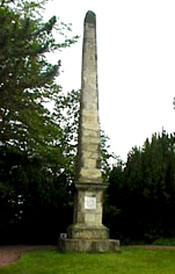
Photograph of the Obelisk at Wentworth Castle
The Obelisk
In addition, Mary memorialised the women she knew in poetry and letters and was at pains not to impress her own ways on this new world, but to respectfully become a part of it. She sought neither publicity nor publication for the majority of the work and instead distributed it to her closest friends, leading William Wentworth, 2nd Earl of Strafford,  to erect an obelisk at Wentworth Castle to celebrate her intellectual achievements.

One particular aspect of life in Turkey that fascinated Mary was the treatment of smallpox, the infection that had so blighted her own life. She was fascinated to learn of the Ottoman Empire's successful experiments with inoculation (known as variolation) and when she returned to England, it was with a passion for this virtually unknown procedure. Mary had her own child inoculated using Turkish method and when George I saw the success of variolation, he permitted members of his own family to undergo the procedure under the care of Charles Maitland, Lady Mary's doctor.


After her adventures in Turkey, English life seemed altogether too staid for Mary and she entertained herself by entering into a romantic correspondence with a French admirer known as Rémond. Far from a knight in shining armour, Rémond proved to be a thoroughly bad sort and first convinced Mary to invest a small fortune in South Sea stock, which she lost; he then came to her for money, threatening to blackmail her with the adoring letters that she had sent him. Mary had no choice but to reveal the truth to her husband and in 1739 she travelled to the continent alone. Although husband and wife did remain on friendly terms, they were eventually divorced. 


Mary engaged in new love affairs but as her health began to fail, her life entered a period of decline and by the age of sixty, she was shadow of herself. Disfigured by smallpox and plagued with ill health, she lived in virtual poverty, only returning to English shores to silence the repeated pleas of her daughter. Their reunion was to be short lived and Mary died that same year.


Portrait of Lady Montagu in Turkish Dress by Jean-Étienne Liotard, 1756
Lady Montagu in Turkish Dress by Jean-Étienne Liotard, 1756


Mary remains a literary force to be reckoned with thanks to her perceptive letters from Turkey; although her days ended sadly, these letters and writings reveal a life well lived and a woman of wit, intelligence and conscience who pushed the boundaries of her time.

References

Halsband, Robert. The Life of Lady Mary Wortley Montagu. Oxford: Clarendon Press, 1956. 
Halsband, Robert (ed.). The Complete Letters of Lady Mary Wortley Montagu. Oxford: Clarendon Press, 1965-67: 
Grundy, Isobel. Lady Mary Wortley Montagu: Comet of the Enlightenment. Oxford University Press,  2001. 


~~~~~~~~~~~~~


Glorious Georgian ginbag, gossip and gadabout Catherine Curzon, aka Madame Gilflurt, is the author of A Covent Garden Gilflurt’s Guide to Life. When not setting quill to paper, she can usually be found gadding about the tea shops and gaming rooms of the capital or hosting intimate gatherings at her tottering abode. In addition to her blog and Facebook, Madame G is also quite the charmer on Twitter. Her first book, Life in the Georgian Court, is available now, and she is also working on An Evening with Jane Austen, starring Adrian Lukis and Caroline Langrishe.