Showing posts with label British Regency. Show all posts

Friday, September 27, 2019

Women’s Lives Recorded in Diaries and Sketchbooks

By Lauren Gilbert

Diaries and sketchbooks fascinate me, especially those of women. Many of my favourites happen to have been drawn or written by English women in earlier times. The ability to depict one’s daily life in a way that is clear and entertaining to a third party, whether in art or in writing, is a real talent. (My own efforts tend to read more like the essay read in Cheech and Chong’s “Sister Mary Elephant”.) One cannot always assume that a diary written by a woman, especially a young, unmarried woman living with her parents or guardian, expressed her true feeling or opinions as her diary may not have been private. However, the details of one’s daily activities and the people with whom time was spent can give the viewer an idea of how life was lived on an intimate level. I’d like to introduce three of my personal favourites.

MRS HURST DANCING & Other Scenes from Regency Life 1812-1823 is a collection of sketches made by a young woman named Diana Sperling living with her family at Dynes Hall in Essex. She was the daughter of John Sperling and his wife Harriet Rochfort. The Sperling family was well-to-do, having made money in the fur trade, but were gentry by Diana’s time. She had two sisters, Isabella and Harriet, and two brothers, Henry John and Charles Robert, as well as a half-brother named John Thomas Kilpatrick (from Harriet Rochfort’s previous marriage). Born in 1791, during the period covered, Diana was between the ages of about 21 to 32. She filled multiple sketchbooks. (MRS HURST DANCING contains 70 of her paintings.)

Diana painted and drew informal and frequently humorous pictures of her family and friends, including her sister Isabella falling from a donkey, her mother swatting flies, and her brother Harry falling into a stream. A military review, country walks, dealing with a stubborn donkey are all captured, along with a spirited game of battledore and shuttlecock and the family at dinner. Fresh, lively and very personal, these paintings show the artist, her family and friends engaged in the normal activities about which one reads in the novels and letters of Jane Austen, providing a visual frame of reference. She had a third sketchbook for 1823-1833 which is not represented here. Diana married in 1834 at the age of 43 to Fred Luard Wollaston, and survived to the age of about 70. She died in 1862. Unfortunately, it appears that she stopped painting upon her marriage.

I recently received MAUD: The Illustrated Diary of a Victorian Woman, and find it fascinating. 

Caroline Maud Tomlinson was born in 1859 to William Tomlinson, a school master already 50 years old and his wife, possibly named Anne. She had several siblings who were much older, to whom she was not close, and a younger brother Hugh. Maud was 14 years old when Mr. Tomlinson retired, and 23 years old when they moved to the Isle of Wight. 

Flora Fraser adapted Maud’s diaries for the period 1888 (when Maud was 29 years old) to 1901. Her entries, which include sketches at water colours, address her family, friends, and her marriage in 1892 at age 33 to Colonel James Cavan Berkeley, an older widower with three daughters not much younger than his new bride. Interestingly, Maud had her first child after her husband’s daughters had left their home for their own lives. Maud’s diary entries continue into 1901, at which point she had had her third child, and announced that her diary keeping days were over as she would commence compiling albums for each of her children. It is no coincidence, I think, that this last entry cited includes a photograph of her children. Maud died in 1949, aged almost ninety. She lived through an era of great change, and her diary records her activities with her friends, her marriage, her stepdaughters, and all of the normal life events with great detail, including drawings of fashion, household duties, and her pets. She had an eye for detail and a great deal of humour which shows through her writing as well as her illustrations.

Another favourite of mine is THE COUNTRY DIARY OF AN EDWARDIAN LADY. This is different to the other two volumes, as it is more than a work of art, yet not primarily a diary of activities. Edith Blackwell Holden focused the 1906 journal on nature, not her daily routine (although there are hints here and there).

Thanks to the publication of this book in 1977, followed by a biography of Edith, we know a great deal more about Edith than we do about Diana or Maud. Edith was born September 26, 1871 in Kings Norton, Birmingham, England. Her mother was the former Emma Wearing, who had been a governess, and was the author of two religious books. Her father, Arthur Holden was a successful business man (Arthur Holden & Sons Paint Factory), a town councillor and philanthropist. They were Unitarians and spiritualists. A cousin was Elizabeth Blackwell, the first female physician; Edith’s middle name was selected to honour Dr. Blackwell. One of seven children (she had four sisters and two brothers), Edith and her sisters were taught at home by their mother. At age 13, Edith was sent to the Birmingham School of Art, where she did extremely well. Two younger sisters followed her there. At age 19, one of Edith’s paintings was accepted by the Royal Birmingham Society of Artists for the Artists’ Exhibition. At the age of 20, in August of 1891, at the suggestion of her tutors at school, Edith became a residential student with Denovan Adam, an established artist, for a year, an unusual step for a young woman. Her work was exhibited several times between 1890-1907 at the Birmingham Society of Artists. She also had a painting exhibited at the Royal Academy of Arts in 1907.

Edith taught art at the Solihull School for Girls from1906-1909. She created NATURE NOTES FOR 1906 as an example to assist her students. Organised by month, each month’s section contained beautiful and detailed illustrations of some combination of flowers, plants, birds, animals, reptiles and insects, which were identified, poems and mottos, and diary entries. She went on to work as a professional illustrator from 1907 on. Her illustrations were found in 4 volumes of the magazine “The Animal’s Friend” and children’s books, including BIRDS, BEASTS AND FISHES, THE THREE GOATS GRUFF and MRS. STRANG’S ANNUAL FOR CHILDREN.

In 1909, she gave up teaching and moved to London. Edith married Ernest Smith, a talented sculptor in 1911 (she was 40 and he was 30 years old). They lived in Chelsea, and she continued her work as an illustrator. Another of her paintings was exhibited at the Royal Academy of Arts in 1917.

Edith drowned in the River Thames near the Kew Gardens Walk on March 16, 1920, at the age of 48. Her death was determined to be an accident. She had no children. NATURE NOTES FOR 1906 stayed in her husband’s family, finally inherited by a great-niece Rowena Stott, who arranged for publication in 1977. It became a best seller. Edith’s biography THE EDWARDIAN LADY: The Story of Edith Holden compiled by Ina Taylor was published in 1980. Much to everyone’s surprised, an unknown document, NATURE NOTES OF 1905 was found in Hampshire, in the possession of people unrelated to the family. The authorship was confirmed, and this was published in 1989 as THE NATURE NOTES OF AN EDWARDIAN LADY. It was also a best seller.

These three women, in their own individual ways, illustrated their lives. Through their art and, in the cases of Maud and Edith, their words, we can see something of what they experienced. Their works are not only delightful to study; they give us valuable insight on the lives of women in their respective times. I highly recommend all of these works, as they give glimpses of normal lives and different perspectives to time periods we may only know from history.

SOURCES INCLUDE:

Fraser, Flora. MAUD: The Illustrated Diary of a Victorian Woman. 1987: Chronicle Books, San Francisco.

Holden, Edith. THE COUNTRY DIARY OF AN EDWARDIAN LADY. 1977: Webb & Bower Ltd, Exeter, England.

Sperling, Diana (watercolours) and Mingay, Gordon (text). Pictures (c) Neville Ollerenshaw. MRS. HURST DANCING & Other Scenes from Regency Life 1812-1823. 1981: Photoset by Rowland Phototypesetting Ltd, Bury St. Edmunds, Suffolk, England.

Corkpastandpresent.ie Green, T. George, H. INDEX TO THE MARRIAGE BONDS OF THE DIOCESE OF CLOYNE, IRELAND For the Years for the Years from 1630 to 1800, p. 88. 1899-1900: Guy & Co. Ltd, Cork. HERE

Geni.com “Diana Sperling, Artist.” (No author or post date shown.) HERE

Countrydiary.co.uk “Edith’s Biography.” (No author or post date shown.) HERE

Encyclopedia.com “Holden, Edith B. (1871-1920)” From WOMEN IN HISTORY: A Biographical Encyclopedia, (c) 2002: Gale Research Inc. HERE

Nationalarchives.gov.uk. “Berkley, James Cavan 1839-1926” Catalogue Description. HERE

~~~~~~~~~~~~~

An avid reader, Lauren Gilbert was introduced to English authors early in life. Lauren has a bachelor of arts degree in liberal arts English with a minor in Art History. A long time member of JASNA, she has presented various programs at meetings of the South Florida region, and presented a breakout session at the Annual General Meeting in 2011. She lives in Florida with her husband. Her first book, HEYERWOOD A Novel, is available. A second novel, A RATIONAL ATTACHMENT, is finally due out later this year. A long-time contributor to this blog, some of her work is included in both volumes of CASTLES, CUSTOMS AND KINGS: True Tales by English Historical Fiction Authors. She is also researching material for a biography. For more information, visit her website here.


Monday, November 12, 2018

Early Education of up-and-coming Gentlemen

by Maria Grace
"In all well-regulated states, the two principal points in view in the education of youth, ought to be, first, to make them good men, good members of the universal society of mankind; and in the next place to frame their minds in such a manner, as to make them most useful to that society to which they more immediately belong; and to shape their talents, in such a way, as will render them most serviceable to the support of that government, under which they were born, and on the strength and vigour of which, the well-being of every individual, in some measure depends." (Sheridan, 1756)
Although sentiments for the education of youth (read here, male youth; female education would not be considered worthwhile yet for quite some time), no one really argued for state-provided education for middle and upper-class children before 1850. (Brown, 2011) That was left entirely in the hands of the parents. Although considerable effort and activity went into educating these children, it was hardly standardized. How a young boy was educated depended entirely on the preferences and means of his family.

Early education

On the whole, early education in the home was preferred. Mothers and governesses would provide a boy’s first education, often teaching him the basics of reading and writing. Usually by the age of seven, he would graduate from being taught by women to being educated by men. There were no standards of how this worked though. The specific details varied by family and by social class.

A male tutor might be brought into the home to teach the child, preparing him for the next step in his education. This could continue for just a few years until the boy was deemed ready for a boarding school, or it could continue until he was ready for university study, depending on the educational philosophy of the family, usually the father. (Selwyn 2010)

Alternatively, a boy might be sent to a local scholar, often a clergyman, for lessons as a day student. Many clergymen also took such students on as boarders, running small schools to supplement their income teaching anywhere for half a dozen to two dozen students.

Preparatory Schools

These smaller schools which routinely took boys in the 7 to 13-year-old age range were often referred to as preparatory schools, preparing boys for the larger public schools that often preceded entry into the universities.

These schools were usually held in the schoolmaster’s home. Jane Austen’s father, Rev. George Austen conducted such a school out of the vicarage in Steventon beginning in 1793. His living as a vicar was £230 a year. He charged £35 per term for each of his student boarders. It is easy to see how taking even just a few students could substantially augment his family’s income. The work though did not fall on him alone. His wife cooked, cleaned, sewed, and mother-henned the boys in her care, much like a surrogate mother. (Sanborrn, 2016)

In larger schools where the teaching staff consisted of ordained clergymen, teachers could make as much as £200-400 a year, giving them a comfortable middle-class income. (Davidoff 2002) Headmasters in such schools, especially if scholars themselves, might enjoy a position of respect and distinction in local society. (Selwyn 2010)

By modern standards, preparatory school curriculum was very limited. It consisted mainly of Latin and Greek classical texts (both prose and verse), modern and ancient history, some mathematics, and the use of globes to locate nations. French and Italian might be taught as extras (for additional fees), along with handwriting, dancing, drawing and a smattering of scientific subjects. (Le Faye, 2002) No curriculum standards existed, so what might actually be taught varied widely and there was no guarantee that a particular teacher was actually well versed in the subjects he taught.

Teachers in these preparatory schools were most often clergymen or failed ordinals. There were far more men ordained than there were livings to provide for them. In 1805, it was estimated that up to 45% of those ordained never found a church living and were forced to work as (usually highly underpaid) curates for men who had a living or to try their hand at teaching or take up another occupation entirely outside the church (Southam, 2005). After their education in these preparatory schools, boys might then progress to a public school.

Public Schools

Public schools were public in the sense that boys were taught in groups outside of their private homes, not in the sense that these institutions were funded by public funds. A number of public schools existed, but the landed elite, in particular, chose to send their sons to a select number of these schools: Eton, Harrow, Winchester, Westminster, Rugby, Charterhouse and Shrewsbury. (Adkins, 2013) The exact timing and duration of a boy’s stay at school varied greatly. Some were sent as young as age seven and stayed until age eighteen. More commonly boys started public schools around age thirteen and stayed about five years.

Though Regency era education was very different from modern education, two factors, in particular, seem to distinguish it most from modern schooling: the curriculum taught and the lifestyle of the students.

What was Taught

In his 1693 treatise, Some Thoughts Concerning Education, John Locke recommended that instruction in foreign languages (beginning with a living language like French) should start as soon as a boy could speak English. Locke considered Latin and Greek to be absolutely essential to a gentleman’s education, enabling him to read classical literature. In addition, he endorsed the study of geography, astronomy, anatomy, chronology, history, mathematics and geometry. (Morris, 2015).

Based on Locke’s foundations, students were expected to know some Latin upon arrival to public school. “The first two years of their education was entirely a study of Latin–memorizing, reciting, reading, and answering set questions in that language, so pronunciation too.… Thus they learned to be confident public speakers, first in Latin, then in classical Greek and finally in English.” (Bennetts 2010) These studies also developed an understanding of the moral and philosophical issues brought up by classical thinkers and a literary appreciation of poetry and prose. Dancing, fencing, and other sports also featured in some curriculums.

What was notably absent from both public school and university educations were courses on anything the modern mind would consider practical. Since these establishments catered to gentlemen who were not destined to actually work for their living, courses like bookkeeping or land management that might equip them for jobs (oh the horror!) were relegated to schools that catered to the sons of men in trade. (Selwyn 2010)

Life in public school

Students at public schools either boarded at the school itself or in town at boarding houses known as ‘Dame’s Houses’ usually overseen by a ‘Dame’ or landlady. In the early 1800s, about thirteen such houses were associated with Eton. Although school life was very regimented, with school days running from six in the morning until eight in the evening, there was actually very little direct supervision over the boys. They were often left to fend for themselves. Once they entered public school, most boys spent the majority of their year at school, with only a few weeks of holidays spent back home during the year.

With a strong economic incentive to admit as many students as possible, public schools were often so crowded that even beds were shared by two or more boys at the same time. The same incentives also influenced the quantity and quality of food made available to the students. Those with pocket money frequently supplemented their rations at local shops. (Brander, 1973)

Under such conditions, it was no surprise that public school culture was wild. Almost no limits were placed to the amount the boys could drink, gamble, fight and indulge any sexual bent with maidservants, local prostitutes, and girls living in town. Even the institution of prefects (older boys in charge of younger ones) did little to curb the out of control behavior. “ … Most schools suffered occasional rebellions, or mutinies, resulting in mass expulsions or floggings. In 1797, Dr. Ingles, headmaster of Rugby, had his door blown open by gunpowder. The boys at Harrow were even more ambitious, setting up a roadblock and blowing up one of the governor's carriage.” (Brander, 1973)

Bullying and Brutality

Not only was dissolute, licentious behavior the norm, bullying and brutality were expected. Corporal punishment consisting of flogging with a birch, or caning with a rod until blood was drawn from the bare buttocks, was regarded as the normal and accepted punishment for transgressions. Such punishments were frequently delivered in public, adding additional humiliation to the experience.

Not only was brutality dished out from the masters to the students, older boys were put in charge of younger ones and permitted to order them about and punish them with beatings just as the schoolmasters did. Depending on the sorts of friends a boy did or did not make and how he got on with others, especially older students, a boy’s public school years could be very testing indeed.

Why was it tolerated?

If public schools could be so bad, why did not parents intervene? Why would a father who had suffered through such school days send his son into a place that brutalized him?

In short, such an environment was regarded as essential for inculcating the toughness and fortitude men needed to perform their social roles. “Educators and parents subscribed to the principle that one was fit to command only after one had learned to obey. And those young boys of the gentry and nobility were there to learn their place and destiny in England's highly structured society.” (Laudermilk, 1989)

So, even if a boy had been able to appeal to parents for help, he would have been unlikely to receive either assistance or sympathy. At a very tender age, he was literally on his own, to survive the experience in whatever way he could. Is it any wonder that the friends a boy made during his time in public school were often strong allies for a lifetime?

References

Adkins, Roy, and Lesley Adkins. Jane Austen's England. Viking, 2013.

Austen, Jane, and David M. Shapard. The Annotated Persuasion. New York: Anchor Books, 2010.

Bennetts, M.M. A gentleman’s education. M.M. Bennets. July 20, 2010. Accessed October 5, 2016. https://mmbennetts.wordpress.com/2010/07/27/a-gentlemans-education/

Brander, Michael. The Georgian Gentleman. Glasgow: University Press, 1973.

Brown, Richard. Educating the middle-classes 1800-1870. Looking at History. Accessed October 29, 2016. http://richardjohnbr.blogspot.com/2011/02/educating-middle-classes-1800-1870.html>

Davidoff, Leonore, and Catherine Hall. Family Fortunes: Men and Women of the English Middle Class, 1780-1850. Chicago: University of Chicago Press, 1987.

Day, Malcom. Voices from the World of Jane Austen. David and Charles, 2006.

Evans, Bronwen. Eton College During the Regency Era. Collette Cameron. May, 9, 2015. Accessed October 3, 2016. https://collettecameron.com/2015/09/eton-college-during-the-regency-era/

Glover, Anne. Regency Culture and Society: Harrow. Regency Reader. November, 15, 2013. Accessed October 10, 2016. http://www.regrom.com/2013/11/15/regency-culture-and-society-harrow/

Laudermilk, Sharon H., and Teresa L. Hamlin. The Regency Companion. New York: Garland, 1989.

LeFaye, Deirdre. Jane Austen: The World of Her Novels. New York: Abrams, 2002.

Locke, John. Some Thoughts concerning Education. London, 1693.

Morris, Diane H. “I Am Illiterate by Regency Standards.” Moorgate Books. Thursday, October 8, 2015. Accessed May 22, 2017. http://www.moorgatebooks.com/10/i-am-illiterate-by-regency-standards/

Sanborn, Vic. "19th Century Learning Academies and Boarding Schools: An Eyewitness Account" Jane Austen’s World. August 1, 20012. Accessed October 28, 2016. https://janeaustensworld.wordpress.com/tag/regency-schooling

Selwyn, David. Jane Austen and children. London: Continuum, 2010.

Sheridan, Thomas. British Education. London: R. and J. Dodeley, 1756.

Southam, Brian . “Professions,” in Jane Austen in Context edited by Janet Todd, p 366-376. Cambridge, UK: Cambridge University Press, 2005.

Sullivan, Margaret C., and Kathryn Rathke. The Jane Austen Handbook: Proper Life Skills from Regency England. Philadelphia, PA: Quirk Books, 2007.

~~~~~~~~~~

Though Maria Grace has been writing fiction since she was ten years old, those early efforts happily reside in a file drawer and are unlikely to see the light of day again, for which many are grateful.

After penning five file-drawer novels in high school, she took a break from writing to pursue college and earn her doctorate. After 16 years of university teaching, she returned to her first love, fiction writing.

Click here to find her books on Amazon. For more on her writing and other Random Bits of Fascination, visit her website. You can also like her on Facebook, or follow on Twitter.

Friday, August 10, 2018

The Real Origins of the Ice Cream Cone

by Maria Grace

It is suggested that ice cream cones were an invention of an ice cream vendor at a fair (possibly the 1904 World’s Fair in St. Louis) in need of a way of serving their frozen treats. Who that ice cream vendor actually was and at what fair were they selling ice cream is a matter of some debate.

It does not take very long to fell that myth though. We know Italo Marchiony was granted a patent for a multiple cone mold on December 15, 1903 so ice cream cones were clearly around before the 1904 fair.

But just how far back do ice cream cones go? That’s where it all becomes rather interesting.

Wafers


Wafers, the stuff of which ice cream cones are made, date to the medieval era where they were an important part of a meal’s end. Over the next few hundred years, they came to be regarded as “stomach settlers,” served at the end to the meal to calm digestion.

Eventually—because creative cooks just can’t leave well enough alone don’t you know—wafers transformed into luxurious treats, making up an important element of the dessert course.  Rolled into three-dimensional shapes called funnels, cornucopias, horns or cornets they could be filled with all sort of fruit pastes, creams, and iced puddings—and chocolate, we must not forget the possibility of chocolate!

The first printed recipe for wafer cones is found Cleremont’s The Professed Cook from 1769.

Of Wafers and other Pastes

What is here meant by Cornets (Horn), is the thin Dutch Wafers twisted like a Horn.
Des Gaufres. 
Of Wafers. 
THE most fashionable are those made with cream. Mix as much powder-sugar as good flour, with a little orangeflower water-; put this into a proper vessel, and pour some good cream to it by little and little, stirring it very well with a spoon to hinder it from forming into lumps, and add as much cream as will make the paste or batter pour out pretty thick from the spoon. This is also made with Spanish, or sweet wine: mix an equal weight of sugar-powder and flour as before, and work it with one or two new-laid eggs, and sweet wine sufficient to make the batter of the same consistence as the first. They are also done with butter: use the flour and sugar as usual, add a little rasped lemon-peel, and a few drops of orange-flower water; mix as before by degrees, with very good butter melted in a little milk until it comes to the same consistence as others: the paste being prepared after this manner, of either kind, warm the waferiron on both sides, and rub it over with some butter tied in a linen bag, or a bit of virgin-wax; pour a spoonful of the batter, and bake over a smart fire, turning the iron once or twice until the wafer is done on both sides of a fine brown colour; if you would have them twisted, put them upon a mould ready at hand for that purpose; put it up directly as you take it out, and press it to the shape of whatever form you please, and so continue; always keep them in a warm place.
 .

From Wafers to Ice Cream Cones


One might note that Clermont does not actually talk about what to do with those cones once they are made. That was left entirely to the cook’s imagination. It was not until Francatelli’s The Modern Cook (1846) more than seventy five years later, that we see a specific recommendation that these wafer shapes be used to hold ice cream.  He recommended filling the wafer cornets with ice cream and using them to garnish ice cream puddings, including the rather spectacular creation Iced Pudding à la Chesterfield.

1342. ICED PUDDING, A LA CHESTERFIELD. 
GRATE one pound of pine-apple into a basin, add this to eight yolks of eggs, one pint and a half of boiled cream, one pound of sugar, and a very little salt; stir the whole together in a stewpan over a stove-fire until the custard begins to thicken; then pass it through a tammy, by rubbing with two wooden spoons, in the same manner as for a purée, in order to force the pine-apple through the tammy. This custard must now be iced in the usual manner, and put into a mould of the shape represented in the annexed wood cut; and in the centre of the iced cream, some macédoine ice of red fruits, consisting of cherries, currants, strawberries and raspberries in a cherry-water ice, must be introduced; cover the whole in with the lid, then immerse the pudding in rough ice in the usual way, and keep it in a cool place until wanted. When about to send the pudding to table, turn it out of the mould on to its dish, ornament the top with a kind of drooping feather, formed with green angelica cut in strips, and arranged as represented in the wood-cut; garnish the base with small gauffres, filled with some of the iced cream reserved for the purpose, place a strawberry on the top of each, and serve. (Emphasis added)

Were there Ice Cream Cones in the Regency?


But I’m pretty sure that someone made the leap to use wafer coronets for ice cream in that seventy-five year gap between Cleremont’s book and Francatelli’s. In fact, near the end of the Regency era, in The Italian Confectioner (1820), G. A. Jarrin “wrote, that his almond wafers should be rolled ‘on pieces of wood like hollow pillars, or give them any other form you may prefer.  These wafers may be made of pistachios, covered with currants and powdered with coarse sifted sugar; they are used to garnish creams; when in season, a strawberry may be put into each end, but it must be a fine’ . . . He suggested turning another of his wafers into ‘little horns; they are excellent to ornament a cream.” (Quinzio, 2000) Sounds like an ice cream filled cone to me!

Of course, that is only supposition, not concrete evidence. But fear not, we do have some tangible indication that ice cream cones might have been publicly consumed as early as 1807.

A colored engraving, titled Frascati, by Parisian Louis-Philibert Debucourt (1755-1832) published in 1807, depicted a Parisian café where at a “small table in the right hand corner of the engraving with two ladies and a gentleman. On the table is a carafe and a glass, and the buxom lady facing us appears to be eating out of a cone which she is holding in her right hand. The gesture is modern and familiar to all of us ice cream cone consumers in the 2lst century: cone slightly tipped, mouth open for a lick. Anyone would recognize this as an ice cream cone.” (Weir, 2004) (I can’t post the image here for copyright reasons, but you can find it HERE )

For more on Ice Cream in Jane Austen's World, click HERE.

Click Here for References


~~~~~~~~~~~~~~~~~~~~~~~~~~~~~~


Though Maria Grace has been writing fiction since she was ten years old, those early efforts happily reside in a file drawer and are unlikely to see the light of day again, for which many are grateful. 

After penning five file-drawer novels in high school, she took a break from writing to pursue college and earn her doctorate. After 16 years of university teaching, she returned to her first love, fiction writing.

Click here to find her books on Amazon. For more on her writing and other Random Bits of Fascination, visit her website. You can also like her on Facebook, or follow on Twitter.

Tuesday, July 10, 2018

Georgian Ices and Ice creams

by Maria Grace


After making its way onto the culinary scene, ice creams and sorbets exploded in popularity during the Georgian era. But Georgian ice cream looked a little different from its modern counterpart.  

The first known recipe for true (dairy-based) ice cream was found (unpublished) in the diary of Lady Anne Fanshawe, an English memoirist. The recipe was written around 1665 under the name icy cream. (Kraft, 2014) You might notice some interesting ingredients for flavoring including orange blossom water, mace, and ambergris, (a waxy substance produced in the gut of whales.) Honestly, between you and me, I can’t imagine what it must have tasted like.
Here’s her recipe, with original spellings:

To make Icy Cream

Take three pints of the best cream, boyle it with a blade of Mace, or else perfume it with orang flower water or Amber-Greece, sweeten the Cream, with sugar let it stand till it is quite cold, then put it into Boxes, ether of Silver or tinn then take, Ice chopped into small peeces and putt it into a tub and set the Boxes in the Ice covering them all over, and let them stand in the Ice twohours, and the Cream Will come to be Ice in the Boxes, then turne them out into a salvar with some of the same Seasoned Cream, so sarve it up at the Table

In the early days of ice cream making, confectioners were uncertain about freezing techniques, worrying about how much ice they needed, the how much salt to mix with the ice, and—perhaps most significantly—how keep the salt out of the ice cream. Beyond all that, they were concerned about storage and drainage, problems endemic to the days before refrigeration. Flavor, on the whole, seemed less important than freezing (Quinzio, 2002).

Freezing Ice Cream Before Refrigeration

Early recipe books focused a great deal of attention to the freezing process. Eale’s 1718 treatise is typical, suggesting you take any sort of cream you like, then detailing how to freeze it.

To Ice Cream.Take Tin Ice-Pots, fill them with any Sort of Cream you like, either plain or sweeten’d, or Fruit in it; shut your Pots very close; to six Pots you must allow eighteen or twenty Pound of Ice, breaking the Ice very small; there will be some great Pieces, which lay at the Bottom and Top: You must have a Pail, and lay some Straw at the Bottom; then lay in your Ice, and put in amongst it a Pound of Bay-Salt; set in your Pots of Cream, and lay Ice and Salt between every Pot, that they may not touch; but the Ice must lie round them on every Side; lay a good deal of Ice on the Top, cover the Pail with Straw, set it in a Cellar where no Sun or Light comes, it will be froze in four Hours, but it may stand longer; than take it out just as you use it; hold it in your Hand and it will slip out. When you wou’d freeze any Sort of Fruit, either Cherries, Rasberries, Currants, or Strawberries, fill your Tin-Pots with the Fruit, but as hollow as you can; put to them Lemmonade, made with Spring-Water and Lemmon-Juice sweeten’d; put enough in the Pots to make the Fruit hang together, and put them in Ice as you do Cream.
Following her instructions produces a solid lump of iced cream, rather unlike anything we would eat today—or possibly be interested in eating given the lack of attention to flavor.

pewter spoon, inner pail, full sabotiere
By the 1770’s improved directions—separate form recipes for actual ice cream flavors—suggested stirring the mixture as it froze to maintain a pleasing texture.

The Way To Ice All Sorts Of Liquid Compositions
WHEN your composition is put in the sabotiere take some natural ice and put it in a mortar, when it is reduced into a powder strew over it two or three handfuls of salt; then take your pails, put some pounded ice in the bottom, and place your sabotiere in those pails which you fill up after with ice to bury the sabotiere in. You must take care in the beginning to open your sabotiere in order not to let the sides freeze first, and on the contrary detach with a pewter spoon, all the flakes which stick to the sides, in order to make it congeal equally all over in the pot. Then you must work them well as much as you are able, for they are so much the more mellow as they are well worked; and their delicacy depends entirely upon that. You must not wait till they are thoroughly iced to begin to work them, because they would become too hard and it is not possible to dissolve what js congealed in lumps or pieces. When you see they are well congealed you let them rest, taking care for this time there should be some which stick to the sides of the icing-pot: this will prevent them from melting and make them keep longer in a right degree of icing (Borella, 1772).

By the nineteenth century, specialty books on ices and ice cream offered even more specific instructions:

Observations on Ice Cream
It is the practice with some indolent cooks, to set the freezer, containing the cream, in a tub with ice and salt, and put it in the ice-house; it will certainly freeze there, but not until the watery particles have subsided, and by the separation destroyed the cream.A freezer should be twelve or fourteen inches deep, and eight or ten wide. This facilitates the operation very much, by giving a larger surface for the ice to form, which it always does on the sides of the vessel; a silver spoon, with a long handle, should be provided for scraping the ice from the sides, as soon as formed, and when the whole is congealed, pack it in moulds (which must be placed with care, lest they should not be upright,) in ice and salt till sufficiently hard to retain the shape--they should not be turned out till the moment they are to be served. The freezing tub must be wide enough to leave a margin of four or five inches all around the freezer when placed in the middle, which must be filled up with small lumps of ice mixed with salt--a larger tub would waste the ice. The freezer must be kept constantly in motion during the process, and ought to be made of pewter, which is less liable than tin to be worn in holes and spoil the cream by admitting the salt water." (Randolph, 1824).
Early Ice Cream Flavors

By the late seventeen hundreds into the early eighteen hundreds, the freezing process was well enough established to really focus on flavors. A perusal of cookbooks from the eighteenth and early nineteenth century suggests that fruit flavors were probably the most popular of ice creams. Hannah Glasse (1747) offered a typical recipe (and one that later appeared in a number of other cookbooks thanks to lack of copyright protections, but that’s another story…)

To make Ice-Cream

PARE and stone twelve ripe apricots, and scald them, beat them fine in a mortar, add to them six ounces of double-refined sugar, and a pint of scalding cream, and work it through a sieve; put it in a tin with a close cover, and set it in a tub of ice broken small, with four handfuls of salt mixed among the ice. When you see your cream grows thick round the edges of your tin, stir it well, and put it in again till it is quite thick; when the cream is all froze up, take it out of the tin, and put it into the mould you intend to turn it out of; put on the lid, and have another tub of salt and ice ready as before; put the mould in the middle, and lay the ice under and over it; let it stand four hours, and never turn it out till the moment you want it, then dip the mould in cold spring-water, and turn it into a plate. You may do any sort of fruit the same way. (Glasse, 1747)

In theory any cream or custard recipe could become an ice cream, which offered any number of wild sounding options which sound more modern than Georgian: avocado, eggplant, lavender, rose petals, crumbled macaroons, caramel, ginger, lemon, tea, anise seed, chervil, tarragon, celery, parsley, cucumber, asparagus and parmesan cheese!

Emy’s 1768 book devoted to ice cream—L’Art de bien faire les glaces d’office; ou Les vrais principes pour congeler tous les rafraichissemens—includes instructions to make rye bread ice cream. He added rye bread crumbs to a basic ice cream mixture, let it thicken, and then strained the mixture before freezing. Brown bread ice cream recipes (which believe it or not are still made today) followed in other confectionary books along with ice creams made with macaroons and various other cookies. Interestingly, these were all strained to produce a smooth product, quite the contrast from today’s ice creams filled with crunchy and chewy bits.

Chocolate, coffee, and tea, the three important luxury beverages of the era made their way into the dessert world as well. Cookery books contained recipes to make sweet dessert creams with all three. Emy then converted those into chocolate and coffee ice creams, mousses, and ices. He suggested adding ambergris (whose flavor I am told ranges from earthy to musky to sweet), cinnamon, vanilla, clove, or lemon for additional flavor. (Jeri 2009)

For more on Ice Cream in Jane Austen's World, click HERE.
Click Here for References

~~~~~~~~~~~~~~~~~~~~~~~~~~~~~

Though Maria Grace has been writing fiction since she was ten years old, those early efforts happily reside in a file drawer and are unlikely to see the light of day again, for which many are grateful. 

After penning five file-drawer novels in high school, she took a break from writing to pursue college and earn her doctorate. After 16 years of university teaching, she returned to her first love, fiction writing.

Click here to find her books on Amazon. For more on her writing and other Random Bits of Fascination, visit her website. You can also like her on Facebook or follow on Twitter.

Monday, June 11, 2018

Life in the Regency Era Nursery

by Maria Grace

Like so many other facets of society, childrearing also underwent significant changes during the Regency era. Despite growing concern over the influence of servants in a child’s life, many families of means still employed nursery maids, who might be lower class women, maiden aunts or poor female relations, to tend young children. Parents might have very little contact with their children during nursery days.

Traditionally the nursery was a separate part of the household, running on its own schedule. The exact routine varied from household to household and depended on the number of children and servants to tend them as well as the servants' education and beliefs about children.

Customarily, babies would be in the care of the head nurse, while the undernurse had care of the older children. She would awaken the children, typically by 7AM, dress and feed them breakfast, then take them out for air and exercise. Sometime before bedtime (typically around 8PM) the children would be dressed in their best clothes and brought to see their parents for some sort of a visit. Between those times, children would play and might partake in some early lessons, depending on the education of the nurses. Social etiquette would be a major component of those lessons.

But in some, more progressive households, children might be drawn more tightly into the family circle, eating their meals together and even spending time with the family instead of being exclusively separated to the nursery. “The belief was that they would better learn to socialize and grow into better adults by seeing the behavior of their elders and to “practice” with them. But it had the added benefit of keeping the family together and letting the parents and children play a larger part in each other’s lives.” (Olsen 2017).

Children’s health

In an era when child mortality was alarmingly high and many never grew to see adulthood, physicians rarely treated children’s disorders. The reason? Doctor’s remedies were considered too drastic (and thus dangerous) for delicate children. Given their treatments consisted largely of laxatives, bloodletting, and emetics, one can see some wisdom in the strategy.

Instead of physicians, parents often consulted surgeons, who were the hands-on medical professionals, trained through apprenticeship rather than university training. When surgeons were unavailable, undesirable, or unaffordable, parents would look to family members, friends and neighbors for advice, sometimes bringing in very unlikely professionals to assist. For example, sometimes the local blacksmith might set bones for humans as well as animals. (Sometimes it seems a wonder that anyone survived.) (Payne, Health in England).

A unique period of gender equality

During the Regency, parents felt little need to identify a small child’s gender by their clothing. Those who knew the family personally would already know the child’s gender, and for those who did not know the family that well, it was none of their business. Moreover, very young children rarely appeared in public. The age at which children began to be seen outside the house coincided with the age at which they would begin to wear gender differentiated clothing.


The majority of garments for infants and babies, whether swaddling bands for the first few months of life or simple gowns worn thereafter, were typically linen or cotton, either white or unbleached natural colored cloth, possibly trimmed with colored ribbons. These ribbons would be chosen to the mother’s tastes, not restricted to blue for boys and pink for girls as would be seen much later in the 19th century. In wealthier families, babies had some "good" clothes to wear while being shown off to visiting family and friends. Typically these garments would be colored or trimmed in ways that would not stand up as well to the harsh laundry techniques of the day, so they would be worn sparingly.

One unique feature of infant clothing still present in the early 1800’s was leading strings. Leading strings were the fashion decedents of the hanging sleeves of the middle ages. Attached to the back of children’s garments when the child began to move independently, leading strings might be sewn into individual garments when a family could afford multiple sets. For those of lesser means a single set could be pinned onto different garments. In some cases, children’s garments were made with buttonhole like slits through which leading strings could pass when fastened to the child’s corset.

Well into the nineteenth century infants, both male and female, were dressed in corsets. These garments were not boned and cinched like adult corsets might be, but rather made of multiple layers of sturdy fabric, most often corded or quilted cotton or linen. These garments did not shape the body so much as provide warmth and train the child to have good posture, which was considered essential for good health at that time. The sturdiness of the garment made it an ideal one for attaching leading strings.


Once attached, leading strings could be used as reins to guide the child during the process of learning to walk. This approach was most prevalent in the upper classes. Pudding caps, a slightly padded helmet of sorts, were also used to help prevent the bumps and bruises that came with learning to walk.

For middle and lower class women who enjoyed less help from servants, leading strings might be used more as a leash to limit a child’s movement. The strings could be fastened to a bed-post or heavy piece of furniture while indoors or something immobile like a fence or tree while outside. Though this might be an uncomfortable idea to modern parents, in a world where child safety measures were largely non-existent, these methods could help keep a child safe while their mother’s attention was diverted elsewhere. Leading strings were usually removed when they learned to walk well, certainly by age three or four.

Boys in Dresses

Before learning to walk, babies wore long gowns that extended beyond their feet. Once out of infancy (walking age), both boys and girls were ‘shortcoated’, dressed in ankle length dresses. The early 19th century saw almost no difference between dresses for little boys and little girls. Little boys might wear their sisters’ hand-me-downs and vice-versa. Dresses might be made of chintz or printed cottons. They were worn with small white caps, sashes and petticoats or long ruffled pantaloons.

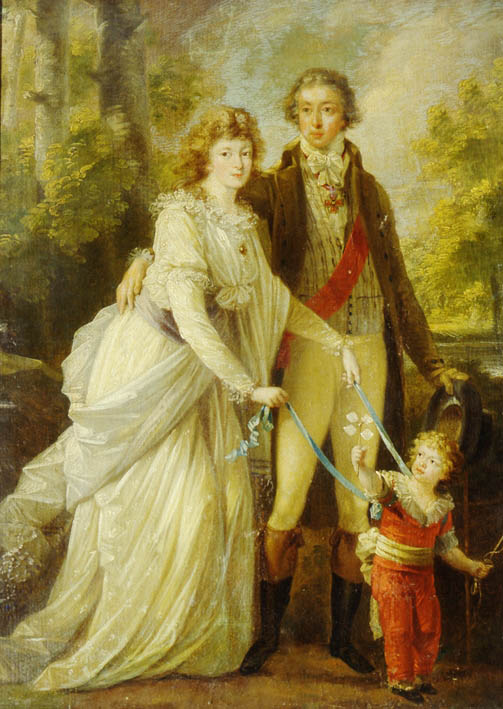
This is William Henry Meyrick
Though it is difficult for the modern observer to wrap their minds around dressing little boys like little girls, the fact was that dresses were considered children’s wear, not little girls’ clothes. Children’s dresses were very distinct from women’s garments, so to the eye of the person in context, it was not a matter of boys in women’s garments. On a more practical note, in the days before disposable diapers and washing machines, dresses were much more practical garments for children who were not toilet trained.

The transition of little boys from wearing dresses to masculine pants was called breeching and marked a major transition in a child’s life.

References:

"Boys' Clothes During the 1800s." Boys clothing during the 1800s. August 27, 2003. Accessed January 07, 2013. http://histclo.com/chron/c1800.html.

Barreto, Cristina, and Martin Lancaster. Napoleon and the Empire of Fashion, 1795-1815. Milan: Skira, 2010.

Black, Maggie, and Deirdre Faye. The Jane Austen Cookbook. Chicago, Ill: Chicago Review Press, 1995.

Brander, Michael. The Georgian gentleman. Farnborough: Saxon House, 1973.

Brooke, Iris. English Children's Costume 1775-1920 . Dover Fashion and Costumes. Minoela, NY: Dover Publications, 2003.

Davidoff, Leonore, and Catherine Hall. Family Fortunes: Men and Women of the English Middle Class, 1780-1850. Chicago: University of Chicago Press, 1987.

Horn, Pamela. Flunkeys and Scullions: Life below Stairs in Georgian England. Stroud: Sutton, 2004.

Kane, Kathryn . “Regency Baby Clothes: Blue for Boys, ??? for Girls.” Regency Redingote. June 8, 2012. Accessed January 5,2013. http://regencyredingote.wordpress.com/2012/06/08/regency-baby-clothes-blue-for-boys-for-girls/.

Kane, Kathryn. “Of Hanging Sleeves and Leading Strings.” Regency Redingote. January 20, 2012. Accessed January 5,2013. http://regencyredingote.wordpress.com/2012/01/20/of-hanging-sleeves-and-leading-strings/.

LeFaye, Deirdre. Jane Austen: The World of Her Novels. New York: Abrams, 2002.

Lewis, Judith Schneid. In the Family Way: Childbearing in the British Aristocracy, 1760-1860. New Brunswick, N.J.: Rutgers University Press, 1986.

Martin, Joanna. Wives and Daughters: Women and Children in the Georgian Country House. London: Hambledon and London, 2004.

Olsen, Quenby. “How to be a child in Regency England.” Jude Knight. May, 1, 2017. Accessed February 18, 2018. http://judeknightauthor.com/2017/05/13/how-to-be-a-child-in-regency-england/.

Payne, Lynda. "Health in England (16th–18th c.)," in Children and Youth in History, Item #166, Accessed February 19, 2018. http://chnm.gmu.edu/cyh/items/show/166

Rovee, Christopher. “The Romantic Child, c.1780-1830.” Representing Childhood. 2005. Accessed Feb. 18, 2018. <http://www.representingchildhood.pitt.edu/romantic_child.htm

Selwyn, David. Jane Austen and children. London: Continuum, 2010.

Stone, Lawrence. The Family, Sex and Marriage in England, 1500-1800. New York: Harper & Row, 1979.

Watkins, Susan. Jane Austen's Town and Country Style. New York: Rizzoli, 1990.

~~~~~~~~~~

Though Maria Grace has been writing fiction since she was ten years old, those early efforts happily reside in a file drawer and are unlikely to see the light of day again, for which many are grateful.

After penning five file-drawer novels in high school, she took a break from writing to pursue college and earn her doctorate. After sixteen years of university teaching, she returned to her first love, fiction writing.

Click here to find her books on Amazon. For more on her writing and other Random Bits of Fascination, visit her website. You can also like her on Facebook or follow on Twitter.


Thursday, January 11, 2018

Giving Birth in Jane Austen’s Day: Confinement, Lying-in, and Churching

by Maria Grace

Unlike women today who often give birth in hospitals or birthing centers, women of the regency era normally gave birth at home. Preparation for confinement fell almost exclusively to the mother--big surprise, I know. Among the most significant of those preparatory decisions was where she would be confined. (Vickery, 1998)

Confinements

The decision was a significant one. A woman's confinement, also called her lying-in, lasted a month to six weeks starting when the baby was born, through her subsequent recovery.  In some cases, women imminently due to give birth were also confined to the house and treated as invalids. (But only in cases where there was sufficient assistance available to take over the mother-to-be’s duties, of course.)   During confinement women were expected to stay indoors, preferably in bed. Most felt well enough to emerge from confinement after a month. (Honestly I think they’d have to be really ill not to be utterly stir-crazy by then. But then again, I get stir crazy confined by a day or two of rain.)

The medical community believed that an extended period of strict rest was necessary to help protect against the postnatal dangers threatening the mother and the baby.  Considering the number of women who died in childbirth and those who experienced complications including puerperal fever, hemorrhage, thrombosis and milk fever, the precaution made a great deal of sense.

Some women chose to return to their mother’s home to give birth. Others brought female relatives to their home for the event.  It was not unusual for rooms used for lying-in to be rearranged or redecorated in anticipation of the event. (Martin, 2004) Ideally, the mother would have two interconnected room. The inner, would contain the mother’s lying-in bed, usually kept dark though labor, delivery and at least the first week afterwards. The outer room would serve as a waiting room of sorts, a place for friends and relatives to gather.  (Lewis, 1986)

For those who could afford it, London, because of its reputation for skilled doctors, was regarded as the best place for a confinement, especially for the birth of an anticipated heir.  When a family went to town for a confinement, it could disrupt the household for weeks, even if the family maintained a house in London. And since delivery dates could not be accurately predicted, all this often happened at the very last minute. (I can’t think of anything I would less rather do at the very end of a pregnancy than be confined for hours on end in a bouncy-jolty carriage, moving households to somewhere else.) 

During the confinement, especially one with all the pomp and circumstance of a London confinement, the mother often received visits from friends and relatives. Sometimes a greate many of them, perhaps even more than she desired. Frequently these were women who had “shared in the drinking of caudle, the hot spiced wine mixture she had imbibed to ease her labor pains,” her ‘gossips.’ (Lewis, 1986) Country confinements had the advantage of fewer ‘drop-in’ sort of visitors. The new parents could exercise a little more control in who came to visit.

“The confinement itself was composed of a set of clearly defined stages in the recovery process. While these provided something of a guideline for the recovery of all women, they were flexible enough to allow for individual differences.  …  Generally, the stages …consisted of increasingly long forays from bed to sofa; thence to the outer or dressing room of the lying-in chambers; downstairs, possibly to dine with the family; and finally to take her first leave of the premises. The entire process lasted from four to six weeks.” (Lewis, 1986)

 Churching

A woman’s confinement ended when the mother had been "churched" and her child christened. Considering the very real risks to both mother and infant, it is not surprising that the Church had a special service of thanksgiving after (surviving) childbirth. The Book of Common Prayer of the Church of England, called it the Churching of Women. Traditionally, a woman paid her first visit upon leaving home to her church for this service which emphasized a woman's gratitude toward God for her full recovery. (Lewis, 1986)

Although sanctioned by the Old Testament (Leviticus 12), churching was a prickly issue within the Church. Some condemned it as a remnant of the Jewish religion or as a Catholic rite. Still, it continued as a pervasive practice, especially in rural areas. (Collin, 2001) This may have been because of superstitions about women bringing bad luck following childbirth unless ritual cleansing took place.  

The ceremony was generally sought after by women, a ceremony that focused on them and acknowledged the perils they had faced. It was also an opportunity to rejoin society after extended isolation and often an opportunity to feast with the friends who had helped her through her labor (her ‘gossips.’)  (Knöde, 1995)

Women who experienced a still birth or whose child died soon after were still churched. But, women who gave birth to illegitimate children were not until they publicly repented before the whole congregation.  “There are also records of a debate whether a woman who had died in giving birth should be buried in the church graveyard if she had died unchurched. Popular custom occasionally had another woman undergoing the ceremony for the woman who had died, but such practice was not favoured by the church. It was eventually decided that an unchurched woman could be buried, but in a number of cases they were buried in a special part of the graveyard and superstitious beliefs had it that women between 15 and 45 were not supposed to be going to that particular part of the graveyard.” (Knöde, 1995)

References

Adkins, Roy, and Lesley Adkins. Jane Austen's England. Viking, 2013. 
Collins, Irene. Jane Austen and the Clergy. London: Hambledon and London, 2001. 
Collins, Irene. Jane Austen, the Parson's Daughter. London: Hambledon Press, 1998. 
Knödel, Natalie. The Thanksgiving of Women after Childbirth, commonly called The Churching of Women. University of Durham. April 1995   http://users.ox.ac.uk/~mikef/church.html   
Lane, Maggie. Jane Austen's World: The Life and times of England's Most Popular Novelist. 2nd ed. London: Carlton Books, 2005.
Lewis, Judith Schneid. In the Family Way: Childbearing in the British Aristocracy, 1760-1860. New Brunswick, N.J.: Rutgers University Press, 1986. 
Martin, Joanna. Wives and Daughters: Women and Children in the Georgian Country House. London: Hambledon and London, 2004. 
Selwyn, David. Jane Austen and Children. New York City: Continuum Books, 2010.
Vickery, Amanda. The Gentleman's Daughter: Women's Lives in Georgian England. New Haven, Conn.: Yale University Press, 1998.


~~~~~~~~~~

Though Maria Grace has been writing fiction since she was ten years old, those early efforts happily reside in a file drawer and are unlikely to see the light of day again, for which many are grateful. 

After penning five file-drawer novels in high school, she took a break from writing to pursue college and earn her doctorate. After 16 years of university teaching, she returned to her first love, fiction writing.

Click here to find her books on Amazon. For more on her writing and other Random Bits of Fascination, visit her website. You can also like her on Facebook, or follow on Twitter.


Monday, December 11, 2017

Living on Credit is Not a New Thing

by Maria Grace

It’s easy to believe that living on credit is a modern thing. The news abounds with tales of woe regarding consumer debt, mortgages, student loans, and other lines of credit. How would Jane Austen have reacted to such news? Probably with great aplomb and a declaration that the more things change, the more they stay the same.

During the Regency era “almost all members of the middle and upper classes had accounts with different suppliers, who extended credit to their patrons. … Only if the amount was small or they were traveling did they pay cash. In fact, only the poor did not live on credit in one guise or another.” (Forsling, 2017) In fact, more people depended on credit than ever before resulting in perpetual overcrowding in the debtor's prisons.

Although debt, both personal and national, were rife in Regency society, attitudes toward debt were largely divided across class lines. “Aristocratic claims for leadership had long been based on lavish displays and consumption while the middle class stressed domestic moderation. In particular, aristocratic disdain for sordid money matters, their casual attitude to debt and addiction to gambling …, were anathema to the middling ranks whose very existence depended on the establishment of creditworthiness and avoidance of financial embarrassment.” (Davidoff, 2002).

Many small and otherwise flourishing businesses failed due to bad debts, especially among the upper classes. Some went so far as to begin refusing credit and to only sell for ‘ready money’. The notion that debts of honor had to be paid and paid quickly while debts to merchants could be put off indefinitely only exacerbated the situation.

Robbing Peter to Pay Paul

Gaming debts were regarded as sacrosanct which might not have been so significant an issue had there not been so many of them. The Regency was a time when Englishmen, especially the wealthy and highborn, were ready to bet on almost anything. Though gaming for high stakes was illegal by Austen’s day, authorities mostly seemed to turn a blind eye to it, (Fullerton, 2004) perhaps because it was considered largely an upper class vice.

Different social classes offered different reasons for the immorality of gaming. The upper classes feared losing their money to the lower class, giving them income without having earned it and opposing the work ethic. The rising middle class also saw gaming as opposing the values of stability, property, domesticity, family life and religion. (Rendell, 2002) Regardless of the reason, there was widespread agreement that gaming was a problem, thus legislation was passed against it.

Unfortunately anti-gaming laws, much like prohibition in the US, only forced gambling from public venues into private clubs where individuals bet on any and nearly everything. Organized sports including cricket, horse racing, prize fighting and cock fighting attracted spectators willing to bet on the outcome. Huge fortunes, even family estates could be won and lost at games of chance. Even the outcome of the Napoleonic Wars were subject to betting.

Moneylenders and bankers made themselves available at private clubs to assist gentlemen in settling their debts of honor which were not otherwise enforceable by law. The cost of this service though (beyond the interest on the debt of course), was creating a legally enforceable debt from which one had not been so previously.

Debtors' Prison

English bankruptcy laws were particularly harsh, demanding personal repayment of all debt, including business debt, and often incarceration. Ironically, there was no disgrace about being sent to gaol during the era, provided it was for an acceptable crime like debt or libel. (Murry, 1999) The Royal Courts administered three prisons primarily for debtors: the Fleet, the King's Bench and the Marshalsea, though debtors might be imprisoned at other facilities as well. (Low, 2005) At any given time during the era, upward of a 10,000 men were imprisoned for debts as small as four pence. (Savage, 2017)

Debtors were probably the largest proportion of the era’s prison population and had privileges not granted to ordinary criminals, including the right to have their family stay with them and to have other visitors. They could also often arrange to be supplied with beer or spirits. (Low, 2005) “During the quarterly terms, when the court sits, (Fleet) prisoners on paying five shillings a-day, and on giving security, are allowed to go out when they please, and there is a certain space round the prison, called the rules, in which prisoners may live, on furnishing two good securities to the warden for their debt, and on paying about three per cent on the amount of their debts to the warden.” (Feltham, 1803)

The process of obtaining an arrest warrant for debt was expensive. Often several tradesmen would have to band together to see a writ for debt issued. (Kelly, 2006)

Once the writ was obtained, the debtor (once caught, of course, as it was not uncommon for debtors to flee in the face of a writ, even so far as to leave the country) would first be confined to a spunging or lock-up house. A spunging-house was a private house maintained for the local confinement of debtors to give them time to settle their debts before the next step, debtors' prison. “…For twelve or fourteen shillings a-day, a debtor may remain [at the spunging house], either till he has found means of paying his debt, or finds it necessary to go to a public prison, when the writ against him becomes returnable. We have heard that great abuses prevail in these spunging-houses, and that many of the impositions practised in them deserve to be rectified. … It would be wrong to quit the sad subject of prisons, without observing that such is the bad arrangement of the laws between debtor and creditor, that ruin to both is greatly accelerated by the expensiveness of every step in the proceedings, insomuch that not one debtor in ten ever pays his debt after he enters a prison. (Feltham, 1803)

Why Debtors' Prison?

Given that once a debtor was in prison, they lacked the ability to earn money making the payment of his debt even less likely, this approach to debt seems ridiculous. So why was it done?

First, it was assumed that the debtor’s family and friends would be available to help pay off their debts. So imprisoning the debtor might help motivate them to action. Second, it was perceived as a deterrent to getting into debt in the first place. (Clearly, given the numbers in debtors’ prison it was a total failure on that count.) (Savage, 2017)

The third reason is perhaps the most difficult for the modern reader to understand. To the people of the time, the issue was bigger than simply insuring the debtor paid off their debts. “The ‘moral’ imperative to make the debtor aware of their responsibility for not living beyond their means was judged more important. … To understand the mind-set of the time, it’s important to remember two things: taking on more debt than you could pay was seen as a form of theft; and, … (t)heft broke the Biblical commandment, “Thou shalt not steal”. The causes of becoming too indebted to pay also pointed to the presence of other sins: idleness, covetousness, greed, deceitfulness. … Sin demanded punishment and repentance not support,” thus jailing the debtor fulfilled the moral imperative. (Savage, 2017)

Myth of the smock wedding

Just because there was a moral imperative to punish debtors didn’t mean that those who owed money accepted their fate easily or didn’t attempt creative means by which to discharge their debts. Running to avoid one’s creditors was common. Beau Brummell fled to France to avoid debtors’ prison. In some cases a debtor could be pressed into naval service in exchange for the Navy to cover their debts.

Marriage, particularly for the upper class, was also a handy means of bringing in quick cash to alleviate a family’s money woes. The (disastrous) marriage of the Prince of Wales to his cousin, Princess Caroline of Brunswick in 1795 came about so that Parliament would pay off his debts.

Not all men were happy to marry a woman with debts, especially a widow still responsible for her late husband’s debts. Consequently, the practice of a ‘smock wedding’ came into being. At such a wedding, the bride would be married naked, bringing nothing into the marriage. In practice, she usually was barefoot and garbed in a chemise or sheet. The salient point was that she was technically bringing nothing into the marriage, thus her husband-to-be was thought not liable for any debts she might have. (Adkins, 2013) It is too bad that snopes.com was not around in the era, because it could have told them that the ‘smock wedding’ way out of debt was an urban myth and would not stop the new bride’s creditors from knocking at their door.

References

Adkins, Roy, and Lesley Adkins. Jane Austen's England. Viking, 2013. 
Craig, Sheryl. Jane Austen and the State of the Nation. New York: Palgrave Macmillan, 2015.
Davidoff, Leonore, and Catherine Hall. Family Fortunes: Men and Women of the English Middle Class, 1780-1850. Chicago: University of Chicago Press, 1987.
Feltham, John. The picture of London, for 1803; being a correct guide to all the curiosities, amusements, exhibitions, public establishments, and remarkable objects in and near London; with a collection of appropriate tables. For the use of strangers, foreigners, and all persons who are intimately acquainted with the British metropolis. London: R. Phillips, 1803.
Forsling, Yvonne . “Money Makes the World Go Round.” Hibiscus-Sinensis. Accessed July 22, 2017. http://hibiscus-sinensis.com/regency/money.htm
Fullerton, Susannah. Jane Austen and Crime. Sydney: Jane Austen Society of Australia, 2004.
Kelly, Ian. Beau Brummell: The Ultimate Man of Style. New York: Free Press, 2006.
Laudermilk, Sharon H., and Teresa L. Hamlin. The Regency Companion. New York: Garland, 1989.
Low, Donald A. The Regency underworld. Stroud: Sutton, 2005.
Murray, Venetia. An Elegant Madness: High Society in Regency England. New York: Viking, 1999.
Rendell, Jane. The Pursuit of Pleasure Gender, Space & Architecture in Regency London. London: Athlone Press, 2002.
Savage, William . “The Georgian Way with Debt.” Pen and Pension. July 19, 2017. Accessed July 25, 2017. https://penandpension.com/2017/07/19/the-georgian-way-with-debt/ .

~~~~~~~~~~

Though Maria Grace has been writing fiction since she was ten years old, those early efforts happily reside in a file drawer and are unlikely to see the light of day again, for which many are grateful.

After penning five file-drawer novels in high school, she took a break from writing to pursue college and earn her doctorate. After 16 years of university teaching, she returned to her first love, fiction writing.

Click here to find her books on Amazon. For more on her writing and other Random Bits of Fascination, visit her website. You can also like her on Facebook, or follow on Twitter.