Showing posts with label Bonnie Prince Charlie. Show all posts

Saturday, November 1, 2025

The Spy Who Changed the Course of British History

 By Nancy Bilyeau


The year: 1745. London? In a panic. The long-exiled Stuart family, driven out in 1688, was threatening to retake the English throne.

Charles Edward Louis John Casimir Sylvester Severino Maria Stuart, commonly known as Bonnie Prince Charlie, and his predominantly Scottish army of 6,000 men had made it to Derby, just over 120 miles from the capital.

Since landing at Eriskay in the Outer Hebrides on July 23, 1745, with not even a dozen men, the charismatic prince, grandson of the deposed James II, had recruited influential Highlands leaders, easily taken Edinburgh, and defeated an army led by Hanoverian supporters of the present King at the battle of Prestonpans. Then he turned south, crossing into England.

Portrait of Bonnie Prince Charlie, painted by Allan Ramsey in 1745. Source: Wikipedia

A horde of "crazed Highlands thieves" was on the move!  There was a run on the Bank of England! George II, who, like his father, had not troubled to hide the fact that he preferred living in Hanover to England, loaded up a ship with personal valuables, in case he needed to flee the vengeful Jacobites and turn the Continent into his permanent home. These were the sorts of wild rumors that swirled around the city.

Yet in Derby, the temporary headquarters of the invading army, the mood was far from confident. Prince Charles' advisers had noted the lack of English Jacobite support. Few were rallying to their cause. Neither was it at all certain that the French would show up to reinforce the Scottish invasion, a cornerstone of the Stuart strategy.

Most worryingly, a well-trained army, most likely led by King George II's son, the Duke of Cumberland, must surely be coming to meet them. Who knew how large it would be?

Exeter House in Derby, where the prince and his men plotted strategy.
Picture taken in 1853. Source: Wikipedia.

As the advisers to the impetuous 25-year-old prince debated their next move, one of Charles's followers spoke up. It was Captain Oliver Williams, a trusted Irish supporter of the cause.

A Hanoverian force of 9,000 men had been sighted in Northampton, Captain Williams informed the men in the room. This army was not much more than 50 miles away. And other units must be hurrying toward Derby.

That sealed it. Overruling Prince Charles' outrage and passionate protests that he wanted to march on London, the Jacobite army's military commanders said they must instead return to Scotland and consolidate their position. Four months after this retreat came the crushing defeat at Culloden, followed by Bonnie Prince Charlie's flight from Scotland.

Artist's rendition of Culloden. Some feel the depiction of the Highlanders relied on stereotypes. Source: wikipedia

Culloden, the last battle ever fought on the British mainland, has been studied and analyzed ever since those hours of fierce fighting, which killed some 2,000 men. Going beyond historians' domain, Culloden has become a cornerstone of popular culture, such as the center of Diana Gabaldon's Outlander books and TV series. The tragedy and glamour of the lost cause, a royal family in embittered exile, even penetrated the Game of Thrones fantasy series, with the Targaryen family living far from the Seven Kingdoms, believed to be modeled on the Stuarts who fled to France and then Italy.  "The people drink secret toasts to your health and cry out for their true king," an adviser whispers to the ambitious young Viserys Targaryen, the "king across the water," in the first episode of the series.

When proposing various "What if"s on the subject of Bonnie Prince Charlie, people often come back to the decision at Derby. 

Historians believe that the turning point was then and there, that he lost the strategic and psychological advantage by retreating. Many of the Scots who followed the prince's cause did so not so much as to prop up a Catholic Stuart monarch as to force through more independence for Scotland. As for the Irish, those followers did wish for a Catholic king, as it would presumably ease the religious discrimination they suffered. Failure brought agony. The punishment the Hanoverian government meted out to the defeated enemy and their supporters was ghastly. The Duke of Cumberland earned the nickname "Butcher" with the slaughter of the injured and the prisoners, and ordered attacks on the helpless civilian population.

The defeat meant that Great Britain became more centralized; bolstered by its industrialized feats and banking policies, the British Empire became a force like no other. The fates of not just Scotland and Ireland but also America and India were arguably influenced by the smashing of Bonnie Prince Charlie's rising.

The impact of Culloden on world history makes it all the more shocking that the information the Stuart army relied on in Derby was a complete lie. There were no 9,000 men in Northampton. In fact, the road to London at that time was clear.

It turned out that Captain Oliver Williams, true name Dudley Bradstreet, was a spy, employed by the Duke of Cumberland to report on the Jacobites' movements and to spread disinformation. Which he most certainly did.

The craft of espionage was in a murky stage in the mid-1700s. Not much is written about the policies and practices of spying between the time of Sir Francis Walsingham, the spymaster of Elizabeth I, and the intense spying that took place later in the 18th century, during the American Revolution.

Those recruited for espionage were a far cry from Ian Fleming's James Bond or any of the Cambridge-educated manipulators from a John Le Carre novel. The Hanoverian government assumed that spying was immoral, so it used immoral men.

Dudley Bradstreet fit that requirement to a "T," a fact he cheerfully admitted in the book he wrote about his life, The Life and Uncommon Adventures of Captain Dudley Bradstreet. There's rarely been a more gleeful rogue than Bradstreet: fortune hunter, gambler, trickster, and spy.

He was Irish; that part was genuine. Bradstreet was born in Tipperary in 1711, the youngest son of landowner John Bradstreet, a man who received Cromwellian grants but, by the time Dudley came along, had a fortune that was "continually declining."

Wrote Dudley in his memoir: "My education was neglected, he removed his whole family from the country to Dublin except for me, whom he left in charge with a Foster-Father. Here I must observe, the injury my being thus abandoned did to my conduct and morals, that it may be a caution to parents whom they trust with the early habits and impressions their children may receive."

Bradstreet became addicted to card playing, and as a young man, left for London with a mistress but returned to Ireland to join the army. He later married for love, but she died; he had children by various women. He inherited nothing from his father and was arrested for debt, managing to marry a wealthy widow to stay afloat.

The Duke of Montagu, Bradstreet's friend, source: wikipedia

"A crony" of the Duke of Montagu, a peer notorious for his practical jokes, Bradstreet came to the notice of the British government in 1744 and was encouraged to infiltrate the Jacobites and report back what he learned. It was a shock to many when Bonnie Prince Charlie, defying the enormous odds against him, landed in Scotland in 1745. Unfortunately for the prince, it meant that Dudley Bradstreet was well-positioned to learn much--and make a lot of mischief.

After "Captain Williams" successfully derailed Bonnie Prince Charlie's quest in Derby, Bradstreet melted away before the Jacobites returned to Scotland. He approached government officials and demanded money and a commission — he got neither. Incredibly, Bradstreet persisted in his haranguing, and eventually George II gave him 150 pounds.

His career then took a decided turn into the fantastical. Bradstreet became a "bottle conjurer," someone who told the gullible he could talk to the dead and restore lost youth. "Bradstreet knew how to touch the infirmity of man," wrote one chronicler. Bradstreet himself said without apology he owed it all to the "superstition" of his victims and their "credulity and faith in wondrous things."

Bradstreet made a lot of money from his conjurings, lost nearly all of it, and then returned to Ireland for good, buying a house and writing his memoir.

The book sold well. "In the free narrative of his reckless adventures, some incidents have a breadth rather suspicious and some a warmth rather indelicate," a critic wrote.

Dudley Bradstreet, the fateful spy in the Jacobite camp, died in Ireland at the age of 52.

~~~~~~~~~~~~~
Nancy Bilyeau is a magazine editor and historical novelist. Her Genevieve Planche series--The Blue, The Fugitive Colours, and The Versailles Formula--is set in the espionage and art world of the mid-18th century. To learn more, go to www.nancybilyeau.com.


Wednesday, November 6, 2019

Eyewitness to History

By Kimberley Jordan Reeman

When I came into this Country, it was my only view to do all in my power for your good and safety. This I will always do as long as life is in me. But alas! I see with grief, I can at present do little for you this side the water, for the only thing that now can be done, is to defend your selves.
Charles Edward Stuart, April 1746, after Culloden

WEDNESDAY, APRIL 16, 1746, 11 a.m. A raw morning, with a bitter north wind scything up from the Moray Firth, bringing heavy showers of rain and sleet. Two armies, some fourteen thousand men, although perhaps only three thousand will engage, are manoeuvring two and a half miles apart on this sloping, boggy ground six miles from Inverness, which adjoins Drummossie Moor and climbs from the elegant parks of Culloden House, owned by Duncan Forbes, the Lord President of the Court of Session.

The Jacobite army, under the command of the Pretender, Charles Edward Stuart, who even in these final, fateful hours radiates the charisma and optimism of his ancestor Mary, Queen of Scots, stumbles into some order of battle with a confusion and disorganization that reflects the rifts, quarrels and indecision of its generals. The British army, under the command of William Augustus, H.R.H the Duke of Cumberland, the charmless, corpulent third son of George II, deploys with a silent purpose that moves a French officer to remark to Charles that ‘he feared the day already lost, for he had never seen men advance in so calm and regular a manner’.

Charles Edward Stuart - Public Domain Image

The onslaught of sleet assaults them all: princes and peasants, volunteers and conscripts, the criminals and the idealists, the men of noble blood and the butchers, gardeners, apprentices; and the veterans recalled from Flanders and the War of the Austrian Succession, professional killers whose service is for life, and whose ages range from seventeen to fifty-four.

The Jacobites stand ankle-deep in water, with empty bellies, sleet beating on their backs: volatile, exhausted, ill-fed. Many have deserted because there is little food and less pay: because their fields are lying unsown; because they fear for their families; because they sense the animosity and dissension among their leaders, who cannot agree on anything from the ground on which to fight what they know will be their final battle to the order of precedence to be accorded to the clans. Some have deserted because prescience has warned them that their cause is lost, and they have foreseen their deaths.

They are not all Highlanders, although there are many Gaelic-speaking clansmen, conscripted and threatened into service by chieftains or landlords. There are also Lowland Scots, many conscripted; volunteers; deserters from the Scottish militia regiments of the British army or enlisted from among those prisoners taken after Charles’s victory at Prestonpans. Two infantry battalions and a squadron of cavalry are French, as well as artillerymen, engineers and volunteers: these are the ‘Wild Geese’, the Irish Brigade of the French army, whose red coats among the coarse homespun of the clansmen are clearly visible across the moor, as are the blue coats of the Royal Écossais, a Scottish unit of the French army raised in 1744.

The wind is now northeasterly. Five hundred yards away, across ground laced with streams and springs, drystone walls and scattered cottages, the standards and colours of the British regiments snap and billow, blowing forward: the wind is at this army’s back, and the smoke of battle will blind the enemy. Many of these officers are Scots, many Anglo-Irish: the 1st, 21st and 25th Foot are Scots regiments, as are the Gaelic-speaking Argyllshire Militia, the Duke of Kingston’s Light Horse, and the regulars of Loudon’s 64th Highlanders. There are many here who wear Highland dress, many for whom the ranting slogans and skirling pipes of the rebel clans are echoes of a culture shared.

The Battle of Culloden, oil on canvas, David Morier, 1746

The sleet stops abruptly: the sky is torn with blue. A little after one o’clock, the Pretender’s artillery opens with irregular fire. The royal artillery, carefully sited, responds with a devastating, sustained barrage aimed at the massed ranks of the Jacobite army. Mud spatters the mounted Charles’s face: behind him a groom is decapitated. The roundshot is followed by canister, sweeping the field with a hailstorm of grape and reaping a terrible harvest. Blinded by the smoke and by unbearable rage and anguish, eight clan regiments break into the charge. At a range of fifty yards, the hardened veterans of the British front-line regiments, Barrell’s, Munro’s, and the Scots Fusiliers, open fire with muskets, inflicting carnage. The shock of the Jacobite charge splits Barrell’s and engulfs it: of four hundred and thirty-eight officers and men, both English and Scots, seventeen are killed and one hundred and eight wounded, many grievously: the colonel of Barrell’s, Robert Rich, falls with a severed hand and serious head wounds; others are dismembered. The naked courage of the Highlanders imprints itself so forcibly upon the mind of a young aide de camp to Cumberland that in Quebec on September 13, 1759, that man, now Major-General James Wolfe, will unleash its fury himself against the forces of the Marquis de Montcalm on the Plains of Abraham.

Of Wednesday, April 16, 1746, no man could know, as he shivered in the prelude to battle, that no British regiment would ever bear Culloden among its honours, or that its very name would become synonymous with infamy. No man, neither prince nor apprentice, could perceive that he was ‘only a mote of dust, and of as much consequence’ in the affairs of nations, and that Culloden was only a footnote, albeit scrawled in blood, across the vast canvas of the eighteenth century, a microcosm in which the hereditary enemies, Britain and France, grappled for supremacy. A turbulent century, which sees America’s bloody and protracted struggle for independence, the insurrection and revolution which will convulse France, and the tragic repercussions, for a people and a culture, which haunt Scotland still.

~~~~~~~~~~

About Kimberley:
Kimberley Jordan Reeman was born in Toronto, graduating from the University of Toronto with a Bachelor of Arts (hons.) in English literature in 1976. She worked in Canadian radio and publishing before marrying the author Douglas Reeman in 1985, and until his death in 2017 was his editor, muse and literary partner, while pursuing her own career as a novelist.

About Douglas (Alexander Kent)
Douglas Reeman was born in Thames Ditton, Surrey, England in 1924. With the outbreak of war, and despite belonging to an army family, he joined the Royal Navy without hesitation at the age of sixteen. In June of 1968 To Glory We Steer was published under the pen name Alexander Kent. Douglas Reeman died in January of 2017. Today, the exploits of Richard and Adam Bolitho feature in twenty-eight Alexander Kent novels.


Buy Coronach on Amazon (Universal Link) : http://author.to/Coronach

Douglas’s Website  https://www.douglasreeman.com/


Friday, December 1, 2017

Not Such A Fine Romance: Clementina Walkinshaw and Prince Charles Edward Stuart

by Lauren Gilbert

Clementina Maria Sophia Walkinshaw c. 1760 

Prince Charles Edward Stuart, known as Bonnie Prince Charlie, was the very stuff of romance. A gallant prince, eldest son of James III/VIII (the Young Pretender to the throne of England, Scotland and Ireland), known for his charm, and a lost cause... Who could resist such a creature? Surprisingly, there are rather fewer identified mistresses for Prince Charles than one might think. One of this number was Clementina Walkinshaw.

Clementina was born to John Walkinshaw of Barrowfield and his wife Katherine Paterson of Bannockburn, their 10th (and youngest) child, all of whom were daughters. Her full name was Clementina Maria Sophia Walkinshaw. Accounts of her place and date of birth vary, some sources placing it between 1720-1725 in Barrowfield in Scotland, others in Rome, Italy. Her father was a staunch supporter of the Jacobite cause, having supported the Stuarts previously in the 1715 uprising and having helped to bring his affianced wife to James III/VIII in 1719. There are suggestions that the family spent a great deal of time on the continent, that Clementina was named for the spouse of James III/VIII, Clementina Sobieski, possibly even her goddaughter, and that Clementina personally was known to the Stuarts in exile. Although suggestions that Clementina and Prince Charles Edward, born December 31, 1720 in Rome, had been childhood friends seem questionable, it does seem possible that there may have been an acquaintance.

At any rate, they definitely became known to one another in 1745. In January of 1746, he stopped at Bannockburn House apparently after the successful battle of Falkirk. Bannockburn was the home of Clementina’s uncle, Sir Hugh Paterson. Clementina was there visiting her uncle and her father may also have been present at this visit. During this time, the prince became ill with a cold and fever, and Clementina was supposedly one of the ladies assigned to nurse him. Much was made in some accounts of her cinnamon possets; there were even suggestions that she may have met him earlier and planned to meet him again in Bannockburn. Whatever prior connections there may (or may not) have been, Clementina and the prince definitely became known to each other at this time. Although David Wemyss, Lord Elcho (once the prince’s aide-de-camp, and a member of the council), and some others, stated unequivocally that Clementina became the prince’s mistress during this visit, it seems to me to be questionable, given her father’s and uncle’s status and the indications of Clementina’s possible connection to the prince’s family.

Prince Charles Edward Stuart, 1720-1788. By Allan Ramsay, c. 1745

At any rate, once the prince left Bannockburn in February of 1746, he did not return, as his road led to disaster at Culloden in April, then five months of running and hiding before finally escaping back to France in September of 1746. Once there, he continued to try to rally support for his cause with little success. When Pope Benedict XIX announced in 1747 that he planned to make Prince Charles Edward’s younger brother Henry a cardinal in the Roman Catholic Church, Prince Charles Edward was enraged, especially when he discovered that the move was made with their father’s support and approval, as this close familial allegiance to the Pope and Church (on top of his family’s known preference for the Catholic Church) would make it virtually impossible to convince the English of his Protestant sympathies, and to make a successful claim to the thrones of England, Scotland and Ireland. He became estranged from his father and brother because of this perceived betrayal.

Sometime during 1747, he became reacquainted with his cousin Marie Louise Henriette de la Tour D’Auvergne, who was then married to Jules Hercule Meriadec de Rohan, prince of Guemene. The Prince of Guemene was away in the French army at this time, and Marie Louise and Prince Charles Edward fell passionately in love. They began a passionate secret affair that was quite difficult to conduct as Marie Louise’s mother-in-law tried to keep a close eye on her. It does not seem to have been a particularly happy affair, as Charles Edward subjected her to jealous rages and was known to have abused her. However, she was passionately in love with him. This may have been his first real relationship. The affair began to leak out, causing something of a scandal, and Marie Louise ultimately became pregnant. She was forced to end the affair and resumed sleeping with her husband to try to confuse the paternity of the infant. Enraged that she was sleeping with her husband, Charles refused her repeated attempts to see him alone, even though he continued to engage with the family. He told her that he had another mistress, and some sources indicate that the new mistress was Clementina Walkinshaw. However, in BONNIE PRINCE CHARLIE IN LOVE, this mistress was identified as the Princess de Talmont with whom he spent at least a couple of years travelling after he was expelled from France in December of 1748. Marie Louise had the child in July of 1748, and named him Charles Godefroi Sophie Jules Marie de Rohan. Although it appears that James III/VIII was told that he had a grandson, there is nothing to indicate what Charles may have felt about the child. Sadly the child, who had been recognized as a legitimate de Rohan, died in infancy.

Where was Clementina Walkinshaw during this time? It is hard to say as little appears to be known. Her older sister Catherine Walkinshaw (about 12 years older than Clementina) was in England in the household of the Augusta, Princess of Wales (wife of Frederick, Prince of Wales). (After Culloden, there was an apparently an unsuccessful attempt to get rid of her.) Her family appears to have had a foot in both camps. Charles had made efforts to find a suitable German princess to marry, and had his relationship the Princesse de Talmont into 1750-51, marred as it was by jealousy and rages. He also made a brief clandestine visit to Jacobite supporters in London in September of 1750. Although numerous sources implied or stated that Catherine went with him when he returned to the Continent in 1746, this does not appear to be the case. There is no indication of even a correspondence between them.

Clementina appears to have lived quietly until she left Scotland in 1751 for France with the intention of joining a convent. Charles apparently heard she was in France, and asked for her to be found and brought to him. This is hardly an indication of a long-term, passionate affair on his part. Clementina agreed to join him, which does argue feelings for him on her part. Available data indicates she joined him sometime in 1752. Because of this, Clementina’s family cut all ties with her. Although Charles’ continental connections were courteous to her, the English and Scottish Jacobites urged him to break with Clementina, as they were convinced she was a spy for the English crown, passing information through her sister Catherine. (A real irony since Catherine had nothing further to do with Clementina once the liaison with Prince Charles Edward was known, just like the rest of the family.)

Charles and Clementina moved to Liege in the summer of 1753, and their daughter Charlotte was born in October of 1753. Prince Charles was by this time moody, bitter about his lost opportunities and increasingly drunk. Most accounts describe his drunken rages. They increasingly quarrelled, and he was known to mistreat her. However, they stayed together and there is an indication that they may have had another child that died in infancy. There were also rumours of a possible marriage between the prince and Clementina, although there is nothing to indicate either Charles or Clementina acknowledged a marriage. However, be that as it may, Prince Charles Edward continued to deteriorate and finally, after years of verbal and physical abuse, Clementina took their daughter and left him in July of 1760. They had lived together for eight years.

Clementina and Charlotte were supported by the prince’s father, James III/VIII until his death January 1, 1766, then by his brother the cardinal (albeit at a reduced rate, and he apparently had her sign an affidavit that she had never married Prince Charles Edward which was done in Paris in March of 1767). Charles refused to contribute to the support of Clementina or their child. The prince married in 1772, to the Princess Louise of Stolberg-Gedern. Unfortunately, his personal decline continued and the marriage was unhappy. It ended when he attacked her in November of 1780, causing her to leave him. There were no children of this marriage. After the end of that marriage, he made a will, leaving Charlotte as his heir, written in March of 1783. He also granted her the Scottish title of Duchess of Albany and signed an act of legitimation allowing Charlotte to inherit French properties. Unbeknownst to him (and apparently everyone else), Charlotte had had a long-term affair with Prince Ferdinand de Rohan, Archbishop of Bordeaux and subsequently Cambrai. They had two daughters and a son. She left them to move in with Charles in Florence in 1784, and she cared for him until his death the end of January of 1788. There are indications that she may have persuaded him to help Clementina, and certainly he wrote to Clementina occasionally before he died. Sadly, Charlotte herself died in November 17, 1789.

Charlotte Stuart, Duchess of Albany by Hugh Douglas Hamilton,  c. 1785-1786
At some point, Clementina was given the title of Comtesse d’Alberstroff. After Charlotte went to live with Prince Charles Edward, Clementina moved to Paris and then subsequently to Switzerland. Accounts indicate that Charlotte left her estate to her uncle, Cardinal York, with instructions for him to take care of her mother. A pension was generated. However, the payment of the pension is not clear. There are indications that, although Clementina should have been comfortably off, she was actually maintained by irregular payments generated by Thomas Coutts, a banker in London, with whom she maintained a friendly correspondence. Many sources indicate she was actually poor and in difficult circumstances. Clementina died in November of 1802. Most sources indicate she died in Fribourg, Switzerland, although there is also an indication that she may have returned to Paris and died there. There is no indication that she ever had any contact with any member of her family. A sad end to a mistress badly treated in a most unromantic affair.

Sources include:

Douglas, Hugh. BONNIE PRINCE CHARLIE IN LOVE The Private Passions of Prince Charles Edward Stuart. 1995: Alan Sutton Publishing Ltd, United Kingdom; 2016: The History Press, Stroud, England-ebook edition. (Kindle)

Archive.org. A HISTORY OF GLASGOW Vol. III. By George Eyre-Todd. 1934: Jackson-Wylie & Co. Chapter 15 “A Glasgow Jacobite: John Walkinshaw of Barrowfield.” P. 121.  HERE  (An easier to read PDF of this chapter can be found HERE)

GoogleBooks.com. MACMILLAN’S MAGAZINE, Vol. XL May 1879 to October 1879. 1879: Macmillan and Co, London and New York. “Burns Unpublished Common-place Book” by William Jack, Part III, PP. 34-39. HERE

GoogleBooks.com. THE SCOTTISH HISTORICAL REVIEW, Vol. XVII, No. 67, April 1920. “Last Days of Clementina Walkinshaw” by A. Francis, Steuart. PP. 249-251.  HERE

HistoryofRoyalWomen.com. “The Real Woman of ‘Outlander’: Marie Louise de la Tour D’Auvergne” posted May 24, 2017 by Franziska. HERE

Jacobites.net. Jacobite Rebellion of 1745 (I) “Clementina Walkinshaw, 1720-1802” (no date or author shown)  HERE

Jacobite.ca. “Charlotte, Duchess of Albany” (no author or post date shown, site maintained by Noel S. McFerran.)  HERE

Scotsman.com. “Bonnie Prince Charlie and his Glaswegian Mistress” by Alison Campsie, January 4, 2017.   HERE

Clanmacfarlanegenealogy.info. MacFARLANE & FAMILIES GENEALOGY. Maintained by Andrew J. Macfarlane. “Individual Report for Clementine Maria Sophia Walkinshaw, Comtesse d’Alberstroff (1603).” HERE; "Lt-Col. John Walkinshaw of Barrowfield, J.P." HERE; "Katherine (Catherine) Walkinshaw" HERE

Images from Wikimedia Commons: Clementina HERE, Prince Charles Edward Stuart HERE and Charlotte HERE
~~~~~~~

About the author:


Lauren Gilbert, a long-time member of the Jane Austen Society of North America, lives in Florida with her husband.  In addition to contributing to the English Historical Fiction Authors blog, she published a novel set in Regency England titled HEYERWOOD: A NOVEL, and is working on a second novel, A RATIONAL ATTACHMENT.  You can visit her website http://www.lauren-gilbert.com/ for more information.

Tuesday, November 11, 2014

Scotland and the Second Jacobite Uprising

by Christy Nicholas

Many a tale has been set in Scotland. Some truly tragic and romantic events have taken place in this isolated corner of the UK, with strong personalities, implacable egos, and cruel masters. The Jacobite Risings were full of such stories, but none so tragic as the Battle of Culloden during the Second Jacobite Rising of 1746.


In 1707, the Act of Union brought England and Scotland together as one economic and political unit, allowing greater trade, and replacing Scottish systems of currency, taxation, and laws.

This move was unpopular in Scotland, of course, and the Jacobites rose again, under James VII’s son, James Frances Edward Stuart, aka “The Old Pretender”. He had lived in exile most of his life, and attempted several failed invasions, most notably in 1715. It was ruined by a failure of coordinated risings in Wales and Devon, lack of leadership, bad timing, and bad luck. By the time James finally landed in Scotland, he was told it was hopeless, and so he fled back to the relative safety of France. If you would like a glimpse into what life may have been like, watch the movie Rob Roy, starring Liam Neeson. Rob Roy was an historical character, though the stories of him are mixed. Some show him as a cattle-thieving rogue; others as a national hero, standing up to the oppressive evil English landlord. I suspect the truth is somewhere in the middle. The real Rob Roy lived near Balquhidder, and there is a small cemetery there, where is grave is situated.

In 1745, James I’s son, Charles Edward Stuart, tried again to reclaim the Scottish crown. He was ”The Young Pretender”, or Bonnie Prince Charlie. The nickname Charlie most likely came, not from a diminutive of the name Charles, but from the Gaelic for Charles – Teàrlach. This rising was more successful, and he won some important battles, such as Prestonpans. Several clans joined the movement, albeit some very reluctantly. While he was successful at first, and managed to secure a good chunk of Scotland, he became greedy, and tried moving south into England. This overextended his resources, and many of his allies changed their minds. The rising ended with a horrible defeat by the Duke of Cumberland at Culloden. Charles fled to exile again, never to return.

If you ever visit Culloden field, please take the time to explore the visitor center. It has very poignant presentations on this time, this battle, and the events leading up to it. It is very moving, even if you have not a drop of Scottish blood.

The loss at Culloden broke the Highlanders and the Jacobites. What followed was a horrible part of British history – the Highland Clearances. In order to remove the teeth of the Scottish clans, the English outlawed Highland dress, custom, language – and capriciously stole from, killed, arrested, and transported thousands of Highlanders. These transportees ended up in Canada and America, often as indentured servants. Crofts were burned, cattle were slaughtered, valuables were stolen, and women were raped. Much of the land that was “cleared” of troublesome Highlanders was used for sheep, to support the budding wool trade in England.

Imagine living on a small farm. Life is hard, but peaceful. You tend your crops, your cattle or flock, and have enough to support your small family. There are, perhaps, four families within ten miles, also crofters. Your husband has gone off to a neighboring farm to help them with a building. Then the soldiers come – they slaughter the cows you rely on for your milk, run your sheep off, trample your crops, perhaps even salting the ground. They tear the door off its hinges, and violate you and your daughters. They leave, taking anything they think might be valuable… and you have no one you can complain to, for they are the Crown’s troops. You must either find a way to survive, leave, or perish. It was a very dark time, though many have managed to remain to this day.


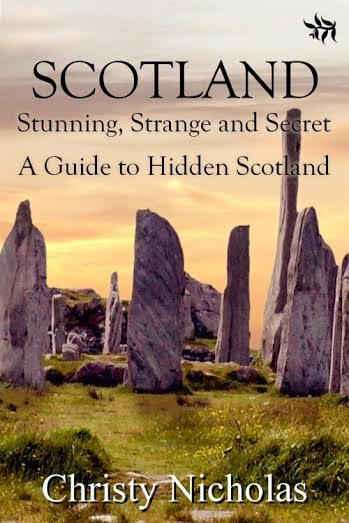
This is an excerpt from my newly published ebook called Stunning, Strange and Secret, a Guide to Hidden Scotland. It contains some myth and history, tips and tricks to planning your own trip, and lots of hidden gems and photographs. It is available in several formats. Please visit my author page on Facebook.

~~~~~~~~~~~~~

Christy Nicholas, also known as Green Dragon, has her hands in many crafts, including digital art, beaded jewelry, writing, and photography. In real life, she's a CPA, but having grown up with art all around her (her mother, grandmother and great-grandmother are/were all artists), it sort of infected her, as it were. She loves to draw and to create things. She says it's more of an obsession than a hobby. She likes looking up into the sky and seeing a beautiful sunset, or seeing a fragrant blossom or a dramatic seaside. She takes a picture or creates a piece of jewelry as her way of sharing this serenity, this joy, this beauty with others. Sometimes this sharing requires explanation – and thus she writes. Combine this love of beauty with a bit of financial sense and you get an art business. She does local art and craft shows, as well as sending her art to various science fiction conventions throughout the country and abroad.

https://www.facebook.com/groups/tirgearr.publishing/?fref=ts


Saturday, August 30, 2014

Flora MacDonald: Scottish Heroine and Staunch British Loyalist

by Lauren Gilbert


Flora MacDonald 1747
Wikimedia Commons

Thanks to her dramatic rescue of Prince Charles Edward Stuart (Bonnie Prince Charlie) after the Rising of 1745, Flora MacDonald is frozen in time. Their names are almost inseparable, and the first thing mentioned about her is this romanticized event. Her life before and afterwards has almost become postscripts to this single event. The story of the rescue is told as drama, sometimes with an implication of romance between the prince and his rescuer. Victorian-era accounts are almost overwrought with their praise and idealization of Flora. But who was she? What happened afterwards?

Flora MacDonald was born in 1722 to Ranald MacDonald and his wife Marion at Milton on the island of South Uist in the Outer Hebrides. Her father was a farmer, and her mother had been the daughter of a clergyman. Ranald MacDonald died when Flora was very small, and her mother married Hugh MacDonald of Armadale on the island of Skye when Flora was about 6 years old. Flora stayed at Uist with her older brother Angus until she was 13 years old at which time she was sent to stay with the Clanranalds to pursue her education. Lady Margaret MacDonald (Clanranald) brought Flora into her home and later had Flora accompany the family to Edinburgh where Flora continued her education, attending boarding school. Flora lived with them in Edinburgh and elsewhere. Lady MacDonald and many of the MacDonalds were Jacobite sympathizers.

Accounts vary, but the rescue consisted of Flora and Niel MacEachainn in June of 1746 taking the prince, who was disguised as a female Irish servant, to the Island of Raasay. Once there, the prince was directed to find shelter in a cave until he could complete his escape. (After Flora and Niel left him, the prince made his way through Skye to the mainland. He had been living rough prior to this, and continued so, in caves and wherever he could find shelter. The prince ultimately escaped after about 3 months on a French vessel to France.) Flora’s part in the physical rescue was approximately 3 days. It would seem she was involved with the planning as her stepfather Hugh MacDonald, a captain in the militia, provided the passports for her, her manservant, and Irish spinning-maid, ostensibly to visit her mother.

The prince’s movements became known, and Flora’s participation became known. Once it was clear that the prince had succeeded in escaping to France, the search for those who had aided him intensified, and Flora was arrested on Skye after a brief visit with her mother. I was unable to find formal accounts of a trial. She was held at Dunstaffnage Castle in August of 1746 for about 10 days, where she was allowed to entertain visitors. Subsequently, she was taken by boat to Glasgow, where she was placed aboard “HMS Furnace” (or possibly the “Bridgewater”), where she stayed on board for 3 months. Again, Flora was allowed to receive visitors and gifts. On November 7, 1746, the ship departed for London.

Flora was held in the Tower of London for a short time, then released into house arrest with friends. Flora was apparently quite popular and entertained frequent visitors. At one point, she met one of George II’s sons (one account said it was Fredrick, the Prince of Wales; another indicated it was the Duke of Cumberland). Supposedly, the prince in question asked her why she aided Prince Charles, and she told him that she would have helped anyone in similar circumstances. It seems she assisted him as a humanitarian, rather than political, obligation. Finally, in June of 1747, George II passed a general free pardon, allowing those who had been convicted of treasonous acts before June 15, 1747 to be released.

Upon her release, she became a guest of a leading Jacobite lady (possibly Lady Primrose of Dunnipace). Flora remained in London for a time, trying to aid other state prisoners, receiving gifts, donations of funds, and many more visitors. After leaving London, her travels took her through England to York and on to Scotland. Apparently Flora travelled for about 12 months, visiting Jacobites on her journey. She finally settled in Skye, after visiting her mother, Lady Clanranald and her brother.

Flora married Allan MacDonald of Kingsburgh, whom she had known since childhood, on November 6, 1750, at the age of 28. She brought with her into the marriage several hundred pounds, and received more money from Jacobite supporters. The couple farmed at Flodigarry, and had seven children, but things did not go well. Whether the result of debts incurred by his father, difficulty in farming, increases in rents, or a combination of all of these factors, the couple experienced increasing difficulties. In 1774, they immigrated to North Carolina in America with their children.

Upon arrival in North Carolina, Flora and her family were welcomed by the Scots community, many of whom had emigrated before, and a ball was given in Flora’s honour in Wilmington. They purchased a plantation in Anson in January 1776, and two of their children died of typhus. Unfortunately, before they had time to get settled, the American Revolution broke out. Flora and her husband were loyalists, her husband having been commissioned an officer in the Royal Highland Emigrant Regiment in 1775. After the war broke out, Allan and several other family members fought, but Allan was captured after the defeat at Moore’s Creek and made prisoner. Their plantation was damaged and ultimately confiscated when Flora refused to take the oath required by the Act of November 1777.

Allan and Flora reunited briefly in 1778 after his release, and they moved to Nova Scotia. Although Alan remained with his regiment in Canada, Flora went back to Skye in 1779. Her surviving two sons and older daughter returned with her, where they were reunited with the youngest daughter. This voyage was more exciting, as the ship was attacked by a French privateer. Accounts indicate that Flora remained on deck and suffered a broken arm. Upon her return, her brother built a cottage for her where she stayed until her husband’s return five years later. It seems she had a sense of humour as she supposedly said that she had fought in the service of both the House of Stuart and the House of Hanover but had been defeated in both endeavours.*

Flora died March 5, 1790, possibly at Kingsburgh, her husband’s family home (accounts differ). Her body was wrapped in a sheet on which Charles Stuart had slept all those years before, and buried at Kilmuir on the north end of Skye in the churchyard. Her funeral was supposedly well attended, and her grave was covered by a thin marble slab. The slab, however, was chipped away within a short time, and the pieces carried away by tourists. Subsequently, public subscriptions allowed a large granite cross on a pedestal to be erected in her memory.

Numerous accounts of Flora’s rescue of the prince and a few biographies were written about her. Although known for a brief adventure with Prince Charles Edward Stuart, her life was exciting and full of incident. Flora showed herself to be intelligent, faithful, determined, and resilient.

Flora MacDonald’s grave in Kilmuir Cemetery on the Isle of Skye, 6/2007, by Adam Cuerden,
From Wikimedia Commons

Sources include:

Dictionary of Ntional Biography, 1885-1900, Volume 35. “Macdonald, Flora” by Thomas Finlayson Henderson. On line at http://en.wikisource.org/wiki/Macdonald,_Flora(DNB00)

Internet Archives. MacGregor, Alexander. THE LIFE OF FLORA MACDONALD and her Adventures with Prince Charles*. Inverness: A & W MacKenzie, 1882. https://archive.org/details/lifeoffloramacdo00macguoft

GoogleBooks. THE SCOTS MAGAZINE Containing A GENERAL VIEW of the Religion, Politicks, Entertainment, etc. In Great Britain: and a Succinct Account of Publick Affairs Foreign and Domestic for the Year MDCCXLVII. Volume IX. June 1747. “Abstract of the act vicesimo George ii R Entitled, An Act for the King’s most gracious , general, and free pardon.” PP 258-261. http://books.google.com/books?id=FVwAAAAAYAAJ&pg=PA259&lpg=PA259&dq=act+of+grace+and+pardon+1747&source=bl&ots=R35BskguE1&sig=d2w5BqLPoKMxUWTkiJtQ1vMoObE&hl=en&sa=X&ei=Oi36U7rGNsqhyAS_tYKwCQ&ved=0CDUQ6AEwBQ#v=onepage&q=act%20of%20grace%20and%20pardon%201747&f=false

Scotland Magazine on-line. “What Flora did next.” By Jackie Cosh. Issue 22, p. 48. Http://www.scotlandmag.com/magazine/issue22/12006639.html

~~~~~~~~~~~~~

Lauren Gilbert is author of HEYERWOOD: A Novel, and lives in Florida with her husband. Her second novel, working title A Rational Attachment, is expected to be released later this year.