Showing posts with label Plunder. Show all posts

Thursday, May 5, 2016

The battle before the battle

by Barbara Gaskell Denvil

We are often proud to announce that England has not been successfully invaded since 1066, but this is not entirely true, and there have been many battles taking place on English soil over the centuries. Henry Tudor invaded in 1485 with an army both financed and principally comprising French mercenaries, and William of Orange did, in one sense, invade although it was comparatively bloodless. Bloodiest of all were the battles of the so-called Wars of the Roses and the later Civil War.

But there was another war, rarely mentioned and rarely considered. This was something that brought more ruin to the general population, and surely mattered more to them than the problem of which king wore the crown. And that was the battle behind each and every battle that took place in this country, and of course, also in others.
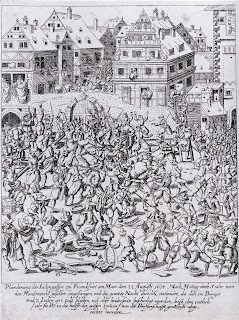
The lords who were called to fight for their faction came from all over the land, and they mustered their troops from their own vast estates, wherever those were situated. Then these mustered armies, sometimes comprising trained soldiers and archers but usually simply of ordinary men, farmers, tradesmen, and craftsmen, tramped across the countryside behind their leaders, making for whatever distant area had been designated as a meeting place. Sometimes this involved crossing hundreds of miles, and several thousand tired men striding across fields and through small villages, could cause devastating damage. Depending on their leader, these men might be disciplined and given food – or they might very likely be left to feed themselves. A  farmer’s crops and animals were frequently seized, taken for the cook pot or to roast over the campfire at night, with recurring demands for free food and drink from the local folk. Women might be abused, and fights and skirmishes would break out along the route. These were men facing possible death, and their consideration for the lands through which they passed would be low.

For example, the ferocious and tragic Battle of Towton, 1461, was fought in Yorkshire. But the men who joined the battle had come from all over England, tramping mile by mile, summoned by their lord to fight for his cause and ambition. The weather was freezing. Men who faced death from hunger before they even arrived at Towton, would take what they needed along the way. One estimate of those killed at Towton stands at nearly 30,000 men. So first the muster brought its own devastation of the countryside, and then the horrific slaughter left a host of widows and fatherless children in wretched penury and with the utter misery of such awful loss without even the opportunity to bury the hosts of the dead.
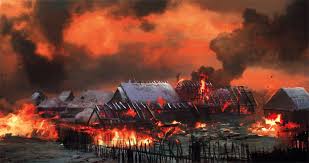
Men called upon to risk life and limb, ready to slaughter or be slaughtered, were not always on their best behaviour, nor were they all the sweetest of polite gentlemen. There were the prickers, for instance. These were mounted men armed with pitch-forks and employed to gallop the outlying limits of a battlefield and force back into action any attempted deserters. I doubt if such men were too careful concerning their manners as they marched the long miles to the battlefront.

There would also be heavy wagons loaded with supplies and arms, followed by women and trailing families, children ready to help deliver arrows on the outskirts once fighting started, and prostitutes hoping to make a little money and a little friendship. No lightweight procession then – trundling across the land, searching for food as they went, and looking for places to camp.
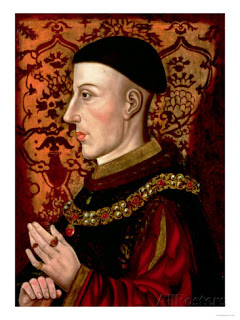
Henry V
But the worst damage came from foreign armies. They could devastate the land they crossed. Burning as they went, many foreign soldiers hoped to force their enemy into surrender by ensuring all farmland and food crops were eradicated as they passed. A starving enemy would be weak and more willing to lay down their arms. Such ruthless cruelty became more and more commonly accepted. The so-called hero of Agincourt, King Henry V, adopted this scorched-earth strategy, and left utter misery and destitution behind him when he invaded France. And it was the common folk, not the lords, who suffered most and whose depleted livestock and burned fields might take years to recover, ensuring bitter hunger and poverty long after the actual battle was won or lost.

When Henry Tudor led an army consisting mostly of soldiers from England’s greatest enemy, France,  across the country from Wales to Warwickshire and Leicestershire, they left a trail of devastation behind them. The French had no love for the English and would not have treated either the people or the land with respect. Besides, many of the French army were mercenaries, or criminals released from prison in exchange for their willingness to fight. The weather was hot and the miles long and sweaty. Robbery, violence and rape would certainly have occurred along the way. Some cities opened their gates to Henry’s troops, which seems unsurprising. Better to invite them in and treat them well, rather than risk the utter desecration of crops, farmland and outlying homesteads by refusing all succour.

Foreign armies could bring little with them in the way of food and comfort. Wagonloads of arms would be hard enough to transport overseas since shipping was not a simple matter in those days. So the whole army needed feeding – thousands of men twice a day. And men had other desires. No camp-followers or prostitutes would have voluntarily served a foreign army and so the troops would simply have taken what they found along the route. The long standing enmity between the English and the French at that time – strongly expressed in both battle and peacetime – could not have ensured any peaceful trudge through those summer lanes. The fields, about to be harvested would have been stripped or trampled underfoot.
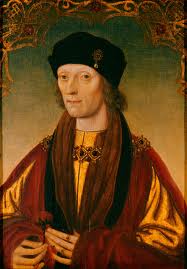
Henry Tudor
There are some contemporary indications of the devastation that occurred in this manner. For instance, Henry Tudor, once he claimed the crown, paid compensation to the farm owners whose lands had been wrecked where the battle actually took place and where his army had camped the previous night. But there is no mention of restitution made for the whole journey from the west coast to the east and nor would the leaders of any foreign invasions ever offer restitution for the purposeful destruction of the peaceful lands they crossed. Later, the Pretender ‘Perkin Warbeck’ when accompanied by a Scottish army marching into England to do battle for his claim as Prince Richard, Duke of York, soon abandoned his invasion because he could not accept the terrible violence he saw done to the local people, destruction of crops and brutality of the men he led as they tramped through the English counties.

There is also considerable evidence of later armies abroad, those of Napoleon for example, and the appalling misery they left behind them across Europe and Russia – not during battle alone – but simply during the passage of such mighty armies through peaceful and suffering country-sides.

So we read of the great battles of the past and we cheer for the heroes, but there was another destruction that went unrecorded, and that was suffered by the ordinary citizens, many of whom would have no chance to recover. This was what hurt the common man, who probably cared little for which king sat snug and smug upon the throne. The heroic victors of historical battles were often exactly those who had inflicted the most appalling disservice to the very folk they sought to rule.


Barbara Gaskell Denvil was born in Gloucestershire, England and later moved to London where she grew up surrounded by books, paintings and antiques. Her Scottish father was an artist and playwright, her Australian mother was a teacher, and elder sister, a successful author first published at age 16. The classic Victorian author Mrs Elizabeth Gaskell was a great, great, great aunt, so a bookish family. When birthdays came around, no one was asked what they wanted. As a child she never owned a bike or scooter, the question was simply, "Which book do you want this year?"

Her passion is for late English medieval history and this forms the background for many of her historical novels. She also write fantasy, yet both fantasy and historical fiction take us into new worlds and Barbara's books do exactly this - being multi-layered, and rich in atmosphere and depth of characterisation. Barbara can be found on her website and on Amazon


Tuesday, October 6, 2015

The Fate of a Grand House in the English Civil War

by Deborah Swift

Towards the end of the English Civil War, many English manor houses and stately homes lay in ruins, their treasures plundered, their art-works melted down, destroyed or divided. One good example of this is Basing House, near Basingstoke.

As the King's cause became more and more hopeless, and he lost the crucial towns of Leicester, Bridgewater, Bath, and Bristol to Cromwell's New Model Army, Cromwell moved on towards London. He wanted to keep the road to the city open, and one of the places that stood in the way was Basing House. The house itself had been under siege on two previous occasions, but this was to be its last stand.

Old postcard of the Garrison Gate at Basing House (circa 1900)

An elegant walled and turreted red-brick stronghold with its own chapel, Basing House was home to the Marquess of Winchester. When it was first built it was the largest private house in the country with around 360 rooms. In Tudor times it was frequently visited by Kings and Queens, including Henry VIII, Elizabeth I, and not forgetting Philip II of Spain and Queen Mary I who spent their honeymoon there in 1554. This fabulous piece of Tudor history was soon to be left a pile of smoking rubble.

Ernest Crofts - Cromwell at the siege of Basing House
The Catholic defenders of the house were not only accused of being 'a nest of Romanists' - but also bad landlords, greedy and self-serving, who cared little for their tenants or neighbours. However, they were to stand no chance against the assembled siege-train of five enormous demi-cannons and a sixty-three pounder cannon, which blasted their way through the walls.

Once the stronghold was breached, the Roundhead storming parties swarmed over the doomed mansion, and the defenders, though they fought bravely, were far too few to stand a chance against the might of the incoming army. Women witnessed their husbands, fathers, and brothers slaughtered before them, and rushed in to try to prevent the attackers, but they were bludgeoned down.

CW Cope - The Defence of Basing House
The house was a treasure trove of beautiful artifacts, silver and gold plate, tapestries, and elegant furniture, so unsurprisingly, the soldiers thoughts soon turned to booty. The treasures in the house were said to have been worth £200,000, and Hugh Peter, Cromwell's chaplain, in his eyewitness account, the Full and Last Elation of all things concerning Basing House, speaks of 'a bed in one room furnished that cost £1300' - nearly $2000, an enormous sum in the seventeenth century.

Landseer - The Plundering of Basing House
The scene by Landseer above shows the Marquess sitting distraught, comforted by his daughter and his dog. Dead on the floor lies Major Cuffle, whilst Hugh Peter, the chaplain, is swigging stolen wine in the background.

In the wardrobes of the house were more than a hundred richly embroidered petticoats and gowns in silks and satins. These were prey to the plunderers, but not content with these, the ladies were stripped of their outer-garments, the dresses taken literally off their backs until they were left clad only in their shifts. Men were also de-robed, and poor old Inigo Jones, famous architect of Whitehall Banqueting House, had to be carried out of the house naked, but wrapped in a blanket.The Marquess of Winchester himself is said to have been captured whilst hiding in a bread-oven.
after that they sold the household stuff, whereof there was a good store; and the country loaded away many carts, and continued a great while...till they had fetched out all the stools, chairs and other lumber, all of which they sold to the country people piecemeal. In these great houses there was not one iron bar left in all the windows before night... and the last work of all was the lead, and by Thursday morning they had hardly left one gutter about the house.
~Hugh Peter
Fire was the great house's final indignity. The flames spread rapidly, burning for twenty hours, leaving little remaining but charred and blackened walls. With the house still hot from the flames, country people flocked in crowds to buy the cheese, the bacon, and the wheat which had been hastily dragged out. A cart took all the popish books, idols, rosaries and relics to London, to be burned on a public bonfire.

Even after his house was burned and looted, the Marquess was heard to say; "If the King had no more ground in England but Basing House, I would adventure as I did, and so maintain it to the uttermost. Basing House is called Loyalty."

When Parliament was queried about the bloodshed, the reply was; "You must remember what they were: they were most of them Papists; therefore our muskets and our swords did show but little compassion, and this house being at length subdued, did satisfy for her treason and rebellion by the blood of the offenders."
Wikipedia

The experiences of the Royalists of Basing House were not uncommon. In my most recent novel, Spirit of the Highway for teens and adults, the setting is a house that has been attacked and plundered in just such a way. Some Royalists, left homeless, with their houses requisitioned by Parliament, turned to highway robbery to survive.

Although the remains of Basing House were demolished by order of Parliament, and much of the masonry carried off to be re-used in other buildings, the ruin can still be visited today.


Pictures :
Further Reading:

By The Sword Divided - John Adair
The English Civil War at First Hand - Tristram Hunt
Going to the Wars - Charles Carlton
British Civil Wars Project
Basing House
Historic Old Basing


Sunday, September 8, 2013

The English Cavalier and his Stomach

by Deborah Swift


File:17th-century unknown painters - The Chef - WGA24061.jpg
The Chef - artist unknown, first half of 17th C (Wiki)

It has long been recognised that an army marches on its stomach - that the importance of food to morale is vital. Apart from just the sustenance, the regularity of meals provides a routine in what can often be chaos during a war or campaign. Eating together has always bonded people and created friendships and loyalties which extend onto the battlefield. Particularly in cold wet weather (and England is often cold and wet!) the cheer of a good hot meal cannot be under-estimated. 

English Civil War scenes
The English Civil War , illustration from British Library online

In the English Civil War, a period I am researching right now, the official ration for a Cavalier was two pounds of bread, one pound of meat and two bottles of beer.

Meat was considered essential by both armies in the conflict, and between January and June 1645 (a six month period) the two hundred Roundheads stationed at Chalfield House,Wiltshire ate:

40000 lbs beef
1600 lbs bacon
580 lbs pork
1900 lbs mutton
64 lbs veal

As well as this heavy diet of meat, they also ate:

15000 pints of wheat
27000 pints of oats
20000 malt
5000 beans
5000 peas

All this was supplemented with small amounts of cheese and dairy produce.(statistics from Charles Carlton, Going to the Wars.)

The fact that vegetables are not mentioned does not necessarily mean that people ate no vegetables, it is perhaps that their cost does not appear in records in the same way as other foods. Pulses were widely grown in England and formed an essential part of most people's diet.

Who remembers this old rhyme?
Pease Pudding hot, Pease Pudding cold,
Pease Pudding in the pot, five days old.

Stroll across the picturesque yard to enter the medieval Manor. © Andrew Butler
Great Chalfield Manor (National Trust)

So how did the troops keep up this diet whilst on the move? When the Earl of Essex came to the aid of Gloucester, the thousand sheep and sixty cows that they drove along with them for food slowed them down. The meat had to be killed, skinned and butchered as they went, often in unsanitary conditions. The carcases were left behind to rot, but were taken by local people to use the bones for glue.

Once farther from a garrison town or when on the move, food became scarcer and scrounging or plundering food was a common occupation. Many citizens during the English Civil War found themselves with unwelcome guests. After their victory in Taunton in 1644, the Roundheads were so hungry that they stopped chasing the King's Army and went in search of food. Finding themselves unguarded, the Royalists counter-attacked, killing many with the bread still 'in their mouths'.

Plunder was a way to show high spirits, but also a way for defeated troops to vent their anger and shame . After the battle of Edgehill, one Royalist platoon got out of hand and brutally plundered their own home towns of Droitwich and Bromsgrove. And in a blind rage after being beaten at Marston Moor, Prince Rupert's men seized cattle, sheep, and chickens, killing all who tried to stop them.


Because the troops sometimes could not carry all their plunder, special market days were arranged where they would sell off what they had pillaged. Records show for example that Joyce Hammon managed to buy back gold plate and also some beaver hats that troops had stolen from her house in Hereford.

Feeding the soldiers on the march was compulsory - in the sense that refusal led to threats and violence. Householders were expected to billet soldiers at a set rate in exchange for an IOU that was often never paid. They were expected to provide food and ale and to feed their horses. The soldiers (on both sides) fresh from blood and battle were often the worst kind of house guest - violent, greedy, and out of control.

The cost to England of free quarter and plunder was enormous. In Cheshire £120,000 of free quarter was said never to have been re-imbursed, not to mention the claims of villages in the same county which lost as much as £190.000 worth of goods and livestock in plunder. Often a lifetime's hard work could be laid waste in one night.

Women alone in their houses whilst the men were at war feared the arrival of troops from both sides, even from the side they supported. In her memoirs Lucy Hutchinson condemned plunderers as 'the scum of mankind', and Milton wrote in his Poem to The Lord General Fairfax,
"In vain doth valour bleed,
Where avarice and rapine share the land."

I recommend these sources:

337707


~~~~~~~~
For more about my books set in the English Civil War and the 17th Century, please visit my website, www.deborahswift.co.uk .