Showing posts with label wales. Show all posts

Thursday, November 15, 2018

Lady Charlotte Guest - Victorian powerhouse of myth and iron

by Deborah Swift

Next weekend* I am booked to give a talk on the Mabinogion, the extraordinary collection of Welsh myths that were first brought to prominence in England by Lady Charlotte Guest. Not only are the myths fascinating, but Charlotte Guest was quite a phenomenon herself.

Charlotte Guest

Born Charlotte Bertie in May 1812, she was the eldest child of the ninth Earl of Lindsay of Lincolnshire, and was brought up at Uffington House, a large country estate. When she was six years old, her father died and her mother remarried a vicar, a man whom she disliked intensely. Charlotte was a bookish and intelligent child, and being educated at home, her only escape was into literature. She soon taught herself several languages, including Arabic, Hebrew and Persian. She began keeping a journal when she was nine, and so we know a lot about her life, because she carried on writing it for another seventy years - until she was was seventy-nine! 

Page from Charlotte Guest's Diary

Her interest in Wales and its history began after meeting the MP for Merthyr Tydfil,  John Josiah Guest.  Full of vitality and energy, Josiah ran the largest ironworks in the country, the Dowlais Iron Company, which employed 7,000 workers. In 1833 Charlotte and John were married. Charlotte took a keen interest in the business, and in the welfare and education of the workers. Moreover, she was keen to escape the oppression of her step-father and Wales was suitably far from her family home.

Ever a keen linguist, she launched herself into learning Welsh. At that time there was a romantic revival and a strong interest in Arthurian legends. Charlotte began translating some Medieval Welsh tales into English. These tales were part of an oral tradition, and drawn from the written sources of the Llyfr Coch o Hergest, or Red Book of Hergest. Her translations included the four branches of the Mabinogi, three Arthurian Romances, and a translation of the well-known myth Taliesin


The Lady of the Fountain  (an Arthurian tale) was first published in 1838, and in 1849 the collected tales appeared as The Mabinogion in a lavishly illustrated edition. Since then they have been widely studied by poets such as Tennyson and scholars of Welsh and Celtic mythology, as well as those interested in the spiritual and wisdom traditions they embody. The myths are much-loved by illustrators too, trying to capture the unknowable in paint.

Click picture for more great
illustrations by Lee

Back to Charlotte Guest.  Not content with documenting the ancient tribes of Britain, Lady Charlotte also produced her own tribe - ten children: five boys and five girls. She was ambitious for her children, marrying them into the aristocracy and ensuring their education through the schools she endowed (the Dowlais Central Schools cost £20,000 to build - an enormous sum in the Victorian era.) This area of Wales was heavily influenced by Chartism, and these principles were evident in Charlotte Guest's educational ideals for her workforce.

On her husband's death she became the only active trustee of the ironworks, and ran the business. Astute and energetic, she insisted on being in control. This included negotiating terms when the men went on strike, and dealing with dissatisfied workers who in those times were unused to being ordered by a woman. One cannot help but think, that the models of the powerful women in the tales from the Mabinogion must have proved an inspiration to her when faced with these difficulties.

Dowlais House, centre of Charlotte Guest's empire

Two years later Charlotte fell in love with her son's classics tutor, Charles Schreiber. They shared a passion for history and collecting ceramics, and from then on they travelled the continent collecting, as many wealthy Victorians did. Their collections were left to the nation and are housed in the V&A, where there is a 'Schreiber' Room, and in the British Museum, which houses her collection of playing cards and fans. In 1891 she became the first woman to receive the freedom of the Worshipful Company of Fanmakers. 

Below - an unmounted fan-leaf,  painted for the occasion of the Schreibers' silver wedding anniversary in 1880, now in the British Museum.


Lady Charlotte died in 1895 but it wasn't until 1950 that her grandson, the Earl of Bessborough, published edited highlights from her diaries. The originals are now housed in the National Library of Wales. 

Charlotte Guest is chiefly remembered for her translations of the Mabinogion, from which we receive most of our knowledge about Welsh mythology, including the story of Rhiannon, the tale of the mysterious mound that leads to the Otherworld, Bran and the ravens that now roost in the Tower of London, about Arianrhod and her turning wheel of stars. Although many now take issue with Guest's translations, without her a whole generation of people would have had the door to these wisdom stories closed to them.

Work with the myths and stories of the Mabinogion still goes on, and new translations have appeared and continue to do so, proving that good stories always outlast those that tell them.


Watch a BBC video about The Mabinogion
The Dancing Floor Film - new film based on Mabinogion Myths

Sources:
The Mabinogion - translations by Guest, Davies, Jones
National Library of Wales

* This post is an Editors' Choice post, originally published on this blog on 16 March 2016

~~~~~~~~~~

Deborah Swift is the author of seven novels for adults and a trilogy for young adults. She lives in the North of England close to the mountains and the sea. Follow her on Twitter @swiftstory or find her on her website www.deborahswift.com

Thursday, June 28, 2018

Britons, Fellow-Countrymen, Foreigners – “For Wales, see Britannia”

By Gareth Griffith

At the start of his book, Rebirth of a Nation: Wales 1880-1980, Kenneth O Morgan commented that, “for Wales, see England,” was the notorious entry in the 1888 edition of the Encyclopaedia Britannica. For Morgan, the entry “encapsulated all the humiliation and the patronizing indifference which helped to launch the modern nationalist movement in the principality…” (OUP, 1982, p 3) The irony is palpable: an encyclopaedia of “Britannica” had expropriated the name the Welsh had for centuries used to define themselves  and their country, only for the same encyclopaedia to obliterate the identity of Wales by subsuming it under the heading of “England.”

Public Domain Image

The story had a long trajectory. We can take a few steps back to the 15th century. In the epilogue to The Age of Conquest: Wales 1063-1415, RR Davies reflected on the condition of Wales following the collapse of the revolt of Owain Glyn Dŵr, by which time the prospect of establishing a native, unitary Welsh polity was lost. According to Davies, “Wales had been reduced to a ‘land’ (terra Wallie), an annex of the kingdom of England.” (OUP, p 464) Davies noted, too, that the status of Wales as a “separate nation” was raised at the Council of Constance in 1417. There the English spokesmen asserted that, ecclesiastically and politically, Wales had been effectively incorporated into England. The assertion was accompanied by the claim “that England was to be equated with Britain (‘inclyta nation Anglicana alias Brytannica’).” Why not? After all, if history tells us anything it is that the winners get to call the shots; they’re the ones that do the name-calling. In 1417, it was a thousand years since the Roman legions had left Britain and here was the final chapter in the resistance of the Britons, one that ended with the transfer of that name to their ancient enemies. As RR Davies wrote, with a heavy heart no doubt:

“So had the English appropriated the mythology of an unitary empire of Britain, which had for so long been a source of memories, inspiration, and hope for the Welsh.” (p 464) 

In the opening chapter of the book, Davies had discussed the importance of their British heritage to the people of Wales in the Middle Ages, writing that:

“An even more powerful ingredient in the chemistry of national unity was pride in a common descent from the Britons of old. It was as Britons, Brytaniaid, that the Welsh normally described themselves until the later twelfth century; ‘Britain’ was the title they gave to their country.” (p 16) 

It was a case of – ‘for Wales, see Britannia.”

The works by KO Morgan and RR Davies are two volumes in the Oxford University Press’ series on the history Wales, published in reverse chronological order. The third volume – Wales and the Britons, 350-1064 by TM Charles-Edwards - was published in 2013. It opens with a short essay on name-calling and related matters. The question he confronts is how the Wales and the Welsh of the medieval period, from the fall of the Roman Empire to the twelfth century, identified themselves and how were they identified by others? What names were used and what did they mean in geographical terms?

In the fifth century and for many centuries after there was no Wales to speak of, only a patchwork of small kingdoms; but there were Britons and Cymry (or Kymry) and Wielisc, the name in Old English for the Welsh. Likewise, in the early period there were no Bretons in Brittany or Cumbrians in Cumbria. According to Charles-Edwards, “Breton in English is a late import from the French where it can mean either Britons or Bretons…”; and, although the Anglo-Saxon Chronicle in the tenth century used Cumbras for the Cumbrians, it had “no relevance to how the Welsh or the Cumbrians saw themselves.”

As Charles-Edwards rightly states, “it would be fatal to import later senses into earlier periods as if they were as valid for, say, the seventh century as they were for the tenth or as they are for the twenty-first.” His argument is that, for the whole of the period up to 1064, “the modern historian must maintain the distinction between modern terminology and the terms used at the time.”
(OUP, 2013, pp 1-2)

The same can be said to apply to the modern writer of historical fiction. Getting it right can be tricky. If a character in a novel set in the seventh century looked out from today’s Bristol over at what is now South Wales, what would they have called the land they were looking at? How should today’s Brittany be referred to in a novel of the same period? Little Britain would be an anachronism, not to mention a source of mild amusement for fans of the BBC comedy of the same name.

The broader point is that, for the early medieval period, Wales was part of a larger whole, the land of the Britons. In this light, Charles-Edwards comments that the idea of Britannia varied, depending on context and circumstance. For Asser, writing at the end of the ninth century it had a “double sense”, either the entire island which the Britons had long conceived of as their own, or as the land we now refer to as Wales. Britannia is also ambiguous in early Breton sources: “it may be the island from which they had migrated; but it may also be Brittany.” (p 1)

Attribution Link

As time passed, the geographical extent of that land changed, expanding occasionally, shrinking more often before the incursions of the Anglo-Saxons to the East, the Gaels in the North and West and later the Vikings and the Normans from every conceivable direction. For Gildas, writing in the mid-sixth century, at its most extensive the whole of the island of Britain belonged to the Britons. But that vision was to contract. Charles-Edwards directs out attention to the Welsh poem of the tenth century, Armes Prydein, which contains the phrase “from Manaw to Llydaw” – in modern terms “from Clackmannanshire to Brittany.” He says the poem “was thinking of the lands which ought to be British, because it recalled a time when they had been British.” (p 3) That is to say that in AD 600, or thereabouts, the land of the Britons – Britannia – had extended from around Sterling in Scotland down almost as far as the Loire in France. By the tenth century, that same geographical region was the Britannia of the imagination. Taking all its improbable and impractical elements into account, of Armes Prydein, Charles-Edwards commented:

“Yet, the visionary element is very strong: the argument is ultimately about the right to all of Britain south of the Forth; the objection was not just to an English empire but to England as such. The Cymry were the Palestinians of early medieval Britain.” (Wales and the Britons, 350-1064, p 535) 

No less complicated is the development of the language used to express these shifting realities. On one side of the language barrier, the Anglo-Saxon name to denote the native population of the island – “Wielisc” or “Welsh”, is often said to derive from “a variant on the standard Germanic label for foreigner…” (see for example Norman Davies, Vanished Kingdoms: The History of Half-Forgotten Europe, Allen Lane, 2011, p 79) Another interpretation is that “Welsh” meant “not so much foreigners as peoples who had been Romanized…” (John Davies, A History of Wales, Penguin Books, 2007, p 69): that is to say, “all the people who had been part of the Roman Empire.” (Wales and the Britons, 350-1064, p 1) Whether one meaning precludes another is not clear to me. At the very least, it seems unlikely that the original meaning would have been maintained in the vernacular across the years of “intimate hostility” between the Britons and the Anglo-Saxons. (Wales and the Britons, 350-1064, p 402) Probably, “foreigner” is not too wide of the mark. At any rate, the idea that the Welsh had become foreigners in their own land is hard to shake off; popular imagination clings to it, as firmly today as in the Middle Ages.

Statue of Owain Glyndwr - Pulic Domain image

Turning to the other side of the language barrier, the historian John Davies has traced the first usage of the word Cymry to a praise poem probably written in 633, in which the poet was referring to the country rather than the people (“Ar wynep Kumry Cadwallawn was”), a country that would have
referred to the Old North as well as Wales. He contends that the word Cymry evolved from the Brythonic word Combrogi, meaning fellow-countrymen and that “its adoption suggests a deepening self-awareness among the Britons.” He goes on to say:

“Although the author of Armes Prydein (c 930) used the word Cymry or Cymro fifteen times, it only gradually came to oust the word Brython. That was the favourite word of the author of Brut y Tywysogyon; his entry for 1116 is the first to mention the Cymry and it was not until the years after 1100 that Cymry became as usual as Brythoniaid in the work of the poets.” (A History of Wales, Penguin Books, 2007, p 69) 

It seems the Welsh of the twelfth century were down-sizing at long last, re-configuring the world of their imagination to conform to prevailing political reality in the Norman age. According to KO Morgan, by Victorian times that process had resulted in a view of Wales, from the perspective of their “Teutonic” neighbours, as a mere “geographical expression”, as a land that “belonged to prehistory.” (p 3) But then, the title to Morgan’s book, Rebirth of a Nation, suggests that if Wales and the Welsh – Britons, fellow-countrymen, foreigners – were down, still they were not out. The imagination continues to work on political reality, seeking to shape what is to what might be; as RR Davies wrote: “The memories of a conquered people are long indeed.” (p 388)

~~~~~~~~~~

Gareth Griffith was born in Penmaenmawr, North Wales, and now lives in Sydney, Australia with his wife Sue. His career has encompassed teaching, research and writing, including many years working as the manager of research for the parliament of New South Wales. These days, when Gareth isn’t writing, he enjoys reading, music, dark Scandi film and TV, and Dark Age Britain. Although Gareth left Wales at the age of twelve, Wales never left him, and its landscape and history loom large in his imagination and his storytelling.

Find Gareth on his website: https://garethgriffithauthor.com/
and on Twitter: @garethgriffith_

Thursday, April 19, 2018

Who Was the Real Elen of the Hosts?

By Kim Rendfeld


I would love to believe “The Dream of Macsen Wledig” in The Mabinogion. Elen of Caernarfon and her husband, Magnus Maximus (Macsen Wledig), have a happy ending, ruling the Roman Empire.

In the legend, our hero, the emperor of Rome, marries the woman of his dreams—literally. He sends messengers all the way to Britain to find her, and when they do, Elen tells them if Macsen is really in love with her so much he will make her his empress, he can come to Britain himself and tell her to her face. Macsen does, and they marry. He loses the throne after being absent for too long but regains it with help from Elen and her brothers. Elen (also known as Helen Luyddawc, or Elen of the Hosts) had roads built throughout Britain—the men would not have constructed them for anyone but her.

From a 15th century Welsh language version of
Geoffrey of Monmouth’s Historia Regum Britanniae
(public domain via Wikimedia Commons)

The reality for this fourth century power couple is sadder. Is “The Dream of Macsen Wledig” a story of a sovereignty goddess common in Celtic lore? A tale with based in history? A bit of both?

If we are to believe Lives of the Queens of England before the Norman Conquest by Mrs. Matthew Hall—my instinct tells me to take what it says with that proverbial grain of salt—Elen was the only child of Eudda (also Eudaf or Octavius) and his wife, Gula, and they were seeking a husband for her. She was quite the eligible bride and heiress. Gula’s dowry was the kingdom of North Wales, and Eudda was the duke of the Wisseans and son of the duke of Cornwall.

Eudda wanted to make sure his daughter was settled before he died and called a council. After some debate, Magnus Maximus, a Spaniard and kinsman of Roman general Flavius Theodosius, was chosen. At the time, he was likely a commander of a Roman garrison in Britain and had already seen battle in Britain and Mauritania.

Marriage at the time was a political arrangement rather than a love match. If husband and wife happened to like each other, great, but the alliances forged by the marriage took precedence over sentiment.

From a political vantage point, Elen’s marriage to Maximus made sense. Another element that boded well for the couple was that both Elen and Maximus were pious. Elen would become a patroness of Welsh churches. Maximus was Orthodox, following the Nicene Creed.

Maximus was not content to remain in Britain. He apparently did not like Emperor Gratian. It could be that Maximus thought he deserved a better rank. Perhaps he resented the execution of Flavius Theodosius, done in Gratian’s name when the emperor was an infant. Or perhaps his army goaded him into seeking the throne for himself (a rather popular and remarkably convenient reason).

In 383, apparently after many years of marriage, Maximus was proclaimed emperor of Britain and traveled to Gaul with an army to confront Gratian. After a few battles, Gratian’s soldiers deserted him. Gratian was killed at Lyons. Maximus claimed not to have ordered it. Still he ruled part of the empire, Britain, Gaul, and Hispania. Gratian’s 12-year-old brother Valentinian ruled Italy and Africa (in name), and Theodosius rule the East, recognizing Maximus on the condition he not bother Valentinian.

Classical Numismatic Group, Inc., cngcoins.com,
Creative Commons Attribution-Share Alike 3.0
Unported license via Wikimedia Commons

Elen accompanied her husband on his conquest. They settled in Trier, which had served as the capital for Gratian’s father. The couple had five children. Their son Victor accompanied his father on his campaigns. Another son, Publicius, became a cleric, and a church at Segontium was dedicated to him. Their third son, Cunetha, apparently remained in Wales.

Apparently all was not well between Maximum and Valentinian. In 387, Maximus decided to cross the Alps and invade Italy. Maybe he wanted to make Valentinian a puppet, or he simply thought war was inevitable and decided to strike while he had an advantage. Italy fell, but Valentinian and his mother escaped and fled to Theodosius. In 388, Theodosius struck back. His generals trapped Maximus in Aquileia. Maximus surrendered, but the generals executed him. Victor was captured in Gaul and killed.

Elen and her daughters were in Trier at the time and taken prisoner. I wonder what Elen said to her captors or what people said about Elen. Theodosius showed some mercy. He released them to the care of a kinsman and provided a pension. Cunetha would inherit his mother’s lands in Wales, and his children would go on to rule.

Perhaps, the emperor believed Elen and her surviving children weren’t a threat. Maybe he thought harming the widowed empress and her family would cause him to lose support. Another speculation: Elen was still popular in her homeland and hurting her would cause a lot more trouble among those troublesome Britons than it was worth.

Sources

The Dream of Macsen Wledig,” The Mabinogion
The Oxford Dictionary of Saints by David Hugh Farmer
Lives of the Queens of England before the Norman Conquest, by Mrs. Matthew Hall
"Magnus Maximus," by R.S.O. Tomlin, Oxford Dictionary of National Biography
Elen of the Ways” by Judith Shaw, Feminism & Religion
~~~~~~~~~~

Kim Rendfeld has written two novels set in 8th century Europe, and a third, Queen of the Darkest Hour, will be published August 7. In The Cross and the Dragon, a Frankish noblewoman must contend with a jilted suitor and the fear of losing her husband (available on Amazon). In The Ashes of Heaven's Pillar, a Saxon peasant will fight for her children after losing everything else (available on Amazon). Her short story “Betrothed to the Red Dragon,” about Guinevere’s decision to marry Arthur, is set in early medieval Britain and available on AmazonQueen of the Darkest Hour is available for preorder on iBooks, Barnes & Noble, and Kobo.

Connect with Kim at on her website kimrendfeld.com, her blog, Outtakes of a Historical Novelist at kimrendfeld.wordpress.com, on Facebook at facebook.com/authorkimrendfeld, or follow her on Twitter at @kimrendfeld.


Friday, November 17, 2017

Lord Rhys; Welsh First, Henry’s Second

by Jean Gill

We all know something about King Henry II of England and Thomas Becket, but few have heard of another powerful man who sparked off the temper of that fiery king and then, against all odds, gained his trust: Lord Rhys.

When Henry died in 1189, Lord Rhys, the Welsh ruler of the kingdom of Deheubarth, had been the royal Justiciar of South Wales for seventeen years, an alliance arrived at through war, truce and stubbornness on both sides. At the peak of their conflict, frustrated in battle, Henry ordered that twenty-two Welsh hostages, including Rhys’ son, should have their eyes gouged out.

Yet the two rulers then became firm allies. How is that possible? How could a father accept such an alliance? The answer might lie in Rhys’ own style of leadership and his background. Maybe he accepted such an action in war because it’s exactly what he himself would have done.

Certainly, the alliance was politically expedient for both rulers as, although Rhys could never win against Henry’s superior manpower, Welsh guerilla warfare could harass and tire the slow, heavy English soldiers, ad infinitum. An alliance gave them both peace and a means to keep in check the greed of the Norman Marcher Lords. However, their truce held strong through later trials, when expediency for Rhys was not in loyalty to Henry, suggesting something deeper between the two men. For his part, there is no doubt that Henry felt respect for Rhys and his countrymen.

‘In one part of the island [of Britain] there is a race of people called the Welsh who are so brave and untamed that, though unarmed themselves, they do not hesitate to do battle with fully armed opponents’

King Henry II 1176

Lord Rhys 

Who was Rhys? His praise-singer described him as ‘golden’ and it might be that he was ‘fair’ like his mother Gwenllian, a princess of North Wales, who eloped with Gruffydd, Prince of Deheubarth to become a legend in her new kingdom. ‘Fair’ and ‘golden’ are compliments with many possible meanings: attractive, just, gifted, lucky, or, of course, blonde (no longer the compliment it once was!). The only other clues to his appearance are in a 14th century effigy on a tomb in St David’s Cathedral, thought to be of Lord Rhys, in which he sports a moustache worthy of a WW2 RAF pilot.

Nobody would have expected him to rule Deheubarth. Youngest of six brothers, he was four years old when his mother, Gwenllian the Warrior Princess, was betrayed by a Welshman and beheaded by the Norman, Maurice De Londres, on the battlefield now known as Maes Gwenllian. One brother, Morgan, died in the same battle and another, Maelgwyn, disappeared, never to be heard of again. Rhys’ father died a year later, of illness or grief.

The eldest surviving brother, Anarawd, then became leader until he was murdered in 1143 by order of his future brother-in-law, Cadwaladr of North Wales. The next brother, Cadell, was so badly injured by Normans from Tenby in 1151, when he was out hunting, that he renounced all worldly matters, retiring to a monastery after going on a pilgrimage.


The coat of arms of Deheubarth
Cadell left his two younger brothers, Maredudd and Rhys as joint rulers in his absence, which turned out to be permanent. Closeness between noble Welsh brothers was rare as they were usually fostered while young and competing for inheritance (with the support of their foster families) as they matured. Gelding and/or blinding were not uncommon ways of showing mercy to the loser while protecting an inheritance. However, Rhys and Maredudd, two years older, had never been fostered and had survived losses that were cruel even by the standard of the day. What little evidence remains suggests that they were close, that they rode together and fought together to win back the lands lost during their father’s time.


Wales 1153
1153, the year my fictional troubadours arrive in Gwalia (Wales), was indeed a golden year for Henry, who was named heir to the English throne by its incumbent Stephen, and also for Rhys and Maredudd. They were on a winning streak and continued to regain castles and land; Carmarthen, Llansteffan, Tenby and St Clears – a 21st birthday present for Rhys in his first sortie as Commander. They even regained Ceredigion, which the North Wales allies had helped them to defend, years earlier – and had then kept for their own, at the time Anarawd was murdered. Now there is a story begging to be told!


Both images are Llansteffan Castle © Jean Gill


I have reconstructed the taking of Tenby and St Clears from details of the building structures there in 1153, starting from the terse statement in the Brut y Tywysogion. ‘There was not much time afterwards before the sons of Rhys attacked the castle of Tenby, and by a night plot, after breaking the gate, they got possession of the castle, and delivered it into the [custody] of William, son of Gerald. And when that was accomplished, Rhys, son of Gruffudd, with an immense host, laid waste the castle of Ystrad Cyngen.

So, a night plot it was! Unfortunately, ‘an immense host’ seems to be poetic license, as on-the-spot research from Tenby sent me records showing the 12th century castle to be a small stronghold, little more than a watchtower, and St Clears (Ystrad Cyngen) was an even smaller motte and bailey.

This is why, in my version of events, my hero Dragonetz observes, ‘It’s smaller than I thought it would be,’ before the men lay siege. There is also some disagreement as to whether events took place in 1152 or 1153, a minor matter considering how little information there is on major events!

I can’t find any indication of how Maredudd died but it seems that this happened in 1155 and Rhys became sole ruler, Prince of Deheubarth, or ‘the Lord Rhys’, the title he’s known by nowadays. He continued to build his kingdom, and not just figuratively. He built castles in the Norman style, and as solidly expensive as theirs; Cardigan, Cilgerran, Dinefwr and Llandovery, among others.

According to the cleric and writer, Gerald of Wales, a relative who stayed as Rhys’ guest on his Journey Through Wales, Rhys was ‘kindly’ and ‘discreet’, a perfect host. He was highly cultured and drew poets and musicians to his court. You can imagine the harper playing in Rhys’ castle in Cardigan, as at King Henry’s court, where a Welsh harper was also employed. Steeped in this musical tradition, Lord Rhys is credited with hosting the first Eisteddfod, at Christmas in 1176.

He also started the codification of Welsh laws, later continued by Hywel Dda. I would argue that, when he did so, he had read The Usatges of Barcelona, laws that influenced law-making throughout Europe.

He founded Cistercian monasteries but hated bad clerics. Rhys was nicknamed ‘the Good’ and yet he died excommunicate for arguing with a bishop over a horse theft. His body had to be scourged before burial, in penance.

He was reputed to be charming, a man who loved many women, and this proved to be damaging for the succession in Deheubarth. Linked to Henry II in their life-times, Rhys faced the same problem; his children’s conflicts, with him and with each other. Rhys had at least nine children by various mothers and as legitimacy was not important in Welsh law, claims to Deheubarth were violently disputed.

Notwithstanding the conflicts, Rhys’ children played their own parts in history. Through one daughter named Gwenllian (there were several, just to add to the confusion), Rhys could claim ancestry to the Tudors, and from them to several of the ruling houses in Europe today, including the UK. Henry Tudor flew a Welsh dragon banner at Bosworth field to acknowledge his descent from this remarkable man, Rhys, Prince of Deheubarth.


Further reading/ Acknowledgements
http://www.maryjones.us/ctexts/brut_y_tywysogion.html This is the version of Brut y Tywysogion translated by William ab Ithel in the 19th century.
The Lord Rhys – Roger Turvey
The Journey through Wales and The Description of Wales – Gerald of Wales

Photos
1) Effigy of Rhys ap Gruffydd in St David's Cathedral, Wales scanned from the 1810 engraving by John Conlon   
Credit: Rhion Pritchard 2/3/2006. Public Domain Image.

2) The coat of arms of Deheubarth
By AlexD (Own work) [CC BY-SA 3.0 (https://creativecommons.org/licenses/by-sa/3.0) or GFDL (http://www.gnu.org/copyleft/fdl.html)], via Wikimedia Commons
https://upload.wikimedia.org/wikipedia/commons/e/ef/Coat_of_arms_of_Deheubarth.svg

3) Map of Wales in 1153
Adapted from Map of Wales 986-99 (Maredudd ab Owain) courtesy of AlexD under the Creative Commons license

4 and 5 Llansteffan Castle © Jean Gill

6 Welsh dragon on plate © Jean Gill

~~~~~~~~~~~~~


Song Hereafter is available as a paperback and an e-book.
Amazon.com 
Amazon.co.uk 
On website

Jean’s website
Amazon author page
Facebook Troubadours Page
Facebook Author Page
Twitter 
Sign up for Jean’s Newsletter for exclusive news and offers, with a free book as a welcome.


Wednesday, July 19, 2017

Dinas Powys Hillfort: A Dark Ages Trading Center

By Kim Rendfeld

When the Romans abandoned Britain around 410, an economy based on mass production and export collapsed. But international trade did not die. From the 5th through 7th centuries, the inhabitants of Dinas Powys hillfort might have enjoyed olive oil, spices, and other imports.

Southwest of today’s Cardiff, Wales, the hillfort is a treasure trove for anyone interested in post-Roman Celtic life. Anglo-Saxons (a catchall term for Germanic tribes who migrated to England) didn’t conquer Wales. The site probably was abandoned around 700, but a nearby village of the same name exists today.

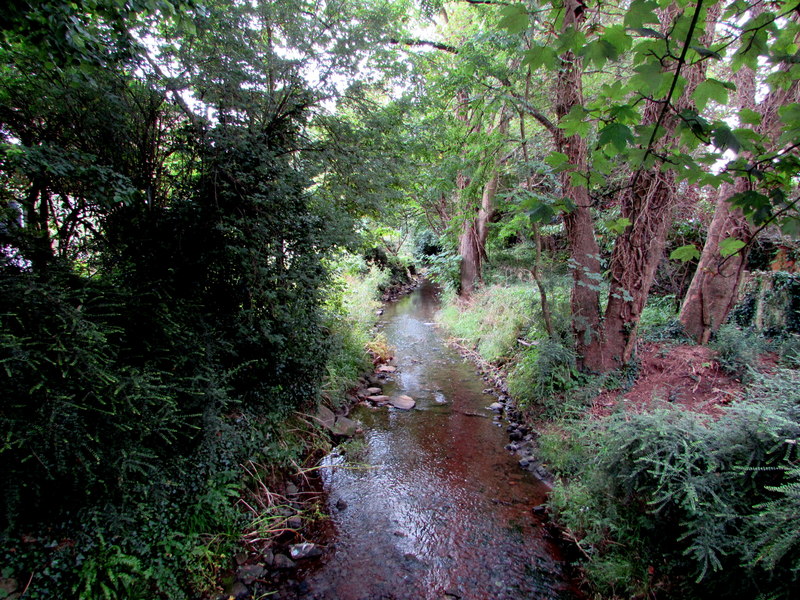
The Cadoxton River, near Dinas Powys hillfort
(by Jaggery CC BY-SA 2.0, via Wikimedia Commons)

In 410, Britons might have thought themselves freed from Roman occupation. Still, they needed to rely on resources close to home for survival, and they faced the constant threat of invasion from opportunistic Irish, Picts, and Anglo-Saxons.

When Dinas Powys was thriving, it was home to a petty king and his family, along with household servants, weavers, and metalsmiths. The property is about one-fourth of an acre, about the size of a good-sized lot in the United States.

Two stone buildings apparently sat at right angles to each other. One was a 600-square-foot hall, a place for feasting. The meals often included meat, particularly pork, but the livestock was likely raised elsewhere and bought into the fortress. The second structure, about half the size of the first, might have been used for storage or slave sleeping quarters. I can imagine it as a treasury.

The hillfort was in a forested area about 1.5 miles from the sea, a good location to trade with merchants who sailed from far-away lands.

Whoever chose the hillfort’s site had defense in mind. The fortress was on a ridge, with steep slopes to the north and west. Over ensuing decades, its rulers constructed a series of ramparts and ditches on the southern part of the area, and they employed smiths to smelt and craft iron, essential for armor and weapons.

The defenses served other purposes. Commoners did the actual building, probably as a service to their king. This reinforced the social order—peasants served their lord, and their lord protected them from enemies. Bulwarks and ditches were also a show of wealth—that the family had possessions worth guarding.

The kings were indeed protecting their source of wealth, much of it not from Britain. Archeologists have found North African and Mediterranean amphorae that could have contained olive oil or wine. The family might have also bought spices, dried foods that didn’t grow in their climate, or textiles.

Detail from illustration
by S. Martin-Kilcher
CC BY-SA 4.0
via Wikimedia Commons
In the kitchen, servants used unglazed, undecorated, and unpainted course ware from western Gaul. Made on a wheel, jugs, jars, and bowls were light brown to grey but could also be red, black, or cream. Hard and gritty, the surface looks like someone had wiped or sponged it while it was still wet.

At the table, visitors would have seen imported pottery, a better quality than vessels made by Britons. Plates, bowls, cups, and mortaria (bowls with flanges and embedded with sand or grit to pound and mix food) from the Bordeaux region would have greyish-black slip, and the bowls featured rouletting and stamp decorations.

Host and guests might have drunk that imported wine from a Kentish blue-glass squat beaker, similar to one in an Anglo-Saxon princely burial, or glass bowls. Apparently, the Celts and Anglo-Saxons weren’t always fighting.

What the kings at Dinas Powys traded for these goods is open to speculation.

They probably didn’t pay with money. The system of exchanging coins for products went away with the Romans.

So the kings needed commodities worth a long and hazardous voyage from the Mediterranean. The fortress could produce cloth, furs, and leather, and it had hearths for melting copper-alloy, silver, gold, and glass, and making the materials into jewelry. Bronze Roman coins might be worth more if they were melted and shaped into a brooch.

From The Portable Antiquities Scheme/
The Trustees of the British Museum
CC BY-SA 2.0, via Wikimedia Commons


The kings might have been something of middlemen, too, trading goods made elsewhere in Britain with merchants from overseas. At their feasts, they would give and receive presents. Perhaps, they exchanged some of those gifts—say an Anglo-Saxon glass claw beaker—a few amphorae of wine.

The finds at Dinas Powys show us Britain was not completely isolated from the rest of the world after the Romans left. Those discoveries also cut into a few stereotypes about the Dark Ages. Although life in early medieval times was far from ideal by 21st century Western standards, it was not all poverty and war.

Sources

Dinas Powys in Context: Settlement and Society in Post-Roman Wales by Andrew Seaman

Daily Life in Arthurian Britain by Deborah J. Shepherd

The Quest for Arthur's Britain, by Geoffrey Ashe

“Early Medieval E Ware Potter: An Unassuming but Enigmatic Kitchen Ware?” by Ian W Doyle, Fragments of Lives Past: Archeological objects from the Irish road schemes

“Mediterranean and Frankish pottery imports in early medieval Ireland” by Ian W. Doyle, The Journal of Irish Archaeology, Vol. 18 (2009)

~~~~~~~~~~

Kim Rendfeld’s work in progress—“Betrothed to the Red Dragon,” a short story about Guinevere’s decision to marry Arthur—is set in Dinas Powys, and in her versions of events, the ruler is a queen. If you’d like to get an email when it’s published, email Kim at kim [at] kimrendfeld [dot] com.

If you want read what Kim has already written, check out her two novels set in 8th century Europe.

Kim's first novel, The Cross and the Dragon, in which a Frankish noblewoman must contend with a jilted suitor and the fear of losing her husband, is available at AmazonKoboiTunesBarnes & NobleSmashwordsCreateSpace, and other vendors.You can order The Ashes of Heaven's Pillar, about a Saxon peasant who will fight for her children after losing everything else, at AmazonKoboBarnes & Noble, and iTunes.

Connect with Kim at on her website kimrendfeld.com, her blog, Outtakes of a Historical Novelist at kimrendfeld.wordpress.com, on Facebook at facebook.com/authorkimrendfeld, or follow her on Twitter at @kimrendfeld.

Wednesday, November 2, 2016

A Norman Frontiersman in Wales

by Tracey Warr

Old style histories merely recounting one king after another do not deliver the full freight of human emotions and actions through time. Charting experiences of lesser people can give more sense of the daily complexity of lived history. Gerald FitzWalter of Windsor, for instance, was a minor Norman knight, a pioneer in Wales at the end of the 11th century and the beginning of the 12th. A clever and resourceful man, he survived and thrived amidst the vagaries of life under two Norman kings: William II, and then his brother, Henry I – the sons of the Conqueror.

It took the Normans more than 200 years to conquer Wales rather than the fortuitous (for them) one day in which they conquered England at Hastings. The challenges of Wales included its mountainous and often sodden terrain, tenacious resistance by the Welsh, the lack of a single Welsh king to overthrow. Wales was initially peripheral to Norman ambitions and William the Conqueror left its subjugation to his marcher lords: Roger Montgommery, Earl of Shrewsbury; Hugh, Earl of Chester; William fitz Osbern, Earl of Hereford. Welsh conquest proceeded erratically with the Normans taking territory and establishing castles which were often soon lost back to the Welsh.

Montgommery Castle, Wales, near the English border, was the seat of the Norman
 marcher baron, the Earl of Shrewsbury and the Montgommery family. By John Speed, 1552?-1629.

It was never a simple case of Welsh pitted against Normans. Sometimes a Welsh king allied with Normans to contest against another Welsh ruler. Welsh leaders exploited disturbances in the Norman state to their own advantage and vice versa. The initial Norman settlement in south-west Wales, where Gerald FitzWalter was active, was precarious. It clustered around the coastline where escape and supply could be effected by sea. ‘Periodic Welsh offensives from 1094 onwards made this province no place for the faint-hearted’, wrote Ifor Rowlands. Gerald FitzWalter proved himself to be a full-hearted frontiersman.

We see glimpses of Gerald in the primary sources including the Annales Cambriae and the Brut y Tywysogion (Chronicle of the Princes of Wales). He was the second son of a minor Norman lord, Walter FitzOther, the Forester of Windsor. When Gerald first appears he is in service to the powerful Montgommery family. Possibly he was sent to the household of Roger Montgommery, Earl of Shrewsbury, at the age of seven, to train as a squire, as was usual. Perhaps being of similar age with Arnulf, the youngest of the five Montgommery sons, he became a member of Arnulf’s conroi – his circle of close friends and bodyguards.

Brut y Tywysogion (Chronicle of the Princes of Wales), a translation of a lost
 Latin work based on the annals kept by churches and monasteries. National Library of Wales

In 1093 Rhys ap Tewdwr, the Welsh king in southern Wales, was killed and the Earl of Shrewsbury made a rapid, opportunistic march through Wales to establish Pembroke Castle on the southern-most tip, as a stronghold for his youngest son. Arnulf also possessed lands in England and he left Gerald as his steward to hold Pembroke for him. And that is exactly what Gerald did. At times - when repeated Welsh resurgences took back territory - he was the only Norman left clinging onto a toehold in south-west Wales. In 1094 Pembroke Castle and Rhy-y-Gors (near Carmarthen) were the only Norman castles to survive Welsh attacks. The commander of Rhyd-y-Gors, William FitzBaldwin, died soon after and the garrison was forced to withdraw. Gerald, however, hung on.

At this time Pembroke Castle was a mere stockade of wooden stakes and turfs with a small garrison. During a desperate, prolonged siege in 1096, fifteen knights deserted by boat, very likely from The Wogan, a cavern deep in the rock beneath the castle, that lets out into the millstream. Gerald transferred the lands of the deserters to fifteen men-at-arms and made them knights. He ordered the last four hogs jointed and the meat thrown over the fortifications, suggesting to Welsh besiegers that supplies were plentiful. He then put together a fake letter to Arnulf with his personal seal attached, saying he would not need reinforcements for at least four more months.

Henry G. Gastineau, 1791-1876 H.W. Bond, fl. 1827-1849
This letter was left outside the Bishop’s Palace at Lamphey, as if it had been accidentally dropped, where it was duly found by the Welsh attackers who called off their siege. The letter was presumably also planted by someone – perhaps Gerald – slipping in and out of the castle under the besiegers’ noses via The Wogan. Gerald’s grandson, the colourful writer, Gerald of Wales, was the source of this story, and perhaps it is embellished, nevertheless a picture emerges of Gerald as a wily and stubborn opponent.

The Wogan cavern beneath Pembroke Castle which shows evidence of prehistoric
 occupation. ceridwen [CC BY-SA 2.0 (http://creativecommons.org/licenses/by-sa/2.0)]

The Norman kings and nobility were as prone as the Welsh to familial dissension. William the Conqueror had to quell a rebellion led by his brother and members of the Montgommery family. William Rufus and Henry dealt with rebellions from Normans who viewed their older brother, Robert, Duke of Normandy, as the rightful King of the English. Henry, William the Conqueror’s third son, was a man of tremendous energy. He became king in 1100 after the unexpected death of his brother William Rufus (but that is another story). Henry immediately began a strategy of getting the Norman nobility thoroughly under control. The powerful and arrogant Montgommery family had been implicated several times over in rebellion and Henry decided it was time to dig them out of their strong, entrenched position.

Pembroke Castle, south-west Wales. In Gerald’s day the castle was a moated,
wood and earthwork fortification. Chris Downer [CC BY-SA 2.0 (http://creativecommons.org/licenses/by-sa/2.0)]

In 1102 Henry accused the Montgommery brothers of treason. The overwhelming evidence against Robert de Bellême, now the Earl of Shrewsbury, was provided by Henry’s spies. Robert at first denied the charges, then escaped from the court in Winchester, and fought a series of sieges against Henry throughout the summer, before finally losing his English earldom and fleeing to his lands in Normandy. His brother Roger chose not to risk King Henry’s ire, taking self-exile on his wife’s lands in France, and losing his vast holdings in England. Arnulf initially fled to Wales and sent Gerald to Ireland to negotiate with  Muirchertach ua Briain, King of Munster, for men and ships. Arnulf then fled to Ireland, where Gerald’s negotiations had included Arnulf’s marriage to Muirchertach ua Briain’s daughter, Lafracoth. Arnulf lost all his lands in Wales and England. Gerald was obliged to hand over Pembroke, which he had defended so well for ten years, to King Henry’s loyal representative, a knight named Saer.

For the next few years Henry sought to control south Wales through Welsh allies (Iorwerth ap Bleddyn and Hywel ap Goronwy). Then he began recolonising Wales with new Norman lords, firmly loyal to the crown, as the marcher earls had never been. These new lords included Richard of Beaumaris, Bishop of London, governing Shrewsbury and the former Montgommery lands; Henry, Earl of Warwick in the Gower; and Roger, Bishop of Salisbury, at Kidwelly.

Gerald might easily have been attainted a traitor along with the Montgommerys, but he managed instead to survive the disaster. He was rehabilitated into King Henry’s good graces (no easy task) and by 1105 Henry was sufficiently reassured of Gerald’s loyalty to reconfirm him as steward of Pembroke. Gerald, after all, knew the lay of the land there as no other Norman did. It is possible he learnt to speak Welsh and had made himself familiar with Welsh laws and customs. Henry strengthened Gerald’s position further by giving him Nest ferch Rhys as his wife. Nest was the daughter of the former king of Deheubarth, of south Wales, and Henry’s own former mistress. (Henry had an exceptional number of mistresses and illegitimate children - at least twenty-two – but that’s also another story.) Nest, as a member of the southern Welsh royal family, lent an air of validity to Gerald’s authority in the area. Gerald was also granted Moulsford in Berkshire and lands in Pembrokeshire, including Carew, which may have been his wife’s dowry. After the plummet of 1102, a few short years later, he was very much on the up again.

Cilgerran Castle, the possible site of Nest's abduction - William M. Connolley
[CC BY-SA 3.0, https://commons.wikimedia.org/w/index.php?curid=6920493]

Between 1104 and 1109 Henry was preoccupied in Normandy where he finally succeeding in ousting his older brother Robert to become Duke of Normandy as well as King of the English. Despite his absence, he did not neglect matters in Wales. Around 1108 Henry settled a community of loyal and pugnacious Flemings in the Rhos district, the hinterland of Pembroke Castle, and Gerald built the castle of Cenarth Bychan (probably modern day Cilgerran) close to the border with Powys. Cadwgan ap Bleddyn, King of Powys, had dominated mid-Wales and been the leading light in Welsh resistance for thirty years. Both the Flemish community and Cenarth Bychan Castle may have been intended as a provocation to Cadwgan, or as a forward-thinking defensive strategy against him. Either way, it is possible that Gerald (as the man on the ground) suggested this strategy to Henry. If so, his strategy backfired spectacularly.

Soon after Christmas 1109, Cadwgan’s son Owain attacked Cenarth Bychan, setting it on fire and kidnapping Gerald’s wife, Nest, and their four small children: (probably) Henry (the illegitimate son of King Henry), William, Maurice and Angharad. Gerald escaped – according to the Chronicle of the Princes – down the latrine chute. The chronicler writes that this escape route was his wife’s suggestion. The image of Gerald wriggling down the privy in the dead of winter as his castle burned and his wife was stolen, might undermine him, make him look ridiculous, but it also seems in tune with his unusual method of defending Pembroke in 1096. The chronicle records that Owain was infatuated with Nest, however stealing her was undoubtedly a political act to undermine Gerald. The children were returned soon afterwards, whilst Nest remained with Owain for a further two years. She may have been an innocent victim in the kidnap, or she may have colluded in the attack. She was Welsh and a cousin of the rebels, making her suspect in Norman eyes.

Garderobe, Peveril Castle, Derbyshire. By Dave.Dunford 

King Henry sent the Bishop of London to negotiate Nest’s return and she was eventually reunited with Gerald. The Bishop astutely exploited rivalry amongst Cadwgan and Owain’s kin and both Cadwgan and his brother Iorwerth died as a consequence in 1111.

In 1113 Nest’s brother, Gruffudd ap Rhys, rightful Welsh king of south-west Wales, returned from Ireland where he had grown up. He spent time with Gerald and Nest at Pembroke; perhaps another wily move by Gerald: keeping the pretender under his eye.

In 1114 Henry led a determined expedition into Wales. Owain, by now King of Powys, was the last to submit but eventually reached agreement with Henry and accompanied him on an expedition to Normandy. On his return Owain may have acted as Henry’s agent against Nest’s rebellious brother Gruffudd ap Rhys, or he may have been in cahoots with Gruffudd, continuing to contest Norman rule. Gradually, however, a Cambro-Norman culture was emerging in Wales.

In 1115 Gruffudd was accused of rebellion against Henry. He fled to the court of the Welsh king of Gwynedd in the north who betrayed him to the Normans. He escaped, taking the King of Gwynedd’s daughter, Gwenllian, with him (yet another fascinating story I can’t tell here). In 1115 another of Nest’s surviving brothers, Hywel, escaped from prison in Carmarthen.

In 1116 Gerald finally got his revenge on Owain for Nest’s kidnap, when they accidentally met, near Carmarthen. Both men were accompanied by soldiers. Gerald’s party included Flemings who had reason to hate Owain for his brutal raids. Owain was killed in the skirmish. Gerald may himself have taken a mortal injury in that fight. He died sometime between 1116, when he disappears from the record, and 1130, when the Fleming Sheriff Hait is recorded accounting for Pembroke. Given Nest’s subsequent two marriages to Hait and Stephen de Marais, Constable of Cardigan, and her further children from these marriages, it seems likely Gerald died sooner rather than later.

Gerald and Nest’s children continued Cambro-Norman lives in Wales and Ireland. William FitzGerald inherited Carew Castle; Maurice FitzGerald became a lord in Ireland; David became Bishop of St David’s; Angharad married William de Barry of Manorbier. (They were the parents of the writer, Gerald of Wales).
If Gerald had not clung so fast to his moated rock at the tip of Wales, the picture might have been very different. In the early 12th century Gruffudd ap Cynan regained most of northern Wales from the Normans and Cadwgan ap Bleddyn had a solid hold in mid-Wales. The Welsh might have taken Wales back from the Normans altogether.

[all above images are in the public domain - unless otherwise attributed, and all via Wikipedia commons]

~~~~~~~~~~

Tracey Warr was born in London, lived in Pembrokeshire, Wales and studied MA Creative Writing at University of Wales in Carmarthen. She currently divides her time between the UK and France. Her writing has been shortlisted for the Impress Prize and the Rome Film Festival Book Initiative, won a Santander Research Award, a Literature Wales Writer’s Bursary and an Author’s Foundation Award. She is a tutor for residential writing courses in France with A Chapter Away. She is a member of the Historical Novel Society, Society of Authors and the Royal Society of Literature. She has published three historical novels with Impress Books, all set in the early medieval period: Almodis (2011), The Viking Hostage (2014) and her latest book, Conquest: Daughter of the Last King (2016), is the first in a trilogy about Nest ferch Rhys.

Website
Facebook
Twitter
Conquest - Daughter of the Last King

Saturday, July 2, 2016

Little mothers and Proto-proletarians: Growing up in Mining

By Lesley Hulonce

Elizabeth was using the last of the daylight to finish mending her brother’s trousers. The job often kept her until the early hours of the morning because of the long hours the miners worked. She hated the thick moleskin that prevented him being injured in the mine as it was almost impossible to get her needle through, and her fingers were hurting. The needle and thread had to be waxed for nearly every stitch before she could get it into the moleskin. He felt differently, these were men's trousers, miners’ trousers which showed that he was now a man, a wage earner and had at last joined the masculine ranks at the pit. Alan Burge identifies boys’ first pair of moleskin trousers as a ‘totem of manhood’. Getting their first pair represented their entry into the ethos of adult ‘manhood’ within the pit.

    (Welsh miners' children)

The South Wales coalfield was one of the few locations in Britain which adhered to a separate spheres agenda.  Unlike most of the country where working-class women went out to work as a matter of course, in the coalfield boys were trained to be miners and girls to be mothers and housewives. They were ‘little mothers’ as soon as they could look after their siblings, they could be taken out of school in times of crisis and were primed to marry a miner, probably from the same village and restart the cycle with their own (numerous) children. While American feminist historian Joan Wallach Scott felt able to claim with confidence that the ‘call for a history of women’ had been comprehensively answered by 1983, Welsh women's historian Deirdre Beddoe argued in 1984 that Welsh women were written out of Welsh history and, ‘if a creature from outer space landed in Wales and worked through Welsh history, she would be perplexed as to how the Welsh procreated. They were all men!’ Within the historiography of Wales, a complete work dedicated to Welsh women’s history was not published until 1991.

The study of childhood in Wales is an under-investigated area of scholarship. The gender roles and expectations of adult life were grafted onto children via the stratification of play, household chores and education. Building on Alun Burge’s study of miners’ learning in the first half of the twentieth century, a gendered analysis of both boys’ and girls’ positioning within coalfield society enhances our understanding of the gender roles ingrained during their formative years. Boys were widely seen as proto-proletarian heroes, union stalwarts and hungry for learning. But not by their mothers who imagined a different future for their children, one which did not include working a mile underground or struggling on after 13 stillborn births. As Dot Jones argues ‘the unremitting toil of childbirth’ killed and debilitated untold numbers of women in the South Wales Coalfield. Burge argues that boys were socialised and trained into the colliery ‘around the fireplace’.  Dai Dan Evans recalled that ‘all the young lads…in the village were steeped in mining, the only conversation you could get in the community was about mining…Therefore we were what you might term, trained for the pit, and nothing else’. Girls, it appears were trained for domesticity and very little else.

 (pithead bathing)

Although elementary education of working-class girls was intended to produce good wives and domestic servants, there is insufficient exploration of the offensive that exacerbated this widely held construction of femininity. Reports such as the Inter-Departmental Committee on Physical 
Deterioration in 1906 set the tone for girls’ education as it thought that the ‘annual sacrifice of infants’ was not due to poverty but to the ignorance of mothers about hygiene and nutrition and it recommended the teaching of cookery, childcare and cleanliness in schools. ‘Schools for Mothers’ were also established which leant heavily on lectures on personal hygiene and the necessity to eliminate dirt from the home. Girls were trained to refute this charge of slovenliness in the home by becoming respectable and ‘tidy’ women.   

Amongst girls who attended and completed a grammar school education, entry into the teaching profession was regarded as an appropriate progression. Sian Rhiannon Williams highlights the limited occupational options of educated working-class women and men in an article that shows that teaching may have not been the girls’ first choice, but as teaching was held in high regard and considered an appropriate feminine profession, many young women were encouraged down this avenue by their parents. Williams has shown that this ‘feminisation’ of teaching from the late nineteenth century did not necessarily lead to a fall in the social standing of teachers.

 (waiting for news)

However, a more complex gendered exploration of why the profession was considered so suitable for women, could deepen our understanding of a coalfield society in which teaching was perceived as the primary ‘escape’ from the pit or domesticity.

Elizabeth Andrews didn't grow up to darn her own sons’ moleskin trousers as she and her husband did not have children themselves. She became the Labour Party’s Woman Organiser for Wales for 29 years and following her retirement in 1948 she equated her work to that of a missionary ‘preaching this new Gospel of Social Justice and a new way of life’. Her long career of political activism had also included campaigning for women’s suffrage and the establishment of several branches of the Women’s Co-operative Guild in the Rhondda. She was a leading figure in the campaigns for pithead baths and better housing for miners; pit head baths were considered vital if women were to be able to stop carrying heavy coppers of hot water to bathe their coal-stained husbands at home. The evidence she gave before the Sankey Coalmining Commission in 1919 raised awareness of a coalfield society in which the health and life expectancy of miners’ wives and daughters was as damaged and diminished by the demands of mining as the miners themselves.

  (Elizabeth Andrews)

These were ‘tidy women’ women whose career was homemaking and mothering; ‘an army of women trained to wash and scrub and polish as men trooped in and out’. Mrs Hughes reminisces about cleaning:

‘I used to wash the path – and our toilet was down the bottom of the garden – and I used to ‘wash the path – we had flagstones – used to wash the path from the back door right down to the toilet…And then the front, flagstones was in front then, and I used to wash the pavement from the front door, right past the window, right down to the drain. The pavement, I used to wash all that. Beautiful, lovely. 

‘Coal House’ was a reality TV series, in which three 2007 families lived and worked in the south Wales coalfield of 1927. http://news.bbc.co.uk/1/hi/wales/south_east/7086725.stm while the programme tried to follow the way life was in 1927, it was of course impossible to recreate the fear, worry and hardship that Welsh children and their families experienced on a daily basis. I was drawn to the way the women failed to keep the range up to a temperature for cooking and water for baths. Women in 1927 would never have let the range temperature drop – if they had done, their miner husbands would have come home dirty and hungry and been unable to bathe or eat; it was unthinkable.

(coal house)

A 1916 Local Government Report showed that some counties in Wales had more than double the average maternal death rate of England and Wales. Stillbirths in Wales were also over a 1/3 higher than England, and in Glamorgan and Monmouth maternal mortality had increased from 14.2% in 1929 to 42% in 1933. A damning report on Maternal Mortality in Wales in 1937 showed that maternal mortality had risen steadily and was over a 1/3 higher than England. Similarly In ‘Counting the Cost of Coal’, Dot Jones shows that in 25-44 age groups in Pontypridd, the female mortality rate was significantly higher than men.

Little girls were growing up to die in childbirth, and little boys were sent into mines where safety standards were low priorities. Mining companies in South Wales of the late nineteenth and early twentieth centuries took the children for the pits and lost them early to the killing fields of coal.
~~~~~~~~~~~
Select references:

For an insight into the pride taken by these ‘tidy women’ listen to http://www.museumwales.ac.uk/welsh_womans_history/9_weekly_routine/
Deirdre Beddoe, ‘Towards a Welsh Women’s History’ in Llafur, 3:2 (1981).

Alun Burge, ‘Swimming against the tide: gender, learning and advancement in South Wales, 1900-1939’, Llafur, 8, 3 (2002), 13-31

Joan Wallach Scott, ‘Women in History: The Modern Period’, Past and Present, 101 (1983), 141; 

Angela V. John, ed., Our Mother’s Land, Chapters in Welsh Women’s History, 1830-1939 (Cardiff: University of Wales Press, 1991).

Rosemary Crook, ‘Tidy women: women in the Rhondda between the wars’, Oral History Journal, 10 (1982), 40-6.

Neil Evans and Dot Jones, ‘“A blessing for the miner’s wife”: the campaign for pithead baths in the south Wales coalfield, 1908-1950’, Llafur, 6:3 (1994), 5-28.

Elizabeth Andrews (ed., Ursula Masson), A Woman’s Work is Never Done and Political Articles (Dinas Powys, Honno, 2006 edition).

Diana Gittins, Fair Sex: Family Size and Structure, 1900-39 (London, Hutchinson, 1982).

Francis and Dai Smith, The Fed: A History of the South Wales Miners in the Twentieth Century (London, L&W, 1980; UWP, 1998).

Carol White and Sian Rhiannon Williams (eds), Struggle or Starve: Women’s Lives in the South Wales Valleys Between the Two World Wars (Dinas Powys, Honno, 1998).

Graham Goode and Sara Delamont, ‘Opportunity denied: the voices of the lost grammar school girls of the inter-war years’, in Sandra Betts (ed.), Our Daughters’ Land: Past and Present (UWP, 1996), 103-24.

Dr Lesley Hulonce is a historian and lecturer in the College of Health and Human Sciences at Swansea University. She researches children, women, disabilities and prostitution and can be contacted at mailto:l.hulonce@swansea.ac.uk
She tweets at @LesleyHulonce and @histhealthcult and blogs at Workhouse Tales https://lesleyhulonce.wordpress.com
Her first monograph is available to preorder at Amazon for £2 (a pound of which goes to the Careleavers trust) Pre-order