Showing posts with label Arthurian Britain. Show all posts

Monday, November 20, 2017

Cats in the Days of King Arthur

by Kim Rendfeld

In 5th-century Britain, cats helped humans survive winter, but the way people regarded them depended on their religious beliefs.

Romans introduced housecats to Britain in the 1st century. The island already had native feline species: the lynx (now extinct) and the Scottish wildcat (now endangered). But these animals had no interest in humans—today a Scottish wildcat remained wild, even if it’s raised in captivity. The most significant difference between the housecat and the wildcat is temperament. Housecats live with us, although we’re big enough to be predators.

Unlike a lot of other animals, the early medieval housecat is similar to today’s domestic shorthair. By contrast, horses and sheep were smaller in the Dark Ages. Pigs had bristles and tusks. While some dog breeds such as greyhounds and mastiffs go back to the ancients, many were quite different from today. Some canines, like a hunting and herding dog called alaunt, have since become extinct.
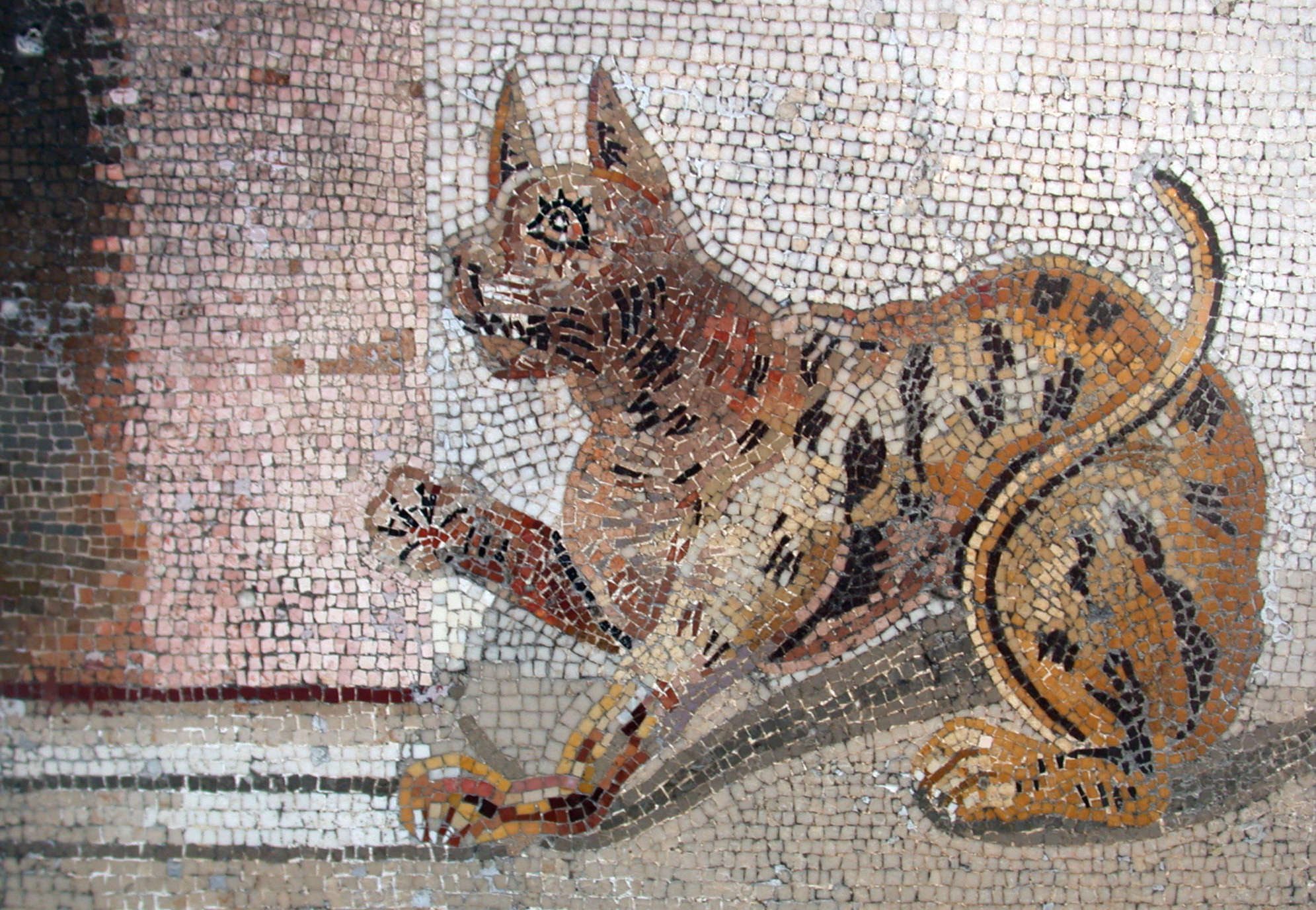

Cat and parrots mosaic (detail), in the National
Archaeological Museum of Naples
(by Massimo Finizio,
CC BY-SA 2.0 Italy, via Wikimedia Commons)

Cats brought by the Roman descended from the Near Eastern wildcat, a species that hunted mice in granaries about 10,000 years ago. Today’s Near Eastern wildcat (Felis silvestris lybica, also called the African wildcat) looks like a large housecat with longer legs and a more upright posture when sitting or walking. In ancient times, the friendlier felines domesticated themselves by hanging out with the humans who fed them table scraps. Just like a cat who decided to live with me and my husband in the 1990s. After my husband fed her, she left a dead mouse on the doormat. A thank-you gift, apparently.

We named the cat Ellie, and she went on to become a pampered pet, still killing rodents on occasion. Had she lived in Arthurian Britain she would have had a job to do—just like every human and every other animal. The only pets, as we understand them, were toy-breed dogs for the wealthy who wanted to show off that they could have an animal that didn’t need to do anything. I suppose those dogs had a job, too—status symbol.

Housecats, along with ferrets and weasels, had the essential job of killing rodents that would otherwise eat the stored grain humans needed to get through winter. Perhaps, it is not too far a stretch for the Egyptians to see them as divine.

When the Romans occupied Britain, housecats and other rodent killers played an important role in the international economy, too. Surplus grain from Britain was exported to the rest of the empire. A lot of people depended on cats’ hunting skills.


Cat and two ducks, Roman artwork, 1st century BC
(public domain via Wikimedia Commons)

Cats had a spiritual role as well. With their reproductive abilities—a female cat can have two to three litters a year, with up to eight kittens—they were symbols of fertility, an important thing in an age when aristocrats needed heirs and people didn’t know how many children would live to adulthood.

Romans might have smuggled housecats from Egypt, where they were believed to be too sacred for export, and some Egyptian beliefs about the cat-headed Egyptian goddess Bastet might have seeped into Greco-Roman mythology. Bastet, goddess of fertility and motherhood and protector of the home, became associated with the Greek Artemis and by extension the Roman Diana. A dream about a cat was a good omen and a sign of a good harvest.

Roman amulets to ward off evil have images of cats. Feline images appear on a sistrum, a bronze musical instrument a handle and a rounded open frame with bronze rods that rattled. Common in Egypt, the sistrum, associated with fertility, also was used throughout the Roman Empire and even as far as London.

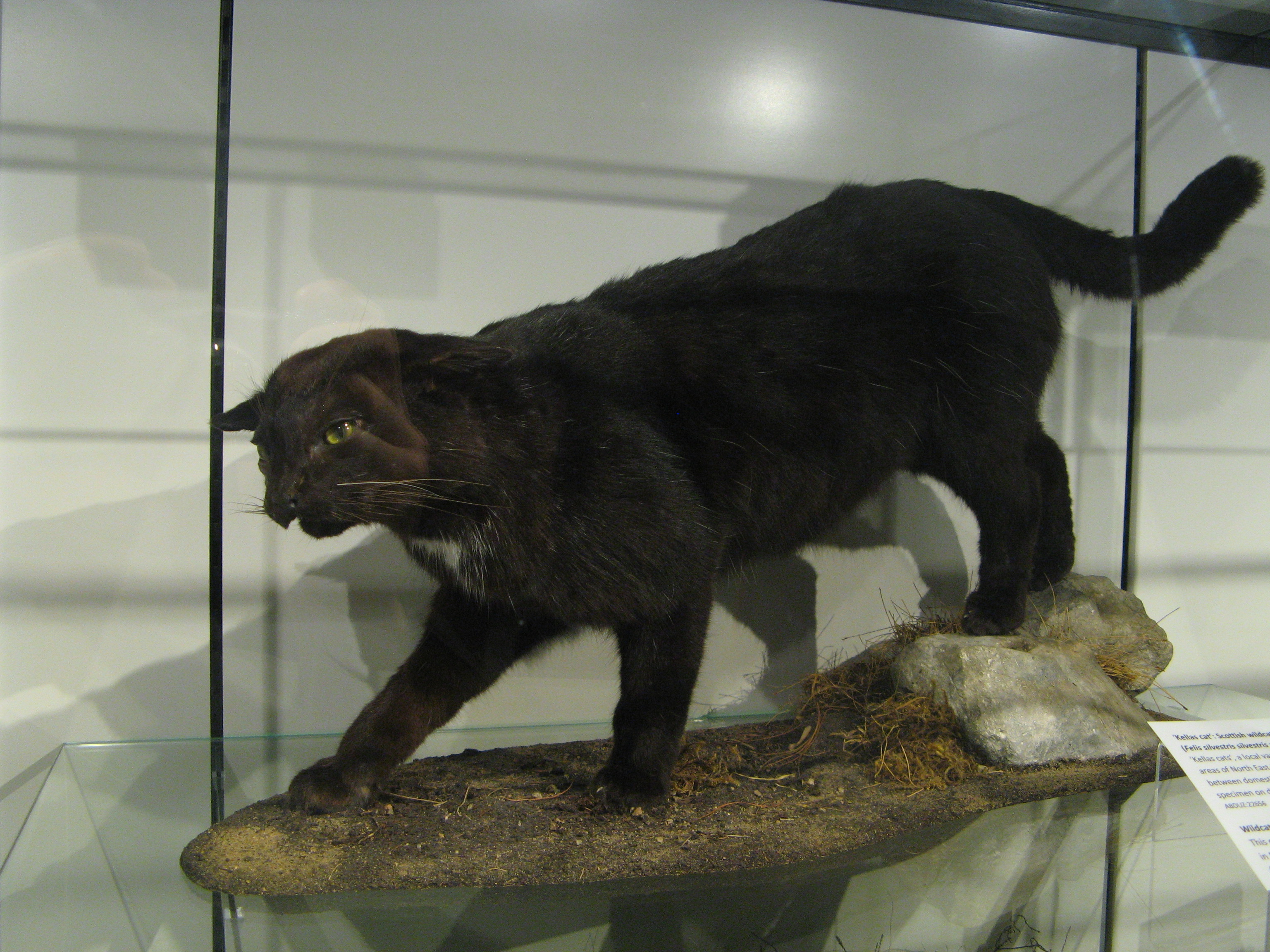
The Celts, particularly the Irish and Scots, had their own belief about cats. It’s possible the Kellas cat, a black hybrid of the Scottish wildcat and housecat, had something to do with it. In the Highlands, the large black Cat Sidhe or Cat Sith could steal the soul of the dead before the gods claimed it, and the folk had several rituals to distract the creature until the body was laid to rest. At Samhain, they left a saucer of milk for the Cat Sidhe, who would bless the house. Those who neglected to leave the treat would be cursed.

Kellas cat on display in the Zoology Museum,
University of Aberdeen (By Sagaciousphil, CC BY-SA 4.0,
via Wikimedia Commons)

Christian clergy saw them as companions—purring sphinxes. Greek monks who came to Europe brought cats with them to share their cells. One of the most delightful poems about a churchman’s relationship with his pet is the 9th century “Pangur Ban.” The Irish monk compares his hunt for knowledge to his white cat’s hunt for mice and the joy each of them feels.

In 5th century Britain, religious beliefs were fluid. Pagan and Christian beliefs coexisted, often in the same person. A Christian might wear an amulet with a cat right beside their cross. They might interpret a dream of a cat as a good omen right before they attend sunrise Mass.

Regardless of religious beliefs, people would have appreciated how the felines preserved the food supply. That furry creature who killed and ate mice in the granary was still essential.

Sources

Daily Life in Arthurian Britain by Deborah J. Shepherd

Greek and Roman Household Pets by Francis D. Lazenby

“Cats were so nice, they conquered the world twice” by Nsikan Akpan, PBS News Hour

Classical Cats: The Rise and Fall of the Sacred Cat by Donald W. Engels

“A cat that can never be tamed” by Bec Crew, Scientific American

The Cat Sidhe by Deborah MacGillivray

"House Cat Origin Traced to Middle Eastern Wildcat Ancestor" by Brian Handwerk, National Geographic News

"Pangur Ban"

~~~~~~~~~~

Kim Rendfeld’s short story “Betrothed to the Red Dragon,” about Guinevere’s decision to marry Arthur, is set in early medieval Britain and available on Amazon.

She has also written two novels set in 8th century Europe. In The Cross and the Dragon, a Frankish noblewoman must contend with a jilted suitor and the fear of losing her husband (available on Amazon). In The Ashes of Heaven's Pillar, a Saxon peasant will fight for her children after losing everything else (available on Amazon).


Connect with Kim at on her website kimrendfeld.com, her blog, Outtakes of a Historical Novelist at kimrendfeld.wordpress.com, on Facebook at facebook.com/authorkimrendfeld, or follow her on Twitter at @kimrendfeld.



Wednesday, July 19, 2017

Dinas Powys Hillfort: A Dark Ages Trading Center

By Kim Rendfeld

When the Romans abandoned Britain around 410, an economy based on mass production and export collapsed. But international trade did not die. From the 5th through 7th centuries, the inhabitants of Dinas Powys hillfort might have enjoyed olive oil, spices, and other imports.

Southwest of today’s Cardiff, Wales, the hillfort is a treasure trove for anyone interested in post-Roman Celtic life. Anglo-Saxons (a catchall term for Germanic tribes who migrated to England) didn’t conquer Wales. The site probably was abandoned around 700, but a nearby village of the same name exists today.

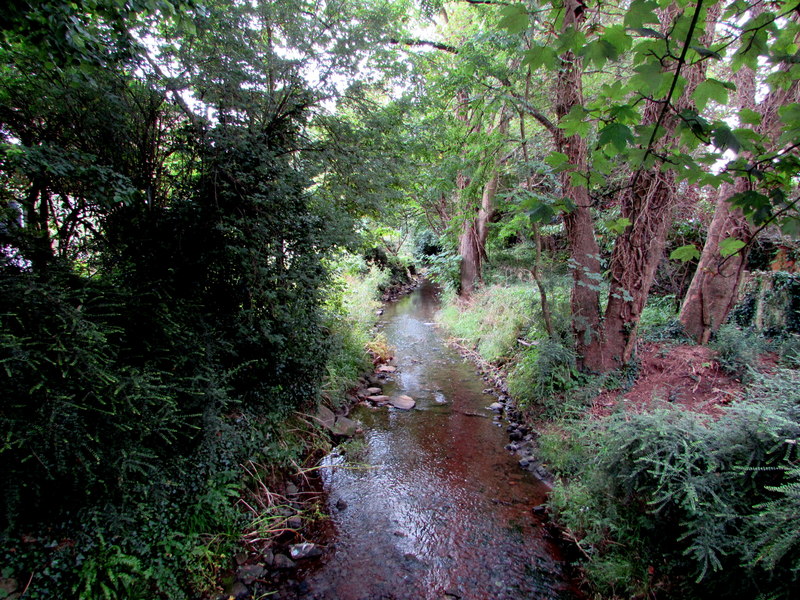
The Cadoxton River, near Dinas Powys hillfort
(by Jaggery CC BY-SA 2.0, via Wikimedia Commons)

In 410, Britons might have thought themselves freed from Roman occupation. Still, they needed to rely on resources close to home for survival, and they faced the constant threat of invasion from opportunistic Irish, Picts, and Anglo-Saxons.

When Dinas Powys was thriving, it was home to a petty king and his family, along with household servants, weavers, and metalsmiths. The property is about one-fourth of an acre, about the size of a good-sized lot in the United States.

Two stone buildings apparently sat at right angles to each other. One was a 600-square-foot hall, a place for feasting. The meals often included meat, particularly pork, but the livestock was likely raised elsewhere and bought into the fortress. The second structure, about half the size of the first, might have been used for storage or slave sleeping quarters. I can imagine it as a treasury.

The hillfort was in a forested area about 1.5 miles from the sea, a good location to trade with merchants who sailed from far-away lands.

Whoever chose the hillfort’s site had defense in mind. The fortress was on a ridge, with steep slopes to the north and west. Over ensuing decades, its rulers constructed a series of ramparts and ditches on the southern part of the area, and they employed smiths to smelt and craft iron, essential for armor and weapons.

The defenses served other purposes. Commoners did the actual building, probably as a service to their king. This reinforced the social order—peasants served their lord, and their lord protected them from enemies. Bulwarks and ditches were also a show of wealth—that the family had possessions worth guarding.

The kings were indeed protecting their source of wealth, much of it not from Britain. Archeologists have found North African and Mediterranean amphorae that could have contained olive oil or wine. The family might have also bought spices, dried foods that didn’t grow in their climate, or textiles.

Detail from illustration
by S. Martin-Kilcher
CC BY-SA 4.0
via Wikimedia Commons
In the kitchen, servants used unglazed, undecorated, and unpainted course ware from western Gaul. Made on a wheel, jugs, jars, and bowls were light brown to grey but could also be red, black, or cream. Hard and gritty, the surface looks like someone had wiped or sponged it while it was still wet.

At the table, visitors would have seen imported pottery, a better quality than vessels made by Britons. Plates, bowls, cups, and mortaria (bowls with flanges and embedded with sand or grit to pound and mix food) from the Bordeaux region would have greyish-black slip, and the bowls featured rouletting and stamp decorations.

Host and guests might have drunk that imported wine from a Kentish blue-glass squat beaker, similar to one in an Anglo-Saxon princely burial, or glass bowls. Apparently, the Celts and Anglo-Saxons weren’t always fighting.

What the kings at Dinas Powys traded for these goods is open to speculation.

They probably didn’t pay with money. The system of exchanging coins for products went away with the Romans.

So the kings needed commodities worth a long and hazardous voyage from the Mediterranean. The fortress could produce cloth, furs, and leather, and it had hearths for melting copper-alloy, silver, gold, and glass, and making the materials into jewelry. Bronze Roman coins might be worth more if they were melted and shaped into a brooch.

From The Portable Antiquities Scheme/
The Trustees of the British Museum
CC BY-SA 2.0, via Wikimedia Commons


The kings might have been something of middlemen, too, trading goods made elsewhere in Britain with merchants from overseas. At their feasts, they would give and receive presents. Perhaps, they exchanged some of those gifts—say an Anglo-Saxon glass claw beaker—a few amphorae of wine.

The finds at Dinas Powys show us Britain was not completely isolated from the rest of the world after the Romans left. Those discoveries also cut into a few stereotypes about the Dark Ages. Although life in early medieval times was far from ideal by 21st century Western standards, it was not all poverty and war.

Sources

Dinas Powys in Context: Settlement and Society in Post-Roman Wales by Andrew Seaman

Daily Life in Arthurian Britain by Deborah J. Shepherd

The Quest for Arthur's Britain, by Geoffrey Ashe

“Early Medieval E Ware Potter: An Unassuming but Enigmatic Kitchen Ware?” by Ian W Doyle, Fragments of Lives Past: Archeological objects from the Irish road schemes

“Mediterranean and Frankish pottery imports in early medieval Ireland” by Ian W. Doyle, The Journal of Irish Archaeology, Vol. 18 (2009)

~~~~~~~~~~

Kim Rendfeld’s work in progress—“Betrothed to the Red Dragon,” a short story about Guinevere’s decision to marry Arthur—is set in Dinas Powys, and in her versions of events, the ruler is a queen. If you’d like to get an email when it’s published, email Kim at kim [at] kimrendfeld [dot] com.

If you want read what Kim has already written, check out her two novels set in 8th century Europe.

Kim's first novel, The Cross and the Dragon, in which a Frankish noblewoman must contend with a jilted suitor and the fear of losing her husband, is available at Amazon, Kobo, iTunes, Barnes & Noble, Smashwords, CreateSpace, and other vendors.You can order The Ashes of Heaven's Pillar, about a Saxon peasant who will fight for her children after losing everything else, at Amazon, Kobo, Barnes & Noble, and iTunes.

Connect with Kim at on her website kimrendfeld.com, her blog, Outtakes of a Historical Novelist at kimrendfeld.wordpress.com, on Facebook at facebook.com/authorkimrendfeld, or follow her on Twitter at @kimrendfeld.

Wednesday, October 9, 2013

The Euhemerist -- Mixing the Lure of Legend with the Power of the Novel


by Persia Woolley

If someone had told Mom that her daughter would grow up to be a euhemerist, she would have run to the dictionary with some trepidation--it didn't sound like a fitting career for a young woman in the '50's when women were expected to become nurses, teachers or wives.

What Mom would have found was that a euhemerist is one who believes that legends are based on the real actions of real people doing real things in their own time which we have endowed with magic and surrealism over centuries of retelling.
So when an author decides to write a novel based on a favorite legend but strips away the trappings of fantasy in favor of reaching the human heart of the myth, he or she qualifies for that title no one has ever heard of and I can't always spell right.

If you're tempted to make that choice as a writer, Rejoice! You've two advantages going for you right from the start--you're dealing with an already proven story and whether you're deeply familiar with it or not, you know the content is going to touch some universal chord or it wouldn't have reached legendary status. Second, it's a wonderful chance to exercise all your skill as a story-teller breathing life and emotions into a cast of iconic characters.

When I first realized I wanted to do for Guinevere what Mary Stewart had done with her Merlin trilogy, I though it would take maybe a year--six months of research and six months of writing. I'd been a journalist for a decade and had two non-fiction books published, so it seemed to me a year would be enough.

Ha, was I wrong! Writers of historical fiction often admit that they love the research as much as the writing, and don't know when to stop exploring the one to concentrate on the other. A lot depends on how accurate you want to be--feeling a need to create as real a world as possible, I dove into it full tilt. My Guinevere Trilogy took up 11 years of my life and completely changed my career direction, but overall it was great fun and I'm still involved with the books and fans.

So how do you start? Getting to know the landscape and culture of the time when the legend began is essential. Since Arthur's traditional foes were the Saxons and there were no Legions to draw on, Camelot's niche was somewhere between 410 (when Rome told the Britons there would no help in fending off marauding barbarians), and 550 A.D. when the Saxons finally conquered Britain and drove the Romano-Celts into the mountains of Wales.

Over the next centuries they sat around their campfires telling tales of their last great leader, Arthur, who taught those Saxons a thing or two for twenty years while he struggled to keep the flame of civilization, orderly governance and political unity alive in the face of onrushing Dark Age chaos.

Great! There went any notion of fancy castles, shiny armor or flowing medieval garments--my Gwen would have to live in Roman ruins or Celtic mud huts, with now and then a stay in a wooden lodge or a Highlander's stonework fortress.


Clothing and armor would be a hodgepodge of what was left over from the days of the Roman empire augmented by common home-spun from the family loom and those local smiths who made spears and swords. (Don't knock provincial the metal worker--this was the origin of the most famous sword Excalibur. It's very name means 'cut's iron' which a metallurgist told me probably indicates that the smith had accidentally created a sort of alloy, thereby giving it it's great strength and renown.)

Foods would be a similar blending of old and new customs and religion was completely up for grabs; a recently excavated Celtic temple was found to have been built after the Roman influence died out, but before Christianity became the dominant moral code.

(The notion that Arthur held a Christian court rose with the power of the Medieval church which also decided that powerful, independent women had to be put in their place, and the stories were changed to make Gwen a repentant sinner and Morgan le Fey an outright witch.)

Once you've begun to feel comfortable with your setting it's time to start exploring the legend for internal clues as to the hidden dynamics of the story and the psychology of the individual characters. In other words, given their circumstances, what would explain why the people did the things the legend says they did? And are there inconsistencies that you can exploit or ignore?

Archaeology shows it was a time of great confusion, jumbled allegiances and odd incongruities--the finest pottery from the Byzantine area was showing up in the courts of warlords in the west of Briton when everyone else was lucky to have a wooden trencher.

Fortunately the mix of cultures--old Celtic in the north, fading Roman memories in the south, and roughshod Saxons along the coastal settlements--provides a potent palette for conflict and courageous endeavor so whatever was lost in the way of medieval glamour was made up for in historically honest color.

It also threw the whole landscape of the story wide open. The medieval tradition of Guinevere as a vain and imperious beauty, convent raised in the south could now rightly be called into question. And in some versions it's clear that a large part of the population loved her and would have taken her side in a war with Arthur following her escape from being burned at the stake. So it seemed unlikely to me that she would have been the shallow, bitchy creature she's made out to be by those who need a scapegoat for the fall of Camelot. Besides, if both such sterling characters as Arthur and Lancelot loved her, common sense says she must have been more than a pretty face.

By the same token, every anthologist will tell you that when a king conquers a new tribe, he'll cement his power by marrying a daughter of his new subjects. So it made perfect sense to place Gwen in the north, where she would have been raised with the power and freedom of a potential Celtic queen. And since one of the first things young Arthur had to do was put down a rebellion of the northern kings, what was more logical than that she was chosen as the political pawn to secure his new position? Her resistance to that provided an internal line of conflict in the first book, which covers her childhood and marriage to the new king. Who needs dragons and unicorns when human nature is running rampant?

While I was at it, I made her homely (at least in her own eyes) and killed off her mother when she was ten so that she could grow up an adventurous tomboy; bold, brave and intelligent--a worthy partner in the effort to form a cohesive unit out of the frequently squabbling Celtic factions under Arthur's rule.

My choice of making her from the north also meant that as an outsider she brought fresh eyes to every new circumstance, a great advantage for an author. How better to give the reader a picture of the remarkable world she would have discovered as the High Queen of Dark Age Britain? It's a great way to involve the reader, whether by recording Gwen's delight at staying in a Roman villa owned by one of the historical characters I wove into the books or her amazement at the cleverness of the warlord who built his fort atop the great rock in Dumbarton which was completely surrounded by swamp and marsh; with a large population of water birds always on guard, he'd have plenty of warning if some military foe tried to sneak up on him!

All such touches came from solid research which in some cases actually supported elements of the story often assumed to be most fantastic. Take the order for Bedivere to throw Excalibur into the lake at the end of the legend. Although I didn't have a hand reach up and grab it, it seems the Celts sometimes made sacrifices of splendid armor to the water goddess--several such finds have been located in the River Thames near Oxford, for example.

Couple that with the fact that if you saw 'the great horse Silver' being ridden by someone new, you'd immediately wonder what had happened to the Lone Ranger. So any important leader who had such a distinctive sword would have expected his followers to hide it when he died...it might not make much sense to us in the 21st century, but that's how things slip from history to legend.

Lastly, what about the fear of turning such archetypical characters into everyday frumps if the 'magic' is taken away? (Don't get me wrong, there's plenty of superstition in my Gwen's world, but no one gets in or out of trouble by supernatural means.) And there are a number of fine fantasy works based in some part on the Arthurian stories. But for me the allure of the Arthurian stories lies in the very human nature of the people involved; people who rose to difficult challenges, struggled with their complexities and lifted us all toward their dream in tales that endure to this day...which is why I love being a euhemerist.

~~~~~~~~~~~~~

Persia Woolley spent 11 years researching and writing on her Guinevere Trilogy, (Child of the Northern Spring, Queen of the Summer Stars, Guinevere-the Legend in Autumn), during which time she made five trips to Britain. All three volumes were Book of the Month Club Alternates and have been translated into seven languages. Recently they have been reissued by Sourcebook.