Showing posts with label nuns. Show all posts

Wednesday, May 28, 2014

Saint Thecla: ‘Like a Light in a Dark Place’

By Kim Rendfeld


The clues about Saint Thecla are tantalizing. Who was this nun entrusted to govern two abbeys in eighth century Francia, east of the Rhine, a more dangerous area than her native Britain?

She was a kinswoman of Saint Lioba and lived with her and other Benedictine nuns at Wimbourne, a double monastery governed by Saint Tetta. In a letter to Wimbourne between 742 and 748, Saint Boniface, Lioba’s kinsman, asked Lioba, Thecla, and Cynehild to pray for him.
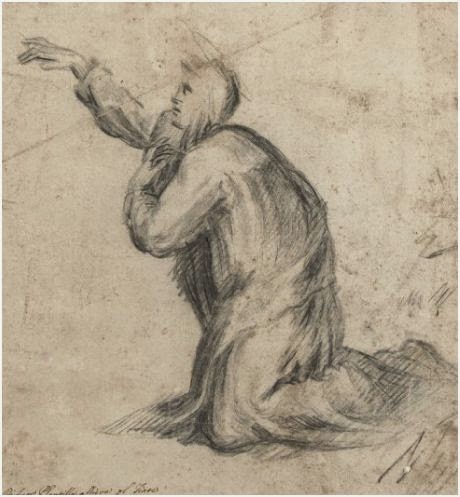
A Kneeling Saint in Nun's Robes,
16th century sketch by Plautilla Nelli,
via Wikipaintings
Around 748, Thecla was among the nuns crossing the Channel with Lioba to assist Boniface in his mission to strengthen Christianity on the Continent. The women were leaving behind the safety of Wimbourne for an area east of the Rhine, with pagan Saxons to the north. Thecla was a disciple and star pupil of Lioba, who was installed as the abbess of Bischofsheim.

Thecla and her abbess were close. When Rudolf, a monk at Fulda, wrote Lioba’s hagiography almost 60 years after her death, Thecla was among the writers he relied on, and she is included during a vignette about a storm so violent it blew the roofs off houses and shook the ground with its thunder. The terrified people sought shelter in the church, and Lioba lay prostrate at the altar, praying. Finally, the crowd had enough and roused Lioba.

“Thecla, her kinswoman, spoke to her first, saying: ‘Beloved, all the hopes of these people lie in you: you are their only support. Arise, then, and pray to the Mother of God, your mistress, for us, that by her intercession we may be delivered from this fearful storm,’” Rudolf wrote.

Motivated by Thecla, Lioba went to the church door and stood on threshold, where she made a sign of the cross, and three times invoked the mercy of Christ through the intercession of the Mother of God. And the storm dissipated. (Hagiographies often have miracles, the veracity of which I leave to the readers.)

Sources contradict each other with what happened next, so here is my best guess. Around 750, Thecla was appointed to lead the new abbey at Ochsenfurt, east of Bischofsheim. Still overseeing Ochsenfurt, she was later called to replace the founding abbess at Kitzingen almost 10 miles away, about a day’s journey if a cart didn’t break a wheel.

Abbesses at this time were in positions of power and influence and acted autonomously. That Thecla was responsible for two abbeys tells us how much Boniface trusted her, both for her abilities and loyalty. The 11th century Passion of Boniface says, “She shone like a light in a dark place.”

She is believed to have died around 790, after more than 40 years in Francia. The year is uncertain as is her feast day, either September 27 or 28 or October 15. If she had taken orders at Wimbourne in the 740s, my estimate is that she lived into her 60s.

Her relics were at Kitzingen, and her cult apparently was strong in the 11th century. But there is a sad postscript centuries later. In 1525 during the Peasants War, the tombs of Thecla and another saint were desecrated, and when the church was rebuilt in 1695, the bodies were covered with rubbish.

Thecla deserves better than that.

Sources

Medieval Sourcebook: Rudolph of Fulda: Life of Leoba

The Oxford Dictionary of Saints, By David Farmer

“Tetta ‘Noble in Conduct’ and Thecla ‘Shining like a Light in a Dark Place,’” Deborah Harmeling, OSB, Medieval Women Monastics: Wisdom's Wellsprings, edited by Miriam Schmitt, Linda Kulzer

Saint Thecla” by Gertrude Casanova, The Catholic Encyclopedia, 1912

Kim Rendfeld is the author of two novels set in eighth century Francia and Saxony: The Cross and the Dragon (2012, Fireship Press),  a tale of love amid wars and blood feuds, and The Ashes of Heaven’s Pillar (August 28, 2014, Fireship Press), a story of the lengths a mother will go to protect her children. For more about Kim visit her blog, Outtakes of a Historical Novelist, at kimrendfeld.wordpress.com or her website, kimrendfeld.com or contact Kim at kim [at] kimrendfeld [dot] com.

Sunday, February 23, 2014

Queen Cuthburga: Sinner or Saint?

By Kim Rendfeld


As the training ground of medieval female missionaries, burial place of royalty, and college of secular (nonmonastic) canons, Wimborne Minster in Dorset holds an influential place in history, but little is known about its eighth-century founder, Saint Cuthburga.

Trying to research the woman and her life has raised many more questions than answers, and the variant spellings of her name are the least of our problems. Her birth date is unknown, and she died Aug. 31, perhaps in 725. We know with certainty that she was the sister of King Ine of Wessex, and she was married to Northumbrian King Aldfrith, from whom she separated to join the religious life.

Whether Cuthburga and Aldfrith parted before or after their marriage was consummated depends on whether we believe manuscripts written in the 12th and 14th centuries. In the latter manuscript, whose author took the creative liberties of a historical novelist, Cuthburga wanted Christ as her spouse, and on the night of her nuptials, she quoted Scripture to her husband to extol the virtues of virginity, a higher calling than marriage. Although Aldfrith desired her, he released Cuthburga from her marital vows and even asked her to pray for him.

Medieval wedding nights were not private events. In a state of undress, the bride and groom accepted each other in front of witnesses. So, the 14th century description stretches credibility.

A more plausible possibility is that Cuthburga took the veil after failing to produce an heir. If she was already drawn to a spiritual life, she might even take the lack of a child as a sign from God. As an abbess, she would still have a position of wealth and power – plus the independence of not having a man telling her what to do – while Aldfrith could free himself for another marriage.

Aldfrith had a son, Osred, around 696, but Cuthburga did not act like the boy’s mother. Osred was 8 when his father died around 704. In such cases, the queen mother often was regent until the son came of age. Cuthburga did not play that influential role. In fact, she seemed to have nothing to with Northumbrian politics.

After leaving her husband, Cuthburga went to Barking, perhaps for a yearlong novitiate under Abbess Hildelith. By 705, she founded the double monastery at Wimborne in Wessex and was joined by her sister and later successor Cwenburga. Cuthburga’s time as a princess and queen would have prepared her to lead an abbey, and this one became a center for teaching religious women. Later, Saint Boniface turned to Tetta, one of Cuthburga’s successors, when he needed nuns to serve as missionaries on the Continent.

Wimborne Minster via Wikimedia Commons
If we are to believe Rudolf of Fulda in his 9th century hagiography about Saint Lioba, men and women at Wimborne lived on the grounds in their own houses and did not interact. The only time the women saw a man was when the priest celebrated Mass. Three centuries later, William of Malmesbury calls Cuthburga’s community “a full company of virgins, dead to earthly desires and breathing only aspirations towards heaven.”

The 14th century manuscript has Cuthburga living a saintly life of fasting and prayer and being well loved by her sisters. When she was gravely ill, they prayed for her to be restored to health, but she told them to let her go.

Yet her fate in afterlife is uncertain. According to an eighth-century anonymous monk, the former queen is screaming in a penitential pit with a couple of other aristocrats, having their carnal sins thrown in their faces like boiling mud. Could the monk have meant a different Cuthburga? He mentions her once being a queen but nothing of her being an abbess.

However, she was canonized by the 14th century, and I prefer this entry from a manuscript of that era: “She was buried with fitting honour in the same church which she had built to the holy mother of God, where by her merits very many miracles were wrought and many benefits were bestowed on the sick; the power of walking was restored to the lame, hearing to the deaf, sight to the blind, through the tender mercy of Jesus our Christ, whose majesty and sway remain for ever and ever.”

Sources

A Dictionary of Saintly Women, Volume 1, by Agnes Baillie Cuninghame Dunbar

William of Malmesbury's Chronicle of the Kings of England: From the Earliest Period to the Reign of King Stephen (12th century, 1866 translation)

Hell and Its Afterlife: Historical and Contemporary Perspectives, edited by Isabel Moreira and Margaret Toscano

Woman under Monasticism: chapters on saint-lore and convent life between A.D. 500 and A.D. 1500, Lina Eckenstein

A Biographical Dictionary of Dark Age Britain: England, Scotland, and Wales, C. 500-c. 1050, Ann Williams, D. P. Kirby

The Collegiate Church of Wimborne Minster, Patricia Helen Coulstock

“The Marriage of St. Cuthburga, who was afterwards Foundress of the Monastery at Winiborne,” by the Rev. Canon J.M.J. Fletcher, Proceedings - Dorset Natural History and Archaeological Society, Vol. 27

Medieval Sourcebook: Rudolph of Fulda: Life of Leoba

Kim Rendfeld was curious about Cuthburga because Wimborne trained female missionaries who played an influential role in medieval Francia, the setting for her novels,  The Cross and the Dragon (2012, Fireship Press) and The Ashes of Heaven’s Pillar (forthcoming, Fireship Press). For more about Kim and her fiction, visit kimrendfeld.com or her blog, Outtakes. You can also connect with her on Facebook and Twitter.

Monday, September 3, 2012

The Will of the Prioress

By Nancy Bilyeau


In the town of Dartford, a 40-minute train ride from London Charing Cross, stands a building called the Manor Gatehouse. Inside you will find a registration office to record the births, marriages, and deaths that occur in Kent. This handsome red-brick building, fronted by a garden, is also a popular place for a wedding. “It looks amazing in the official pictures,” gushed one satisfied bride in a website testimonial.

But when I first walked up that path to the Gatehouse, I was filled with awe, and definitely not because I was planning a wedding. I was thinking of who stood on this same piece of ground six centuries ago. Because it was then a Catholic priory—a community of women who constituted the sole Dominican order in England before the dissolution of the monasteries—and it is where I chose to tell the story of my first novel, The Crown.


This is where Sister Joanna Stafford, my half-English, half-Spanish protagonist, prayed, and sang, and wept, and struggled.
The Gatehouse of Henry VIII, today

I didn't create a Catholic novice as a protagonist for my book because of a religious or political agenda. A lifelong Tudor fanatic, I felt I had no choice but to set a story in the 16th century. I wanted to write about someone different, and so I plunged into researching the life of a young nun at the most tumultuous time in the Dissolution of the Monasteries. What would it be like to have your way of life taken from you--would you try to stop the destruction, or accept the inevitable? 


Supreme head of the Church

At one time, like many others, I accepted a series of "truths" about life in the time of Henry VIII: people did not often live to old age; women were rarely educated outside of the royal family or high aristocracy; women outside of the court of the king, and the carnal grasp of the king, were not as interesting to our modern sensibilities; the monastic life was in decline, most likely corrupt, and deserved to be ended; and nuns were either forced to take vows or ended up in convents because they were not as "good" as the women who married--ie, they were rejects. 

My years of research revealed to me how wrong all of those stereotypes were.

The true story of one woman's life, Prioress Elizabeth Cressner, illuminates some of the complex truths.   A "good and virtuous woman," she was the leader of the priory in Dartford for 50 years; she died in December 1536 at somewhere between 75 and 80 years of age, just as Henry VIII was putting intense pressure on the monasteries to submit to his will.

Dartford Priory had been founded with great care by Edward III, although the idea of establishing a house for Dominican sisters is attributed to Edward II. Did he feel some obligation to carry out the wish of his deposed father? Impossible to know. Once the pope approved the founding of the order, four Dominican sisters were recruited from France, for whose expenses 20 pounds was paid from the Exchequer.

Edward III
The English priory soon established a reputation for "strict discipline and plain living." Dartford was known for the value put on education and contained a library of books. It also drew aristocratic nuns, even royalty, most famously Princess Bridget of York, the daughter of Edward IV and Elizabeth Woodville.

Artist's conception of the priory in 15th century

Prioress Elizabeth Cressner took on her tasks with great energy and a bold temperament. She executed wills for people in the community and appointed priests to celebrate Mass in the parish church and masters to oversee the local almshouse for the poor. She administered much of the property owned by the priory, even though it was technically the job of the friars assigned there.

In the 1530s, Thomas Cromwell was turning a speculative eye on the monasteries. Undaunted, Prioress Elizabeth sent Henry VIII's minister a series of firm letters over a recent appointment of a certain Friar Robert Stroddel as president at the Dartford community. The prioress found him unkind and even dishonest.
Thomas Cromwell

The prioress wrote Cromwell:
"And now of late I understand {Stroddel} hath purchased letters of your good lordship under our most gracious founder's seal to be president here the term of his life, by feigned and untrue suggestion, for as much as he hath governed the office so well, as he himself reporteth."
Despite her fiery letters, the prioress was unable to dislodge Friar Stroddel. When Elizabeth Cresssner died, the convent at Dartford was still intact. There was no corruption found at the priory by the king's investigators. But her successor, Joan Vane, was forced to surrender it just the same to the king, and all of the nuns were expelled with small pensions and no place to go. The king did not award the priory to a favored courtier, as he usually did. He took the priory for himself, ordered it demolished and a luxurious manor house raised on the property. Henry VIII never slept there, though his ex-wife, Anne of Cleves, lived there for a time.

The manor house was given to Sir Robert Cecil by King James I, and passed through various hands before being demolished by the 19th century. All that remains is the red-brick gatehouse, although that was built by Henry VIII. Nothing is left of the priory itself, except for the stone wall that ran along its perimeter.

Original priory wall, seen at right


One a cloudy afternoon, I walked the perimeter of the centuries-old wall, as the cars whizzed by. There are no Dartford Priory gift shops, as exist at the carefully preserved Tower of London. No mugs for sale bearing the face of Prioress Elizabeth Cressner. But her life was significant all the same.

I paid her homage on my solitary walk.


-----------------------------------------------------------------------------------------

Nancy Bilyeau has written a trilogy of historical thrillers taking place in the reign of Henry VIII. The Tapestry was published on March 24, 2015 in North America and the United Kingdom. For more information, go to www.nancybilyeau.com