Showing posts with label Glorious Revolution. Show all posts

Monday, June 29, 2020

When Kensington Palace became a Royal Residence

by Andrea Zuvich

There’s something about Kensington Palace that immediately conjures up the word glamorous. Perhaps it is because in recent memory, it has been the home of notable, glamorous royals such as the late Princess Margaret, the late Diana, Princess of Wales, and also because of its current inhabitant, Catherine, Duchess of Cambridge. But what we now know of Kensington Palace is very different from what it once was. As I had the great honour to have been on the original team that developed the Garden History Tours at Kensington Palace, I learned first-hand about the history and rather more humble origins of the great royal palace – and I hope to share some of that here with you all today. 

Before modern Kensington became the playground of the world’s richest people, it was a sleepy verdant little village renowned for its purity of air. Royals have only inhabited the house since the late 17th-century, when William III and Mary II moved in. But the history of the land goes back farther than that. According to Kensington Palace by W.J. Loftie, a late Victorian historian, the land upon which Kensington Palace now lies was (in the 14th century) on an area called Neyt Manor, one of three manorial estates owned by the Abbey of Westminster. Indeed, archival documents and archaeological assessments from the Royal Borough of Kensington and Chelsea state there was a Neyt Manor in 1386. Whatever building was left standing is believed to have been demolished in 1602.

A Jacobean house was built in 1605 for Sir George Coppin three years after the Neyt Manor structure was razed. Following Coppin’s death in 1619, it was purchased by the Finch family. Much later on, the house was named “Nottingham House” because Sir Heneage Finch was the Earl of Nottingham (since 1681).

In 1688, what is known as the “Glorious Revolution” occurred in which James II was ousted from power by his nephew/son-in-law William of Orange and James’s daughter/William’s wife and cousin, Mary. In 1689, William and Mary were crowned King and Queen, and they soon set out to find where to live. Why? You may well wonder, considering that they already had St. James’s Palace and Whitehall Palace. But Whitehall rested in an area by the River Thames that was full of fog, smoke, and generally unpleasant air. This wreaked havoc with King William’s chronic asthma and so more verdant climes were sought. They soon purchased Nottingham House from Daniel Finch, the 2nd Earl of Nottingham (who happened to be his Secretary of State), for a whopping £14,000-18,000.

After this, they hired Sir Christopher Wren to expand and modernise the Jacobean building into something bigger and more fashionable. Construction work went on between 1689-1690. Unfortunately, Mary was a bit impatient with what she perceived to be the slow progress of the building. This can probably be attributed to her desire to make a comfortable home for William. She wrote to her beloved:

“the schafolds are up, the windows must be boarded up, but as soon as it is done, your own apartment may be furnished.”

Her over-eagerness to get the building works completed meant that the workman built too quickly, and so the quality of their work became a secondary consideration. Mary wrote (original spelling maintained): “This made me go often to Kinsington to hasten the worckmen, and I was so impatient to beat that place, imagining to find more ease there.”

As a result of this, sadly, November 1689 saw part of the newly-built building fall down ‘killing seven or eight workman’ – and this tragedy also occurred during renovation work to Hampton Court Palace. Mary characteristically blamed herself for these deaths.

Her diary continues: “This I often reproved my self for and at last it pleased God to shew me the uncertainty of all things…All this much as it was the fault of the worckmen, humanly speacking, yet shewed me the hand of God plainly in it, and I was truly humbled.”

The gardens were redone at this time as well, with heavily manicured box hedging – elaborately formed in the formal Baroque (modern) style which was then so popular. William and Mary spent nearly the same amount on these magnificent gardens as they did on the house! They both loved gardening and their previous homes in the Dutch Republic (The Netherlands), especially Paleis Het Loo, also had wonderfully symmetrical parterres in this elegant style. Sadly, none of their Kensington gardens exist to this day!

In 1690, the interior of the house began to be decorated with glorious woodcarvings from Baroque carver Grinling Gibbons. Visitors to Kensington Palace’s State Apartments can see these for themselves, in the King’s Presence Chamber and in Queen Mary’s Gallery. Outside the Queen’s Entrance, the monogram (entwined initials) of William and Mary is clearly visible above the doorway.


Mary died from haemorrhagic smallpox in 1694, plunging her husband into a deep grief. John Evelyn, the diarist and courtier, visited the now-sole-monarch William in 1696 at Kensington House and said of it:

“I went to the King’s house at Kensington with some Ladys: The House is very noble, tho not greate; the Gallerys furnished with all the best Pictures of all the Houses, of Titian, Raphael, Correggio, Holbein, Julio Romano, Bassan, V. Dyke: Tintoret, & others, with a world of Porcelain; a pretty private Library; the Garden about it very delicious.”

King William III died in 1702, leaving the throne to his sister-in-law, Anne, who became the last of the Stuarts. The famous statue of William III that faces High Street Kensington is a 20th-century addition – a gift from Kaiser Wilhelm of Germany in 1907. I hope that those who are able to visit Kensington Palace in the future will take a moment and think about this – about the time when Kensington Palace first became a royal residence.

All photos © Andrea Zuvich.
           
Sources:
·         Ashworth, Helen. York Place Kensington. The Heritage Network, via Royal Borough of Kensington and Chelsea. Access date: 27/02/2015.
·         Beard, Geoffrey. The Works of Grinling Gibbons. John Murray Publishers Ltd, London, 1989.
·         Evelyn, John. Diary.
·         Faulkner, Patrick A. Nottingham House: John Thorpe and his Relation to Kensington Palace.  Archaeology Data Service. Access date: 27/02/2015.
·         Howard, Philip. The Royal Palaces. Hamish Hamilton, London, 1970.
·         Loftie, W.J. Kensington Palace. 1898.
·         Mary II, Queen. Letters & Memoirs, 1689.
·         Tinniswood, Adrian. His Invention So Fertile: A Life of Christopher Wren. Pimlico, London, 2002.
·         Williams, Neville. Royal Homes of Great Britain from Medieval to Modern Times. Lutterworth Press, London, 1971.
·        WORK 38/428. Sir George Coppin’s House, Kensington. National Archives, Kew, UK.


This is an Editor’s Choice from the #EHFA archives, originally published February 28, 2015.

~~~~~~~~~~

Andrea Zuvich is an independent seventeenth-century historian and anthropologist specialising in the House of Stuart (1603-1714). Zuvich obtained degrees in History and Anthropology at the University of Central Florida and is the host of the popular ‘The Seventeenth Century Lady’ blog. Zuvich is also a historical consultant for TV, film, and radio. She most recently appeared in BBC Four’s ‘Charles I: Downfall of a King’. She was one of the original developers of and leaders on the award-winning Garden History Tours at Kensington Palace and has written six books about the Stuart period. Zuvich is also a trained actress and professional voice-over artist, narrating audiobooks and providing voice work for several mobile apps.

Connect with Andrea on social media:


Friday, September 28, 2018

Loyalty unto death – of a gallant man and the First Jacobite Rising

by Anna Belfrage

In July of 1689, the first battle of the Jacobite rebellion took place up in Scotland. I see some of you wrinkling your brows: for most people, the Jacobite rebellion is an 18th century thing involving Bonnie Prince Charlie and the brave Highlanders. Well, before there was a bonny prince there was an ousted king, grandfather to the young man who led the clans to their death at Culloden.

James II

In 1688, James II of England was faced with a most unpalatable challenge: seven of his Protestant grandees had offered the English crown to James’ son-in-law, William of Orange, and his daughter, Mary. Why? Well, the Protestant powers-that-were had been made most nervous back in June of 1688, when James II’s second wife, Mary of Modena, presented him with a healthy son.

One would assume the birth of a prince would have been greeted with joy. Problem was, James II and his wife were Catholics. The baby boy was therefore a vile papist, and England in the late 17th century was not exactly tolerant when it came to papists. The birth of little James Francis Edward was, according to the good Anglicans, a catastrophe. Prior to his birth, James’ heir was Mary, safely married to that most staunch of Protestants, Dutch William. With the baby prince, the English could potentially face a dynasty of Catholic kings, a fate to be avoided at all costs, even if the cost was treason.

No sooner was baby James Francis Edward born but the rumours started: the baby was obviously a changeling, smuggled in via a warming pan to replace the stillborn babe Mary of Modena had birthed. Anyone who has seen a warming pan and compared it size wise with a living baby would realise transporting a newborn child in one was risking the baby’s life, but people were more than happy to believe this lurid tale. Poor James. Poor Mary of Modena. This was a couple who’d seen more than their fair share of babies die away from them and now, when at last there was a healthy son, they had to listen to all this evil gossip. Even worse, it seemed it was James’ two eldest daughters who had fanned these rumours into life.

In November of 1688, William landed in England. Upon his arrival, there was a general stampede among James’ closest men, all of them falling over their feet in their eagerness to declare themselves for William.

Not all Protestants sided against James. Very many remained loyal to their king. James was a proven general and as his army was superior to that of William, one would have thought he’d chase his son-in-law straight back into the North Sea.

Mary of Modena and James Francis Edward
Problem was, James lost his nerve. First, he had no desire to submerge England into yet another civil war—he remembered well the terrors of the previous war. Secondly, too many of the men he had trusted and believed in had turned their backs on him. So James dithered. Never a good thing to do. William did not dither. Come December, James was a prisoner of his son-in-law, but William found all this rather uncomfortable so he obligingly looked the other way when James “escaped” and fled to France, where his wife and baby son were waiting.

Back in England, those loyal to James regrouped. Among these was a certain James Graham of Claverhouse, a Scotsman who had served both Charles II and James. In Ayrshire, John Graham went by “Bluidy Clavers”, held responsible for the brutal oppression of the Covenanter movement. This is probably not entirely correct: James Graham was married to Jean Cochrane, daughter to a very Presbyterian family, and in his letters he generally advocated leniency, not violence.

James Graham
Whatever the case, James Graham was a competent man. Among the last things James II did before fleeing England was to raise John Graham to the viscountcy by making him Viscount Dundee. In many ways an empty gesture, but James II also made Dundee commander-in-chief of the Scottish forces. This was not quite as empty a gesture—Dundee had quite the reputation as a soldier and inspired loyalty among the men who served with him.

In the beginning of 1689, Dundee did his best to convince his fellow Scotsmen that they should fight for their Stuart king. At one point, he even climbed up the extremely steep castle rock to ensure the Duke of Gordon, governor of Edinburgh Castle, remembered to whom he owed his loyalty. Gordon did, and for some months more he held the castle for the king—albeit with waning enthusiasm. To be fair to Gordon, his situation was precarious: James was nowhere close (he was in Ireland at the time) and William’s forces under Hugh Mackay were advancing north. Public opinion in Lowland Scotland was firmly with William, no matter how “Scottish” the Stuart dynasty may have been. Most Lowland Scots were suspicious of papists in general, and William of Orange had proved himself a capable defender of the Protestant faith.

William III
In April of 1689, the Scottish Estates decided to acclaim William as their king. Some days later, Dundee raised the Scottish Royal Standard, calling for all men loyal to their true king to join him. Many men did. Not quite as many as Dundee had hoped for, however, and his situation was made precarious when the Scottish Estates declared him a traitor and attempted to arrest him. Dundee entrusted his pregnant wife into the care of his father-in-law and took to the hills.

Over the coming months, Dundee breathed fire into the Highland hearts. Clan Cameron under Ewen Cameron of Lochiel brought a further 1800 men to the Jacobite cause, but leading an army of Highlanders was a challenge—as was keeping them fed. It is testament to Dundee’s leadership skills that he managed to keep his troops together throughout late spring and the summer of 1689. Meanwhile, Mackay marched in pursuit, his ranks swelled by eager volunteers. For a while there, Mackay and Dundee played a complicated game of hide-and-seek, neither of them willing to commit to a full out confrontation.

Things were to come to a head at Killiecrankie, a pass south-east of Blair Atholl. Blair Castle was under Jacobite control, thereby barring access to the Highland north and Mackay led his troops north to offer support to John Murray, at present besieging the castle. (This is all very complicated: Blair Castle was the seat of the Duke of Atholl and in an attempt to keep his options open no matter who won the ongoing conflict, Atholl himself retired to England, bemoaning the Jacobite garrison holding his castle while leaving his son, Murray, to “besiege” the castle. Thing is, the garrison was commanded by one Patrick Stewart, one of Atholl’s loyal retainers. A rather elegant way of hedging one’s bets…)

James Graham - not quite as dashing
as in the first pic
When Dundee heard Mackay was trundling north and making for the pass at Killicrankie, he mobilised with speed. Here was a golden opportunity to wreak havoc on Dutch William’s men, and Dundee intended to make the most of it. Killicrankie was a two-mile pass, on one side bordered by the river Gerry, on the other by steep hills. Mackay must have been aware of the risk he took, but his information was probably not entirely up to date so it must have come as quite a surprise when Mackay’s army emerged from the pass only to find the slopes facing them bristling with Jacobite soldiers.

Retreating down the narrow track was the equivalent of suicide and so Mackay did the only thing he could do: he prepared for battle. He deployed his men, had his artillery move forward and then he waited for the Highlanders to charge. After all, everyone knew that once the Highlanders charged, discipline went out their head and Mackay was probably gambling on them becoming so disorderly he’d be able to fight back.

Mackay waited. And waited. He waited some more. His men were beginning to fidget. It was a nerve-wracking experience to stand in front of the slope, knowing full well the Highlanders had all the advantages on their side. Mackay’s men had the Gerry at their back, they couldn’t run left or right and before them the Highlanders had their muskets and swords at the ready.

The July afternoon waned. Men were thirsty and hungry and probably in need of a human break or two. Still, the Highlanders did not move. Guns roared, but Mackay’s cannon were too far away to cause any damage, nor did the shots provoke the Highlanders into doing something. Dusk began to seep upwards from the ground. The sun dipped out of sight. At last, Dundee ordered his men to attack. Wave after wave of Highlanders came rushing down the slope.

Mackay’s men did not stand a chance. Many of them were untrained, few had seen real action and here they were, staring at a horde of roaring men wielding swords. Many turned and fled. Most of these drowned in the Gerry. Some tried to jump across, but the river was too wide, and man after man fell to die in the waters. Others were hewn down, incapable of withstanding the sheer momentum of the Highlanders who came leaping down the hill.

There was blood, there was gore, there were screams. Men died, men fell. Bodies were trampled underfoot as the Highlanders rushed onwards. Approximately 2000 of Mackay’s 3500 men died. The Jacobite army had won the day and one would have thought the coming night would have been spent in rejoicing.

But it wasn’t only Mackay’s men that died. The Jacobites had losses of their own. In the final minutes of the battle, Dundee was hit by a musket ball just below his breastplate. By the time the battle dust had settled, Dundee was dead. He had won the battle but lost his life. Even worse, the Jacobite army had lost its general. The victory at Killiecrankie was therefore flavoured with the bitter taste of crushed hope. Without the gallant and talented Dundee, the Stuart cause in Scotland was a dead duck in the water.

Mackay's men defending Dunkeld
Mackay and 500 or so of his men managed to escape when the victorious Highlanders turned to looting Mackay’s baggage train. Desperate and exhausted, they made it to Stirling Castle, there to regroup. Some months later, Mackay led his troops to a decisive victory over the Jacobites at Dunkeld. The First Jacobite Rising had come to an end, but over the coming six decades or so the men of the Scottish Highlands would die repeatedly on behalf of the Stuarts—right up to the crushing defeat at Culloden.

Dundee was buried in St Bride’s crypt, Blair Castle. Some months later, his wife gave birth to a son—Dundee’s only known child.  By then, Dundee was already becoming a legend, a valiant man who would rather die than betray his king. Not much of a comfort to his widow, I imagine.

Many, many years ago, a man chose to hold to the oath he had sworn to always serve and protect his king. To this day, the memory of James Graham lives on. In the words of Sir Walter Scott:

"Away to the hills, to the caves, to the rocks
Ere I own an usurper, I'll couch with the fox;
And tremble, false Whigs, in the midst of your glee,
You have not seen the last of my bonnet and me!"

Come fill up my cup, come fill up my can,
Come saddle the horses, and call up the men,
Come open your gates, and let me gae free,
For it's up with the bonnets of Bonny Dundee!

He waved his proud hand, the trumpets were blown,
The kettle-drums clashed and the horsemen rode on,
Till on Ravelston's cliffs and on Clermiston's lee
Died away the wild war-notes of Bonny Dundee.

Come fill up my cup, etc. 

And just so you know, James Graham rides, fights and dies in the eight book of The Graham Saga. Such a gallant man deserves some air-time...

All pictures in public domain and/or licensed under Wikimedia Creative Commons

~~~~~~~~~~~

Had Anna Belfrage been allowed to choose, she’d have become a professional time-traveller. As such a profession does not exist, she became a financial professional with two absorbing interests, namely history and writing.

Anna's most recent series is The King’s Greatest Enemy, a series set in the 1320s featuring Adam de Guirande, his wife Kit, and their adventures and misfortunes in connection with Roger Mortimer’s rise to power.  The fourth instalment, The Cold Light of Dawn, was published in February 2018.

When Anna is not stuck in the 14th century, she's probably visiting in the 17th century, specifically with Alex(andra) and Matthew Graham, the protagonists of the acclaimed The Graham Saga. This is the story of two people who should never have met – not when she was born three centuries after him. The ninth book, There is Always a Tomorrow, was published in November 2017.

Anna has recently published the first book in a new series, The Wanderer. A Torch in his Heart tells the time-spanning story of Jason, Sam and Helle who first 3 000 years ago and have since then tumbled through time, trapped in a vicious circle of love, hatred and revenge.


Saturday, June 27, 2015

Lady Protectress: Elizabeth Bourchier Cromwell

by Lauren Gilbert

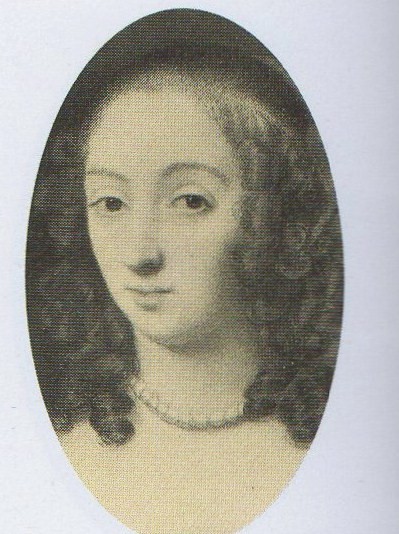
Elizabeth Bourchier
by Samuel Cooper

Even her date of birth is unclear.  Very little is actually known about the wife of Oliver Cromwell.  Her name was Elizabeth, and she was the daughter of Sir James Bourchier and Frances Crane.  Sir James was a successful London merchant in the fur and leather trades.  He was knighted in July of 1603 by James I and given a grant of arms in 1610.  Elizabeth was born in Felsted, Essex, apparently sometime in 1598, and was one of eleven children, possibly the oldest.  She is believed to have some education.  However, nothing is known of her childhood or girlhood.  For all intents and purposes, she came to life on August 22, 1620 when she married Oliver Cromwell.

There is no indication of when or how they met.  The Bourchiers and the Cromwells were both established in Essex.  There was also a family connection in that Elizabeth’s Aunt Eluzai Crane married Oliver’s Uncle Henry Cromwell.  While it seems likely that they may have met as children (being close to the same age, Oliver born April 25, 1599), it is equally possible that they met in London.  At any rate, they were married in London at St. Giles Cripplegate.  It is known that she had a dowry of 1500 pounds, but not whether their marriage was arranged or an affair of the heart.  The marriage was definitely an advantage for Cromwell, as his father-in-law’s connections in the London merchant community were politically valuable.  

Elizabeth and Oliver began their married life in Huntingdon and began having children.  However their marriage began, it appears that they developed a sincere affection for each other.  At some point later in the 1620’s, Oliver went through a period of depression and illness from which he emerged a devout  and radical Puritan. By 1628, he was Member of Parliament for Huntingdon, a position he held 1628-1629.  King Charles dissolved this Parliament and Parliament did not meet again for 11 years.

Unfortunately, the Cromwells were not successful in Huntingdon.  In 1631, Oliver ended up selling what property he had left in Huntingdon, and he and Elizabeth relocated to St. Ives. There, he rented a farm and supported his wife and children by farming, a significant reduction in status.  The farm produced chickens and sheep, generating eggs and wool which Oliver and his brother sold.  Being a small farmer’s wife cannot have been easy for Elizabeth, especially as the mother of six children (the oldest about ten). 

 This state of affairs lasted for five years, when in 1636 he inherited a house and other significant advantages (including a job as a tithe collector) in Ely from his mother’s brother. At this point, Oliver and Elizabeth had had seven children, five boys and two girls.  The youngest son, Robert, had been born and died in 1632.  Apparently, during this difficult period prior to the inheritance, no more children were born.  It is not known if there were unsuccessful pregnancies, or if there were other causes for the break in the births of children.  At any rate, Oliver and Elizabeth had two more children, both daughters in 1637 and 1638 respectively and, by the end of the 1630’s, the Cromwells had regained their position as gentry.

In 1640, the family was living in Ely.  King Charles called another Parliament and Oliver was returned to Parliament as the member for Cambridge, and the family moved to London.   This particular Parliament became known as the Short Parliament as it lasted only three weeks before the King dissolved it.  However, Parliament was called again later in the year, and Oliver was returned as member for Cambridge.  During this period, Oliver became linked to a group of members of the Houses of Lords and of Commons with a strong reform agenda.  There is no indication that Elizabeth took any sort of active role outside of the positions of wife and mother.  She was very concerned about domestic affairs, and was apparently known throughout her life for her frugality, which I would think had been hard-learned during her family’s years on the farm.

In 1642, the English Civil Wars began.  Oliver raised a troop, had success at Marston Moor, and the rest is history.  He rose to general of Parliament’s army, and seemed to have had an instinct for command despite his lack of military background.  During the war years, He wrote to Elizabeth and she to him.  Two of his letters and one of hers survive, and show their loving relationship and mutual affection.  

King Charles was captured, but would not compromise with the Parliamentarians.  King Charles escape led to the second Civil War, which resulted in his being recaptured, tried and convicted of treason.  King Charles was ultimately executed in 1649 by the Rump Parliament, an act for which Oliver bears significant responsibility (he was a dominant member of the Rump Parliament and signed the warrant).   After the execution, he led the Rump Parliament and exercised power over the short-lived Commonwealth.  Disillusioned with Parliament, he dismissed it April 20, 1653 and ultimately became Lord Protector December 16, 1653.

  As Cromwell rose in power, the family moved to different quarters, reflecting their changing status.  From lodgings adjoining Whitehall Palace, they moved into apartments in the Palace itself in the spring of 1654.  Elizabeth seems to have exercised great discretion, and stayed out of the limelight as much as possible.  There is no record that any member of her family received preferment, and comments about her simplicity and frugality as Lady Protectress would appear to indicate that she did not attempt to appear to shine in a court-like setting.   Personal taste for a simpler life and long habit could have been factors; she may also have wished to avoid any comparison to Charles I’s queen Henrietta Maria.  She did help entertain at state dinners and with the wives and daughters of various dignitaries, but apparently had no formalized role in the Protectorate.

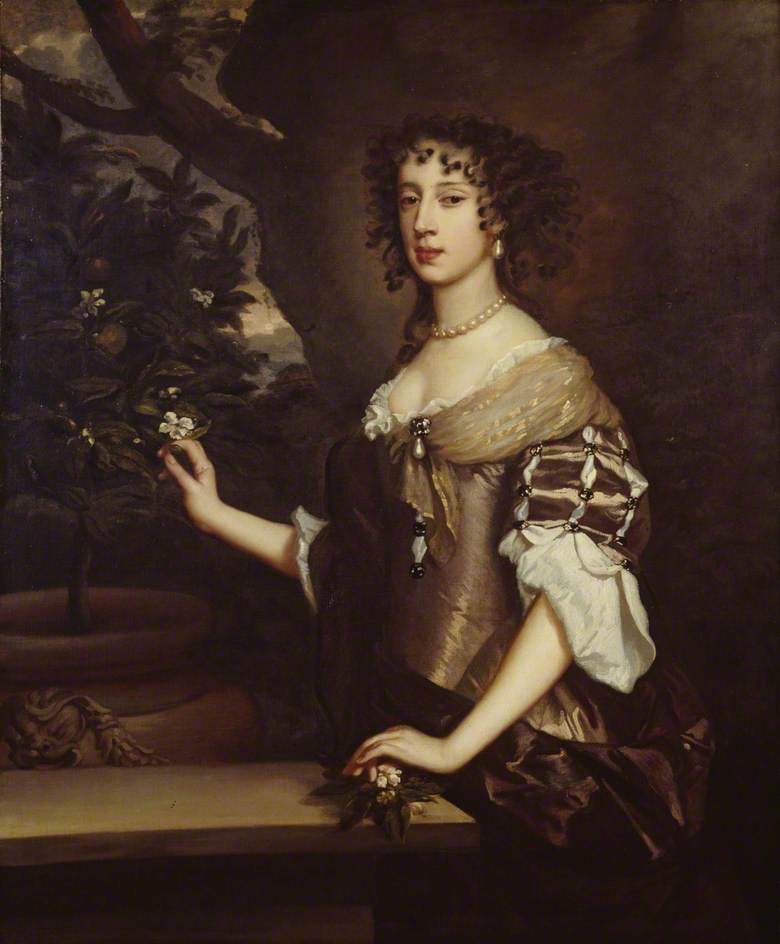
Elizabeth Bourchier Cromwell, 
Lady Protectress of England, Scotland and Ireland 
by Robert Walker, c. 1653

The portrait of Elizabeth as Lady Protectress shows her in a formal black velvet gown with orange lining, and pearls, looking very elegant.  Her important status is clearly shown.  (It must be remembered that black was a stylish colour at the time.)   However, to my mind, it also shows a certain discretion.  There is no diadem, crown or other elaborate ornament on her head, and her hands and wrists are not overloaded with jewels.  Although no longer a simple housewife, this portrait shows Elizabeth as a woman of wealth and rank but not necessarily royalty.  I believe it is an accurate reflection of her position in England at the time: the wife of a powerful, important man who was not a king, in its way a statement as much about her husband’s position as her own.

There was great sadness following the death of daughter Elizabeth Claypole in August of 1658, which exacerbated things.  Oliver died September 3, 1658 at the age of 59 in Whitehall. He apparently suffered from malaria and urinary tract problems. He was buried with great ceremony (based on the burial of James I) at Westminster Abbey.  His daughter had been buried in Westminster Abbey already.  There is no record of how this double blow affected Elizabeth or if she attended his funeral.  She was offered an annuity and lodging in St. James’ House, and son Richard took on the Protectorate.  However, the army refused to follow Richard and his protectorate fell in the spring of 1659.  The army did propose a generous pension for Elizabeth.
 
Charles II was invited to return as King.  In April of 1660, just before the Restoration, Elizabeth left London.  She was accused of stealing jewels and other possessions belonging to the crown, charges she vigorously denied.  Her whereabouts during this time are not known; however, it appears that her letter to Charles II denying the thefts was written from Wales.  She denied having taken part in Oliver’s regime and promised her obedience as Charles’ subject.   Elizabeth was allowed to take up residence with her widowed son-in-law John Claypole at Northborough Manor in Northamptonshire.

Being out of London meant Elizabeth missed the posthumous trial of her husband, the exhumation of his body (and those of others although daughter Elizabeth’s still remains in Westminster Abbey) and the “execution” which resulted in Oliver’s mummified remains being dragged to Typburn when they hung for the day of Charles I’s death.   Elizabeth lived with her son-in-law until her death.  Like so much else about Elizabeth Bourchier Cromell, the date of her death is not clear.  She supposedly died in November of 1665, and was buried in Northborough Church November 19, 1665.  However, there is an indication that this death date is a blind, put about protect Elizabeth, and an alternative date in October of 1672 is suggested.  There is a memorial tablet at St. Andrew’s Parish Church at Northborough that shows she died in 1665.  As with so many other details of her life, the correct date of her death may never be known.

Sources include:
Find A Grave.  “Elizabeth Bourchier Cromwell.”  http://www.findagrave.com/cgi-bin/fg.cgi?page=gr&GRid=44873970

Good Gentlewoman blog.  “Elizabeth Bourchier-Mrs. Oliver Cromwell” posted 6/9/2012. https://goodgentlewoman.wordpress.com/2012/06/09/elizabeth-bourchier-mrs-oliver-cromwell

The Cromwell Association website.  “Cromwell’s Family.”  (c) 2001-2005.  (No author or post date.)  http://www.olivercromwell.org/faqs6.htm .  The letters of Oliver and Elizabeth Cromwell mentioned in this post can also be found on the Cromwell Association site.

Westminster Abbey.  “Oliver Cromwell and Family.”  No author or post date.  http://www.westminster-abbey.org/our-history/people/oliver-cromwell

Wikipedia.  “Elizabeth Cromwell.”  Last modified 6/23/2015.  https://en.wikipedia.org/wiki/Elizabeth_Cromwell

THE SECRET LIVES OF ROYAL WOMEN True Stories of Queens and Princesses, from the Tudors to the Windsors.  Editors of BBC HISTORY Magazine.  “Elizabeth Cromwell’s Shadowy Queen” by Simon Guerrier.  PP. 82-85.   (c) Immediate Media Company Bristol Limited, 2015.

Elizabeth Bourchier image from Wikimedia Commons: https://upload.wikimedia.org/wikipedia/commons/5/55/Elizabeth_Bourchier.jpg

Elizabeth Bourchier Cromwell image from Wikimedia Commons: https://upload.wikimedia.org/wikipedia/commons/thumb/0/0d/Elizabeth_Cromwell%2C_Her_Highness_the_Protectoress.jpg/480px-Elizabeth_Cromwell%2C_Her_Highness_the_Protectoress.jpg


~~~~~~~~~~~

Lauren Gilbert has always been an avid reader of fiction and non-fiction with a particular interest in English literature and history.  She earned a BA in English Literature and is a member of the Jane Austen Society of North America.  Her first book, HEYERWOOD: A Novel was published in 2011.  Her second, A Rational Attachment, is expected to be released later in 2015.  She lives in Florida with her husband.  Visit her website at www.lauren-gilbert.com. 


Wednesday, March 25, 2015

Religious persecution and Glorious revolution

by Anna Belfrage

Louis XIV
In 1685, Louis XIV of France revoked the Edict of Nantes, thereby indirectly laying the foundation to what would become the so called Glorious Revolution in England.

“Eh, what?” I hear some of you say, brows rising as you consider just how the revocation of the Edict of Nantes could lead to the events that ousted England’s rightful king. Well, dear people, as so many events in the 17th century, it comes down to religion – or rather, to religion as a political instrument.

Louis XIV was, as we all know, French. King since childhood, he was a firm believer in the divine right of kings and in his own capacity to rule. He was equally determined to expand French interests and territories and therefore promoted an expansive – aggressive – foreign policy. Plus there was the ever present issue of religion, a hot potato that had temporarily been set on a back-burner by Henri IVs 1598 Edict whereby all Frenchmen were allowed to worship according to their own conscience.

Louis was no big fan of this tolerant approach to heretics. It irked him that there should be close to a million such heretics living in his France, a country that should in its entirety belong to the Holy Church. (Here dear Louis was being somewhat hypocritical, turning a blind eye to the fact that France, this oh so Catholic nation, had happily bankrolled the Swedish Protestant Army under Gustav II Adolf as it laid waste to the Holy Roman Empire during the Thirty Years' War. Bygones, he probably said, waving a perfumed handkerchief...)

To Louis, his Protestant subjects were a personal affront – they should take heed, listen to their King and convert. And when milder forms of coercion didn’t help, Louis launched the dragonnades in the early 1680’s whereby dragoons were forcibly billed with Protestant families, there to constantly persecute them and hound them until the poor people either converted or fled. Many of them fled, and the surrounding European nations saw a huge influx of Huguenot refugees.

And yet, Louis was not satisfied. Egged on by his pious wife, Madame de Maintenon, he took the drastic step of revoking the Edict of Nantes, thereby making it illegal to adhere to any other faith than the Catholic one. Over the coming months, France suffered a major brain drain as an entire generation of Protestant tradesmen, merchants, and skilled labourers left – no doubt to Louis’ personal joy. By early 1686, less than 2 000 Protestants remained in France.

James
For Protestants in the surrounding countries, Louis XIV’s measures just went to prove the point that Catholic rulers were dangerous, intolerant creatures. In countries such as England, the anti-papist sentiments that were a constant presence throughout the 17th century were further strengthened by the terrifying stories told by the Huguenot refugees. Unfortunately – at least in the eyes of some of the more bigoted Englishmen – the English king was a Catholic. Even worse, James II was Louis XIV’s cousin, and as we all know, blood will tell…

James is second from the left
James II didn’t begin his life as a Catholic. His father, Charles I, was raised an Anglican, remained an Anglican, and ensured his children were raised as Anglicans, no matter their Catholic mother, Henriette Marie of France. As we all know, Charles I hit the dust in 1649 – in his case almost in the literal sense, given that he was beheaded. At the time, James II was not quite sixteen, and he was to spend the coming decade in either the French or the Spanish army where he served with distinction - and came into contact with various men of Catholic faith.

Like his older brother, James had an eye for pretty women. In 1659 he seduced Anne Hyde by promising to marry her, and to his credit he followed through on his promise, even if no one expected a prince to do so. Sometime during his marriage to Anne, James and his wife converted to Catholicism, even if he kept this secret. His surviving daughters by Anne, however, were raised as Anglicans as ordered by their royal uncle, Charles II.

Mary of Modena
When the English Parliament introduced a new Test Act in 1673, it became impossible for James to keep his conversion a secret. The Test Act was one in a series of laws put in place to stop Catholics from holding higher office, either in government or the military, by requiring all such officers to take an oath by which they disavowed certain central tenets of Catholic faith, and also to take communion under Anglican rites. James refused to do so, stepping down from his post as Lord High Admiral. He didn’t exactly improve his popularity ratings when he then went on to marry Mary of Modena, a fifteen-year-old Catholic Italian princess.

Over the coming years, Parliament and King were locked in a constant power struggle, with Charles II adamantly refusing to sign anything that would potentially exclude his brother from the line of succession, the so called Exclusion Crisis. When tensions were at their highest, James was recommended to leave the country, which he did, spending a number of years in Scotland.

In 1685, Charles II died – and a pretty awful death it was. On his deathbed, he converted to Catholicism, allowing himself the privilege to die professing the faith he must have held to in secret for years. With no legitimate heirs of his body, Charles was succeeded by James, and the powers that were in England were not pleased – at all.

It was unfortunate that in this self-same year Louis XIV upped the persecution of the Huguenots by revoking the Edict. It was also unfortunate that James II lacked that streak of pragmatism that had always guided his older brother. Had James but taken the time to stop and think he would have realised that for a newly crowned Catholic king in a country so mistrustful of Catholics, it made sense to take things slow. Instead, the man immediately set off on his own personal crusade to revoke all legislation that made it impossible for Catholics to hold office. Not, to put it mildly, a popular move.

James II
At the time, James was accused of wanting to return England in its entirety to the Catholic Church. These days, historians agree that James’ purpose was to create a more tolerant approach to his co-religionists. They also agree that James was somewhat inept – call it heavy-handed – in his attempts, thereby alienating former supporters. Whatever the case, while Parliament may have grumbled and Protestant Peers protested, there were never any plans to depose James. Deposing kings was simply not done, and the English public did not want a repeat on the royal execution not quite forty years ago.

So, what have we here? On the one side, a disgruntled English populace, angry with their king for promoting his Catholic friends, even angrier when he initiated a massive conversion campaign. On the other, a bewildered monarch, who didn't understand why everyone misinterpreted him so. (A simplification, of course. And I haven’t even touched upon James’ attempts at fiscal reform, but seeing as most people find taxes boring, let’s not go there…)

On the other side of the Channel, Louis XIV was more than thrilled to see his Catholic cousin on the English throne, while further north William III and his wife Mary, James’ oldest daughter, bided their time. Unless James had a son, the English crown would revert to their staunchly Protestant hands upon his death. The probability of James ever having a son was deemed as low. So far, Mary of Modena and James had been singularly unfortunate when it came to children. She’d been pregnant close to ten times, but as yet there was not one surviving child. And yes, I do feel this is a good moment to feel sorry for poor Mary – and her husband.

It was indicative of how out of touch James was with his people that throughout 1686 he tried very hard to influence the Anglican faction into accepting his more lenient approach to Catholics. England was a hotbed of anti-papist emotions, nurtured over several decades, first by the Parliamentarian forces, then by the Restoration government and their anti-Catholic legislation. Well, if we’re going to be quite correct, the anti-papist sentiments went back further than that, to the reign of Elizabeth I and onwards. No, in England of the 17th century a good Catholic was a dead Catholic – or at least a Catholic who had the sense to stay well away from the green fields of fair England.

In 1687, a frustrated James decided he needed new allies to pursue his political ambitions, and so he started flirting with the Protestant Dissenters so as to undermine the Anglican Church. To win their support, in April of 1687 he announced a Declaration of Indulgence whereby all penal laws and the Test and Corporation Acts were suspended. Suddenly, religious freedom raised its head in England. Suddenly, one could openly be a Quaker, or a Baptist, or a Presbyterian – hang on, even a Presbyterian? Hmm. James was no major fan of the Scottish Kirk, but yes, they were also included, albeit after some pressure – or a Catholic. We rarely give James II the credit he deserves for this attempt at creating a society where people could worship as they pleased. Was it self-serving? Of course it was, but for the thousands upon thousands that had been oppressed by the Anglican Church, the Declaration of Indulgence provided quite a breath of fresh air.

William 
This innovative piece of legislation was not greeted with spontaneous outbursts of joy. Most people were sceptical of the King’s motives, and besides, there was a bigger concern. The Queen was pregnant, and should she be delivered of a healthy boy child, England would face a succession of Catholic kings. The Protestant nobility gulped. Combining a potentially healthy baby boy with the King’s recent legislation would, over time, erode their power base. No, this needed to be stopped before it went too far, and where else to go for support than to William of Orange in the United Provinces? After all, should the Queen be delivered of a boy child that would not be good for William’s aspirations.

It was a boy. Delirious with joy, James wanted to embrace the entire world. A son, he had a son, and even the cruel stories whereby it was insinuated that the boy was a changeling, smuggled into the royal apartments in a warming pan, could not quench his joy – even if it must have hurt that his elder daughters were implicated in this gossip-mongering. James Frances Edward Stuart was born on June 10th of 1688 – less than six months later, the baby would begin his lifelong exile.

On June 30th, seven protestant grandees sent a letter to William III, inviting him to invade – not to depose James, but to curb his policies. All the same, the letter signed by Edward Russel, the earls of Shrewsbury, Devonshire and Danby, Bishop Compton, Lord Lumley and Henry Sidney cannot be described as anything but high treason. However, the large majority of the political establishment in England did not support this move. Yes, they wanted to restrain James, but far too many had far too recent memories of the consequences of plunging England into a civil war to risk taking up arms against their king.

This is where we have to return to Louis XIV and his revocation of the Edict of Nantes, this in an attempt to understand William’s motivations in invading England. If we’re going to be honest, no one does know the man’s motivations – William was a man who mostly kept his own counsel. One thing that is very apparent, however, is that William’s lifelong ambition was to halt France’s expansion, especially into his own territories. He found little support at home for his bellicose activities – the Dutch states depended on trade with France and saw no reason to antagonise this huge market, no matter that it was nibbling at the borders of the United Provinces.

Spain was no help at all, the Holy Roman Empire had its hands full with the Turks, and William all on his own was no match for Louis XIV. However, should one combine England with the United Provinces, well then…Whatever the case, as long as the pacifists remained in power in the United Provinces, William was without the funds required to do more than gnash his teeth when the French took Strasbourg (1681) and Luxembourg (1684) And then came the revocation.

Horrified Dutch Protestants opened their homes to the refugees from Louis XIV’s France. They listened, aghast, to stories of bloodshed, to being forced to leave all their wealth behind (with which the wealthy Dutch traders could more than relate), to being beaten and whipped, murdered even, by angry Catholic mobs. Which is when William coughed and said “ahem”. Now he was given funds – plenty of funds. Even more fortuitously, the Holy Roman Emperor beat off the Turks and was more than happy to join the coalition against France. Only England, ruled by Louis XIVs cousin, remained loyal to France. The invitation from the seven grandees therefore came at an opportune time. By invading, William hoped to strong-arm his father-in-law into supporting his efforts to contain France. Whether his initial ambitions extended beyond that, we don't know.

William landed in Torbay on November 5, 1688. William was hailed as a liberator. James dithered, uncertain as to what to do – William was family, and James was more than aware of how much his eldest daughter loved her husband. Besides, he was unnerved by the last year’s outbreak of violent anti-Catholic riots throughout the north of England, and he definitely did not want to be the one who started a new Civil War – he was as beset by spectres as his peers.

On November 23, James took the decision to retire to London rather than meet William on the field. A capable military leader, an experienced battle commander, James could probably have held his own – and his was the larger force. So why did he retreat? Why did he attempt to flee to France rather than defend his crown? We will never know – but chances are that had he stayed and fought, he would have carried the day, thereby rewriting history as we know it. But then, history is full of ‘what if’s’, isn’t it?

Mary II
Captured by William's troops in December of 1688 while making for France, James then managed to escape - and one suspects he was allowed to escape - and fled to his powerful French cousin. In 1689, William and Mary were confirmed by Parliament as the new King and Queen.

James made one serious attempt to regain his throne that ended at the Battle of the Boyne in 1690. His son would go on to make his own attempts, as would his son, the famous Bonnie Prince Charlie who for a short while in 1745-46 actually seemed to be carrying the day. Until the disaster at Culloden, that is.

These days, James II is often considered a parenthesis, a king who is remembered mainly because he lost it all. I do believe the man deserves a somewhat grander epitaph than that, however ineptly he handled the single most momentous event in his life. James Stuart was a loyal son, a loyal brother. He was brave and honourable, served his country as well as he could and was allowed to. He was a loving father – doting, even – a caring husband and a man who stood by his friends and his word. He was also a Catholic, and somehow the matter of his faith overshadows all his qualities. After all, it is because of his faith and his pig-headed efforts to make life easier for his co-religionists that he lost his throne. A high price to pay for his faith, although personally I think James considered his daughter’s betrayal and defection the far heavier price. The lesser me must admit to hoping Mary suffered endless sleepless nights as a consequence, but on the other hand, her life was not exactly a bed of roses either, and who are we to sit in the comfort of hindsight and judge those that went before?

The events of 1688 and 1689 play an important role in the recently released To Catch a Falling Star, the eighth book in The Graham Saga.

~~~~~~~~~~~~~


Anna Belfrage is the successful author of seven published books, all of them part of The Graham Saga. Set in 17th century Scotland, Virginia and Maryland, this is the story of Matthew Graham and his wife, Alex Lind - two people who should never have met, not when she was born three centuries after him.

Anna's books have won several awards and are available on Amazon US,  Amazon UK, or wherever else good books are sold.
For more information about Anna and her books, please visit her website. If not on her website, Anna can mostly be found on her blog.

Sunday, October 13, 2013

How to Send a King Mad...and Steal his Crown at the Same Time

by P. L. Farrar


One of the best things about history is that we can always learn something from it. In this instance, we learn that it is in fact possible to drive someone crazy.

Whilst everyone remembers George III as being the Mad King there has been more than one mad king in English history. In this case James II, one of the unfortunate Stuart kings. Except he didn't have a rare blood disease. He was driven to madness.

From the early days of his reign in 1685, it had been felt that James II was attempting to return England to Catholicism, a thought which frightened the fiercely Protestant Parliament and a large proportion of the English nation. When his wife, Mary of Modena, gave birth to a son, James Francis Edward Stuart, on 10th June 1688, that threat of Catholicism seemed even greater.

So, naturally Parliament did what any self-respecting Parliament would do in this position. They (or more specifically the Immortal Seven) invited William of Orange -- husband to James' Protestant daughter, Mary -- to come and save them, claiming that the people were 'desirous of a change' and would 'willingly contribute to it, if they had such protection to countenance their rising, as would secure them from being destroyed.'

How could William possibly refuse? A fellow Protestant country needed his help. Not only was he being offered his own kingdom, but it would also give him the means to stand up to Louis XIV. Two birds, one stone.  Ideal!

Quite frankly James' attempts to keep his kingdom were not the most effective. He attempted to call Parliament -- he was not exactly in their good books -- sent his wife and son over to France to get foreign help and threw the royal seal into the Thames, because there was no way that they would be able to make another one. 

James was already losing the plot, but really William pushed him that little bit further. 

William defied all expectations by sailing in the autumn. (It just wasn't invading season, old sport.) He landed in Torbay, Devon, on 5th November 1688 and proceeded to Exeter with his forces. He stayed in the city for three weeks as he tried to gauge local opinion. Both William's army and James' army then went to meet on Salisbury Plain where no doubt the deciding battle would occur!


There was just one slight hiccup.... James abandoned his troops before they even reached the battlefield and scarpered back to London. Whereupon, all the officers from his army went to join William.

James then tried to flee the country, but he was caught in Kent, because a local fisherman recognized his face from the coin. Oops.

James was imprisoned in Rochester Castle after his foiled escape (his first cousin five times removed, Louis XVI, suffered the same fate during the French Revolution when he was also recognized from a coin). And William, just to make certain that he stayed put, positioned Dutch guards outside the king's quarters.

None of them spoke English and so all James heard was these men jabbering in Dutch -- which he didn't understand. His obvious conclusion was that he was surrounded by devils and that he had gone mad. This was probably not William's intention. It is most likely that he wanted his father-in-law guarded by men he trusted who would not be open to bribery from the king. 

The final difficulty for William was deciding what to do with his father-in-law.  If he remained in England, he and his supporters would remain a threat. The most important thing was to avoid executing him like his father, Charles I, which would have erupted into another Civil War. William realized that he needed to make it seem as if James had abandoned the country and left the throne vacant.

Now, the one thing that James wanted more than anything was to escape, so if a boat happened to be waiting to take him across the Channel then he would surely take it. Such a boat was found on 23rd December 1688 and he was allowed to escape without his guards making any attempt to stop him.

It is debated by historians as to whether William planted the convenient boat there or not or whether James' followers did, but either way James was able to slip away to France. 

This left William able to consolidate his position as joint monarch with his wife. 

Whether or not James was already slightly mad is debatable. He certainly had little grasp on reality and believed that his people would welcome a conversion back to Catholicism. Really William's actions were just the tip of the iceberg that resulted in James' believing he had gone mad. 

James II never saw England again and after an attempt to regain his throne with Louis XIV's help, and coming face to face with William III when they fought each other at the Battle of the Boyne in 1690, James returned to France where he spent the remainder of his life living off the charity of his cousin the Sun King.

As for England, William took it forward to the future, creating a compromise of power between Crown and Parliament through the Bill of Rights 1689, the Triennial Act 1694 and the Act of Settlement 1701, many of the articles of which are still in effect today.

~~~~~~~~~~~~
P.L. Farrar is a young writer, working on an historical novel set in early 19th century England, and currently studying the history of the Tudor and Stuart monarchs.


Tuesday, April 2, 2013

Babies, warming pans, and wars.

by Tim Vicary


This is the story of a baby who wasn't born at all - or at least, not when his mother said he was. (And she wasn't his mother anyway, so what did she know?) That, amazingly, seems to have been the view of many people in England at the time - perhaps the majority view.

Or to put it another way, it's the story of sixty people - adult men and women - many of whom refused to believe their own eyes.

And so, to prove that this baby hadn't been born - even though it had happened right in front of their own eyes - they raised an army, invaded a country, and deposed a king.
King James II
So what was it all about? 

Well, here's the story. In 1685, Charles II died, and his brother James became king. Unfortunately, King James II was a Roman Catholic.  This made him hugely unpopular with most of the English ruling class, who hated and feared Catholicism -  just as many people fear Islam today - so the idea of a Catholic king was anathema to them. 

In Charles II's reign, there had been a determined attempt to exclude his brother James from the succession. As soon as James was crowned his Protestant nephew, the Duke of Monmouth, led a rebellion against him.

When Monmouth was executed, James seemed secure. His opponents consoled themselves with the thought that James' heirs - his two daughters, Mary and Anne - were both loyal Anglicans with staunch Protestant husbands. So all they had to do was wait a few years for James to die and everything would be all right again.

Mary of Modena
But then - oh dear - James' second wife, Mary of Modena, became pregnant. At first this wasn't too much of a worry because Mary was well into her forties and had suffered a number of miscarriages and still-births already. 

But while her husband proceeded with his plans to reintroduce Catholic officers to his army and Catholic clergy into the universities, the baby in Mary's womb grew steadily bigger. The bigger her belly, the more the public worried. What if she gave birth to a Catholic prince? That would change everything. In their minds people saw a long line of Catholic kings stretching into the future.

Some of their fears were real, others imaginary. The real fears were that England could be plunged into religious war, like those which had convulsed Europe for the past century. Millions on both sides had been massacred. The English Civil War had been partly about religion. And just over the Channel, French Protestants - Huguenots - were being forcibly converted, imprisoned and tortured by the agents of King Louis XIV. Many fled to England with genuine tales of terror.

But there were imaginary terrors too. The reign of Charles II had been disfigured by fantasists like Titus Oates, whose lies about non-existent Catholic plots had sent many innocent men to the scaffold. Many believed the Great Fire of London, even the Plague, were spread by Catholics. To the London mob, Catholics were monsters, like Jews in Nazi Germany.

And here was the Queen about to give birth to one! It was such an awful thought that many people refused to believe it.  After all, the last Catholic queen - Bloody Mary - had claimed she was pregnant too. And it had all turned out to be a fantasy, a dropsy, a joke. Surely this would be the same.

Plans were laid to ensure that 'unbiased' witnesses - respectable Protestants - would be on hand to witness the birth. The Archbishop of Canterbury, for instance, and King James' second daughter, Princess Anne.

Ambulance
But the Queen went into labour a month early, while Princess Anne was still in Bath, taking the waters. On the evening of 9th June 1688, Queen Mary was playing cards in Whitehall until midnight. Then, as her labour started, an ambulance (a sedan chair!) was hurriedly called to carry her to St James' Palace and messengers were sent running hither and thither to summon help and witnesses. Lots of them. A really enormous number of people.

Poor lady - she gave birth in front of no less than sixty people!!

She had two midwives, Mrs De Labadie and Mrs Wilkins, who each received 500 guineas. There were doctors too, and priests, and Lords of the Privy Council, and Ladies of the Bedchamber. Presumably the King was there too (a new man!) and a few servants to light the fire and change the sheets. If it had been possible to invite a TV crew they would have done that too, no doubt.

Or perhaps not. Because even though the Queen gave birth in as public a way as it is possible to imagine, many people still refused to believe it. Princess Anne said it must be a conspiracy to pretend the birth had come early while she was in Bath and couldn't witness it. The Archbishop of Canterbury had been arrested the day before (about something quite different) so he wasn't present either. And the royal obstetrician, Dr Hugh Chamberlen, missed the birth too because no-one could find him - he was attending another birth in Chatham.

Weapon of mass deception
So there you are, people cried. It's obviously not true - it's a conspiracy, a fraud! (Dan Brown would have had a field day.) Gilbert Burnet, a prominent churchman, said the Queen had deliberately sent Dr Chamberlen away so that she could deceive everyone by smuggling in a changeling. 

And why were so many of the witnesses Catholics? Why hadn't the King invited the Dutch ambassador, for instance? No, only a fool would believe the Queen had actually given birth as she claimed. The baby wasn't hers at all.  They'd smuggled one into the bed in a warming pan.

Dr Burnet, who was in Holland at the time, was quite certain of this.

And so the evidence of sixty eye-witnesses counted for nothing. Not even the evidence of the vociferously Protestant midwife, Mrs Wilkins, who surely ought to know what had happened if anyone did. She protested to Dr Chamberlen:  'Alas, will they not let the poor infant alone! I am certain no such thing as the bringing of a strange child in a warming-pan could be practised without my seeing it; attending constantly in and about all the avenues of the chamber.'

Crazy, isn't it? People just believed what they wanted to believe. Nothing like that could happen today, surely? We're far more rational now. Ah, but bear with me. Here's a thought. Far-fetched, I admit, but still ...

Ten years ago, British and American soldiers invaded Iraq. (I told you my idea was far-fetched - a giant leap across centuries!) Why? Because Saddam Hussein had weapons of mass destruction. Almost everyone believed that; even the protesters. I certainly believed it, and so did George Bush and Tony Blair.  I don't think they lied; they deceived themselves. They believed what they wanted to believe, because they were afraid of another, bigger 9/11.

Oh dear, I'm in seriously hot water now. Let's jump swiftly back to 1688. What happened as a result of this earlier bout of mass self-deception, this refusal to believe a baby prince had been born? Well, a large force gathered in Holland, sailed across the Channel and landed in Torbay, England. King James II fled, and was replaced, at Parliament's invitation, by his daughter, Mary, and her husband, William of Orange--the throne, with strings attached. This was the Glorious Revolution of 1688-1689.
James III - 

So there you have it: the invasion of a foreign country, regime change, and a change in the balance of power between monarch and Parliament. Coincidence, or what? All because of a bout of self-deception.

Amazing what a warming pan can do. Especially when it wasn't there at all.

**********

You read about Tim Vicary's books on his website and his blog