Showing posts with label Buried Treasure. Show all posts

Wednesday, June 25, 2014

English Treasure on Gotland

Gotland coat of arms; sheep, called on Gotland
"lamm"have always been important to the local economy
By Marmelad and Leonid 2 / Wikimedia Commons
And Irish treasure And Frankish treasure. And German treasure. And Arabic – most especially Arabic.

More than 700 purposefully assembled collections, or hoards, of silver treasure have been found on the Baltic island of Gotland, most deposited in the ground for safe keeping during the Viking age (9th through mid-11th centuries).

A few of these hoards are of unequalled size, including the largest ever found. The Spillings Hoard, unearthed by a farmer in his field in north-eastern Gotland in July 1999, contains more than 14,300 silver coins, and much silver jewellery: hundreds of armlets, and numerous finger rings, as well as silver ingots, coils of rolled silver, and hack-silver, pieces of broken jewellery and cut-up coinage.

The Spillings Hoard was buried under the floorboards of a farmhouse about 881 CE, as the latest coin is dated to then. The house quite possibly was that belonging to a metalsmith - always a prosperous member of society in medieval times - judging by the other metal remains found on site. The earliest coins in the hoard are 6th c Sasanian. The vast majority of the coins are Arabic dirhams, not brought to the island as plunder but rather through the extensive trade around the Baltic basin that connected Gotland with the Silk Road and its fabled riches of silk, furs, and spices. The area where the Spillings Hoard was found abounded in well-to-do savers; a hoard was found in the same field in 1883 and numbered 5,922 coins.

Part of the Spellings Hoard, found inside a copper barrel by a farmer and
weighing 67 kg of silver (almost 148 pounds) and 20 kg (40 pounds) of bronze objects
Photo by Wolfgang Sauber / Wikimedia Commons

Gotland is an island 109 miles long and 32 miles wide in the Baltic sea, and today is home to some 58,000 residents. An independent nation until captured by the Danish King Valdemar Atterdag in 1361, Gotland did not become part of Sweden until 1645.

Map of Gotland
Created by Oona Räisänen / Wikimedia Commons

The walled capital city of Visby, on the eastern coast, grew immensely rich in the later middle ages as part of the Hanseatic League, leaving it and all of Gotland dotted with impressive medieval buildings, including the 94 parish churches it is justly famed for.
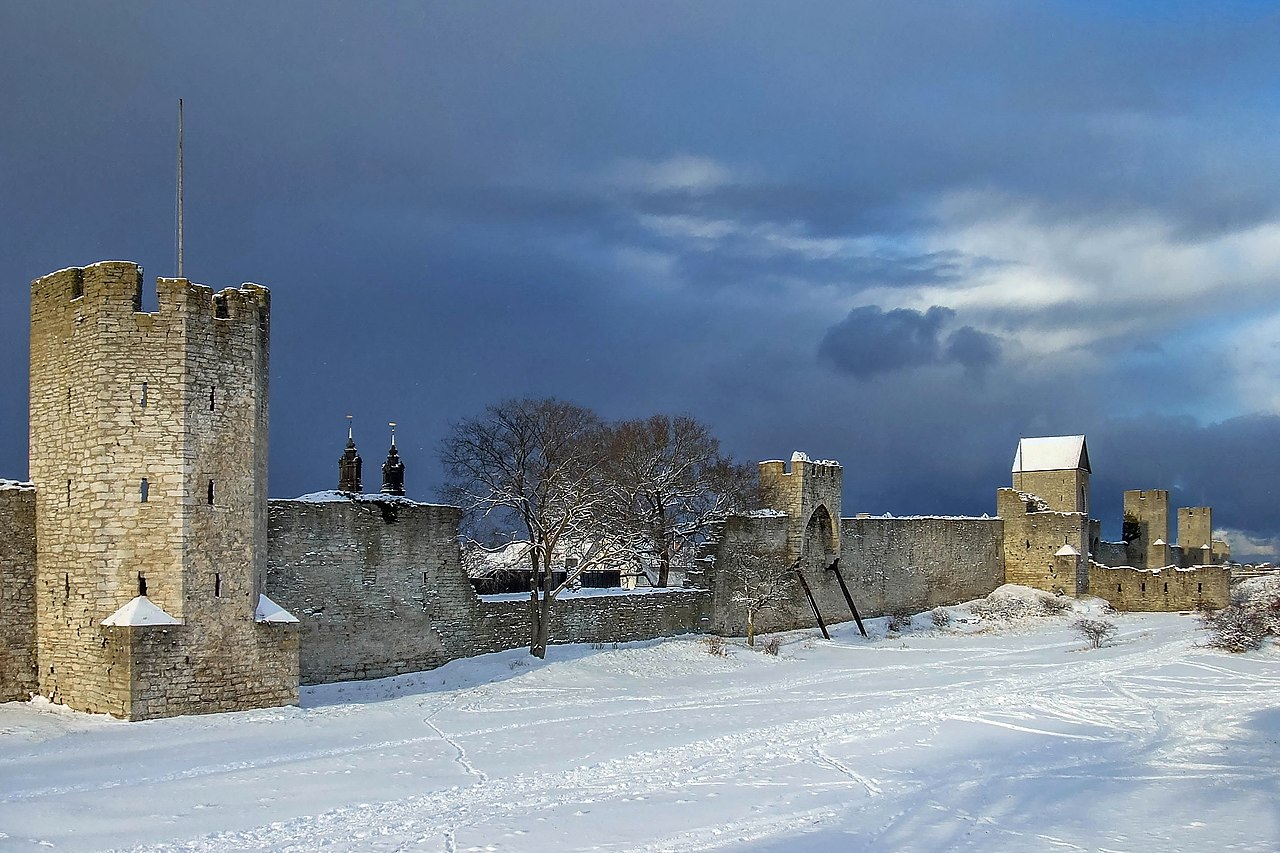
Visby, an UNESCO World Heritage designated site
Photo by En-cas-de-soleil / Wikimedia Commons

It is a place of exceptional beauty, its extensive coast and many inlets dotted with rauk – wind- and water-swept limestone rock formations - and blessed with the sunniest location of all Sweden. The name “Gotland” – Gutland in Gutnish, the original language of the settlers, is “Goth-land”, land of the Goths. Although the official language politically is Swedish, Gutnish is still spoken amongst some residents, although sadly barely survives in written form. Swedish friends living and studying on Gotland tell me that when they overhear Gutnish it is unintelligible to them, so distinct a language it is.


Raukar, weathered limestone towers
Photo by Allen Watkin / Wikimedia Commons
Nearly 200,000 old coins have been found on Gotland, including more late Anglo-Saxon coins than have been found in Britain itself. Yes: more late Anglo-Saxon coins have been found on this small distant island than in England itself. Many of these English coins were almost certainly plunder, and from the payment of thousands of pounds of danegeld (the payments paid by Anglo-Saxon rulers to stave off the predations of the Vikings). But the Gotlanders themselves were not “Vikings” – they were prosperous and peaceful farmers and traders, highly independent, pragmatic, and successful. Gotland’s location in the Baltic Sea made it perfect for trading runs across to the eastern and southern shores, where tribes such as the Polanie, Pomerani, and Prus ran Summer trading posts. These connected to trade routes heading further East deep into Russia, South to present day Iraq and Uzbekistan, and West to the great trading towns of the Svear (Swedes) such as Birka, and Aros (Aarhus) of the Danes.

The Spillings Hoard, along with much more treasure and examples of Gotland’s famed standing memorial stones, are on view in Visby at the Gotlands Museum. An excellent book is available on the Hoard: The Spillings Hoard: Gotland’s Role in Viking Age World Trade, Visby, Gotlands Museum, 2009

We'll return to Gotland in a later post; the island is too rich in interest not to.

~~~~~~~~~~~~

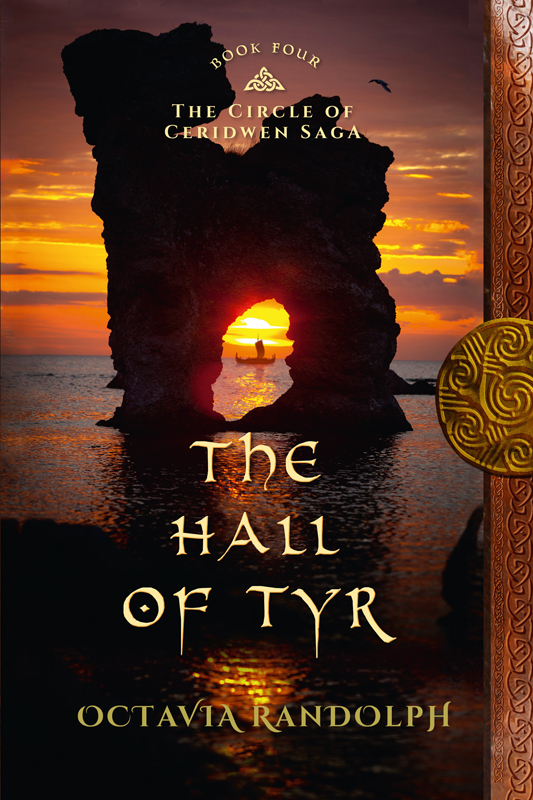
The Hall of Tyr, Book Four of the Circle of Ceridwen Saga, is set on Gotland at the same time the Spillings Hoard was buried. The Hall of Tyr debuted last week on the Amazon.com Top Ten in Women's Adventure. Available now at Amazon.com and Amazon.co.uk.  Octavia Randolph.

Book Four
Book Two
Book Three


Book One

Sunday, February 16, 2014

The Story of Pepys's Buried Treasure

by Deborah Swift

What did you do with your money in the 17th century if you thought looters might be after it? There were no banks of course, so the answer was - to bury it.

After the battle of the Medway in which the Dutch sailed boldly up the Thames and captured the English flagship, the 'Royall Charles', there was a widespread fear amongst Londoners that the Dutch would then take the city. Samuel Pepys, who was (to say the least) careful with his money, became panic-stricken that the Dutch would take his gold, but could not leave the city himself as he was in charge of the Navy treasury. He also feared that the Navy Office might be blamed for this disaster, and that angry Englishmen, let alone the Dutch, might besiege the offices and his house adjoining them.

By the time the news arrived that a second Dutch fleet were on their way, and worse, that English ships were being sunk to prevent the enemy coming further up the Thames, Pepys was desperate. He was determined to save his hard-earned wealth, so he dispatched his father and his wife Elizabeth to the family home in the country. Elizabeth and Mr Pepys senior left London by coach, the gold in bags under the seats, with the orders that they should bury it ringing in their ears.

Brampton House

They chose the vegetable garden at the family home in Brampton, probably in great haste because they feared servants might see them doing it, and they did not want to risk anyone else knowing where it was.

The gold stayed were it was, and in the end the invasion was just a scare, and the Dutch retreated. So a few months later Pepys went back for his treasure. Impatient to see if it was all there, he would not wait until morning but went out by lantern-light to look for it. If you've ever tried digging up something you've hidden, you will know that once the ground has been flattened by rain and weather, it is not easy to remember where the exact spot is. So of course they could not find it:

'But, Lord! what a tosse I was for some time in, that they could not justly tell where it was; that I begun heartily to sweat, and be angry, that they should not agree better upon the place' says Pepys.

Pepys of course blamed Elizabeth, first for not being able to find it, but then when he did, for not burying it deeply enough. Poor woman, she just could not win! 

'But, good God! to see how sillily they did it, not half a foot under ground, and in the sight of the world from a hundred places, if any body by accident were near hand, and within sight of a neighbour's window, and their hearing also, being close by: only my father says that he saw them all gone to church before he begun the work, when he laid the money, but that do not excuse it to me.'

The cloth bags had rotted so that they had to scrabble in the dirt for the individual coins. With the help of Will Hewer they managed to unearth most of it. At which point Pepys would not go to bed until they had sieved and washed every last coin and note.

11th October 
'And then rose and called W. Hewer, and he and I, with pails and a sieve, did lock ourselves into the garden, and there gather all the earth about the place into pails, and then sift those pails in one of the summer-houses, just as they do for dyamonds in other parts of the world; and there, to our great content, did with much trouble by nine o'clock (and by the time we emptied several pails and could not find one), we did make the last night's forty-five up seventy-nine:'

So Pepys did get his gold back after all.

An interesting footnote to the story is that in 1842, when an old wall was removed at Brampton, a hoard of silver coins was discovered, and taken to the Earl of Sandwich, the owner of the house. The iron pot was corroded and fell apart, but the coins were preserved. They were Elizabethan half-crowns and coins of James and Charles I, of the right date to be part of Pepys's treasure. Although Pepys only mentions gold in his diary, such a coincidence is unlikely, and it is probable Elizabeth buried some other silver coins too.

Seventeenth century tokens from Pepys's Small Change

If you have an interest in the sort of coins and tokens used by Pepys, or seventeenth century money and trade, then you will find the following website absolutely fascinating: Pepys's Small Change


Sources: Pepys's Diary Online
You might also enjoy this novel - The Journal of Mrs Pepys - Sara George

All three of my novels are set in the Seventeenth Century, and I rely on Pepys's Diary for his wealth of detail, and his fascinating insights into seventeenth century life.


'The past comes alive through impeccable research, layers of intriguing plotline, and the sheer power of descriptive prose.Add to all this Swift’s rich characterisation and subtle evocation of a period of religious upheaval and you have a classy, compelling adventure story and a true journey of discovery.' Lancashire Evening Post