Saturday, October 25, 2014

A Humble Vicar, and the Discovery of 'Aspirin'

by Mike Rendell

Next time you reach for a bottle of aspirin to treat your headache, or back pain or rheumatic fever – let’s just call it “an ague” – spare a thought for good old Edward Stone, a vicar who lived at Chipping Norton. One day in around 1757 he was walking across the meadow near his home. Willow trees were thriving in the damp boggy conditions and he idly stripped off a piece of the willow bark (as one does) and chewed it. Now, willow bark is extremely bitter – and the good Reverend immediately remembered another very bitter bark – one brought back from South America and known at the time as Jesuit’s Powder or Peruvian Bark. It was known for its beneficial qualities – because it contained quinine.

jesuits bark

My ancestor Richard Hall used Jesuit’s  Bark as a cure for wind or flatulence, and I still have books and books of his medical recipes (or 'receipts' as he called them). Richard would have appreciated the laterally-thinking Reverend Stone.

Stone surmised that the bitter willow might have similar qualities to Jesuit’s bark. He carried out an experiment by gathering a pound of common white willow bark. He dried it by hanging it in a bag over a bread oven for three months and then pulverised it with a pestle and mortar to create a dry powder. He then split it up into small doses and administered it to around fifty ague-ridden parishioners (amazing to think how many gullible people must have been living in Chipping Norton at the time – “Trust me, I’m a vicar, now swallow this bitter pill”). Every one of the victims/patients noticed an improvement, or as the vicar himself said, the pills “were a powerful astringent and very efficacious in curing agues and intermittent disorders.”

Stone conducted a series of clinical trials to ascertain the most efficacious dose. As he was later to write:

“Being an entire stranger to its nature I gave it in very small quantities, I think it was about twenty grains of the powder at a dose, and repeated it every four hours ….Not perceiving the least ill consequences I grew bolder with it and in a few days increased the dose to two scruples, and the ague was soon removed.”


My ancestor Richard Hall’s explanation of apothecaries’ measures – a scruple being the equivalent of twenty grains ( originally a twenty-fourth part of one ounce).

Stone administered the powder “with any common vehicle such as tea, water or small beer” and noted the time taken for the patient to improve. In fact he had discovered salicylic acid, the active ingredient in aspirin. On 25th April 1763 he wrote a letter to Lord Macclesfield, the President of the Royal Society, outlining his researches of the previous six years, and giving details of the findings.

Stone's letter, published courtesy of the Royal Society

Stone’s letter, published courtesy of the Royal Society. In it he was
mistakenly referred to as ‘Edmund’ but his name was ‘Edward’.

It was to be another ninety years before a more digestible compound
of acetyl chloride and sodium salicylate was developed. It was later
marketed by Beyer under the name of Aspirin. (The name "Aspirin"
was finally trade-marked at the end of January 1899). But it was Stone who did the initial scientific research and who ironically
"re-discovered" the use of the willow. These had been known to the
ancient Greeks - Pliny and Hippocrates had both extolled its virtues
as a pain-killer some 2000 years earlier, but it had then disappeared
from view. Stone's scientific approach kick-startede more research -
not bad going for a vicar with no medical or scientific training.


Stone died aged 66 in 1768 and the blue plaque recording his
achievement was put up near where he lived in Chipping Norton some
ten years ago. Now, where can I find a headstone for an Ed Stone…

~~~~~~~~~~~~~

Mike is the author of a book about his
ancestor Richard Hall called The Journal
of a Georgian Gentleman
and is currently
working on a book about the loose morals
of the Georgian era, due to be published
next year under the title Sex, Scandal and
Satire - in bed with the Georgians
.

The Handfast Ceremony - Then and Now

by Octavia Randolph

Bound in love. www.forevertogetherseattle.com

OVER the years I have received several requests from readers seeking advice in planning their upcoming handfasting - that is, wedding. Seeing as though Love and mutual attraction continues - thankfully- to exert its pull upon humans, I thought perhaps it was appropriate to build upon my responses to these initial requests and present some information in a more formal way, in the hope that it may serve as an inspiration for those so inclined to celebrate their union in this manner.

It must be stated at the onset that very little is reliably known of the heathen handfast. Few historians whose reports have come down to us saw fit to record these occasions, and if others did their records do not survive. The Christian clerics Bede, Asser (biographer of King Ælfred), and Nennius did not deign to cover this topic and what we can glean comes from Anglo-Saxon law codes, wills, poetry, and incidental writings by Roman historians observing the continental Saxon tribes. Although in my novel The Circle of Ceridwen two handfastings take place, these ceremonies are what I term well-reasoned imaginings or reconstructions of what the old Anglo-Saxon and Norse handfastings might have been, based on the scant historical documentation left to us. So this essay will begin by touching upon the reliable, historical, attested information that has come down to us - a truly skeletal tree - and then branch out into ways in which the twenty-first century couple can through their imaginations clothe these barren boughs with vivid and fresh new greenery.

Prince William weds the lovely Kate Middleton.
The cope about their wrists is a reminder of the "making fast of hands".
BBC image

Let's look first at the word handfast, a word quite similar to the Old English original and related to the Old Norse handfesta, "to strike a bargain by joining hands". One of the early English meanings is "a contract, specifically a betrothal or marriage contract." At times this referred to a trial marriage, or to the betrothal period, but the term was also used to distinguish a marriage not blessed by the Church - a heathen marriage, legal just the same.

What were the elements of these early handfasting ceremonies? Certainly the clasping or binding together of hands, and exchange of some sort of vows. Such ceremonies were honoured whether witnessed or not; a liturgical blessing was not required. The important element was the free choice of the participants:
If anyone's marriage is in question, all that is needed is that they gave their consent, as the law demands...If this consent is lacking in a marriage then all the other celebrations count for nothing, even if intercourse has occurred.
- Pope Nicholas I, 866 CE
Secular laws agreed; the law code of Ælfred the Great (849-899) specifically states that no woman can be forced to wed against her will. The scholar Dorothy Whitelock addresses Anglo-Saxon weddings in her book The Beginnings of English Society:
There were two parts to a marriage: the 'wedding', that is, the pledging or betrothal, when the bride-price was paid and the terms were agreed on; and the 'gift', the bridal itself, when the bride was given to the bridegroom, with feasting and ceremony. Ecclesiastical blessing was not necessary to the legality of the marriage, though the Church advocated it.
Christian couples generally wed at the church door. If a priest was available he may have simply blessed the couple. Not until the 12th century was the wedding ceremony formalized by the saying of a Mass.

One oftentimes hears a couple saying, "Rev. Jones married us" or "Judge Brown married us." This is true only if you are now living in a menage-a-trois. In fact bride and groom marry each other - you create the legal and moral bond; the person who may stand before you may be designated by church or State as a qualified witness, and is "officiating" but the marriage is performed by you two. (Indeed, even when the Church held greatest sway it has upheld the idea that the man and woman were the actual "ministers of the sacrament", and Pope Alexander III (1159—81 CE) reasserted this.)

An exchange of meaningful gifts is another element. The Roman historian Cornelius Tacitus (circa 54-117 CE) in De Origine et Situ Germanorum wrote in some detail concerning the exchange of gifts amongst Germanic couples as part of their union,
...gifts not chosen to please a woman's whim or gaily deck a young bride, but oxen, horse with reins, shield, spear and sword. For such gifts a man gets his wife, and she in turn brings some present of arms to her husband...
- H. Mattingly translation
These Germanic peoples were formidable warriors, and the most valued personal objects of any such people are likely to be their weaponry. Fine weapons were expensive and whenever possible passed down from generation to generation. The exchange of heirloom weapons to mark the union of two families linked not only man to woman but clan to clan.

The poem Ruodlieb, written in Latin circa 1050 by a German poet/monk (possibly of the Bavarian foundation of Tagernsee) contains a description of a wedding in which the bride is passed a ring on the hilt of a sword. This underscores the seriousness of the bond now between husband and wife - the honour of the young couple is now linked to the honour of the family sword.

The sword has obvious phallic symbolism and is thus a potent fertility symbol. It also embodied the idea of fidelity (vows taken on a sword to a war-lord were common around the world), the honour of one's acts, and indeed even life and livelihood itself, for warriors lived and died by their steel.

Using these three elements - the exchange of vows, the exchange of symbols of livelihood and honour, and the actual "act of the handfast", we will now turn to the construction of your own handfast ceremony.

A ribbon-bound handclasp. lifethreads.ca

First Things First

Ascertain that your handfasting will be legally recognized as a wedding. In many places all it truly takes is for the exchange of vows to be witnessed by at least two persons of legal age who then sign the certificate which is registered at the local town hall or whatever local government you have. So research this first, and avoid having to have an additional "civil" or other ceremony (unless of course you plan an additional ceremony for family reasons.)

For the exchange of vows, we have no precise historical record of what may have been said, save that the man and woman spoke openly their intentions. This could be as simple as "I take you for my wife" and "I take you for my husband" or as complex as you both see fit. (In my novel two handfastings are depicted, one of actions only, and one with spoken vows. Of the vows the man makes, he begins by stating who he is, and saying he will defend her body with his life. The young woman he is pledging to responds by saying she will never harm him or bring dishonour.) You might have an elder or friend ask you both at the beginning if you enter into this bond with open and loving hearts and free wills, and also to inquire of the gathered if anyone protests this union, but the point is that the pledging is performed by you two.

Then there is the exchange of the tools of livelihood, such as we read of Tacitus' account. Perhaps this was always a mutual exchange, and not only the man offering some symbol of his ability to provide for the woman. (In the first of the two handfastings I write of the bride is marrying a warrior chief, and he gives her his sword to hold for a moment. She as new mistress of his hall must preside over all the provisioning of his men and supervision of the stores, and she hands him a weaving shuttle as her willingness to take this responsibility.)

So think about this: you two will want to exchange temporarily or permanently some token of your livelihoods. Think of what best carries this message. Are you in the medical field? You could come to your partner carrying your stethoscope and hand him that. A teacher or lawyer? You might carry a school-book or law book. An artist - a brush. Does your man work in construction? - a hammer. Is he a writer? A pen, charmingly archaic as that may be. Software developer - a flashdrive with one of his best programs upon it (I'm serious). You get the idea - each of you appear before the other with this important symbol of what you bring to the union for its economic viability. If the woman intends to be at home and begin a family - then a weaving shuttle or drop spindle, simple and ancient as it is, would be beautiful and appropriate.

Now the actual handfasting. You could simply face each other and clasp one or both hands and say, "May we be made one". Or perhaps your eyes will lock as your hands have in a moment of profound and silent communion. Or the left hands could be placed together and wrapped for a brief moment with a special cord, ribbon or sash. Perhaps it is something one or both or you have made, or embellished with embroidery or other ornamentation. The bride could come to the ceremony wearing it as a sash if she likes, or it might be a braided leather cord borne by the groom. If a friend or elder is officiating she or he could wrap your hands, or you two could do it yourselves. If rings or other jewellery are to be given, exchange them first, before the actual handfast. Then the wrists are unbound, and the cord or sash or ribbon goes into the new wife's keeping.

The simplest of gestures can be full of meaning and import to you. Perhaps there are elements from your ancestor's lives or even weddings that you could incorporate into your ceremony. Or you and your beloved may be committed members of a historical reenactment group. In this case you will have well developed personas in your era of interest to further guide your choices. One couple who wrote to me were part of a Viking reenactment society, and I suggested that the man come to the ceremony wearing a hammer of Thor to place around his bride's neck to ensure her protection. Likewise such a couple devoted to Norse and Anglo-Saxon deities might choose a Friday as their handfast day, the day sacred to the Goddess Frigg, protector of marriage and childbirth.

Now you have spoken your vows, faced each other and exchanged your tokens of livelihood, and then wrapped your wrists briefly with this special ribbon. What else would be appropriate? Perhaps share a small goblet of mead - apple-cider will work just as well, for abstainers. The new husband should take up this cup, lift it to his lips, and sip. He then passes it to his bride for her to sip. She returns the cup to him and he drains the rest in a single draught.

Multi Ribbon Handfast. thecivilcelebrant.uksoc.com

The sharing of cake is an ancient ritual, and before you you might have a small cake, no larger than a scone. This is a seeded cake much like a soul cake. It should be baked not by either bride nor groom, but by a female friend or relation of either. She should add any kind of seeds to the batter, be they poppy, sesame, caraway or rye, but only one variety. A bit of honey should be used to sweeten this little cake. She should bake only one, discarding the rest of the batter. The wife should break off a bit of this cake and gently feed it to her husband, and he do the same. Needless to say the seeds represent fertility and abundance, the honey concord between the new couple. No one else should taste this little cake; it is only for the newly wedded pair. If you do not eat it all then, wrap it in a linen napkin and do so in bed that night.

What else might you do? The stories of the Norse gods (who with very little alteration were the Saxon ones; Thor = Thunor, Oden = Woden, Tyr = Tiw) will supply much inspiration. I suggested to one young woman that she might come to the ceremony with a friend holding an apple, one with a yellow skin, which she take from her and place upon the altar and ask Idunn, keeper of the Golden Apples (the daily eating of which kept the Gods youthful and beautiful) to always make her fair in her husband's eyes.

Planting a tree together could provide another important focal point to the ceremony. The tree would represent your hopes for your married life together. A tree could also be planted to commemorate the birth of each child, a custom once widespread but now too infrequently practiced. Such a tree would grow to become a sacred symbol in one's life, similar to what Anglo-Saxon scholar Stephen Pollington refers to as
...the Scandinavian notion of the barnstokkr (barn 'baby, child' stokkr 'tree trunk') which was a potent symbol of the regeneration for the family - a reminder of one's place in eternity, a link with both past and future generations who revered it. It was customary at a wedding for the groom to thrust his sword into the barnstokkr to judge from the resultant gash what the luck of his marriage would be (according to the evidence of Volsungasaga), and in a difficult childbirth, the wife would invoke or even clasp the tree for assistance. Such trees were, then, 'guardians' of the well-being of the people who venerated them." - Leechcraft: Early English Charms, Plantlore and Healing
One aspect of Anglo-Saxon weddings of which we have reliable information (as they are mentioned in wills and other legal documents) is the morgen-gifu or morning gift. This should be as costly a present as the new husband can afford (as it is a point of social pride to him, and status to his new wife) and the nature of it should be a complete surprise to the bride.

It might be an exceptionally beautiful piece of jewellery, a wooden chest or jewel casket, anything sumptuous that would please her. If she has been given a ring at the ceremony he might give her quite a simple one then and a magnificent one in the morning after they are truly man and wife. My point is not to bankrupt the poor fellow, but to stress that this gift should equal several Yule and birthday gifts combined, and that if it means the bride goes with very little in the way of presents for a while it will be well worth it to have a meaningful morgen-gifu. (Think about it: she has given him her body - it is supposed to be splendid gift in return.)

~~~~~~~~~~~~

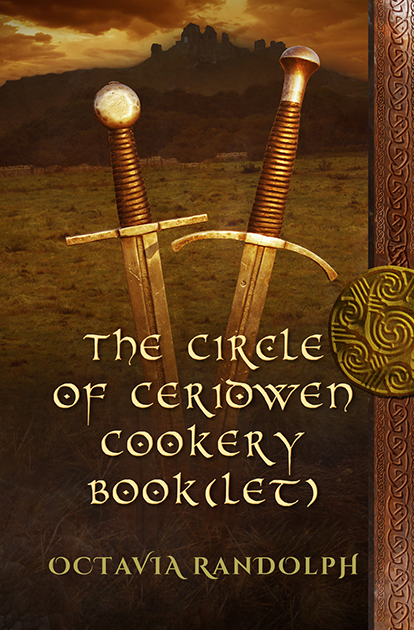
Of course one can't hold a wedding without a feast to follow.  Enter The Circle of Ceridwen Cookery Book(let), ten easy, delicious, and authentic 9th century recipes, charmingly illustrated with medieval woodcuts and filled with fascinating facts about medieval cookery.

And it's FREE. Receive your two PDF versions when you sign up on my mailing list at http://www.octavia.net.  Be my guest, and enjoy!


Thursday, October 23, 2014

Silhouettes, Paper Cuts, and a Brilliant French Profilist

by Mike Rendell

I recently gave a talk about 18th Century paper-cutting at the Holburne Museum at Bath. It included a section about the life and works of a remarkable French profile-cutter who rejoiced in the name of Auguste Armand Constant Fidele Edouart. He had been born in 1789, served under Napoleon, and fled to England as a penniless refugee when the Bourbon monarchy were restored to the French throne. I find his work fascinating because it was a peculiarly time-sensitive “art” which became largely overtaken by the development of photography towards the middle of the eighteenth century – suddenly black “shades” went out of fashion and in came daguerreotypes and other photographic images.

When he first fled from France as a young man he tried to eke a living teaching French to the English and making mourning pictures - usually portraits on ivory, made with hair from the deceased. But one day he was shown a shadow picture (as silhouettes were called) which had been cut by a machine. Never modest about his talents, Edouart announced that he could do better - and promptly did just that! He describes the scene as follows:
I ... took a pair of scissors, I tore the cover of a letter that lay upon the table, and took the old man by the arm and led him to a chair. I placed him in a proper manner so as to see his profile, then in an instant I produced his likeness.

The paper being white I took the black snuffers
[in other words, candle snuffers covered in soot] and rubbed it on with my fingers.

This likeness and preparation, made so quickly, as if by inspiration, was at once approved of… the ladies changed their teasing and ironical tone to one of praise and begged me to take their mother’s likeness, which I did with the same facility and exactness.

Note the small boy on the right trying to distract the boy on the chair,
earnestly declaiming poetry, by tickling the back of his neck.

It led to a total change of course for Edouart - he gave up teaching, and hair pictures, and concentrated on what he called "silhouettes" - named after the despised French finance minister Etienne de Silhouette. The term 'a la silhouette' was originally intended to be derogatory, because the man was renowned for being a cheapskate. Etienne de Silhouette's 'crime' was trying to balance the books of the French economy by melting down the gold table settings used by the royal family, and replacing them with silver plate and gilt. For that he got the sack - and a reputation for being miserly. But Edouart was happy to adopt the term, in order to distinguish his profile cuts from the inferior ones made by machine. The point was: if you could afford it, you would have your portrait painted in oils; if not, you could have your profile cut out of paper for just a few pence. It was a substitute - but a very popular and effective one.

He spent time in Bath and Cheltenham before moving to Edinburgh, cutting hundreds and hundreds of portraits along the way. And then he decided that he would go to the States, and prepare likenesses of all the great and the good. His years there involved creating some 4,000 portraits, including profiles of four U.S. presidents, five members of the Supreme Court, six state governors, six college presidents, eighteen mayors, six commodores, thirteen generals, thirty state or federal court judges, fifteen authors, and at least twenty-nine physicians....

He also became a favourite with the Quaker community, who felt that it was mere vanity to hang a portrait done in oils on the wall, but were perfectly happy "to display a copy of their shadow".

The Gibbs brothers playing squash


But somehow you get the impression that Edouart measured his own importance by the importance of the people whose likenesses he took!

The famous violinist Paganini fiddling away


A magic lantern show, the silhouettes
positioned against a lithographed background.

He meticulously kept copies of every single silhouette he ever made - indexed and cross-indexed five times over, with the records kept in numerous leather-bound books. But by 1849 he decided to return to France - and set off aboard the good ship Oneida. The vessel got as far as the Channel Islands where it was wrecked in a bad storm - Edouart escaped with his life, but lost most of his luggage, including many of the volumes of duplicates.

The poor man was devastated - he had set such store by keeping a complete record of his life's work, and he suffered something of a nervous breakdown. Certainly he never cut another profile ever again. Mind you, his withdrawal from the world of silhouettes may have had something to do with the fact that Mr Daguerre had brought out his 'daguerreotype' in 1839. The same year had seen Fox-Talbot patent his system of recording photographic images on paper, and the new-fangled photography was spelling the death-knell of the silhouette. It was a shame - some of Edouart's profiles are beautifully done, and his surviving cut-outs are a fascinating record of the movers and shakers of the period between 1825 and 1850, on both sides of the Atlantic. I particularly like the way he captured a sense of movement.

And my own interest in all this? I have a collection of some fifty or sixty paper cut-outs made by my great great great great grandfather Richard Hall in the 1780's and they give a wonderful insight into the everyday life of families living in England at that time. Almost certainly they were made to amuse the family - you can just imagine him, scissors in hand, cutting out a paper replica of his rapier, or showing  farmyard scenes.


He also made a very fine 'in memoriam' picture to mark the death of his beloved wife Eleanor. It measures just an inch and a quarter across and is like fine lace.

More information on my collection can be found here.

~~~~~~~~~~~~~

Mike is the author of a book about his ancestor Richard Hall called 'The Journal of a Georgian Gentleman' and is currently working on a book about the loose morals of the Georgian era, due to be published next year under the title 'Sex, Scandal and Satire - in bed with the Georgians'.

Wednesday, October 22, 2014

The Edinburgh Vaults

by Richard Denning

Any visitor to the city of Edinburgh cannot fail to be aware of the various bridges that are an integral feature of the city center. The city stands on a number of hills with deep valleys in between. Constructing bridges over these valleys massively improved the ease of moving around the city. Any visitor to the Edinburgh Fringe (as I was in the summer of 2014) will spend a great deal of time crossing and recrossing the city via these bridges.

Many of the visitors may be unaware that beneath the South Bridge is a hidden world of passages and catacombs called the South Bridge Vaults.


The South Bridge was built to cross the gorge along which Cowgate runs and to link the city to the University to the south. Building work on the bridge started in 1785. The bridge consisted of 19 stone arches. Towering tenements, shops and workshops were built alongside the bridge, sealing off the archways. As part of the construction some 120 chambers of varying sizes were built. The idea was that these would be store rooms and workshops for the businesses above.

The Cowgate arch - today the only visible archway.

The bridge officially opened for business in 1788 in a manner which seemed to single it out as cursed right from the start. The wife of a local judge was selected to be the first across the bridge, but she died just before the official opening, so she was pushed across in her coffin instead! Many locals refused to cross the bridge after that incident.

As for the vaults being used as warehouses and workshops, this proved a failure. The builders had not waterproofed the vaults and soon water was leaking down the walls. Stocks of goods rotted and became mildewed, and the traders soon abandoned the vaults - within thirty years of their being opened.


Abandoned by the legal owners, the vaults started to attract an underclass of inhabitants. The poorest people who could not afford accommodation elsewhere moved in. So too did Highlanders trying to evade the clearances. Criminals found the dark places ideal lairs or places to find victims or store stolen goods. In 1815 local authorities raided the vaults and found and shut down a distillery.  Burke and Hare, the infamous serial killers who sold corpses to medical schools, are rumoured to have selected their victims in the Edinburgh Vaults.

Between 1835 and 1875 the vaults were gradually cleared and sealed off. There is poor documentation of this operation. What we can say is that the vaults passed out of use and into memory and in time even out of that. Forgotten, they lingered sealed off for over a century.


Students moved in to many of the tenements in the post war period. In 1985 one of the walls of these student flats was accidentally knocked through. Curious, the land lord excavated further and so opened a way into some of the Vaults. So it was that over a hundred years after they were sealed off, the Vaults were rediscovered.


Nowadays the vaults on the south side of Cowgate are home to nights clubs as well as containing remnants of houses that were mostly demolished to create the bridge.There is even a well in one chamber.

The vaults on the north side of the Cowgate arch are used mainly for tours. This summer my family and I went on one of these tours. Apart from historical tours the guides also run ghost tours (mainly at midnight). The links with ghosts have featured on a  number of TV programmes with reported recordings of strange voices such as that of a  priests recanting a prayer.


Some of the chambers do have have obvious links with the occult and witchcraft - like this one which is owned by the local Wiccans and in which weddings and other rituals are performed:


Or this one below in which the circle is rumoured to be haunted. The guide challenged us to walk across the center but warned us that visitors who had reported after effects such as scratches!


None us took up the challenge!

All in all it is a fascinating and atmospheric place. When the lights are off you can almost feel Burke and Hare creeping around. I recommend taking the tour.

~~~~~~~~~~~~~

Richard Denning is a historical fiction author whose main period of interest is the Early Anglo-Saxon Era. His Northern Crown series explores the late 6th and early 7th centuries through the eyes of a young Saxon lord.

Explore the darkest years of the dark ages with Cerdic.


www.richarddenning.co.uk

Tuesday, October 21, 2014

The George and Its Patrons – Lord Nelson, Jack Aubrey and Horatio Hornblower

by Margaret Muir

Lord Nelson
The George Hotel in Portsmouth was long regarded as a prestigious establishment providing rooms and meals for weary travellers arriving by coach from London. It was frequented by admirals and sea captains alike, including Horatio Nelson who stayed there on several occasions. The most notable was his last day on English soil before embarking on HMS Victory.

While factual history fixes the George on the map, nautical fiction authors, Patrick O’Brian and CS Forester used the venue to colour the exploits of Jack Aubrey and Horatio Hornblower respectively. Patrick O’Brian refers to the George at least 10 times in his 21 books, and CS Forester not only made several mentions of the famous coaching inn, but (in ‘Hornblower and the Hotspur’) chose the hotel’s coffee-room to host the wedding breakfast following Hornblower’s marriage to Maria.

Russell Crowe as Jack Aubrey

Because of the intriguing connections existing in both fact and fiction, when I planned a 5-day visit to Portsmouth (from Australia), there was only one hotel I wanted to stay at – the George. But in the words of Robert Burns, ‘The best-laid schemes o' mice an' men gang aft agley’.

On arrival at the hotel, full of anticipation, I was confronted by a building dating back to 1781. And for a visitor, it was ideally located only a stone’s throw from the Portsmouth Historic Dockyard. But this was neither the original George Hotel, nor the one I had come looking for. I soon learned that the famous coaching house had been severely damaged by German bombs on 10 January 1941 and subsequently demolished. Disappointed but not undaunted, I set about to locate the site where the original George had stood and, if possible, secure an image of the old hotel.

Having ascertained the coaching house was located near Portsmouth’s Anglican Cathedral, I headed for the High Street and found a pair of post-war lamp posts gracing the curb where a pair of gas lamps had one stood. They marked the spot where the London coaches came to a halt outside the George’s front entrance. It was here Lord Nelson had stepped from his post-chaise from Merton and entered the building. It was here, in fiction, that Jack Aubrey and Horatio Hornblower had entered the premises to spend many a happy hour.

Today, on the pavement between the two lamp posts is a bronze plaque that reads: ‘Lord Nelson rested at this old Posting House on 14th September 1805 before embarking on his flagship H.M.S. Victory’.

Because of the devastation caused by the WW11 air raids, the site was levelled and, in 1954, an uninspiring block of flats arose in its place. It was named "George’s Court". On the wall of the latter-day building is another plaque paying tribute to Nelson’s visit.

But my search had not been for the ghosts of the past but for the building that had accommodated them. While the first hotel on this site had been a thatched-roofed house called the “Waggon and Lamb”, I can only presume the name George Hotel was adopted during the reign of George I, when the new building, with its Georgian façade, was constructed.

At that time, High Street was a busy thoroughfare, not only with horse-drawn carriages, coaches and carts, but sailors, soldiers, local traders and pedestrians.

In 1739 a Town Hall and Market House had been constructed in the centre of the road. This seemingly odd location created a thriving hive of shops, stalls and offices, but it also created a massive bottleneck to the traffic passing along the street. For that reason, it was eventually demolished in 1837.

Also situated on High Street, only a cable’s length from the hotel was the Church of St Thomas à Becket or St Thomas of Canterbury (now Portsmouth Anglican Cathedral). It was here CS Forester’s characters Horatio Hornblower and Maria were married before repairing to the George for the wedding breakfast.

Portsmouth Anglican Cathedral
Continuing along to the end of High Street brought the visitor to the fortifications that had defended the town since the reign of Henry VIII to one of the sally ports and the beach. But when Nelson left the George in the early afternoon of the 14th, he did not head down the High Street; instead, to avoid the already congested thoroughfare and the well-wishers who were eager to accompany him, he slipped out of the hotel’s back entrance into Farthing Street.

As a further means of avoiding attention, from Fighting Cock Lane (Pembroke Road), he detoured across the garden of the Governor’s residence. At the time, this was part of the complex occupied by the Garrison Church – a building dating back to 1212. Sadly, the Church’s nave was also badly damaged in the war-time bombings.

Accompanied by George Rose, the Vice-President of the Board of Trade, and George Canning, the Treasurer of the Navy, Nelson headed across a narrow bridge over the moat to the triangular shaped fortification – the Spur Redoubt, which protruded into the sea, and to the beachfront beyond. There, with pebbles crunching under his feet, he was able to gaze across Spithead and see the fleet gathering for departure to the Cadiz Road.

Nelson’s diary entry of Saturday, Sept 14th, 1805 reads, “… embarked at the Bathing Machines with Mr Rose and Mr Canning at 2: got on board Victory at St Helen’s; who dined with me; preparing for sea.”

Mermaids at Brighton,
William Heath, 1829
As an aside – I find it hard to imagine bathing machines, normally associated with the Victorian era, being present on the beach in Nelson’s time. They are described in Outon’s Traveller’s Guide of 1805 as:
“four-wheeled carriages, covered with canvas, and having at one end of them an umbrella of the same materials which is let down to the surface of the water, so that the bather descending from the machine by a few steps is concealed from the public view, whereby the most refined female is enabled to enjoy the advantages of the sea with the strictest delicacy.”

Goodbye, My Lads! by Fred Roe
Fred Roe’s 1905 stylized painting “Good bye, my lads” depicts Lord Nelson, with a ship-of-the-line in the background, waving farewell when he departed Portsmouth. It is a far cry from the image I conjure in my mind of a senior naval officer standing on a shingle beach with bathing machines and swimmers in the water nearby.

Nelson’s final hours on English soil had been busy and included two visits to the George Hotel. But they were to be his last. The hotel long remembered the Admiral’s visit with pride and preserved his room for the next 136 years until the hotel, like the British admiral, fell to enemy fire during an unforgettable conflict that would long be remembered.

Note: this follows an earlier post – “The Portsmouth Road aka the Sailor’s Highway


Images to blog post.

1 – Admiral Lord Nelson – statue in Trafalgar Tavern in Greenwich

2 – Jack Aubrey - Russell Crowe from Master and Commander: www.imdb.com

3 – Two street lamps on High Street mark the old coaching stop

4 – Plaque on wall of George’s Court.

5 – The George Hotel (Pre-war image – taken from plaque outside George’s Court.)

6 – Town hall and Market Place from Portsmouth Image Town Hall images

7 – Portsmouth Anglican Cathedral

8 – Pembroke Road and the Garrison Church

9 – ‘Mermaids at Brighton’ by William Heath 1829

10 – ‘Good-bye, my lads’ Fred Roe - 1905

Photo images by Margaret Muir (2012)

~~~~~~~~~~~~~

Margaret Muir is author of 4 historical fiction novels set in Yorkshire (her birthplace) and a nautical fiction series written under the by-line M.C. Muir. Inspired by her love of tall ships, Muir’s latest adventures are set during the Napoleonic sea wars. The first 3 books in the series have been published as an e-book boxed set: “The Oliver Quintrell Trilogy”. Book 4 is due later this year. Other individual titles are available from Amazon.


Monday, October 20, 2014

The Independent English Domestic

by Diane Scott Lewis

In the eighteenth century, a time when domestic service was seen as easier than toiling in a shop or factory, a poor farmer’s sons and daughters would go happily into this type of work. Even a parson’s family did not look down on the occupation. However, the English domestics thought of themselves as a cut above.

The English servant was quite independent and rarely satisfied with low wages. Instead of being content in the early part of the century with £2 a year, they were demanding as much as £6 and £8. Writer Daniel Defoe wanted to see wages fixed at no more than £5, or soon this rabble would insist on as much as £20.

Lord Fermanagh, when writing to a friend about his butler, who had the audacity to ask for £10, said: "I would have a sightly fellow and one that has had the smallpox, and an honest man, for he is entrusted with store of plate, and can shave, but I will give no such wages as this."

The English servant stood up for himself, giving notice or running away if ill-treated. One servant, after being struck by his master, turned on the man and killed him with a pitchfork.

Foreigners were amazed—since they treated their servants like slaves—to see a nobleman like Lord Ferrers hanged in 1760 for the murder of his steward.

In the earlier part of the century there was a scarcity of women servants, but later, after years of bad harvests, starvation sent many girls into service. One lady, upon advertising for another housemaid, had over 200 applicants.

If wages were low, servants in a large house could supplement their pay with vails (tips). One foreigner complained after dining with a friend at his home: "You’ll find all the servants drawn up in the passage like a file of musqueteers from the house steward, down to the lowest liveried servant, and each of them holds out his hand to you in as deliberate a manner as the servants in our inns on the like occasion."

One clergyman reported that when he dined with his Bishop, he spent more in vails than would have fed his family for a week.

At lease the Duke of Ormonde, when inviting a poor relation to dine, always sent him a guinea ahead of time for the vails.

A movement, rumored to have started in Scotland, was put forth to abolish vails, but nothing came of it.

If servants believed themselves independent, striving for respect, their employers often demanded too much from them for little pay. Mrs. Purefoy advertised for a coachman who can not only drive four horses but must understand husbandry business and cattle, plus he’d also be expected to plough. She also required a footman who could "work in the garden, lay the cloth, wait at table, go to the cart with Thomas, and do any other business that he is ordered to do and not too large sized a man, that he may not be too great a load for the horse when he rides."

Servants were derided by their "betters" as being lazy and selfish, especially when they’d leave their positions for higher wages and vails.


Of course, many servants during the eighteenth century—especially in the larger towns and cities—were mistreated and far underpaid, if paid at all.

Still, some servants were honored and treated as members of the family, as shown by this epitaph on a coachman’s headstone: Coachman the foe to drink and heart sincere; Of manners gentle and of judgment clear; Safe through the chequered track of life he drove; And gained the treasure of his master’s love...

~~~~~~~~~~~~~

Diane Scott Lewis. To learn more about her eighteenth-century novels, please visit her website:

http://www.dianescottlewis.org

Source: English Country Life in the Eighteenth Century, by Rosamond Bayne-Powell, 1937


Sunday, October 19, 2014

Giveaway: The Kraals of Ulundi by David Ebsworth

David is giving away a copy of The Kraals of Ulundi. You can read about the book HERE. Please comment below to enter the drawing. Be sure to leave contact information.


A Visit That Changed a Life and Led to Sainthood

by Kim Rendfeld


What did those Irish missionaries say to Richarius that made him give up what he knew and devote his life to Christ?

As with many early medieval saints, information about the seventh century Frank also known as Riquier is scant and contradictory, but the stories are tantalizing. Whether they’re true is up to the reader.

Richarius was born in a village then known as Centula in today’s France. Either he was working class guy who pursued rustic occupations or he was a nobleman, depending on which source you consult. With the events that follow, I think he was an aristocrat. Whatever his background, the visit of the two Irish missionaries, Caidoc and Fricor, changed his life.

When visitors arrived in Centula, they were mistreated by the locals. Except for Richarius, who offered his hospitality. After listening to their preaching, Richarius repented of his sins. So much that one story has him surviving only on barley bread strewn with ashes and water often mingled with his tears. Another has him offering protection to his guests so they could preach freely – something a nobleman could do.

A 17th century illustration
of St. Riquier Abbey (public domain)
Richarius later became a priest providing relief for the sick and poor and redeeming captives. He spent a few years as a missionary in Britain, then returned to Centula, where he founded a monastery around 625 and served as its first abbot. Such an accomplishment would be easier for a nobleman, especially if he already owned the property to give to the Church. Apparently, Richarius remained close to Caidoc and Fricor. They joined him at Centula and spent the rest of their lives there.

As an abbot, Richarius would be in a position of influence. He had control over land, which was power in early medieval times, and could make alliances among fellow noblemen, both lay and clergy. In addition, the medieval populace believed that prayers from the monks could sway events here on earth, including who won the battles.

During a visit from Frankish King Dagobert, Richarius impressed the monarch by giving him good advice, especially not to listen to flatterers, and the king rewarded him with a generous gift.

Richarius could have kept his place as abbot for life. Or if illness prevented him from performing his duties, he could retire in relative comfort at the monastery. Instead when his health was failing, he traveled 15 miles away to a forest and lived in a hut with only one companion, Sigobart.

St. Riquier’s relics in the abbey he founded
(photo by Paul Hermans,
used under the terms
of the GNU Free Documentation License)
Shortly before his death, believed to be April 26, 643, he told Sigobart to make a coffin. His grieving companion felled an oak in whose trunk the body was placed. The monks at Centula must have guessed that Richarius would soon be declared a saint, a decision of local bishops at the time, and took his relics back to the monastery.

About 150 years later, that monastery, named St. Riquier, became a center for learning with Angilbert as its abbot. His close friend, Charlemagne, provided a golden shrine for the founder’s relics.

Images via Wikimedia Commons

Sources

Lives of the Saints, Omer Englebert

A Dictionary of Christian Biography, Literature, Sects and Doctrines: Naamanes-Zuntfredus Sir William Smith, Henry Wace

The Lives of the Fathers, Martyrs, and Other Principal Saints, Alban Butler

Daily Life in the World of Charlemagne, Pierre Riché (translated by Jo Ann McNamara)

An Ecclesiastical History of Ireland, from the First Introduction of Christianity among the Irish to the Beginning of the 13th Century, John Lanigan

Kim Rendfeld’s latest release, The Ashes of Heaven’s Pillar (2014, Fireship Press), has a few scenes taking place at St. Riquier monastery 12 years before Angilbert became its abbot. During a trial there, the characters swear on a piece of wood from a tree the monastery’s founder liked to rest under. The Ashes of Heaven’s Pillar, Kim’s second book, is a tale about a medieval mother who will go to great lengths to protect her children. It is a companion to Kim’s debut, The Cross and the Dragon, in which a young noblewoman must contend with a jilted suitor bent on revenge and the anxiety her husband will die in the coming war.

Kim's book are available at Amazon, Barnes & Noble, and other retailers. To read the first chapter of either book, get purchase links, or find out more about Kim, visit kimrendfeld.com or her blog Outtakes of a Historical Novelist at kimrendfeld.wordpress.com. You can also like her on Facebook at facebook.com/authorkimrendfeld, follow her on Twitter at @kimrendfeld, or contact her at kim [at] kimrendfeld [dot] com.

Saturday, October 18, 2014

Who Was the Real Charles Brandon?

By Nancy Bilyeau

English Princess Mary Tudor
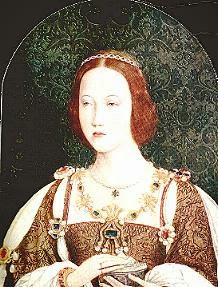
The great humanist scholar Erasmus once said of Mary Tudor, "Nature never formed anything more beautiful." The pampered and adored younger sister of Henry VIII was married at 19 to Louis XII, king of France. After the princess arrived in Paris with her dowry of 400,000 crowns and hundreds of attendants, the French, disposed to find her a disappointment, admitted that she was, indeed, a "nymph from heaven."

King Louis, 52, crippled with gout, died less than three months after the wedding to the English princess, but not before showering her with jewels, including "the Mirror of Naples," a diamond pendant with a pearl "the size of a pigeon's egg." Everyone expected the widow of the French king to make another spectacular royal marriage.

Instead, while still in France, she secretly took as her second husband a 31-year-old Englishman, Charles Brandon, the newly elevated Duke of Suffolk, celebrated for his good looks, military valor and jousting skill. Before she sailed for France, Mary had told her brother she would only agree to wed the old French king if she could choose her second husband herself. Desperate for the diplomatic alliance, Henry VIII had agreed. But Mary feared that if she returned to England, her brother would force her into another arranged marriage. She persuaded Brandon, whom she had known for years and had probably fallen in love with in England before her marriage, to marry her.  They had no permission to do so and were in disgrace, with Brandon facing arrest, until Henry VIII forgave them. Charles Brandon was, after all, his best friend.

It was a highly romantic episode, inspiring a stream of novels over the centuries, most significantly When Knighthood Was in Flower in 1898, which sold so many copies it inspired a burst of similar historical novels and no less than three films, including one in 1922 financed by William Randolph Hearst and starring Hearst's mistress, Marion Davies.


Mary Tudor and her new husband, Charles Brandon


A booted Marion Davies in When Knighthood Was in Flower


"Margaret" Tudor (Gabrielle Anwar) and Charles Brandon (Henry Cavill) in the miniseries "The Tudors"

But the real Charles Brandon, while an impressive and charismatic man to his contemporaries, is not a one-dimensional figure of handsome chivalry. His record with women was notorious. He'd already been married twice when he wed Mary Tudor -- one of the wives was still alive and fighting the annulment --and had contracted to wed yet a third, a child heiress whose family title he was using. A year and a half before he married Mary, ambassadors gossiped that he was trying to seduce Margaret of Austria, Regent of the Netherlands and daughter of the Holy Roman Emperor. The root of his behavior was not womanizing--or at least not only womanizing--but a willingness to use women as a means of gaining fortune and, if possible, fame, a common policy in the Tudor and Stuart age. He had a powerful sexual appeal, and he monetized it.

Like many real people of Henry VIII's court, Brandon is made up of both light and shadow. He is a product of the man-on-the-make spirit of the early Tudor age, which itself was made possible by the violent chaos of the death of Plantagenet rule.

His life is buried in myth, and the first is that Charles Brandon was a favored royal ward, orphaned by the Battle of Bosworth when his father, Sir William Brandon, a heroic man of "pure Lancastrian heritage" bearing the standard of Henry Tudor, was personally slain by Richard III. Which is not true in every respect.

The Brandons were an old, respectable country family. They lived in a small West Suffolk town, drawing income from farms and cattle for at least three centuries. A Geoffrey Brandon, succeeding in trade in Norwich, sent his son, William, to London in the last half of the 15th century. Says one historian: "He was a pushing, shrewd, energetic and very unscrupulous knave, who soon acquired great influence in the city and amassed corresponding wealth. Finally he became sheriff and was knighted by Henry VI." Yet when Henry VI was no longer king, replaced by the Yorkist Edward IV, Sir William Brandon switched to that side, and he lent Edward IV "considerable sums of money."

Which Edward IV declined to pay back.

Ordinarily a rich man would have had no recourse to a King's reneging. But when King Edward died, and his brother Richard III displaced his nephews and took the throne, an opportunity arose for another switching sides. Henry Tudor, in exile in Brittany, was now the leader of the Lancastrians. Brandon threw his support to Tudor. Two of his sons, William and Thomas, joined the Duke of Buckingham's rebellion against Richard III and when it failed, they fled England to join Tudor's cause. William was married to a young widow with some money named Elizabeth Bruyn. In 1484, she gave birth to Charles, the future Duke of Suffolk, in either England or France, and died shortly after.

But before we travel to the heroics of Bosworth, a terrible fact must be disclosed about the young William Brandon, knighted by Henry Tudor before they invaded England. He was, by one historical document, a rapist. In 1478 he was "in ward" for raping an "old gentlewoman" and her daughter, according to Paston. One chronicler of the time thought he would hang for it, but for unknown reasons he went free. The veracity of this record is debated today.

Early 19th century depiction of the Battle of Bosworth

It was a period of sexual brutality. Edward IV tried to assault a beautiful young woman named Elizabeth Woodville but she turned a knife on her own throat, threatening to kill herself. Somehow this made the right kind of impression, and she became his wife and queen. They were the parents of Elizabeth of York, grandparents of Henry VIII, and the present royal family are descended from them. Edward IV had countless mistresses, passing them to his courtiers when he tired of them, often against their will.

But even within this context, standard bearer was a great honor, and William Brandon was a strange choice for it. He was not a close friend of Henry Tudor's, he lacked a distinguished battle record and he was no noble. Probably Tudor, who left England for foreign exile in 1471, did not know about the rapes. One theory is William Brandon was chosen to carry the standard and stand at the side of Tudor because he was tall and strong. Nonetheless, Richard III is said to have "cleaved" his skull in his desperate charge on Tudor. Brandon's death was the most notable loss on Tudor's side.

After Bosworth, the baby Charles Brandon was an orphan. But the romantic tradition that a grateful King raised the boy with his son Henry, sharing lessons, is simply not correct. There is no record of him living with the royal children. And Charles was seven years older than Henry (and two years older than Arthur). As an adult, he was obviously intelligent but knew scant French and exhibited no interest in scholarship; he lacked Henry VIII's knowledge of languages, history, theology, and literature. Instead, Charles Brandon seems to have spent his childhood in the care of his grandfather and uncles, possibly in the country. His later letters, the "worst spelled and written of his day," were "phonetically spelled, proved him to have spoken with a broad Suffolk accent."

When Charles' grandfather died, the family fortune passed to the oldest surviving uncle, Richard. Little Charles had nothing.

Thomas Brandon, another uncle, is an under-appreciated force in the life of Charles. He was an ambitious man of ability who managed to advance himself in the court of Henry VII, and he pulled his young nephew Charles along as best he could. After he became Master of Horse, he found a place for Charles in Arthur's household: he was a sewer, or waiter. A far from cry from the legendary status of chosen playmate to princes.

How then did Charles Brandon rise so high from such inauspicious beginnings, sewer to duke? Like Thomas Cromwell, he used his personal gifts and worked extremely hard. Cromwell was a brilliant lawyer. Brandon was an outstanding athlete, the best jouster in a highly competitive group of men fighting for the attention of first Prince, then King Henry. At the age of 17, he appeared in the lists honoring Arthur's wedding to Catherine of Aragon, and was noticed by all for his prowess when he rode in a tournament held in honor of Philip of Austria and his wife, Joanna of Castile, in 1506. At this time young Brandon was serving as Master of Horse for the Earl of Essex. That household is where he lived; he did not have lodgings at the royal court.

This is the time when Charles Brandon began his marital misadventures. He seduced Anne Brown, a gentlewoman of good family serving Queen Elizabeth, and according to her family, promised to marry her. She was pregnant by him in 1506. But then Brandon jilted Anne for her wealthy widowed aunt, Dame Margaret Mortimer, old enough to be his mother. They married and, once he got his hands on her property, he sold it all and kept the cash. An appalled Venetian ambassador wrote, "In this country, young men marry old ladies for their money."

In 1507, 23-year-old Charles Brandon had the brief marriage annulled and returned to Anne Brown, whom he married. They had two daughters before she died in 1511.

Mary Brandon, by Holbein. She was one of the daughters from his first marriage.

 Lady Mortimer bitterly opposed the annulment, and became a thorn in Brandon's side for 20 years, until he managed to get the pope himself to support the annulment in 1527. The mess of his early marriages was to haunt not just Brandon but his descendants. Decades later, Elizabeth I was supposed to have examined the legal documents of the Mortimer annulment to find a way to discredit Brandon's granddaughter, Catherine Grey, who many considered next in line to the throne but whom Elizabeth loathed.

After Henry VIII succeeded, Brandon rose higher and higher in his estimation, based mostly on his tournament prowess. He took over his uncle's position of Master of Horse. When England went to war with France, Brandon served with great bravery and distinction. Throughout his long life, he was to serve Henry VIII on the battlefield time and again. "He is like a second king," an awestruck advisor wrote Margaret of Austria.

Margaret of Austria

Back in England, Brandon was soon up to his old tricks. He signed a contract to marry his 10-year-old ward, Elizabeth Grey, a wealthy heiress, and was known as Lord Lisle, her family's title, until his best friend, King Henry VIII, made him Duke of Suffolk. "From a stableboy into a nobleman," commented Erasmus skeptically. Now he was one of only three dukes in England.

Brandon was still contracted to his ward when he flirted with Margaret of Austria, pretending to steal her ring while Henry VIII laughed in encouragement. There were rumors that she would marry him, until her father, the Holy Roman Emperor, grew furious. She backed away quickly.

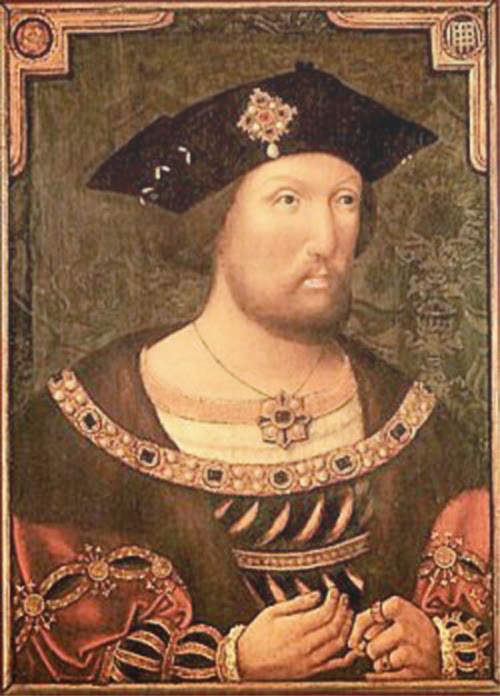
Young Henry VIII


A 19th century historian wrote of Henry VIII and Charles Brandon:
"The two men were of the same towering height but Charles was, perhaps, the more powerful... both were exceedingly fair and had the same golden curly hair, the same steel gray eyes planted on either side of an aquiline nose.... owing to the brilliance of their complexions, they were universally considered extremely handsome."

This was the man Princess Mary fell in love with at the same time her brother was arranging her marriage to the King of France. There is no hint of impropriety between them at the English court; she was scrupulously chaperoned. Brandon did not escort her to France. So why did Henry VIII send his friend, infamous for his treatment of women, to escort a vulnerable Mary back to England after King Louis died? He is supposed to have made Brandon promise not to marry her in France. Brandon was always a loyal friend to Henry VIII...yet he did marry her. The French royal jewels that the couple smuggled out of the country and gave to Henry VIII--including the Mirror of Naples--mollified him.

Henry Cavill's portrayal of Brandon adds to his mythic appeal

Did Mary Tudor find happiness with the husband she chose for herself, who she risked her brother's wrath to marry? Was this a man who, despite his irresistible good looks and athletic prowess, could be a good husband, even in the 16th century? Perhaps. That is another question entirely, fit for another blog post.

---------------------------------------------------------------------------------


Nancy Bilyeau is the author of a trilogy of mystery novels set in the court of Henry VIII, published by Simon and Schuster. The main character, Joanna Stafford, is a Dominican novice. The Crown was an Oprah magazine pick in January 2012. The Tapestry, the third in the series, was published in 2015. For more information, go to www.nancybilyeau.com