Saturday, May 24, 2014

Early English Architecture:Part Two

by Octavia Randolph

This month we continue our examination with Early Stone Construction
For Part One, dealing with wood framed buildings, click here

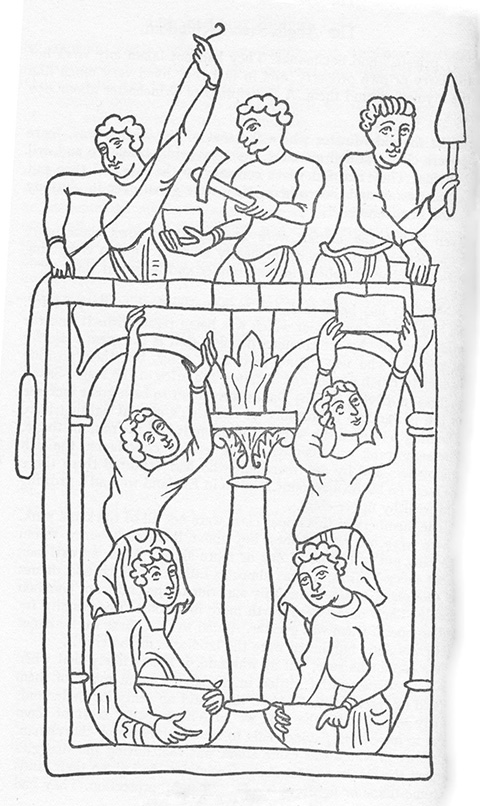
At left, masons of the 11th century at work. One, perhaps the master-mason, lowers a plumb line to check the squareness of the masons' stone laying. The essential materials and tools of the mason's craft remain unchanged for more than two thousand years - hewn stone, trowels to spread mortar, plumb line to ascertain square and level construction.

It is likely true that many early churches were of timber, but it is clear from both archeological and textual evidence that many were of stone. Some Anglo-Saxon stone churches were in fact adaptations of churches originally built by Roman Christians, for there were Christians in Britain by the second century CE. (In some cases these basilicas had been heathen temples before Christianity became widely adopted amongst the Romano-British population) The Venerable Bede (c 673 - 735) wrote that the original cathedral at Canterbury was of basilica form with an apse (half round wall) at each end. It had been used as a Christian Church under Roman rule, and it is thus fitting that it is still considered the mother church of the Anglican Communion. This early building was repaired by St Augustine in 602 (at which time it had two towers), enlarged by St Cuthbert about 750, and again by Bishop Odo in 940. All of the ancillary buildings - the cloisters, refectory, workshops, and so on - were likely of timber, but the sanctuary itself was stone. (In 1067 the cathedral was utterly destroyed by a devastating fire, and the Normans built anew.)

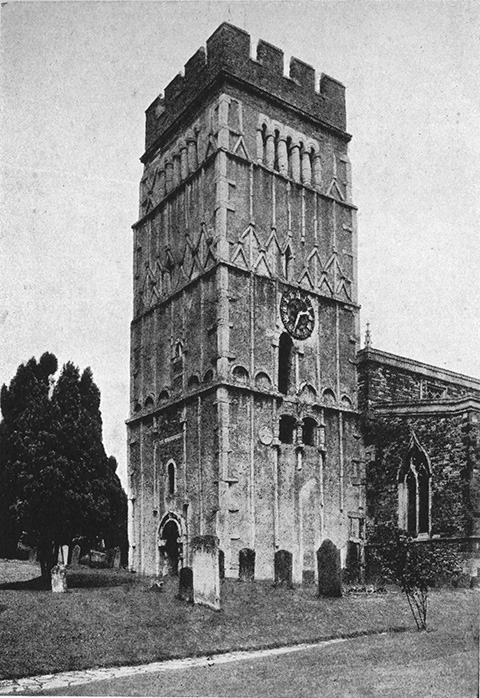
In Northumbria the church of St Andrew in Bywell retains its Anglo-Saxon tower of multi-hued sandstone. It may date from as far back as 850, and has walls 5 m (16 feet) thick.

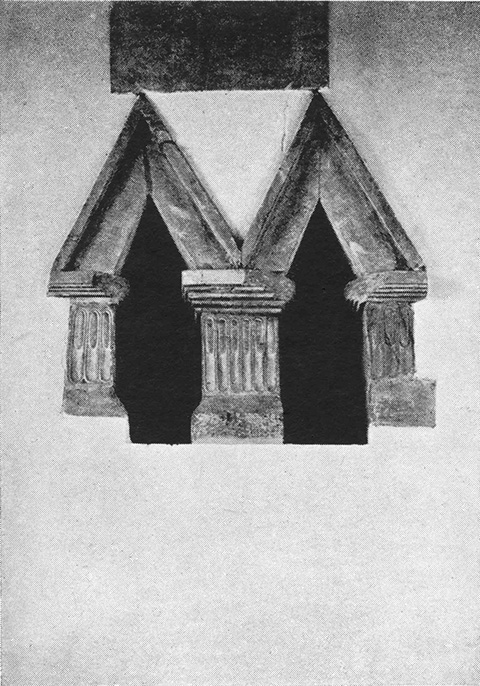
The beautiful tower of All Saints Church in Earls Barton Northamptonshire dates to 970 and holds especial interest in that the stonework is imitative of timber. The battlements at top are of a later medieval date. Earls Barton also features a substantial earthwork, and it is possible that it was the site of a Saxon burh.

St Andrew in Bywell Photo by F. H. Crossley

All Saints Church, Earls Barton
Photo by Brian Clayton

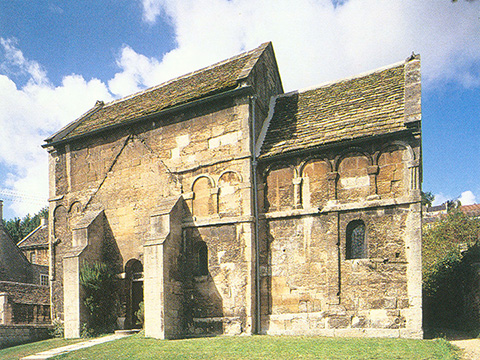
Church floor plans varied widely. Small porches or chapels were built onto simple rectangular churches, such as the small and jewel-like Bradford-on-Avon in Wiltshire. The lower part of this church may date from as early as 705, and the arcades from the end of the 10th century.

St Laurence Church, Bradford-on-Avon St Laurence Church,
Bradford-on-Avon Photo by Michael Holford

The Old Minster in Winchester, precursor of the modern Cathedral there, had when built in the 7th century a rectangular nave, square chancel and two small side chapels. Sometimes these buildings became incorporated into later larger churches which still stand: The present day parish church at Jarrow has as its chancel such an early church.

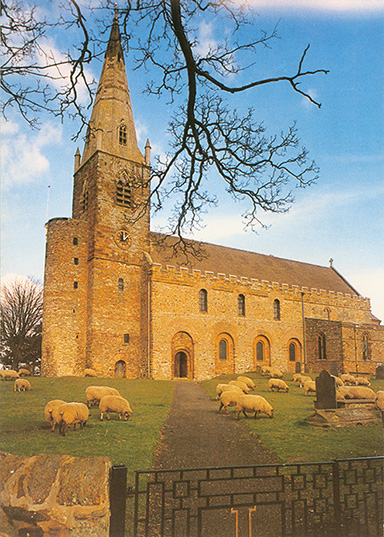
Only a few Saxon churches featured the classical "basilica" plan with apse (half round wall at one or either end). The impressive All Saints Church at Brixworth, Northamptonshire, parts of which date to the 7th century, is one which demonstrates this feature.

All Saints Church, Brixworth


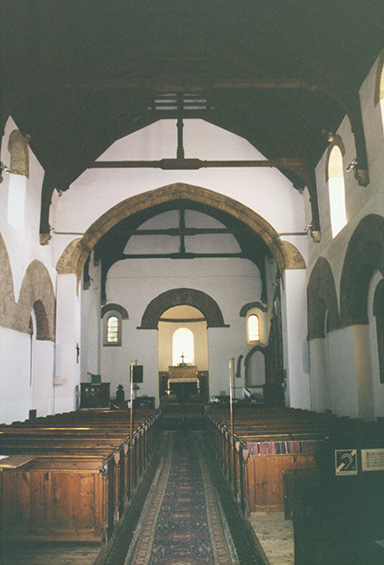
All Saints Church, Brixworth. Interior looking
toward apse.  Photo by Jonathan Gilman.

The (modern) plaster on the interior would have been richly overpainted with images of saints, parables, object lessons and Bible scenes. Pews are a convenience unknown to our hardier Anglo-Saxon forbears; worshippers stood throughout the service.

The large and important monasteries at Monkwearmouth and Jarrow and founded in 674 and 681 respectively by Benedict Biscop, were distinguished by the ambitiousness of their building scheme. Benedict had travelled to Gaul and was unimpressed with the wooden churches of Northumbria. He imported stonemasons and glassmakers from Gaul and built a monastery complex at Jarrow of masonry buildings with concrete floors, coloured glass windows, and tinted plaster walls. The remains of his stone basilica dedicated in 685 survive incorporated as the chancel of the church of St Paul, and the dated dedicatory stone can still be seen. At the monastery at Monkwearmouth the still-extant western porch issued from Benedict's hands. It was originally two stories high, over 10 m tall (33 feet), and has four doorways facing North, South, East, and West. It now forms the base of a later Saxon tower.

Nearly all Saxon churches contained crypts, generally with two means of egress so that religious processions or pilgrims might enter down one stair and exit from another. Burial in church crypts or by the altar was naturally reserved for high ranking clerics (many of them soon to be saints) or outstanding patrons; Godgyfu (Lady Godiva) and her husband Leofric Earl of Mercia were buried in the Priory Church of St. Mary, St Osburgh, and All Saints which they founded and endowed in Coventry in 1043. (This small stone church no longer exists - it was replaced by a far larger church in the 13th century, then dissolved as a religious foundation by Henry VIII in 1539, and thus fell into ruin.) Godgyfu and Leofric endowed many churches, and the still-extant Priory Church of St. Mary's Stow-in-Lindsay in Lincolnshire was among them. To see their church, click here.

The interiors of churches during this period contained no pews or seating. Worshippers stood in the nave facing the chancel in which the priest officiated. Windows could be very irregular in placement. Most windows of course were unglazed, although thin slices of horn made up small multi-paned windows, much as Ælfred devised a lantern protected from draughts using such a method. Window glass was being formed by Anglo-Saxon artisans by at least the 10th century (if we discount the Gaulish glaziers brought over by Benedict Biscop in the 8th century) and precious panes were also imported from the Continent.

St Marys, Deerhurst, founded 804.Early pointed
windows high up in the west wall of the Saxon tower.
Photo by F. H. Crossley

Cement, Plaster, and Paint

Good quality stone amenable to hewing in dimensional blocks for building is rarely evenly distributed throughout the landscape. Fortunately human inventiveness honed through trial and error can make suitable substitution. Flints in mortar serve well as a building material where quality material such as limestone or sandstone is lacking. Once the art of making cement mortar was mastered fire-resistant construction was available even where dimensional stone was not.

Saxon cement mortar was quite strong, allowing masons to safely construct walls which were unusually thin and tall for the material. Ninth century mixing pits for the creation of mortar have been found near St Peter's Church in Northhampton. Paddles attached to a huge timber cross bar centred on a vertical pin were turned when men pushed against the bar while walking in circles around the shallow mixing pit. Arduous work, but the resulting high quality cement was obviously worth the expended effort.

Mortar was used not only to affix stones to each other but in the creation of plaster. Many stone buildings had plaster exteriors as well as interiors. Plastered interiors in the case of churches were almost always decorated by figural paintings. These were uniformly over-painted during the Reformation (in many cases with scriptural verses), but still could have been recovered using modern techniques. Wrong thinking "restorations" in the 18th and 19th century stripped away nearly all of the extent plaster on Anglo-Saxon stone structures, including the remains of Anglo-Saxon wall paintings - a great and irreparable loss. Early restorers did not understand that the original builders of these churches meant them to be plastered and painted. They rashly chipped off centuries-old painted plaster to expose rough stone work that the generation who erected the buildings never intended to be seen. Still, a handful of fragments survive in a handful of churches to tantalize.

At any rate the painting of timber, stone, and plaster was commonplace. It is important to consider this when looking at the remaining Anglo-Saxon stone structures, or contemplating the reconstruction of a great hall. In the same way that it is hard for us to believe that the chaste white sculpture of Phidias was once painted in riotous colours when it adorned the Parthenon so must we allow our preconceptions to fall away while imagining Anglo-Saxon architecture in actual use.

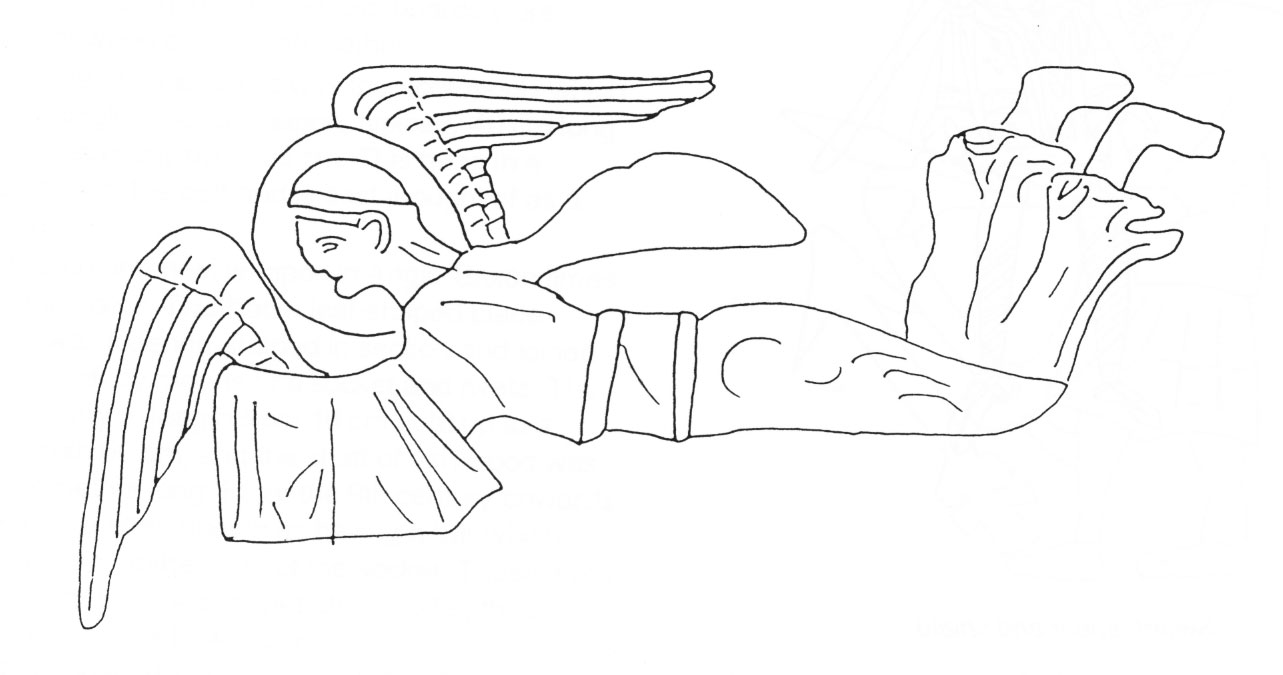
Stone carving was well evolved and many Saxon churches were embellished with stone sculpture and bas reliefs. Like so much from the era, what remains is very often fragmentary, and much sculpture was broken up and used as rubble filling in later construction. The juxtaposition of depicted scenes reveal a sophisticated knowledge of scripture and of contemporary religious commentary, oftentimes incomprehensible to later viewers.

Wiltshire Stone angel from St Laurence, Bradford-on-Avon, Wiltshire.
Drawing by Andy King

Stone and wooden sculpture too (very little of the latter has survived) was routinely coated with gesso, painted with mineral paints in brilliant colours, and often had additional attachments such as gems of glass or metal work affixed to them. Paints included black, white, red, yellow, green and mixtures thereof. Iron oxides yielded red and yellow ochre, copper salts gave green, charcoal black, and lime brilliant white for highlighting. Painting not only gave life and colour to the stone, but could be used to correct any defects in the natural stone or in its carving. The painting of sculpture also allowed distinguishing elements such as special colours or even the names of personages included as means of identifying the subject.
Entire walls were painted by plastering over wood timber or wattle work or stone. The plastered wall was next lime-washed, readying it to receive mineral colour paints which were then fixed with casein made from skim milk. Apart from the beauty and liveliness they imparted during services, wall paintings in churches served as a Biblia Pauperum, "Poor Man's Bible" illustrating episodes from scripture, scenes from the lives of saints, and allegorical lessons.
Sometimes the plaster itself was tinted either inside or out; in the case of the religious complex at Monkwearmouth the exterior plaster bore a pale rosy tint.

The End of It All

The Norman invasion of 1066 had an immediate and disastrous effect on Anglo-Saxon architecture. With the huge influx of Norman clergy following Hastings virtually every important English church was rebuilt or substantially altered. The great halls of now-slain ealdormen and thegns were taken over by Norman victors and altered to new tastes. Many existing structures whether sacred or secular were completely dismantled and their successor erected over the site. The necessity to subdue the populace led to the rapid building in stone of castles and other fortifications. But the Norman style of building in stone did not obliterate all timber halls in burh settings, and the Normans were quick to seize upon and make use of local forest reserves. The Saxon burh at Goltho described above was rebuilt by its Norman owner in the middle of the 12th century, using timber construction.

If you have enjoyed these essays on architecture you'll also enjoy looking into some of the reference books I used:

  • Timber Castles, Robert Higham and Philip Barker, Stackpole Books 1995
  • Anglo-Saxon Architecture, Mary and Nigel Kerr, Shire Archaeology 1989
  • Medieval Wall Paintings, E. Clive Rouse, Shire Publications 1991
  • Winchester in Anglo-Saxon Times, Andy King, Winchester Museums Service 1993
  • Anglo-Saxon and Viking Life at the Yorkshire Museum, Elizabeth Hartley, The Yorkshire Museum 1985
  • The Mead-Hall: Feasting in Anglo-Saxon England, Stephen Pollington, Anglo-Saxon Books 2003
  • English Church Design, F.H. Crossley, Batsford 1948
  • The Anglo-Saxons, James Campbell, editor, Penguin 1982
  • The Meaning of Mercian Sculpture, Richard N. Bailey, Vaughan Paper No 34, University of Leicester 1988
~~~~~~~~~~~~

Octavia Randolph is the author of The Circle of Ceridwen Saga.  Six months on Amazon's Top Ten for Women's Adventure. Book Four coming Summer 2014. Young women with courage. Swords with names. Vikings with tattoos. Warfare. Passion. Survival. Sheep. And Other Good Things...

Book One
Book Three


Book Two


Melkorka: A Novella


Friday, May 23, 2014

History and What It Feels Like - The Great Helm

by Scott Higginbotham

The Past
The annual fair is fast approaching.  My gut churns in anticipation, and my mind swims with wonder.  I have done well in the past year, for my trade has seen a brisk business and crops have been plentiful.  God be praised, war has not touched our humble existence in years.

In many ways I am like my young lads and lass, eagerly awaiting Christmastide and the joy of the New Year, as I save and set aside my earnings in hope of finding the perfect sword or dagger.  Perhaps a good yew bow can be found amongst the packed stalls, or a new helm.  Aye, a new helm.  Should I purchase one with a visor or the tried and true Great Helm?

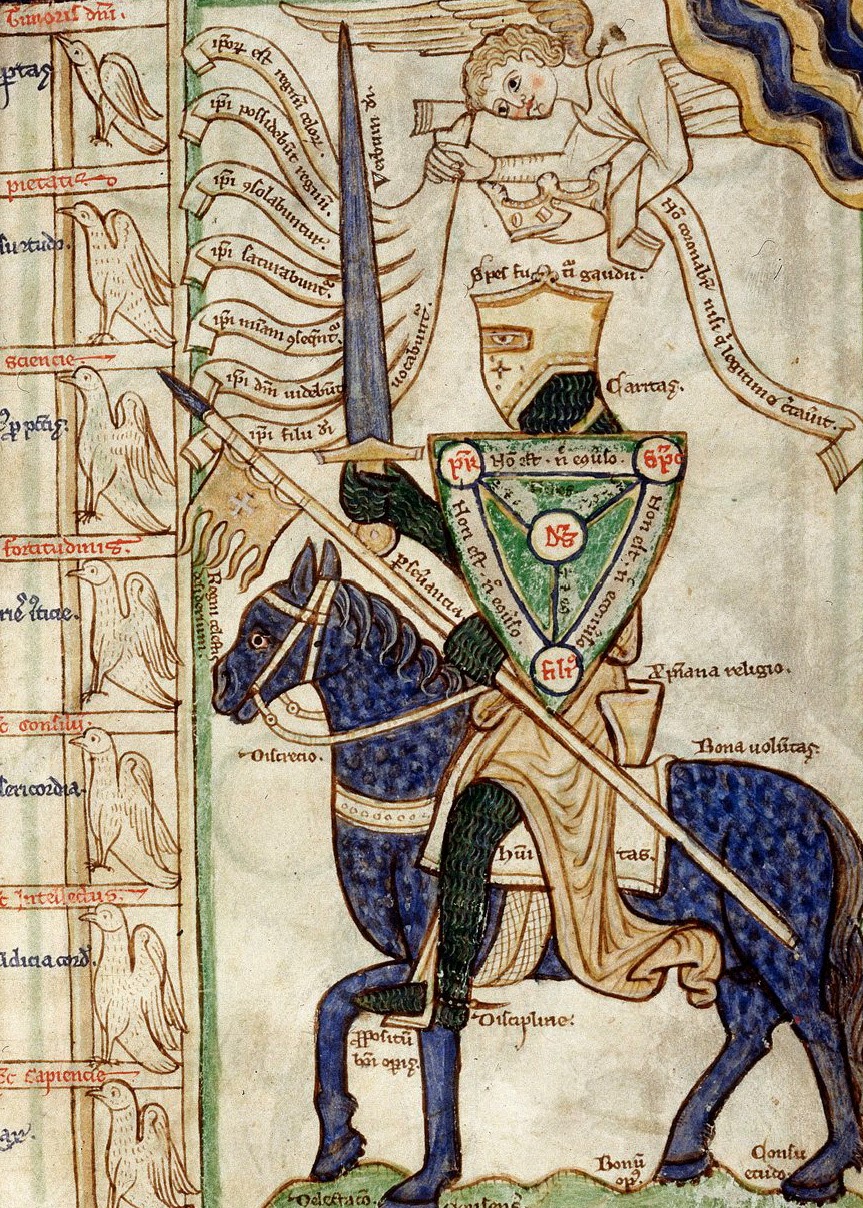
Public Domain - From Wikimedia Commons

Alas, the decisions are aplenty.

Not many years past, I met a kindred spirit, a man who appreciated good sword steel as much as he enjoyed banter and good conversation.  I oftentimes wonder if he was once a soldier, trying desperately to forget.  Whilst sailing the Middle Sea, I had the wanderlust, much like this man.  It is in the eyes, the wanderlust.  But so are the memories.

This year, I had a sword in hand, ready to exchange good coin for a master’s craft. But a Great Helm, dulled with age and spots of rust, quietly beckoned with it siren song. Placing it over my head, the past returns - for who could forget the hush of the Middle Sea under a canopy of stars? Perhaps it is the soft footfalls of mail-covered boots upon the sands of Outremer or the swish of a horse’s tail that quietly echo and remind?

I once wore a padded coif to cushion its weight; five or so pounds of steel upon one’s bare head can drive even the stoutest soul mad. The coif aided in keeping the helm centered and even, especially during close combat or daring charges into a great press of screaming men and horses. Aye, the memories come as a flood.

The heat of Outremer was unbearable. No sooner would the sun start its ascent and I would begin to bake like a wild boar on a spit. From the cold of winter to the heat of high summer - and that in minutes. Who was the foolhardy? Those that slowly addled their wits or those poor souls that sought relief and risked death from a stray arrow shot into the ranks?

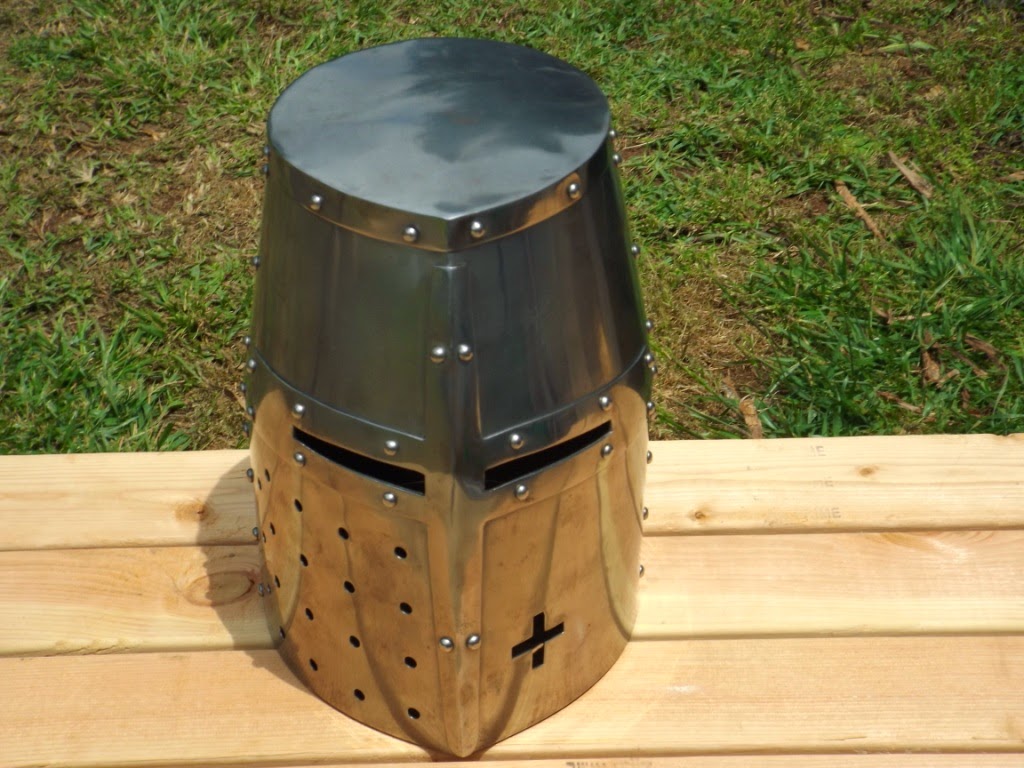
The sergeants got us used to sweat and heat, whilst we were swaggering lads and squires. God bless those old masters, for I never removed my Great Helm, even if the road was open and clear. And for good reason; the smith whose hand once crafted it made its shape like that of an egg. In truth, arrows would glance off it flat top or its sides with little more than a scratch.

Not all are made alike; each armorer had his own style and way. Small holes or even crosses that reminded us to protect and show mercy removed some of the stifling heat. An extra layer of steel in the shape of a cross protected the eyes and nose; the days of the open-faced Norman helms being long gone.

Photo by Scott Higginbotham

Present Day
The Great Helm replaced the old open-faced Norman helm that had the nasal bar, effectively adding on to it so that the wearer’s head was completely enclosed. It is so much more than an upturned water bucket. It was a staple during the latter part of the 12th century, knights having worn it during the Crusades and the numerous battles between England and France. Heat made it unbearable, vision was restricted to the narrow eye slits, but what it lacked in comfort it made up for in safety. Its slightly oval shape made arrows and sword blows glance off. Even its flat top was improved in such a way that the top became slightly rounded; this was called the Sugarloaf Helm.

Every year since 2009, I have faithfully visited Museum Replica's annual open house sale.  The deals are as hot as the steamy warehouse where tables piled high with period clothing, swords, daggers, armor, arrows, and a host of replica parts and pieces are begging for a home.

But each visit is a trip into the past, a past that you can purchase, feel, and experience as though you are truly stepping into history. Remember, when you look at old paintings and depictions of medieval knights, take a closer look at the helmets.

Now you know.

Public Domain - From Wikimedia Commons

~~~~~~~~~~~~~

http://www.amazon.com/dp/B007EHUMSC?tag=forathogen-20&camp=0&creative=0&linkCode=as1&creativeASIN=B007EHUMSC&adid=0EC3CR9J80NNHXXSP77Q
A Soul’s Ransom


Scott Higginbotham writes under the name Scott Howard and is the author of A Soul’s Ransom, a novel set in the fourteenth century where William de Courtenay’s mettle is tested, weighed, and refined, and For a Thousand Generations where Edward Leaver navigates a world where his purpose is defined with an eye to the future.  His new release, A Matter of Honor, is a direct sequel to For a Thousand Generations.  It is within Edward Leaver's well-worn boots that Scott travels the muddy tracks of medieval England.

Tuesday, May 20, 2014

The Irish Rebellion

by David Cook

What is that in your hand?
A green bough
Of What?
Of the Tree of Liberty
Where did it first grow?
In America
Where does it bloom?
In France
Where did the seed fall?
In Ireland
When will the moon be full?
When the four quarters shall meet


United Irish catechism, the "four quarters" being reference to the four provinces of Ireland uniting.

The Irish Rebellion (the second) of 1798 was an uprising against British rule in Ireland lasting from May to September of that year. The first, in 1641, was against Protestant settlers from England and Scotland, which saw great swathes of land given to them from Irish landowners.

The Society of United Irishmen, a republican revolutionary group founded in Belfast, 1791, and heavily influenced by the ideas of the American and French revolutions, were the main organising force behind it. Their doctrine was to secure a reform of the Irish parliament and did this by uniting Roman Catholics, Presbyterians, Methodists, other Protestant "dissenters" into their party.

From the very beginning, Dublin Castle, the seat of government in Ireland, viewed the new organisation with deep suspicion, and with the outbreak of war between Britain (including Ireland) and France in February 1793, mistrust turned to naked hostility. The Society members were viewed as traitors and it was supressed in 1794. Led by Theobald Wolfe Tone, a barrister, he vowed to "break the connection with England" as the group was driven underground and into the arms of the French.

A planned uprising with French military help in January, 1797, resulted in a series of blunders (mainly due to the weather), and so the first invasion faltered and the fleet sailed home.

The government, often criticised as being lazy, corrupt and callous, responded to the widespread disorders by launching a counter-campaign of martial law in early 1798. Its principles used tactics such as planting spies, half-hangings, house burnings, pitch-capping and murder of suspected United oathmen, particularly found in Ulster as it was the one area of Ireland where Catholics and Protestants had achieved a common cause of revolt.

Leaders of Pro-United Irishmen groups began to circulate that every Protestant was an Orangeman, and seeking Catholic blood-letting. The Orangemen were of the Orange Order whose aims were to preserve Crown, Church and Ireland's Constitution, harking back to the days when their ancestors won the Williamite Wars a hundred years before. Rebels impersonated Orangemen, spreading fear and calamity. A plan to take Dublin was thwarted, but just after dawn on 24th May, pockets of insurgents rose and the fighting quickly spread throughout the country over the next five months like a straw-fed fire.

The aftermath of the fighting was marked by the massacres of captured and wounded rebels with some on a large scale, such as at the attack of New Ross and Enniscorthy. Rebel prisoners were regarded as traitors to the Crown, and were not treated as prisoners of war. They were simply executed.

County Wexford, once wealthy and industrious from the large swathes of its corn fields and long coast-line, was the only area which saw widespread atrocities committed by the rebels during the rebellion. After the defeat of the rebel attack at New Ross, the ‘Scullabogue Barn Massacre’ occurred where between one and two hundred mostly Protestant men, women, and children were imprisoned in a barn, which was then burned to the ground. Anyone that managed to break free of that inferno was piked to death by the mob outside. In Wexford town, on 20th June some seventy loyalist prisoners were marched to the bridge and piked by crowds of United supporters.

On 22nd August, one thousand French soldiers under General Humbert landed in County Mayo. Joined by several thousand rebels, they inflicted a humiliating defeat on the British at the Castlebar, mockingly known thereafter as 'the Castlebar races' to commemorate the speed of the retreat. Hundreds of Militia deserted. But the French were then roundly defeated at the Battle of Ballinamuck, 8th September and repatriated to their homeland in exchange for British prisoners of war. For the hundreds of captured Irish rebels, their fate was the hangman's noose, firing squad, or the penal colony of New South Wales.

On 12th October, another French force, including Wolfe Tone, attempted to land in County Donegal near Lough Swilly. They were intercepted by the Royal Navy, and finally surrendered after a three hour battle without ever landing in Ireland. Tone slit his own throat rather than wait for the noose and died a week later. But by then, with most of the rebel leaders dead, imprisoned or exiled, it was all over.

Small fragments of the rebel armies did survive and fought on in a form of guerrilla warfare. It was not until the failure of Robert Emmet's rebellion of 1803 that the last organised force finally capitulated.

Prime Minister William Pitt’s ‘Act of Union’ came into effect on 1st January, 1801, where the red diagonal cross of St Patrick was incorporated into the Great Union Flag. The Irish parliament was abolished. The Act was passed largely in response to the rebellion and was founded by the perception that the rebellion was provoked only by the brutish misrule of the Irish Ascendancy (descendants of the Tudor and Stuart settlers) as much as the efforts of the United Irishmen.

The rebellion caused thousands of deaths. Modern accounts estimate the death toll from ten to as many as fifty thousand men, women and children killed by fighting, starvation and disease.


My debût ebook ‘Liberty or Death’, is an authentic historical story set against the brutal backdrop of the rebellion, the first novella in The Soldier Chronicles series. Here is the description:

It is May, 1798, and Ireland is a country at war.
One hundred thousand peasants have risen up against the Crown to the tales of men, women and children butchered as traitors. It is whispered that the feared and despised ghosts of Oliver Cromwell’s New Model army have returned seeking bloodshed, and no one is safe.
Major Lorn Mullone, a man forged by war and torn by past failures, is sent by the government to apprehend Colonel Black, a dangerous and shadowy figure, who is harming the fragile peace talks with his own murderous retribution.
In a race against time, Lorn must journey across a country riven by fighting, where at the walled town of New Ross, he discovers a new horror.
In the desperate battle for peace, Lorn must survive for the sake of Ireland's future.


~~~~~~~~~~~~~

David Cook is from Chandlers Ford, Hampshire, but now lives in Leicestershire with his wife and young son.
David has been interested in history since his school days, and developed a love for the Napoleonic Wars era from his father, who painted and amassed a lead model army of the Battle of Waterloo. From there David became fascinated with The English Civil Wars, The Wars of the Roses and English medieval history, particularly the legend of Robin Hood. David is currently writing a novel entitled 'The Wolfshead', a story of Robin Hood, but based on the original medieval ballads as the source.

David is keen to answer any questions about his stories, or about anything else history related, and can be found on twitter @davidcookauthor and the official Liberty or Death facebook page.


Monday, May 19, 2014

Looking for Love ~ Victorian Style

by Carol Hedges

I was idling through The Guardian's 'Soulmates' column the other week, as you do, because it has good adjectives, and I was struck by the number of ladies and gentlemen who are looking for love - or possibly romance, friendship, affection, a good time, adventure, passion or felicity (yup, copied that last from someone's ad.)

This makes me think that nothing really changes, does it? The sequel to my current novel Diamonds & Dust, A Victorian Murder Mystery is about the Victorian search for the perfect partner, and the many and various ways such a search could be derailed, shipwrecked or run aground. I have therefore been researching the history of the 'lonely hearts' advertisements which go back, amazingly, to 1695. Yes, that is not a typo. The very first advert for Ms Right dates back to the seventeenth century.

Admittedly I know I am lucky in that Beloved Husband and I have been married for 39 years come this September, and although those of you who know us well would say that in our case it is definitely Mr Chalk wed Ms Cheese, we go along amicably and are looking forward to growing even older together. We still make each other laugh. A lot. In his case, every time I open my mouth and say something about football.

Others do not have such good fortune. 'Good fortune' being the critical attribute. To snare Mr Right in the 18th and 19th centuries, it was not so much GSOH as ''Comeliness, Prudence, and 5 or 600l. in Money, Land or Joynture'' that would guarantee you an admirer quicker than you could say knife. Or wife. By the 1800's, there were fifty-three newspapers all containing lonely heart ads of one sort or another. I was fairly gobsmacked at the audacity of one advertiser who wrote: ''A young man wants a wife with two or three hundred pounds; or the money will do without the wife - whoever will advance it shall have 5%'' (Daily Advertiser) Not for nothing did Jane Austen pen those famous words at the beginning of Pride and Prejudice that: 'a young man in possession of a good fortune ... must be in want of a wife.'

Sadly, despite the Victorian ideal of the 'happy wife and busy mother' fulfilling her destiny as 'the Angel in the house' for many young women, especially those of the middle and upper middle class, there was little hope of marriage. Class and income were the two great bugbears. And many men just preferred to remain single rather than take on the expense of a wife, a home and children. After all, a man could just as easily be fed at his Club and 'entertained' elsewhere other than the marriage bed. And statistically, there were very many more women than men in the mid and late Victorian periods.

To be unmarried was, for women who had few other opportunities in life, a particular hardship. George Sala in Twice Round the Clock (1862) refers to these poor unfortunates as: 'these uncloistered nuns ..wearing the stigmata of old maidenhood'. It is interesting that many novels of the period focus upon the educated middle class woman forced into governess or companion roles...but liberated at the end into marriage, which was clearly seen as the true vocation for the female sex. One wonders how many women must have seized upon these novels and been given hope, albeit false hope.

In a way, I guess we are more fortunate (sic) in that money does not feature quite so prominently in today's search for love, though I'm sure it lurks behind the scene, gurning happily. And as modern men and women, we can chose when and to whom we should marry. Not for us the advice of George Sala that: "The proper mission of man is to marry, and of women to bear children; and those who are deterred from marriage by the hypocritical cant about 'society' and 'keeping up appearances', had much better send society to the dogs and appearances to the devil, and have nothing more to do with such miserable sophistries." (op.cit)

~~~~~~~~~~~~~

Carol Hedges is the successful British writer of 11 books for teenagers/Young Adults/Adults. Her writing has received much critical acclaim, and her novel Jigsaw was long-listed for the Carnegie Medal. Her four Spy Girl books, published by Usborne Books and featuring feisty sassy heroine Jazmin Dawson are available to buy on Amazon.

Her ebook Jigsaw Pieces is also available in Amazon. Her latest book, Diamonds & Dust, A Victorian Murder Mystery is published by Crooked Cat books,and is available as both book and ebook from Smashwords and Amazon. It is her first adult novel.

Carol Hedges lives in Hertfordshire, England. When not writing/sleeping/trying to resist cake, she tutors A level and GCSE English Literature. She also campaigns as chair of a local action group to save a community urban green space from possible development.

Bits of her writing life can be viewed on her award winning blog:
http://carolhedges.blogspot.co.uk
She is also on Twitter @carolJhedges
and on Facebook: www.Facebook/Carol Hedges

Diamonds & Dust
Crime Writers Association 2014 Award Entry
Available as book and ebook on Smashwords, Amazon.com,  to order in bookshops.


Giveaway: The Matchmakers by Ruth J. Hartman

Ruth is giving away an ecopy of The Matchmakers to an international winner. You can read about the book HERE. Please comment below to enter the drawing, and be sure to include contact information.

Sunday, May 18, 2014

Will the Real Anne Boleyn Please Stand Up.

by Judith Arnopp

Anne Boleyn, National Portrait Gallery
I am often told that readers are fed up with Tudors.  They know the stories, they’ve heard it all. The need for Tudor novels is over. But the reading public doesn’t seem to believe that. Since I first became an author of historical novels the most recurrent question has been, “Have you written any Tudor books?” 

It seems to me that the reading public, both in England and especially overseas, cannot get enough of Henry and his wives. I think the reason for this is not just the glitz and the danger of Henry’s court; it is the many different interpretations we can put upon the stories and the people that inhabit them. There are more explanations for what went on than there are stars in the skies, and there are novelists enough to encompass them all. Added to that of course is that new generations are emerging all the time; a new batch of people who know nothing about the Tudors.

Anne Boleyn remains the number one favourite; the wife that everyone loves to read about. She has been depicted in many different ways; a schemer, a witch, a victim, a whore. She has been demonised by some novelists, and sanctified by others but how close to we ever come to the real Anne? We can never really know the truth about her, we can only piece little snippets together to make up a shadow of the real woman. That is what makes history, and enigmatic figures like Anne, so irresistible. Anne Boleyn was, and still is, a fascinating woman who deserves after all this time a fair reappraisal of her life and death.

In his nonfiction book The Life and Death of Anne Boleyn, Eric Ives,  now sadly passed on, reveals a credible figure. He has done the hard work for us, demolishing many of the myths that in the space of several centuries have solidified into fact, and illustrating that what remains is an intelligent, ambitious, but God-fearing woman who happened to win the love of a king. 
 
It is refreshing to discover that perhaps Anne was not a scheming witch with a penchant for sleeping with half the court, (her brother included). Nor was she a woman who gave birth to a monster and plotted the death of the king. Ives’ research reveals someone more sinned against than sinning, and a woman whose mistakes were human ones. Anne was a queen who failed to produce an heir, and a woman who fell foul of the King’s most powerful advisers.  The woman that emerges from Ives’ research is the Anne Boleyn that walks the pages of my novel The Kiss of the Concubine.

To be honest, the real Anne is so obscured by myth and legend that we know much less about her than we think we do. We are not even sure what she looked like. We think of her as dark haired and thin but the familiar portraits we see of her are not contemporary; the originals were lost long ago. Experts disagree, but the oldest 17th century portrait now in the National Portrait Gallery is likely to be a copy of an original, and is favoured by Eric Ives as being the one that comes closest to a real likeness. 

There are several written descriptions from her contemporaries and, while none rate her as a great beauty, none remark upon any physical failing either. The fact that she doesn’t emerge as breathtakingly beautiful is refreshing, and illustrates that Henry may have been more taken with the personality within, than with an alluring or fashionable face and figure.

Brantome, a courtier from France, wrote in his memoirs that Anne Boleyn was ‘the fairest and most bewitching of all the lovely dames of the French court.’ (Weir, p. 151) And Lancelot de Carles stated that she was beautiful with an elegant figure and was ‘so graceful that you would never have taken her for an Englishwoman, but for a Frenchwoman born.’ (Weir, p. 151)

This is praise indeed, perhaps a little too flattering to be true, and many eyewitnesses agree that her looks were unfashionable and not to every one’s taste. As Francesco Sanuto, a Venetian diplomat, illustrates with his description of Anne as  ‘Not one of the handsomest women in the world; she is of middling stature, swarthy complexion, long neck, wide mouth, a bosom not much raised and eyes which are black and beautiful.’ (Ives, p. 40)

It is only after her death that the really detrimental reports begin to emerge. Writing in the reign of Elizabeth I, Catholic supporter, Nicholas Sander, describes Anne as, “rather tall of stature, with black hair and an oval face of sallow complexion, as if troubled with jaundice. She had a projecting tooth under the upper lip, and on her right hand, six fingers.  There was a large wen under her chin, and therefore to hide its ugliness, she wore a high dress covering her throat. In this she was followed by the ladies of the court, who also wore high dresses, having before been in the habit of leaving their necks and the upper portion of their person uncovered.” (Ives. P.39)

 attributed to John Hoskins [Public domain]
But, although there are common factors when it comes to colouring and bone structure in all these descriptions, I think we can dismiss the idea that she was seriously disfigured in any way. The 16th century was a superstitious time and the characteristics described here all point to witchcraft. It is a clear attempt by Sander to demonise the former queen. Even had the king not been superstitious, I cannot image Henry VIII, who had the pick of the court ladies, finding a woman disfigured in this way to be even remotely attractive, let alone spend seven years of his life trying to get her into his bed. You can read a more in depth look at Anne’s appearance on an earlier blog I wrote for the English Historical Fiction Authors here.

Anne was accused of adultery, incest, high treason, and plotting to kill the King, and she died for those crimes. Yet none of these charges would stand up in a modern day courtroom. Eric Ives states that it can be proved that she was elsewhere on at least twelve of the occasions when she is supposed to have been committing adultery. The only actual ‘confession’ came from her musician Mark Smeaton, who we believe was subjected to torture in the Tower. Although Anne’s sister in law, Jane Rochford, gave evidence against Anne and her husband, George, she later retracted it in February 1542 before she herself faced execution for her involvement with Katherine Howard’s downfall.

While Anne was imprisoned in the Tower, Henry had his marriage to her annulled on the grounds of his former relationship with Anne’s sister, Mary. This made their daughter Elizabeth illegitimate. In truth, this should also have made the charge of adultery invalid, but this was Tudor England when justice was anything but just.

So, those are the bare facts. We can assume Anne was dark, and had attractive eyes and an oval face. We know she was intelligent and witty; even her detractors credit her with that. We know she was pious and refused to be Henry’s mistress, holding out until he promised marriage. That could make her a schemer, but equally it could make her chaste. During her marriage to Henry she tried and failed to produce a son, suffering several miscarriages and providing the king with just one daughter, later to become the greatest queen that has ever lived, Elizabeth. We also know that Anne worked in tandem with Cromwell and others toward church reform, and we also know that at a later stage there was a disagreement between them, and Anne’s downfall followed swiftly after.

Most novels of Anne I have read (but I confess I haven’t read them all) hold Henry alone to blame for Anne’s downfall. They show him as falling out of love with Anne, and place Jane Seymour as the sinister ‘other woman’ whose presence at court and her influence over the fickle king makes Anne’s fall inevitable. There is little evidence to suggest this and perhaps there were other reasons; perhaps another agenda came into play. Perhaps it was politics and not passion that killed her.

In writing The Kiss of the Concubine I have worked closely with the writing of Eric Ives and other prominent Tudor historians to come up with a less clichéd reason as to why Anne Boleyn had to die on that bright May morning in 1536.

Further reading

Lispcombe, Susannah, 1536: The Year that Changed Henry VIII, 2009.
Fraser, A. The Six Wives of Henry VIII, 1992.
Ives, E. The Life and Death of Anne Boleyn, 2004.
Weir, A. The Six Wives of Henry VIII, 2007.
Weir, A. Mary Boleyn, 2011.
Weir, A. The Lady in the Tower,2009.
Fox, J. Jane Boleyn, 2007.
Denny, J. Anne Boleyn, 2007.

~~~~~~~~~~~~~

Judith’s other work (click on the link for more information)


Saturday, May 17, 2014

"...Till Death Us Depart" -- Archbishop Cranmer's Beloved, Joan and Margarete

by Beth von Staats

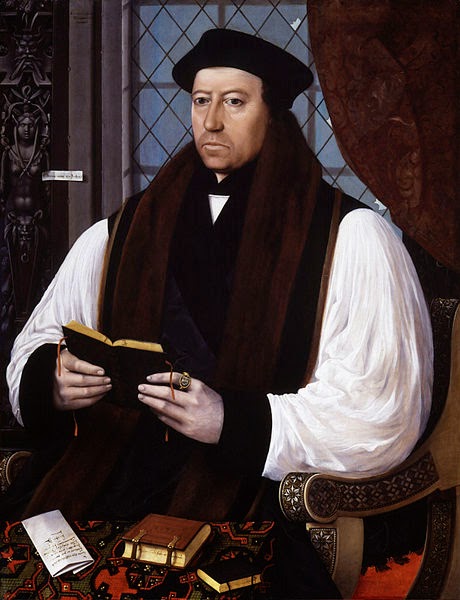
Archbishop Thomas Cranmer, by Gerlach Flicke 
________________________________________

I take thee to my wedded wife, to have and to hold from this day forward, for better, for worse, for richer, for poorer, in sickness, and in health, to love and to cherish, till death us depart.
- Archbishop Thomas Cranmer - Book of Common Prayer (1549) -
________________________________________

Although Thomas Cranmer is often considered by historians to be a cautious reformer, his marriage liturgy composed for the Church of England in the Book of Common Prayer introduced a very radical and innovative concept. Beyond the traditional rationals of avoidance of sin and procreation, marriage became for the first time by definition an enjoyable partnership between a man and woman who vowed to "love and cherish" one another.

In our modern era, the thought that God brings people together as kindred spirits and soul mates is embedded in our very societal norms and cultural identity, but in Cranmer's world, his theological stance was revolutionary. Just how did he form his scriptural interpretation of marriage? Many would propose his study of the First Epistle of the Corinthians may have influenced Cranmer's thoughts, but more likely his scriptural studies were personified in his love for two women, a love so profound that he took enormous personal and professional risks uncharacteristic to his highly cautious personality.

Thomas Cranmer certainly was not a priest who kept a mistress as many of his time did. No, this was a man who instead threw to the wayside his vows of clerical celibacy, a practice he came to believe to be a pagan invention, and instead vowed to the women he loved "to love and to cherish, till death us depart", not literally in those words, but certainly in spirit and practice. 

Thomas Cranmer's first tragic marriage is a mere footnote to history, a short relationship with a woman named Joan. Cranmer rarely spoke about the marriage, and then only to those he most trusted. The memories were understandably too painful. 

In 1515, Cranmer was conferred a Masters Degree in Divinity at Jesus College, Cambridge and was elected to highly sought fellowship. At some point between 1515 and 1519, Cranmer met and married Joan, and in so doing was stripped of his fellowship, along with all affiliation with Jesus College. With no home of his own, Cranmer turned to a family member in Cambridge, a female proprietor of an inn called The Dolphin. There his wife lived, while he worked as a common reader and resided at Buckingham College. 

Cranmer's trusted secretary Ralph Morice reported that the marriage ended tragically within a year. Joan, surname unknown but reported to be either Black or Brown at Cranmer's heresy hearings in 1555, died in child bed, along with their baby. This unfortunately all too common 16th century event changed the course of history, altering the course of the impending English Reformation.

Soon after his wife's and child's deaths, Cranmer was readmitted to Jesus College. He subsequently was ordained a priest in 1520. As the years past, Roman Catholic detractors and later Roman Catholic recusants commonly scorned Cranmer's wives to discredit him. 

Regarding his first marriage, Cranmer was proclaimed to be an ostler (a caretaker of horses), while the elusive Joan was labeled, "black Joan of the Dolphin". Detractors armed with little detail of the heart-wrenching short marriage painted "black Joan" as a sinful whore, obviously pregnant before marriage.

________________________________________

What the heart loves, the will chooses and the mind justifies.
-- Thomas Cranmer, Archbishop of Canterbury --
________________________________________


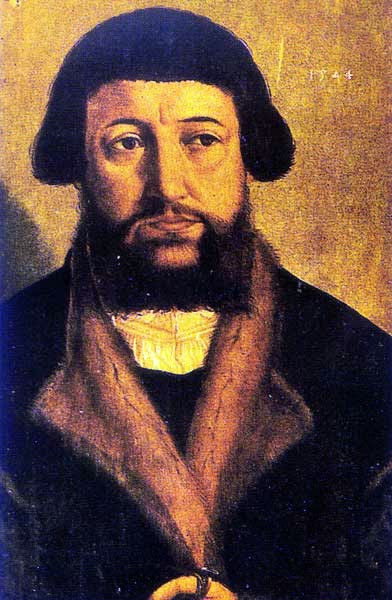
Andreas Osiander, German Lutheran Theologian
In July 1532, Thomas Cranmer, then an ordained priest, Archdeacon of Taunton and England's Ambassador to the Holy Roman Emperor, King Charles V of Spain, married once again. While following King Charles throughout Europe, he visited the independent city of Nuremberg, then increasingly Lutheran in both it's governance and religious teaching.

At the time Cranmer arrived in Nuremberg, his theological beliefs very closely aligned with King Henry VIII. Besides a strong belief in the Royal Supremacy, Cranmer was highly humanist in his thinking, heavily influenced by Desiderius Erasmus. Thomas Cranmer's two visits to Nuremberg, however, unleashed a watershed change in Cranmer's religious beliefs, which were heavily influenced through a friendship he developed with Lutheran priest and theologian, Andreas Osiander.

Beyond the religious discussions Cranmer and Osiander enjoyed, which influenced both men's theological development, Andreas Osiander, as well as other Lutheran priests in Nuremberg, was happily married with children. He introduced Cranmer to his niece, Margarete (surname unknown) over dinner.

Soon after, Cranmer did the absolutely unthinkable for a priest working directly in service for the King of England. He ignored his vows of clerical celibacy and married yet again, a Lutheran woman at that. The risks were incalculable. What was the man thinking? Perhaps Cranmer decided it was God's will. If so, he was right. Though the marriage endured years of secrecy and long separation, Thomas Cranmer and his wife begot children and lived openly and by all appearances lovingly upon the ascension of King Edward VI.

Now secretly married, Archdeacon Thomas Cramner continued his services to King Henry VIII through his Ambassadorship to the Holy Roman Emperor, following King Charles through his travels. Given the Holy Roman Empire's ongoing war with the Ottoman Empire, Cranmer's job was a dangerous one indeed. He eloquently updated King Henry VIII, often in cypher, of the horrors he witnessed.

Unknown to Cranmer at the time, William Warham, Archbishop of Canterbury, died August 22, 1532. The death, though not unexpected, provided King Henry VIII, Thomas Cromwell, and the Boleyns with an outstanding opportunity to hand select a new Archbishop like minded to resolving the "King's Great Matter".

Who was their man? Certainly not Bishop Stephen Gardiner, who though highly qualified, recently enraged the King through his defiance over Church liberties. Instead, at the urging of the future Queen of England, King Henry VIII appointed the Boleyn family patroned Archdeacon Cranmer, a move that stunned everyone but those who proposed it. After all, Thomas Cranmer's title of Archdeacon was largely honorary. He never administered a single parish, let alone a diocese.

In October 1532, Cranmer was shocked to learn of his appointment while on assignment in Italy. Commanded to return home immediately to prepare for his consecration as Archbishop of Canterbury, he was left to sort out what steps were needed to safeguard the secrecy of his marriage and more importantly, the safety of his wife.
________________________________________

Those that God hath joined together let no man put asunder.
-- Book of Common Prayer (1549), translated from the Book of Matthew --
________________________________________

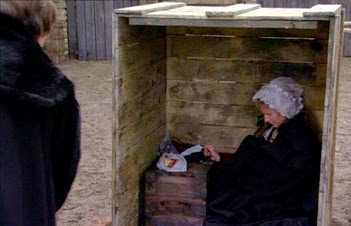
Thomas Cranmer's wife depicted hidden in a crate.
Julia Wakeham, The Tudors, Showtime
Exactly when Margarete Cranmer stepped on English soil is not known, but all indications are that she arrived after her husband's return. Where did she live? A closely guarded secret successfully kept, her location was and still is unknown. Margarete certainly was not either at Lambeth Palace, where a German woman's presence would elicit curiosity -- nor as humorously and commonly believed, hidden in a large wooden box.

In December 1543, Thomas Cranmer endured the personal tragedy of his palace at Canterbury being destroyed by fire. One of his brothers-in-law and several of his faithful servants were killed.

Saved from the fire was a precious box owned by the Archbishop, the contents within unknown. This in turn evolved into a story commonly enjoyed and told repeatedly by Roman Catholics during the reigns of Queens Mary and Elizabeth Tudor. Margarete was hiding in that box. Well, of course she was!

Shortly after Thomas Cranmer's martyrdom, detractors published a widely distributed and humorous story weaving a plot where during the reign of King Henry VIII, Cranmer traveled throughout England with his wife, carefully hidden in a large crate with breathing holes. Later versions of the story portray Cranmer anxiously praying for the safe retrieval of a precious wooden crate during the Canterbury Palace fire, the box of course containing "this pretty nobsey". Unfortunately, this is our only hint of Margarete Cranmer's appearance.

In reality, a complete silence enveloped Margarete Cranmer during her stay in England throughout the 1530's. For all intents and purposes, she was invisible. For the politically naive Thomas Cranmer, this was an outstanding accomplishment. In fact, the feat was "astonishing", claims historian Diarmaid MacCulloch. With conservative detractors seeking any way possible to upend him for good, Cranmer's ability to keep his wife and later also his daughter safe speaks to his steadfast commitment to his family and his remarkable resourcefulness.

Unfortunately, even with Thomas Cranmer's great caution, by 1539 it became too dangerous for his wife Margarete and their young daughter Margaret to remain in England. The passage of the Act of Six Articles through Parliament, which included a mandate of strict adherence to clerical celibacy, imposed all married clergy put away their wives. The risk to his family now untenable, he arranged for their exile in Europe. Thus, Thomas Cranmer was separated from his family for the remaining eight long years of King Henry VIII's reign.

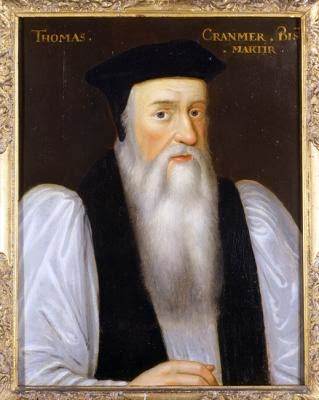
Upon the death of King Henry VIII, Archbishop Thomas Cranmer became theologically liberated to craft a Church of England in line with his increasingly Protestant religious beliefs. His first two decisions clearly forecast the sweeping reforms to come. Cranmer began growing a beard, commonly known to be a casting away of Roman Catholicism and papal authority. Far more importantly, he brought his family home.

For the first time since marrying 15 years earlier, Thomas and Margarete Cranmer lived openly as man and wife. An utter astonishment to all those but the very few entrusted through the years, their long kept secret was finally revealed. Unfortunately, they enjoyed a mere five years of family life together before the untimely and premature death of King Edward VI. Soon after, Archbishop Cranmer was arrested by Queen Mary Tudor. His fate sealed, Cranmer's separation from Margarete and his two children, the youngest less than five years old, was permanent.

Thomas Cranmer's arrest, imprisonment and eventual execution a foregone conclusion, some sources propose that with the help of friends in the London printing community, Margarete Cranmer and her daughter escaped the wrath of Queen Mary Tudor and again lived in exile in Europe. Whether reports Margarete fled England are accurate, the London printing community was forefront in her sheltering and protection.

Cranmer's young son, Thomas, was entrusted to the care of his brother, Edmund Cranmer. They too fled with 100% certainty to the Continent. Without the support of his family, and then later colleagues Hugh Latimer and Nicholas Ridley, the Archbishop completely broke down, signing the recantations so damaging to his legacy.

Eventually, after Thomas Cranmer's magnificent final speech and ultimate martyrdom at age 66, the much younger Margarete remarried his close friend and favored publisher, Edward Whitchurch while still in Europe. Upon the ascension of Queen Elizabeth Tudor, the couple settled down with her daughter of Thomas Cranmer in Surrey.

Widowed once more, Margarete married yet again, this time to Bartholomew Scott. Some historical sources claim that Scott married Margarete solely for her money, so she reportedly left him, seeking refuge with Thomas Cranmer's close friend Reyner Wolfe, yet another London printer who hailed originally from the Netherlands, and his wife.

Margarete Scott, widow of  Thomas Cranmer, England's first Protestant Archbishop of Canterbury, died on a date lost to history during the 1570's. Unfortunately for us all, her legacy to the nation is unknown but to her family, those who knew her and God.
____________________________

SOURCES:

Author Unidentified, Thomas Cranmer (1489 - 1556), Luminarium: Anthology of English Literature

Author Unidentified, Thomas Cranmer (Archbishop of Canterbury), tudorplace.com.

Foxe, John, "The Life, State, and Story of the Reverend Pastor and Prelate, Thomas Cranmer, Archbishop of Canterbury", Foxe's Book of Martyrs

MacCulloch, Diarmaid, Thomas Cranmer, A Life, Yale University Press, 1996.
____________________________


Beth von Staats is a short story historical fiction writer and administrator of 


____________________________

Friday, May 16, 2014

Avoiding the Tooth-Pullers: Dental Hygiene, Eighteenth-Century Style

by Diane Scott Lewis

Up through the seventeenth century, dental care was erratic. Tooth extraction was usually performed by barber-surgeons and had a horrific and painful connotation. That pain and irregularity continued into the eighteenth century. Teeth were hammered loose and jerked out sideways. Sometimes the patient was laid out on the floor with his head between the surgeon’s knees for the extraction of rotten teeth.


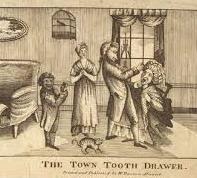
To advertise their services as "tooth-pullers," these barber-surgeons hung rows of rotten teeth outside their shops.

Thankfully the dental field did evolve in this century. Frenchman Pierre Fauchard (1678 –1761) is considered the father of modern dentistry. A highly skilled surgeon, he made remarkable improvements in dental instruments, often adapting tools from watch makers, jewelers and even barbers. He introduced dental fillings as treatment for dental cavities. He insisted that sugar derivate acids like tartaric acid were responsible for dental decay—a man ahead of his time.

In Britain "Operators for the teeth" developed into "dentists." Samuel Darkin, who practiced in Whitechapel in the 1760’s, advertised himself as "Surgeon-dentist to his Majesty; Families attended by the year." Several women combined dentistry with other skills, such as the enterprising Madame Silvie who made and fitted artificial teeth. "Those who don’t chuse to make their grievances known by asking for the Artificial Teeth-maker may ask for the Gold Snuff-box and Tweezer-case Maker."

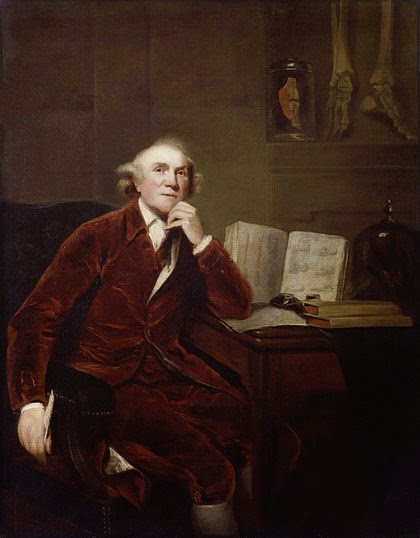
British surgeon John Hunter penned two important books in this time period, Natural History of Human Teeth (1771 ) and Practical Treatise on the Diseases of the Teeth (1778). In 1763 he entered into a period of collaboration with the London-based dentist James Spence. Hunter theorized the possibility of tooth transplants from one person to another.

The fear of tooth-pulling remained widespread (and without modern pain-killers it was understandable). After her niece’s excruciating experience, Jane Austen declared she would not let Mr. Spence "look at my teeth for a shilling a tooth and double it!"

Horse hair toothbrush
Basic dental hygiene was little more than a toothpick and wiping down your gums with a cloth. Women suffered tooth loss worse than men due to vitamin loss during pregnancy. The poor also struggled with dental care. They were more concerned with buying food for their family than paying for tooth powders and the newly invented mass-produced toothbrush.


But dental procedures and care gained respect in the later eighteenth century. To avoid the pain of tooth extraction, or the expense of dentures, the art of teeth cleaning advanced.

England’s William Addis (a rag trader) is believed to have invented the first mass-produced toothbrush in 1780. In 1770, jailed for causing a riot, he found the prison method to clean teeth—rubbing a rag with soot and salt over your teeth—ineffective. From one of his meals, he saved a small animal bone, drilled it with holes, and obtained bristles from a guard. He tied the bristles into tufts in the holes and sealed them with glue. After his release, he started a business that would manufacture his toothbrushes, and he became very rich.


With the desire for better hygiene came the marketing of toothpaste and powders. These were hyped as not only keeping teeth clean but in a time of rampant pyorrhoea and scurvy, useful for fastening in those pesky loose teeth. Toothpowder came in a ceramic pot and was available either as a powder or paste. The ingredients could include crushed bones, oyster shells and pumice. The rich applied it with brushes and the poor with their fingers. 

A 1780 recipe for tooth powder:

1 1/2 oz. dragons blood (not easy to find I imagine)
1 1/2 oz. cinnamon; and 1 oz. burnt alum.
Beat the above ingredients together and use every second day.

Horace Walpole put his faith in alum. He’d occasionally dissolve a lump in his mouth to keep his teeth strong. It must have tasted terrible.

Fauchard recommended using your own urine to clean your teeth—something that was always handy. Another method was bashing the end of a wooden skewer, to render it brush-like: "You must clean your teeth with this brush alone...once a fortnight, not oftener, dip your skewer brush into a few grains of gunpowder..."

Not surprisingly, most of these concoctions and methods did more harm than good by destroying tooth enamel. Lord Chesterfield warned against the use of these sticks or any hard surface, as they "destroy the varnish of the teeth." Smart man.

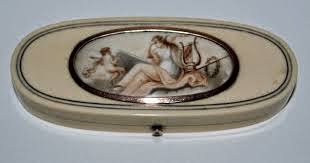
Delicate gold-handled toothbrushes, sometimes with replaceable heads, were included in the cases of toilet instruments for the rich. Toothpicks made of quills were the eighteenth-century dental floss and were kept in pretty jeweled boxes. Sounds more for show than practical use.


Fortunately for us, the knowledge and advantage of dental hygiene improved greatly in the years to come.

Sources: Dr. Johnson’s London by Liza Picard, and Wikipedia.

My eighteenth-century characters, all strong-willed women, thankfully had healthy teeth: check out my website to visit the wilds of Cornwall:

http://www.dianescottlewis.org