Wednesday, June 20, 2012

Culpeper's Complete Herbal

by Farida Mestek

“Culpeper, the man that first ranged the woods and climbed the mountains in search of medicinal and salutary herbs, has undoubtedly merited the gratitude of posterity.” 
Dr. Johnson 

I wanted to get my hands on this book ever since I heard J.K. Rowling mentioning it in one of the old interviews and calling it an answer to her every prayer, because [she said] she is not a gardener at all and her knowledge of plants is not great and she used to collect names of plants that sounded witchy and then she found this – Culpeper's Complete Herbal – and it supplied her with everything that she needed for potion-making, because this book is perfect in that it lists plants, their medical and occult properties and also recipes. 

The book that I bought was published in 1981 and it was reproduced from an original edition published in 1826 and consists of both Culpeper's Complete Herbal and English Physician and you have no idea how astonishing it was for me to find it here in Ukraine and just when I needed it for my current WIP too. Of course, I have long since discovered its whereabouts on the Internet but it's so much better to have the actual book, not to mention that it's much more convenient for doing research. So... 


Nicholas Culpeper (18 October 1616 – 10 January 1654) was an English botanist, herbalist, physician and astrologer. His published books include The English Physician (1652) and the Complete Herbal (1653), which contain a rich store of pharmaceutical and herbal knowledge, and Astrological Judgement of Diseases from the Decumbiture of the Sick (1655), which is one of the most detailed documents we have on the practice of medical astrology in Early Modern Europe. 

Culpeper spent the great part of his life in the English outdoors cataloging hundreds of medicinal herbs. He studied at Cambridge and became apprenticed to an apothecary. He married the daughter of a wealthy merchant, which allowed him to set up a pharmacy in the halfway house outside the authority of the City of London at a time when medical facilities in London were at breaking point. Arguing that “no man deserved to starve to pay an insulting, insolent physician”, and obtaining herbal supplies from the nearby countryside, Culpeper was able to provide his services for free. 

This, and a willingness to examine patients in person rather than simply examining their urine, Culpeper was extremely active, sometimes seeing as many as forty people in one morning. He used a combination of his experience, astrology and herbals to treat their illnesses. During the early months of the English Civil War he was accused of witchcraft and the Society of Apothecaries tried to rein in his practice. 

Alienated and radicalised he joined a trainband in 1643 and fought at the First Battle of Newbury, where he carried out battlefield surgery. Culpeper was taken back to London after sustaining a serious chest injury from which he never recovered. He died of tuberculosis at the age of 38.


I am fascinated by the kind of language that he uses in his book and I admire his complete faith in herbs against all possible diseases (even though I myself do not quite believe in them). Here is one such example (just something that everyone is well familiar with): 

The Mulberry-Tree 

This is so well known where it grows, that it needs no description. 
Time: It bears fruit in the months of July and August. 
Government and virtues: Mercury rules the tree, therefore are its effects variable as his are. The Mulberry is of different parts; the ripe berries, by reason of their sweetness and slippery moisture, opening the body, and the unripe binding it, especially when they are dried, and then they are good to stay fluxes, lasks, and the abundance of women's courses. The bark of the root kills the broad worms in the body. The juice, or the syrup made of the juice of the berries, helps all inflammations or sores in the mouth, or throat, and palate of the mouth when it is fallen down. The juice of the leaves is a remedy against the biting of serpents, and for those that have taken aconite. The leaves beaten with vinegar, are good to lay on any place that is burnt with fire. A decoction made of the bark and leaves is good to wash the mouth and teeth when they ache. If the root be a little slit or cut, and a small hole made in the ground next thereunto, in the Harvest-time, it will give out a certain juice, which being hardened the next day, is of good use to help the tooth-ache, to dissolve knots, and purge the belly. The leaves of Mulberries are said to stay bleeding at the mouth or nose, or the bleeding of the piles, or of a wound, being bound unto the places. A branch of the tree taken when the moon is at the full, and bound to the wrists of a woman's arm, whose courses come down too much, doth stay them in a short space.

Tuesday, June 19, 2012

A Witch's lair found buried under a Mound

by Deborah Swift


Mother and daughter
from the Chattox family
Darkest December last year - a group of workmen unearth a spooky find.... 

Near Lower Black Moss reservoir, close to the village of Barley in England workmen were digging a trench for a new water main. That was until they suddenly struck rock, and began to find the outlines of walls and doorways.

Beneath a grassy mound in the shadow of Pendle Hill they found a remarkably well-preserved 17th century building. United Utilities' workers were  amazed to find a witch's-style cottage, complete with a mummified cat sealed into the walls. Immediately links were made to the famous Pendle Witches, who were tried for witchcraft 400 years ago this year in 1612. The fame of the Lancashire Witches in England is similar to that of the Salem Witches in the States, so excitement was running high.

Simon Entwhistle, an expert on the Pendle Witches said; "Cats feature prominently in folklore about witches. Whoever consigned this cat to such a horrible fate was clearly seeking protection from evil spirits," His view was that the cottage could even be the famous Malkin Tower, the site of a notorious meeting between the Pendle witches on Good Friday in 1612.

The cottage is said to be in remarkable condition although most of the objects unearthed seem to have been from the 19th-century - artefacts such as crockery, a cooking range and a bedstead, so whether this is really anything to do with the Lancashire Witches is purely conjecture. Still, the Lancashire Witches have such a hold on the local imagination that it is tempting to ascribe any find in this area to those times.

"In terms of significance, it's like discovering Tutankhamun's tomb. We are just a few months away from the 400th anniversary of the Pendle witch trials, and here we have an incredibly rare find, right in the heart of witching country," Mr Entwhistle said.

View of the unearthed cottage walls


And a few months later, we have reached the 400th anniversary of the Pendle Witches, when ten people were hanged accused of the deaths of other villagers by witchcraft. They were executed at Lancaster on the 20th of August, 16I2, for having bewitched to death 'by devilish practices and hellish means' no fewer than sixteen inhabitants of the Forest of Pendle. All over Lancashire events are being organised to commemorate the women who died, unjustly condemned to death on the hearsay of their neighbours.


The Demdike family and the Chattox family were the main victims of the witchhunt. Their story was well-documented in "A Discoverie of Witches", a pamphlet of the time. The full story is a complicated one, but almost everything that is known about the trial is in this report written by Thomas Potts, the clerk to the Lancaster Assizes, completed by 16th November 1612. 

At the end of the 16th and into the 17th century Lancashire was regarded by the authorities as a wild and lawless region: an area "fabled for its theft, violence and sexual laxity, where the church was honoured without much understanding of its doctrines by the common people." (Hasted) In addition, James I was obsessed with daemonology and witches, and only fuelled the nation's enthusiasm for finding witches where none existed.

It is from these dark times and this grim northern environment that the two sisters, Sadie and Ella Appleby in The Gilded Lily go on the run. Ella has been involved in a Witch Trial, the story of which is told in The Lady's Slipper.They hope to re-invent themselves and find glitter and glamour in fashionable London.

The Gilded Lily: "A beautifully-written blend of fast pace and historical detail" - Gabrielle Kimm
The Lady's Slipper: "Her characters are so real that they they linger in the mind long after the book is back on the shelf. Highly Recommended." Historical Novel Review

As for the mummified cat - concealing things in old buildings was very common in the 17th century. One of the most common things found in old buildings is shoes. Nobody knows why, but it was supposed that a shoe trapped the spirit of the wearer, and some 1,700 concealed shoes have been found—not just in Britain, but in Germany, Australia, Canada and the United States.
More research on concealed shoes can be found here
More on the story of the Archaeological find here at The Guardian 
And I would be interested to hear if anyone else has come across concealed objects in buildings, and what they were.

Monday, June 18, 2012

Giveaway of The Queen's Lady by Barbara Kyle

Barbara Kyle is giving away a signed copy of The Queen's Lady (Book #1 in the "Thornleigh" series). This giveaway ends at midnight Sunday June 24th. For information about The Queen's Lady please click HERE. Leave a comment here to enter the draw, and be sure to leave your contact information.

Sunday, June 17, 2012

Priceless: The Author-Reader Bond

By Barbara Kyle

There's a giveaway on this site of my novel The Queen's Gamble this week, and it got me thinking about the bond between reader and author. Most of us vividly recall a book that changed our lives, whether as young adults or at a crucial moment later in life. That moment makes us feel a special kinship with the author. It's a meeting of minds - even of souls. A potent bond, indeed.

Ask any author and they'll tell you it's always a happy day when a reader gets in touch to say how much that author's book has meant to them. Sometimes the message is moving, like the Yarmouth museum curator who told me The Queen's Lady helped him as he mourned the death of his father. Sometimes the message brings a laugh, like the lady who cheerfully told me she got The Queen's Captive out of the library because she remembered having loved a similar book, and then realized, as she was enjoying The Queen's Captive, that this was the very book she'd read and loved!

Here are three readers whose messages to me were special.

The Colonel 

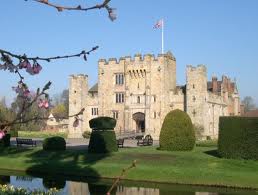
Some years ago I was in England researching The Queen’s Lady and spent a day exploring Hever Castle in Kent. This was the home of the Boleyn family, and Henry VIII came here to court Anne. That tempestuous affair, as we know, changed the course of England’s history.  

Hever Castle
As I strolled the grounds in a happy haze of imagination, I picked up an acorn. What a lovely feeling to hold in my hand something living from the so-called "dead" past. I squirreled the acorn away in my pocket and brought it home to Canada, and it sat on my desk beside my computer, a sweet reminder of its place of birth as I wrote The Queen’s Lady. The acorn was still on my desk when I wrote The King’s Daughter. It had become a touchstone that spirited me back to the Tudor world. I was very fond of it. 
 
Then my husband and I moved, and in the shuffle the little acorn got lost.

A few months later I got a cheery email from a reader telling me he was on his way to England for an Anne Boleyn Tour during which he’d be staying at Hever Castle. There would be dinners in the Great Hall where Henry and Anne ate, plus lectures, plays, and demonstrations – “A once in a lifetime experience,” he said. I replied to wish him a happy trip and told him about my acorn. He is a retired air force colonel and lives in Tennessee.

Four weeks later a small package arrived in my mailbox. It was from the Colonel. Inside was a note: “I looked for an acorn to replace the one you lost but couldn’t find one.  I did get you this.” Nestled under the note was a pine cone. He had scoured the Hever grounds for it. “It’s from the area where Henry courted Anne, according to the castle staff,” wrote the Colonel. 

I was so touched. The pine cone now sits on my desk beside my computer as I write the next “Thornleigh” book. Thank you, Colonel, for what you gave me. A once in a lifetime experience.


The Embroiderer

A music educator in Ontario recently emailed me with praise about my books and told me she was part of a sewing club of about three dozen ladies who get together at the delightfully-named shop The Enchanted Needle. She said they were working on Tudor period sewing techniques, and she attached images of historic Tudor-era embroidery. Now, I know little about sewing, but I know beauty when I see it.  

Edlin Jewelry Case

Parham Park House


Wollaton Cap

As she waxed lyrical about bygone sewing techniques like "stumpwork" and "Assisi," "blackwork" and "bargello," "cross-stitching" and "the morphing power of color," I could only, in ignorance, try to keep up, but when she said my books inspired her in this Tudor-era needlework I was moved again by how glorious and various are the connections between author and reader.


The Boy

That's what I'll call him, the gangly pale-faced kid who showed up at a public reading I did from The Queen's Gamble and listened so intensely. He looked about fourteen, the only person there who was so young. After the reading I saw him at the edge of the knot of people I was chatting with. The others all asked lively questions, but he said nothing. He looked like he wanted to, but he never took a step nearer. When I finished talking to the eager questioners, I noticed the boy was gone.

Some days later I found in my mailbox a package: a slender book and a note. The writer of the note said he'd been at the reading, and was a high school student who loved history, and he hoped to one day be a history teacher. My novels were his favorites, he said. The book he'd enclosed was Bloody Tower by Valerie Wilding, a young adult novel in the form of a Tudor girl's diary. It had meant a lot to him when he was younger, he said, so he wanted to share it with me.


There, now I've shared it with you. That's what the writer-reader bond is. We share what touches us. And that connection is what makes the writer's work a joy.

________________________________

Barbara Kyle is the author of the acclaimed "Thornleigh" novels which follow a family through three turbulent Tudor reigns. All are published internationally.

The Queen's Gamble an "Editor's Choice" of the Historical Novels Review

Her upcoming novel The Rival Queens features Elizabeth I and Mary Queen of Scots. It will be released in early 2013. See Barbara's blog post on this site about these two famous rivals.

Twitter: @BKyleAuthor

Saturday, June 16, 2012

The Royal Coat of Arms

by Debra Brown

Royal Coat of Arms of the United Kingdom of Great Britain and Northern Ireland. Heraldry.

Officially the Coat of Arms of the British monarch, currently Queen Elizabeth II. The Coat of Arms is used by the Queen as monarch and is officially known as her Arms of Dominion.

Many images and symbols make up the Coat of Arms, and each represents something specific.

At the bottom is a white ribbon or banner which reads Dieu et Mon Droit. This is French, meaning God and my Right. French was the language of the Royal Court at the time of the introduction of the words by Edward III in the 14th century. At the time, it was believed that the monarchs were answerable only to God.

This motto is not required on the Coat of Arms, and although most monarchs used it, there were a few that did not. Queen Anne used Semper Eadem, which means Always the Same.

Originally, mottoes may have been associated with badges or war cries, but they usually expressed loyal or pious sentiments or a play on the name of the bearer. Henry IV was apparently the first monarch to adopt a motto on the Royal Arms with Souverayne, which meant Sovereign. His son, Henry V, first adopted Dieu et mon Droit.

Behind the banner on the Royal Arms, a grassy mound incorporates the plant emblems of Scotland (thistle), Ireland (shamrock) and England (rose).

The shield has evolved in shape from its Medieval long ‘kite’ shape in the late 1100s into the ‘flat iron’ shape used today. This mirrors the change in actual shields. The kite-shaped shields were large, covering almost half of the bearer’s body. As armour became more sophisticated, shields became smaller until they were about a third the size of the bearer.

It wasn’t thought appropriate for the arms of a woman to be shown on a shield connected with warfare, therefore they are always shown on a lozenge or diamond shape shield.
 
The first and fourth quarters of the shield of the current Royal Arms (at the top left and bottom right): In both, there are three golden lions, one above the other on a red background representing England. They walk facing out with flexed blue claws and tongues sticking out.

The second quarter (at the top right): There is a red lion on a gold background representing Scotland. Standing on his hind legs, he faces forward with blue flexed claws and his tongue sticking out. There is a double border decorated with fleur de lis alternating in direction.

The third quarter (at the bottom left): A golden harp with silver strings is sitting on a blue background representing Ireland. The Harp has been the symbol of the Kingdom of Ireland since the early 1200s. The harp is on 8th and 9th century stone crosses and manuscripts and is said to represent the Biblical King David. This possibly explains why harpists have always been a favorite in Ireland. Added in 1541 to the Royal Arms, it now represents only Northern Ireland.

Around the shield you will find the Order of the Garter. It is a French Royal blue ‘belt’ with the motto Honi Soit Qui Mal y Pense, meaning Shame on Him who thinks Evil of it. The Order of the Garter, founded by Edward III in 1348, was inspired by King Arthur and the Knights of the Round Table. It is a symbol for one of the oldest and most senior orders of chivalry. Though the order was founded by Edward III, it was King Henry VIII who added the symbol to the Royal Arms.

The fleur de lis at the bottom of the garter appeared first on the French Royal Arms in the 1100s and was included on the English Royal Arms in 1340. It existed as an emblem long before its use on heraldry when it appeared on the top of the scepter and as on ornament on crowns. Its origins have been widely debated.

The helmet, or helm, sitting atop the shield is based on real helmets that were worn in battle. The shape was originally a simple, cylindrical steel design with a flat top and, at times, gold embellishments. This evolved into more elaborate designs which would never have been used on a real battlefield, but looked more convincing.

During the reign of Elizabeth I a unique style of helm was designed for the Royal Arms – gold with a barred visor, facing the viewer. This has been used ever since. From the 17th century stylized forms of Medieval helm have been depicted to indicate the rank of the bearer: the melee helm for a peer; the barriers helm for baronets and knights; and the tilting helm for gentlemen.

Tied to the helmet atop the shield is the mantling, a cloth of gold trimmed with ermine fur. The mantling is based on the small cloak that hung from a knight's helmet over his shoulders to protect him from the elements. Often torn or jagged from the cuts and slashes it had received in battle, it would have greatly enhanced a knight’s reputation on his return home.

The mantling is usually in the principal colours (tinctures) and metals of the shield. Generally a colour on the outside and metal or fur in the lining is depicted, however; the Royal Arms is a rare exception to this as it uses a metal and a fur and no colour. It was originally a red cloth lined with ermine fur, but Elizabeth I altered it.

The crest is a group of symbols atop the helmet. The royal crest is a stately lion standing on the crown facing us and wearing a gold crown himself.

Real crests were attached to a knight’s helmet so he could be easily recognized in battle. Originally a practical object, the crest degenerated into a farce when it became a drawn formality, rather than worn. Crests appeared in the shape of enormous monsters, odd ships or clouds, for example, which would have considerably hampered a knight had they been worn.

The supporters of the shield are the animals that stand on either side to hold and guard it. On the left, the most important side, is a crowned, gold lion looking towards us, representing England. Lions represent great strength, ferocity and majesty- the king of beasts. Though very few people in Europe had ever seen one, the symbol was used. The first actual lion arrived in England during the reign of Henry I (1100-1135) to be kept in his zoo at Woodstock.

In the early days of heraldry, emphasizing their fierceness, lions were shown as rampant or passant. Many people wanted to have lions on their coats of arms, and it became necessary to have sixty or more different positions so that no two coats of arms were alike.

On the right is a silver Unicorn with a gold horn, a mane, beard and hooves, representing Scotland. Chained to the compartment, he has a coronet around his neck with alternating crosses and fleur de lis.

Unicorns were well known through classical Greek and Roman texts, the Bible and Medieval beasteries. They were described as large and very fierce. Thus they were chosen to guard the Royal Arms, and and it explains why they are always shown chained up. A unicorn’s whiteness symbolised purity and chastity, later leading to them being seen by some as symbols of Christ and his incarnation.

In England, supporters were not integral originally to the Royal Arms and were subject to frequent change. Only in the 15th century did their use became consistent. Since then, various imaginary and real beasts have been used. Examples include the hart, greyhound, dragon and bull.

My information in this article comes from The Churches Conservation Trust who contacted me to share their fabulous information near the time of the Queen's Diamond Jubilee. Please visit their website- there is much to be seen! I hope you have enjoyed this history and its symbolism that they have worked so hard to share.

The top picture of the Royal Coat of Arms comes much appreciated from Wikimedia.

Debra Brown is the author of Regency and Victorian stories. The Companion of Lady Holmeshire, an Austen-style story with suspense, was published in 2011 by World Castle Publishing, and Debra is working on For the Skylark, the start of the Dante and Evangeline Suspense Series.

Website
Twitter: @kescah

Thursday, June 14, 2012

Scotland Yard and a New British Mystery

by Mary Simonsen

Although I am the author of several Jane Austen re-imaginings, when I read for pleasure, I like to kick back with a good mystery. After having achieved some success with my Austen novels, I decided to try my hand at writing a mystery. In Three’s A Crowd, Patrick Shea, a young detective sergeant serving at a police station in Greater London, has his eye on a position with a murder investigation team at New Scotland Yard. Part of Scotland Yard’s attraction for Patrick is an organization steeped in history.

London has always been a city of haves and have nots with many unsavory neighborhoods abutting some of London’s most posh addresses. If you walk the streets of Mayfair you might admire the shiny black wrought-iron gates that surround many of the properties. However, they are not there for decoration, but, instead, were used to keep the less fortunate from becoming more fortunate at the expense of London’s well heeled by smashing a window and gaining entrance to the townhouse for the purpose of thievery. Despite having a significant criminal element, London did not have an organized police presence until 1749 when the Bow Street Runners were founded by, believe it or not, Henry Fielding, the author of Tom Jones, who was also a magistrate, and his blind brother, John, aka the “Blind Beak,” who reputedly could recognize 3,000 criminals by the sound of their voices.

Fast forward to 1829 when Parliament passed an act introduced by Home Secretary Sir Robert Peel (who gave his name to the “Bobbies”) in which the first true London police force was organized under the direction of Commissioners Colonel Charles Rowan and Richard Mayne. The men occupied a private house at 4 Whitehall Place, the back of which opened onto a courtyard: the Great Scotland Yard. The Yard’s name was inspired by its site, a medieval palace which housed Scottish royalty on their visits to London.

The police were originally viewed by the public as “spies,” but their role in several important cases cemented their reputation with the citizens of London. Inspector Charles Frederick Field became good friends with Charles Dickens, who occasionally accompanied constables on their nightly rounds. Dickens used Field as a model for the all-knowing Inspector Bucket in his novel Bleak House.


Following a major scandal in 1877, the Metropolitan Police was reorganized, and the Criminal Investigation Department (CID), a respected unit of plainclothes police detectives, was born. In 1890, the police force moved to its new building on the Victoria Embankment, retaining its name, but as New Scotland Yard.

During the second half of the 19th century, one of Scotland Yard’s most durable detectives, Frederick Porter Wensley (aka “The Weasel”), began his 40-year career and investigated cases including the murder of 32-year-old French woman Emilienne Gerard. On the morning of November 2, 1917, street sweepers found Gerard’s torso along with a note reading: “Blodie Belgium.” (This was during the First World War.) Wensley questioned Louis Voisin, Gerard’s lover, asking him to write “Bloody Belgium.” Voisin made the same spelling error indicating his guilt. Wensley may very well have crossed paths with another superlative detective prowling London’s dark underside at this time: Sherlock Holmes.


With the setting of narrow streets and a London encased in a dense fog, the year 1888 also saw the first appearance of Jack the Ripper, who was responsible for five murders between 1888 and 1891 in the Whitechapel area of London. More than 160 people were suspected of being the Whitechapel murderer, including Lewis Carroll, the author of Alice in Wonderland, and painter William Richard Sickert. Two letters received by the Yard gave detailed facts and were signed “Jack the Ripper.” With no more leads or murders, in 1892, the Ripper case was officially closed.


In 1967, the police force moved once again to its present location, a modern 20-story building near the Houses of Parliament. Today, Scotland Yard has roughly 30,000 officers patrolling 620 square miles occupied by 7.2 million citizens.

I hope my post on Scotland Yard has piqued your interest in my novel, Three’s A Crowd. It is available in e-book format only from Amazon. Here is a description:

In Three’s A Crowd, we are introduced to Patrick Shea, a detective sergeant with the Hampden Criminal Investigation Department, whose career is being fast-tracked by the Metropolitan Police in London. With an eye to an appointment with a murder investigation team at New Scotland Yard, Shea is doing everything by the book. Unfortunately, his love life is a bit of a mess and gets messier when he learns his former lover, Annie Jameson, has been assaulted on someone else’s patch. Will Shea’s involvement in the under-the-radar investigation of his ex-girlfriend put his career in jeopardy and possibly her life as well? If you are a fan of the television series Law & Order UK, you will enjoy Three’s A Crowd.

I am having a giveaway of two e-books for Kindle owners only. If you would like to participate, please post a comment and your e-mail address. The final day to enter is Monday, June 18th. Winners will be announced on Tuesday.

The winners are June Williams and Rhonda. Congratulations!


Further reading:
http://knowledgeoflondon.com/bobby.html
http://www.smithsonianmag.com/history-archaeology/brief-scotland.html?c=y&page=2

George III's Golden Jubilee

by Regina Jeffers

With Queen Elizabeth's recent celebration of her Diamond Jubilee, I thought it only appropriate to look at one of the first Jubilee celebrations - that of "Mad King George."

At age 72, George III was still a virile man, who attended to everyday affairs of government. He still rode out regularly with his children, and he took icy dips in the waters off Weymouth. And on October 25, 1809, he was to celebrate his 50th year on the throne. Even those who had once ridiculed the King for his stolid personality and unbending morality cheered the "Kindly King." The King remained his country's leader against the French on the Continent and the Americans across the Atlantic. The King and other members of the Royal Family attended a private service in Windsor and a grand fete and firework display at Frogmore. In London, the Lord Mayor led a procession to St. Paul's Cathedral for a service of thanksgiving before holding a dinner at the Mansion House.

Unfortunately, before the celebration, George III had his "infamous" dream, the one that always announced a return of a return of his "madness." The illness had first appeared when King George was in his mid twenties; next at the age of 50; and again at ages 63 and 66. The symptoms included: insomnia, severe abdominal spasms, agitation, and an "excessive love of talking." It was said that the King would talk for hours and hours, often speaking so quickly he was incoherent. He would contradict himself and repeat himself. He spoke to "nothing" and to everyone until he his voice became hoarse. The King's frenzy took on bizarre forms. He would dash about on horseback, drop his breeches and display his buttocks, knighted his pages, and sent couriers on nonexistent missions.

During his second attack in 1788, the royal physicians declared the King to be suffering from "biliary Concretions in the Gall Duct." The physicians thought the King's "humor" had left his legs and had entered his bowels. However, the medications he was given supposedly drove the humor from his bowels to his brain. To make the "humor" return to the King's legs, they immersed him in hot baths, covered him with multiple blankets, and burned the soles of his feet with plasters of cantharides and mustard. When the King tried to tear off the blisters from his feet, the physicians placed leeches on his head to draw off the "humor" in that manner.

A man named Francis Willis eventually took over the King's treatment. Willis held a reputation for his unique treatment of "lunatics." Willis and his sons Robert and John treated the King as if he were a crazed animal. They constricted the King's movements by binding him in a winding sheet. George III's legs were tied to the bed. A handkerchief was stuffed in the King's mouth if the sovereign used foul language. The King was tied to a restraining chair for hours upon end. He was given tartar emetic, which made him extremely nauseated.

What really amazed everyone was, despite being incapacitated for several months at at time,  how suddenly the King recovered from his illnesses. The mysterious malady simply vanished. On the night of his Golden Jubilee celebration, George III entered the hall at Windsor with Queen Charlotte on his arm. "The dreadful excitement" on his countenance told his gathered children that the malady had returned. Eleven of his thirteen children were in attendance. Amelia was ill (near death), and Princess Charlotte had married the King of Wurttemberg and lived abroad.  George III greeted his daughters (Augusta, Elizabeth, Mary, Sophia) before turning to his sons. The King addressed each son loudly and with a bit too much familiarity for the other guests in attendance.

Afterwards, Queen Charlotte and her daughters retreated to the Queen's chambers. George III was turned over to the latest attempts to cure him. Princess Amelia, who suffered from a similar malady, remained insensible, but aline for another week. Meanwhile, King George thought her living happily at Hanover. In fact, he did not grieve for his darling Amelia. His malady made him unaware of her passing. The family drew together to ward off another round of rumors regarding their father's condition. The Prince of Wales acted as its head. George III died a few months short of his Diamond Jubilee in 1820.

Wednesday, June 13, 2012

Ellis Island and British Immigrants to the USA

by Vincent Parrillo

Most people do not think of British immigrants in connection with Ellis Island. In fact, most historical photographs of the place depict southern, central, and eastern Europeans, easily recognizable in their kerchiefs, folk costumes, or dark-haired, dark-complexioned countenances. In fact, in my own public television (PBS) documentary, Ellis Island: Gateway to America, I utilized many of those same images.

However, many British immigrants also went through Ellis Island. For example, in the 1890s— the period in which my historical novel, Guardians of the Gate, begins its tale of the people and events occurring there—nearly 329,000 emigrants left the United Kingdom for the United States. Some were first- and second-class passengers and therefore processed on board ship and not at Ellis Island. Most, though, were the lower and working classes traveling in steerage, and their first steps on American soil were on the Island. (Included in my novel, for example, is the true
incident of the deportation of a Scottish family.)

Earlier, between 1870 and 1889, about 1.3 million British immigrants arrived. Ellis Island did not exist then, so they were processed at a state-run immigration station called Castle Garden, which previously had been a concert hall, and still stands in Battery Park at the southern tip of Manhattan. That impressive number was lessened somewhat by the hundreds of thousands of British subjects who left, disenchanted with what they had found in America. Perhaps, as Charles Dickens complained after his visit in 1842, they found Americans too rude, arrogant,
anti-intellectual, prone to be violent, and hypocritical. His was a harsh judgment, indeed, but it didn’t stop other Brits from coming. Between 1900 and 1929, another 1.2 million British migrated to the United States. Again, most were first processed at Ellis Island to gain clearance for entry.

Just because they were British didn’t ensure these immigrants would breeze through Ellis Island. For example, among my weekly blogs that relate true immigrant stories is the firsthand account of a Scottish teenager arriving in 1921 with her family and the hunger and other tribulations they experienced there. A more recent blog gives the account of an English minister, whose 1911 detention on Ellis Island so disgusted him that he testified before a congressional committee on the abysmal conditions he encountered. If you’re interested, you can read these and other immigrant tales at vincentparrillo.posterous.com.

Ellis Island was also a transit stop for several notorious or otherwise prominent British subjects. In 1903, anarchist John Turner was detained at Ellis Island and then deported to England because of his political opinions. Her political views kept English suffragette Emmeline Pankhurst detained on the Island in 1913 and then ordered deported by a Board of Special Inquiry on the grounds of “moral turpitude.” A public outcry prompted President Woodrow Wilson to reverse that decision two days later. Sir Auckland Geddes, British ambassador to the United States, inspected Ellis Island in 1922, and his report criticized its lack of cleanliness, inefficiency in handling appeals, smells, and wire cages. The controversial report strained relations between the two countries for a while.

Among some of the well-known British immigrants arriving in the Port of New York (although not all went through Ellis Island) were writer Rudyard Kipling (1892), comedian Henny Youngman (1906), comedian Bob Hope (1908), comedian Stan Laurel (1912), conductor Leopold Stokowski (1912), actor Cary Grant (1920), actor Leslie Howard (1921), and author Joseph Conrad (1923).

Born in London to an English-born cabinet maker of Polish heritage and an Irish-born mother, Stokowski presented what an Ellis Island inspector thought was a good opportunity. He told the future conductor that his name was “foreign” and he would give him a new name. “Thank you very much,” said Stokowski, but my name is Stokowski.” His voice rising more and more, he added, “It was my father’s name, and his father’s before him, and it will stay my name!” The inspector, accustomed to intimidating immigrants by his presence, was taken aback and quickly withdrew the offer.

Other prominent British expatriates who settled in the United States include model and actress Mischa Barton, musician Peter Frampton, labor leader Samuel Gompers, movie director Sir Alfred Hitchcock, actor Anthony Hopkins, actor Peter Lawford, and preservationist John Muir.

On average, about 17,000 British immigrants continue to arrive annually in the United States. These not-so-famous arrivals—mostly known only to their family, friends, and co-workers— settle in many states, but Southern California, particularly the Santa Monica region, has become the permanent home of several hundred thousand first-generation British Americans, who maintain their pubs and traditions among the surfers and rollerbladers.

Mols Coffee House - Exeter

This month, I am looking at a interesting building in the heart of Exeter, Devon called "Mol's" (below).

Mol's 


The four storey building sits overlooking Exeter Cathedral in the centre of the city and has a rich history. Visually stunning, it was built in the 16th century by the Cathedral authority, and throughout it's history has been used for a variety of purposes. First to house priests for the cathedral, and later as a customs house. The Royal Coat of Arms on the front was put there in 1596 to show it's official status as a customs house for the Crown. The Dutch-style gable was added very late on in 1879. Each floor has different style windows, which should make the building look strange, but somehow the building pulls it off, and still manages to look amazing.

It was reputed that Sir Francis Drake discussed battle plans for defeating the Spanish Armada in Mol's, and his family crest is displayed on the oak panelling on the second floor. However, recent research has shown that this was probably not true, and made up by one the Victorian era tenants who used the building as a gallery and wanted to get more people into the building.

However, it is believed that in 1588, Mol's was used as a place where Exeter city men discussed their contribution to the fleet that destroyed the Armada.


Drake Family Crest


Mol's is most remarkable for the fact that for over a hundred years it was a coffee house and all the proprietors were women:

1726 - 1752 Mary Wildy 
1752 - 1787 Margaret Wildier
1787 - 1789 Mrs Vinnicombe. 
1789 - 1792 Mary Murch. 
1793 - 1817 Miss Sarah Hurd (Heard)
1820 - 1832 Mrs Mary Commins - moved business to 253 High Street


Victorian postcard image of the second floor interior of Mol's

Some have said the building was named after an Italian man called Mol, but the name "Mol" being a short version of Mary is now known to be the reason why the building became known as "Mol's". 

Coffee houses were popular throughout this period as places where gentlemen could relax, read the newspapers and catch up on gossip. Though women were often coffee shop owners, it is unusual for six in a row. Mol's was very popular during this time, and often acted as a ticket agent for the Royal Clarence hotel next door. 

Since the coffee shop closed, Mol's has also been used as an apothecary shop, a shoe shop, stationers, jewellers, printers, gallery and map dealers. 

Cathedral Close, Exeter. Mol's is on the right,


These days the building is a gift shop for exclusive gifts and remains one of the most photographed buildings in Exeter.


Jenna Dawlish


Monday, June 11, 2012

Evening Amusements

by V.R. Christensen

My friends and family are aware of my strange (to them) fascination with old books, and so, at times, I'm blessed with random gifts of literary kindness.


Recently, I was given a very old and fascinating copy of a book called Evening Amusements, which describes, and gives detailed instructions for parlour games and tricks and various other suggestions for activities that might while away the evening hours in a time before t.v., internet and cinema. I believe the book was printed in the 1880's. Some sources say 1870's, but certainly by 1880 it was in publication.

Preface
With the winter time of the year, a book like this should prove a welcomed guest; as it is essentially intended as a book to amuse, to pass quickly away the long nights, to add to the festivity of Evening Parties, and to be a pleasurable companion on all Social Gatherings; for it is to be hoped we are none of us so old or so crusty but that we can still appreciate

"Jest and youthful jollity,
Sport that wrinkled Care derides,
And Laughter, holding both his sides."

 With this book as one's guide, we are promised that we will never find ourselves, 'for an evening's entertainment, like the poor old lady in this picture' . . .
 
The Game of Frog in the Middle
A player selected by lot sits on the carpet, while the others form a circle round him, taking him unawares every time he turns his back, pulling him, pinching him, buffeting him, and pulling his hair. When he succeeds in catching one of them the captive must change places with him. As the players dance and caper round the Frog they cry "Frog in the middle—catch him who can."

The Game of the Huntsman
This game is one of the liveliest winter evening's pastimes that can be imagined. It may be played by any number of persons above four. One of the players is styled the "Huntsman," and the others must be called after the different parts of the dress or accoutrements of a sportsman: thus, one is a coat, another a hat, whilst the shot, shot-belt, powder, powder-flask, dog, and gun, and every other appurtenance belonging to a huntsman, has its representative. As many chairs as there are players, excluding the huntsman, should next be ranged in two rows, back to back, and all the players must then seat themselves; and being thus prepared, the huntsman walks round the sitters, and calls out the assumed name of one of them; for instance, "Gun!" when that player immediately gets up, and takes hold of the coat-skirts of the huntsman, who continues his walk, and calls out the others one by one. Each must take hold of the skirts of the player before him, and when they are all summoned, the huntsman sets off running round the chairs as fast as he can, the other players holding on and running after him. When he has run round two or three times, he shouts out "Bang!"and immediately sits down on one of the chairs, leaving his followers to scramble to the other seats as they best can. Of course one must be left standing, there being one chair less than the number of players, and the player so left must pay a forfeit. The huntsman is not changed throughout the game unless he gets tired of his post.


The Game of Evasion
This amusement is of an intellectual character, and consists in a number of questions being addressed to the company, alternately, by the director of the game, or by themselves to each other; to every one of which questions, evasive or indirect answers must always be given, and never a direct affirmative or negative, under a penalty of a forfeit; for instance:—
DIRECTOR. I proclaim, that no question from this time be answered either in the affirmative or negative.
EDWARD. Does your injunction extend to every question that may be proposed from this moment?
DIRECTOR. Yes, to every question.
EDWARD. Then please to pay a forfeit for your "yes".
DIRECTOR. Oh! you cunning rogue! you took advantage of me; but you shall not escape, if I can help it: perhaps you have played the game before?
EDWARD. Perhaps I have.
DIRECTOR. Which do you prefer, Maria, music or drawing?
MARIA. Indeed, I hardly know to which to give the preference.
DIRECTOR. Experience, I perceive, has made you wary; you do not, however, expect to escape, I suppose?
MARIA. I only hope to do so.
DIRECTOR. Have you been to the theatre, Sophia, lately?
MARIA. You seem to have forgotten that I last week informed you of my having seen the Comedy of Errors.
DIRECTOR. Well, and how did you like it?
MARIA. No one, I think, possessing a taste for dramatic representations, can witness the performance of any of Shakespere's plays without feeling truly gratified. But did not I hear the bell ring?
EDWARD. Oh, no; it's not supper-time yet.
SOPHIA. How happy I am to call on Edward for a forfeit! are you not glad, Maria, that he is bit at last?
MARIA. Yes, that I am; how silly he was to allow himself to be so easily caught!
DIRECTOR. As Maria is so much wiser, she certainly cannot mind paying a forfeit for her "Yes, that I am!"

The director continues the game in this manner until enough forfeits have been collected.
*   *   *
So! What does one do with all these 'forfeits'? The book offers suggestions for that, as well.


Ninety-and-Five Forfeits
The most enjoyable pleasure of an evening's entertainment, or nearly so is "Crying the Forfeits," as it usually concludes the holiday evening's gambols. The previous portion of the evening, as respects the games, being generally looked upon as a means for the collection of this description of mirth and glee . . .

 As it frequently takes the invention of those who are called upon to decide on the penalty to be paid for the mistakes made during the evening, the following forfeits, even though they are not literally carried out, may be the means of starting ideas that might not, without such a spur to thought, have come into existence. We all remember what Campbell says in the "Pleasure of Hope."

"Wake but one thought, and lo! what myriads rise."

Much inconvenience may be avoided, if the persons who subject themselves to forfeiture in play, would, instead of depositing their trinkets, or the like, merely write their names on a strip of paper or card each time, and give it to the Director; it being arranged that each person is bound to redeem his name, the same as if it were the most valued of ornaments.

The Director, or any one of the party who has no forfeits, collects them altogether; and sitting down calls any of the players to kneel with his (or her) face on the Director's knees, so that the forfeit cannot be seen, as the Director, holding up one of the slips of card (or the forfeited article) a little way over the head of the person kneeling, cries out "Here's a pretty thing, a very pretty thing; and what's to be done to the owner of this very pretty thing?" The person having to declare the penalty then asks, "Is it for a lady, or a gentleman?" and, on receiving the answer, proclaims the forfeit, choosing the most difficult things to be thought of (suggested by the others in attendance). The person to whom the forfeit belongs has accordingly to perform the penance or forfeit just mentioned. In this way all the forfeits are cried, one at a time. The Director can call a different person to kneel as often as is pleased; or, if preferred, each one can cry a fixed number of forfeits a-piece.

We here give some very good forfeits for our friends to cry when they (the persons who must perform the forfeit) are kneeling down before the Director:—
1. To laugh in one corner, to cry in another, to sing in another, and to dance in another.
2. To put one hand where the other cannot touch it.
This forfeit is managed by putting the right hand to the left elbow.
3. To say "Quizzical Quiz, kiss me quick" six times running without drawing breath.
4. To lay a sheet of newspaper down without leaving it, and place two persons on it in such a way that they cannot touch each other with their hands. (This must be done by putting the newspaper on the floor, half inside the door, and half outside; then, if you put one person on the end of the newspaper outside the door, and shut the door, and put the other person on the inside half, they cannot touch each other, do all they can.)
5. To bow to the wittiest, kneel to the prettiest, and kiss the one they love the best.
6. To bite an inch off a hot poker.
This is done by making a bite, with your mouth one inch distance away from the hot poker.
7. To make a wall-flower of yourself. (To perform this forfeit; if it is for a lady, she must place herself with her back against the wall, and remain there until she has been kissed twice, by two different gentlemen, each of whom she must herself ask to come and kiss her. But if this forfeit falls on a gentleman, he must place himself against the wall until any one of the ladies will take compassion on him and release him by kissing him.)
*   *   *
And that's only seven of them! Interesting, isn't it, how absurd, comical, and altogether "undignified" some of these are? I love it!

The book also contains magic tricks. These are my favourite. I hardly think they'd be recommended today.
 *   *   *
The Great Gun Trick
Amalgamate some tin-foil and quicksilver, and with the composition make a bullet, which will be as heavy as a leaden one. Produce a leaden bullet, and request some person to mark it, and then state you have a composition with which you must rub the bullet to prevent it from hurting you. Rub it with some of the composition, which will give it the exact appearance of the artificial bullet previously prepared by you. It is easy to change one for the other during the process, and when ready you ask which of the audience will fire at you! Having obtained a volunteer, you tell him to put the powder in the gun, then ask him to observe you put in the bullet, telling him to listen and he will hear it fall. You then order him to "present" and to "fire;" when you say the word "fire" you must slip the real bullet in your mouth, or between your shirt and your waistcoat, so that on undoing the latter it will drop down, or if kept in the mouth you can spit it out on a plate.

We strongly advise our young readers to be very cautious and careful if they try this trick, and to have an old hand with them while learning it.

Turning a Sovereign into a Shilling
If a sovereign be rubbed with mercury, it will lose its usual appearance, and become as if silvered over; the attraction of gold for the mercury being sufficient to cause a coating of it to remain.

When it is wished to remove the silvery appearance, dip the sovereign in a dilute solution of nitric acid, which will entirely take it off. Some rather laughable circumstances have occurred, where persons, having a little quicksilver get loose in their pockets, have been surprised to find their sovereigns apparently changed to shillings.

To Make Fusible Spoons
Melt about four ounces of bismuth in a crucible, and, when fused, throw in about two ounces and a half of lead, and one ounce and a half of tin. These metals will combine, and form an alloy, which melts at a very low degree of temperature. If some of it is formed into tea-spoons (which may easily be done by making a mould in a clay, or plaster of Paris, from another spoon), the spoons thus made will produce much amusement; for if one of them be placed in hot tea it will melt, and sink to the bottom of the cup, much to the surprise of the person using them; and even if they do not melt, they will bend considerably. They have a bright appearance, and if made well, will not be easily distinguished from ordinary metal spoons.

There is even a section entitled How to Make Laughing Gas. But I'll leave that one for another time. I'd hate to have the authorities after me.

*   *   *

Don't miss the Of Moths & Butterflies giveaway!  Find out more about the book at www.vrchristensen.com. To enter, leave a comment here, or see here for more details.