by Margaret Porter
During the Georgian era, the performance season at Drury Lane and Covent Garden, London's two Theatres Royal, concluded in June. Actors and actresses therefore sought employment elsewhere, resulting in mass migration of theatrical personnel towards provincial theatres. During the summer months, England's most celebrated players augmented their income in the distant cities in which they had first honed their talents. From afar they also negotiated their terms for the next London season, commencing in September.
Liverpool
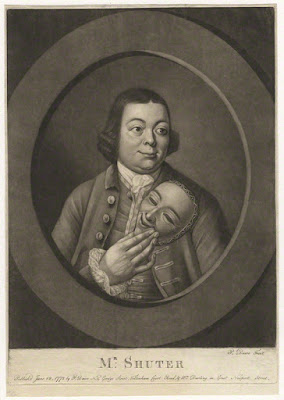 |
| Ned Shuter |
From the 1750s, Liverpool's Drury Lane Theatre offered summer entertainment to prosperous visitors flocking there for the bathing season. As no playbills are extant, little is known about its company or the performances. In 1756 the newspaper alerted the public to the arrival of 'Comedians from the Theatres Royal in London at the Theatre in Liverpool. During the months of June, July, and August next, will be perform'd variety of the best plays. N.B. The days of acting will be Mondays, Wednesdays, and Fridays.' On 4th June the season opened with The Constant Couple, or a Trip to the Jubilee, followed by the farce The Virgin Unmask'd. Seats in the pit cost two shillings and the gallery one shilling. At that time there were no boxes, although they were added during a subsequent renovation, with seats offered at three shillings. For many years the theatre attracted London players, including famous comic actor Ned Shuter as well as John Palmer, Thomas King, and Miss Pope.
The fortunes of the Liverpool theatre improved in 1771 when, by Act of Parliament, a licence was granted. In the Letters Patent, the location of the Theatre Royal would be Williamson Square.
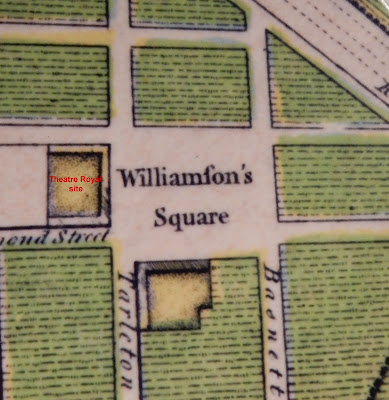 |
| Williamson Square, Liverpool |
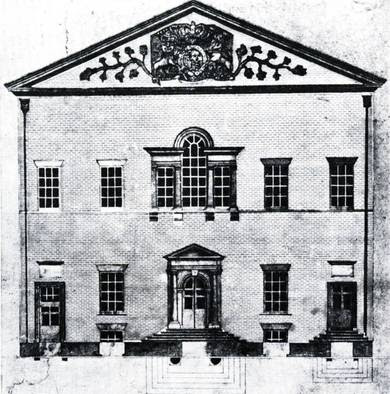 |
| Facade of the Theatre Royal |
After the opening 5th June, 1772, the summer season proceeded with a company populated primarily by London performers. In 1775 Charles Macklin appeared as Shylock, his most famous character. Prior to his retirement from the stage the great David Garrick also trod the boards in Every Man in His Humour by Ben Jonson. The Georgian theatre repertory relied heavily on plays from prior centuries.
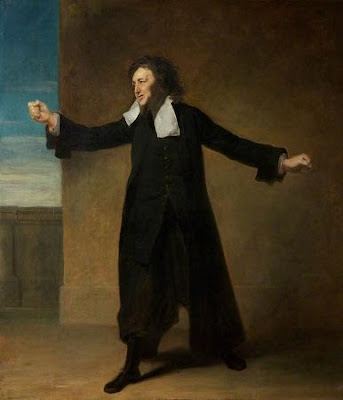 |
| Macklin as Shylock, The Merchant of Venice |
During late 1770s, Sarah Kemble Siddons was a mainstay of the theatre. The daughter of provincial players, she had disappointed them by becoming an actress and compounded her error by wedding an actor. She began her career in provincial theatres and eventually David Garrick of Drury Lane hired her. After her inauspicious debut and departure after a single London season, she accepted employment in Liverpool, where her brother John Philip Kemble joined her.
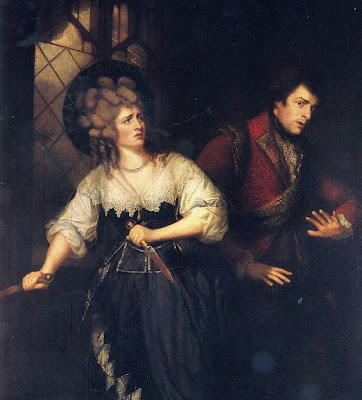 |
| Sarah Siddons & John Philip Kemble in Macbeth |
In 1782 her second attempt to establish herself in London was hugely successful. After her metropolitan triumph, on her way to a summer engagement in Dublin, she stopped to perform in Liverpool. She returned in 1785, 1789, 1797, and 1809.
The popular comedienne Mrs Jordan performed there in 1786. She delighted local audiences as Hippolyta in She Wou'd and She Wou'd Not, and in The Romp, one of her most popular roles.
 |
| Mrs Jordan as Hippolyta |
Kemble, who had risen to succeed Garrick as actor-manager at London's Drury Lane, spent the summer of 1786 in Liverpool. Three years later he became a co-lessee (with Francis Aickin) of the Theatre Royal. In his diary he records: 'This day [1st January] I agreed to take the Liverpool Theatre with Mr F. Aickin for several years. Our rent is to be 360 Pounds per ann. We are to use the Theatre for six months of the twelve and are to pay down twelve hundred pounds for the purchase of wardrobe, etc.' He was present on 15th June to open its summer season with an address, but due to his London responsibilities was an absent manager, leaving most responsibilities to Aickin. Their partnership failed, and after losing money Kemble gave it up.
 |
| Harriot Mellon |
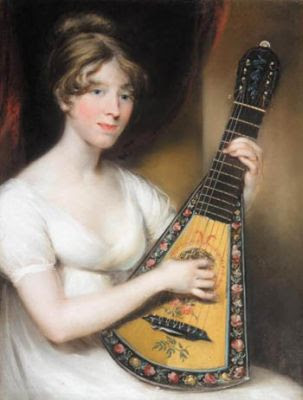
Another player of that period who achieved popularity in Liverpool was Harriot Mellon, who wrote, 'When I was a poor girl, working very hard for my thirty shillings a week, I went down to Liverpool during the holidays [from London's Drury Lane], where I was always kindly received.' Harriot later wed her devoted and elderly admirer, wealthy banker Thomas Coutts. After his death she chose the much younger, impoverished Duke of St Albans as her second husband.
By 1803 the Theatre Royal had been rebuilt and given a graceful curved facade, reopening in June of that year. Actor Charles Mathews left a rich description of the theatre and his experiences in the city:
The theatre is beautiful...the prices are now lowered, and we play to houses of £90 or £100, which is thought to be bad; the pit is usually well attended. They had little opinion of any actor who has not appeared in London...The town I like; the situation is beautiful. I have ridden seven miles on the sands; the sea on one side, the town and harbour on the other. The opposite Cheshire coast and distant Welsh mountains for altogether a most enchanting prospect. Prince William [of Gloucester] is here....He has bespoken plays three times.
The improved theatre continued to draw the most eminent players of the late Georgian and Regency periods: Edmund Kean, Charles Mayne Young, Robert Elliston, George Frederick Cooke, Master Betty ('The Young Roscius'), and Miss O'Neill.
In the waning days of his long career John Philip Kemble returned for a farewell performance as Corialanus. On 12 July, 1816, in his remarks at the conclusion of the performance, he expressed his appreciation of the Liverpool audiences, emotion overcoming him as he declared:
Ladies and gentlemen, I have tonight appeared before you for the last time, and cannot take my leave without expressing my high sense of the liberal support that I have always received from you....It was on this stage that I first adapted this play of Shakespeare's for representation, and the success which it met with in the fostering smile of your approbation encouraged me to persevere in my profession and determined me to pursue an industrious and methodical study of my art....Ladies and gentlemen, I wish you all a very good night, and every prosperity and happiness to this town.
There remains a theatre in Williamson Square in a slightly different location. The site of the 18th century one now looks like this:
Manchester
An early theatre located at King and Marsden Streets housed a repertory company and occasionally hosted concerts, oratorios, balls, and auctions. In the summer of 1762 it welcomed the first London actors, 'His Majesty's Servants from the Theatres Royal,' who performed three times a week from June to September, and every night during the August race meeting.
In 1764 the theatre was described by Thomas Wilks (sometimes Snagg) as 'plain and unadorned, having been newly built....the manager had a room to himself, the first male performer likewise a separate room; the useful plebians, of which I made one, a general apartment for habiting. The heroines and principal ladies had likewise an attiring room, and the underlings their cockloft....' The following summer an actress relatively new to London's Drury Lane established herself in Manchester, Mrs Baddeley, whom Wilks admired as 'an extremely beautiful woman. She played the ladies in most comedies and operas, and I...was often allotted to be her lover before the curtain, which brought an intimacy, with many a cup of tea and private walk with her, where I have been charmed with her melodious voice...I'll venture to say she was the best and most beautiful Ophelia I ever saw.' Nearly a decade passed before London players returned to Manchester.
In 1775, Lord Lyttelton sponsored a bill for a licenced Theatre Royal in Manchester: 'to establish a Theatre in Manchester, to keep a company of comedians for His Majesty's service, and to act such Tragegies, Plays, Operas, and Entertainments only as had been or should be licenced by the Lord Chamberlain of His Majesty's Household.' The licence was granted to Joseph Younger and George Mattocks (managers of the Liverpool theatre), and subscriptions were raised to construct a brick building at the corner of York Street and Spring Gardens, with boxes, pit, and gallery. The season in Manchester was not intended to overlap the summer season in Liverpool.
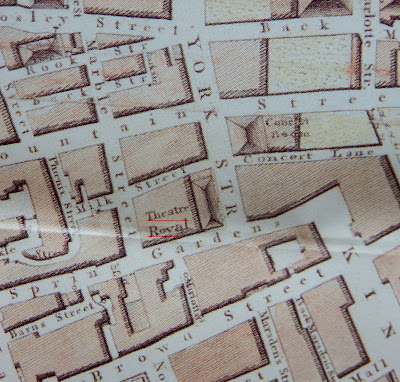 |
| Manchester's Theatre Royal, York Street & Spring Gardens |
The theatre opened June 5, 1775, with Othello--Younger playing the lead. Performance nights were Monday, Wednesday, and Friday. The regular season commenced the following October. Sarah Siddons and her brother John Kemble spent time at Manchester in the winter of 1776, as did Elizabeth Farren and Elizabeth Inchbald. All were destined to gain greater fame--and notoriety--in London. Farren left the Drury Lane stage to marry her lover, the Earl of Derby, and was transformed from actress to countess.
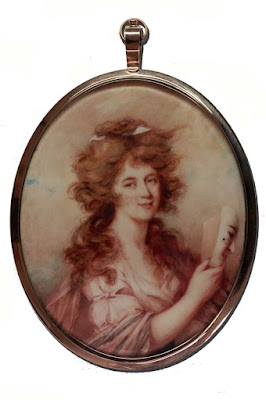 |
| Elizabeth Farren |
A German resident in the 1780s left a description of the theatre and its audiences:
The gallery is here, as everywhere in England, unbearably unashamed; they throw apples, pomegranates, nut-shells on the stage, in the pit and the boxes they cry out and make a lot of noise; I know people who refuse to sit in the front seat of the boxes. With ladies they are more polite. Many years ago a flask flew from the gallery into the pit, striking a man's skull. This shrieking and din and all this bad behaviour is difficult in the intervals...during the play itself the gallery is quieter than I have heard in any other place, and the applause and laughter in the middle of speeches does not last so long that one loses the thread or misses the climax...Of battles and murders they are especially fond.
The Liverpool company sometimes performed in Manchester during the summer, bringing with them luminaries from Drury Lane and Covent Garden. Those who turned up in Manchester included George Frederick Cooke and comedian Dicky Suett. John Philip Kemble returned in 1784 after achieving success in Dublin and prior to emulating his sister's fame in London. He reappeared periodically, whenever playing at Liverpool. In May 1785 his sister Sarah Siddons, by then London's leading actress, returned, prompting a sudden rise in prices for her two performances--to five, three, and two shillings for box, pit, and gallery respectively.
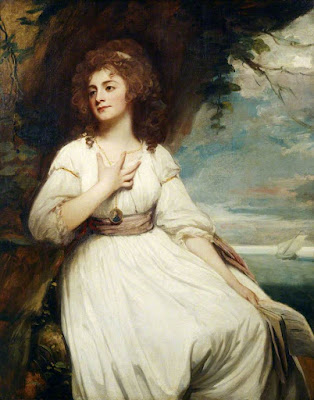 |
| Anna Maria Crouch |
The Manchester theatre was rebuilt in 1790. The next year, playwright/librettist Charles Dibdin's son joined the company for its winter season. George Frederick Cooke was present, as he was in most years, for Race Week, and stayed on. In some years there was a brief September season. Kemble returned for Race Week in the summer of 1798. By this time, the theatre was often used in summer for special events--a one-off performance by a well-known player, or singers such as Charles Incledon, Michael Kelly, and Mrs Crouch, Mr and Mrs Charles Dibdin, and Madame Mara.
Near the turn of the century John Ducrow 'The Flemish Hercules'--a clown who performed thrilling acrobatic feats--came to town. He posted a notice in the newspaper, informing the public of his intent in to display 'those wonderful leaps from the Trampoline in particular one over Eighteen Grenadiers, with shouldered firelocks and fixed bayonets; also through a hogshead of Real Fire, and will fly over a grand Pyramid of Light.'
A banking establishment was built on the site of Manchester's Theatre Royal, a building that has since become a restaurant.
Coming next: Part 2 of this article, featuring the theatres of York, Bristol and Bath, follows on 14 June 2016 and you can read it here.
~~~~~~~~~~~~~~
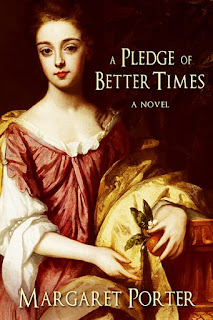 Margaret Porter is the award-winning and bestselling author of twelve period novels, whose other publication credits include nonfiction and poetry. A Pledge of Better Times, her highly acclaimed novel of 17th century courtiers Lady Diana de Vere and Charles Beauclerk, 1st Duke of St. Albans, is her latest release, available in trade paperback and ebook. Margaret studied British history in the UK and the US. As historian, her areas of speciality are social, theatrical, and garden history of the 17th and 18th centuries, royal courts, and portraiture. A former actress, she gave up the stage and screen to devote herself to fiction writing, travel, and her rose gardens.


 Margaret Porter is the award-winning and bestselling author of twelve period novels, whose other publication credits include nonfiction and poetry. A Pledge of Better Times, her highly acclaimed novel of 17th century courtiers Lady Diana de Vere and Charles Beauclerk, 1st Duke of St. Albans, is her latest release, available in trade paperback and ebook. Margaret studied British history in the UK and the US. As historian, her areas of speciality are social, theatrical, and garden history of the 17th and 18th centuries, royal courts, and portraiture. A former actress, she gave up the stage and screen to devote herself to fiction writing, travel, and her rose gardens.


