Showing posts with label Raglan Castle. Show all posts

Tuesday, September 12, 2017

Henry Tudor at Raglan Castle

by Judith Arnopp

Raglan Castle

At the start of the wars of the roses Margaret Beaufort was a relatively insignificant member of the house of Lancaster but after years of struggle she and her son, Henry became the ultimate victors. During her years of struggle for her son’s rights she can have had no inkling that he would one day become King of England.

Margaret was a wealthy heiress, heir to the Duke of Somerset. Her great grandfather was the eldest son of John of Gaunt and his then mistress, Katherine Swynford. Although the Beauforts were later legitimised they were excluded from the succession and never to inherit the throne.
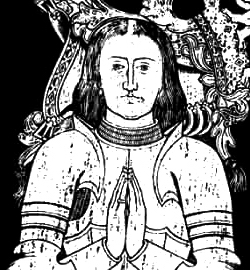
Edmund Tudor
She was married to the king’s half-brother, Edmund Tudor and travelled with him to Wales where he upheld the authority of the king. Shortly after impregnating his teenage bride, he died, either of wounds sustained in a skirmish with the adherents of York, or from plague, or possibly a combination of both. Margaret, widowed and pregnant, was left vulnerable and turned to her brother in law, Jasper Tudor, for support. He offered her shelter at his stronghold in Pembroke where her son was born a few months later. She named him Henry, after her cousin the king.

To avoid another marriage arranged by the king, Margaret quickly married Henry Stafford, a younger son of the Duke of Buckingham. While she moved with her husband to Bourne in Lincolnshire and later Woking, her son remained at Pembroke in the care of his uncle, Jasper, Earl of Pembroke.

Margaret would have seen nothing unusual in her son being brought up in the household of a powerful lord. The couple visited and wrote to young Henry regularly until the trouble between York and Lancaster flared again. Jasper did not take part in the battle of Towton but remained at Pembroke defending the castle against Yorkist forces. After a few weeks of siege, Pembroke and its inhabitants were eventually surrendered into the hands of William Herbert. Jasper managed to escape but he left behind a valuable prize - the four year old Earl of Richmond, Henry Tudor.

Pembroke Castle

Sir William Herbert took Henry into his custody at Raglan and in 1462 paid the king an enormous sum for his wardship. It is not documented how Margaret or Henry felt about this but there was long standing rivalry between the Herbert and Tudor families and, together with the high probability that William Herbert was responsible in some degree for the death of Edmund Tudor, it is quite likely she did not see it as pleasing.


Henry’s time at Raglan is often viewed as one of imprisonment but there is no doubt he was well treated: chronicler Polydore Vergil recorded that Henry was “kept as prisoner, but honourably brought up with the wife of William Herbert”.  As I mentioned earlier, it was not unusual for the sons of noblemen to be sent from home to be raised in the household of a great lord, to learn warfare and sword skill. The Herberts treated Henry with great civility but even so his movements were restricted and although he kept his title Richmond, his properties were in the hands of the Yorkists. He was, you might say, a lucrative guest. Henry and Herbert’s son were the offspring of opposing houses – Henry was from the House of Lancaster, Walter and William Herbert (the younger) were loyal to their father and to York. But ties of friendship formed at this time in the nursery at Raglan proved beneficial to Henry in the years to come.

Raglan Castle

It is interesting to consider that the ruins we see today at Raglan were once the rooms frequented by the young Henry Tudor. When Herbert inherited the castle from his father it was already a magnificent fortress with an impressive tower but William transformed it into a palace with huge glazed windows, a magnificent Fountain Court, the Pitched Stone Court and Great Gatehouse.

Henry spent the next seven years at Raglan, treated as a member of the Herbert family, educated by ‘the best and most upright instructors’ and mingling with the Herbert children. It seems he was happy there and developed strong connections to the family. Testimony of his affection or gratitude to the family, after he became king Henry invited Herbert’s widow, Lady Anne Devereux, to court. Herbert harboured plans to unite his family with the Tudors by marrying his daughter, Maud, to Henry. He left orders for the betrothal in his will but the arrangements were prevented by the readeption of Henry VI. Maud later married another of Herbert’s wards, Henry Percy, 4th Earl of Northumberland. Margaret Beaufort and Henry Stafford continued to visit and correspond with Henry until 1469, when Richard Neville, Earl of Warwick betrayed King Edward IV and joined the Lancastrians.

Raglan Castle

Taking Henry and probably his two sons, William and Walter, with him, Herbert rode off to battle at Edgecote Moor; not to fight but to observe and learn. It may seem incredible to us that an eleven year old should be exposed to the dangers of battle but things were different then. Young boys had to be educated in warfare, exposed to the violence of the battlefield to ensure that when their time came to fight, they’d be prepared. Possibly Herbert saw it as an opportunity for education. Possibly he desired to keep his valuable asset close to hand. Unfortunately for Herbert the battle did not go well for York.
Herbert was captured during fighting and executed by Warwick. It is often recorded that Henry was abandoned on the side lines and later rescued from the field and taken to safety at Weobley, the family seat of Herbert’s wife, Anne Deveraux.

Raglan Castle

For a while, Lancaster was in ascendance in England. The former king, Henry VI, was placed once more on the throne, to be ruled like a puppet by Warwick. At last, Jasper Tudor was able to return from exile, at which time he presented Henry to the Henry VI. 

The supporters of Lancaster emerged once more and everything seemed settled in Lancaster’s favour; King Edward was beaten and Margaret and Jasper would have been confident that the Richmond holdings would now be restored to Henry. Margaret attended court, bringing her son to the attention of the king and queen but it was not to last. In 1471, Edward IV came back with a vengeance and regained the throne with a decisive battle at Tewkesbury which saw the death of the Lancastrian heir, Edward of Lancaster and the fall of his mother, Margaret of Anjou. Edward IV crushed the Lancastrian hopes by the murder of the mentally unstable king, Henry VI, leaving just one possible claimant to the Lancastrian crown - Henry Tudor.

Henry Tudor

Jasper, taking the boy with him, fled to Brittany where Henry spent most of the next fourteen years until August 1485 when he returned with his mother’s financial support, with a mercenary army to face Richard III on the field at Bosworth. During the battle several Welshman ostensibly loyal to Richard, turned their coats and fought for Henry instead; Rhys ap Thomas is believed to have dealt the Yorkist King’s killing blow and Walter Herbert of Raglan is believed to have fought alongside his old friend of the schoolroom.

~~~~~~~~~~

Margaret's battle for her son's rights and Henry's time at Raglan is featured in the trilogy The Beaufort Chronicles.


Judith Arnopp is the author of nine historical fiction novels set in the medieval and Tudor period. You can find more information by following the links below:
author.to/juditharnoppbooks
www.judithmarnopp.com

Picture credits
Edmund Tudor https://upload.wikimedia.org/wikipedia/commons/9/9c/Edmund_Tudor%2C_1st_Earl_of_Richmond.jpg
Henry Tudor - https://upload.wikimedia.org/wikipedia/commons/d/da/Henry7England.jpg
Castle Photographs - Judith Arnopp


Tuesday, July 5, 2016

Margaret Beaufort: The King's Mother

By Judith Arnopp

3rd July 1509, Westminster Abbey - the body of a woman lies in state in the Abbey Refectory. The light of a thousand flickering candles falls upon nun-like clothing, hands clasped as if in prayer, a lined face testament to a life of battle, a life of uncertainty, a life of unflinching duty. This woman was the King’s mother …


Literature has not been kind to Margaret Beaufort. She was not a pretty woman, but she was pious, and she was resilient. It is not easy to turn a strong, plain woman into a romantic heroine and so, in fiction at least, she has become a harridan, a half-mad zealot. Feminists today celebrate the few medieval women who stepped from beneath the thumb of masculine authority but Margaret is seldom among them.

Due to their illegitimate roots, the Beauforts were barred from succession but that did not prevent them from becoming one of the most powerful families in England. From the day of her birth Margaret was a prominent player in the story of what we now know as the wars of the roses.

In the first year of her life Margaret’s father, out of favour with the king after a failed campaign in France, took his own life and Margaret was placed in the protection of the Duke of Suffolk, William de la Pole. When she was six-years-old she was married to the Duke’s son, John, a boy of seven.

Shortly after this the Duke himself fell into trouble and was killed trying to flee the country. Margaret and John’s marriage was quickly dissolved. As the country deteriorated into civil war the king’s brothers, Edmund and Jasper Tudor, were given the wardship of Margaret. At the age of twelve she became the wife of Edmund, the Earl of Richmond. She followed him to Wales where Edmund battled on the king’s behalf against Gruffyd ap Nicolas. They made their home at Caldicot Castle and Lamphey Palace which Edmund used as a base for his military operations. It must have been an alien environment for Margaret so fresh from the nursery at her mother’s home at Bletsoe.

After winning back Carmarthen castle, Edmund fell into dispute with the Yorkist, William Herbert, who imprisoned him at Carmarthen. Edmund died there, either of wounds, or plague, or a combination of both. He left his twelve-year-old widow, Margaret, six months pregnant with his child.

Margaret, vulnerable and alone, turned to protection to her brother-in-law, Jasper, who took her to Pembroke castle. It was in his cold, lofty fortress that Margaret gave birth to her only child, a son, whom she named Henry after her cousin the king.

Within weeks of his birth Margaret had taken her life into her own hands and arranged, with Jasper’s assistance, to marry Henry Stafford, a younger son of the Duke of Buckingham. Henry remained in the care of Jasper but, when Edward IV won the throne, he was placed in the hands of William Herbert to be raised at Raglan Castle in Wales.

How Margaret must have felt at handing her beloved son into the custody of the man responsible for her husband’s death can only be surmised. Henry maintained his title of Richmond but his lands and properties went to the new king’s brother, George, Duke of Clarence. As soon as she was able Margaret began to campaign for the return of Henry’s birthright. Henry was well treated by the Herberts, and given a place almost as a family member. Margaret maintained good relations with Herbert and his wife, wrote to him often and visited Henry on several occasions.

In 1469, after the Battle of Edgecot, Herbert was executed by the rebel Warwick, and Jasper took back control of his nephew until the Lancastrian defeat at Tewkesbury when he and the boy took flight to France, ending up in Brittany. They rode away without saying goodbye, and Margaret was not to see her beloved son for fourteen years.

Margaret seems to have been happy with Henry Stafford who sought peace with Edward IV, winning positions at court. Their main residence was at Woking where they made several improvements to the palace but Henry Stafford was wounded at Barnet in 1471 fighting for York. He died shortly afterwards, never recovering from his injuries. Wasting no time, before the year of mourning was up Margaret again made a strategic match, marrying Thomas Stanley in 1472.

Stanley was a prominent member of Edward IV’s court who offered her the position she craved. She seems to have remained loyal to King Edward but, on the accession of Richard III in 1483, she began to plot against him. There is no evidence she had anything to do with the disappearance of the princes in the tower but she was behind a series of rebellions. After a failed attempt involving the young Duke of Buckingham, despite her clear involvement, Richard was merciful and placed her in the custody of her husband – where she continued to conspire against the king. Her machinations eventually paid off and with her help Henry and Jasper raised an army in France and landed at Milford Haven in 1485. The Battle at Bosworth marks the beginning of the end of the Wars of the Roses and, like it or not, on that day Margaret achieved her life’s ambition. Not only did she finally see the ultimate victory go to Lancaster but she witnessed her only son, Henry Tudor, crowned King of England.


An objective look at the Wars of the Roses reveals no saints, no sinners; each side was as much at fault as the other. It is clear to me that Henry VI and his queen, Margaret of Anjou, were ineffective and unsuitable rulers. I can understand the frustrations of the ambitious Duke of York. On the other hand it is also clear that Edward IV became a lazy king, too fond of his leisure and exasperating his most loyal brother, Richard of Gloucester. In the few short years he ruled Richard III showed promise as king, he may have made a decent job of it given the chance. It would be a different world today had the outcome at Bosworth been different.

Henry Tudor, a complete opposite of Edward IV, cared nothing for the favour of the people. He ruled as he saw fit, his decisions often dictated to by his experiences as an exile. He made tough, sensible decisions regardless of contemporary opinion. On his death the royal coffers were full, riches that were quickly depleted by his son Henry VIII who seems to have inherited the love of excess from his grandfather, Edward IV.

During his reign Henry Tudor was guided by his mother, a woman who never for one moment faltered in her support for him, and to listen to her was probably one of his best decisions. She was a woman to be reckoned with, a wise politician, and a formidable opponent. Henry owed her everything. When he died in 1509 the future of the Tudor dynasty rested with his son, Henry VIII, a virile, golden prince whom everybody loved.

Margaret died seven days after the coronation of her grandson, Henry VIII. She had taken a prominent part in the upbringing of all her grandchildren, perhaps finding some solace for only having given birth to one son. It seems that on the death of her son and the accession of her grandson, her job was done. She had lain down her life for the Tudor cause, worn herself out for her cause, and for England. It was time to go.


Margaret Beaufort was a diminutive, self-reliant, determined woman whose piety was outstanding even in the devout days of medieval England. Most historic female achievers are saluted today. We see them as early feminists, pioneers for modern women to emulate, but Margaret is seldom celebrated. In her day she was a hallowed figure (she made sure of that) but today she is tainted with ignominy. I can only think it is her lack of romance, her lack of prettiness, her lack of sexiness, yet Margaret was awesome!

During my research for The Beaufort Chronicles I have discovered a new respect for Margaret Beaufort; I salute her metamorphosis from pawn to the most powerful person in England beneath the king.

~~~~~~~~~~~~~~~
Judith Arnopp is the author of eight historical novels, her latter work concentrating on the transitional years of the wars of the roses. She is currently working on The Beaufort Chronicles, charting the life of Margaret Beaufort. Book one: The Beaufort Bride is available now in paperback and on kindle. The Beaufort Woman coming soon.

The Beaufort Bride: Book one of The Beaufort Chronicles – out now
The Beaufort Woman: Book Two of The Beaufort Chronicles – pre-order now
The King’s Mother: Book Three of The Beaufort Chronicles – to follow.


The Beaufort Bride
The Beaufort Woman
A Song of Sixpence
The Winchester Goose
The Kiss of the Concubine
Intractable Heart
The Song of Heledd
The Forest Dwellers
Peaceweaver

mybook.to/thebeaufortbride

 https://upload.wikimedia.org/wikipedia/commons/3/3f/Tudor_Rose.svg
https://upload.wikimedia.org/wikipedia/commons/3/31/Margaret_Beaufort_2.jpg
https://upload.wikimedia.org/wikipedia/commons/9/9b/Henry_Seven_England.jpg
https://upload.wikimedia.org/wikipedia/commons/b/b3/Lady_Margaret_Beaufort_from_NPG.jpg