by Mark Patton
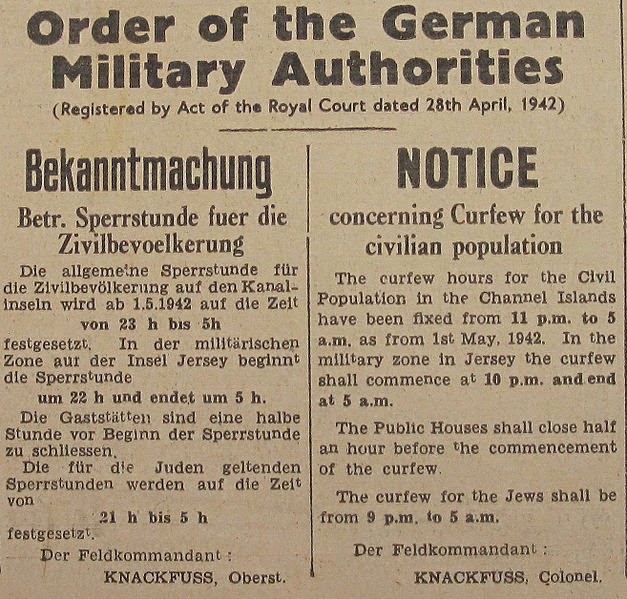
In an earlier Blog Post, I explored the circumstances under which, during the course of the Second World War, the Channel Islands of Jersey, Guernsey, Alderney, Herm and Sark became the only British territories in the Western Hemisphere to be occupied by the forces of Nazi Germany. German troops took control of the islands in June 1940, but the islanders suffered their greatest hardships in the final year of the war. After the D-Day landings of June 1944, the islands were effectively cut off from all external supplies. Islanders and German troops alike came close to starvation.
Despite the very real threat of execution, many islanders kept illicit radios in their home, enabling them to listen to the broadcasts of the BBC. The news of Hitler's suicide on 30th April circulated widely, both among the islanders and within the German garrison, yet there remained uncertainty. The formal instruments of surrender were signed at Reims on 7th May, and Churchill declared VE Day on the 8th, but the islands remained in German hands. There were rumours that the German commander of the islands, Admiral Huffmeier, an ardent Nazi, would refuse to surrender them.
On the 8th May, the Bailiff of Jersey, Alexander Coutanche, raised the British and American flags from the twin flag poles of the island's parliament building, and spoke to the assembled crowd in the Royal Square. German troops, still armed, mingled with people in the streets (Huffmeier was on Guernsey, and Coutanche's action had probably been authorised by one of the senior German officers on Jersey, most of whom were not Nazis).
Later that day, two Royal Navy warships, HMS Beagle and HMS Bulldog, were dispatched from Plymouth and anchored four miles off Guernsey. Huffmeier at first threatened to fire on them, and subsequently declared that he would only surrender the islands after having detonated all the ammunition stored on them, but there were, among his own officers, several who were willing to assassinate him rather than allow this to happen. The surrender was signed at Saint-Peter-Port at 0714 on the 9th May. Shortly afterwards, an RAF force of Mosquitoes and Mustangs overflew the islands, whose people were reassured to see that they met no fire from the German batteries.
The Beagle continued to Jersey, where officers came ashore and raised the British flag. British troops were in control of both of the larger islands before the sun went down that day.
The larger infantry force of "Operation Nest-Egg" (the last military operation of the war in Europe) arrived on the 12th May in landing craft and amphibious vehicles. It took several months to evacuate all of the German troops, who were dispersed among a number of prisoner-of-war camps around the UK (many first needed medical treatment for the effects of malnutrition).
The restoration of normal life on the islands would, of course, take years. Some islanders had been deported to internment camps on the continent, and not all had survived; others had been serving with the British armed forces; those who remained on the islands had lost all contact with those who were elsewhere.
Some islanders were considered to have "collaborated" with the occupiers (acts of "collaboration" ranged from the denunciation of neighbours to the Gestapo, to romantic liaisons with German troops), whilst others took pride in their acts of resistance (hiding escaped Russian and Spanish slave-workers, for example). Divisions were opened up which certainly endured into my life-time (my mother, who moved to Jersey from England after the war, befriended a local woman who was shunned by many of the islanders as a "Jerry-Bag").
The physical reminders of the Occupation - concrete gun-batteries, bunkers and observation towers - endure to this day. Some were my childhood playgrounds, others have been put to ingenious uses, from fish hatcheries to strawberry and mushroom farms, radio stations and cafes.
But the 9th of May will always be remembered on the islands as "Liberation Day," commemorated with annual ceremonies and public statues as marking the end of the islanders' darkest days.
Mark Patton blogs regularly on aspects of history and historical fiction at http://mark-patton.blogspot.co.uk. His novels, Undreamed Shores, An Accidental King and Omphalos, are published by Crooked Cat Publications, and can be purchased from Amazon.
In an earlier Blog Post, I explored the circumstances under which, during the course of the Second World War, the Channel Islands of Jersey, Guernsey, Alderney, Herm and Sark became the only British territories in the Western Hemisphere to be occupied by the forces of Nazi Germany. German troops took control of the islands in June 1940, but the islanders suffered their greatest hardships in the final year of the war. After the D-Day landings of June 1944, the islands were effectively cut off from all external supplies. Islanders and German troops alike came close to starvation.
 |
| A German officer with a Channel Island policeman. Photo: Imperial War Museum (non-commercial license). |
Despite the very real threat of execution, many islanders kept illicit radios in their home, enabling them to listen to the broadcasts of the BBC. The news of Hitler's suicide on 30th April circulated widely, both among the islanders and within the German garrison, yet there remained uncertainty. The formal instruments of surrender were signed at Reims on 7th May, and Churchill declared VE Day on the 8th, but the islands remained in German hands. There were rumours that the German commander of the islands, Admiral Huffmeier, an ardent Nazi, would refuse to surrender them.
On the 8th May, the Bailiff of Jersey, Alexander Coutanche, raised the British and American flags from the twin flag poles of the island's parliament building, and spoke to the assembled crowd in the Royal Square. German troops, still armed, mingled with people in the streets (Huffmeier was on Guernsey, and Coutanche's action had probably been authorised by one of the senior German officers on Jersey, most of whom were not Nazis).
Later that day, two Royal Navy warships, HMS Beagle and HMS Bulldog, were dispatched from Plymouth and anchored four miles off Guernsey. Huffmeier at first threatened to fire on them, and subsequently declared that he would only surrender the islands after having detonated all the ammunition stored on them, but there were, among his own officers, several who were willing to assassinate him rather than allow this to happen. The surrender was signed at Saint-Peter-Port at 0714 on the 9th May. Shortly afterwards, an RAF force of Mosquitoes and Mustangs overflew the islands, whose people were reassured to see that they met no fire from the German batteries.
 |
| The surrender of Oberst Heine, one of the senior German officers, to British troops. Photo: Imperial War Museum (non-commercial license). |
The Beagle continued to Jersey, where officers came ashore and raised the British flag. British troops were in control of both of the larger islands before the sun went down that day.
 |
| The crowd in Saint-Peter-Port cheering as the British flag is raised. Photo: Imperial War Museum (non-commercial license - D24590). |
The larger infantry force of "Operation Nest-Egg" (the last military operation of the war in Europe) arrived on the 12th May in landing craft and amphibious vehicles. It took several months to evacuate all of the German troops, who were dispersed among a number of prisoner-of-war camps around the UK (many first needed medical treatment for the effects of malnutrition).
 |
| The arrival of British troops in Saint Helier. Photo: Imperial War Museum (non-commercial license). |
 |
The evacuation of German prisoners-of-war
from Saint Aubin's Bay, Jersey.
Photo: Imperial War Museum (non-commercial license).
|
The restoration of normal life on the islands would, of course, take years. Some islanders had been deported to internment camps on the continent, and not all had survived; others had been serving with the British armed forces; those who remained on the islands had lost all contact with those who were elsewhere.
Some islanders were considered to have "collaborated" with the occupiers (acts of "collaboration" ranged from the denunciation of neighbours to the Gestapo, to romantic liaisons with German troops), whilst others took pride in their acts of resistance (hiding escaped Russian and Spanish slave-workers, for example). Divisions were opened up which certainly endured into my life-time (my mother, who moved to Jersey from England after the war, befriended a local woman who was shunned by many of the islanders as a "Jerry-Bag").
The physical reminders of the Occupation - concrete gun-batteries, bunkers and observation towers - endure to this day. Some were my childhood playgrounds, others have been put to ingenious uses, from fish hatcheries to strawberry and mushroom farms, radio stations and cafes.
 |
| German observation tower at Les Landes, Jersey, part of Hitler's "Atlantic Wall." Photo: Man Vyi (image is in the Public Domain). |
But the 9th of May will always be remembered on the islands as "Liberation Day," commemorated with annual ceremonies and public statues as marking the end of the islanders' darkest days.
 |
| The monument to the Liberation in Saint Helier. Photo: Man Vyi (image is in the Public Domain). |
~~~~~~~~~~~~~
Mark Patton blogs regularly on aspects of history and historical fiction at http://mark-patton.blogspot.co.uk. His novels, Undreamed Shores, An Accidental King and Omphalos, are published by Crooked Cat Publications, and can be purchased from Amazon.