Showing posts with label Legend. Show all posts

Tuesday, November 17, 2015

Winter Crone Legends

by Elaine Moxon

"She who hardens the ground with the frost and ice, which quickens the dormant seeds in the earth's womb."
'VISIONS OF THE CAILLEACH' - Sonia d'Este & David Rankine

'The Cailleach' by Michael Hickey

Winter is almost upon us, the solstice looming as the nights lengthen and daylight becomes a rare and precious thing. To our ancient ancestors we are in 'Geimredh', the dark half of the year. The sun takes his leave of us for more and more hours, our lives increasingly illuminated by the moon. Writing Dark Ages historical fiction, it is important that I know what this time means to my characters, both Britonic and Saxon. Both cultures contain legends of the Crone or Winter Hag, a goddess of good or evil who shapes the land and controls the very forces of nature. She has many guises and names, including:-
  • Death Goddess
  • Wise Woman
  • Frau Holle/Hel
  • Valkyrie
  • Cailleach
  • Lady of the Beasts
  • Hag of the Mist
  • Harsh Spirit of Winter
  • Hag of the Mill-Dust
Geimredh begins at 'Samhuinn' (1st November), which for the Celts marked the beginning of a new year, a beginning shrouded in darkness, where they believed the veil between the living and dead was at its thinnest, thus allowing ease of communion between the worlds. Incidentally, burial chambers and stone circles are often oriented to the midwinter solstice, aligning those buried and the winter rituals performed within them to the Otherworld. It is also the time of the last harvest where the pagan Lord dies with the cutting of the last sheaf and begins his journey through the underworld, laid to rest in the womb of the Great Mother. It is therefore fitting that his matrimonial partner, the Lady or Goddess, takes the helm to guide her people until he is re-born in the spring. Then she will be the virgin maiden, awaiting her lover. If the harvest was good, this final sheaf was fashioned into a 'kern maiden', referencing the fruitful spring goddess. However, if the harvest was poor, it was fashioned into the guise of the Crone and no, one farmer would wish to keep it long in his house for it brought bad luck. Such was the fear of the Crone's power.

Even before man cultivated grains and modelled kern maidens, the Crone was still venerated and was a symbol of death. The elder tree is sacred to the autumn equinoxe for pagans to this day, but as far back as the Megalithic period it was present. Known as the 'tree of death', representations of elder leaves have been found carved onto funerary flints at Megalithic burial sites. There is also evidence of Welsh and Manx Celts planting elders on new graves. Winter continues to be a harsh time for many in our modern world. Death is never far away. The old or infirm, people or animals, can perish. For our ancestors, living so close to the land, tied by their dependency upon it, this was moreso. As in death, the world around them was bereft of light. Devoid of life, it must have seemed as though the Otherworld had taken over; the world of the Crone. In winter, fodder is scarce and our ancestors slaughtered weaker animals to save feed for the stronger beasts, and to feed themselves through the winter.

In such a barren landscape, any fruits borne during this time were considered sacred. Apples, a symbol of the sun and immortality, would be stored as long as possible. These remain in our modern psyche when we bob for apples at Hallowe'en, chew toffee apples or wassail our apple trees. When cut crossways an apple forms a 5-pointed star or 'pentacle' and this referred to the 5 sacred roles of the Lady or Goddess: birth, initiation, consummation, repose and death. Blackberries, with their growing cycle of green-red-black as the fruits turn, signifies the 3 stages of the goddess as maid-mother-crone and was sacred to the Celts. They also revered the hazelnut tree, as in autumn it produces flowers for beauty and fruit (nuts) for wisdom. Eating the nuts was said to impart knowledge and wisdom to those who ate them. Its association with water (the entrance to the Otherworld) made it a popular offering and has been found in lakes, wells and springs - once again the domain of female deities. This is further confirmed by 'Coll', the bardic number nine - hazel trees fruit after 9 years of growth. Nine is sacred to the aspect of the triple goddess (3 x 3 = 9). Finally, elder berries, indeed any berries remaining through winter, were deemed by the Druids to be a gift from the 'Earth Mother' or Crone and would be gathered to make ceremonial wines. In other rituals, married Celtic women would paint their naked bodies in woad to honour 'the veiled one'. Again, this is a reverence of the Winter Crone, She who controls the veil to the Otherworld, She who folds the elderly and 'tired children into her cloak of death to await another dawn'.

'White Wolf' courtesy of wallpapercave.com

The Crone can be found throughout many cultures in both a benevolent and malevolent form. You may recognise some of them!

"It is written that before the Norman invasion of England, Gyrth had a dream that a great witch stood on the island, opposing the King's fleet with a fork and trough. Tord dreamed that before the army of the people of the country was riding a huge witch-wife upon a wolf, and she tossed the invading soldiers into its mouth."
FROM BRANSTON'S DESCRIPTION OF A FAILED INVASION ATTEMPT BY HAROLD HARDRADA IN 1066 IN 'THE LAST GODS OF ENGLAND'.

Here we see resemblance to the Norse Valkyrie, Frau Holle or Hel - goddesses associated with death.


She rides through the sky on the back of a wolf, striking down signs of growth with her wand, spreading winter across the land. If she sees you, she will keep her mantle of snow over the land, so you must remain still.

"The man held the Druid wand first over his head and then over hers, at which she dropped down as if dead. He then mourned for her, dancing about her body to the changing music. Then he raised her left hand, touched it with the wand, and the hand came alive, and began to move up and down. The man became overjoyed and danced about. Next he would bring her other arm and her legs to life. Then he knelt over her, breathed into her mouth and touched her heart with the wand. She leapt up fully alive, and both danced joyously."
THE 'CAILLEACH AN DUDAIN' DANCE OR 'HAG OF THE MILL-DUST', APPROPRIATELY DANCED AT THE AUTUMN EQUINOXE, FROM THE ORDER OF BARDS, OVATES AND DRUIDS FOR 'ALBAN ELUED'.

Here we see 'the death of the fertile Mother of Life in the barren months that were to come and the promise of her resurrection in springtime'.

Other familiar representations of the Winter Crone are the Hag witches in Disney's 'Snow White' and 'Sleeping Beauty', where the aforementioned princesses are the spring-like maidens and the evil Crones their nemeses. We can also find similarities between the 'Snow Queen' in C. S. Lewis' 'The Lion, the Witch and the Wardrobe', who is reminiscent of Hans Christian Andersen's 'The Snow Queen'. Meanwhile, Queen Elsa of Disney's 'Frozen' provides us with a more benevolent Winter Witch. She holds swathe over the land that is plunged into an eternal winter, building a palace of ice and a giant, boulder-like creature. As Beowulf hunts Grendel's mother in her watery cave (another Crone legend), so Elsa is hunted. It takes her sister Anna, another representation of the spring goddess, to persuade Arundel's population their Snow Queen has a good heart and can, if she wants to, remove winter from the land.

'The Snow Queen' by Elena Ringo

In conclusion, we are never far from these legends. Despite the many years separating us from our Megalithic or Dark Age ancestors, the legends persist and continue to permeate our so-called 'modern' lives. In reality, we are closer to our forebears than we imagine!

BIBLIOGRAPHY:
'Pagan Feasts' - Anna Franklin & Sue Phillips
'Visions of the Cailleach' - Sonita d'Este & David Rankine
'Alban Elued' - Order of Bards, Ovates & Druids

~

Elaine has always loved writing and history. When she decided to combine the two, she wrote her Dark Ages debut 'WULFSUNA', which was published in January 2015 through SilverWood Books. She enjoys baking, knitting and gardening and lives in the Midlands with her family and their mad Labrador. She is currently writing the second book in her ‘Wolf Spear Saga’ series.


Saturday, November 22, 2014

Robin Hood – A Short Guide

by Steven A. McKay


Like King Arthur, Robin Hood seems to hold a special place in the hearts of all sorts of people. There’s something very romantic about a downtrodden normal man rising up and thumbing his nose at society’s corrupt rulers. Hundreds of years after the first stories of Robin were told, we can still identify with the concept – some things just don’t change…

No one is quite sure when Hood might have lived, with most authors following Sir Walter Scott’s lead in Ivanhoe and placing him around 1194 and the time of King Richard, although the original tales mention King Edward which would push the time-frame back a century or so depending on which Edward they meant.

There’s also some question over the religious aspects of the character – was he an extension of a pagan figure like John Barleycorn, Cernunnos or Herne the Hunter? Or was he simply a devout Christian as the early ballads suggest? The people of the middle-ages were certainly Christian, as the Crusades so violently testify, but they also held to some of the “old ways” – could a real man have taken on some of these pagan aspects and become the mythical figure we know today?


The Green Man represents nature and the seasons – more specifically the cycle of life, death and the rebirth in spring. John Barleycorn is similar, although he stands for autumn and the barley crop which would be used to make beer. It's obvious this kind of archetype – of a symbolic figure that brings life (and beer!) to the common man while triumphing over the oppressive, killing cold of winter – fits nicely with the myth of Robin Hood. Indeed, in my own Wolf's Head Robin brings ale, food and money to the starving people of Wakefield, foiling the ever-present medieval spectre of an early death.

Of course, the bold outlaw has been portrayed countless times in TV shows and movies – the hugely popular “Prince of Thieves” and Richard Carpenter’s wonderful fantasy-tinged “Robin of Sherwood” probably being the pick of the bunch, but the popularity of the recent BBC series and the Russell Crowe movie proves again how audiences continue to connect with the legend.

In novel form Robin hasn’t fared quite as well as the ever-popular King Arthur, who was, of course, immortalized in fantastic books by Bernard Cornwell and Marion Zimmer Bradley among others. Angus Donald has taken a refreshingly new look at the character in his successful Outlaw Chronicles, making Hood something of a medieval gangster, although the books are still set around the 13th century. David Pilling, Prue Batten and Parke Godwin are others who have explored the legend although I haven't got around to reading them yet, simply because I don't want to be accused of stealing ideas!


For my own novel Wolf’s Head I chose to follow the very first, original ballads by placing the action in Yorkshire, rather than Nottingham, and in the early 14th century. All the old characters are still there though, with the much-maligned sheriff doing his best to bring the “merry men” to justice. The second in the series, The Wolf and the Raven also sees the introduction/return of Sir Guy of Gisbourne...


There are, of course, lots of other ideas and theories around Robin Hood. Was he really William Wallace? Was he a Templar knight as suggested by John Paul Davis in The Unknown Templar? Or the Earl of Huntingdon, rather than the yeoman of the early ballads? Did he really use a longbow or did that only come into use after Robin lived?


We’ll probably never know the answers to these questions, and that’s the great thing about Robin, Little John and Will Scarlet, just as it is with King Arthur and Merlin: we can allow our imaginations to fill in the blanks, knowing no one interpretation will ever be “right” or “wrong”. For me, there was a real man – or more likely men – that the Robin Hood legend was based on, over a period of decades. Hard men – probably violent criminals that weren't very heroic at all. But their exploits – stealing from the obscenely wealthy while evading the unpopular ruling class – brought cheer to the downtrodden peasants and commoners of the medieval period. The tales grew in the telling to include elements of heroism, paganism and romance until, eventually, Hood became a symbol for justice and, perhaps most importantly, hope.

But that's just how I see it. How do you picture the legendary wolf's head and his band of men? In the end, that's all that matters!

~~~~~~~~~~~~~

Steven A. McKay is the author of the Amazon "War" chart number 1's Wolf's Head and The Wolf and the Raven. The third in the series, Rise of the Wolf, is underway, while a spin-off novella, Knight of the Cross, has just been released.
To find out more go to StevenAMcKay, Amazon UK, or Amazon US

Tuesday, April 1, 2014

Writing In Insula Avalonia – Suspending Disbelief

by Adam Alexander Haviaras

I’m walking into fabled mists today and, historically speaking, I may be on shaky ground.

I want to write about Glastonbury.

To most, the mere mention of this town’s name will conjure images of wild, scantily clad or naked youths and aged hippies. One thinks of thousands of people covered in mud as they wend their way, higher than the Hindu Kush, among the tent rows to see their favourite artists rock the Pyramid Stage.

It’s a great party, but to me that’s not the real Glastonbury.

Removed from the fantastic orgy that is the music festival, this small town in southwest Britain is an ancient place of mystery, lore and legend. It’s a place that was sacred to the Celts, Pagan and Christian alike, Saxons, and Normans. For many it’s the heart of Arthurian tradition, and for some it’s the resting place of the Holy Grail.

Across the Levels

I lived outside of Glastonbury for about 3 years, and I never tired of walking around the town and exploring the many sites that make it truly unique. The religious practices that have been carried out in this one place span from the Neolithic to the Celtic, early Christian, and beyond.

Today, Glastonbury is a place where those seeking spiritual enlightenment are drawn. The New Age movement is going strong here, yet another layer of belief to cloak the place.

Now I find myself back there not in person, but in story.

With my current novel, I’m in an interesting position. Some of the scenes in the story take place in what is now Glastonbury, in the early 3rd century A.D. Some of the characters I’m writing about are a Celtic priestess, a Druid (in hiding), an early Christian ‘priest’, and of course my Roman protagonist.

It would be easier, I think, to avoid the whole religious mélange and focus on my Roman protagonist. That way, I wouldn’t risk confusion or inaccuracy.

However, if I did that, I feel that I would be doing an injustice to the place, and missing out on a wonderful clash or confluence of beliefs that would add to the story. The Roman Empire was vast and encompassed many different religions. Many beliefs, gods or goddesses, were adopted by the Empire, others were persecuted, especially the Jewish, Druidic and Christian religions.

For the purposes of my current work-in-progress, I don’t think I can honestly write about Glastonbury in Roman Britain without touching on the mysteries and religious beliefs that run so deep there.

But what sites or aspects of Glastonbury should I incorporate?

There are so many historic and legendary treasures that make up this wondrous place known as the Isle of Avalon.

The Tor
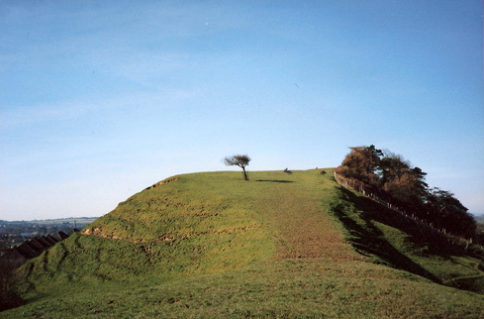
From where I lived on the other side of the peat moors, I awoke every morning to see Glastonbury’s most prominent feature shrouded in mist – the Tor.

Tor is a word of Celtic origin referring to ‘belly’ in Welsh or a ‘bulging hill’ in Gaelic. Glastonbury Tor thrusts up from the Somerset levels like a beacon for miles around. Every angle is interesting.

Habitation of this site goes back to around 3000 B.C. It has been a religious centre and a Dark Age stronghold.

Somerset Levels flood
In Arthurian lore, the Isle of Avalon is a sort of mist-shrouded world that is surrounded by water and can only be reached by boat or secret path. In fact, during the Dark Ages and into later centuries, until the drainage dykes were built, the Somerset levels were prone to flooding. This flooding made Glastonbury Tor and the smaller hills around it true islands. With the early morning mist that covers the levels, this watery land would have been a relatively safe refuge for Druids and early Christians seeking to avoid too much contact with Rome.

In Celtic myth, Glastonbury Tor was said to be the home of Gwynn ap Nudd, the Lord of Annwn, the Celtic otherworld.

Gwynn ap Nudd was the Guardian of the Gates of Annwn, which the ancient Celts believed to be at the Tor. It is at Samhain that the gates of Annwn open. This was also the place where the soul of a Celt awaited rebirth.

Wearyall Hill and Thorn
Another place that I should like to include in my story is Wearyall Hill, which is home to one of Glastonbury’s most ancient treasures – the Holy Thorn.

Across the street from the Safeway, you can climb up Wearyall’s gentle slope to see a hawthorn tree known as the Glastonbury Thorn, or ‘Holy Thorn’. One popular legend associated with Wearyall Hill and the Holy Thorn is that in the years after Christ’s death, his uncle Joseph of Arimathea came with twelve followers by boat to Glastonbury. When they set foot on the hill, tired from their journey, Joseph plunged his staff into the ground and it took root.

There is actually archaeological evidence for a dock or wharf on the slopes of Wearyall Hill that date from the period. Did Joseph of Arimathea actually arrive in Britain with the Holy Grail?

Well, that depends on what one believes. And Glastonbury is just that, an amalgam of beliefs living, for the most part, in harmony.

The Thorn
Cuttings of the Thorn grow in three places in Glastonbury. What is interesting is that this type of hawthorn is not native to Britain, but is rather a Syrian variety. Curiously, it flowers at Christmas and Easter, both sacred festivals for Pagans and Christians. Every holiday season, the Royal family is sent a clipping of this very special tree that hails from the earliest days of Christianity in Britain.

The current Thorn is not the original, but rather a descendant of the original which was burned down by Cromwell’s Puritans in the seventeenth century as a ‘relic of superstition’. How much destruction has been wrought on the ancient sites of Britain during the wars waged by Henry VIII and Oliver Cromwell? It’s horrifying to think about.

Whatever legend or myth one believes, or doesn’t believe, about Wearyall Hill is up to the wanderer. The stories are many and convoluted, but such is the fate of great and sacred places of the past.

Since my own days In Insula Avalonia, it seems that tragedy has struck Wearyall Hill. During the night a couple of years ago, vandals came and cut off all of its limbs leaving only a stump. It was heartbreaking to see those pictures. But the Thorn has seen worse, and I feel hopeful that it will carry on.

Chalice Well Fall
Another place of pilgrimage for some in Glastonbury is what is known as The Chalice Well, which lies at the foot of the Tor.

The Chalice Well is one of those places that you don’t quite know what to make of at first. When you enter under the vine-covered pergola you are met by colour, soft light, and the gentle trickle of water playing about your senses.

Chalice Well Yew Trees
You see young, wildly coloured blossoms exploding from the soil, and Yew trees that have seen centuries of summers.


The thing about this place is its overwhelming sense of peace and harmony, from which all can benefit.

But what exactly is the Chalice Well?

Scientifically-speaking, Chalice Well is an iron-rich spring, the source of which is unknown. Some believe it comes from deep in the Mendip Hills to the north. The Chalice Well is where it comes out of the ground.

Springs were sacred to the Celts. To those who inhabited this area from the pre-historic era on, the Well may have been a healing place beside the Tor. The waters that run red were sacred to the Goddess and were perhaps considered her water of life.

Chalice Well Gardens
It is also believed that Glastonbury was the site of a Druid ‘college’ of instruction and that the avenue of sacred Yew trees, some still remaining in the Chalice Well gardens, were part of a processional way to the Tor, passing beside the Well.

Later legend, and the reason for the name given to the Well, relates how Joseph of Arimathea brought the Holy Grail to Glastonbury around A.D.37. It is said that he buried the Grail near the Well and that the water runs through it, hence the redness of the water.

The Goddess’s blood was replaced by that of Christ, and though that has changed, the sanctity of the place remains intact. The spring has never failed, even in drought.

Just over the hill from the Chalice Well, giants still dwell in Glastonbury.

They are tall, and broad, and green, and together they have stood the test of time. Their names are Gog and Magog.

The giants of which I speak are not the evil powers of the Old and New Testaments, nor the giants of the British foundation myth in Geoffrey of Monmouth’s Historia Regum Britanniae.

Gog and Magog
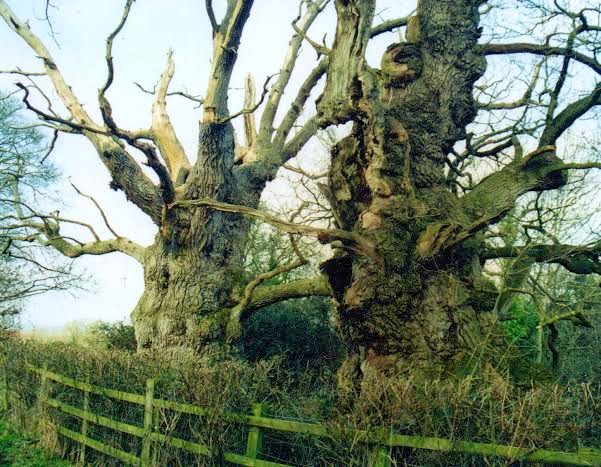
They are in fact two magnificent oak trees that represent the last of the great oaks of Avalon.

Gog and Magog are all that remain of an avenue of oaks that once led to the Tor, and which was used as a processional way by the Druids in ages past.

Sadly, the avenue was cut down for farmland in 1906, and these two trees are all that remain.

Oak trees like Gog and Magog were sacred to worshippers of the Great Mother, and later the Druids. Before Rome and mass farming came to Britain, the whole of the south of Britain was covered in forests from Hampshire to Devon.

Oak groves were sacred and were the sites of the Goddess’ perpetually burning fires. They were also where the Druids, who used oak leaves in their rituals, held their rites.

The sanctity of the oak was not relegated to Celtic Europe either, but also goes back to ancient Greece. At the sanctuary of Zeus at Dodona, priests would glean the will of Zeus from the rustling of the leaves in the sacred oak groves.

At Glastonbury, Gog and Magog would likely have seen many a ritual or procession.

If they could only speak in a way we could understand, I’m sure they would have some fantastic tales to tell.

Going from the town, past the Tor, and down Paradise Lane to see Gog and Magog was always one of my favourite walks. Because there are no roads nearby, the sound of cars is absent and all that can be heard is the chirruping of birds and the whisper of the wind as it blows across the Somerset levels.

Glastonbury Abbey
What about the site of Glastonbury Abbey? In the early third century A.D. it was certainly not there. The lovely ruins that can be seen today are a medieval creation, the remains of which date from the twelfth to sixteenth centuries. But the place itself is said to be the site of the first Christian church and oldest religious foundation in the British Isles.

According to tradition, Joseph of Arimathea and his followers built a wattle church on the site on land he was given by the local king, Arviragus, around the middle of the first century A.D.

Lady Chapel

Circa A.D. 160, two Christians named Faganus and Deruvianus are supposed to have added a stone structure on the site of what is the Lady Chapel. It is here that there is an ancient well dedicated to St. Joseph.

St. Joseph's Well
Perhaps this structure and the well would have been there when my protagonist comes onto the scene? It would have been a much simpler place than the magnificent ruins of the abbey we see today.

Somerset was settled by Romans after Vespasian stormed the southern hill forts. The people became Romano-British and the Roman peace began. There was lead mining in the Mendips, a thriving villa economy, and larger settlements like Illchester and Aquae Sulis.

But Glastonbury was more neutral, or on the fringe, during the centuries of Pax Romana in the south, and seems to have remained untouched by polytheistic Roman religion. It was an island of sorts, surrounded by wealthy villa estates.

Despite its isolation, and because of the direction my story is taking, my Roman protagonist will come into contact with the three characters mentioned above, the priestess, the druid, and the Christian who dwell in their sacred isle, away from the wider Roman world.

What sort of place was Glastonbury like then? If my Roman somehow finds his way there, what will the people be like? How will they receive him?

The prospect of thrusting Lucius into this world is exciting for me as a writer and historian. It’s the ‘What if?’ of various situations that I like the most.

Glastonbury is suffused with layers of history, legend, and belief, and I have but scratched the surface of its secrets. I think it only fitting that some of that mystery be reflected in my story.

And in order to do that, I will need to believe.

Thank you for reading!

~~~~~~~~~~~~~

Adam Alexander Haviaras is an author of historical fiction/fantasy set in the ancient world. He has studied history and archaeology in Canada and the United Kingdom. Adam blogs weekly on his website, Writing the Past, about ancient and medieval history and historical fiction. You can Tweet him at @AdamHaviaras or find him on Google+ and Facebook. He loves to hear from readers, writers, and fellow history-lovers.

Links:
Adam’s website
Google+
Facebook
Twitter: @AdamHaviaras