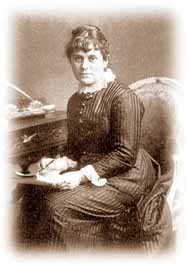
Showing posts with label Kate Greenaway. Show all posts

Wednesday, February 26, 2020

What to do about the nudes? Women Artists & the Slade School of Art, Victorian London

By Karen Odden

The Slade School of Fine Art in London is currently ranked as the top art and design school in the UK—but like so many of my favorite elements of England(!), it has its origins in the Victorian period. In 1868, a forward-thinking lawyer and philanthropist named Felix Slade (1788-1868) donated funds to create three Chairs in fine art, based at Oxford, Cambridge, and University College London. Students would only be taught in London—and, in an unprecedented condition set by the founder, women and men at this new school would study art together.

This directive was met with consternation and resistance—for what should be done about the anatomical drawing classes, with live nudes present? The accommodation made was to place the men and women in separate classrooms for the live models, draping the loins when desired. The drawing of nude marble statues, however, was done together.


 Requiring that women be admitted on equal footing with men was a significant swerve away from norms and set a new path for the University College London. Significantly, the Annual General Meeting Report of 1872 recorded that women were permitted to compete for scholarships, and during the first four years, four women and four men were awarded scholarships; the first two recipients in 1872 were women.

The first Chair hired was Edward Poynter, an esteemed artist who painted in the popular “Aesthetic” style which valued “l’art pour l’art” (art for art’s sake).

Poynter - Portrait by Legros

The son of an architect, Poynter was born in Paris. His early education was in England, but he returned to Paris for his training in art, attending the studio of Charles Glevre, where James McNeill Whistler and George du Maurier were also students. Well known for his large historical paintings, he served as professor at the Slade from 1871, when it opened, until 1875, when Alphonse Legros, a friend of Whistler, was given the Chair and Poynter took a position as principal of the National Art Training School.

One of the earliest students at the Slade was Kate Greenaway (1846-1901), the daughter of a working-class engraver who had once been commissioned to create the wood-cut illustrations for Dickens’s Pickwick Papers. So from childhood, Kate—an avid reader—was acquainted with the relationship between books and art. When she was twelve, she enrolled in the Finsbury School, in night classes, which were open to women. The curriculum leaned toward the training of artisans in the design of geometric materials such as wallpaper and tile, rather than the more imaginative, creative arts of painting and sculpture.

Subsequently she moved to the Royal Female School of Art, where she became friends with Elizabeth Thompson, with whom she shared a studio. Together they honed their craft, and Kate was able to draw figures from plaster casts and costumed figures but was frustrated that she was unable to practice anatomical drawing from nudes—which was finally permitted when she moved to the Slade. Even before she arrived there, however, Kate had exhibited and sold her work. She received commissions for illustrations for children’s books, exhibited her watercolors, and had been hired by the successful greeting card company Marcus Ward & Co. where she was praised for her “special talent … in the direction of costume figures and dainty colours.” Kate continued her education, studying painters and illuminated manuscripts at the National Gallery and British Museum, and made her living illustrating books, designing bookplates, and exhibiting her work both in England and America. In 1955, the annual Kate Greenaway Medal was established to honor an illustrator of children’s books.

Greenaway illustrated "Diamonds and Toads" for Frederick Warne & Co in 1871.

Another early Slade student is one of my favorite Victorian artists—Evelyn de Morgan, born Mary Evelyn Pickering (1855-1919) to upper-class parents, descended from landowners, politicians, artists, and nobility. Educated at home, she was tutored in Greek, Latin, French, and Italian, classical mythology, literature, and science, like her brother. As a child, she poured her creativity into poetry, which reflects the spiritual and feminist themes she would explore later in her painting. She found daily tasks expected of women tedious and reportedly told her father that if she were forced to attend the Drawing Room to be presented to society, she would “kick the Queen.” Struggling to be taken seriously as an artist, she entered the Slade in 1873 and won one of the prestigious Slade scholarships. Around this time, she began to use her middle name, Evelyn (think Evelyn Waugh), which was used for both men and women, so that her work would be judged on its merits rather than her gender. She made meticulous studies of the human form, paying particular attention to hands and feet, which many artists find challenging. After graduating from the Slade, she sold her works to prominent members of society, and she became friendly with painters in the pre-Raphaelite movement including Dante Gabriel Rossetti and William Holman Hunt. In 1887, she married William De Morgan, a ceramicist whom she helped to support; later he became a novelist and freed Evelyn from the need to sell her work. Although her artistic style changed over her fifty-year career, her paintings are generally figural, often allegorical, and gorgeous, and many were displayed in various galleries and museums throughout England during her lifetime.
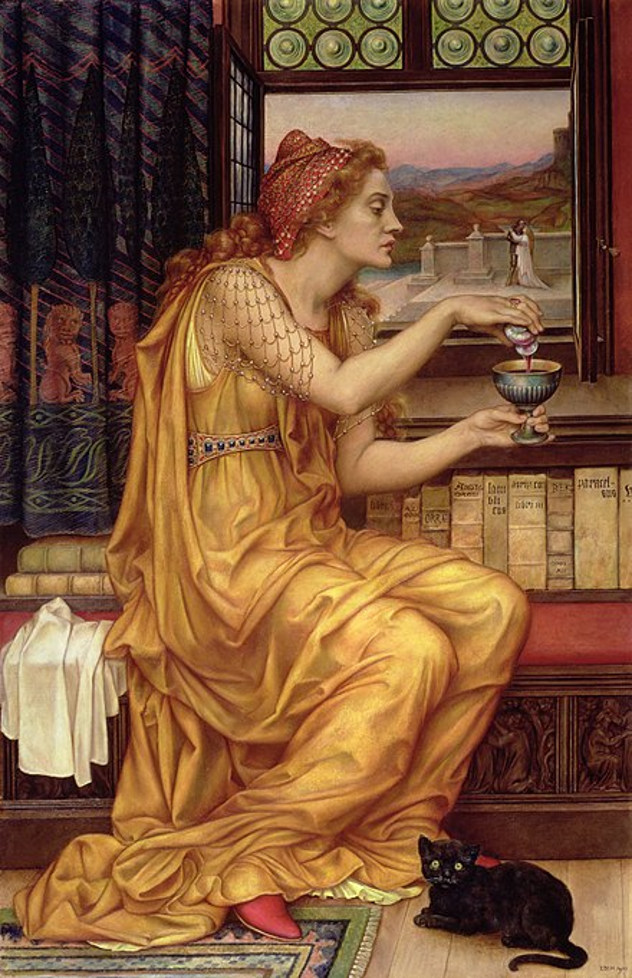
“The Love Potion,” 1903 

Since the 1870s, women have been included in every class. The Slade School currently offers degrees from the BA/BFA through the PhD, and according to its site, the Slade approaches “the practice of contemporary art and the history and theories that inform it in an experimental, research-oriented and imaginative way.” You can find the Slade in Gower Street, with its easily identifiable façade (illustration); and the University College London Art Museum nearby houses reserve collections, available for viewing by appointment, that include prize-winning work from the Slade students as well as works by Old Master artists and sculptural masterpieces. The closest tube station is Euston Square.


~~~~~~~~~~

Karen Odden earned her PhD in English literature from New York University, where she wrote her dissertation on representations of railway disasters in Victorian medical, legal, and popular literature, tracing our current ideas about “trauma” back to a time before the shell-shock of WWI to the railway disasters of the 1850s-1880s. She has taught at the University of Wisconsin-Milwaukee; her critical essays on Victorian literature have appeared in numerous books and journals; and for nearly a decade, she served as an assistant editor for the academic journal Victorian Literature and Culture. Her first Victorian mystery, A LADY IN THE SMOKE, was a USA Today bestseller, and her second novel, A DANGEROUS DUET, won for best Historical Fiction at the New Mexico/Arizona Book Awards. Her third, A TRACE OF DECEIT, was published in December 2019 by William Morrow. She lives in Arizona with her family and her beagle-muse, Rosy.

twitter: @Karen_odden
Instagram: @karen_m_odden
Facebook: KarenOddenAuthor

Thursday, April 14, 2016

Kate Greenaway, Artist and Poet

By Lauren Gilbert

From MARIGOLD GARDEN by Kate Greenaway


When I was a child, “Kate Greenaway” dresses were a fashion necessity for little girls.  I had one; it was pale green with embroidery and a dark green velvet sash, and I loved it.  Children’s rooms were also decorated with Kate Greenaway pictures and so forth.    Her work was greatly admired during her own time, and its popularity revives periodically.  Her illustrations are seen on note cards and prints as well as reprints of her books for children.  However, I never knew much about the artist herself, and became curious when I saw a vintage dress and some of her books for sale.

Born March 17, 1846 in London, her first name may have been Catherine, but she seems to have been always known as Kate.  She was the daughter of John Greenaway, a draughtsman and wood engraver whose illustrations appeared in PUNCH and other periodicals, and Elizabeth Jones Greenaway, a seamstress.  Kate seemed to have inherited talents from both parents, as she loved to draw and to make clothes for her dolls.  She was taught at home, and encouraged to draw.   As a child, she spent time with relatives in Rolleston, Nottinghamshire, and acquired a love for the country.  She pursued her art studies, including some time studying drawing and watercolours in Chelsea, and later at the Slade School of Fine Art.  In 1867, she made Christmas cards, illustrated a book for author William Kingston, and she exhibited some of her work in 1868 at the Dudley Gallery in London.  Her cards, book plates and calendars were popular, and her illustrations appeared in magazines as well.  She illustrated children’s books by multiple authors, and a couple of novels by Charlotte M. Yonge.  Her first exhibit at the Royal Academy was held in 1877.  She was, however, quite eager to write, as well as illustrate, her own book.

Miss Greenaway’s first book Under the Windows, Pictures and Rhymes for Children, was published in late 1878 or early 1879 by Edmund Evans,  who was a colleague of her father.  The original printing sold out quickly, and the book ultimately sold about 70,000 copies in England alone.  Her trademark style was already set: sweet and innocent illustrations of boys and girls and small children dressed in early 19th century fashion, with simple rhymes.  Ms. Greenaway received 40% of the profit, and had the satisfaction of seeing this book, as well as her next 3 books (Kate Greenaway’s Birthday Book for Children published in 1880, Mother Goose; or, The Old Nursery Rhymes published in 1881, and The Painting Book published in 1884, maintain their popularity and have solid sales for a number of years.  She was also commissioned to paint portraits, particularly of children, which were well received.  At her peak, she published multiple books annually, and ultimately published at least 20 books.

Miss Greenaway found herself relatively well-to-do as a result of her success.  She was able to help out with household expenses, and built a home in Hampstead which she shared with her parents.  In addition to her books, she published a series of yearly almanacs that spread her popularity further, and were especially popular in the United States.  The Language of Flowers  was published in 1884, and was even more popular in the United States than in England.  The merchandizing of Ms. Greenaway’s work began very early, and included dresses, “skeleton suites” and other garb for children, dolls and other goods.  

The Greenaway look was popular not only in England and the United States, but in France and other countries as well.  Instead of dressing her characters in fashions current to her time in the late Victorian era, she looked back to the Regency era, with her little girls wearing the high-waisted dresses and bonnets, tiny boys wearing the frocks, and their mothers in caps and narrow-skirted gowns according to the modes of the early part of the century.  Thanks to the popularity of her illustrations, these styles were very fashionable again for children in the 1880’s and 1890’s.  Unfortunately, this also led to the piracy of her work, with goods copying her designs being manufactured and sold for which she was not remunerated.  Eventually, she retained her original works, selling only the rights, so that she could control their use and any income generated from them. 


Miss Greenaway never married.  By all accounts, she was very shy and rather plain.  Her work allowed her to meet and become acquainted with other artists and writers.  She received a letter from John Ruskin, the noted art critic, which led to a long correspondence.  He complimented her work, but also criticized, and could be quite cruel.  After corresponding for several years, they finally met.  She seemed to have had something of a “crush” on him, despite the difference in their ages (he was 64 years old and she was 36).  He asked her to visit him, and she did so.  Sadly, she apparently hoped for a marriage proposal which never materialized.   Ruskin tried to influence her to pursue more serious art instead of her illustrations, and suggested they collaborate on something.  He had had a marriage which had been dissolved, with all the accompanying scandal, and was not considered altogether healthy in his designs and influence on Kate (possibly somewhat of a Svengali?).   His criticisms took their toll and damaged her self confidence.  Despite the difficulties, including  her seeing him suffer a mental breakdown, their friendship and correspondence continued.

In 1890, Miss Greenaway was elected to the Royal Academy of Painters in Watercolour.  Unfortunately, that was also the year her father died.  Her mother died 4 years later, and John Ruskin died in 1900.  During this period, her sales declined, causing her to have to reduce her household expenses even though she took more portrait commissions to try to make up some of the difference.  Due to Ruskin’s urging, Miss Greenaway had been working on water colours of a different style than that reflected in her illustrations, which was not as favourably received, which further reduced her sales.  She also suffered from ill health which was originally diagnosed as acute muscular rheumatism, but actually appears to have been breast cancer.  In any event, it seems to have been quite painful.  She kept her illness to herself.  Ultimately, the condition spread to her lungs and she died November 6, 1901 at age 55.  She was cremated, and her ashes were interred next to her parents.

It is easy to see why her illustrations were so beloved during her own time and later.  Their soft colours, sweet faces and air of innocence are soothing and nostalgic, and evoke a gentler time that one wishes one had known.  While her poetry may no longer have broad appeal (although very young children still seem to enjoy the old fashioned rhymes), her paintings are still a pleasure to view.

Sources include:
Encyclopedia.com. "Kate Greenaway." Encyclopedia of World Biography, 2004. Here.
HistoryToday.com. “Death of Kate Greenaway,” by Richard Cavendish. From History Today, Vol. 51, Issue 11, Nov. 2001. Here.
JaneAustenCentre.com. “Kate Greenaway, Regency Revivalist” by Laura Boyle, March 5, 2012. Here.
Metrocast.net. Women Children’s Book Illustrators. “Kate Greenaway (1846-1901).”
Here.
Slade School of Fine Art. “History.” Here.
The Cleveland Museum of Art. “K is for Kate...Kate Greenaway.” Here.
The Victorian Web. Here.
Top illustration is from my copy of MARIGOLD GARDEN by Kate Greenaway, which was originally published in 1885 by Edmund Evans Ltd. (My copy seems to be a facsimile reprint issued between 1966-1970.) All others are in the Public Domain via Wikipedia.


Lauren Gilbert is the author of HEYERWOOD: A Novel, published in 2011, and is working on A RATIONAL ATTACHMENT, which is due out later this year. She lives in Florida with her husband, and is a member of the Jane Austen Society of North America. Please visit her website here for more information.