Monday, April 13, 2020

Sea Bathing in the Regency Era

By Megan Walker

Regency era physicians had unique ways of treating various ailments and physical conditions in addition to prescribing herbal remedies and routine care such as exercise, nutrition, etc. Sea bathing is one such treatment prescribed by eighteenth century physicians who believed the water, even the cold temperature of the sea, could be a remedy for certain ailments. Because of this new interest in the medicinal properties of seawater, attitudes about the sea shifted from those of fear and uncertainty to excitement and enthusiasm.

Bathing at Bridlington, Yorkshire

Eighteenth century physicians also prescribed drinking seawater, sometimes mixed with honey or sugar, to their patients in addition to bathing in the sea. This fact is proven in an excerpt from an article published in The Atlantic entitled, The Historic Healing Power of the Beach: "In 1750 Dr. Richard Russell published a treatise, A Dissertation on the Use of Seawater in the Diseases of the Glands, Particularly, the Scurvy, Jaundice, King’s Evil, Leprosy and the Glandular Consumption, in which he advocated using seawater for bathing and drinking. In one case, Russell describes a man suffering from leprosy; a “most troublesome case.” The patient’s head and entire body was “sprinkled over with leprous spots.” But after being prescribed to “drink a pint of sea water every morning during nine months, without any intervals” the patient recovered. The regimens also usually involved bathing in seawater to strengthen and invigorate the body. As seawater drinking became more popular, these kinds of case studies proliferated. The miracle of the sea seemed to provide infinite therapies."


Though there were many sea towns on the coasts of England, the first of which is thought to be a resort in Scarborough, in Yorkshire. I mainly researched Brighton, a fascinating town with a history of the Royal Pavilion and plenty of tourism. While people of various ailments, including the Prince Regent himself, flocked to the sea for whatever medicinal benefits they believed they'd receive, later, many people came simply for the enjoyment of bathing or dipping in the sea.

Sea Bathing at Scarborough

In order to experience the waters fully, men and women often, if not most of the time, attended separate or opposite ends of beaches for the purpose of maintaining privacy and modesty, since some bathed naked. Careful distance was always rendered in the event that this was not the case. "Bathing" doesn't necessarily mean swimming, though we know from paintings and depictions that both men and women in some respects seemed to know how to swim well. An attendant was always nearby to help the person into the water, and would stay with them if needed. Oftentimes bathing in the sea meant a quick, cold dip in the waters, even in freezing temperatures. Jane Austen's cousin said in a letter to her, "I still continue bathing notwithstanding the severity of the Weather & Frost & Snow which is I think somewhat courageous."

Men’s wardrobes while sea bathing were less of a special event, as many did not require anything new or noteworthy, oftentimes bathing in the nude. Women, on the other hand, often wore flannel dresses, even sometimes with weights sewn into the hems of their skirts so as to keep them from floating up, but some women also enjoyed a private nude dip as well. Some women even had special hairstyles and commissioned dresses that were adorned with frills and lace instead of the typical blue costume many wore.

The new BBC drama Sanditon depicts well what a typical bathing experience would look like. A small wheeled carriage house called a bathing machine would be driven out into the water with person or persons inside. Once changed or unrobed in the tight little room, attendants would be waiting. The person would be assisted down into the waters, or a brave person might jump right on in if they were experienced. How long someone bathed was, as far as I found, entirely up to them. These same practices that were used in sea towns were also used out in the country in lakes or ponds for families and friends. The question of how many people actually knew how to float or swim, especially women, is debated, though it seems likely that more men than women took up the sport.

What little we know about sea bathing comes from paintings, drawings, diaries and other writings. Though the sea was first feared, medicinal beliefs changed the minds of many who saw the waters as a miraculous experience, and even further an enjoyable time. Were the waters of Brighton healing for the people and physicians who believed? As much as there are different people in the world, there are different opinions. Some people believed firmly in the healing powers of sea water. Others thought it a foolish notion. Even Jane Austen had her doubts.


Jane Austen's cousin letter can be found in this article: https://www.janeausten.co.uk/tag/sea-bathing/
The Atlantic article: https://www.google.com/amp/s/amp.theatlantic.com/amp/article/279175/
More reading on sea towns: http://www.jasna.org/persuasions/printed/number19/sutherland.pdf

~~~~~~~~~~

Megan Walker was raised on a berry farm in Poplar Bluff, Missouri, where her imagination took her to times past and worlds away. While earning her degree in Early Childhood Education, she married her one true love and started a family. But her imaginings of Regency England wouldn’t leave her alone, so she picked up a pen. And the rest is history. She lives in St. Louis, Missouri, with her husband and three children.


Book Purchase links:

https://shadowmountain.com/product/lakeshire-park/

https://www.amazon.com/Lakeshire-Park

facebook.com/authormeganwalker

Instagram: @authormeganwalker

www.authormeganwalker.com

Friday, April 10, 2020

Parliament in the Middle Ages

by Susan Appleyard

Parliament was the feeble offspring of the Magna Carta. ‘No taxation without representation.’ That was the slogan of a later age and a different country, but it serves here. Magna Carta was forced on King John by the barons, and what the barons meant by representation was… well, themselves, plus some of the more prominent landed knights. The barons were serving the commonwealth of the realm which was… well, themselves.

Nevertheless the weakling child that had been born in a meadow near Runnymede, despite lack of nurturing, survived and was given an infusion of vitality in 1265 by Simon de Montfort.

Simon de Montfort

His father of the same name was the one who did such sterling service for the Catholic Church during the Albigensian campaign. De Montfort junior is credited with being the Founder of Parliament, but his motives were far from altruistic. He was a rebel who seized power from King Henry III after his victory at the battle of Lewes. But his position was tenuous. To gather more support for his cause, he summoned burgesses from all the major towns, as well as the barons and knights who had previously counseled the king. It was the creation of a new limb: the Commons.

Under Henry’s son, Edward I, the calling of parliament became a more frequent event. In the thirty-five years of his reign, parliament was summoned no less than forty-six times. Nor was Edward’s motive altruistic. He needed money to pursue his Welsh and Scottish wars. The Commons had not yet learned that they could say ‘No, Sire,’ or perhaps they were a little overawed by him, but they did soon learn that if they voted the King money they could get something in return.

16th-century illustration of Edward I 
presiding over Parliament 

To summon parliament writs were sent out from the chancery instructing the sheriffs of each county to hold a county court for the election. Freemen who owned freehold land worth 40 shillings a year could vote. Two knights of the shire were elected from the thirty-seven counties in England, and two burgesses were elected from every town that had the right to send members to parliament enshrined in its charter, as many as two hundred and twenty-two.

Inevitably there were abuses and fights aplenty. A man who thought he had a good chance of being elected and took along some friends for support would swiftly change his mind when he arrived and found the door blocked by a rival who had even more friends. In 1362 deputies of the sheriff of Lancaster returned themselves without consulting the constituents.

John Paston got into a fight at the shire house with the sheriff, Sir John Howard, and was twice struck by a dagger. Members were supposed to live in the borough, but sometimes nobles and knights would invade a town, bringing along their own candidate and forcing the voters to elect him. Or a local baron would send along his thugs to make sure the candidate who best supported his interests was elected. Some of the great nobles didn’t have to resort to strong-arm tactics; they simply let their wishes be known, and it was done. These practices were particularly prevalent during the War of the Roses.

The money was good: four shillings a day for the knights; two shillings for the burgesses. Not bad when the average daily wage for a peasant was two pennies. The financial burden fell on the shires and the boroughs.


By the late middle-ages the Commons had won some clout. They made laws and they made kings. And they unmade some kings too.

For more information visit:
http://www.parliament.uk/about/living-heritage/evolutionofparliament/originsofparliament/birthofparliament/

http://www.bbc.co.uk/history/british/middle_ages/birth_of_parliament_01.shtml


This Editor's Choice from the EHFA Archives was originally published on May 24, 2015.
~~~~~~~~~~~~~

Susan Appleyard is the author of numerous work of historical fiction. Her latest release is Bonfire of the Perfect: The Albigensian Crusade. See all Susan's works at Amazon.

Connect with Susan
Blog: https://susanappleyardwriter.wordpress.com/
Facebook: https://www.facebook.com/susan.appleyard.9
Twitter: https://twitter.com/Mexisue1

Wednesday, April 8, 2020

The Golden Age of the Canal in England and Northern Wales

By Jude Knight

If a breakthrough technology is one that offers a solution to a complicated problem, leading to explosive economic growth, canals were one of eighteenth-century England’s breakthrough technologies.

Not that canals were new, or even unique. The Persians and the Chinese built massive canals, and the Chinese are credited with inventing the pound lock, with a sluice gate either side and a pool in the middle that could be lowered or raised by opening one gate or the other.

Mitred gates followed. With a mitred gate, the gates are slightly too large to close flat. They meet with mitred edges pointed towards the higher water level, and water pressure keeps them shut. When the level on both sides is the same, the pressure is off and the gates open easily.

Canal Lock

Europeans started building canals in the twelfth century, and the first mitred gate was built in the fifteenth century. It was probably the San Marco lock in Milan, which joined two canals at different levels.

Canals were slow but steady
The impetus, of course, was economic. Canals allowed heavy goods to be moved reliably, efficiently, and in bulk lots.

The roads, where they existed at all, were dreadful, limiting the amount that could be pulled by a team of horses or oxen. Boats could carry heavier loads, if they could move. Rivers had currents: travelling against them was hard and even drifting downstream could be dangerous after rain. Sails are fine if the wind is blowing and in the right direction, but what about when the river bends? On a river, boat captains had to wait: for the weather, the tide, a fair wind.

A canal offered still water. Even better, a horse or mule could be yoked to the boat and walk beside the canal. A horse could move around fifty times as much weight pulling a boat on still water than on pulling a cart over old-fashioned roads.

The industrial revolution depended on transportation
By the mid-eighteenth century, England was putting together the elements of what would later be called the industrial revolution. Cheap cotton from the colonies fed the textile mills. All sorts of industries began to mechanise, with more and more efficient steam engines to turn the wheels of their operations. Mechanised manufactories turned out vast quantities of goods compared to previous methods. And those engines consumed huge amounts of coal. How could raw materials get to the mills? How could the finished products get to the market. A complicated problem, indeed!

In 1759, the Duke of Bridgewater proposed a simple canal project: a canal with a series of locks to join his coal mine to the nearest river, the Irwell, which travelled through a valley three miles away. Brindley, the engineer he hired had a far more ambitious plan. He proposed a canal straight to Manchester, ten miles away, jumping the Irwell on an aqueduct and built as level as possible to avoid time-wasting locks. 

Salt Mills Canal

The Bridgewater canal opened in 1861 and the duke’s coal reached Manchester for half the previous cost. The great age of canal building had begun, and before it ended the whole of the South, Midlands, and parts of North England and Wales would be linked by a connected network of canals, locks, aquaducts, and tunnels.

Canals fed the factories; factories fed the canals
Others soon followed. The first canals were built by private individuals who had stuff to move. Josiah Wedgewood was one. He needed clay at his manufactory in Staffordshire, and then wanted to transport the pottery he created to market with as few breakages as possible.

Canals allowed the existing manufactories to move more goods at lower prices, and encouraged others to build along their lines.

Brindley, builder of more than 300 miles of canal, set the standard dimensions for canal locks, and those dimensions governed the length of the boats. The locks were 72 feet 7 inches long, and 7 feet six inches wide. The boats had to be a smidgeon shorter, and became known as narrowboats. They could carry thirty tons of cargo, and be pulled by a single horse, walking the towpath.

The network ran on horses and horse feed 
The horses worked hard all day. They had to be fed well and regularly with high energy food, and stalled in a stable at the end of each day's journey (because a hot tired horse will become ill if kept in a cold field at night).

So the canal system was peppered with stopping places where horses could be cared for and where local farmers could sell corn, crushed oats and chopped hay.

To keep working, a horse had to be fed well and regularly with high energy food and all the corn, crushed oats and chopped hay had to be prepared and available at the provender stores all over the system. An army of ostlers and blacksmiths made sure the horses were well and well-shod. The system employed thousands of people and horses, quite apart from those who were on the water.

The railways were the beginning of a long century of decay
When I first started researching the canals, I saw them through a Victorian lens, and expected to find families living on the boats, but in the glory days of the canals, narrowboating was a male enterprise. Families lived in cottages along the banks or at one terminus or the other. Once the railways began, they offered a faster alternative for transporting bulk goods, and the rates for the narrowboats dropped to the point that wives and children came to live aboard, to save rent and to provide extra labour.

Motorised canal boat on the Pontcysyllte aqueduct

Though canal boats, most now motorised, would continue for more than a century, the golden age of the canal was over.

Images: 
Salts Mill Canal.jpg
Salt's Mill from the canal, Saltaire
Salt's Mill is mainly on the south bank of the Leeds and Liverpool canal. But there is also a building on the north bank, connected by an enclosed bridge. On a Monday morning in early March, it was really quiet between the buildings, the loudest sound was the ducks quacking. Think of it 150 years ago when barges would have been loading and unloading at the large doors on the ground floor in the foreground.
© Copyright Rich Tea and licensed for reuse under this Creative Commons Licence.

Canal boat on aquaduct.jpg
A canal boat traverses the longest and highest aqueduct in the UK, at Pontcysyllte in Denbighshire, Wales
Public Domain image

Canal lock.jpg
Kennet and Avon Canal, Wootton Rivers looking north-east The lock gates don't appear to be particularly watertight. The lock-keeper's cottage is the white building to the right of the image.
Brian Robert Marshall [CC BY-SA 2.0 (http://creativecommons.org/licenses/by-sa/2.0)], via Wikimedia Commons

[This is an Editor's Choice archive post, first published on EHFA on May 9, 2017]

~~~~~~~~~~

Jude Knight’s writing goal is to transport readers to another time, another place; to give them a virtual holiday within a compelling story with interesting company.

In her novel A Raging Madness, released 9 May 2017, her hero and heroine are fleeing villains; one near crippled after an injury and the other recovering from forced laudanum addiction. If they go by road, they’ll be dead or caught. Jude sends them on a canal boat, one of the slowest forms of transport known to human kind, but so ubiquitous in the early 19th century landscape as to be nearly invisible. Researching canal boats was great fun.


Monday, April 6, 2020

All the Plays Not Fit to Perform: Theatrical Censorship in London

By Lauren Beglin

In 1909, the Lord Chamberlain banned a play by George Bernard Shaw. The play included the following exchange about what the government should do regarding suffragettes:

BALSQUITH: But you can’t shoot them down! Women, you know!
MITCHENER: Yes you can. Strange as it may seem to you as a civilian, Balsquith, if you point a rifle at a woman and fire it, she will drop exactly as a man drops.

The play, Press Cuttings, was banned from public performance. This was due not to suggesting the government should murder protesters but that the Prime Minister character bore too close a likeness to the then-sitting Prime Minister.

And so went the censorship of London’s theatres.


Parliament’s earliest known interference with theatres dates to 1530 and was intended to curb potential mob violence. Censoring plays due to subject matter began not quite a decade and a half later in 1543. As part of the English Reformation, Parliament banned plays that involved any sort of religious indoctrination, including interludes and mystery plays. Put another way: If a performance could be viewed as pro-Catholic, best not to stage it.

Modern censorship, as it were, began on June 24, 1737, courtesy of Prime Minister Robert Walpole and his Licensing Act. Playwrights and managers were required, at least fourteen days before performance, to submit plays to the Lord Chamberlain for approval. Anyone who did not would be considered “a rogue and a vagabond” and potentially fined.

Examiners of Plays read the plays and flagged those that required the Lord Chamberlain’s attention. Examiners were not required to provide any reason for censoring a play. While some did, those who did not left playwrights guessing as to what needed to be altered for a play to reach the general public. What was allowed and what was forbidden seemed an ever-moving target. Comedies had more leeway than drama, and censorship was pre-production and limited to a play’s text.

Even these generalities had exceptions, as demonstrated by Arthur Wing Pinero’s A Wife Without a Smile. This 1904 comedy included a doll that one reporter wrote “acts as indicator of the different degrees of amorousness of persons using the couch.” Upon reading a review that referenced this dancing doll, one man wrote to the Lord Chamberlain and demanded the play be closed for being “repugnant to every sense of decency.” The gentleman in question had not seen the production, but the Lord Chamberlain had and initially allowed the play to continue. Public outrage and pressure, however, caused the Lord Chamberlain to withdraw the play’s license.

These events occurred alongside a widening divide between public performances, which required the Lord Chamberlain’s approval, and private performances, which did not. The latter were not amateur performances done in residential drawing rooms but clever legal fictions. Private theatre clubs were usually subscription based and sometimes presented at major London venues. For those in the know, these clubs were the best way to see controversial productions. Earning the Lord Chamberlain’s disapproval came to be considered a badge of honor. Press Cuttings became the Edwardian version of a cult favorite in private performances.

Other notable plays that earned the Lord Chamberlain’s disapproval included:

  • Waste by Harley Granville-Barker. Originally written in 1906 about a politician’s affair with a married woman and her subsequent abortion.
  • Mrs. Warren’s Profession by George Bernard Shaw. Completed in 1894 and focusing on a young woman who discovers her gilded existence is thanks to her mother being a member of the world’s oldest profession.
  • Lorelei by Jacques Deval. A 1938 anti-Nazi drama never granted a license for fear of offending the German head of state.
  • Phyl by Cicely Hamilton. Centers on a governess who turns to prostitution, and licensed in London in 1911 but not performed after it ran afoul of the censor in Oxford.
  • Vectia by Marie Stopes. Banned due to its central theme of couple’s lack of marital relations stemming from the man’s disinterest.

Granville-Barker rewrote Waste, and the updated version premiered in the 1930s. Mrs. Warren’s Profession reached a limited audience via private performances in London before causing an uproar following its 1905 New York premiere (a story unfortunately beyond the scope of this essay).

1918 Production of Mrs Warren's Profession

Stopes recorded her thoughts on censorship in the 1926 printed edition of Vectia. That Vectia was published demonstrates one of the oddities of the censorship laws: books did not fall under the Licensing Act. Similar to private performances, books became another avenue for writers to bring their work to at least part of the public.

With what one assumes was unintended irony, in the same essay where she argued against banning her play, Stopes ended by supporting the status quo on the basis of limiting theatre’s liability. By taking this position, she sided with theatre owners and managers rather than playwrights.

Beginning in the late Victorian Era, writers and actors had chafed against being limited by one man’s tastes, morals, and convictions. The importation of plays such as Hedda Gabler had increased the demand for dramas that tackled social issues. The sometimes arbitrary system of censorship made creating such plays tricky as those who write for money are unlikely to devote time to projects unlikely to reach an audience.

Parliament convened a joint select committee to study theatrical censorship in 1909. In the course of hearings, several well-known members of the theatrical community spoke. George Bernard Shaw, Harley Granville Barker, JM Barrie, Arthur Wing Pinero, and John Galsworthy all argued in favor of artistic freedom.

Suggestions were made. A report was issued. Nothing of substance was done.

World War I ended the push to curtail the Lord Chamberlain’s powers. The issue was not taken up again until after World War II. Not until 1968 would theatres be allowed to stage whatever filth and controversy they desired.

For trivia buffs: The last censored play was Hair. Once the Theatres Act 1968 passed, the musical went onto a run of 1,997 performances, ended only by the theatre’s roof collapsing.

These days, plays sent to the Lord Chamberlain’s office before 1968 can be referenced at the British Library. Some now in the public domain are available online (see below).

Returning to the Edwardian Age, which has been the focus of my research, censorship had an unintentional side effect of aiding the movement towards realism and modernism in the twentieth-century English theatre. The forbidden fruit, after all, is that much sweeter.


Sources
Fraser, Neil. Theatre History Explained. Ramsbury, UK: Crowood, 2004.
Granville-Barker, Harley. Three Plays. New York: Mitchell Kennerley, 1909.
Ellis, Samantha. “Pinero's A Wife Without a Smile, October 1904.” The Guardian, June 11, 2003. https://www.theguardian.com/stage/2003/jun/11/theatre.samanthaellis
Hamilton, Cicely. Diana of Dobson’s: A Romantic Comedy in Four Acts. London: Century Co., 1908. Reprinted with preface and notes by Diane F. Gillespie and Doryjane Birrer. Peterborough, Ont.: Broadview, 2003.
Licensing Act 1737. 10 George 2 c. 28. Available at http://statutes.org.uk/site/the-statutes/eighteenth-century/1737-10-george-2-c-28-the-licensing-act/
Shaw, George Bernard. Mrs. Warren’s Profession. With an introduction by Leonard Conolly. Peterborough, Ont.: Broadview Press, 2005.
Shaw, George Bernard. Press Cuttings: a topical sketch compiled from the editorial and correspondence columns of the daily papers. Reprint of the 1913 London Constable edition, Project Gutenberg. http://www.gutenberg.org/ebooks/5723
Shellard, Dominic. The Lord Chamberlain Regrets … : A History of British Theatre Censorship. London: British Library, 2004.
Stopes, Marie C. A Banned Play and a Preface on the Censorship. London: John Bale, Sons & Danielson, 1926.
Theatres Act 1968. c. 54. Available at https://www.legislation.gov.uk/ukpga/1968/54

Plays Available Online
Mrs. Warren’s Profession
https://babel.hathitrust.org/cgi/pt?id=njp.32101064790387&view=1up&seq=11
Press Cuttings https://babel.hathitrust.org/cgi/pt?id=uc2.ark:/13960/t7hq42c8r&view=1up&seq=7
Waste
https://archive.org/details/wasteplayinfoura00gran/page/n8/mode/2up
A Wife Without a Smile: A Comedy in Disguise
https://babel.hathitrust.org/cgi/pt?id=uc2.ark:/13960/t2q52hv6n&view=1up&seq=7

~~~~~~~~~~

Lauren Beglin is based in Los Angeles. Her current manuscript is a comedic novel set in Edwardian London. Although unable to travel to England for research, she did visit the Library of Congress, the Folger Shakespeare Library, and the Belmont-Paul House in Washington, DC. In Los Angeles, she’s become a regular fixture at several libraries, most notably the Los Angeles Central Library and its fabulous collection of plays, including several first editions circa 1900.

The aforementioned institutions are not to blame for any errors in the preceding paragraphs.

For updates on her road to publication or to connect with her via social media, please visit: laurenbeglin.com
Twitter: @lauren_beglin
Instagram: laurenbeglin

Friday, April 3, 2020

The Rise of the Medical Profession

By Judith Leask

The medical profession – that is, the role of physician – was one of the few ‘gentlemanly’ professions of the 18th-19th centuries[1]. Was it the prospect of attaining this status in society that attracted so many young men into the profession during this era? Was there an enthusiasm to practise the emerging powers to heal the sick that drew them in, or was it a desire for a place of public prominence at a charitable hospital? For some it may have been a philanthropic ambition to address the shameful living conditions of the poor, in both urban and rural locations; for others, no doubt, it was a hankering to gain access to the drawing-rooms of the wealthy and titled.

Dr Lydgate, the beautifully crafted character in George Eliot’s Middlemarch, was motivated by the need to view himself as a success, and to leave a legacy – to leave his name to some key piece of advancement in medical science; Dr Harrison in Elizabeth Gaskell’s The Cranford Chronicles wished to spread modern medical principles to the sleepy country town.

Whatever their varying motivations, young men were increasingly drawn to the study of this field – prominent centres of learning were London hospitals[2], as well as Edinburgh[3] and Glasgow[4]. In the later part of the 19th century, it was not only the young men who aspired to this profession – women began to question why they should be shut out, and began to break down the door (more on this later).

Anatomy

An improved knowledge in this area was essential for advancing medical science, and a continuous supply of cadavers was required to educate students of medicine, but the public were naturally averse. From the times of Henry VIII, dissection had been associated with the executed corpses of convicted felons or murderers, which were not permitted to be buried, and therefore did not receive the proper religious rites[5]. To have one’s body dissected was therefore an added punishment, and was a mark of an utter lack of respect, even ignominy. It’s easy to imagine, therefore, that doctors who pursued this form of study were held in suspicion – why would any person of respectability wish to do such a thing? Who could tell what such a doctor, so lacking in a sense of moral rectitude, may do to gain a further supply of cadavers to study?

The increasing demand for cadavers that outstripped the supply of executed bodies had somewhat ghoulish, if perhaps predictable, results – the practice of grave-robbing began to flourish. The trade of the Resurrectionists paid quite well: a gang of 15 grave robbers operated in the vicinity of Lambeth, using 30 burial grounds, until they were rounded up in 1795[6]. Families who were wealthy enough would have their deceased relative entombed in a metal coffin or had a mortsafe of iron bars placed around the grave.

Illustration of resurrectionists at work - Credit

While disturbing a grave was a criminal offence, the taking of the corpse was not – a corpse was not considered property, therefore could not be stolen[7]. However, engaging in this act was very ill-advised, given the strength of public feeling against dissection, and many medical students were lucky to escape with their lives from the angry crowds when suspected of being involved.

Others found a more direct source of cadavers to sell – famously Burke and Hare killed 15 of the lodgers who stayed at Hare’s Edinburgh lodging house over the course of about a year, until they were discovered in 1828. Before embarking on this killing spree they had taken the body of a man who had died of natural causes to the university and sold it for £7 10s; it seemed they could not resist engaging in a further trade[8].

This grisly trade resulted in the Anatomy Act of 1832, which gave physicians, surgeons and medical students the legal right to corpses that were unclaimed after death, in particular those who had died in a hospital, prison or workhouse [9].

Burke and Hare circa 1850 - Credit


Hospitals

The setting up of charitable hospitals also flourished through this period.

To take London as an example, in the early 18th Century St Thomas’s and St Bartholemew’s hospitals were the only two hospitals, endowed by Henry VIII and Edward VI respectively, and were supported by estates confiscated from the church at the time of the reformation. Then came Guy’s Hospital, founded in 1721 and supported by the large estate of Thomas Guy – these three ‘endowed’ hospitals could survive independently without the need for public donations[10] .

Further hospitals were set up in the 18th century via charitable associations. Coinciding with advancements in medical knowledge, hospitals became places where one might seek a cure, rather than simply receiving refuge and comfort. Many were also institutions for medical training, with some being set up specifically to serve close-by medical colleges.

This sounds as though people who could not afford to pay for their chosen doctor to treat them at home were well catered for – that multiple hospitals that served the growing urban population would provide for their needs. The reality was unfortunately quite different; in most cases it took some time and effort to gain admission – and often time was not on the patient’s side. To receive charitable treatment a patient would have to seek a letter of recommendation from a governor, who would be limited to the number they could recommend, and could pick and choose who they agreed to support.

Admissions were also only possible on one or two days a week[11].  Imagine falling ill with a dangerous fever on a Tuesday, if admissions at your local hospital occurred on Mondays only. Fortunately from the 1820s, institutions began to appear that did not require such a recommendation, or any payment – they would treat in case of need. Prince Albert was the supporter of one such hospital.

In addition to general hospitals, a number of lying-in (or maternity) hospitals were established.

Initially these were for married women only; perhaps the controversy that arose from these hospitals related to taking this activity into a more public sphere rather than existing only in the domestic – certainly the attendants were women only at first. One can only imagine what was said by genteel folk of the General Lying-In Hospital’s policy of admitting single as well as married women, when it was established in London 1767[12] .

Women in Medicine

In the 18th and early part of the 19th century, women’s role in the medical world extended to midwifery only, an occupation for a skilled low-born female.

As far as education was concerned, schools that admitted girls equipped them to be considered ‘accomplished’ and to at least know a little history, and so on; after all, what genteel man would want a wife who could not hold a reasonably intelligent conversation with their dinner guests, or play the pianoforte in the drawing-room? The story of women educationalists is a fascinating one – of women who defied convention to set up schools that taught a full curriculum, such as the Cheltenham Ladies’ College, founded in 1858[13] .

No university in this country awarded degrees to women until the University of London in 1878[14]  – and the London School of Medicine for Women, established in 1874, formed an association with this university in the late 1800s[15]  to enable women to train as doctors. To put this into context – Oxford did not award degrees to women until 1920[16], and Cambridge in 1921 began to acknowledge the studies of women but only with a ‘diploma’[17] . The first woman doctor in this country (registered in 1859) did not gain her degree here – Elizabeth Blackwell studied in Geneva, New York, gaining her medical degree in 1849, the first woman in America to do so[18].

Elizabeth Blackwell Postage Stamp - Credit

Can you imagine what it must have been like, as a young woman with aspirations, to attempt to break through the beliefs so firmly rooted throughout society at the time? To persuade the world to break with the centuries-old convention that prohibited their having an education and a professional role?

Nursing

While this post is about medicine, I couldn’t possibly neglect to mention Florence Nightingale in a discussion on healthcare and women’s roles in the 19th Century. She is described as the founder of modern nursing, and after her famous role as ‘the lady with the lamp’ in the Crimean War, she set up the nursing school at St Thomas’s hospital in 1860[19]. At a time before germ theory was accepted as the cause of disease, Florence instilled more sanitary conditions in hospitals and transformed nursing care.
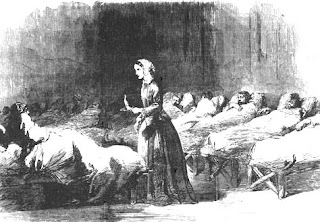
Florence Nightingale - Illustrated London News, 1855 - Credit

But it is her determination to pursue her passion despite her family’s opposition that fascinates me – her refusal to have her life shaped by the conventional roles dictated by society. It was my admiration for her approach that led me to preface my book with this quote:

‘The world is put back by the death of every one who has to sacrifice the development of his or her peculiar gifts to conventionality.’ – Florence Nightingale.

Notes

 [1] http://englishhistoryauthors.blogspot.co.uk/2015/09/gentlemanly-professions.html
 [2] https://www.medsci.ox.ac.uk/about/history/oxford-medical-sciences-through-the-centuries/1800s
 [3] http://www.electricscotland.com/history/medical/medicine8.pdf
 [4] https://en.wikipedia.org/wiki/List_of_historical_medical_schools_in_the_United_Kingdom
 [5] http://www.leeds.ac.uk/chb/lectures/anatomy1.html
 [6] http://onlinelibrary.wiley.com/doi/10.1046/j.1440-1622.2001.02127.x/pdf
 [7] https://en.wikipedia.org/wiki/Burial_Act_1857
 [8] https://en.wikipedia.org/wiki/Burke_and_Hare_murders
 [9] https://en.wikipedia.org/wiki/Anatomy_Act_1832
 [10] http://www.nhshistory.net/voluntary_hospitals.htm
 [11] ibid
 [12] https://en.wikipedia.org/wiki/General_Lying-In_Hospital
 [13] https://www.cheltladiescollege.org/about-clc/history-of-college/
 [14] https://en.wikipedia.org/wiki/Timeline_of_women%27s_education
 [15] https://en.wikipedia.org/wiki/London_School_of_Medicine_for_Women
 [16] http://www.telegraph.co.uk/only-in-britain/oxford-university-allows-women-to-graduate/
 [17] https://en.wikipedia.org/wiki/University_of_Cambridge#Women.27s_education
 [18] https://en.wikipedia.org/wiki/Elizabeth_Blackwell

 [19] https://en.wikipedia.org/wiki/Florence_Nightingale

~~~~~~~~~~

Judith Leask is a long-term reader of historical and classical novels, and began writing fiction when dared to do so by a fellow wordsmith in her project management office. Six years, many writing group sessions and several re-writes later, her first novel Her Peculiar Gifts has now been released – a contemplative tale of James, a shy doctor, and his daughter Laura, who possesses unused talents. A further historical novel, set in Jamaica, is underway, and for her dragon-loving children she wrote The Silver Shell, to be released soon. Her story about the ghost of Charles Dickens can be found in the anthology Haunted. She has discovered a passion and a talent for developmental editing, and is now a freelance book editor with Just Right Editing. This gives her the chance to read and help to refine all manner of books – which is heaven for a bookworm.

https://judithleask.wordpress.com/
https://judithleask.wordpress.com/just-right-editing/


Wednesday, April 1, 2020

Miss Willmott’s Ghost

By Judith M. Taylor

“Miss Willmott’s Ghost” is the vernacular name of Eryngium giganteum, a large prickly ornamental thistle but by now I am afraid Miss Willmott herself has become something of a ghost too. Born the eldest of three sisters into a wealthy family she managed to spend her entire fortune on her gardens and ended up in grave financial difficulties. Not only did she inherit the family estate but her godmother left her a lot of money at her death.  Ellen Willmott, 1858- 1934, had no internal governor or compass, otherwise known as “common sense”, nor did she employ an external one such as a financial adviser. If she did she ignored whatever advice she received.

Portrait of Ellen Ann Willmott
(Rosina Mantovani)

Already the possessor of two estates with stellar gardens, one in England and one in France, in 1905 she insisted on buying a third in Italy, making the total number of gardeners she employed more than one hundred. Even Rockefeller might have thought twice about that. All her gardeners were men. She had nothing but contempt for women gardeners. The men were frightened of her as she was both autocratic and arbitrary. In old age this behavior hardened into eccentricity. For the last few years of her life she carried a revolver everywhere with her.

While still young she learned a great deal about plants and began to import new and exotic ones from all over the world. She herself never went on such expeditions but contributed to syndicates which did. Horticulture was her life and her world. This single-minded focus earned her a lot of respect in the garden community. She was the first woman to receive the Victoria Medal of Honour at the Royal Horticultural Society in the same year as Gertrude Jekyll, 1897. That was the first year the medal was awarded, an even greater honour. More than sixty plants are named for her personally or for Warley, her estate.

Warley Place

Ellen Willmott was particularly expert in roses, writing a well received monograph, “The Genus Rosa”, which is still useful today. The book was published in two volumes between 1910 and 1914 and dedicated to Queen Alexandra. Miss Willmott commissioned Alfred Parsons, a well known watercolorist, to illustrate her book and she later got him to paint many of her plants. The book came at a later phase of her life.

When she was younger narcissus fascinated her. Warley Place had thirty three acres, an expanse which allowed her to experiment with dozens of species of narcissus on a very grand scale. Ancient drifts of Narcissus pseudonarcissus had covered the hillsides. At first Miss Willmott added more and more species narcissus to the land offering varying hues of gold, yellow and white to occupy the eye at different times: N.incomparabilis, N. pallidoflorus and N. campernelii among many others. The gardeners loaded the bulbs on to wheel barrows and let their gleeful children toss handfuls of them all over the grounds. It was licensed pandemonium. The bulbs grew where they fell and then multiplied every year. She followed a similar course with crocus.

Ellen Willmott kept very careful notes, following each bed and site to see how the bulbs grew in different months. She crossed some species and once she found a hybrid she thought worthy she handed it off to commercial nurserymen to test further. Eventually they bulked it up and offered it for sale. This skill and expertise was the reason the royal Horticultural Society elected her a fellow in 1894. She served on their bulb committee for many years. Her complete mastery of the subject impressed the members of the society.

A Plan of Miss Willmott's House & Garden at Great Warley, 1904

In 1903 Miss Willmott played a big role in persuading Sir Thomas Hanbury to donate sixty acres of his property in Wisley, Surrey to the society to found an experimental site outside London.  The grounds at Chiswick had become too small. RHS Wisley now flourishes in its own right and recently built new science and visitors’ centres and other essential structures. All the trials of new flowers and vegetables are carried out in their grounds. Every year they make a very brave show.

Ellen’s father, Frederick Willmott, came from a very respectable family of pharmacists but he decided to become a solicitor. Although always very genteel in his behaviour he knew exactly where he was going and what he wanted. He married a woman slightly above him in the social scale, Ellen Fell. Both families were English Catholics. His three daughters were  brought up in the church, going to convent schools and spending much time in the company of religious women. The girls’ godmother Helen Tasker was very wealthy and each year presented the children with a thousand pounds each for their birthdays. At her death they inherited most of her money. The youngest daughter, Ada, died of diphtheria as a child leaving only Ellen and her younger sister Rose. It took the family a long time to recover from the shock of her death.

When Frederick began to make serious money he bought a fine estate in Essex, Warley Place. At the time it was quite far into the country side, though on the train line but now it is subsumed into Brentwood and the property is a public nature reserve. Mrs Willmott took the neglected garden in hand and made it handsome. She did not care for carpet bedding and used a more naturalistic style.

The family had a very active social life. Ellen played tennis very well and was also an accomplished violinist. Because she had complete access to her own money she began to buy expensive objects very early. She started by purchasing four very valuable string instruments, two violins, a viola and a violoncello, made by old Italian masters. She allowed an eleven year old prodigy, Lionel Tertis, to play the viola. Tertis was the first musician to be a virtuoso on the viola, an instrument so often neglected for the other strings.

Women were discouraged from playing the violin at that time because it brought the bosom into great prominence and was thus unladylike! It says a lot for the wisdom of her parents that they did not intervene but allowed her to study the instrument.

The Willmotts travelled together on the Continent every year and enjoyed all the delights that these journeys offered.  They had favourite haunts and particularly liked the countryside around Aix – en – Provence. Tresserve was a sleepy hamlet which had caught Queen Victoria’s eye. The monarch wanted to buy property there but the negotiations failed leaving Miss Willmott to snap it up in 1899.

Ellen Willmott was too intelligent and uncompromising to attract the sort of man likely to marry her and remained single all her life. Her sister married into the Berkeley family, also Catholic but actual gentry. There were some awkward moments due to snobbery. Rose Willmott Berkeley was also a good gardener and the grounds at Spetchley Park were made  to resemble those at Warley Place.

When Ellen was twenty-one she told her father she was going to build a rock garden in a corner of the Warley Place garden. He was very complacent and paid very little attention to what she was spending. All he asked her to do was to build it nowhere near his study so he was not bothered by the work.

The well known Yorkshire nursery of Backhouse laid down the rocks and planted the new grotto. The excavations led down to a small stream which supplied the necessary water. The plants have died and the stream now runs dry but the rocks remain showing how handsome the garden must have been. Ellen had learned how to do this by careful study in her growing library. She also sought advice from many known experts. It was the opening salvo in her future career. In view of Willmott’s interest in narcissus it is worth noting that Sarah Backhouse, sister in law of the owner, bred one of the signature new narcissi of the epoch, N. ‘Mrs R. O. Backhouse’ . It was an early pink type.

Many of the Warley hybrids were bred to championship levels. Ellen Willmott won a series of awards of merit and first class certificates at the Royal Horticultural Society shows for her narcissus. Perhaps her favourites were the ‘Triandus’ type, with three stamens. She named some of them for her sister and brother in law and one for her dead baby sister, Ada.

In 1923 her sister Rose died of cancer. Although the Willmotts were not demonstrative people Ellen and her sister were always close and it was assumed that she as the elder sister would die first. The loss was very grievous and may have contributed to her psychological unravelling as time went by. Poor management and profligate behaviour led to the dwindling and eventual loss of her fortune. Very reluctantly she was forced to sell first Tresserve and then Boccanegra.

Painting Ellen and Rose Willmott (Spetchley House)

Her almost encyclopaedic knowledge of horticulture won her many more awards even from the French and Italian organizations but her personality was to be her downfall. In spite of many individual acts of charity she was prickly, intolerant and always had to be right, no matter how misguided her point of view was. When she absent-mindedly left a shop in London without the receipt for her purchase the store detective called a policeman.

By then she was no longer smartly dressed and was assumed to be a poor thief. Within a very short time some of her highly placed friends rallied around and pointed out the mistake. The shop was ready to apologize and close the incident. Something in her nature made her reject that face saving measure. She insisted on going to jail for the night and being heard in court the next morning to be vindicated. This was to be a Pyrrhic victory. Foolish financial decisions had begun as early as 1907 when she bought more than even she could afford and began to borrow money.

By the mid 1920s she did not have enough money left with which to pay taxes and tried to sell some of her valuable things to scrape by. There was nowhere nearly enough of value for the sums involved. In spite of all her reverses Miss Willmott still attended meetings at the Royal Horticultural Society regularly though she no longer competed in the shows.

She died very abruptly in the night on September 26, 1934, at the age of seventy six. The loyal butler who had stuck with her throughout found her in the morning.

Eryngium giganteum 'Miss Willmott's Ghost'


Reference

Le Lievre, Audrey  1980      Miss Willmott of Warley Place
London and Boston         Faber and Faber

~~~~~~~~~~

Judith M. Taylor MD is a graduate of Somerville College and the Oxford University Medical School and is a board certified neurologist. She practiced neurology in New York and since retiring has written six books on horticultural history as well as numerous articles and book reviews on the same subject.

Dr Taylor’s books include The Olive in California: history of an immigrant tree (2000), Tangible Memories: Californians and their gardens 1800 – 1950 (2003), The Global Migrations of Ornamental Plants: how the world got into your garden (Missouri Botanical Garden Press 2009), Visions of Loveliness: the work of forgotten flower breeders (Ohio University Press 2014) and An Abundance of Flowers: more great flower breeders of the past (Ohio University Press  2018).  In 2019 she published A Five Year Plan for Geraniums: growing flowers commercially in East Germany 1946 – 1989.
Dr Taylor’s web site is: www.horthistoria.com

Monday, March 30, 2020

Duties and Obligations in Tenth-Century England

By Annie Whitehead

Placing oneself under the protection of a lord was a solemn and ceremonious affair. In England it took the form of a hold-oath, or fealty oath. The physical act of bowing was accompanied by the oath:

“By the lord before whom this relic is holy, I will be to N [name of lord] faithful and true, and love all that he loves, and shun all that he shuns, according to God’s law, and according to secular custom; and never, willingly or intentionally, by word or by work, do aught of what is loathful to him, on condition that he keep me as I am willing to deserve, and all that fulfil that our agreement was, when I to him submitted and chose his will.” [1]

Essentially this is a negative commitment, a promise not to act against the lord’s interests. Nevertheless, a personal bond of this nature carried with it certain positive obligations.

For the king’s thegn, lord and king were the same person. A thegn whose lord was not the king still had a duty to the monarch. (It should be remembered that the king’s title was “Cynehlaford” or lord-king.) Thegns in turn would have men who called them lord. The role of lordship entailed a dual responsibility, that of serving one’s lord, and that of protecting one’s men.

The king with his witan
The king was ever mindful of the need to control his ealdormen. Their attendance at the royal council was one way of ensuring their co-operation, and failure to attend a summons to the witan was punished severely. The witan had the right, rather than the privilege, to advise the king, and at times it acted on its own; following the death of a king the election process for his successor was carried through in the witan. It was in the royal council that the laws were promulgated. Its members met indoors, and the Anglo-Saxon Chronicle tells how, in 978, “the leading councillors of England fell down from an upper storey at Calne, all except the holy Archbishop Dunstan, who alone remained standing on a beam.” [2] Business transacted in the witan included general, financial and judicial matters. Essentially though, its function was of a deliberative and consultative nature.

Saint Dunstan

The test of royal authority is how effectively it is felt in the localities. The law codes abound with directions to individual ealdormen to ensure that laws are enforced. King Edgar commands that:

“Earl Oslac and all the host that dwell in his aldermanry are to give their support that this may be enforced” and that “Many documents are to be written concerning this, and sent both to ealdorman Aelfhere and ealdorman Aethelwine, and that they are to send them in all directions, that this measure may be known to both the poor and the rich.” [3]

King Edgar

There is some evidence to suggest that the ealdormen disliked the king’s reeves (administrative officials.) A breach of the law by a reeve could only be dealt with by the king [4] and when Aethelred II adopted the policy of appointing reeves instead of ealdormen, the Anglo-Saxon Chronicle tells us that in 1002 Ealdorman Leofsige slew Aelfric, the king’s high-reeve. The grant of Aethelred’s explains why these men were disliked. The reeve broke the law by giving Christian burial to those who had forfeited the right. Instead of punishing him, Aethelred granted the reeve their land. To the ealdormen it must have seemed that the reeves were above the law.

Naturally the king’s officials were instrumental in the enforcement of law and order, and their duties included presiding over the shire and hundred courts. The hundred ordinance [5] directs that the hundred court is to meet every four weeks. II&III Edgar acknowledges this and states that the borough court is to be held three times a year and the shire court twice a year. It also succinctly sets out the duty of those presiding over the courts:

“And the bishop of the diocese and the ealdormen are to be present, and there to expound both the ecclesiastical and the secular law.” [6]

The shire court was unspecialised in the tenth-century, and did not develop into a full royal court until after the Norman conquest. It had a variety of functions, including procedures in outlawry. [7] It was here that arrangements were made for the collection of taxes. It was in the interests of landowners to be represented, and the shire-reeve gradually became recognised at the chief executive royal officer.

The hundred court met on an appointed day, and anyone who failed to appear had to pay thirty shillings compensation. Each man was to do justice to another. Great concern was shown over theft. Compensation had to be paid to the victim; half of the offender’s remaining property went to the hundred, and half to the lord. Aethelred II’s reign saw an emphasis placed on the importance of oath-taking, and the origins of the jury of presentment.

“The twelve leading thegns are to come forward and swear on the relics … that they will accuse no innocent man nor conceal any guilty one.” He who pronounced a wrong judgement could forfeit his thegnly status, and “A sentence where the thegns are unanimous is to be valid.”

The importance of all courts was to provide a place where good witness could be obtained. King Edgar ordered thirty-six witnesses in each borough, and twelve in each hundred. [9]

Aethelred II

By the middle of the tenth-century it was becoming customary for lords, ecclesiastical or lay, to receive grants of jurisdiction from the king. Many hundreds fell into private hands; a lord often had considerable rights here and in his own lands. The grants were usually laid down in the charters as rights of “sake and soke”, these being rights of jurisdiction and to the profits of justice.

A charter of Aethelred II
This usually meant the control of a court. These rights were not granted lightly, and were really intended to emphasise royal authority rather than to weaken it. Grants of rights over a hundred court involved financial advantages, and the right to appoint hundredmen. HR Loyn suggests that the sheriffs (shire-reeves) played an important part in preventing the disintegration of royal power as private jurisdiction grew. [10] Landowners exercised other specific rights on their estates. They had a right to impose a toll on goods sold within the estate, the right (known as Team) to supervise the presentation of convincing evidence that goods for sale belonged to the vendor, and the right (infangenetheof) to hang a thief caught on the estate.

The nobility served the king, and were granted lands and privileges as a reward for that service. As lords they could expect service from their own men, and in turn they had a duty to protect those who called them ‘lord’.

To read more in this series, see Military Service in Tenth-Century England.


[1] Origins of English Feudalism 59 p145 - Of Oaths (c.1920)
[2] Anglo-Saxon Chronicle (E) 978
[3] IV Edgar 15. & 15.1
[4] EHD (English historical Documents) 117 p525
[5] This document is often called I Edgar, but was possibly written before Edgar’s reign. It was definitely in existence during Edgar’s reign.
[6] II&III Edgar 5.2
[7] HR Loyn - The Governance of Anglo-Saxon England p138
[8] III Aethelred 3.1 & 13.2
[9] IV Edgar 4. & 5.
[10] HR Loyn Op Cit p163. By 1086 approx. 130 hundreds were in private hands.

All images used above are copyright free in the Public Domain

This Editor's Choice article was originally published July 16, 2016.
~~~~~~~~~~

Annie Whitehead studied History under the eminent Medievalist Ann Williams. She is a member of the Royal Historical Society and an editor for EHFA (English Historical Fiction Authors.) She has written three award-winning novels set in Anglo-Saxon England, one of which was long-listed for the Historical Novel Society (HNS) Indie Book of the year 2016, and a full-length nonfiction book, Mercia: The Rise and Fall of a Kingdom. She has contributed to fiction and nonfiction anthologies and written for various magazines, including winning the New Writer Magazine Prose Competition. She was the winner of the inaugural Historical Writers’ Association/Dorothy Dunnett Prize 2017. She has recently been a judge for that same competition, and for the HNS Short Story Competition. Annie’s new book, Women of Power in Anglo-Saxon England, will be published on May 30 by Pen & Sword Books. 

For more information, visit Annie's Website or her Author Page. Also connect with Annie through her Blog and Twitter (@AnnieWHistory).

Friday, March 27, 2020

The Battle of Cheriton, 29th March, 1644

By Mark Turnbull

On 29th March 2020, the English Civil War Society was to have marched to the commemorative stone at the site of the 1644 Battle of Cheriton. In light of recent events this has unfortunately had to be cancelled. Being the day of the battle’s anniversary, a short memorial service would have marked this turning-point encounter between the forces of King Charles I and those of Parliament. Symbolising the national divide, the commanders of each side had been the best of peacetime friends; the parliamentarian Sir William Waller had not long written a famous letter to his royalist counterpart, Sir Ralph Hopton in which he referred to ‘this war without an enemy’. Cheriton was one of many front lines that criss-crossed the kingdom, splitting families, friends and neighbours, all of whom became entrenched in their allegiance to one side or the other. It also highlighted a stark need for change in the high command of both sides.

English Civil War Society Infantry

376 years ago, near fifteen thousand soldiers converged upon sleepy Cheriton. That morning it dawned on Hopton that the parliamentarians had crept closer during the night and were seeping towards Cheriton Wood. Anxious not to be outflanked, Hopton pulled back his lines and occupied a ridge overlooking a valley which was divided by four narrow lanes. When the old pals chose a battle cry, their minds must have been in tune, for both commanders landed on the same one; ‘God with us!’, though the parliamentarians quickly changed theirs to, ‘Jesus with us!’. As a result, the Battle of Cheriton opened with confusion, but prior to this, there had been confusion of a very different nature in Parliament’s ranks.

The parliamentarian Captain Robert Harley recorded the reaction of a London regiment who had ran, “to see what manner of things cows were. Some of them would say they had all of them horns and would do great mischief with them. Then comes the wisest of them crying, ‘speak softly!’” Although the cows initially distracted his troops, Waller’s focus had never wavered from Cheriton Wood, recognising it as a key defensive position. He poured one thousand musketeers, comprised mainly of the White Regiment of the London Trained Bands, into the task of securing it, only for Hopton to send an equal number to dislodge them. Divided into four battalions, the counter-attacking royalists prevailed after a vicious firefight.

Although Hopton oversaw royalist operations with his experienced military eye, he was subject to the direction of a backseat driver. Patrick Ruthven, Earl of Forth and Brentford, was the King’s Captain-General. A hard-drinking Scotsman approaching seventy years of age, with selective hearing loss in councils, applied the brakes to the royalist onslaught and instructed Hopton to adopt a defensive stance. For reasons unknown, Colonel Henry Bard disregarded orders and spearheaded a lone attack with his regiment right to the hedges of Cheriton Lane. Exposed, and well ahead of the royalist lines, he had become a focal point for the parliamentarians who piled in for the kill.

English Civil War Society Swordsman and Horse

In Hopton’s own words, “the engagement was, by forwardness of some particular officers, without order.”

The parliamentarians agreed. One of their officers, Sir Walter Slingsby reported that Bard had led, “his regiment further than he had orders for.” A large understatement!

Sir Arthur Haselrig’s parliamentarian cavalry swept down on Bard’s men. By that point Lord Forth had realised Bard’s destruction would leave a gaping hole in the royalist right wing which could be infiltrated. Therefore, he sent in the cavalry.

English Civil War Society Cavalry

The parliamentarian Sir Walter Slingsby picked up the thread of what occurred next. “The [royalist] horse was repulsed with loss. They immediately tried the second charge … and were again repulsed, and so again a third time, the [parliamentarian] foot keeping their ground in a close body, not firing til within two pikes’ length, and then three ranks at a time after turning up the butt end of their muskets, charging their pikes and standing close…”

The royalist cavalry found the terrain rough going for a gruelling four hours. The hedges and lanes prevented them attacking en-masse, and the parliamentarians were able to pick off each piecemeal detachment before they could establish themselves. Royalist officers went down like nine-pins; Major-General Sir John Smith (a hero of the Battle of Edgehill) and Lieutenant-General Lord John Stuart (a distant cousin of King Charles) were both killed in action. Although the royalist infantry seemed to be holding their own, it was clear that the cavalry was foundering. Lord Forth decided to withdraw the artillery to safety, followed shortly after by the infantry, who were pulled back to Titchborne Down. Hopton held the lanes with three hundred horsemen to cover the retreat to Alresford, and the stronghold of Basing House.

The desperate royalists set fire to Alresford in a bid to hamper their pursuers, though the wind turned and the parliamentarians used the smoke cover to their advantage, reporting that, “very many Irish men were slain here.” Cheriton was a victory for Parliament, yet it offered opportunities to both sides and also demonstrated the stark need for change in their high commands.

After the battle Parliament jubilantly called for a co-ordinated attack upon the royalist HQ of Oxford. By praising Waller they sparked the jealousy of their Lord General, the Earl of Essex, who subsequently refused to co-operate. Lord Manchester stated that his army was pre-occupied with the war in eastern England and Waller was soon weakened when his Londoners returned to the confines of their city. This lack of cohesion and rivalry gave the King a chance to take stock.

But all was not rosy for the royalists. A detachment had been blocking parliamentarian supplies from getting to Gloucester and following Cheriton they were recalled. Lord Forth’s grip on the military tiller was also loosening, and by the end of the year he was replaced by the fiery Prince Rupert. Sir Edward Walker, King Charles’s Secretary at War, observed that the aftermath of Cheriton, “necessitated His Majesty to alter the scheme of his affairs and in the place of an offensive, to make a defensive war.” Cheriton had played a part in the tactics of the civil war’s end game, as well as shaping the new order which would oversee it.

English Civil War Society Pikemen


Recently Richard Vobes created a documentary video for his website, The Bald Explorer, in which he walks the terrain of Cheriton and interviews historian Julian Humphrys. The link to the video is: https://youtu.be/SeNr_Bg6_kQ

[All photos copyright of the author, taken at an English Civil War Society event in 2019]
~~~~~~~~~~

Mark Turnbull is the author of civil war novel, Allegiance of Blood. Since the age of ten he’s been fascinated with the war and has written other articles which can be found on his website www.allegianceofblood.com